INDUSTRY 4.0 AND
MANUFACTURING
ECOSYSTEMS
JAYESH C S PAI
“INDUSTRIE 4.0 connects embedded system
production technologies and smart production
processes to pave the way to a new
technological age which will radically transform
industry and production value chains and
business models.”
—Germany Trade and Invest
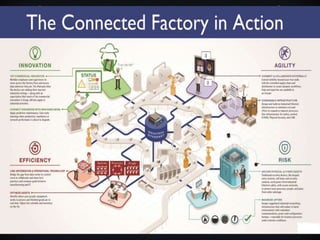
Exploring the world of connected
enterprises
MANUFACTURERS FACE
CHANGES ON
MULTIPLE FRONTS.
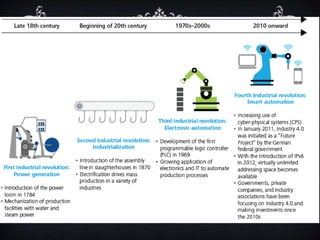
 Advanced manufacturing—in the form of additive manufacturing, advanced
materials, smart, automated machines, and other technologies—is ushering in a new age
of physical production.
 At the same time, increased connectivity and ever more sophisticated data-gathering
and analytics capabilities enabled by the Internet of Things (IoT) have led to a shift
toward an information-based economy.
 With the IoT, data, in addition to physical objects, are a source of value—and
connectivity makes it possible to build smarter supply chains, manufacturing processes,
and even end-to end ecosystems.
INDUSTRY 4.0
 Smart, connected manufacturing
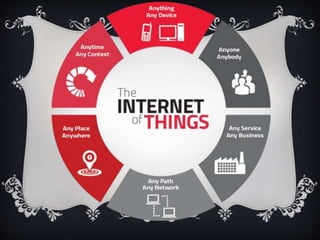
 Industrial Internet
 Connected Enterprise
 SMART Manufacturing
 Smart Factory
 Manufacturing 4.0
 Internet of Everything
 Internet of Things for Manufacturing
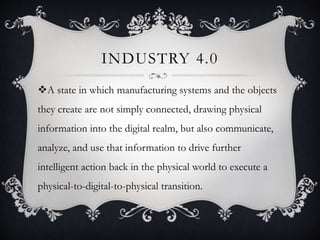
INDUSTRY 4.0
A state in which manufacturing systems and the objects
they create are not simply connected, drawing physical
information into the digital realm, but also communicate,
analyze, and use that information to drive further
intelligent action back in the physical world to execute a
physical-to-digital-to-physical transition.
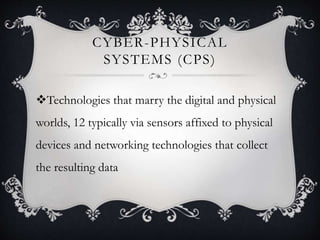
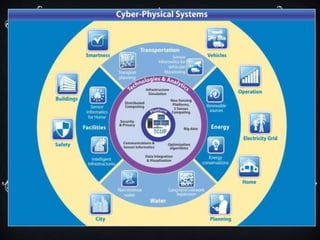
CYBER-PHYSICAL
SYSTEMS (CPS)
Technologies that marry the digital and physical
worlds, 12 typically via sensors affixed to physical
devices and networking technologies that collect
the resulting data
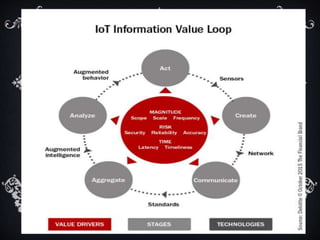
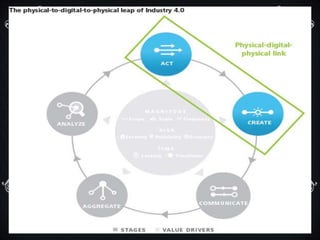
IOT INFORMATION VALUE
LOOP
 Currently, a host of connected technologies is advancing rapidly, including
high-quality sensors, more reliable and powerful networks, high-performance
computing (HPC), robotics, artificial intelligence and cognitive technologies, and
augmented reality.
 Taken together, these technologies can change manufacturing in profound
ways. The resulting flows of information motivates a framework that captures
the series and sequence of activities through which organizations create value
from information
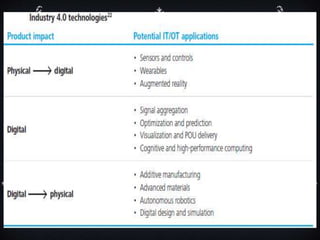
PHYSICAL-TO-DIGITAL AND
DIGITAL-TO-PHYSICAL
 It is the leap from digital back to physical—from connected, digital
technologies to the creation of a physical object—that constitutes the
essence of the Industry 4.0 concept.
INTEGRATING THE DIGITAL AND
THE PHYSICAL TO ACHIEVE
BUSINESS OBJECTIVES
 By augmenting the value chain with Industry 4.0 technologies,
information generated in various stages can inform other points, making the
structure— while linear—far more dynamic and, from an information
perspective, a circular feedback loop.
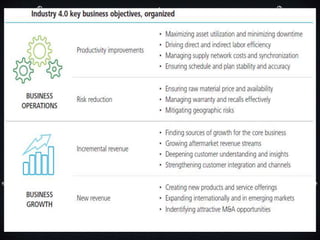
 2 business imperatives for manufacturers:
 operating the business and growing the business.
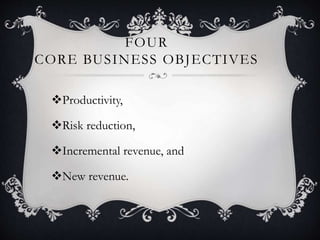
FOUR
CORE BUSINESS OBJECTIVES
Productivity,
Risk reduction,
Incremental revenue, and
New revenue.
THE FIRST STAG E OF THE MANUFACTURING
VALUE CHAIN FOCUSE S ON R&D AND
DE SIGN
 Areas where Industry 4.0 technologies can accelerate and improve
the design cycle, reducing time to market, and linking design to
smarter products.
 Stakeholders most impacted by Industry 4.0 at this stage will likely
be design engineers.
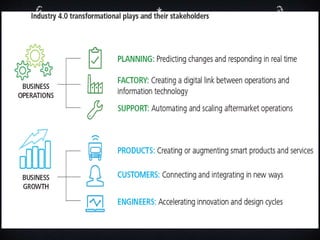
STAGES AT THE MIDDLE
OF THE VALUE CHAIN
Planning, factories, and support
Can use Industry 4.0 technologies to
transform operations in various ways.
OTHER END OF THE VALUE
CHAIN, NEW OR
INCREMENTAL REVENUE
Business growth
Can emerge from Industry 4.0
applications in the form of new and
improved products and services.
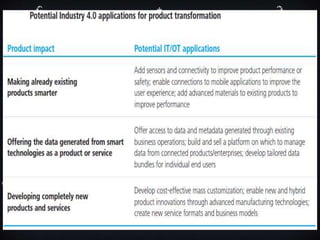
CREATING SMART
PRODUCTS AND SERVICES
 Manufacturers are already using advanced OT (such as additive
manufacturing) and advanced IT (in the form of scanning and embedded
sensors) to create new products and improve upon old ones.
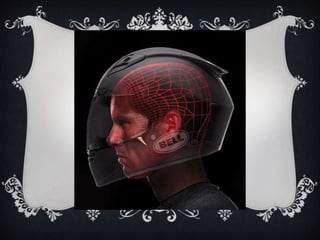
 For eg. - By taking a 3D scan of players’ heads, helmets can be built to
individual measurements.
 Embedded sensors are also used to detect the magnitude of impacts and
report the data via an app—creating a completely new data product.
CHANGE
THE VALUE PROPOSITION FOR
INDUSTRIAL PRODUCTS
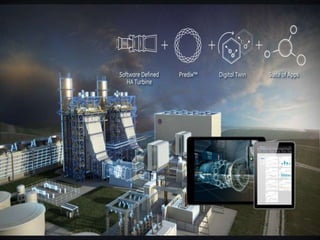
 Using sensors and controls, signal aggregation, and HPC, GE is
developing real-time digital simulation models of its real-life,
physical parts operating within the plant. These cloud-based
“digital power plant” models will enable plant operators to know
the condition of parts, optimize power, determine the right time
for machinery maintenance, and simulate various conditions to
understand how they might impact the plant
CUSTOMERS: CONNECTING
AND
INTEGRATING
 Rideshare service Uber uses data from its drivers and customers to power
an algorithm that calculates surge pricing, a dynamic pricing model meant to
adjust prices upward when demand is high
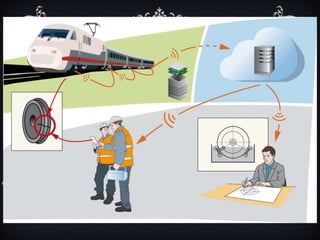
 Deutsche Bahn AG, a European cargo rail consortium, integrated its
extensive network of railway monitoring sensors with its customer ordering
and billing database and added in additional real-time data around traffic and
capacities to generate intelligent pricing models customized to a client’s needs
and the current conditions.
ENGINEERS: ACCELERATING
INNOVATION AND DESIGN
CYCLES
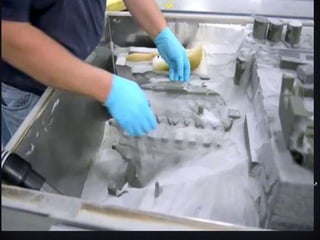
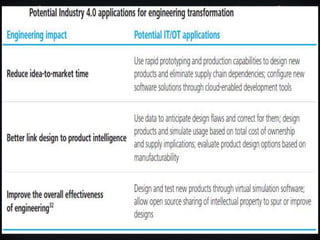
The use of digital-to-physical manufacturing technologies such
as additive manufacturing in rapid prototyping can speed up the
design process as well as the production of end-use products, thus
reducing supply chain dependencies.
Using advanced manufacturing technologies can also enable
engineers to optimize manufacturability, as they can evaluate
product design options based on the eventual assembly process.
JOHN DEERE USES
AUGMENTED REALITY
 Allows customers to test and provide feedback on early design
concepts, so that it can adjust and redevelop designs.
OPERATING THE BUSINESS
 Using Industry 4.0 technologies to increase productivity and
reduce risk
 In the “plan,” “source,” and “make” stages of the value chain,
various physical-to-digital and digital-to-physical connections can
transform planning, support, and factory operations.
PLANNING: PREDICTING
CHANGES
AND RESPONDING IN REAL TIME
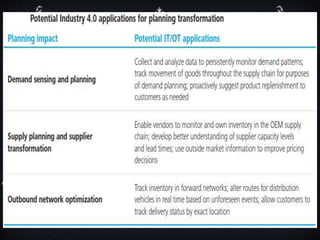
Demand sensing and planning using IT (for example,
sensors, signal aggregation, optimization, and prediction)
enable manufacturers to gather data throughout the value
chain. Data can be analyzed to uncover patterns, track
movements, and, ultimately, understand what customers want,
and where—so they can better plan to provide it at the right
time and place.
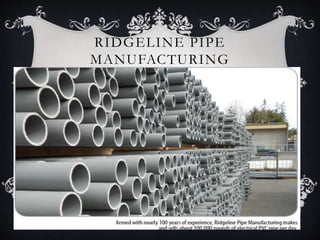
RIDGELINE PIPE
MANUFACTURING
FLEXIBLE PRODUCTION
PLATFORM
Constantly changing customer demand and short lead times.
Automated production controllers managed the
manufacturing equipment while providing access to
information on diagnostics and performance.
The system also analyzes production data to offer predictive
failure analytics
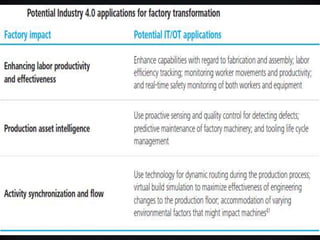
FACTORY: CREATING A
DIGITAL
LINK BETWEEN OT AND IT
Augmented reality, sensors and controls, wearables, and the
Internet of Things to track movement and production,
monitor quality control, and manage the tooling life cycle.
Enables enhanced capability effectiveness, production asset
intelligence, activity synchronization and flow, safer conditions
for workers, enhancing labor productivity and effectiveness.
SUPPORT: AUTOMATING AND
SCALING AFTERMARKET
OPERATIONS
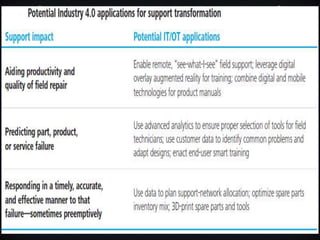
Once a part or product has been developed,
manufactured, shipped, and sold, Industry 4.0 technologies
can impact support in at least three key ways
Learning the causes behind a failure can enable
manufacturers to more effectively address the root of the
problem, rather than its symptoms.
LOOKING AHEAD
COMPANIES implementing or planning to implement
Industry 4.0 practices can face several challenges that relate to
the management and integration of IT and OT.
While some have an organization-level impact, other
challenges exist at the broader, ecosystem level.
These challenges are heightened as connected technologies
evolve at a rapid pace.
1. TALENT AND WORKFORCE
 In the process of trying to integrate IT and OT through the use of
Industry 4.0 practices at the organization level, companies often face a
shortage of talent to plan, execute, and maintain new systems
 The number of engineers trained in handling unstructured data and
big data tools—crucial for the type and scale of data generated by
connected systems—is gradually increasing, but still falls far short of
anticipated demand
1. TALENT AND WORKFORCE
Many leaders feel uncomfortable with advanced
manufacturing
Leaders should adopt a proactive stance partnering with
outside organizations, high schools, technical colleges, and
universities to develop an ongoing flow of workers versed in
and attracted to advanced digital and physical manufacturing
technologies.
2. STANDARDS AND
INTEROPERABILITY
From a broader, ecosystem-wide perspective, many of the
systems underpinning Industry 4.0 applications are
proprietary and can present integration challenges.
Peer consortiums, industry associations, and government
bodies are working to establish competing sets of standards
3. DATA OWNERSHIP AND
CONTROL
 Who owns the data generated and how to ensure appropriate privacy,
control, and security
 This information can be used to drive product improvements, use of
components, and efficiencies within the supply chain, it is particularly
valuable.
 Managers should therefore pay close attention to the covenants they sign
related to data ownership and access.
4. SECURITY
Complex cryptographic algorithms might improve the
security of devices, but this often comes at the cost of higher
power consumption.
Retrofitting old systems to new Industry 4.0 applications
may also increase security risks, as the old systems were not
designed to be connected in this way.
CONCLUSION
 As the integration of information technology and operations technology
evolves, manufacturers will need to assess not only where they are but where
they wish to be—decisions that will dictate the types of information they will
need to gather, analyse, and act upon. By integrating the information identified
through the Information Value Loop, where the focus lies along the
manufacturing value chain, organizations can understand which types of
information will be most relevant to them as they seek to transform either their
business operations, or growth, or both.
CONCLUSION
The path to realization of Industry 4.0
involves a clear understanding of the ways in
which the physical can inform the digital,
and vice versa.

Exploring the world of connected enterprises

  • 1.
  • 2.
    “INDUSTRIE 4.0 connectsembedded system production technologies and smart production processes to pave the way to a new technological age which will radically transform industry and production value chains and business models.” —Germany Trade and Invest Exploring the world of connected enterprises
  • 3.
    MANUFACTURERS FACE CHANGES ON MULTIPLEFRONTS.  Advanced manufacturing—in the form of additive manufacturing, advanced materials, smart, automated machines, and other technologies—is ushering in a new age of physical production.  At the same time, increased connectivity and ever more sophisticated data-gathering and analytics capabilities enabled by the Internet of Things (IoT) have led to a shift toward an information-based economy.  With the IoT, data, in addition to physical objects, are a source of value—and connectivity makes it possible to build smarter supply chains, manufacturing processes, and even end-to end ecosystems.
  • 4.
    INDUSTRY 4.0  Smart,connected manufacturing  Industrial Internet  Connected Enterprise  SMART Manufacturing  Smart Factory  Manufacturing 4.0  Internet of Everything  Internet of Things for Manufacturing
  • 7.
    INDUSTRY 4.0 A statein which manufacturing systems and the objects they create are not simply connected, drawing physical information into the digital realm, but also communicate, analyze, and use that information to drive further intelligent action back in the physical world to execute a physical-to-digital-to-physical transition.
  • 8.
    CYBER-PHYSICAL SYSTEMS (CPS) Technologies thatmarry the digital and physical worlds, 12 typically via sensors affixed to physical devices and networking technologies that collect the resulting data
  • 10.
    IOT INFORMATION VALUE LOOP Currently, a host of connected technologies is advancing rapidly, including high-quality sensors, more reliable and powerful networks, high-performance computing (HPC), robotics, artificial intelligence and cognitive technologies, and augmented reality.  Taken together, these technologies can change manufacturing in profound ways. The resulting flows of information motivates a framework that captures the series and sequence of activities through which organizations create value from information
  • 14.
    PHYSICAL-TO-DIGITAL AND DIGITAL-TO-PHYSICAL  Itis the leap from digital back to physical—from connected, digital technologies to the creation of a physical object—that constitutes the essence of the Industry 4.0 concept.
  • 16.
    INTEGRATING THE DIGITALAND THE PHYSICAL TO ACHIEVE BUSINESS OBJECTIVES  By augmenting the value chain with Industry 4.0 technologies, information generated in various stages can inform other points, making the structure— while linear—far more dynamic and, from an information perspective, a circular feedback loop.  2 business imperatives for manufacturers:  operating the business and growing the business.
  • 17.
    FOUR CORE BUSINESS OBJECTIVES Productivity, Riskreduction, Incremental revenue, and New revenue.
  • 20.
    THE FIRST STAGE OF THE MANUFACTURING VALUE CHAIN FOCUSE S ON R&D AND DE SIGN  Areas where Industry 4.0 technologies can accelerate and improve the design cycle, reducing time to market, and linking design to smarter products.  Stakeholders most impacted by Industry 4.0 at this stage will likely be design engineers.
  • 21.
    STAGES AT THEMIDDLE OF THE VALUE CHAIN Planning, factories, and support Can use Industry 4.0 technologies to transform operations in various ways.
  • 22.
    OTHER END OFTHE VALUE CHAIN, NEW OR INCREMENTAL REVENUE Business growth Can emerge from Industry 4.0 applications in the form of new and improved products and services.
  • 24.
    CREATING SMART PRODUCTS ANDSERVICES  Manufacturers are already using advanced OT (such as additive manufacturing) and advanced IT (in the form of scanning and embedded sensors) to create new products and improve upon old ones.  For eg. - By taking a 3D scan of players’ heads, helmets can be built to individual measurements.  Embedded sensors are also used to detect the magnitude of impacts and report the data via an app—creating a completely new data product.
  • 26.
    CHANGE THE VALUE PROPOSITIONFOR INDUSTRIAL PRODUCTS  Using sensors and controls, signal aggregation, and HPC, GE is developing real-time digital simulation models of its real-life, physical parts operating within the plant. These cloud-based “digital power plant” models will enable plant operators to know the condition of parts, optimize power, determine the right time for machinery maintenance, and simulate various conditions to understand how they might impact the plant
  • 28.
    CUSTOMERS: CONNECTING AND INTEGRATING  Rideshareservice Uber uses data from its drivers and customers to power an algorithm that calculates surge pricing, a dynamic pricing model meant to adjust prices upward when demand is high  Deutsche Bahn AG, a European cargo rail consortium, integrated its extensive network of railway monitoring sensors with its customer ordering and billing database and added in additional real-time data around traffic and capacities to generate intelligent pricing models customized to a client’s needs and the current conditions.
  • 30.
    ENGINEERS: ACCELERATING INNOVATION ANDDESIGN CYCLES The use of digital-to-physical manufacturing technologies such as additive manufacturing in rapid prototyping can speed up the design process as well as the production of end-use products, thus reducing supply chain dependencies. Using advanced manufacturing technologies can also enable engineers to optimize manufacturability, as they can evaluate product design options based on the eventual assembly process.
  • 32.
    JOHN DEERE USES AUGMENTEDREALITY  Allows customers to test and provide feedback on early design concepts, so that it can adjust and redevelop designs.
  • 34.
    OPERATING THE BUSINESS Using Industry 4.0 technologies to increase productivity and reduce risk  In the “plan,” “source,” and “make” stages of the value chain, various physical-to-digital and digital-to-physical connections can transform planning, support, and factory operations.
  • 35.
    PLANNING: PREDICTING CHANGES AND RESPONDINGIN REAL TIME Demand sensing and planning using IT (for example, sensors, signal aggregation, optimization, and prediction) enable manufacturers to gather data throughout the value chain. Data can be analyzed to uncover patterns, track movements, and, ultimately, understand what customers want, and where—so they can better plan to provide it at the right time and place.
  • 37.
  • 38.
    FLEXIBLE PRODUCTION PLATFORM Constantly changingcustomer demand and short lead times. Automated production controllers managed the manufacturing equipment while providing access to information on diagnostics and performance. The system also analyzes production data to offer predictive failure analytics
  • 39.
    FACTORY: CREATING A DIGITAL LINKBETWEEN OT AND IT Augmented reality, sensors and controls, wearables, and the Internet of Things to track movement and production, monitor quality control, and manage the tooling life cycle. Enables enhanced capability effectiveness, production asset intelligence, activity synchronization and flow, safer conditions for workers, enhancing labor productivity and effectiveness.
  • 42.
    SUPPORT: AUTOMATING AND SCALINGAFTERMARKET OPERATIONS Once a part or product has been developed, manufactured, shipped, and sold, Industry 4.0 technologies can impact support in at least three key ways Learning the causes behind a failure can enable manufacturers to more effectively address the root of the problem, rather than its symptoms.
  • 47.
    LOOKING AHEAD COMPANIES implementingor planning to implement Industry 4.0 practices can face several challenges that relate to the management and integration of IT and OT. While some have an organization-level impact, other challenges exist at the broader, ecosystem level. These challenges are heightened as connected technologies evolve at a rapid pace.
  • 48.
    1. TALENT ANDWORKFORCE  In the process of trying to integrate IT and OT through the use of Industry 4.0 practices at the organization level, companies often face a shortage of talent to plan, execute, and maintain new systems  The number of engineers trained in handling unstructured data and big data tools—crucial for the type and scale of data generated by connected systems—is gradually increasing, but still falls far short of anticipated demand
  • 49.
    1. TALENT ANDWORKFORCE Many leaders feel uncomfortable with advanced manufacturing Leaders should adopt a proactive stance partnering with outside organizations, high schools, technical colleges, and universities to develop an ongoing flow of workers versed in and attracted to advanced digital and physical manufacturing technologies.
  • 50.
    2. STANDARDS AND INTEROPERABILITY Froma broader, ecosystem-wide perspective, many of the systems underpinning Industry 4.0 applications are proprietary and can present integration challenges. Peer consortiums, industry associations, and government bodies are working to establish competing sets of standards
  • 51.
    3. DATA OWNERSHIPAND CONTROL  Who owns the data generated and how to ensure appropriate privacy, control, and security  This information can be used to drive product improvements, use of components, and efficiencies within the supply chain, it is particularly valuable.  Managers should therefore pay close attention to the covenants they sign related to data ownership and access.
  • 52.
    4. SECURITY Complex cryptographicalgorithms might improve the security of devices, but this often comes at the cost of higher power consumption. Retrofitting old systems to new Industry 4.0 applications may also increase security risks, as the old systems were not designed to be connected in this way.
  • 53.
    CONCLUSION  As theintegration of information technology and operations technology evolves, manufacturers will need to assess not only where they are but where they wish to be—decisions that will dictate the types of information they will need to gather, analyse, and act upon. By integrating the information identified through the Information Value Loop, where the focus lies along the manufacturing value chain, organizations can understand which types of information will be most relevant to them as they seek to transform either their business operations, or growth, or both.
  • 54.
    CONCLUSION The path torealization of Industry 4.0 involves a clear understanding of the ways in which the physical can inform the digital, and vice versa.