PART 1
Prepared by
Nabeel Hassan Al-Zamror
Outline
1. Basic principles
2. Devices, symbols, and circuits
Basic principles
Objectives
1. To refresh basic electrical concepts
2. To define basic concepts of transformer
3. To refresh single-phase power concepts
4. To refresh three-phase power concepts.
Basic electrical concepts
 Electricity is found in two common forms:
◦ AC (alternating current)
◦ DC (direct current).
 An electrical circuit has the following three
basic components irrespective of its
electrical energy form:
◦ Voltage (volts)
◦ Ampere (amps)
◦ Resistance (ohms).
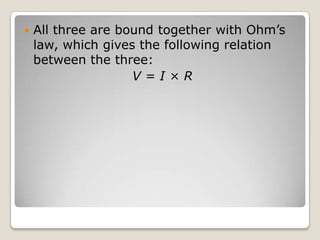
 All three are bound together with Ohm’s
law, which gives the following relation
between the three:
V = I × R
Power
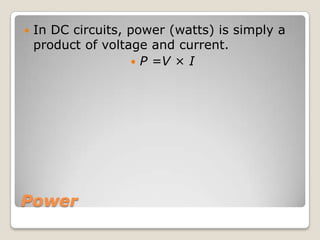
 In DC circuits, power (watts) is simply a
product of voltage and current.
 P =V × I
Power
 For AC circuits, the formula holds true for
purely resistive circuits, power is not just
a product of voltage and current.
 Real power or true power is the power
that can be converted into work and is
measured in watts.
Power
 Reactive power If the circuit is of an
inductive or capacitive type, then the
reactive component consumes power and
cannot be converted into work.
 This is known as reactive power and is
denoted by the unit VAR.
Relationship between powers
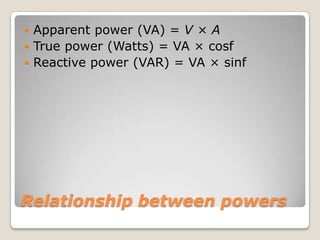
 Apparent power (VA) = V × A
 True power (Watts) = VA × cosf
 Reactive power (VAR) = VA × sinf
Power factor
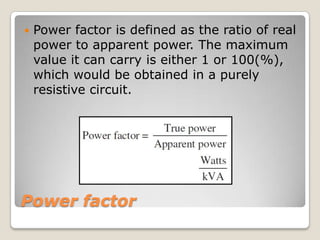
 Power factor is defined as the ratio of real
power to apparent power. The maximum
value it can carry is either 1 or 100(%),
which would be obtained in a purely
resistive circuit.
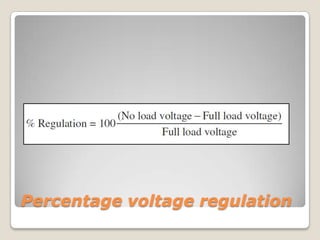
Percentage voltage regulation
Electrical energy
 This is calculated as the amount of
electrical energy used in an hour and is
expressed as follows:
 Kilowatthour = kW× h
Types of circuits
 There are only two types of electrical
circuits – series and parallel.
series circuit
 A series circuit is defined as a circuit in
which the elements in a series carry the
same
 current, while voltage drop across each
may be different.
parallel circuit
 A parallel circuit is defined as a circuit in
which the elements in parallel have the
same
 voltage, but the currents may be
different.
Transformer
 A transformer is a device that transforms
voltage from one level to another. They
are widely used in power systems.
 With the help of transformers, it is
possible to transmit power at an
economical transmission voltage and to
utilize power at an economic effective
voltage.
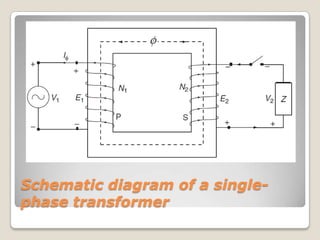
Schematic diagram of a single-
phase transformer
Potential-induced
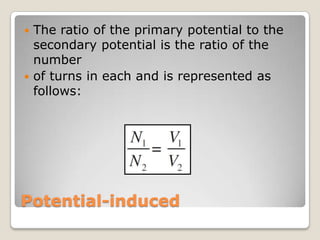
 The ratio of the primary potential to the
secondary potential is the ratio of the
number
 of turns in each and is represented as
follows:
step-up and step-down
 The concepts of step-up and step-down
transformers function on similar relation.
 A step-up transformer increases the
output voltage by taking N1 > N2 and a
step-down transformer decreases the
output voltage by taking N2 > N1 .
Current-induced
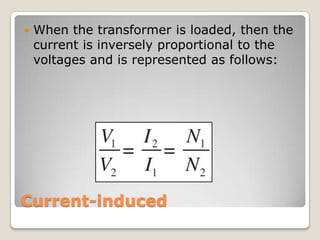
 When the transformer is loaded, then the
current is inversely proportional to the
voltages and is represented as follows:
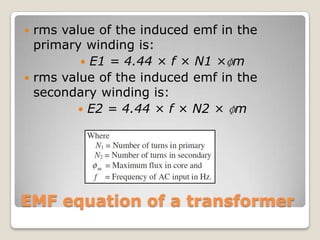
EMF equation of a transformer
 rms value of the induced emf in the
primary winding is:
 E1 = 4.44 × f × N1 ×ɸm
 rms value of the induced emf in the
secondary winding is:
 E2 = 4.44 × f × N2 × ɸm
Types of transformers
As per the type of construction
a) Core type: Windings surround a
considerable part of the core.
b) Shell type: Core surrounds a
considerable portion of the windings.
As per cooling type
a) Oil-filled self-cooled: Small- and
medium-sized distribution transformers.
b) Oil-filled water-cooled: High-voltage
transmission line outdoor transformers.
c) Air Cooled type: Used for low ratings
and can be either of natural air
circulation (AN) or forced circulation (AF)
type.
As per application
a) Power transformer : These are large transformers used
to change voltage levels and current levels as per
requirement. Power transformers are usually used in
either a distribution or a transmission line.
b) Potential transformer (PT): These are precision voltage
step-down transformers used along with low-range
voltmeters to measure high voltages.
c) Current transformer (CT): These transformers are used
for the measurement of current where the current-
carrying conductor is treated as a primary transformer.
This transformer isolates the instrument from high-
voltage line, as well as steps down the current in a
known ratio.
d) Isolation transformer : These are used to isolate two
different circuits without changing the voltage level or
current level.
Connections of single-phase
transformer
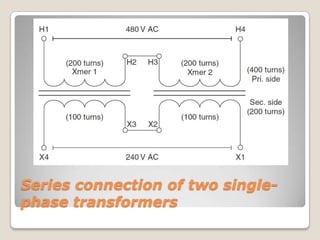
Series connection of two single-
phase transformers
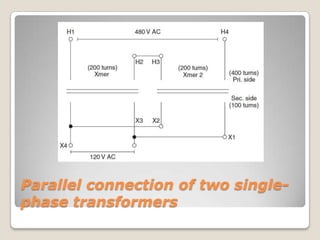
Parallel connection of two single-
phase transformers
Three-phase
transformers
Commonly used three-phases are
 Three-phase three-wire (delta)
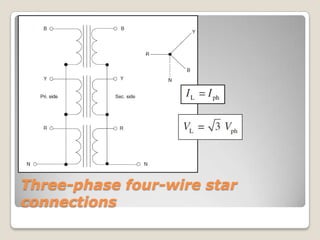
 Three-phase four-wire (star).
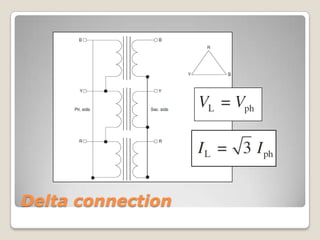
Delta connection
Three-phase four-wire star
connections
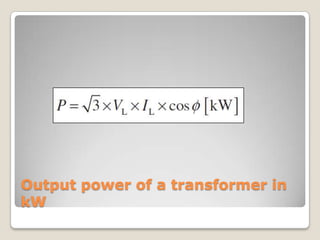
Output power of a transformer in
kW
Testing transformers
 The following tests are carried out on
transformers:
 Measurement of winding resistance
 Measurement of Voltage ratio
 Test phasor voltage relationship
 Measurement of impedance voltage, short-circuit
impedance and load loss
 Measurement of no load loss and no load current
 Measurement of insulation resistance
 Dielectric test
 Temperature rise.
Why is transformer rating defined
in kVA
 usual to express the rating of the
transformer as a product of the rated
voltage and the rated current (VA or kVA).
This however does not mean that you can
apply a lower voltage and pass a higher
current through the transformer. The VA
value is bounded individually by the rated
voltage and rated current.
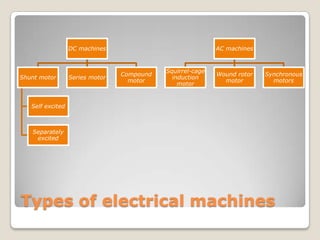
Types of electrical machines
DC machines
Shunt motor
Self excited
Separately
excited
Series motor
Compound
motor
AC machines
Squirrel-cage
induction
motor
Wound rotor
motor
Synchronous
motors
Meters used in troubleshooting
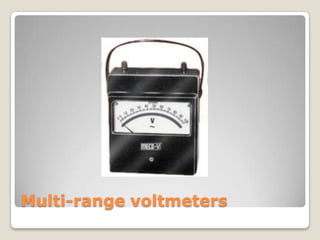
Multi-range voltmeters
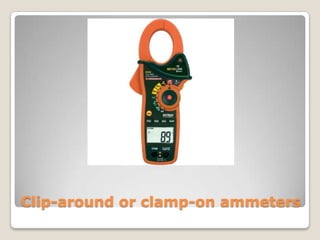
Clip-around or clamp-on ammeters
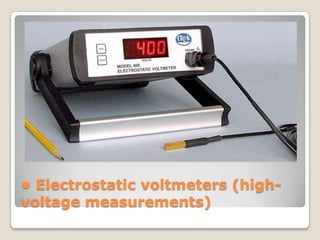
• Electrostatic voltmeters (high-
voltage measurements)
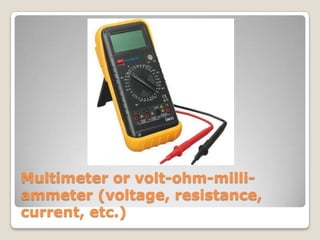
Multimeter or volt-ohm-milli-
ammeter (voltage, resistance,
current, etc.)
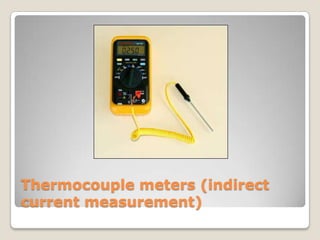
Thermocouple meters (indirect
current measurement)
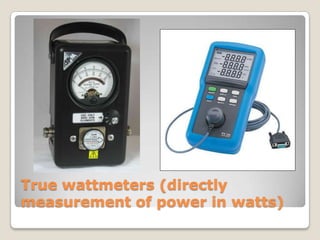
True wattmeters (directly
measurement of power in watts)
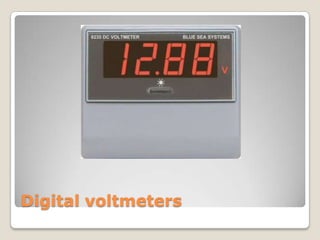
Digital voltmeters
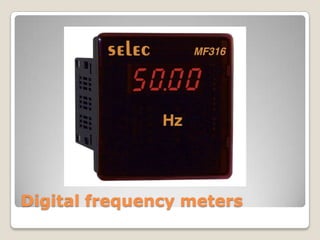
Digital frequency meters
Continuity testers
Insulation testers
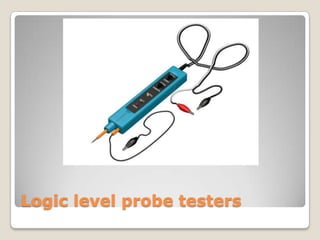
Logic level probe testers
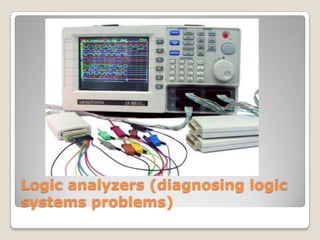
Logic analyzers (diagnosing logic
systems problems)
Devices, symbols, and
circuits
Objective
1. To understand basic electrical symbols
2. To understand power and control circuits
3. To read electrical drawings
Devices and symbols
 See page 25
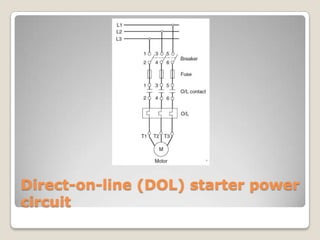
Direct-on-line (DOL) starter power
circuit
Control circuit
 A control circuit is for the automatic
control of equipment, for safety
interlocking, and sequencing the
operations of the plant equipment and
machines.
 Control circuits hardware consists of relay
contacts, wires, hardware timers, and
counters, relay coils, etc.
 These consist of input contacts
representing various conditions; the
output coils are energized or de-energized
depending on the input conditions
represented by the control circuit.
 There are two types of contacts NO
(normally open) and NC (normally
closed).
 Input contact: These are contacts of
relays, contactors, timers, counter, field
instrument switches, pressure switches,
limit switches, etc.
 Output coil: These have two states – On
or Off. Output coil can be auxiliary
contactor or Main contactor coil.
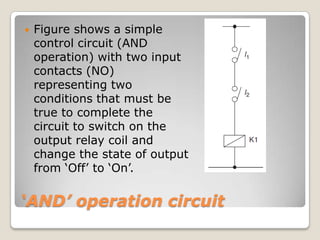
‘AND’ operation circuit
 Figure shows a simple
control circuit (AND
operation) with two input
contacts (NO)
representing two
conditions that must be
true to complete the
circuit to switch on the
output relay coil and
change the state of output
from ‘Off’ to ‘On’.
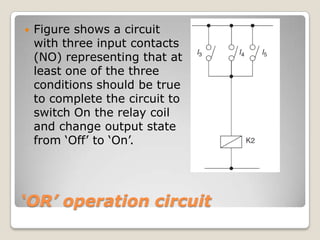
‘OR’ operation circuit
 Figure shows a circuit
with three input contacts
(NO) representing that at
least one of the three
conditions should be true
to complete the circuit to
switch On the relay coil
and change output state
from ‘Off’ to ‘On’.
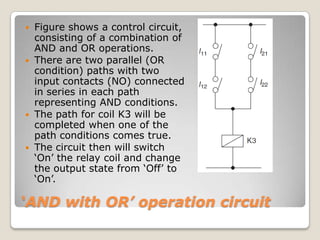
‘AND with OR’ operation circuit
 Figure shows a control circuit,
consisting of a combination of
AND and OR operations.
 There are two parallel (OR
condition) paths with two
input contacts (NO) connected
in series in each path
representing AND conditions.
 The path for coil K3 will be
completed when one of the
path conditions comes true.
 The circuit then will switch
‘On’ the relay coil and change
the output state from ‘Off’ to
‘On’.
Practical Example
 Workshop practical.
Reading and understanding electrical
drawings
Practical
 Workshop page 28
End of Part 1

Electrical Troubleshooting

  • 1.
    PART 1 Prepared by NabeelHassan Al-Zamror
  • 2.
    Outline 1. Basic principles 2.Devices, symbols, and circuits
  • 3.
  • 4.
    Objectives 1. To refreshbasic electrical concepts 2. To define basic concepts of transformer 3. To refresh single-phase power concepts 4. To refresh three-phase power concepts.
  • 5.
    Basic electrical concepts Electricity is found in two common forms: ◦ AC (alternating current) ◦ DC (direct current).  An electrical circuit has the following three basic components irrespective of its electrical energy form: ◦ Voltage (volts) ◦ Ampere (amps) ◦ Resistance (ohms).
  • 6.
     All threeare bound together with Ohm’s law, which gives the following relation between the three: V = I × R
  • 7.
    Power  In DCcircuits, power (watts) is simply a product of voltage and current.  P =V × I
  • 8.
    Power  For ACcircuits, the formula holds true for purely resistive circuits, power is not just a product of voltage and current.  Real power or true power is the power that can be converted into work and is measured in watts.
  • 9.
    Power  Reactive powerIf the circuit is of an inductive or capacitive type, then the reactive component consumes power and cannot be converted into work.  This is known as reactive power and is denoted by the unit VAR.
  • 10.
    Relationship between powers Apparent power (VA) = V × A  True power (Watts) = VA × cosf  Reactive power (VAR) = VA × sinf
  • 11.
    Power factor  Powerfactor is defined as the ratio of real power to apparent power. The maximum value it can carry is either 1 or 100(%), which would be obtained in a purely resistive circuit.
  • 12.
  • 13.
    Electrical energy  Thisis calculated as the amount of electrical energy used in an hour and is expressed as follows:  Kilowatthour = kW× h
  • 14.
    Types of circuits There are only two types of electrical circuits – series and parallel.
  • 15.
    series circuit  Aseries circuit is defined as a circuit in which the elements in a series carry the same  current, while voltage drop across each may be different.
  • 16.
    parallel circuit  Aparallel circuit is defined as a circuit in which the elements in parallel have the same  voltage, but the currents may be different.
  • 17.
    Transformer  A transformeris a device that transforms voltage from one level to another. They are widely used in power systems.  With the help of transformers, it is possible to transmit power at an economical transmission voltage and to utilize power at an economic effective voltage.
  • 18.
    Schematic diagram ofa single- phase transformer
  • 19.
    Potential-induced  The ratioof the primary potential to the secondary potential is the ratio of the number  of turns in each and is represented as follows:
  • 20.
    step-up and step-down The concepts of step-up and step-down transformers function on similar relation.  A step-up transformer increases the output voltage by taking N1 > N2 and a step-down transformer decreases the output voltage by taking N2 > N1 .
  • 21.
    Current-induced  When thetransformer is loaded, then the current is inversely proportional to the voltages and is represented as follows:
  • 22.
    EMF equation ofa transformer  rms value of the induced emf in the primary winding is:  E1 = 4.44 × f × N1 ×ɸm  rms value of the induced emf in the secondary winding is:  E2 = 4.44 × f × N2 × ɸm
  • 23.
  • 24.
    As per thetype of construction a) Core type: Windings surround a considerable part of the core. b) Shell type: Core surrounds a considerable portion of the windings.
  • 25.
    As per coolingtype a) Oil-filled self-cooled: Small- and medium-sized distribution transformers. b) Oil-filled water-cooled: High-voltage transmission line outdoor transformers. c) Air Cooled type: Used for low ratings and can be either of natural air circulation (AN) or forced circulation (AF) type.
  • 26.
    As per application a)Power transformer : These are large transformers used to change voltage levels and current levels as per requirement. Power transformers are usually used in either a distribution or a transmission line. b) Potential transformer (PT): These are precision voltage step-down transformers used along with low-range voltmeters to measure high voltages. c) Current transformer (CT): These transformers are used for the measurement of current where the current- carrying conductor is treated as a primary transformer. This transformer isolates the instrument from high- voltage line, as well as steps down the current in a known ratio. d) Isolation transformer : These are used to isolate two different circuits without changing the voltage level or current level.
  • 27.
  • 28.
    Series connection oftwo single- phase transformers
  • 29.
    Parallel connection oftwo single- phase transformers
  • 30.
  • 31.
    Commonly used three-phasesare  Three-phase three-wire (delta)  Three-phase four-wire (star).
  • 32.
  • 33.
  • 34.
    Output power ofa transformer in kW
  • 35.
  • 36.
    Testing transformers  Thefollowing tests are carried out on transformers:  Measurement of winding resistance  Measurement of Voltage ratio  Test phasor voltage relationship  Measurement of impedance voltage, short-circuit impedance and load loss  Measurement of no load loss and no load current  Measurement of insulation resistance  Dielectric test  Temperature rise.
  • 37.
    Why is transformerrating defined in kVA  usual to express the rating of the transformer as a product of the rated voltage and the rated current (VA or kVA). This however does not mean that you can apply a lower voltage and pass a higher current through the transformer. The VA value is bounded individually by the rated voltage and rated current.
  • 38.
    Types of electricalmachines DC machines Shunt motor Self excited Separately excited Series motor Compound motor AC machines Squirrel-cage induction motor Wound rotor motor Synchronous motors
  • 39.
    Meters used introubleshooting
  • 40.
  • 41.
  • 42.
    • Electrostatic voltmeters(high- voltage measurements)
  • 43.
    Multimeter or volt-ohm-milli- ammeter(voltage, resistance, current, etc.)
  • 44.
  • 45.
  • 46.
  • 47.
  • 48.
  • 49.
  • 50.
  • 51.
    Logic analyzers (diagnosinglogic systems problems)
  • 52.
  • 53.
    Objective 1. To understandbasic electrical symbols 2. To understand power and control circuits 3. To read electrical drawings
  • 54.
  • 55.
  • 56.
  • 57.
     A controlcircuit is for the automatic control of equipment, for safety interlocking, and sequencing the operations of the plant equipment and machines.
  • 58.
     Control circuitshardware consists of relay contacts, wires, hardware timers, and counters, relay coils, etc.  These consist of input contacts representing various conditions; the output coils are energized or de-energized depending on the input conditions represented by the control circuit.
  • 59.
     There aretwo types of contacts NO (normally open) and NC (normally closed).  Input contact: These are contacts of relays, contactors, timers, counter, field instrument switches, pressure switches, limit switches, etc.  Output coil: These have two states – On or Off. Output coil can be auxiliary contactor or Main contactor coil.
  • 60.
    ‘AND’ operation circuit Figure shows a simple control circuit (AND operation) with two input contacts (NO) representing two conditions that must be true to complete the circuit to switch on the output relay coil and change the state of output from ‘Off’ to ‘On’.
  • 61.
    ‘OR’ operation circuit Figure shows a circuit with three input contacts (NO) representing that at least one of the three conditions should be true to complete the circuit to switch On the relay coil and change output state from ‘Off’ to ‘On’.
  • 62.
    ‘AND with OR’operation circuit  Figure shows a control circuit, consisting of a combination of AND and OR operations.  There are two parallel (OR condition) paths with two input contacts (NO) connected in series in each path representing AND conditions.  The path for coil K3 will be completed when one of the path conditions comes true.  The circuit then will switch ‘On’ the relay coil and change the output state from ‘Off’ to ‘On’.
  • 63.
  • 64.
    Reading and understandingelectrical drawings
  • 65.
  • 66.