

1
Electrical Basics
&
Classic Control
2
COURSE CONTENTS
Part One
Electrical Basics
&
Control Circuits
Chapter 1 Electrical Basics
Chapter 2 Types of Control System
Chapter 3 Classic control components
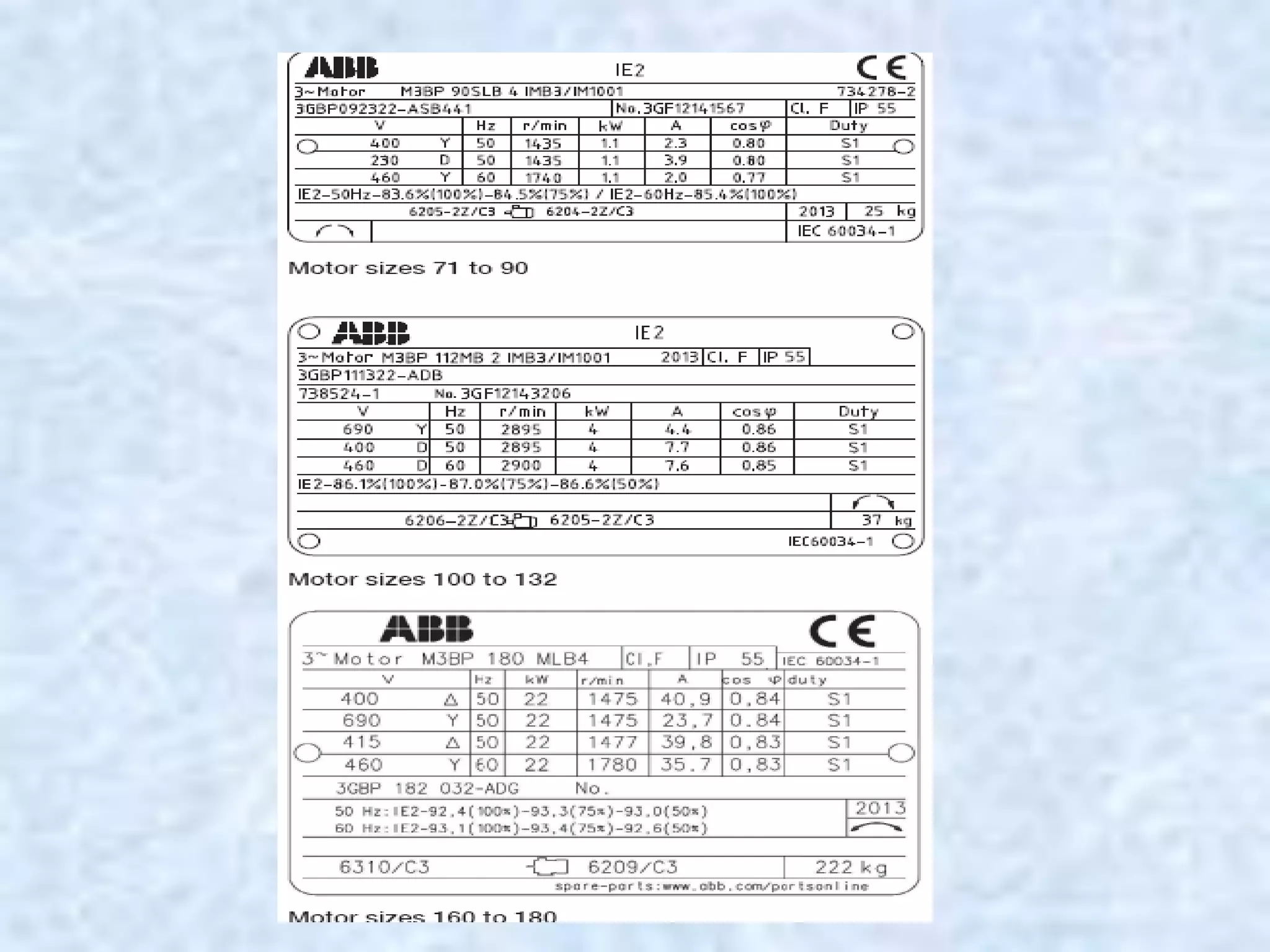
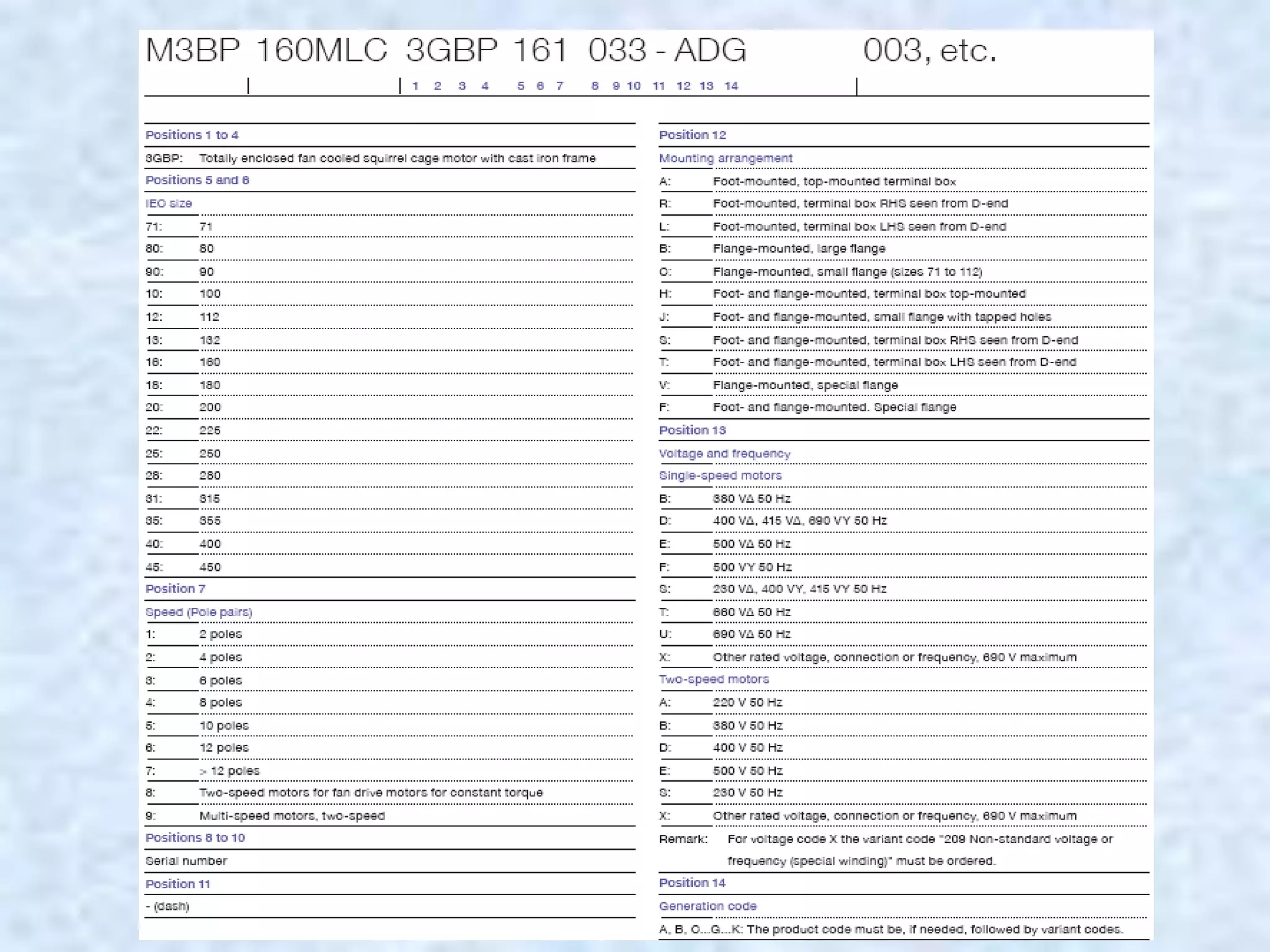
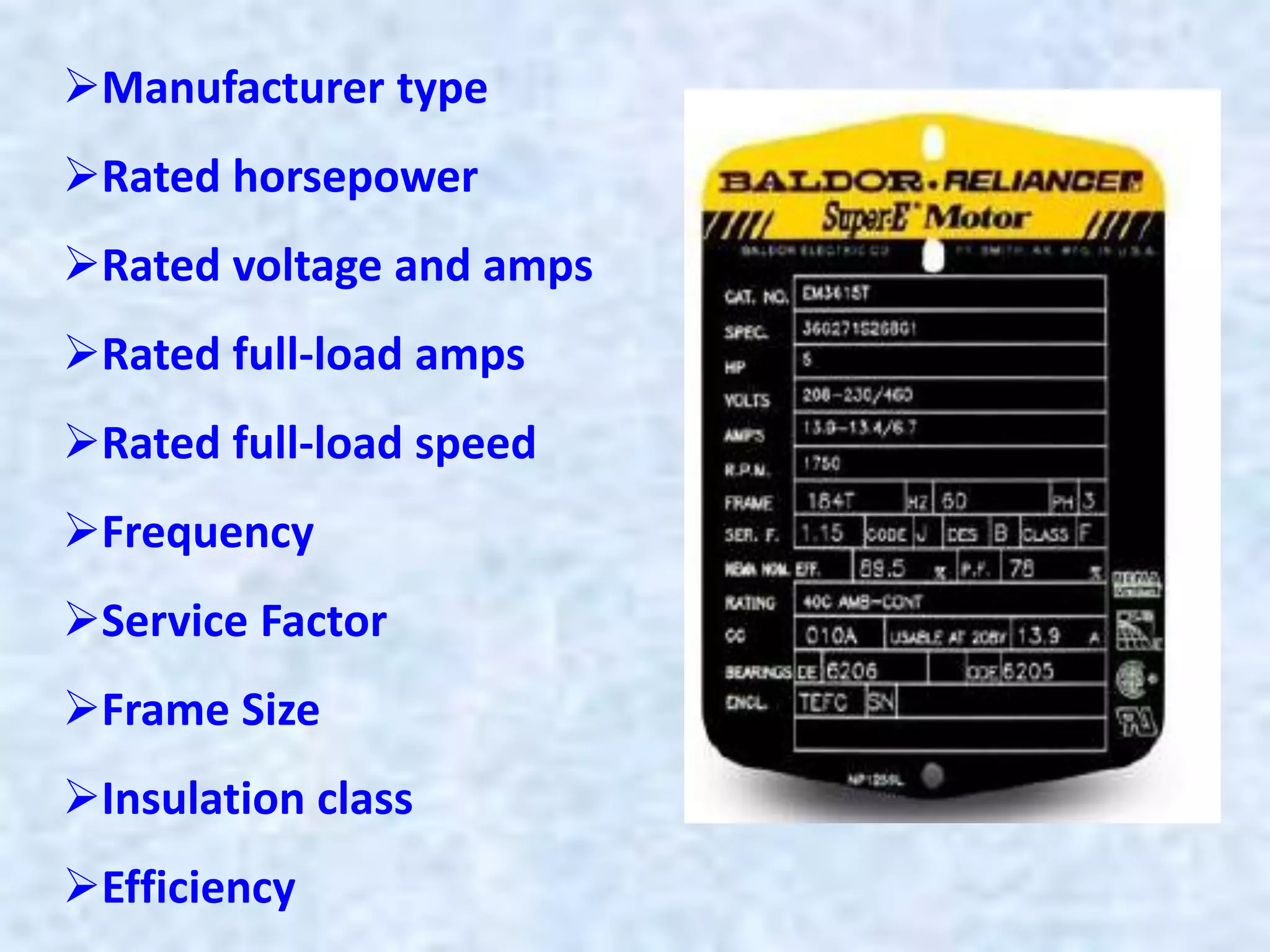
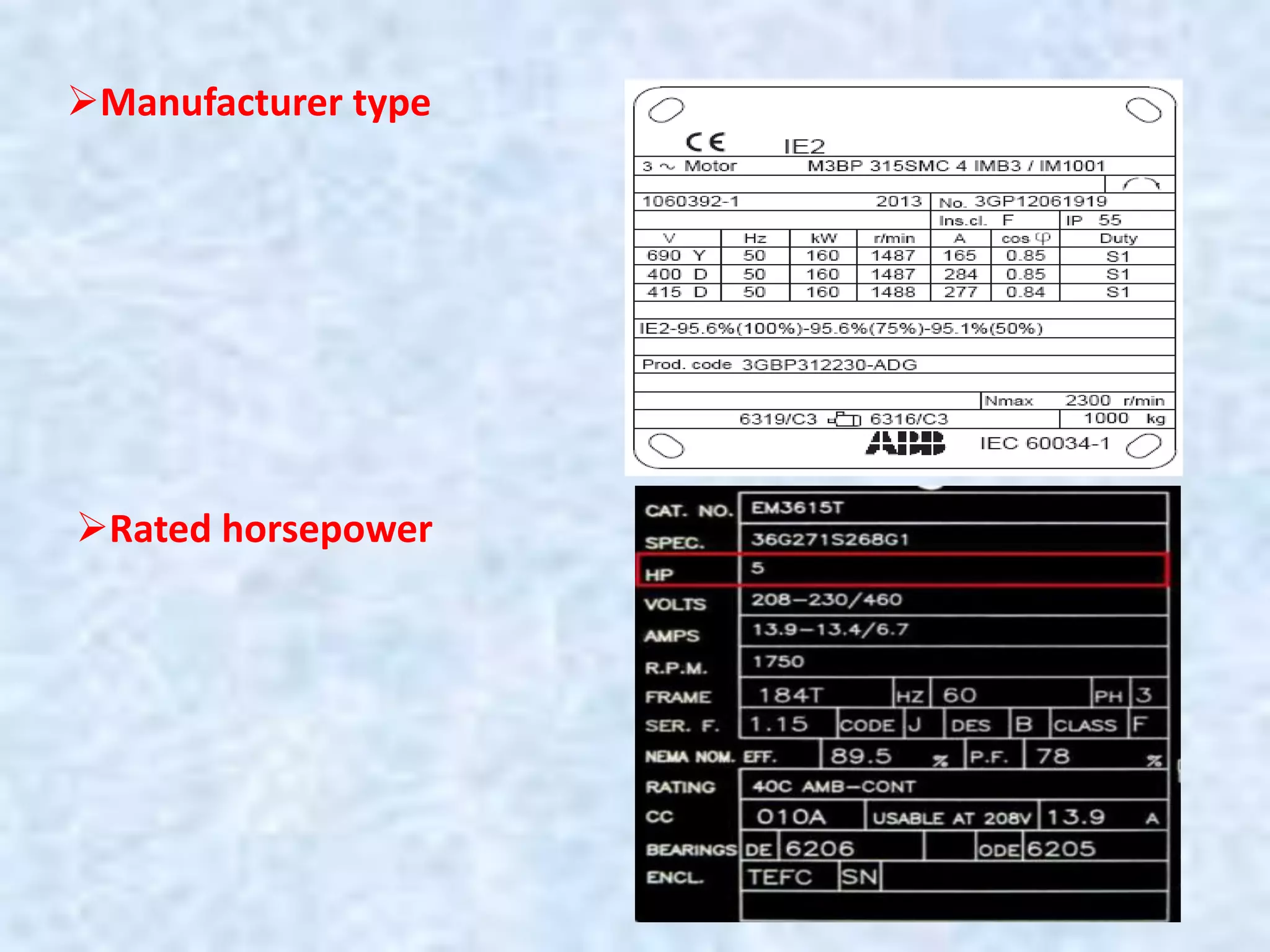
Chapter 4 Motor Name Plate
Chapter 5 Types of AC Motors
Chapter 6 Different types of Control Circuits
Chapter 7 Types of Starter for Induction motors
Chapter 8 Testing of Induction Motor
Chapter 9 Typical Motor Failure & Protection
3
CHAPTER 1
Electrical Basics
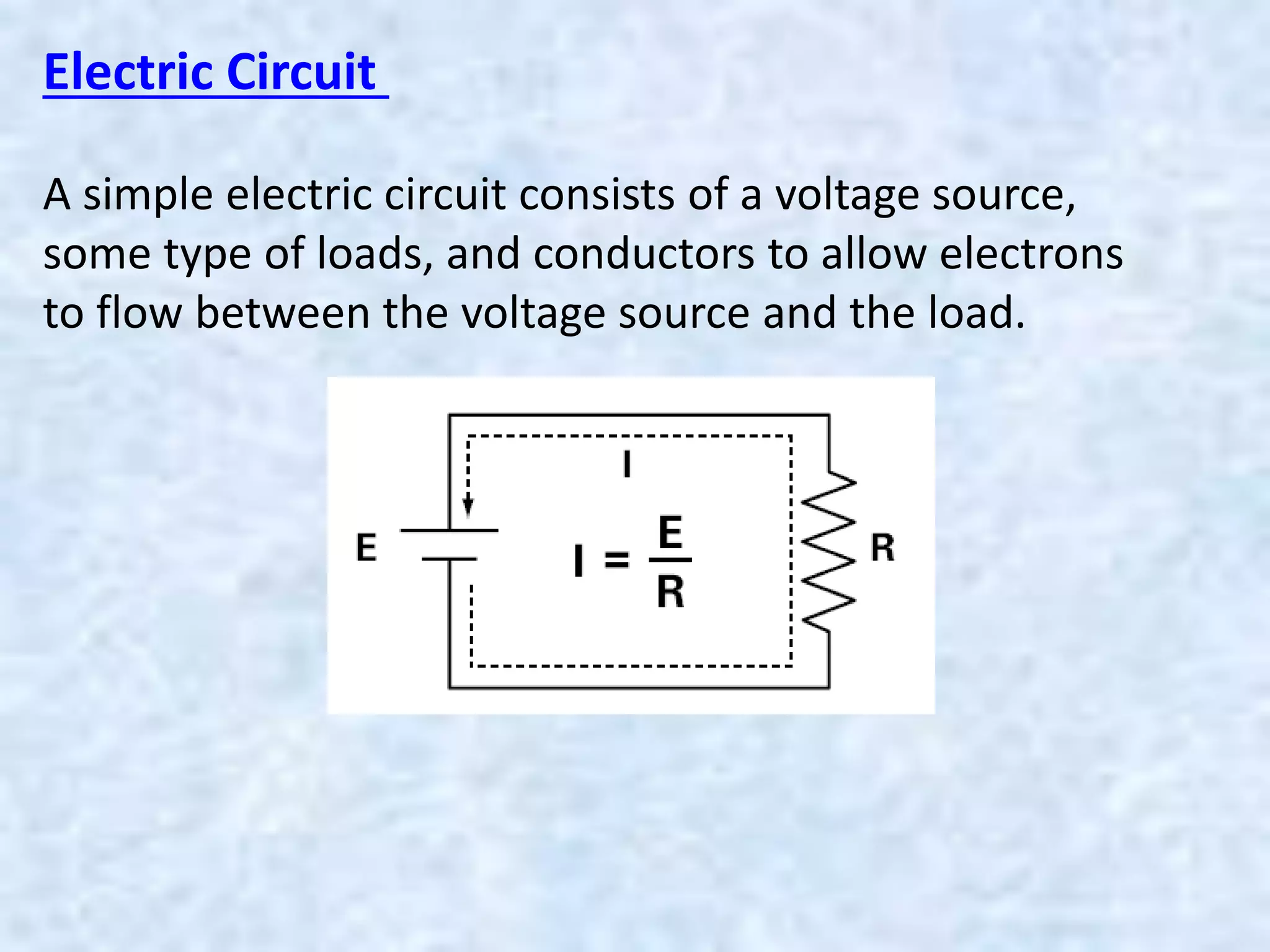
Electric Circuit
A simple electric circuit consists of a voltage source,
some type of loads, and conductors to allow electrons
to flow between the voltage source and the load.
Direct & Alternating current
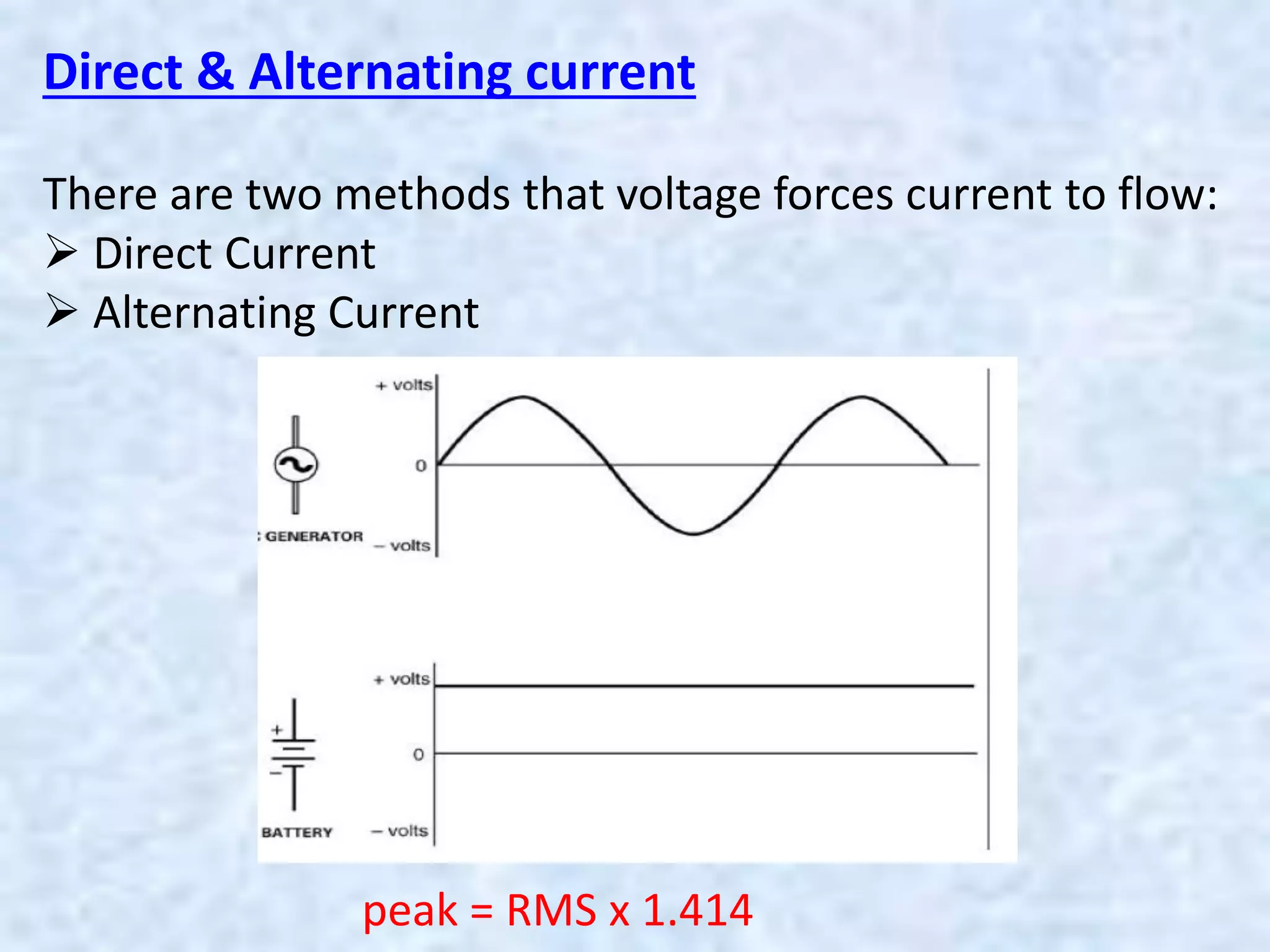
There are two methods that voltage forces current to flow:
 Direct Current
 Alternating Current
peak = RMS x 1.414
Direct & Alternating current
DC (Thomas Edison)
Unidirectional (one way street)
AC (Nicolas Tesla)
Bidirectional (HZ) ( number of alternating in a second
50 HZ === It is alternated 50 times in a second.
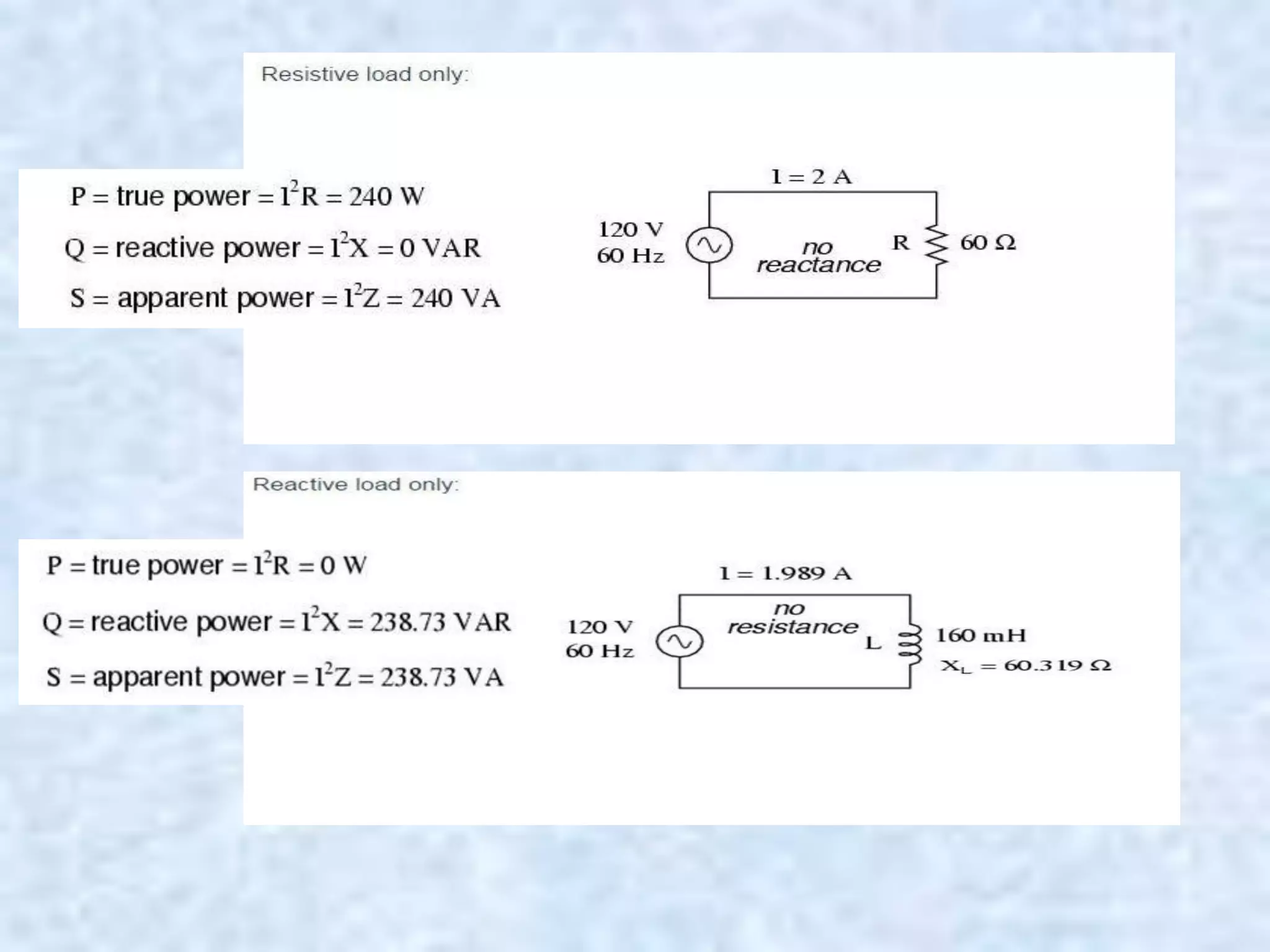
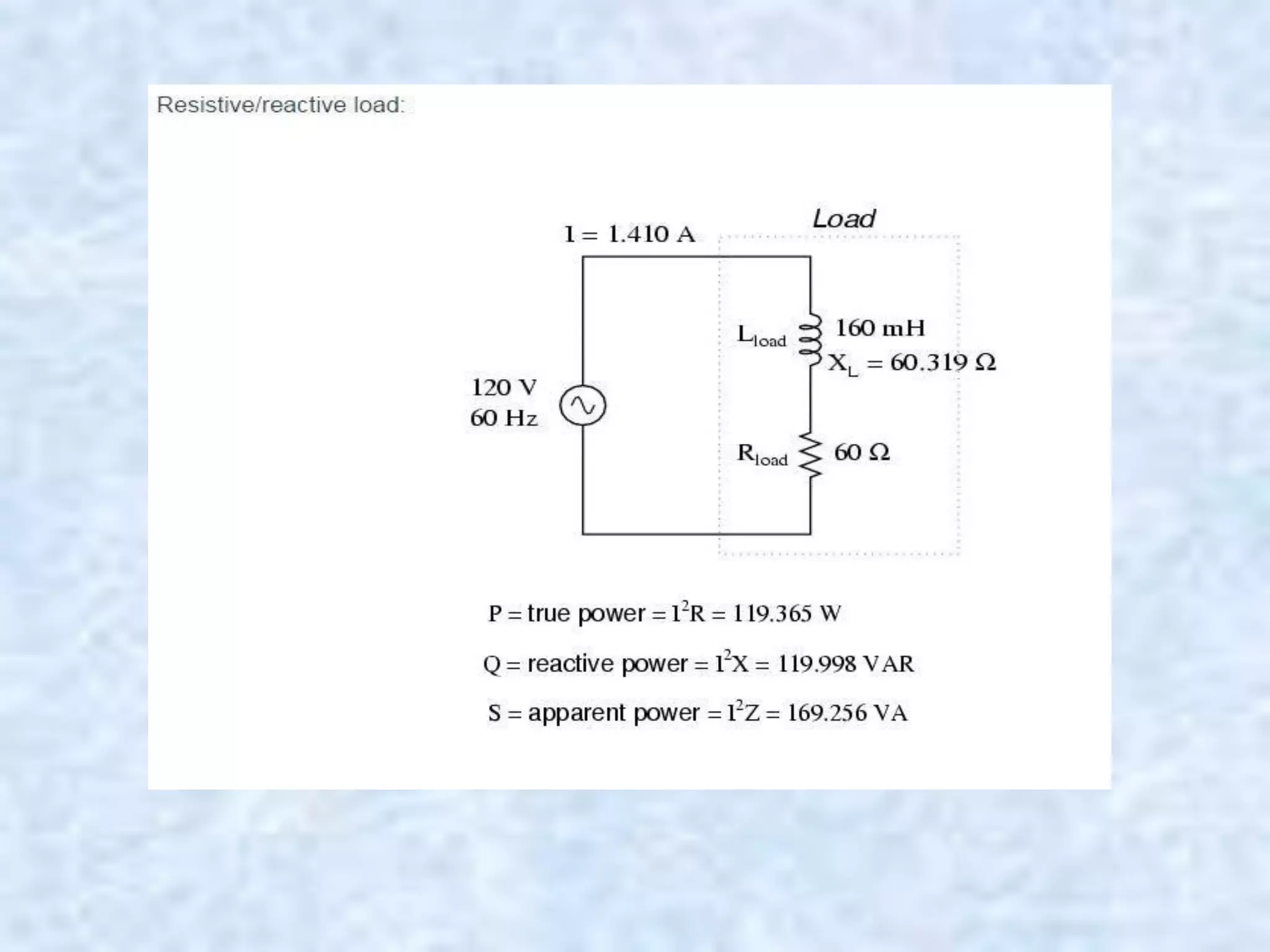
Electric Power
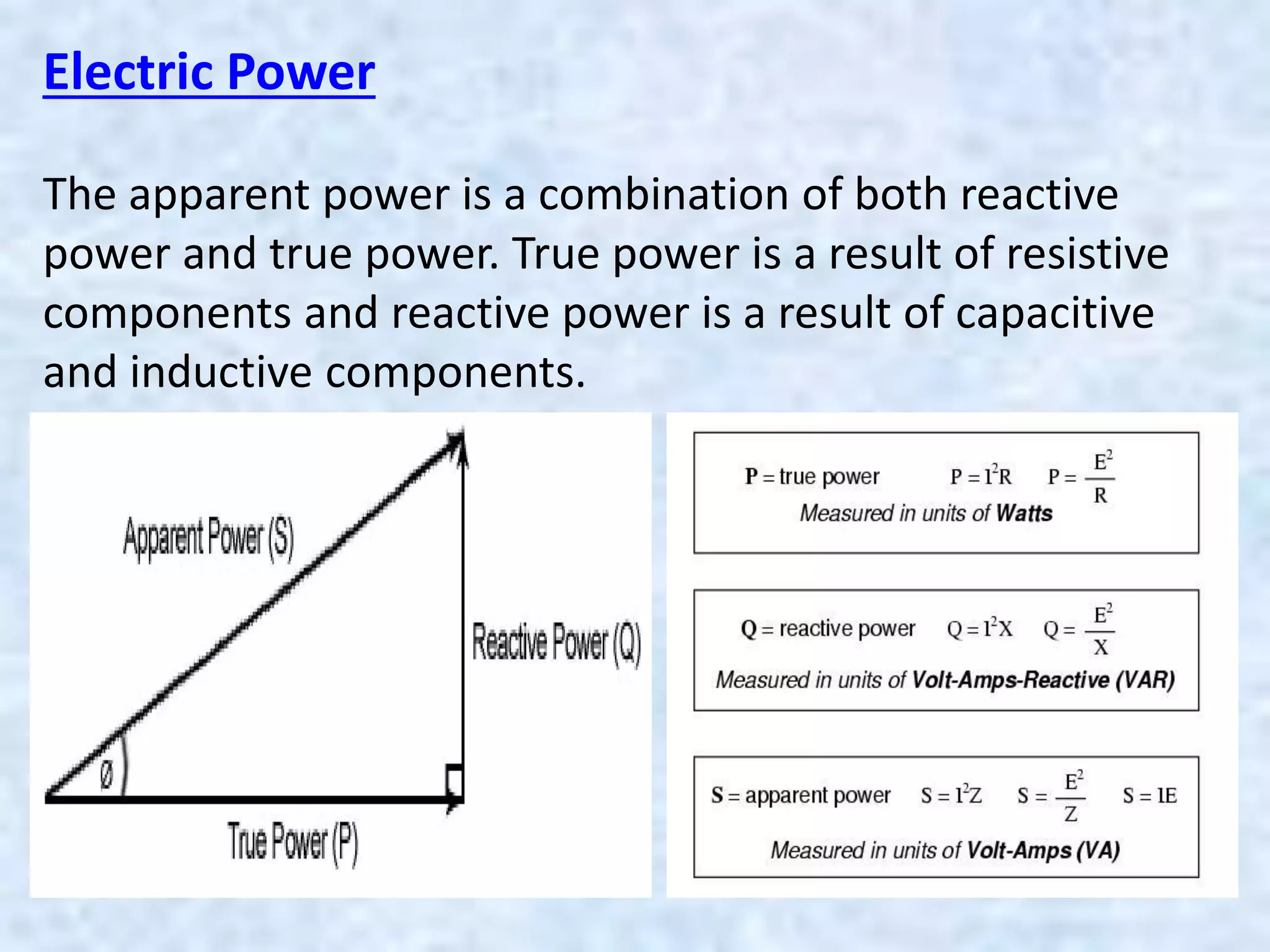
The apparent power is a combination of both reactive
power and true power. True power is a result of resistive
components and reactive power is a result of capacitive
and inductive components.
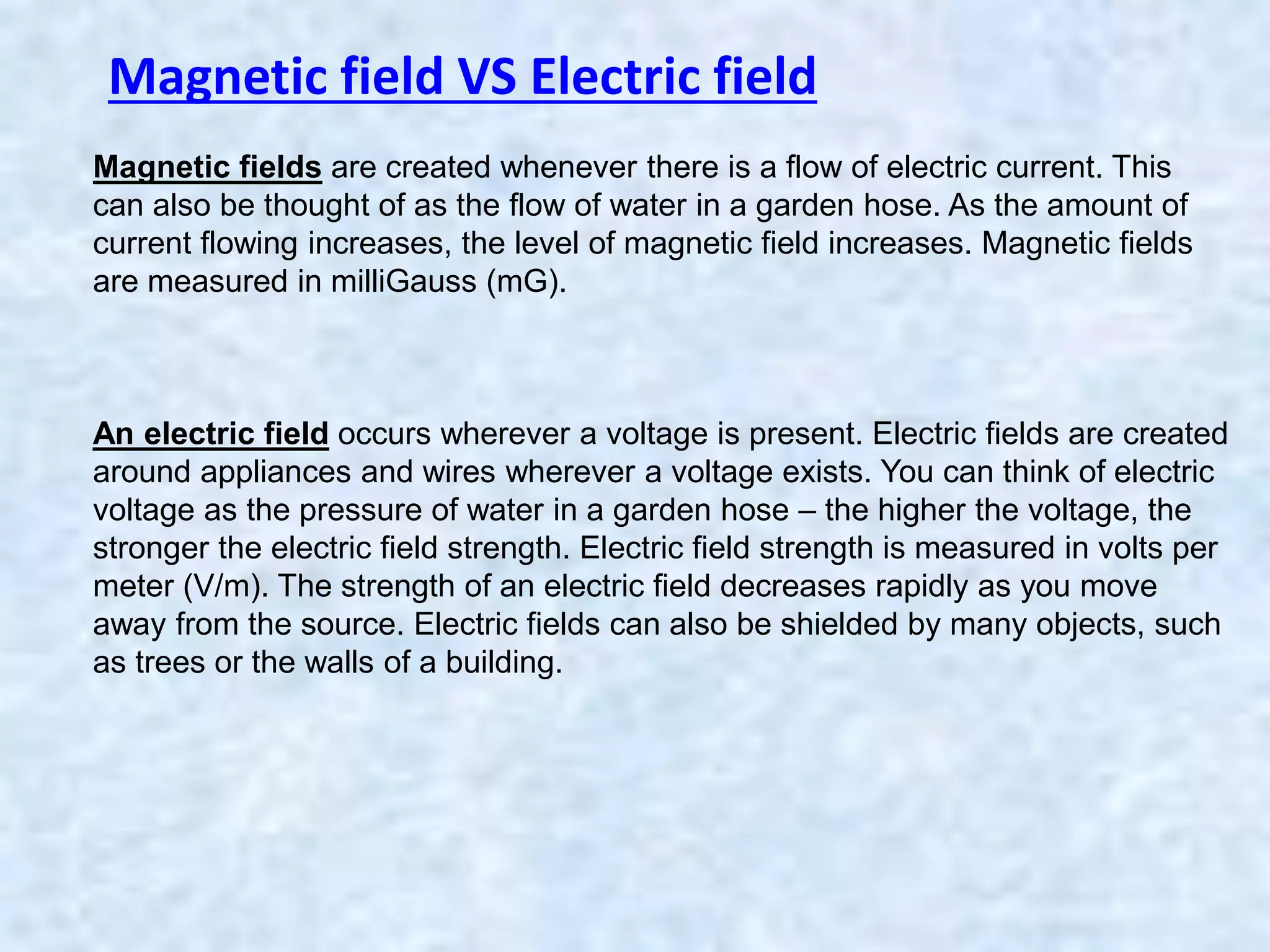
Magnetic fields are created whenever there is a flow of electric current. This
can also be thought of as the flow of water in a garden hose. As the amount of
current flowing increases, the level of magnetic field increases. Magnetic fields
are measured in milliGauss (mG).
An electric field occurs wherever a voltage is present. Electric fields are created
around appliances and wires wherever a voltage exists. You can think of electric
voltage as the pressure of water in a garden hose – the higher the voltage, the
stronger the electric field strength. Electric field strength is measured in volts per
meter (V/m). The strength of an electric field decreases rapidly as you move
away from the source. Electric fields can also be shielded by many objects, such
as trees or the walls of a building.
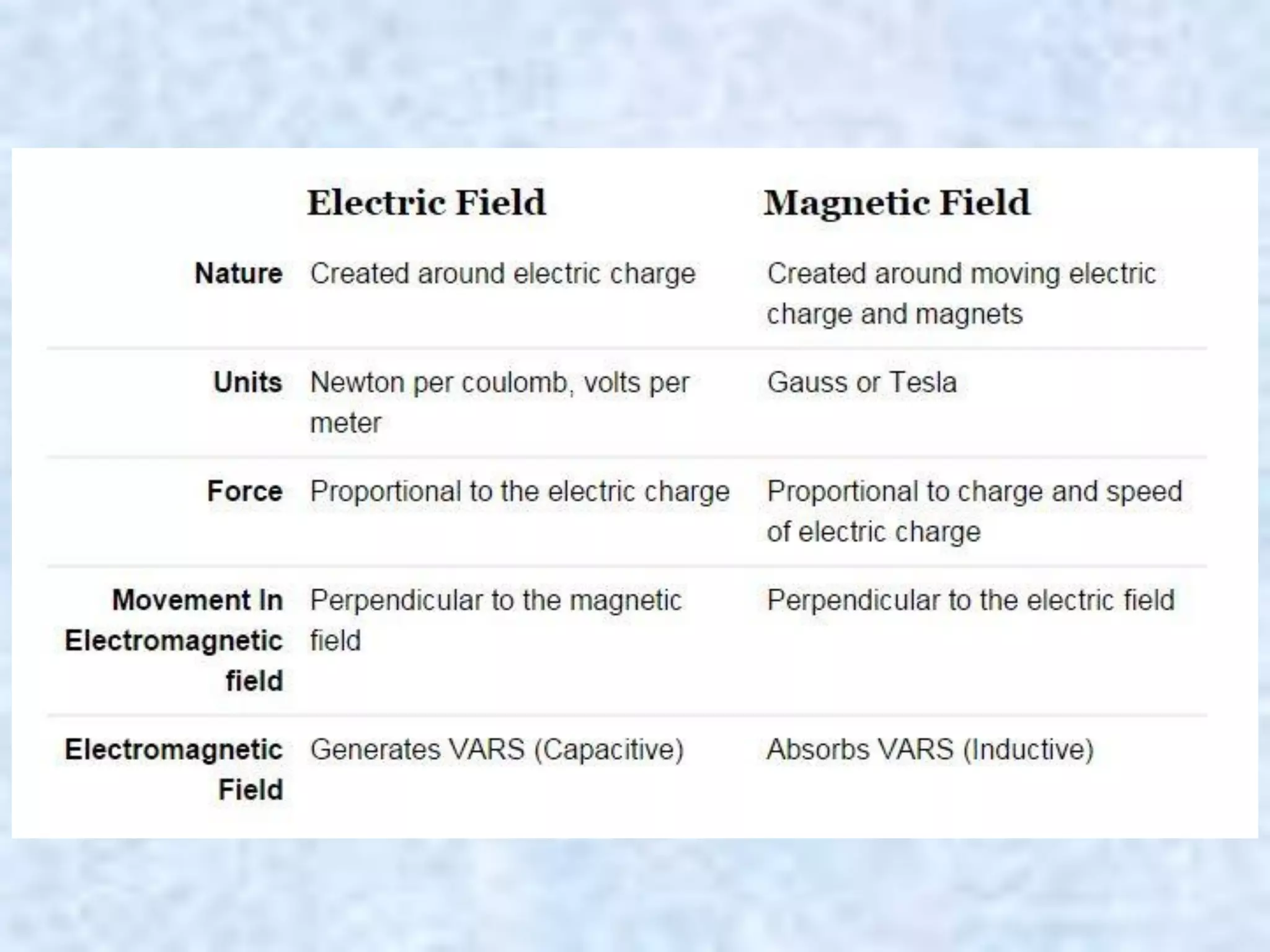
Magnetic field VS Electric field
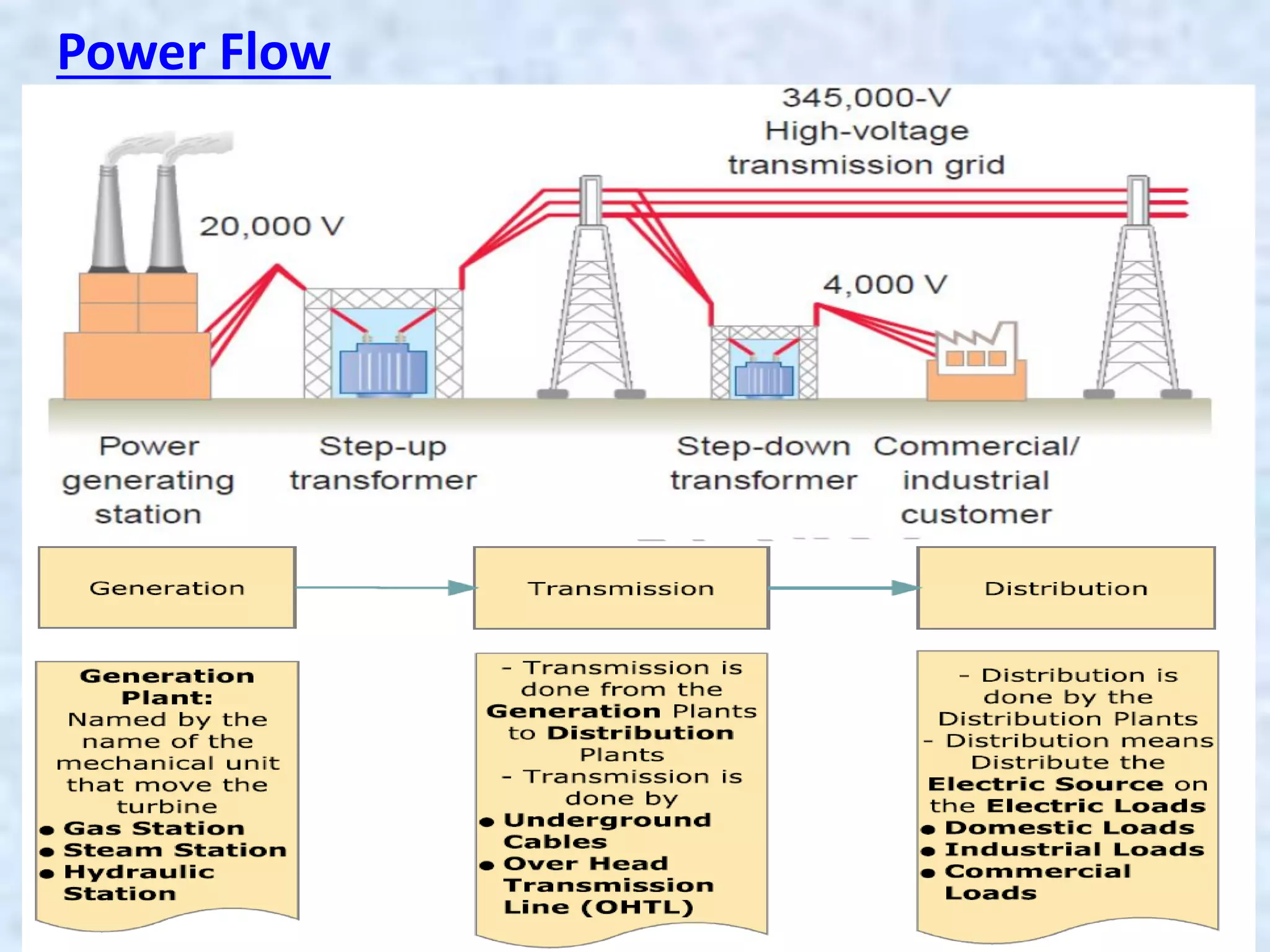
Power Flow
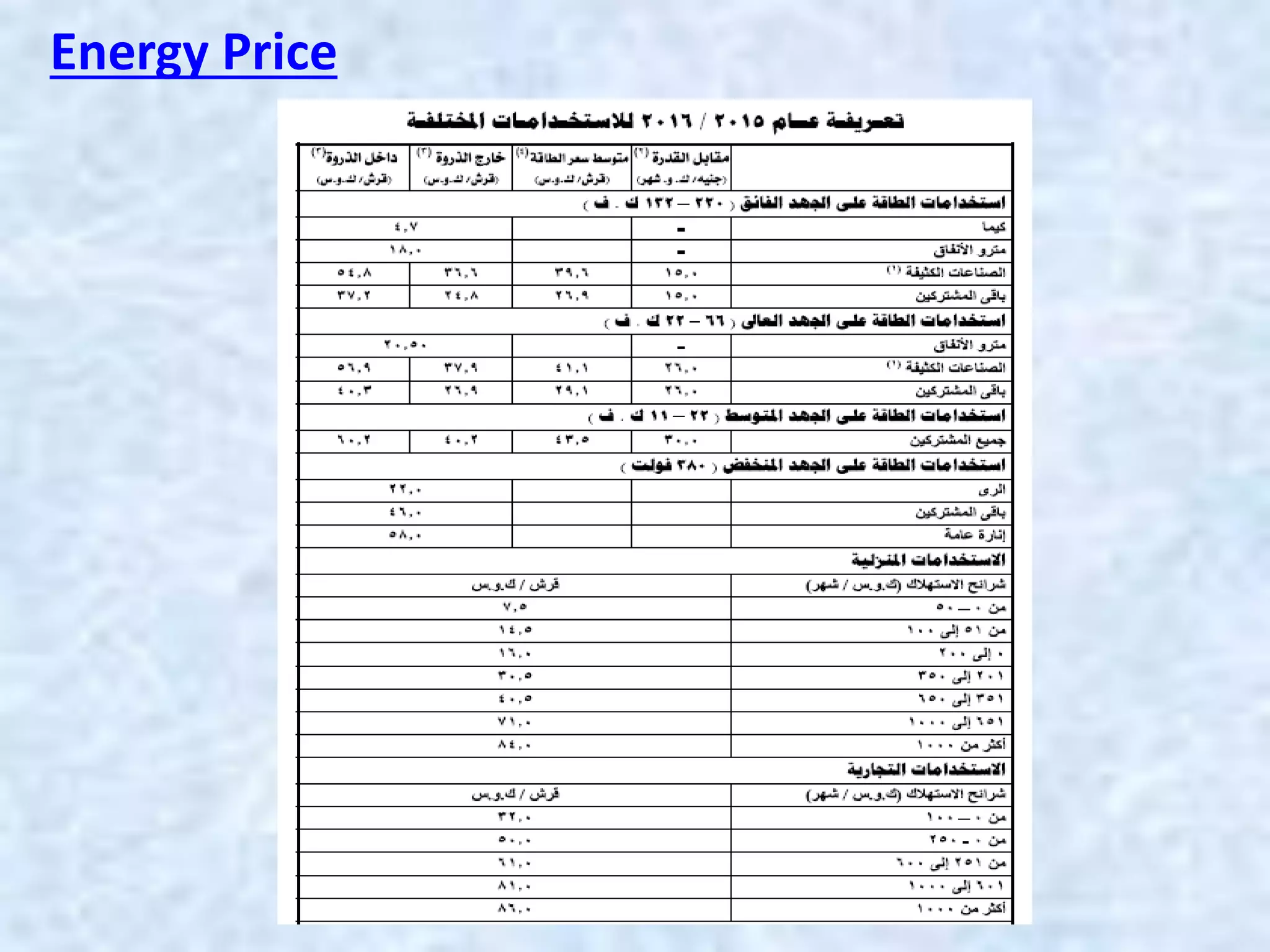
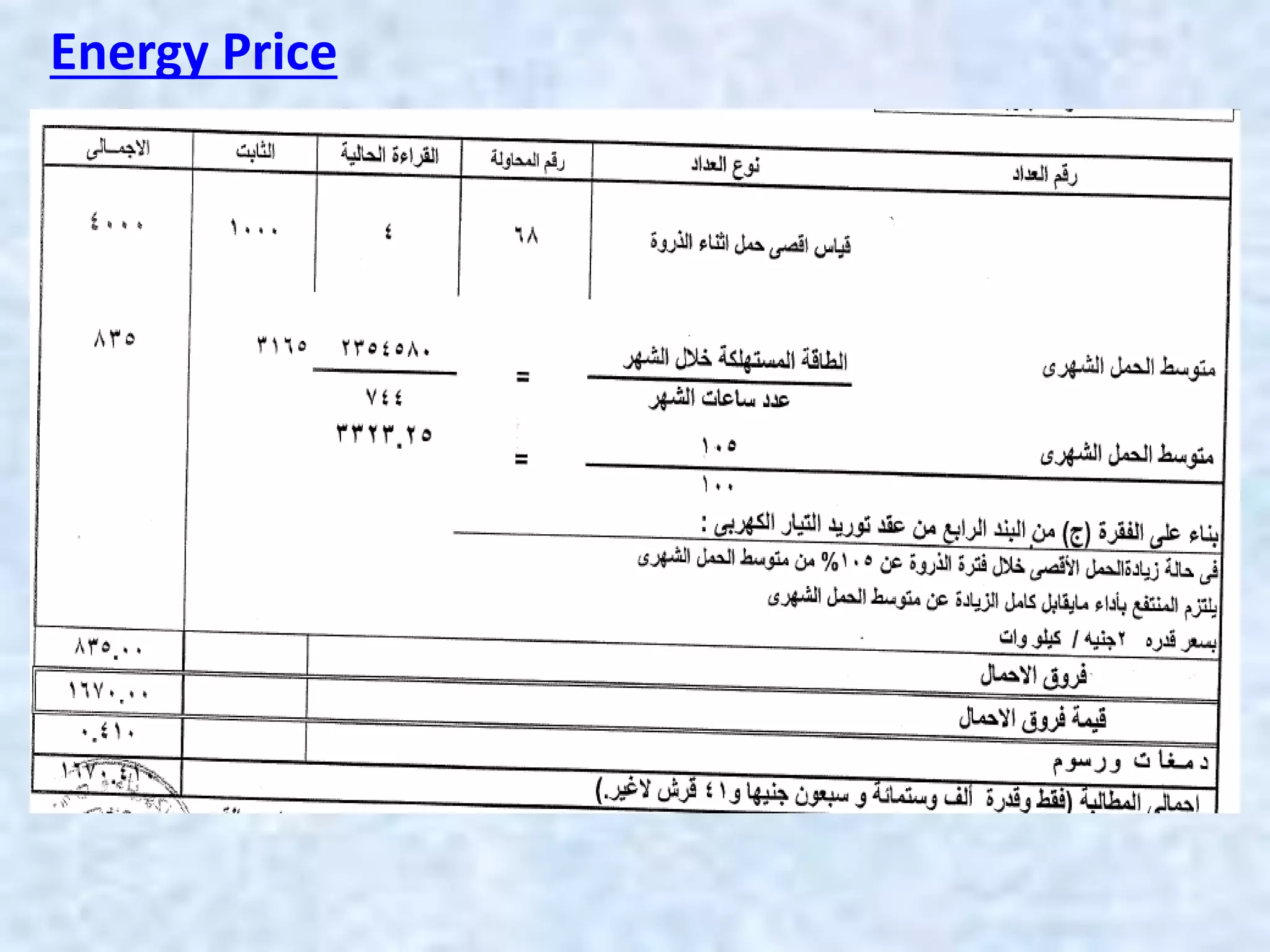
Energy Price
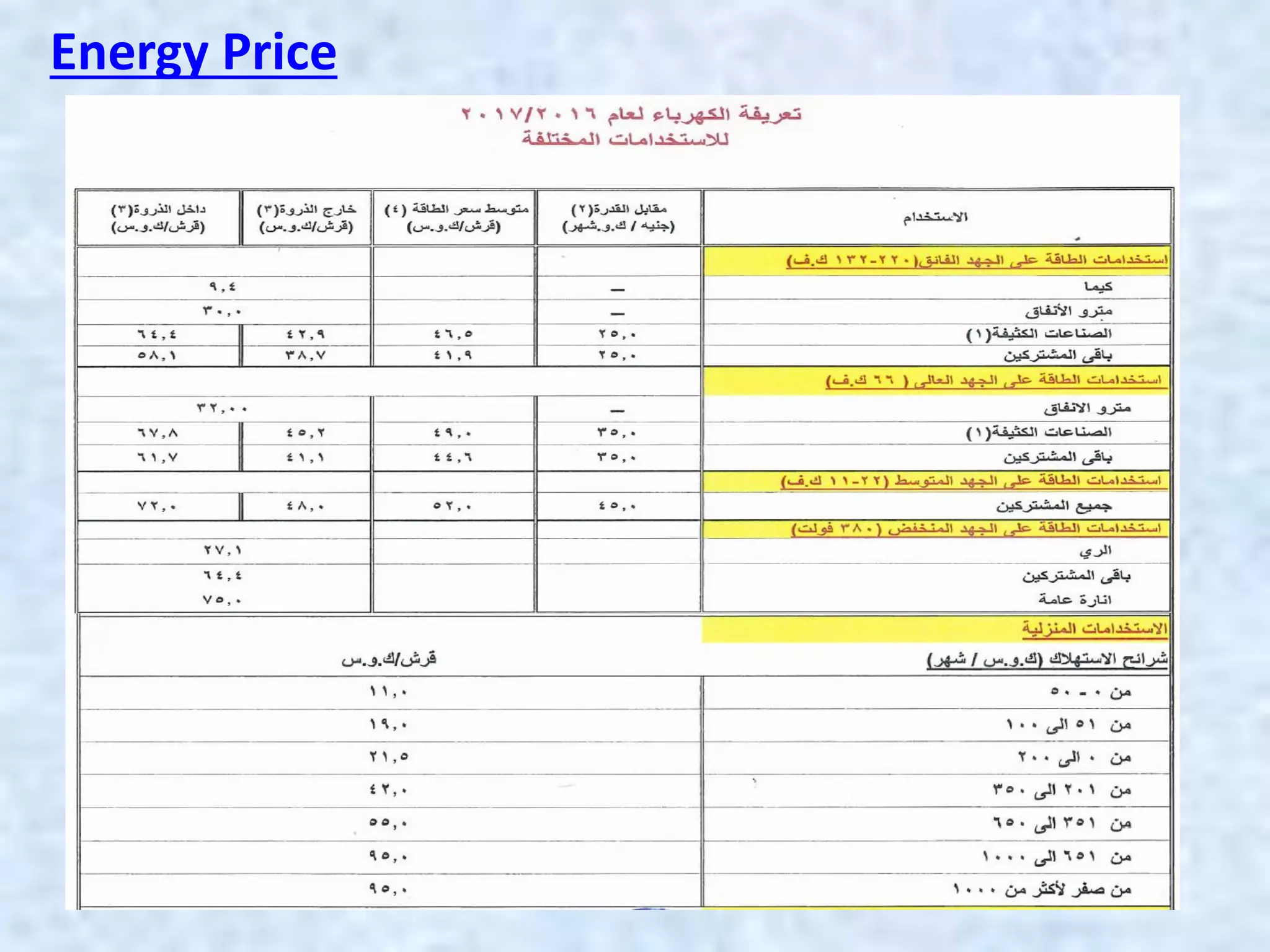
Energy Price
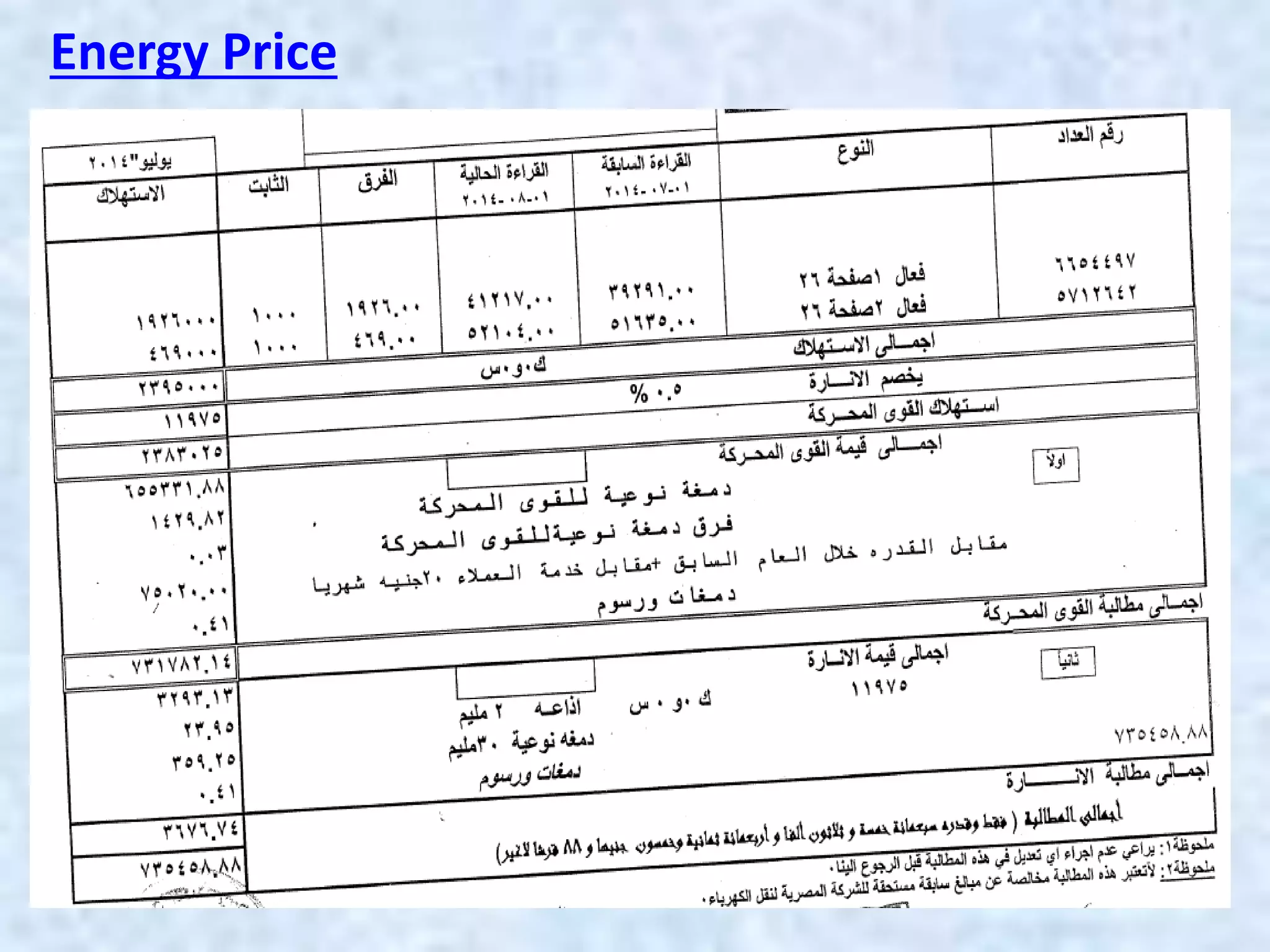
Energy Price
Energy Price
Energy Price
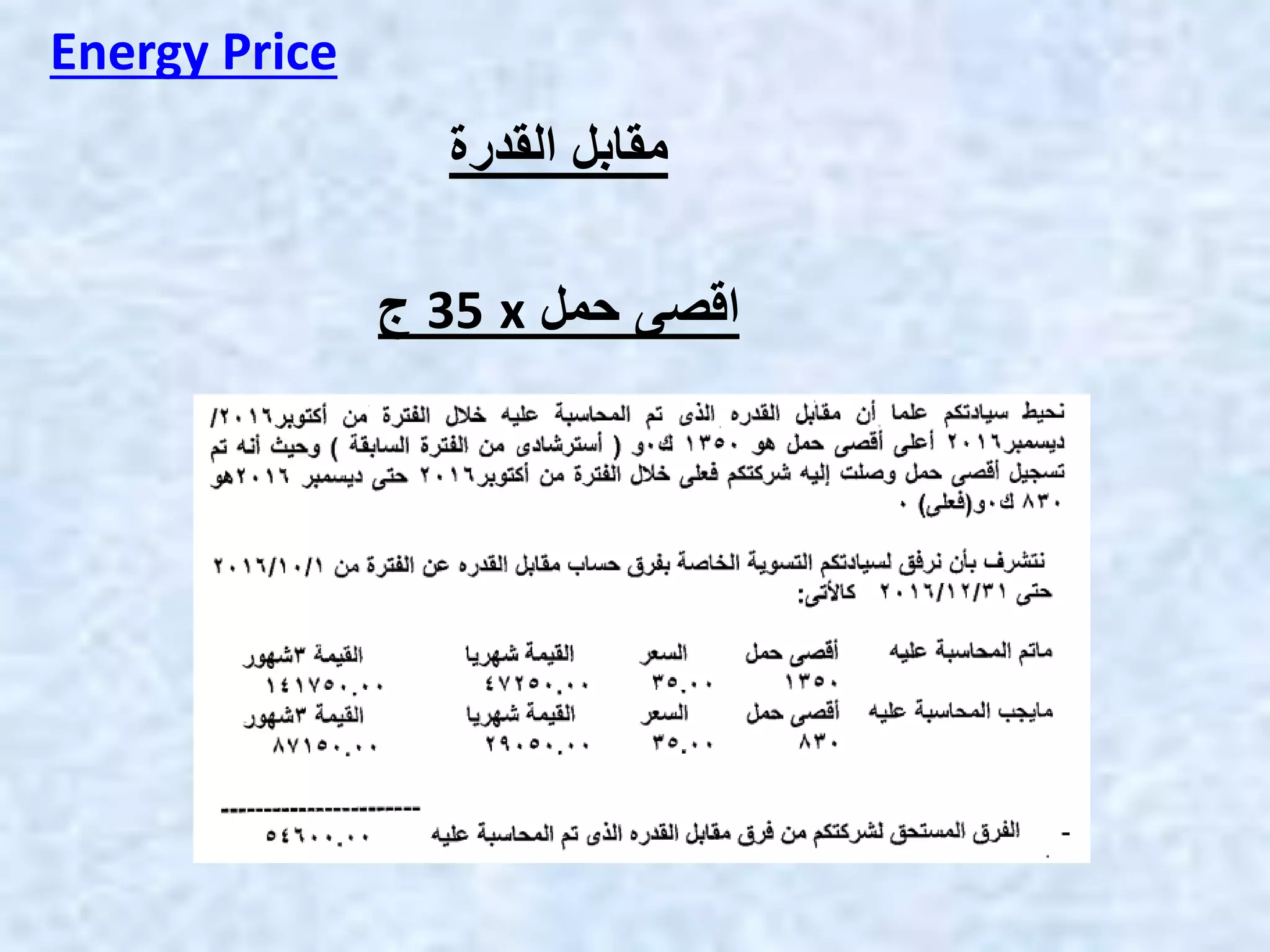
‫القدرة‬ ‫مقابل‬
‫حمل‬ ‫اقصى‬
x
35
‫ج‬
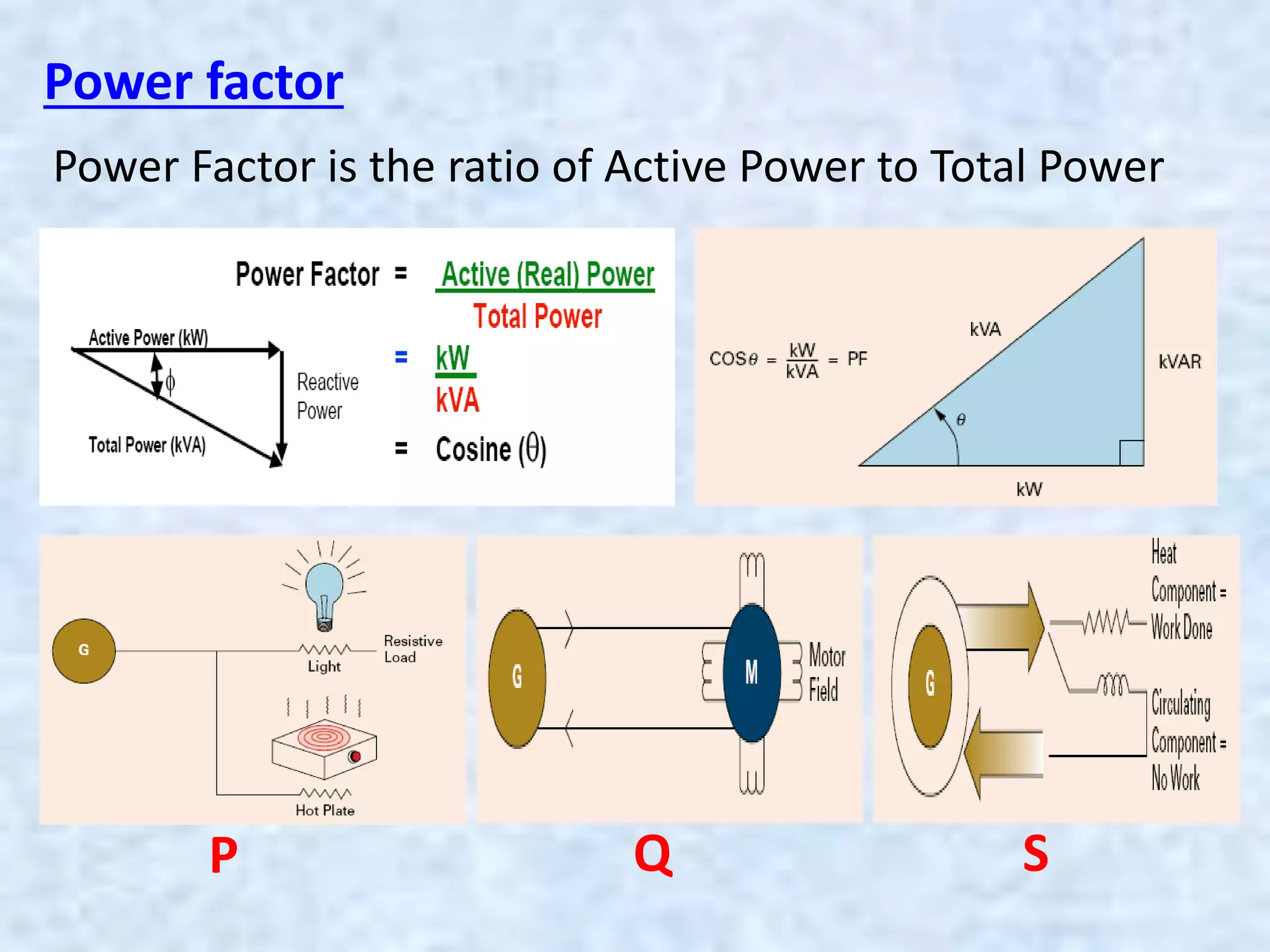
Power factor
Power Factor is the ratio of Active Power to Total Power
P Q S
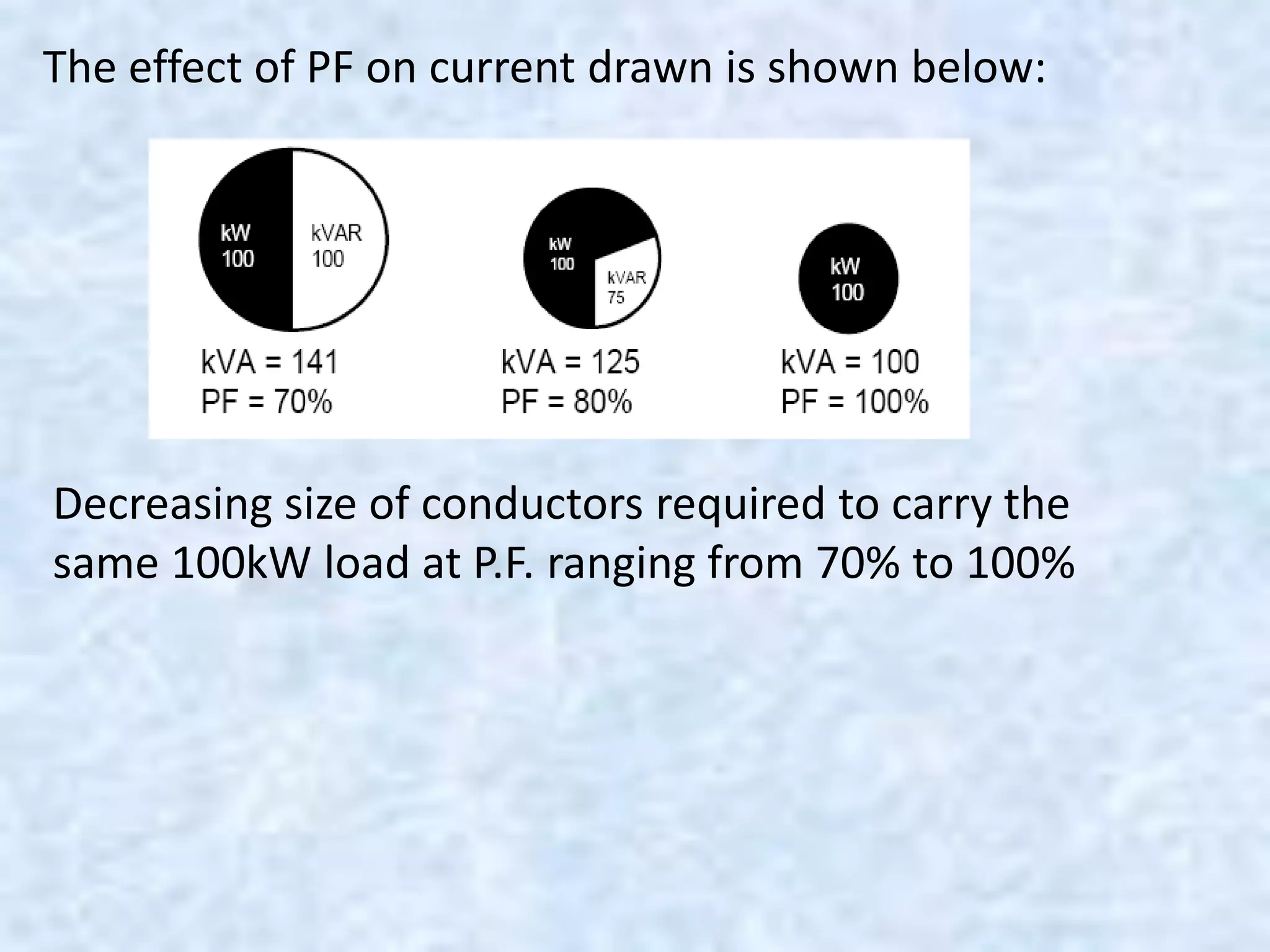
The effect of PF on current drawn is shown below:
Decreasing size of conductors required to carry the
same 100kW load at P.F. ranging from 70% to 100%
Why is Power Factor Important?
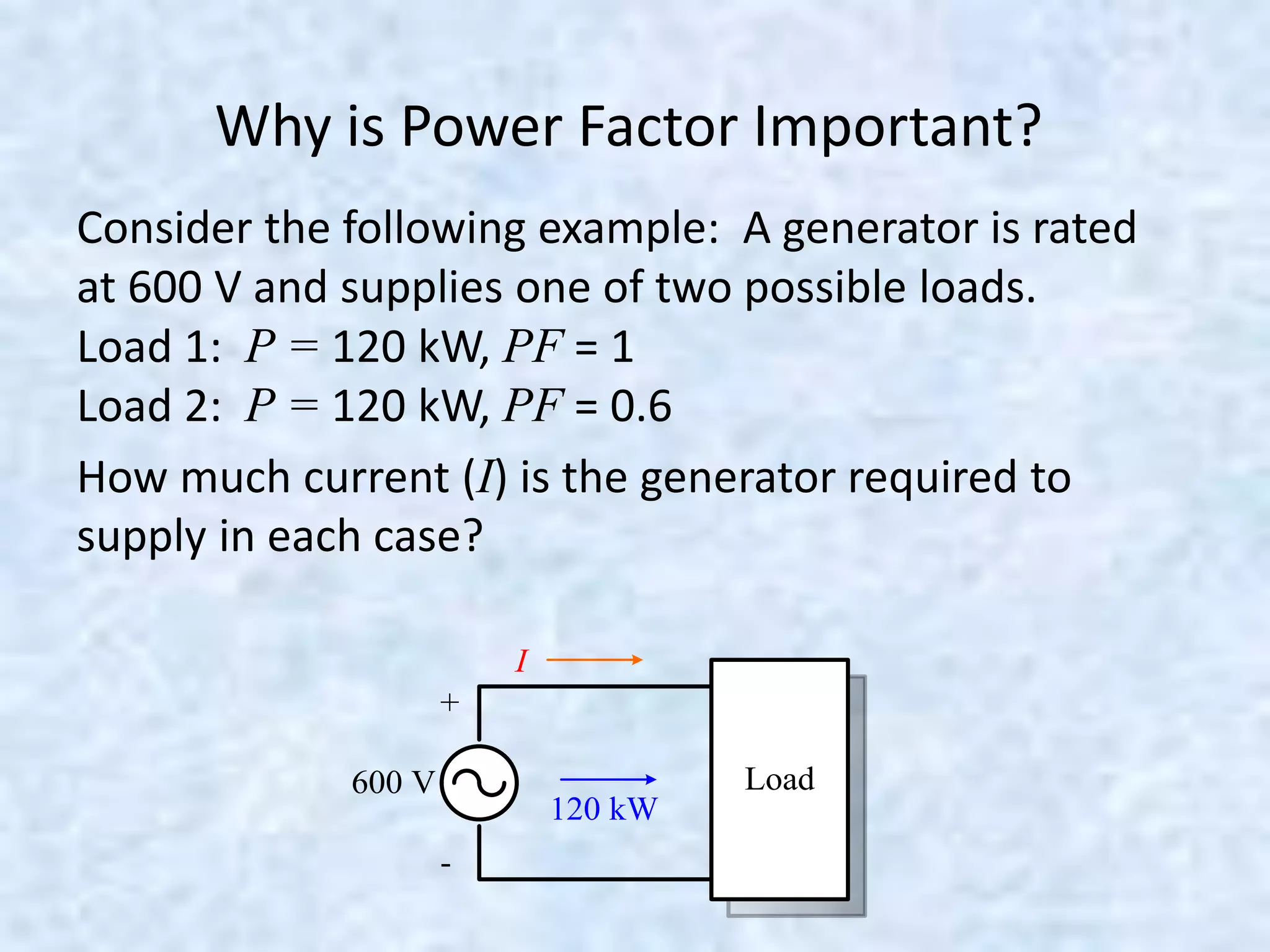
Consider the following example: A generator is rated
at 600 V and supplies one of two possible loads.
Load 1: P = 120 kW, PF = 1
Load 2: P = 120 kW, PF = 0.6
How much current (I) is the generator required to
supply in each case?
Load
600 V
+
-
I
120 kW
Why is Power Factor Important?
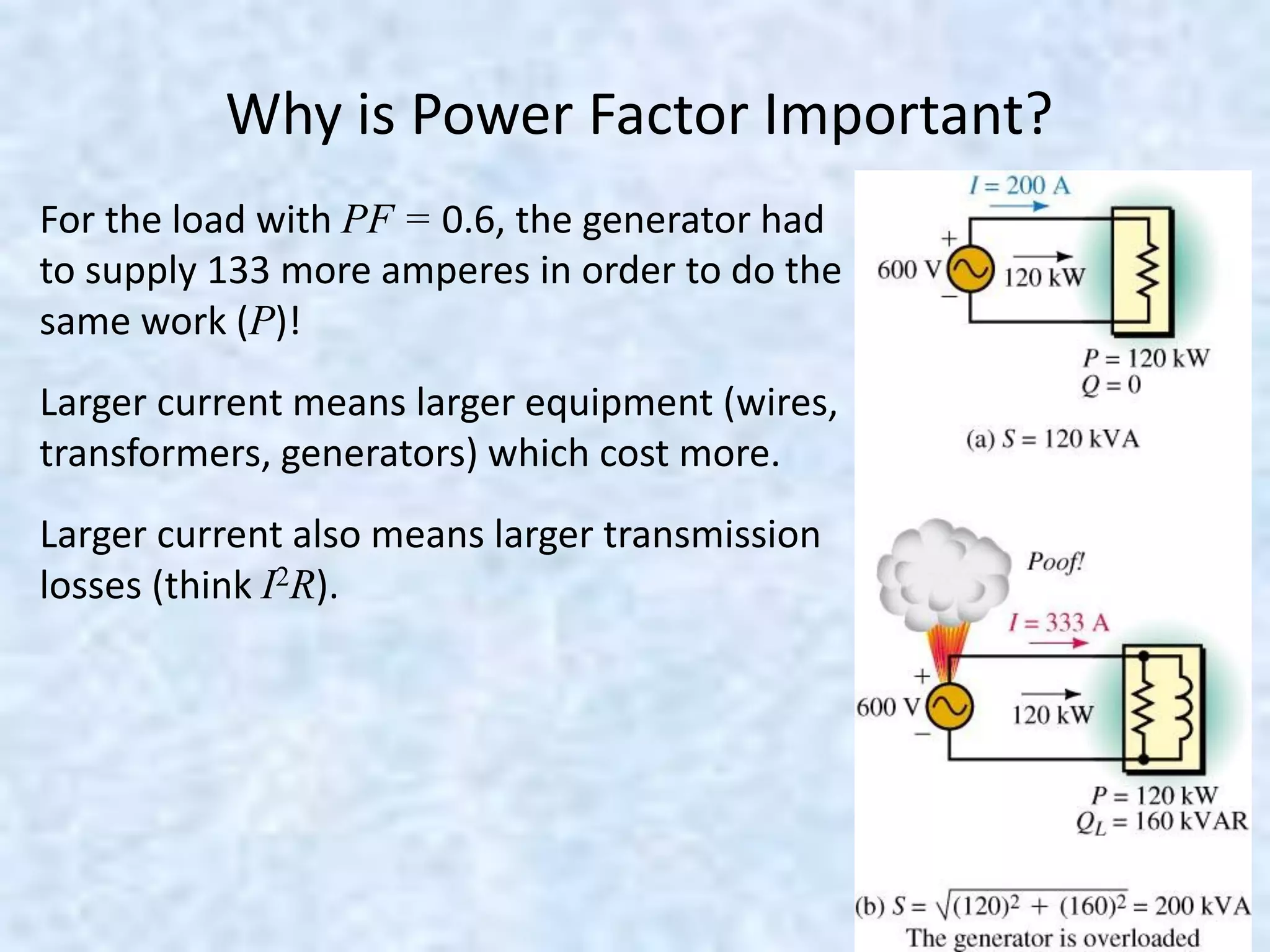
For the load with PF = 0.6, the generator had
to supply 133 more amperes in order to do the
same work (P)!
Larger current means larger equipment (wires,
transformers, generators) which cost more.
Larger current also means larger transmission
losses (think I2R).
Is it possible to change the power factor of the
load?
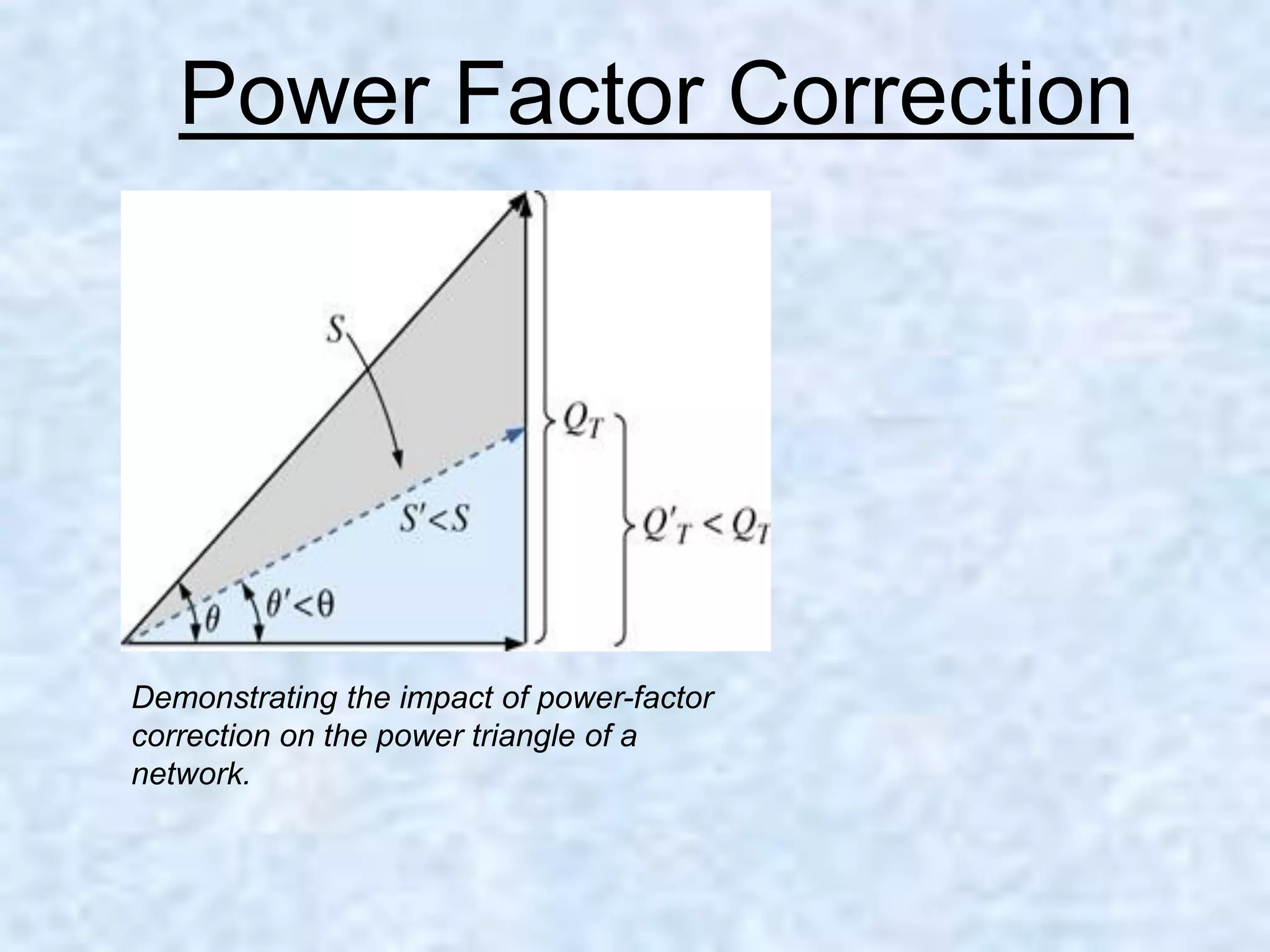
Power Factor Correction
Demonstrating the impact of power-factor
correction on the power triangle of a
network.
Power Factor Correction
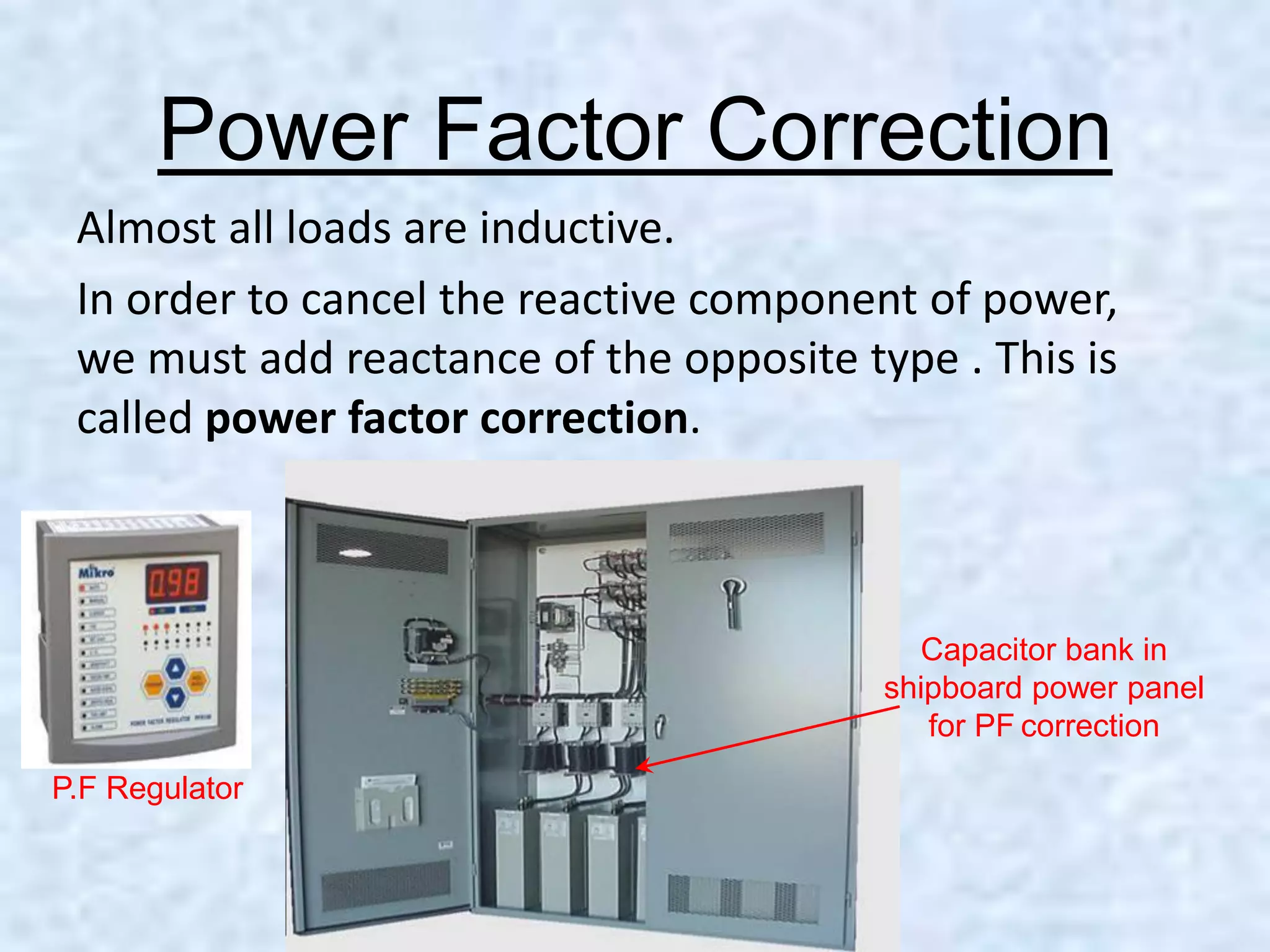
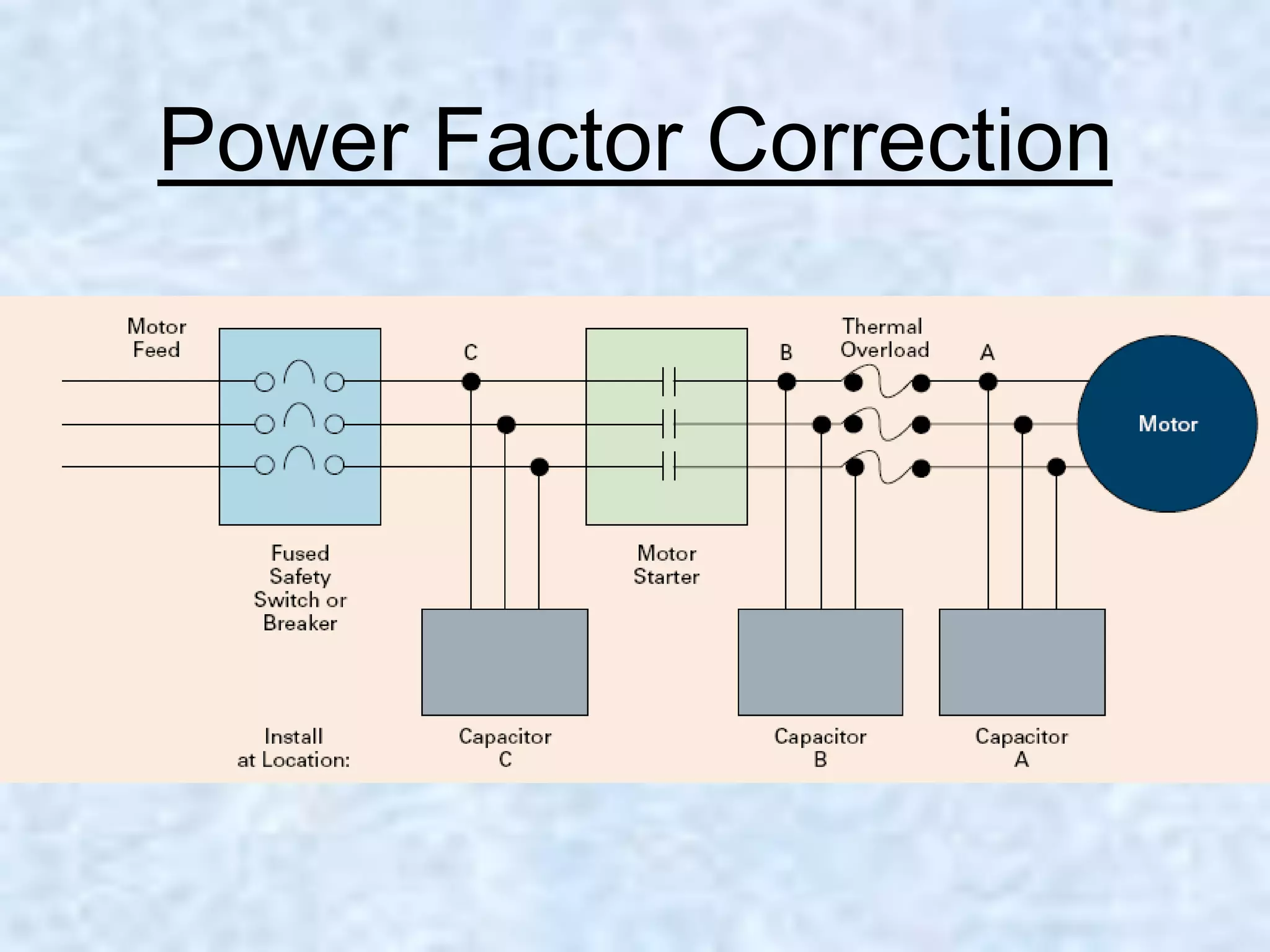
Almost all loads are inductive.
In order to cancel the reactive component of power,
we must add reactance of the opposite type . This is
called power factor correction.
Capacitor bank in
shipboard power panel
for PF correction
P.F Regulator
Power Factor Correction
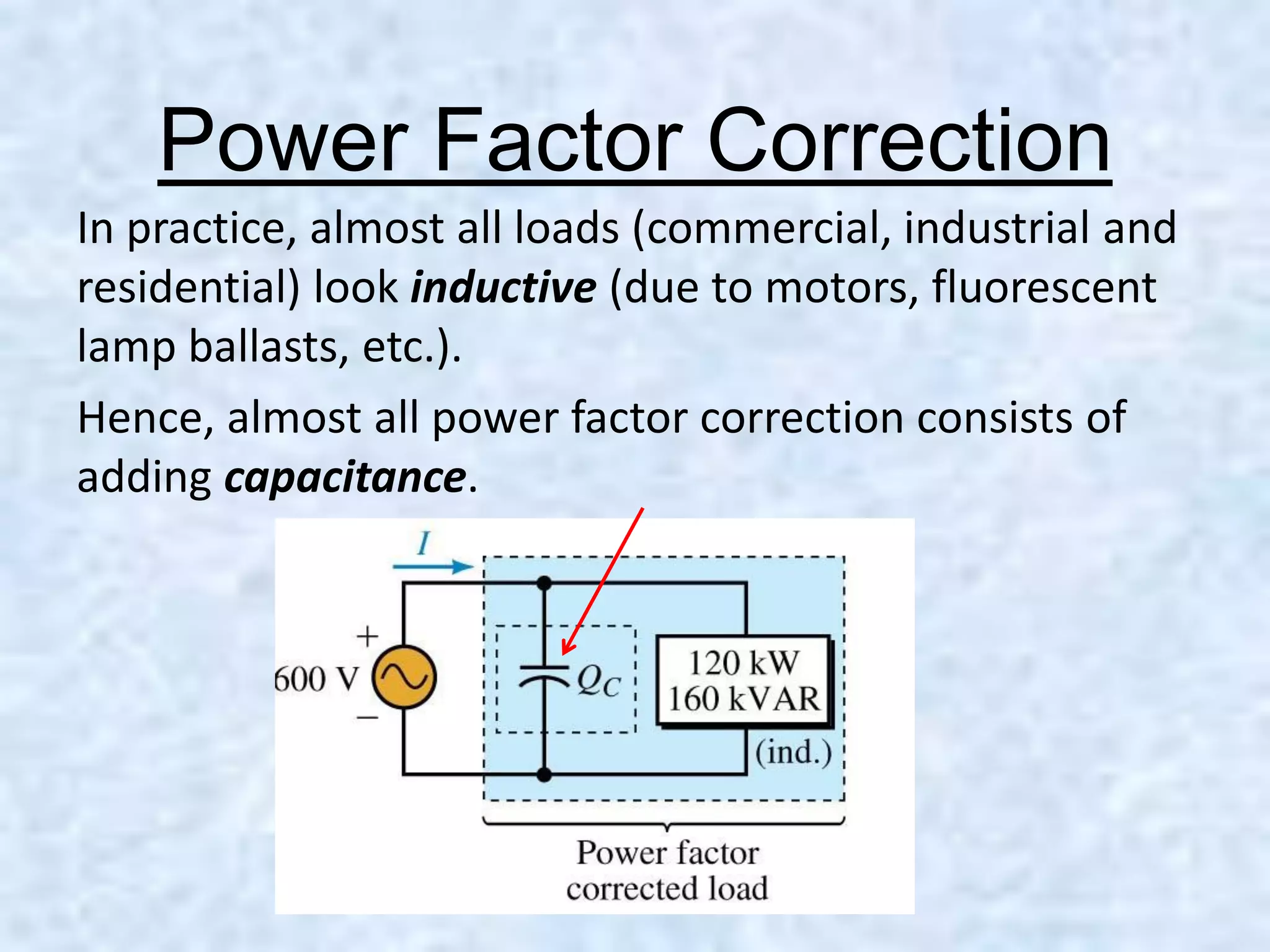
In practice, almost all loads (commercial, industrial and
residential) look inductive (due to motors, fluorescent
lamp ballasts, etc.).
Hence, almost all power factor correction consists of
adding capacitance.
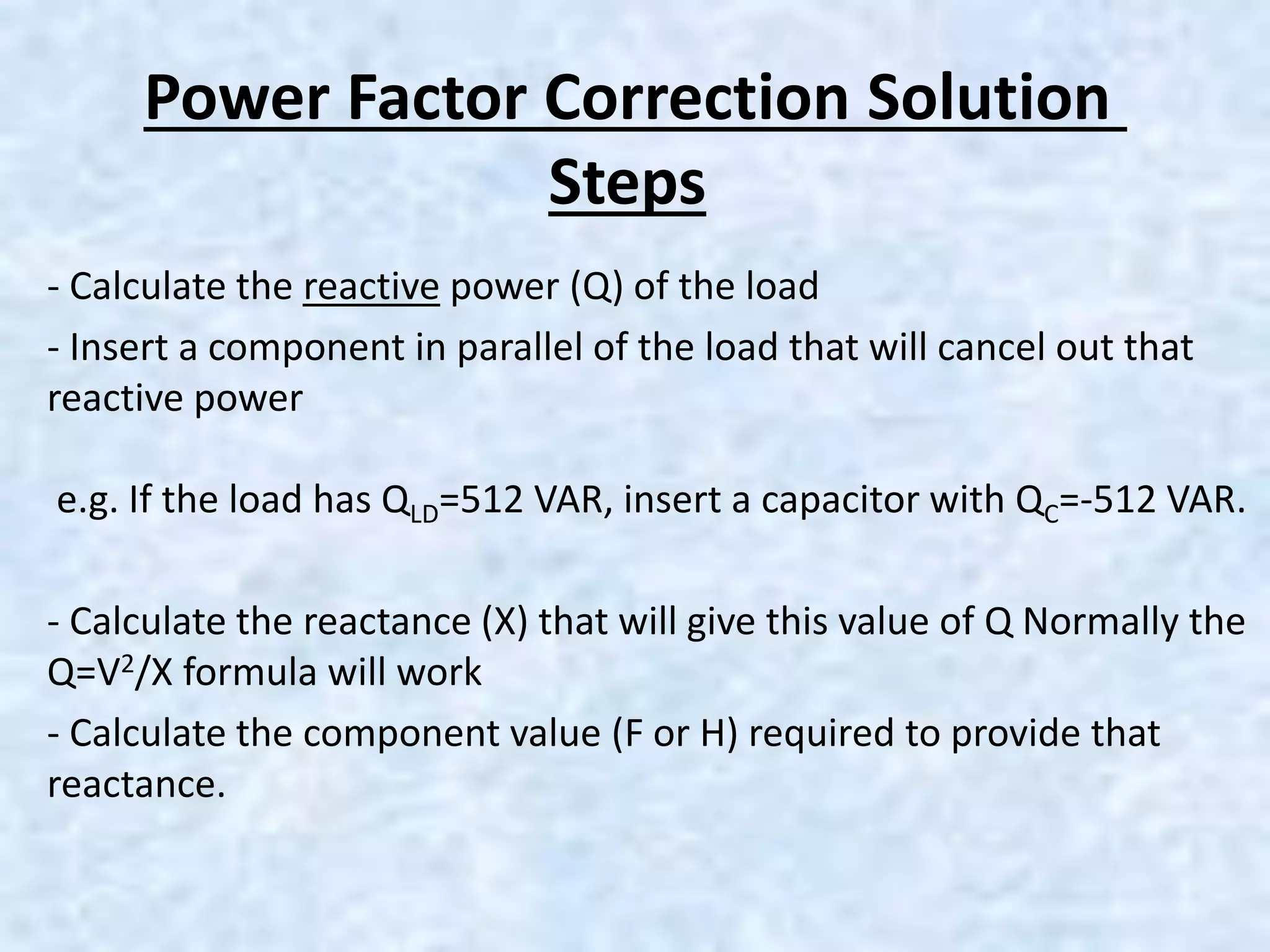
Power Factor Correction Solution
Steps
- Calculate the reactive power (Q) of the load
- Insert a component in parallel of the load that will cancel out that
reactive power
e.g. If the load has QLD=512 VAR, insert a capacitor with QC=-512 VAR.
- Calculate the reactance (X) that will give this value of Q Normally the
Q=V2/X formula will work
- Calculate the component value (F or H) required to provide that
reactance.
Power Factor Correction
Qc = P (tan (cos-1 Ө1) - tan (cos-1 Ө2) )
Qc = P * Multiplier (get from table 0.536 if 0.7 to be 0.9)
Formula
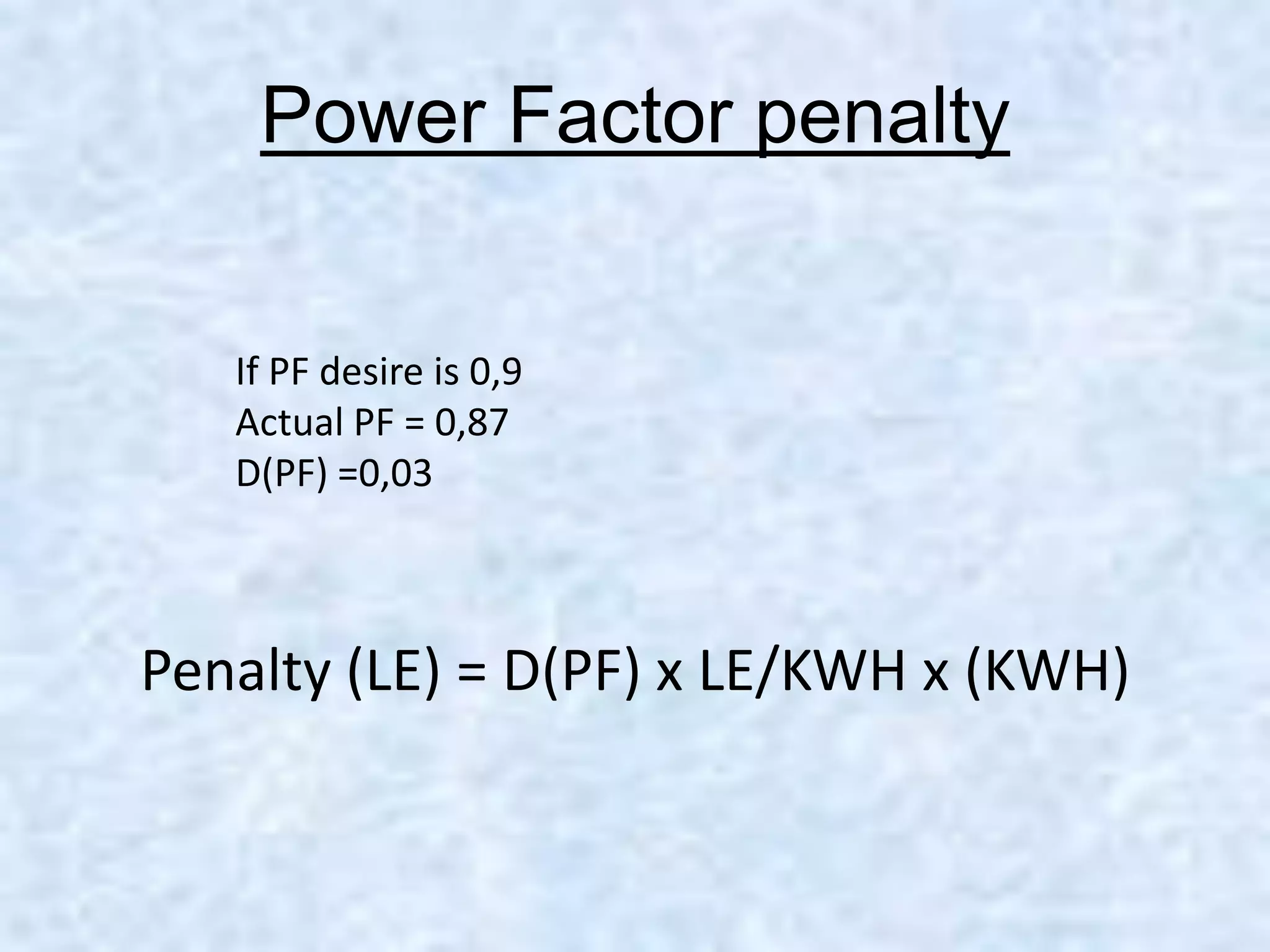
Power Factor penalty
If PF desire is 0,9
Actual PF = 0,87
D(PF) =0,03
Penalty (LE) = D(PF) x LE/KWH x (KWH)
Example
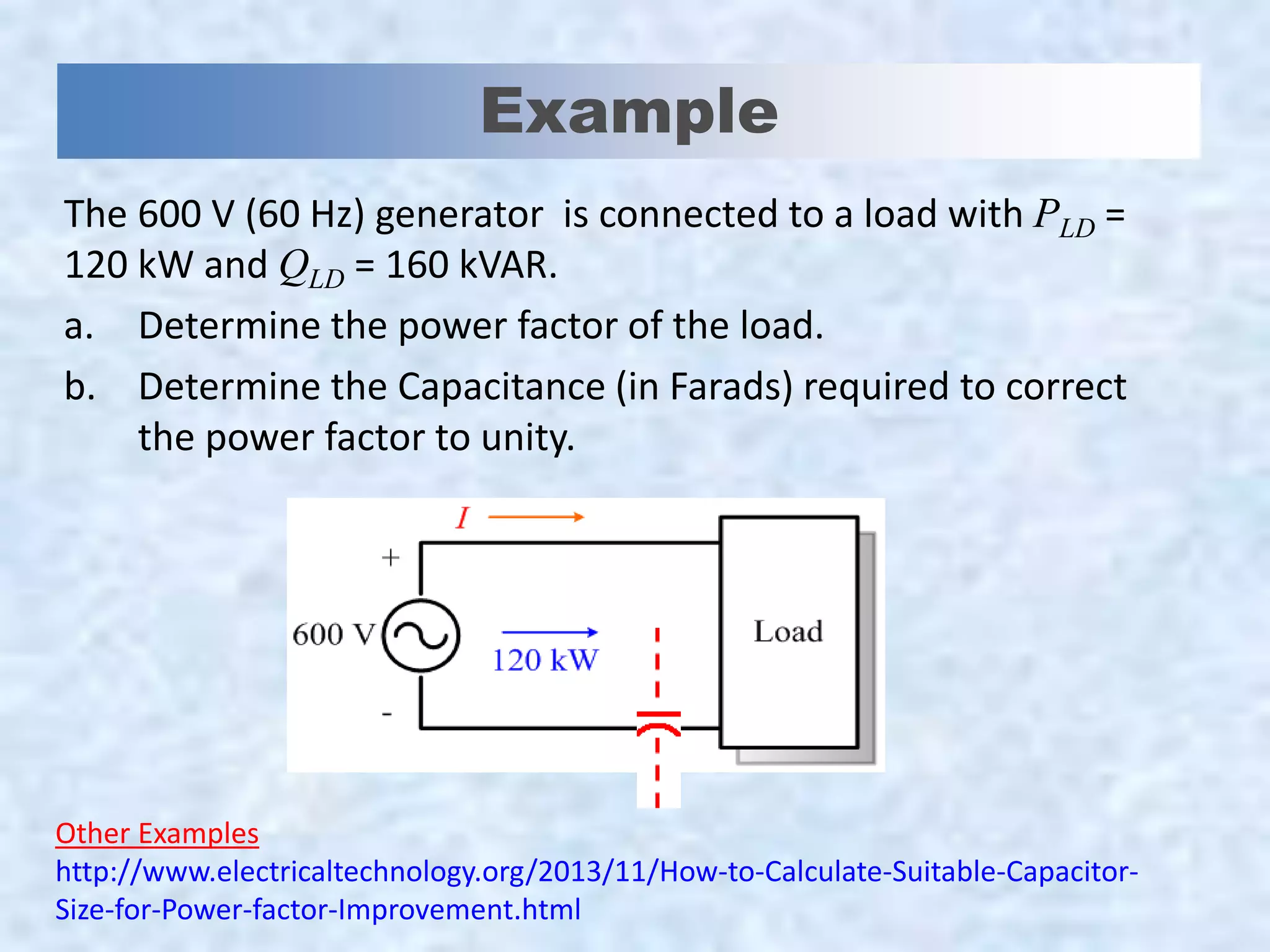
The 600 V (60 Hz) generator is connected to a load with PLD =
120 kW and QLD = 160 kVAR.
a. Determine the power factor of the load.
b. Determine the Capacitance (in Farads) required to correct
the power factor to unity.
Other Examples
http://www.electricaltechnology.org/2013/11/How-to-Calculate-Suitable-Capacitor-
Size-for-Power-factor-Improvement.html
CHAPTER 2
Types of Control
System
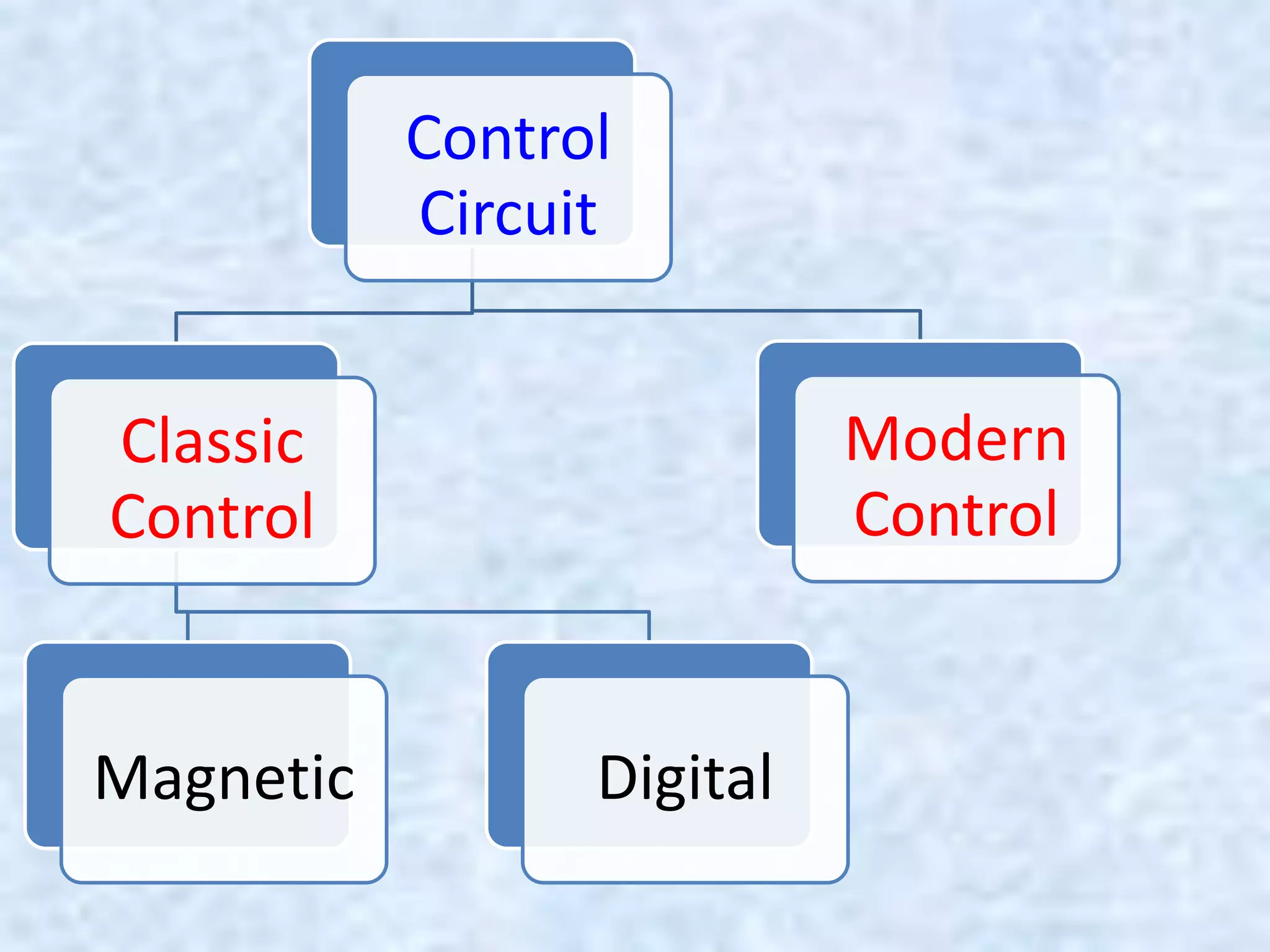
Control
Circuit
Classic
Control
Magnetic Digital
Modern
Control
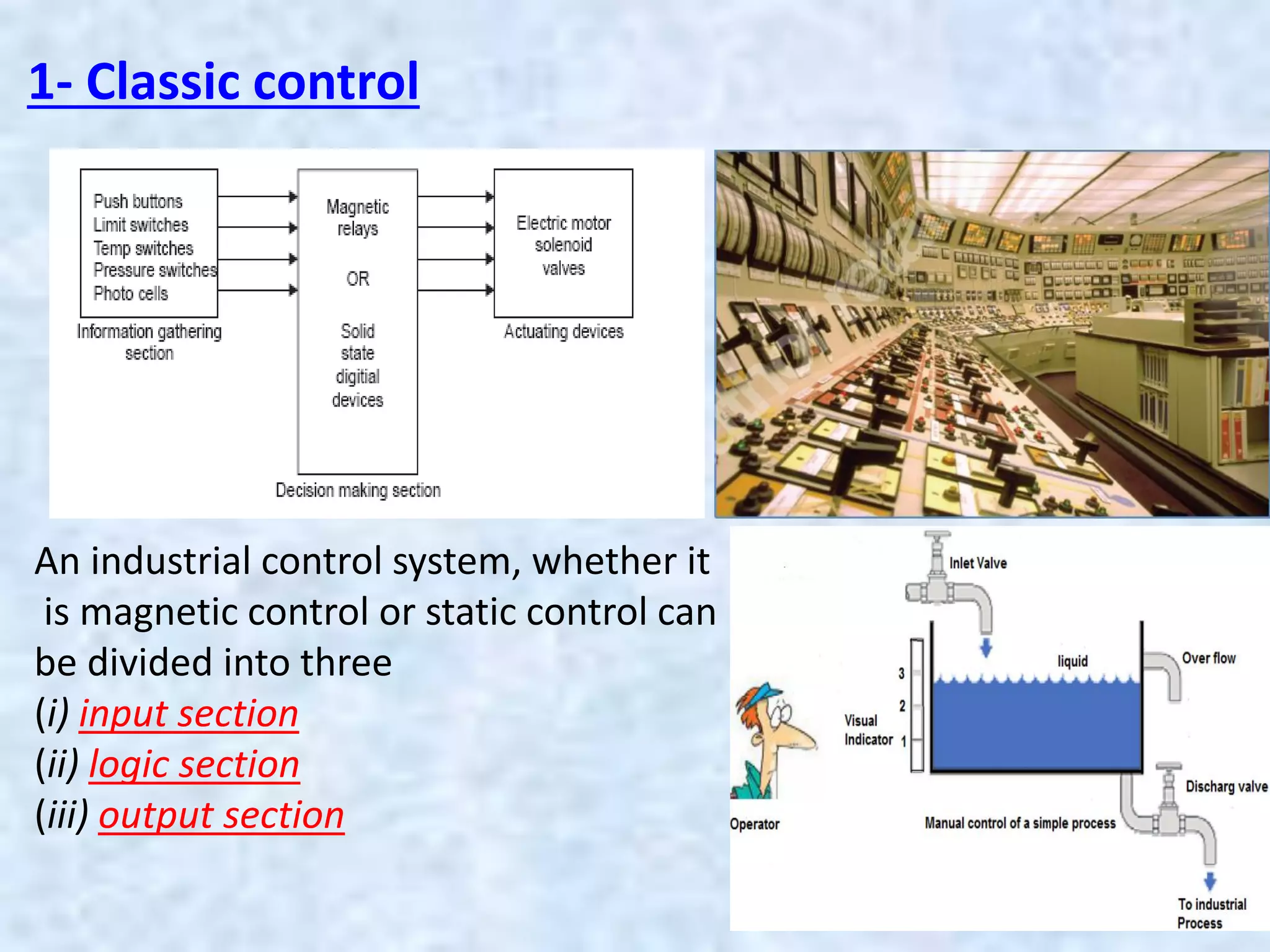
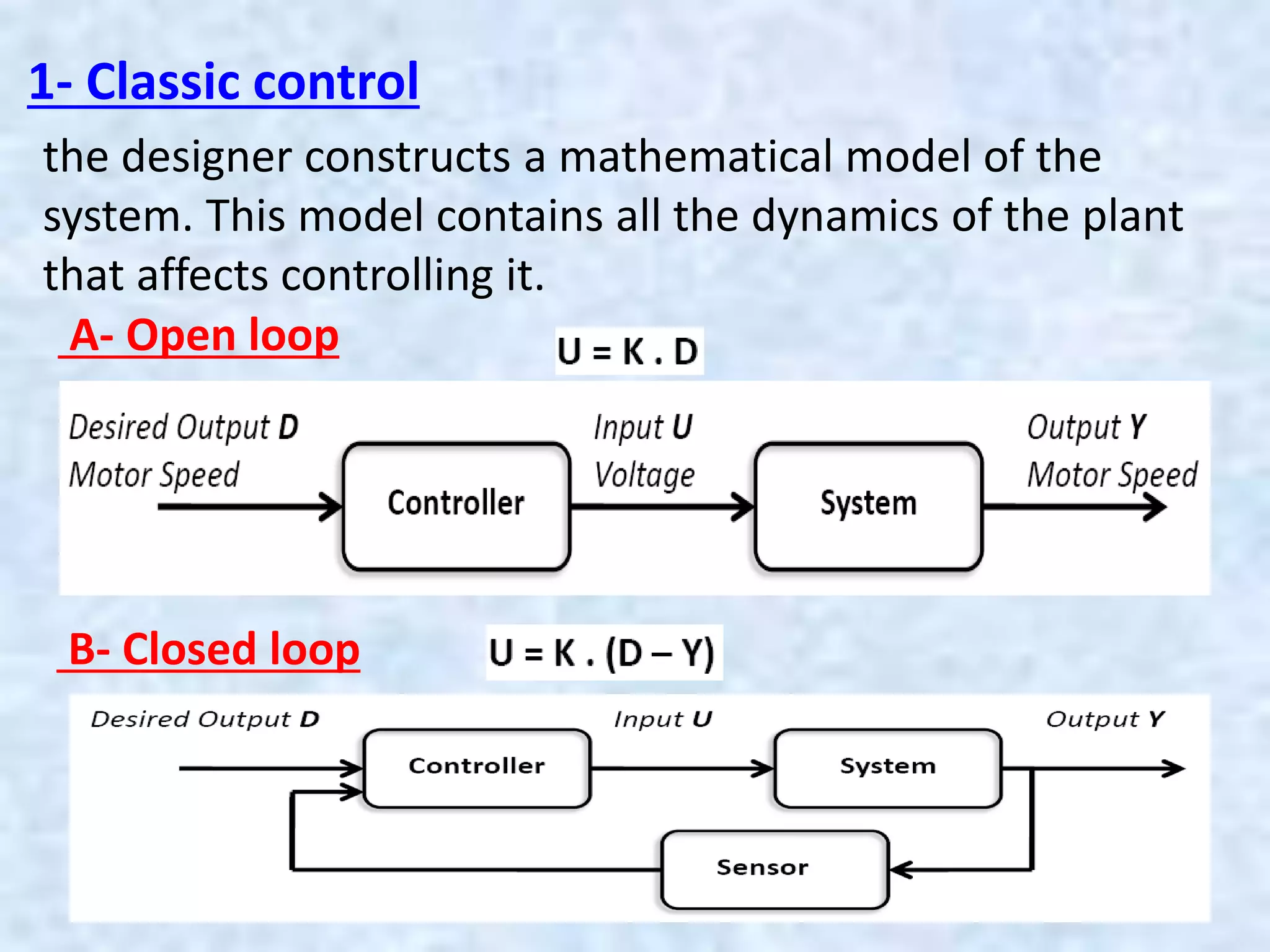
1- Classic control
An industrial control system, whether it
is magnetic control or static control can
be divided into three
(i) input section
(ii) logic section
(iii) output section
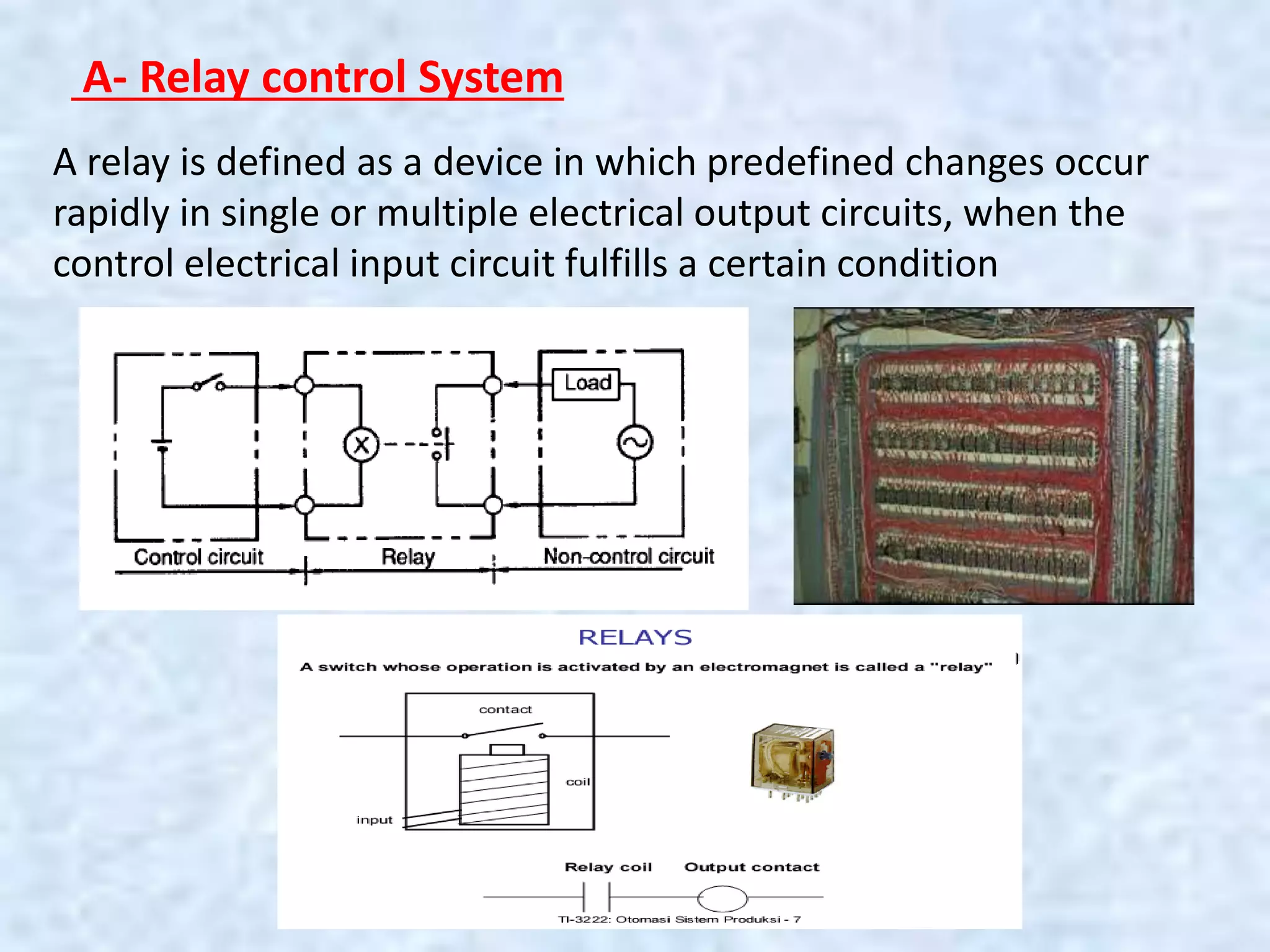
A- Relay control System
A relay is defined as a device in which predefined changes occur
rapidly in single or multiple electrical output circuits, when the
control electrical input circuit fulfills a certain condition
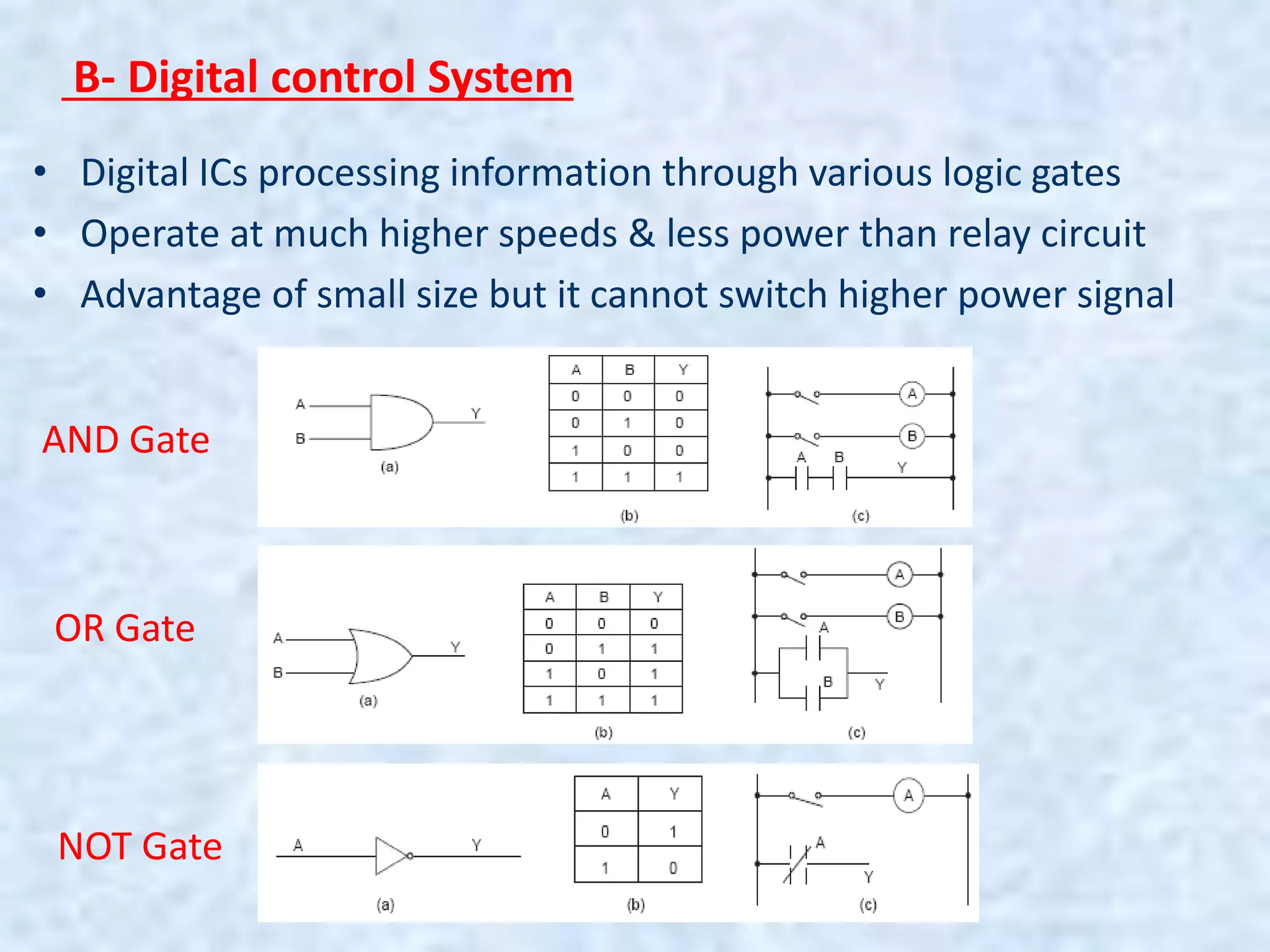
B- Digital control System
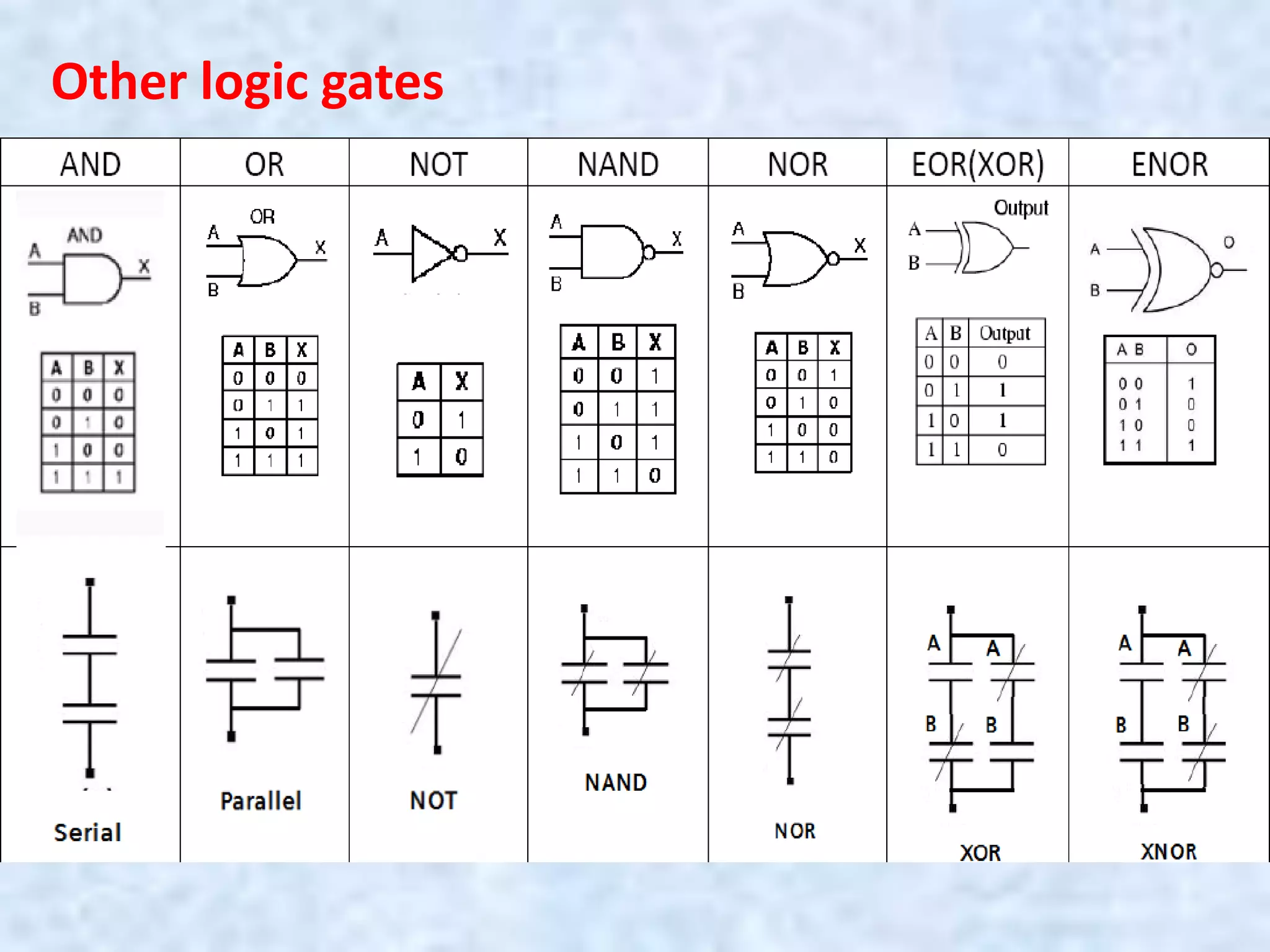
• Digital ICs processing information through various logic gates
• Operate at much higher speeds & less power than relay circuit
• Advantage of small size but it cannot switch higher power signal
AND Gate
OR Gate
NOT Gate
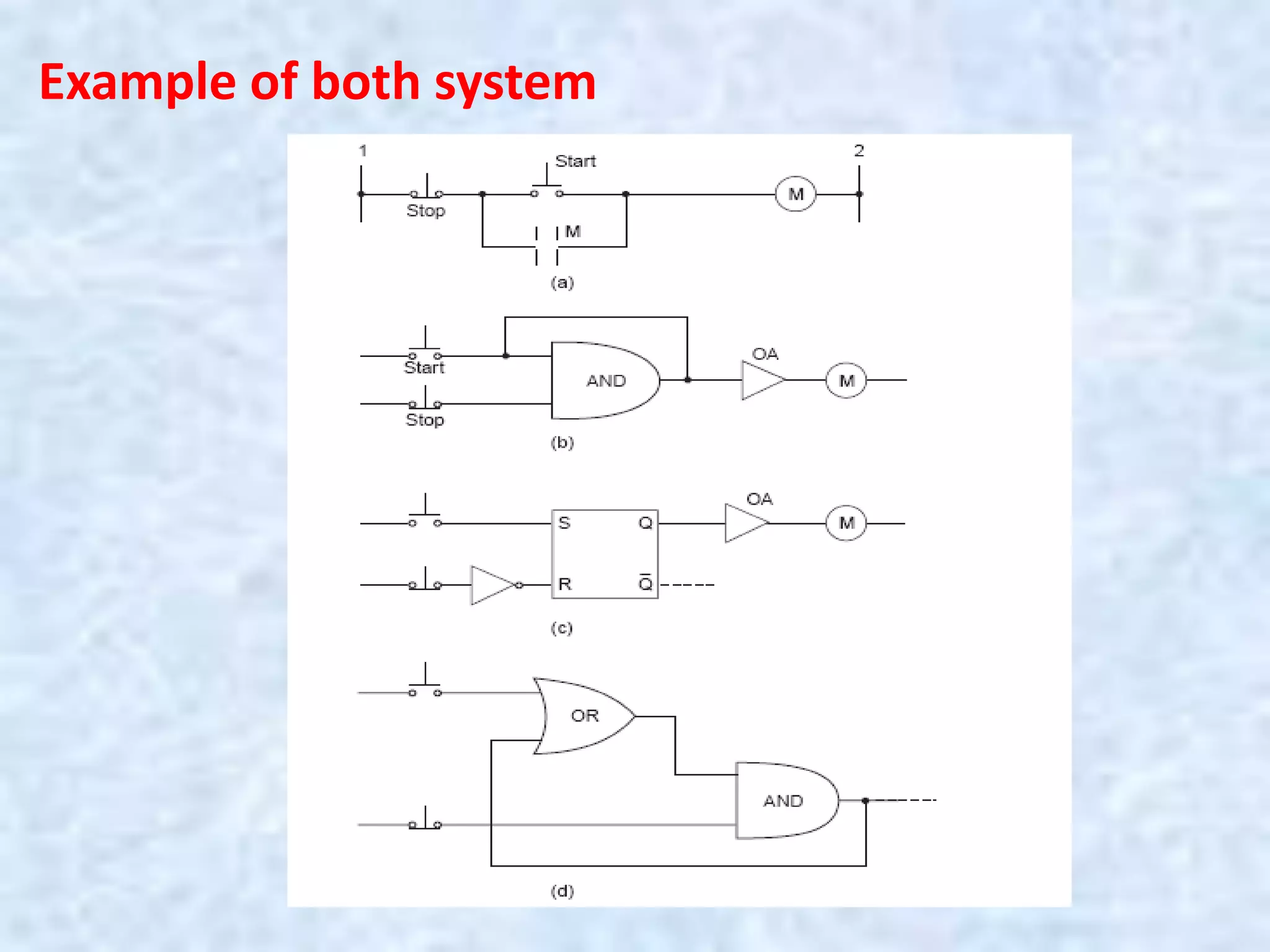
Example of both system
Other logic gates
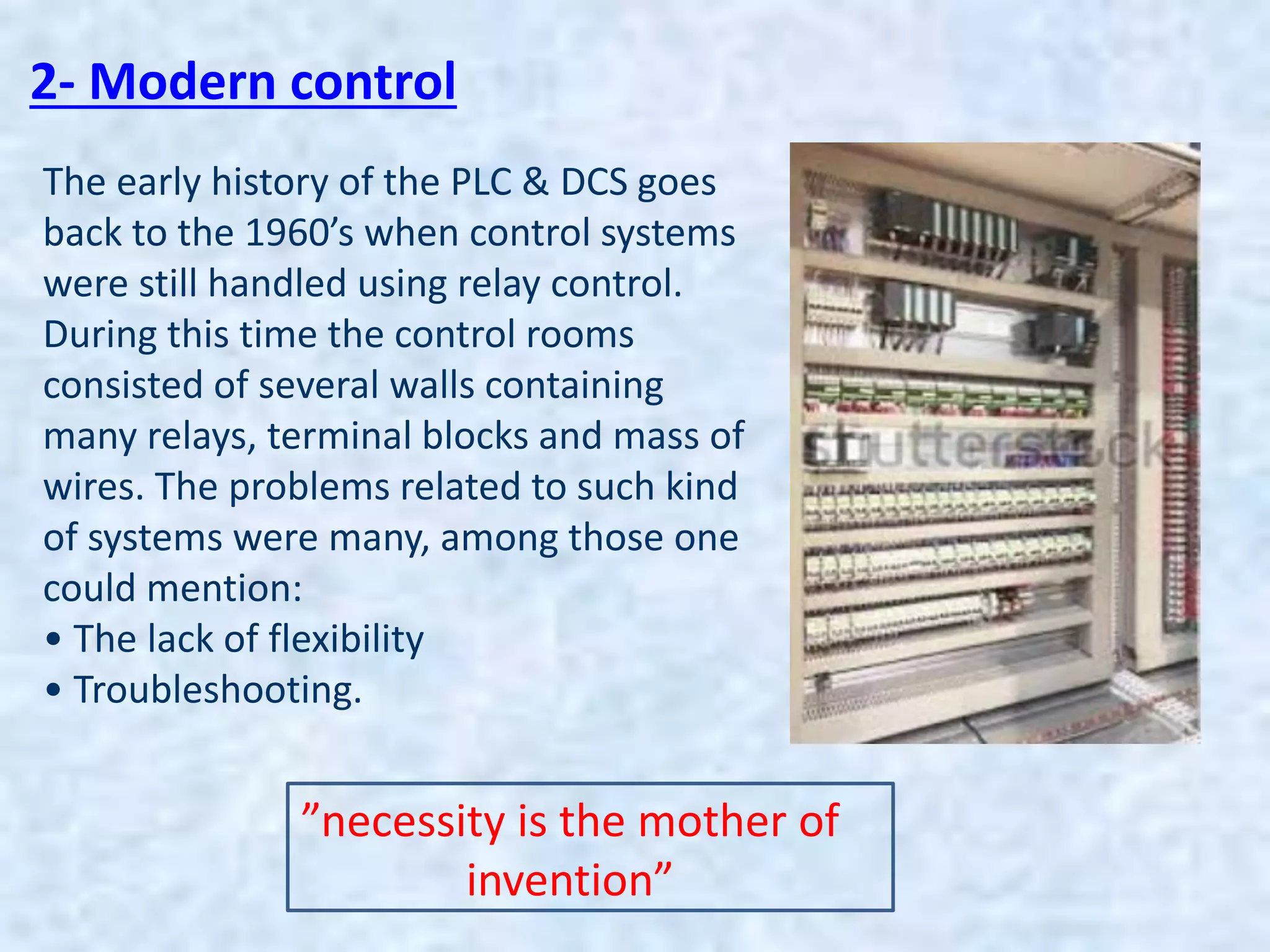
2- Modern control
The early history of the PLC & DCS goes
back to the 1960’s when control systems
were still handled using relay control.
During this time the control rooms
consisted of several walls containing
many relays, terminal blocks and mass of
wires. The problems related to such kind
of systems were many, among those one
could mention:
• The lack of flexibility
• Troubleshooting.
”necessity is the mother of
invention”
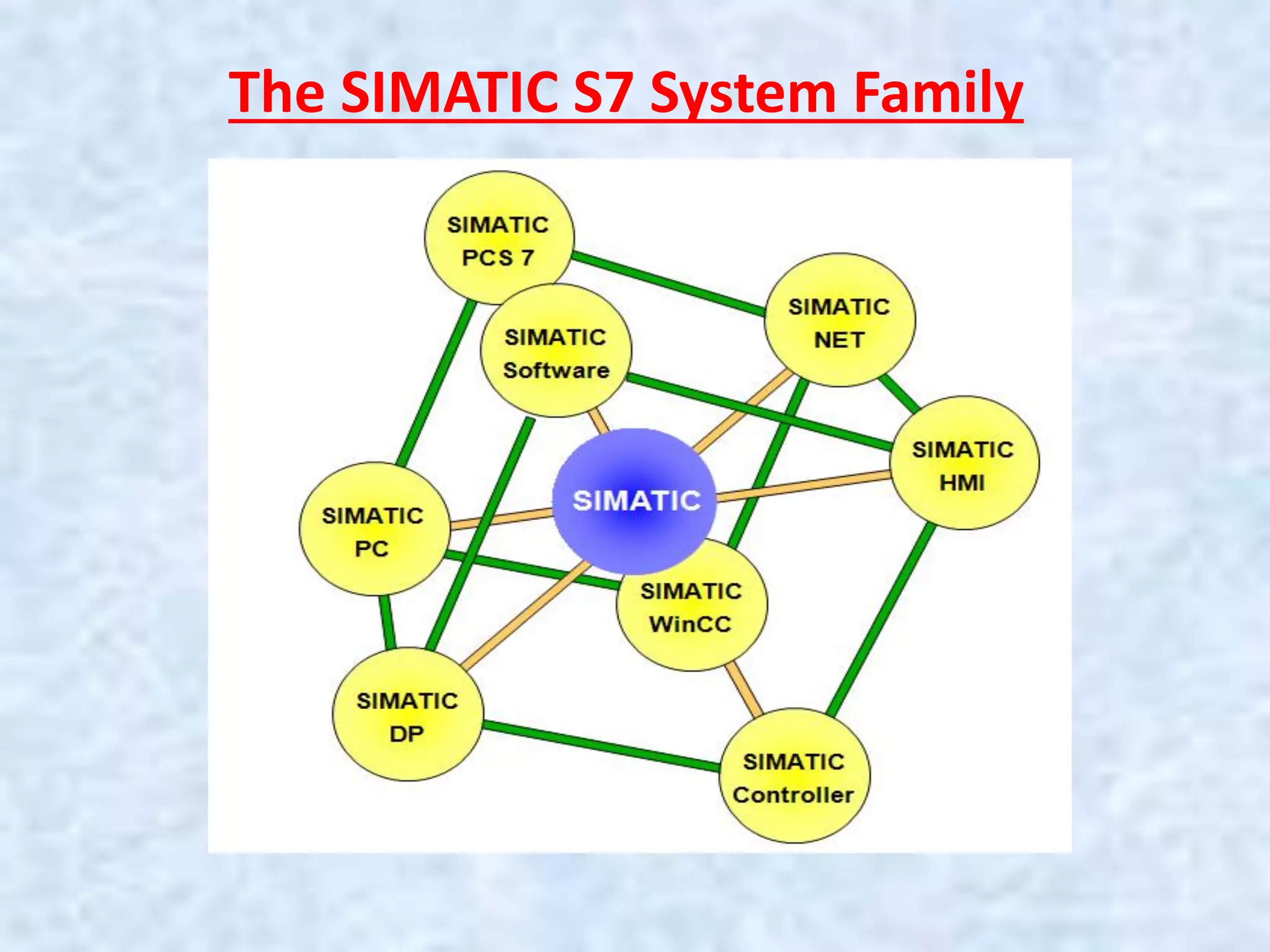
The SIMATIC S7 System Family
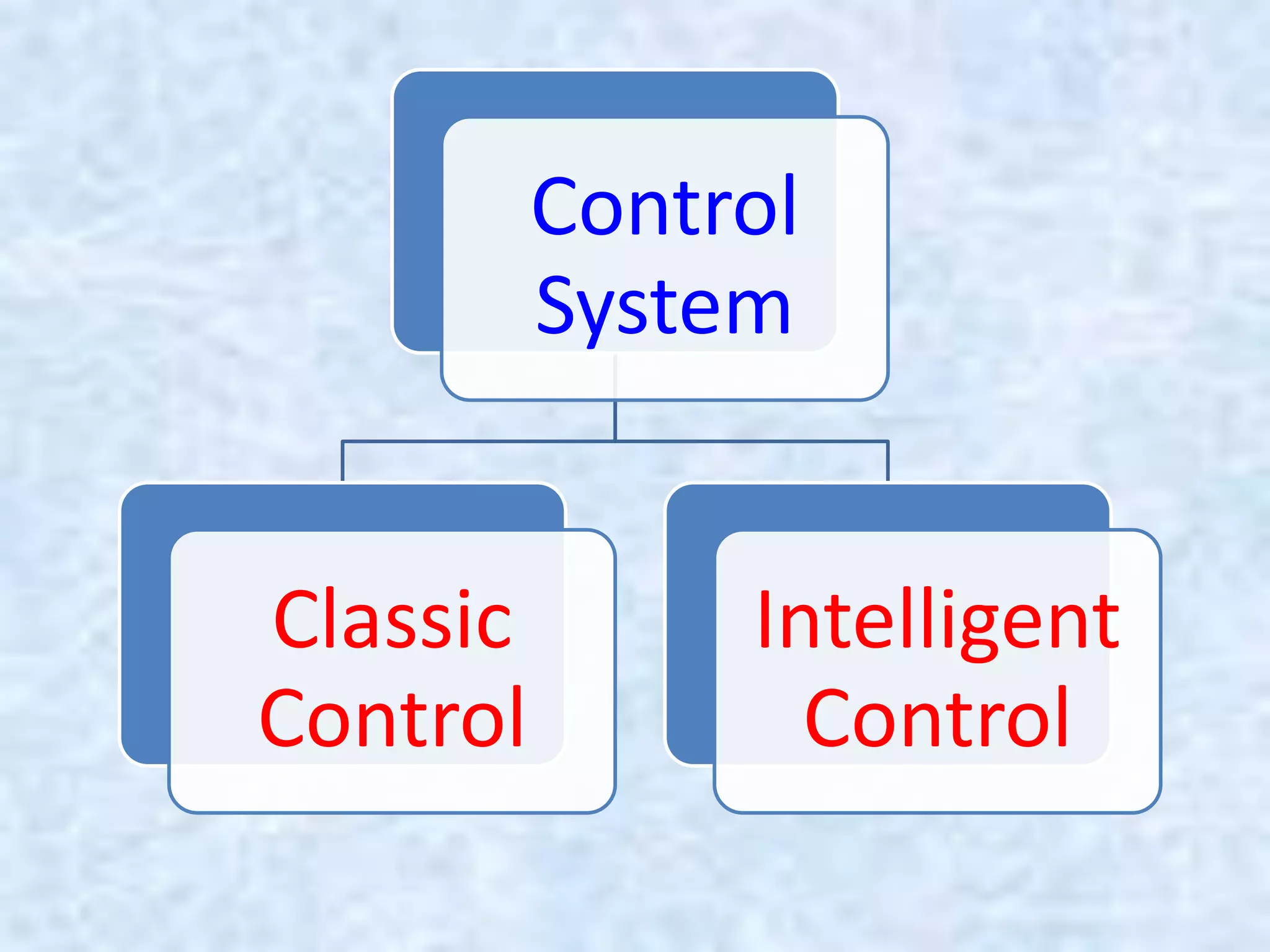
Control
System
Classic
Control
Intelligent
Control
1- Classic control
the designer constructs a mathematical model of the
system. This model contains all the dynamics of the plant
that affects controlling it.
A- Open loop
B- Closed loop
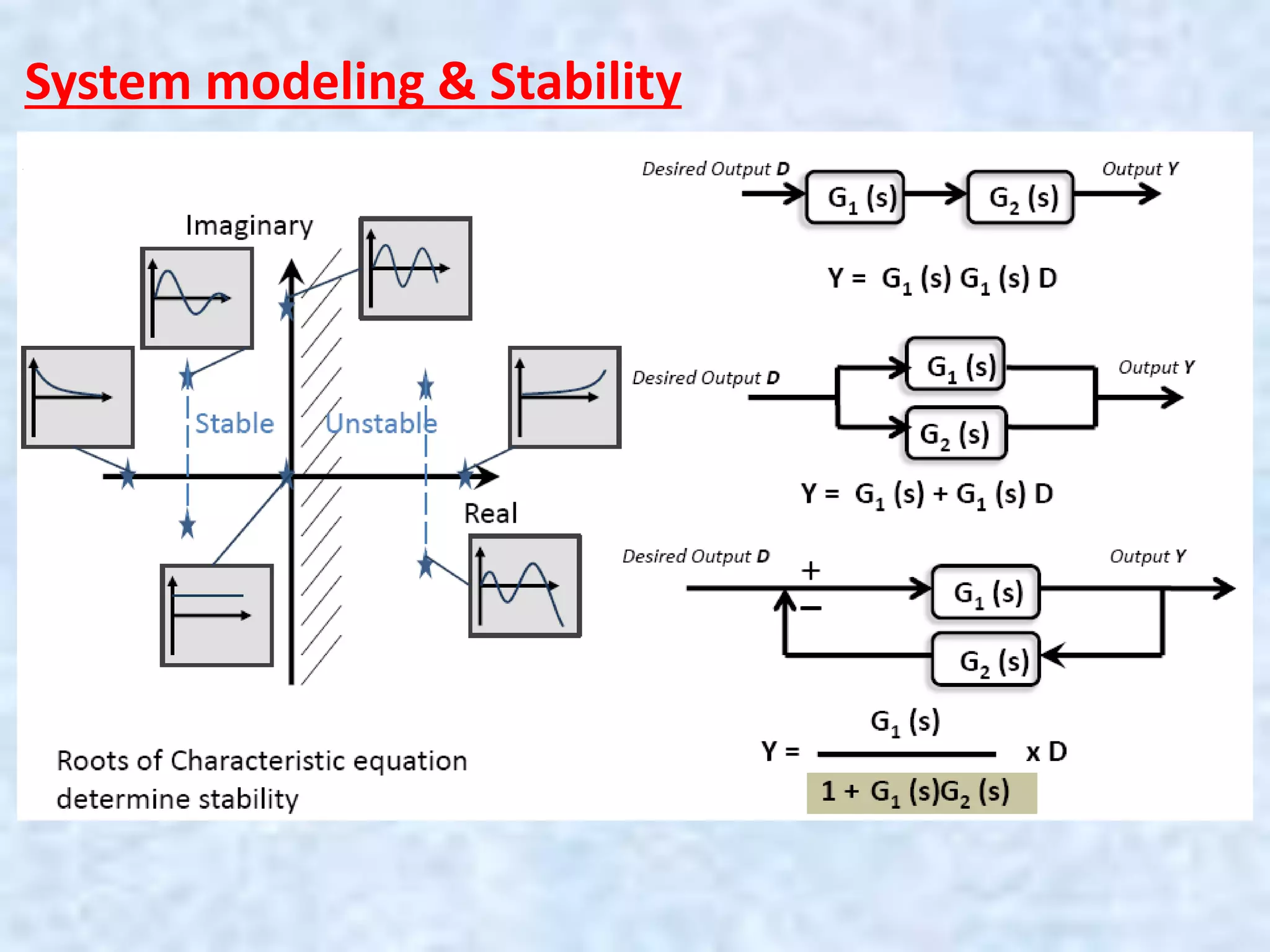
System modeling & Stability
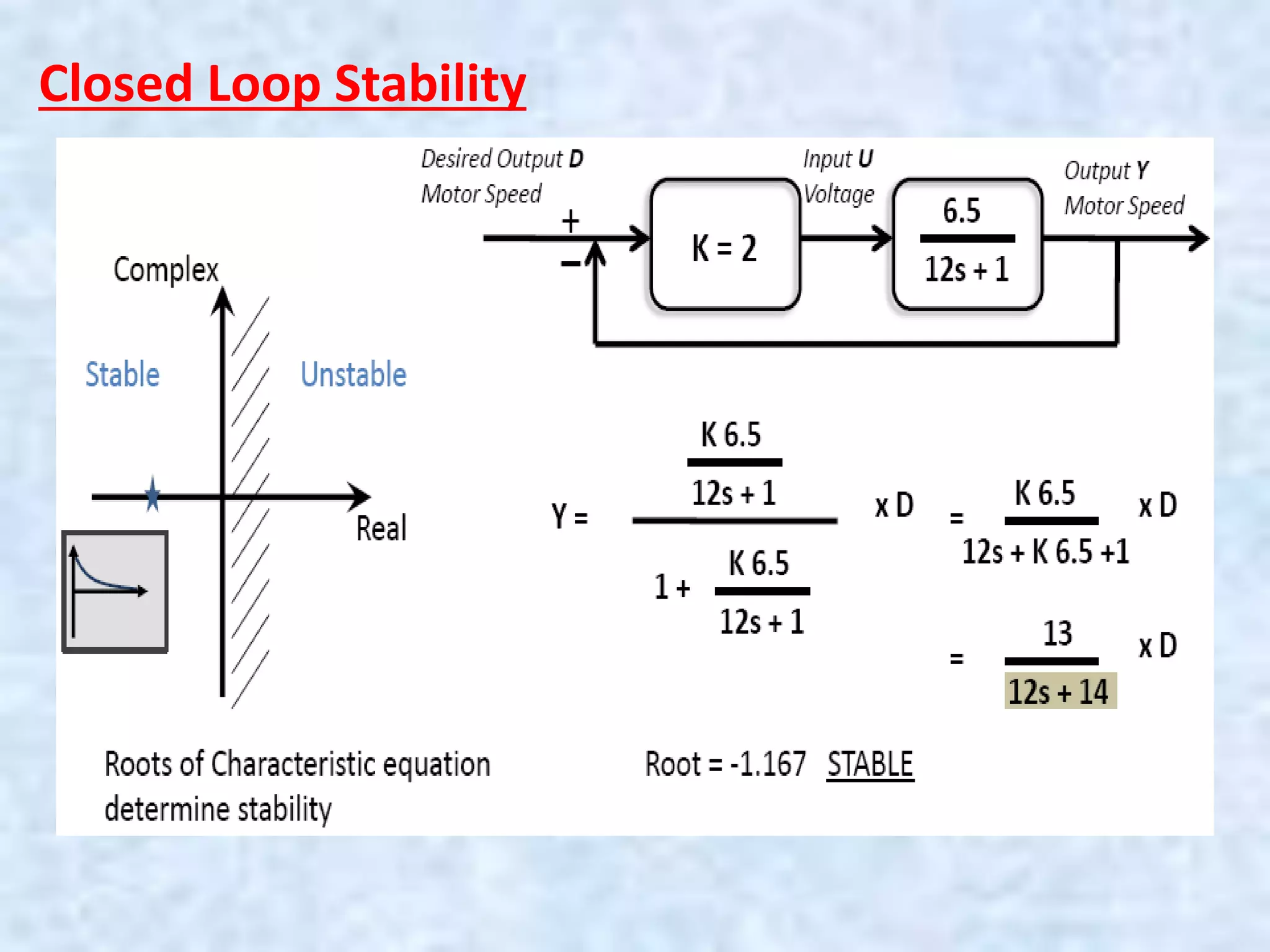
Closed Loop Stability
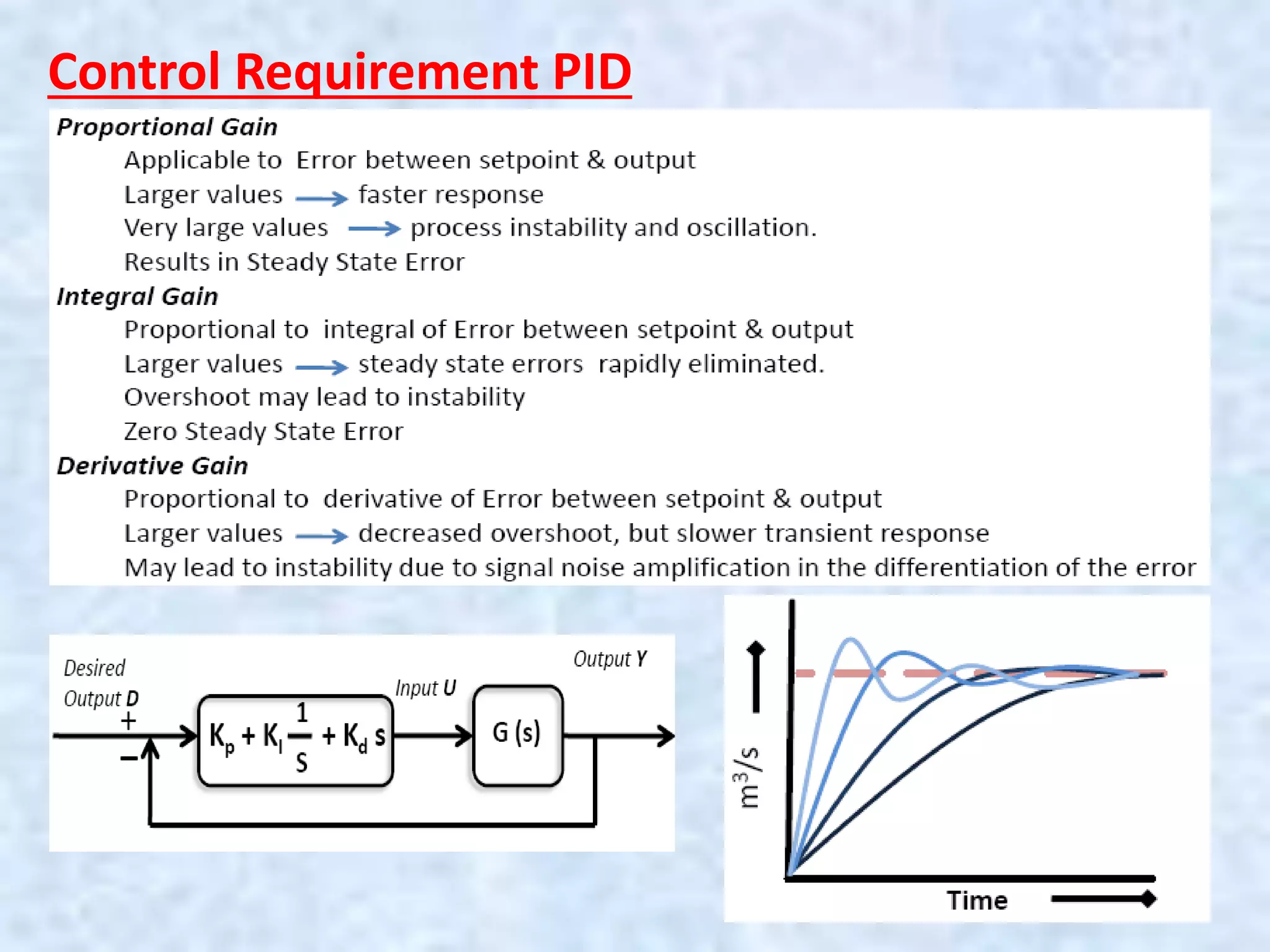
Control Requirement PID
Explain this video
Video
CHAPTER 3
Classic Control
Components
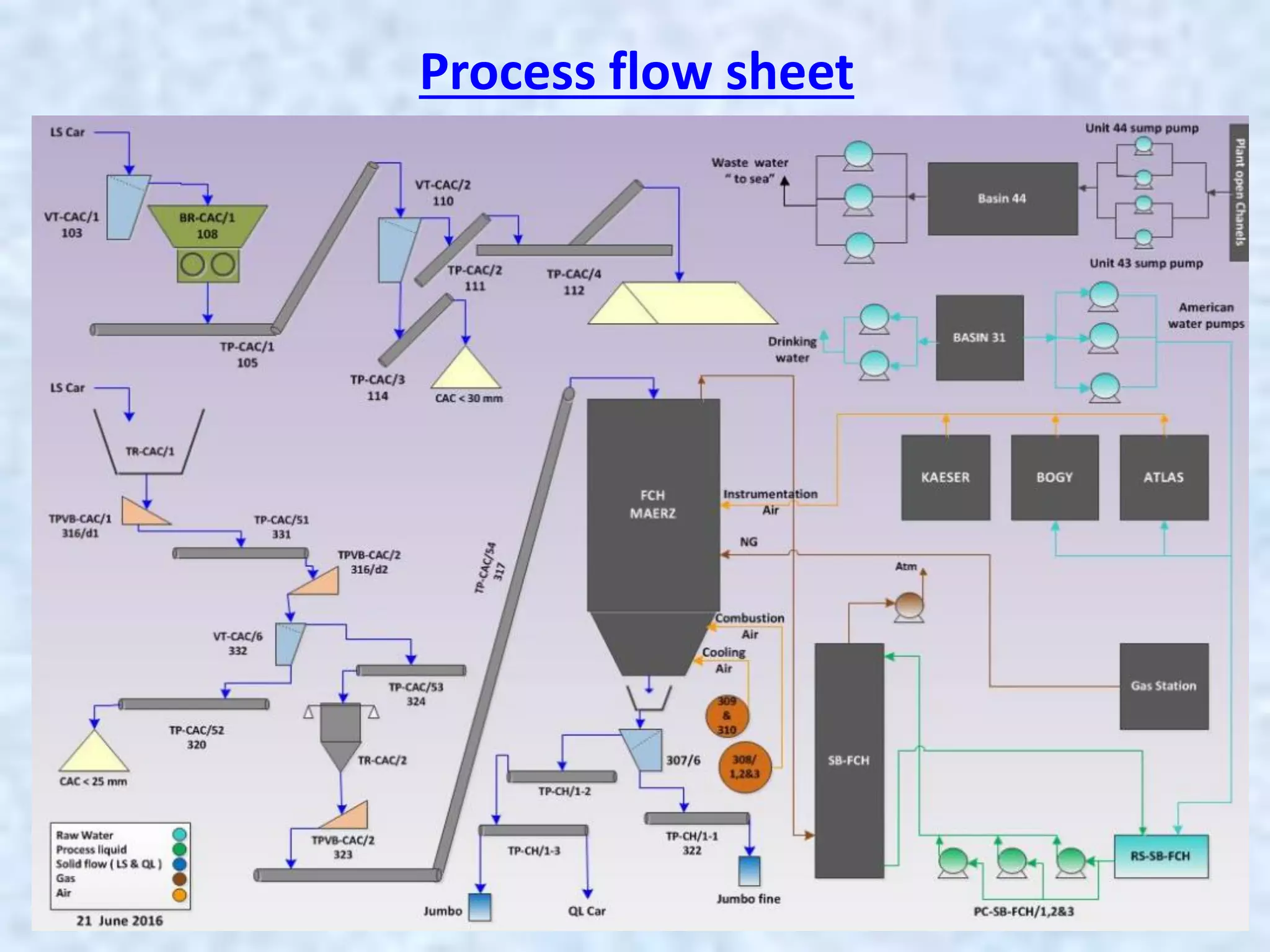
Process flow sheet
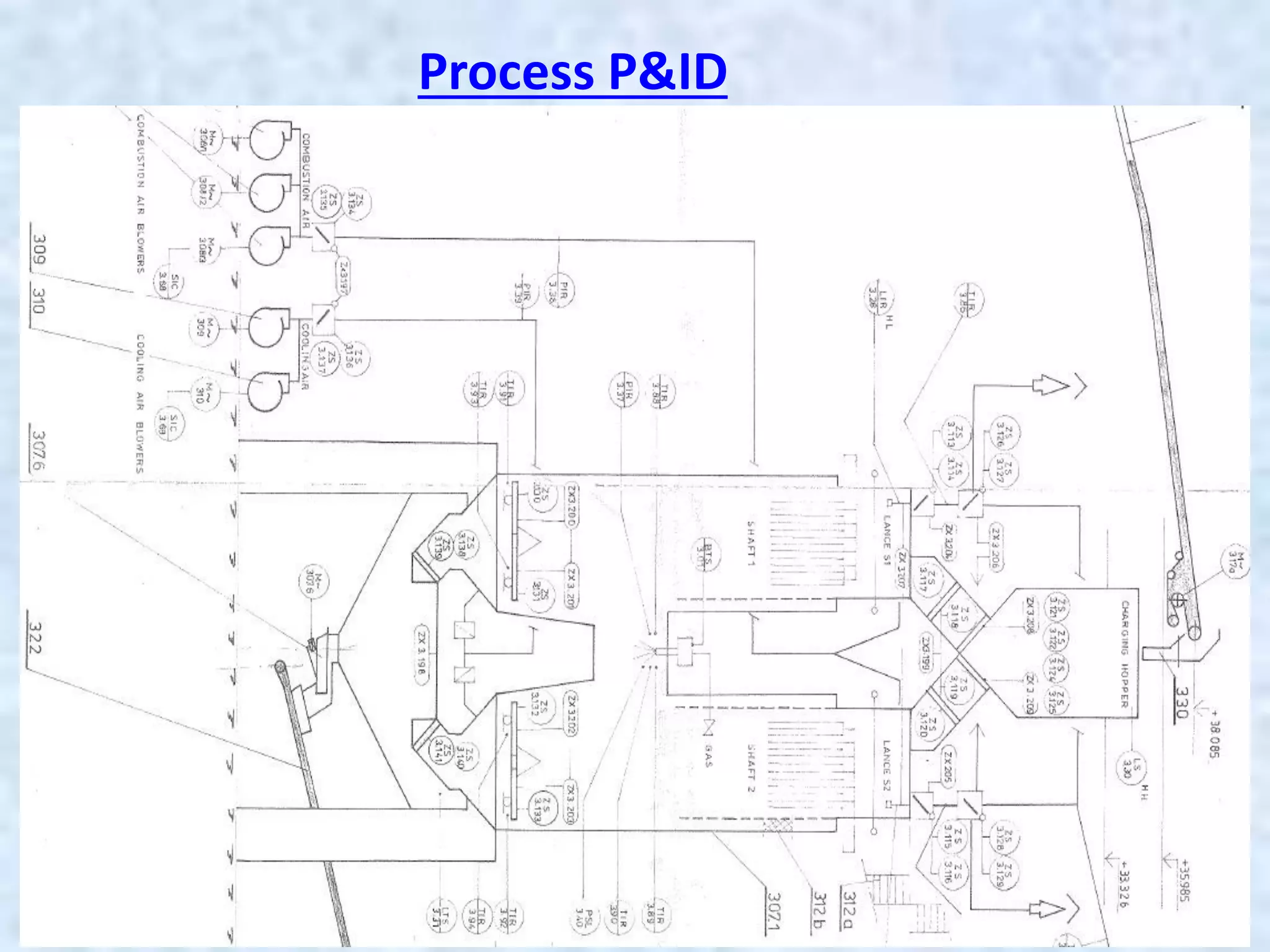
Process P&ID
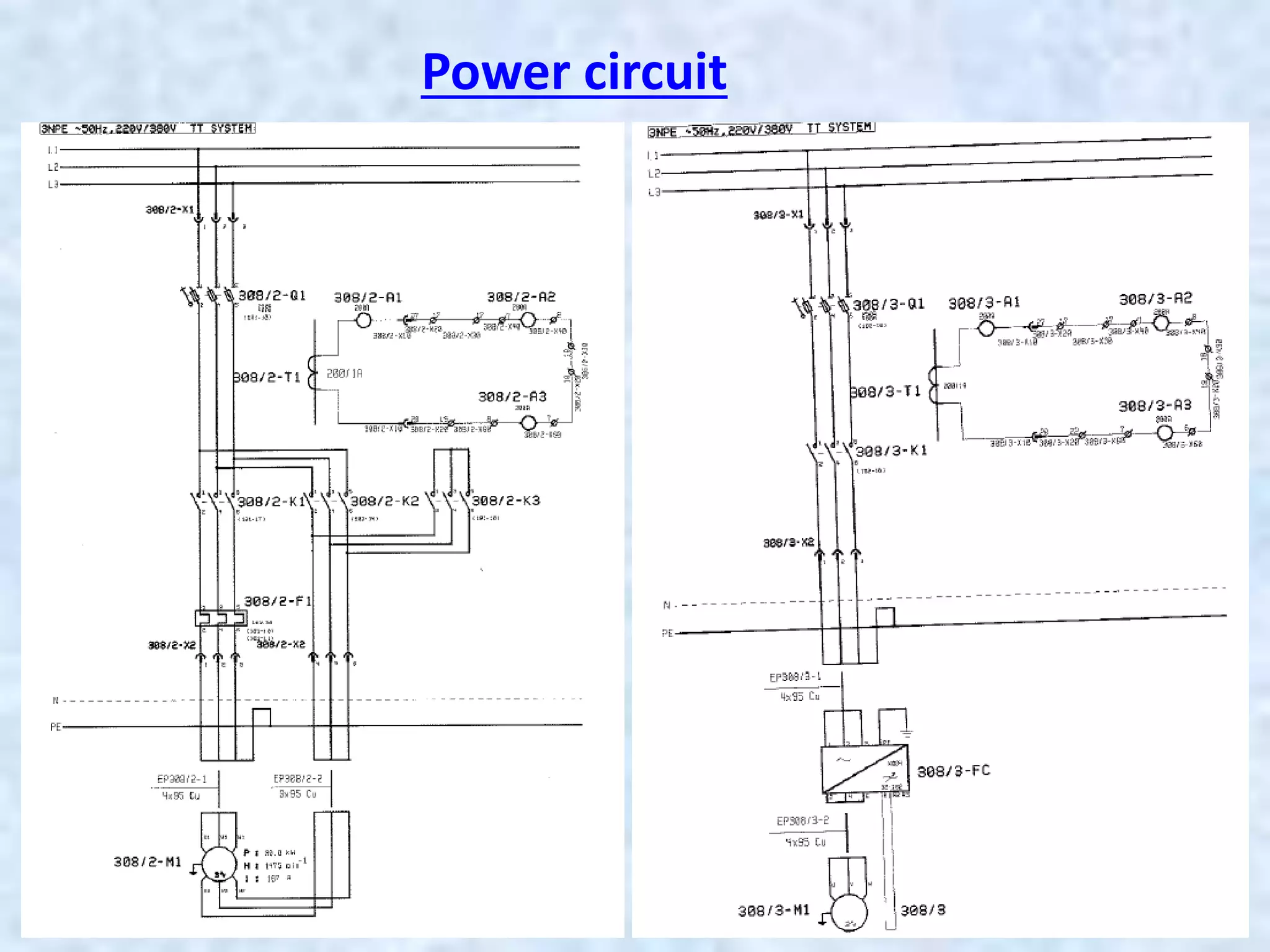
Power circuit
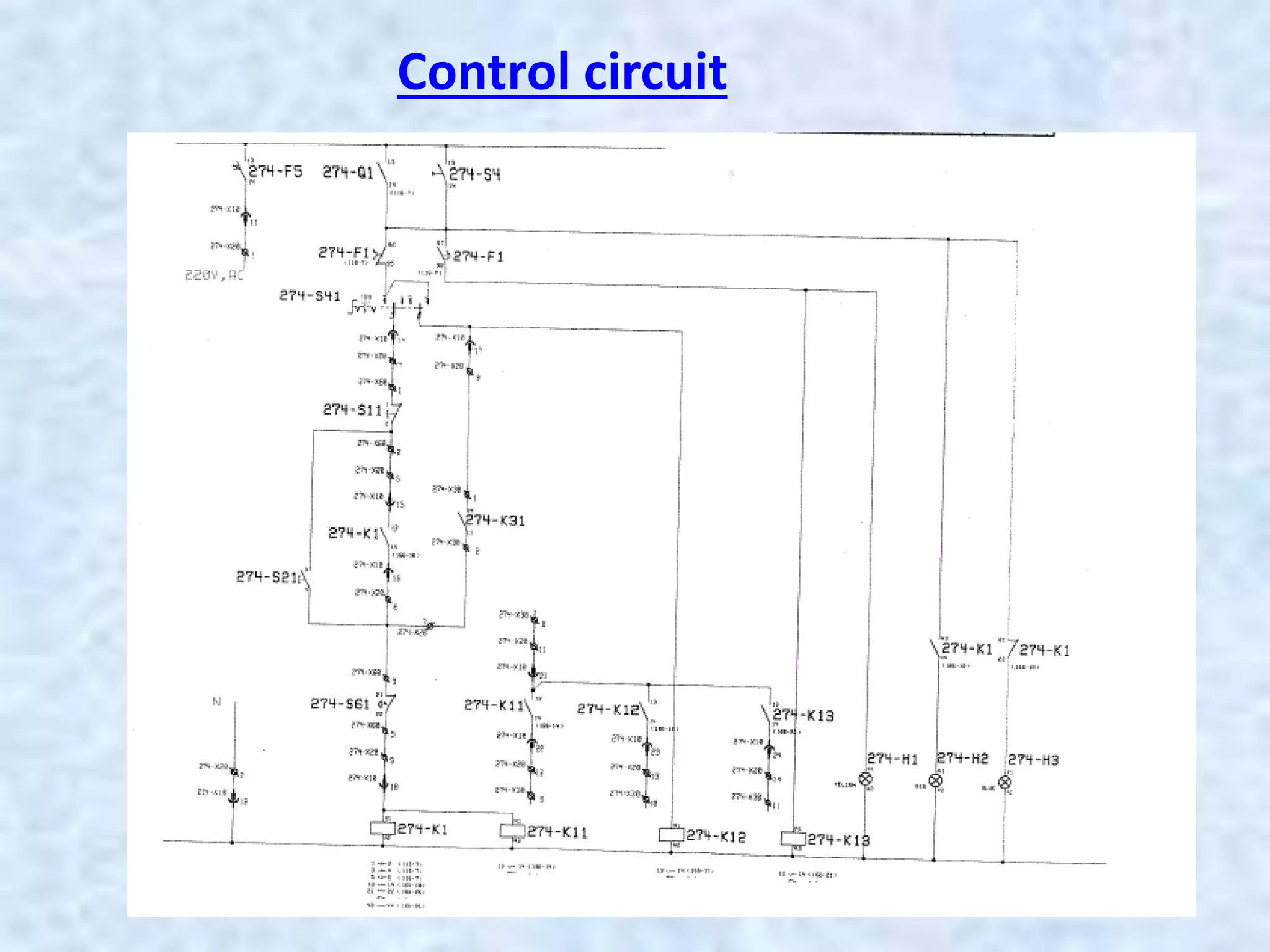
Control circuit
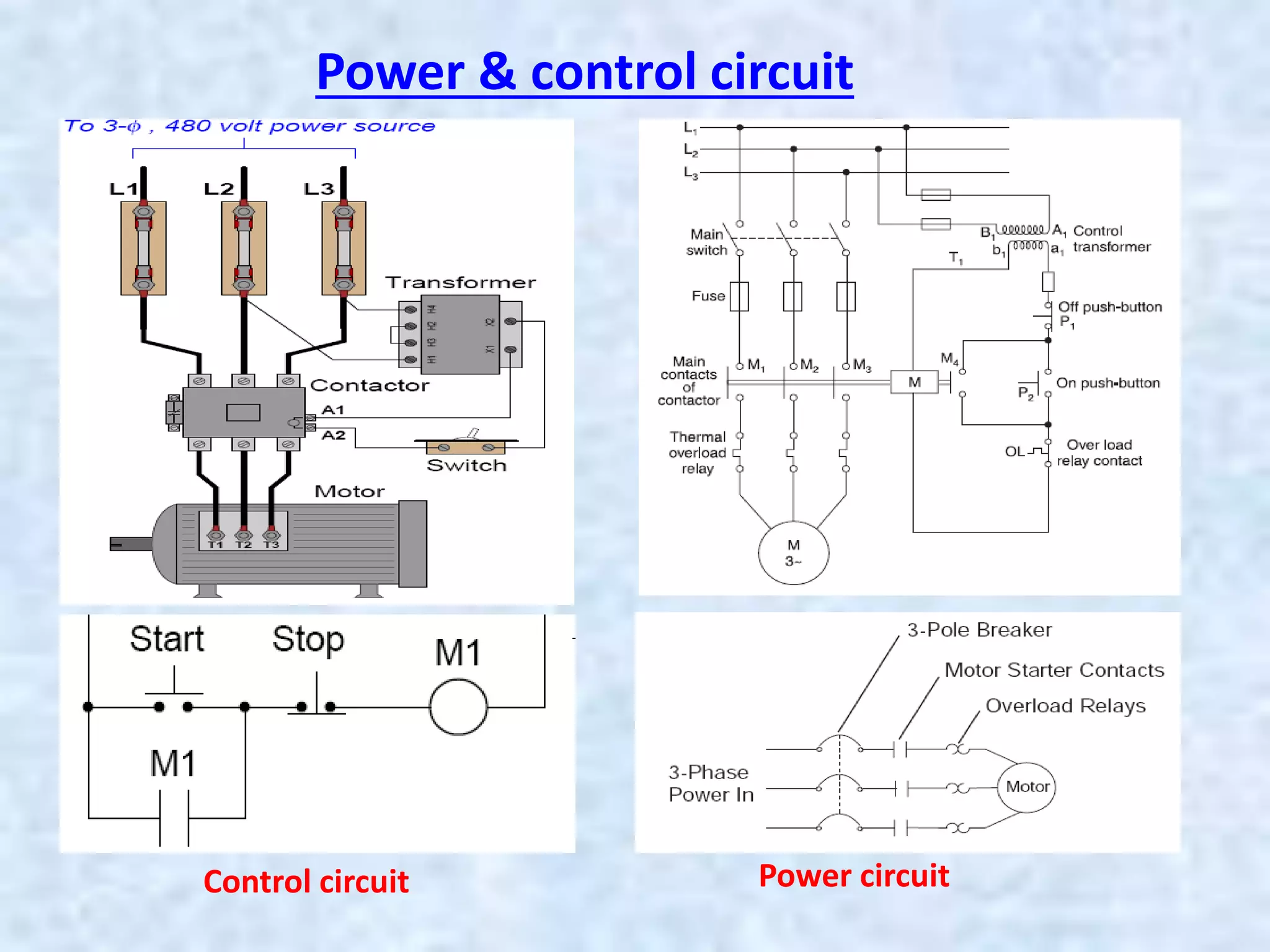
Power & control circuit
Control circuit Power circuit
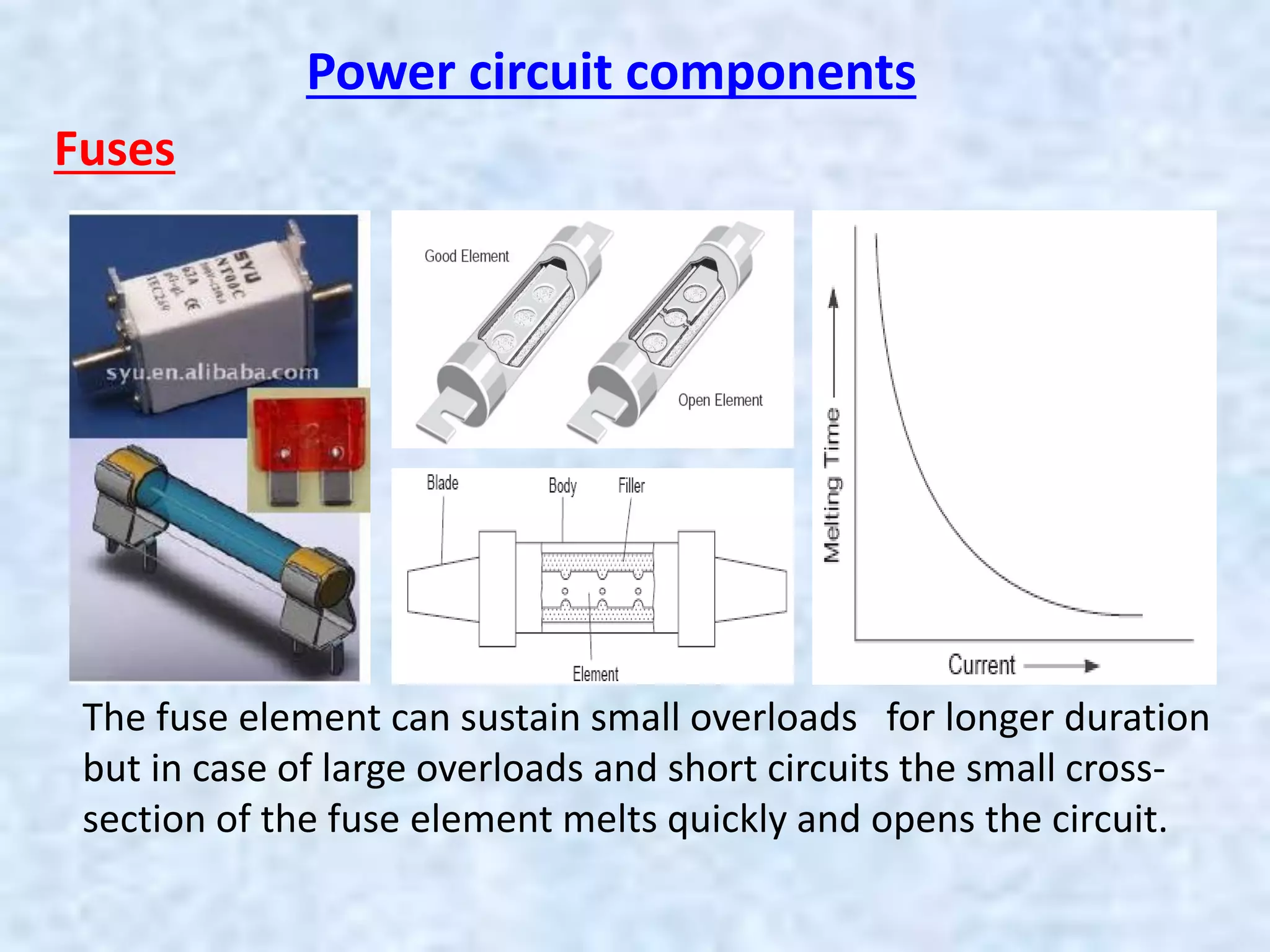
Power circuit components
Fuses
The fuse element can sustain small overloads for longer duration
but in case of large overloads and short circuits the small cross-
section of the fuse element melts quickly and opens the circuit.
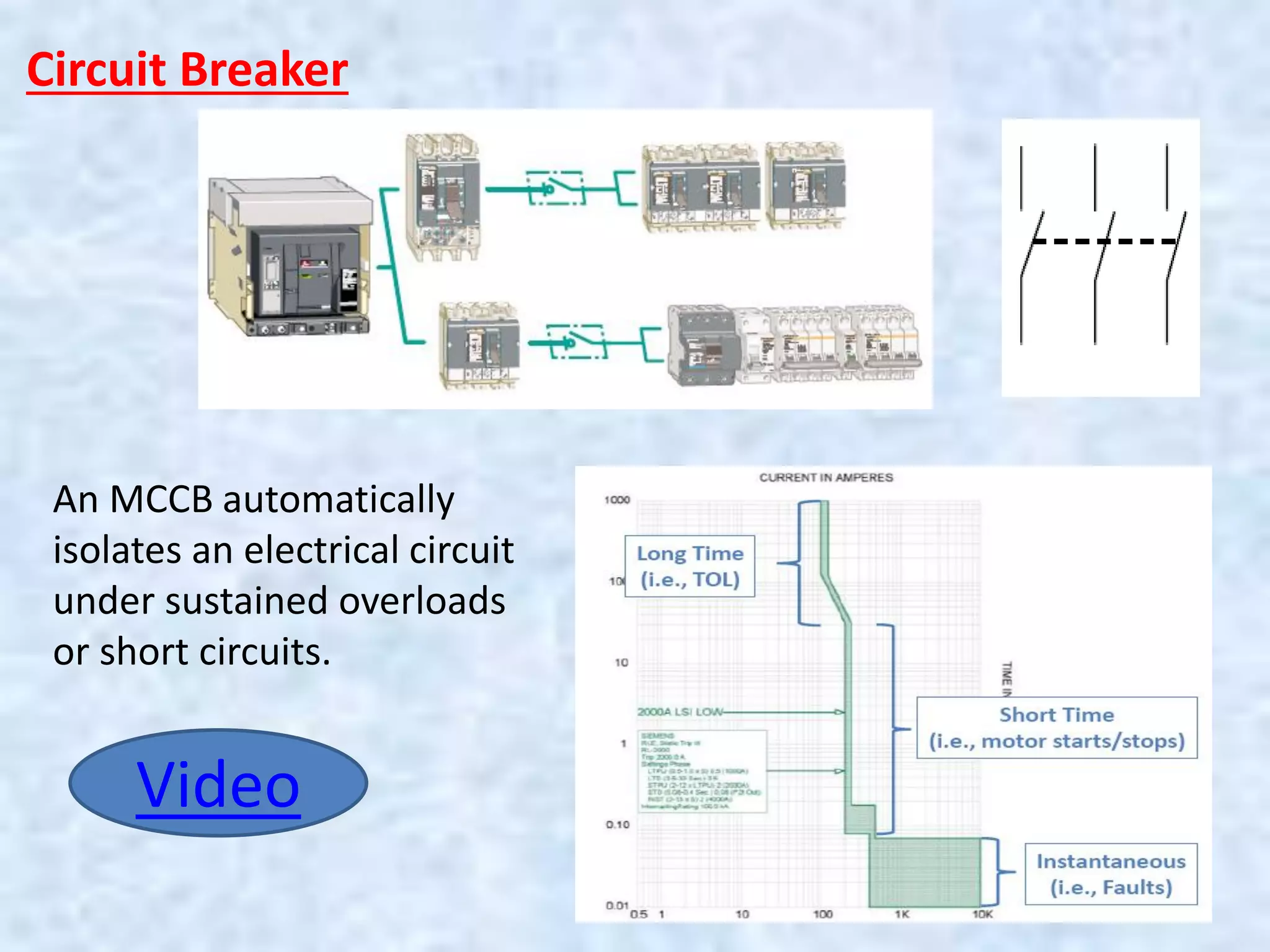
Circuit Breaker
An MCCB automatically
isolates an electrical circuit
under sustained overloads
or short circuits.
Video
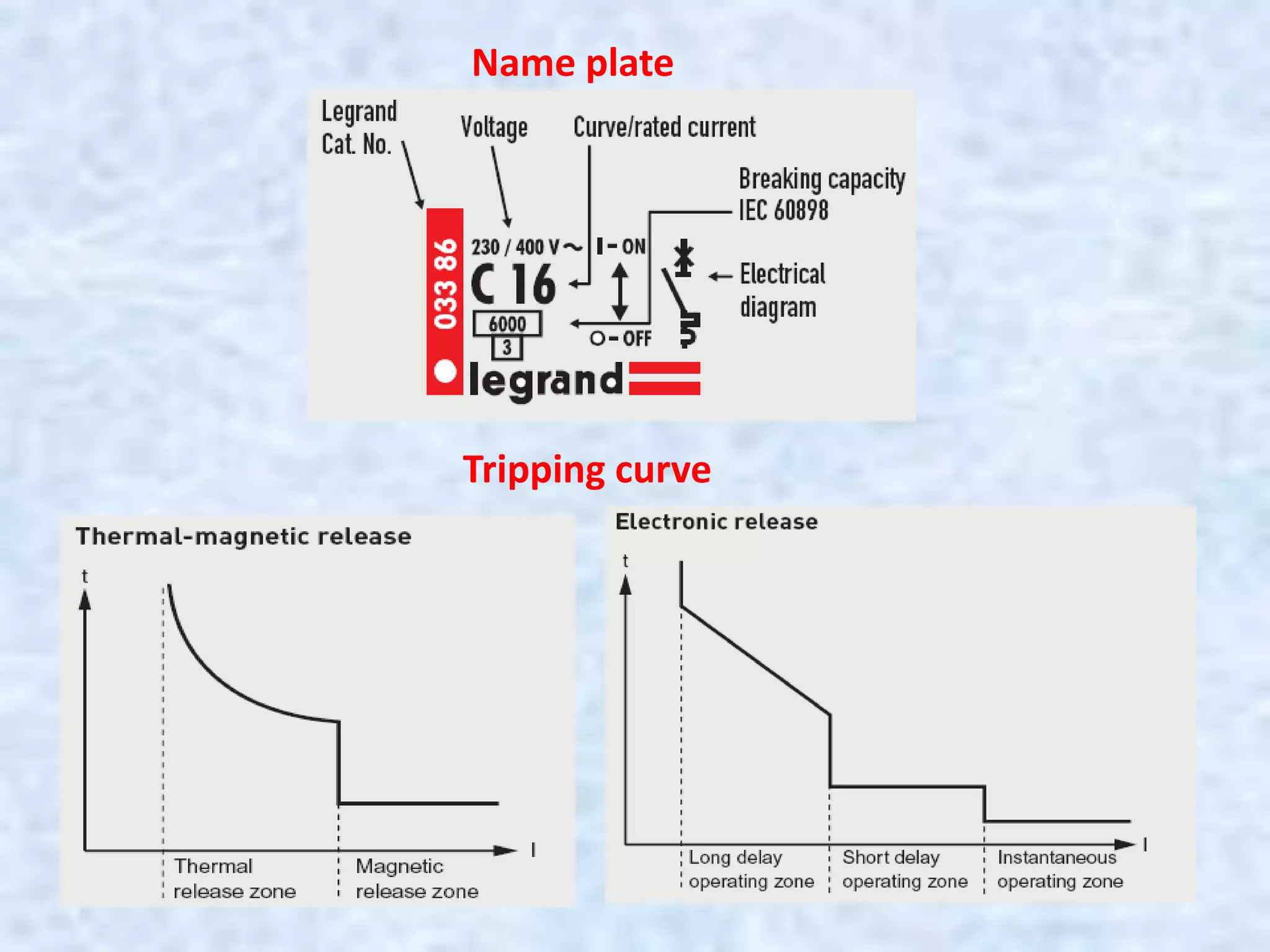
Name plate
Tripping curve
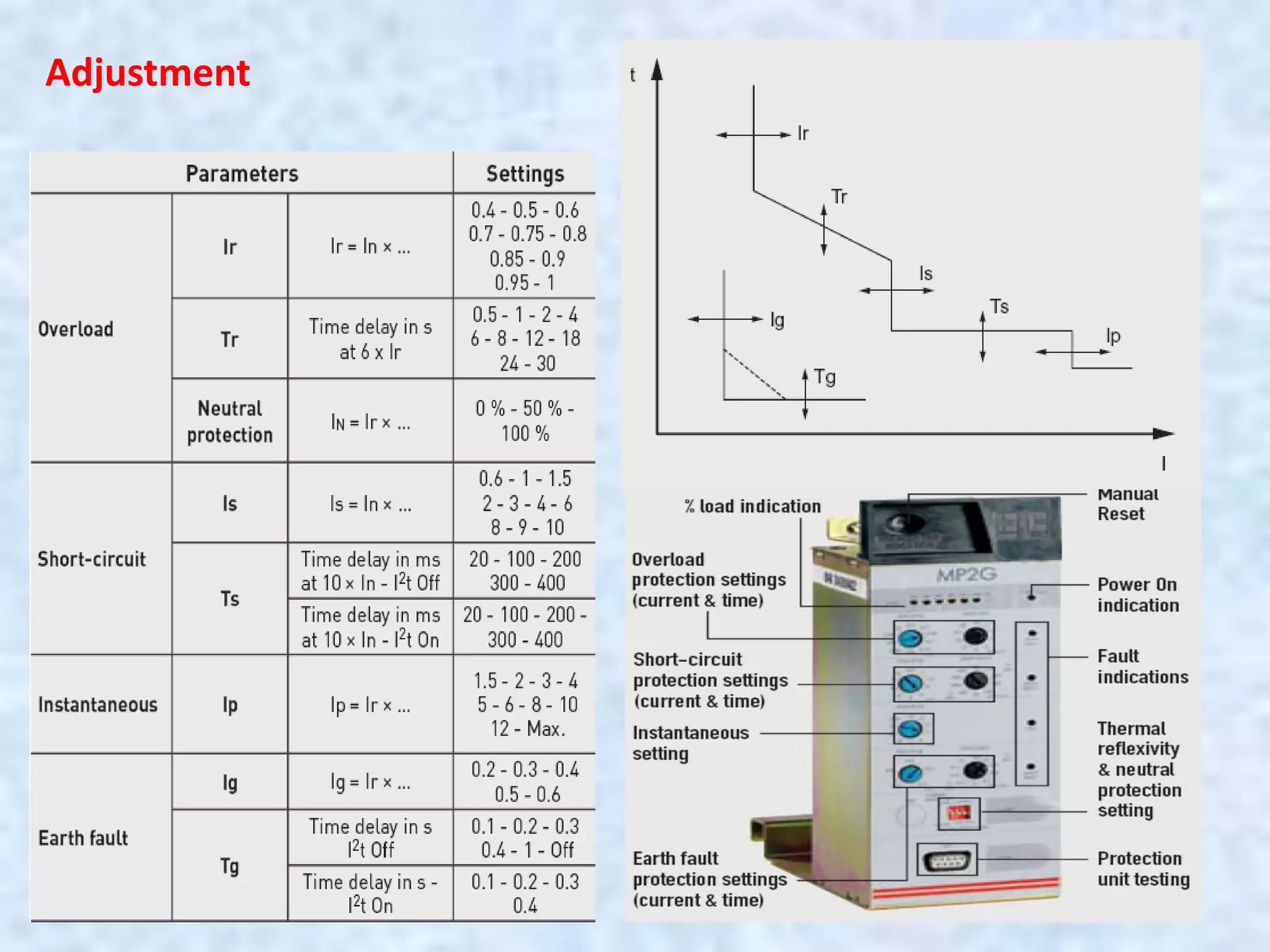
Adjustment
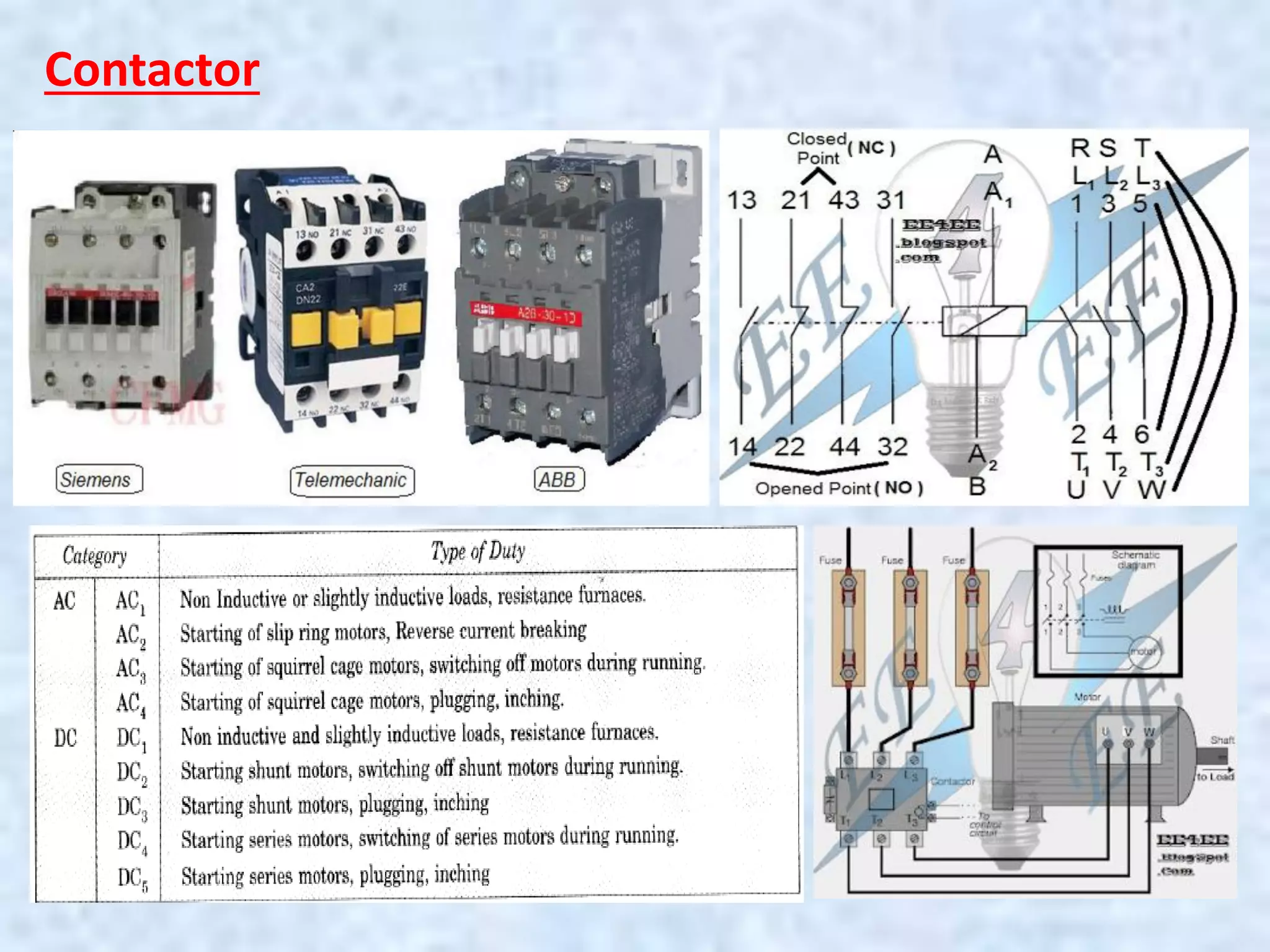
Contactor
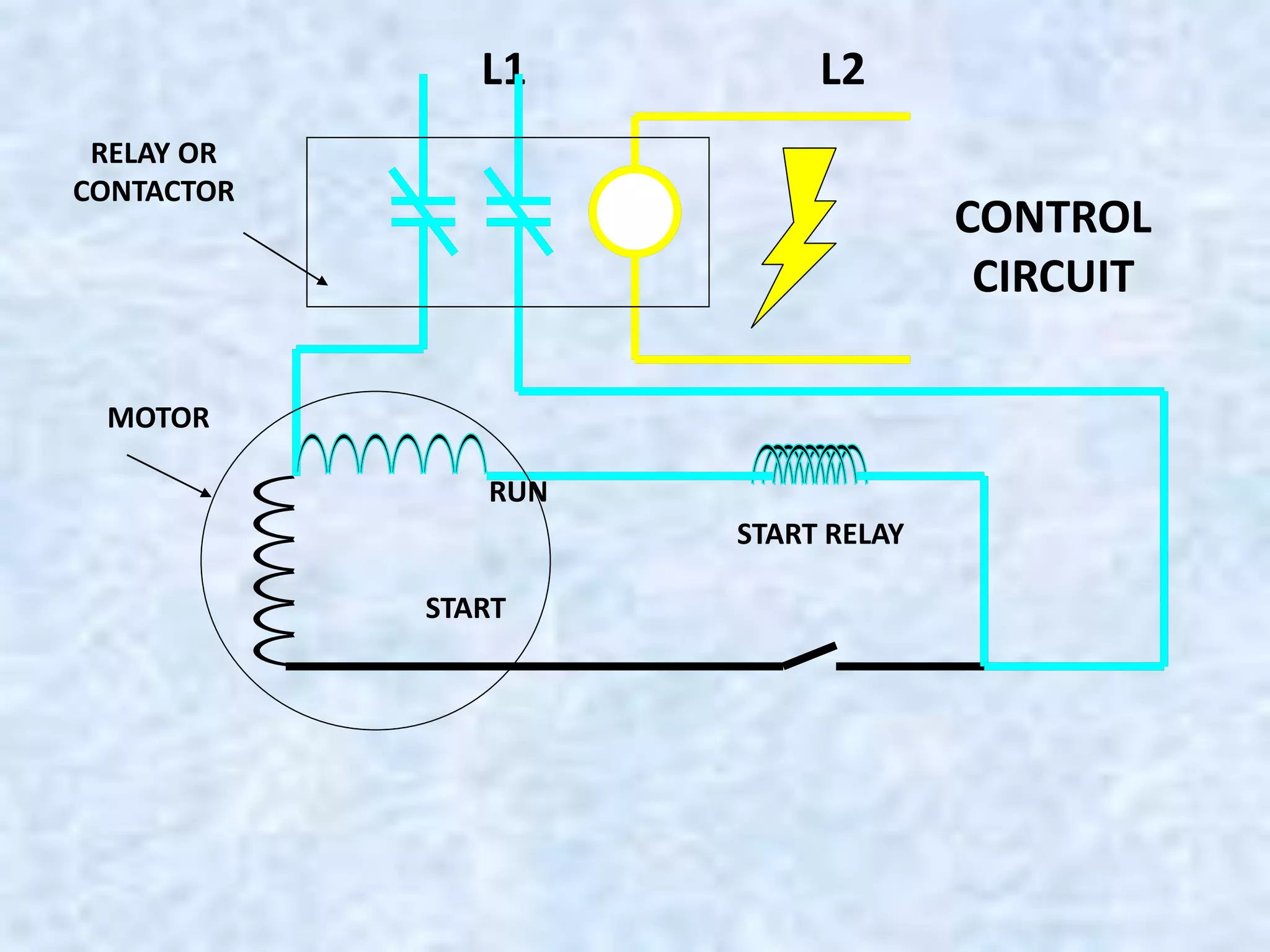
L1 L2
CONTROL
CIRCUIT
RELAY OR
CONTACTOR
MOTOR
RUN
START
START RELAY
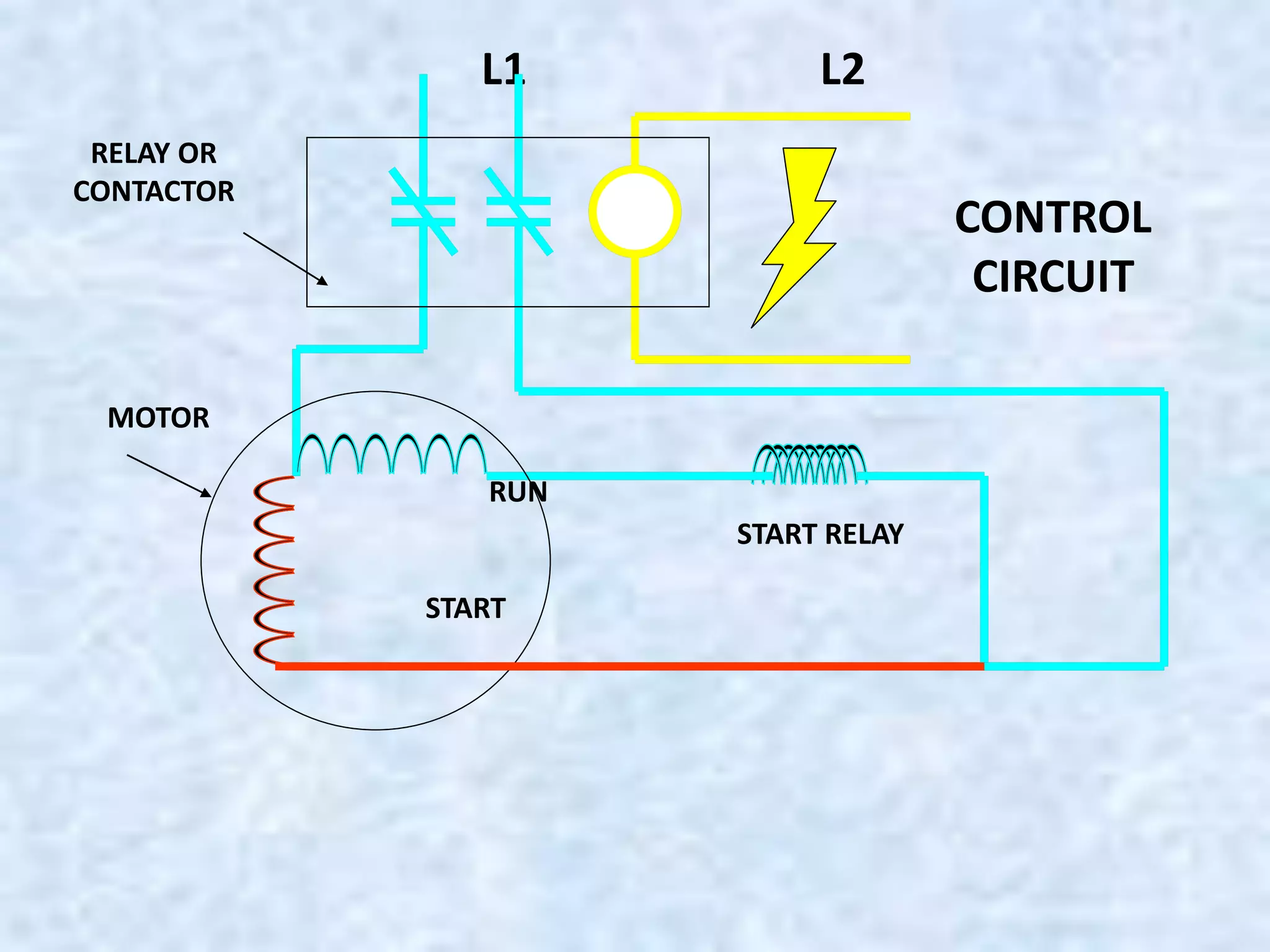
L1 L2
CONTROL
CIRCUIT
RELAY OR
CONTACTOR
MOTOR
RUN
START
START RELAY
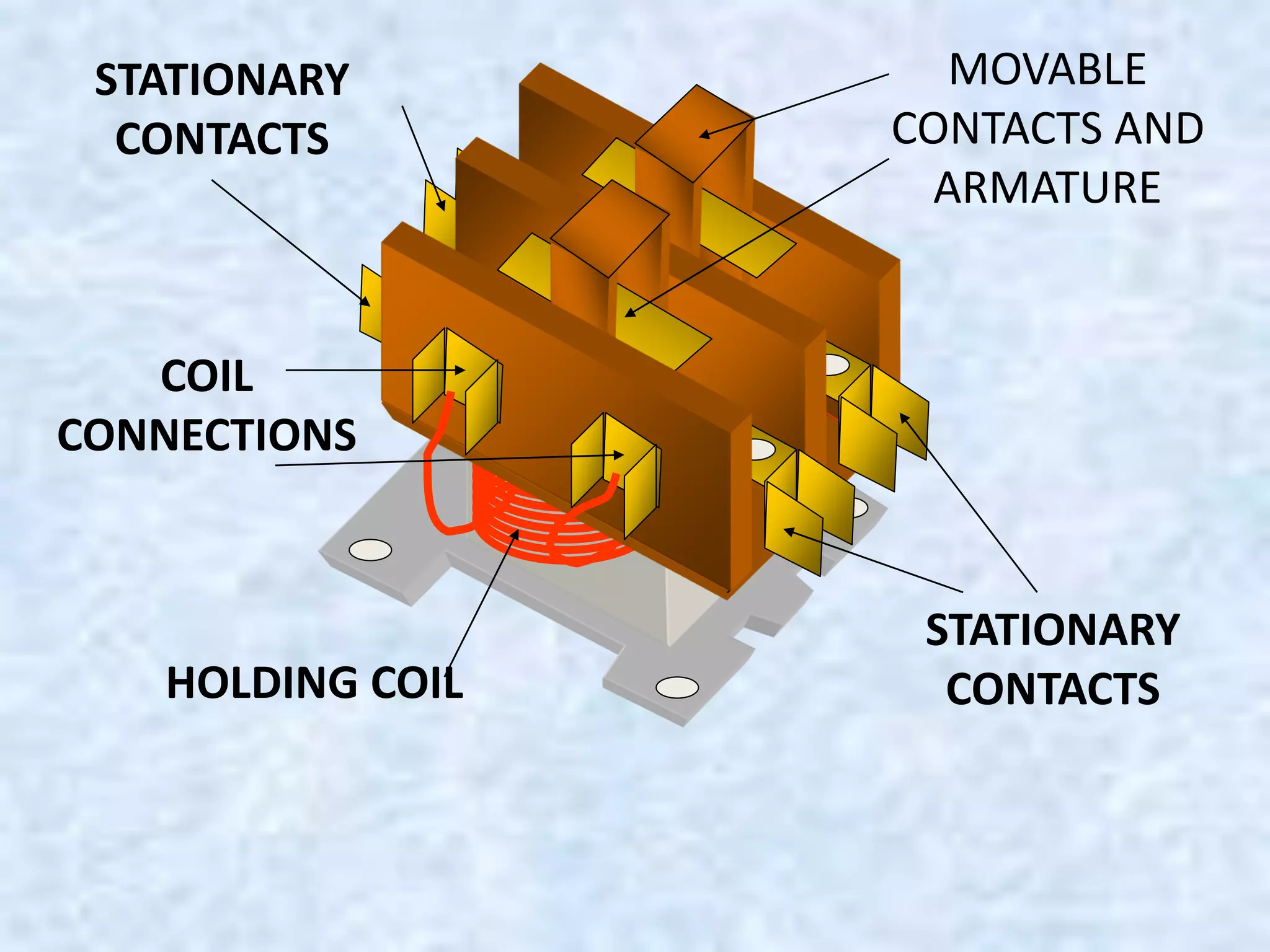
HOLDING COIL
STATIONARY
CONTACTS
STATIONARY
CONTACTS
MOVABLE
CONTACTS AND
ARMATURE
COIL
CONNECTIONS
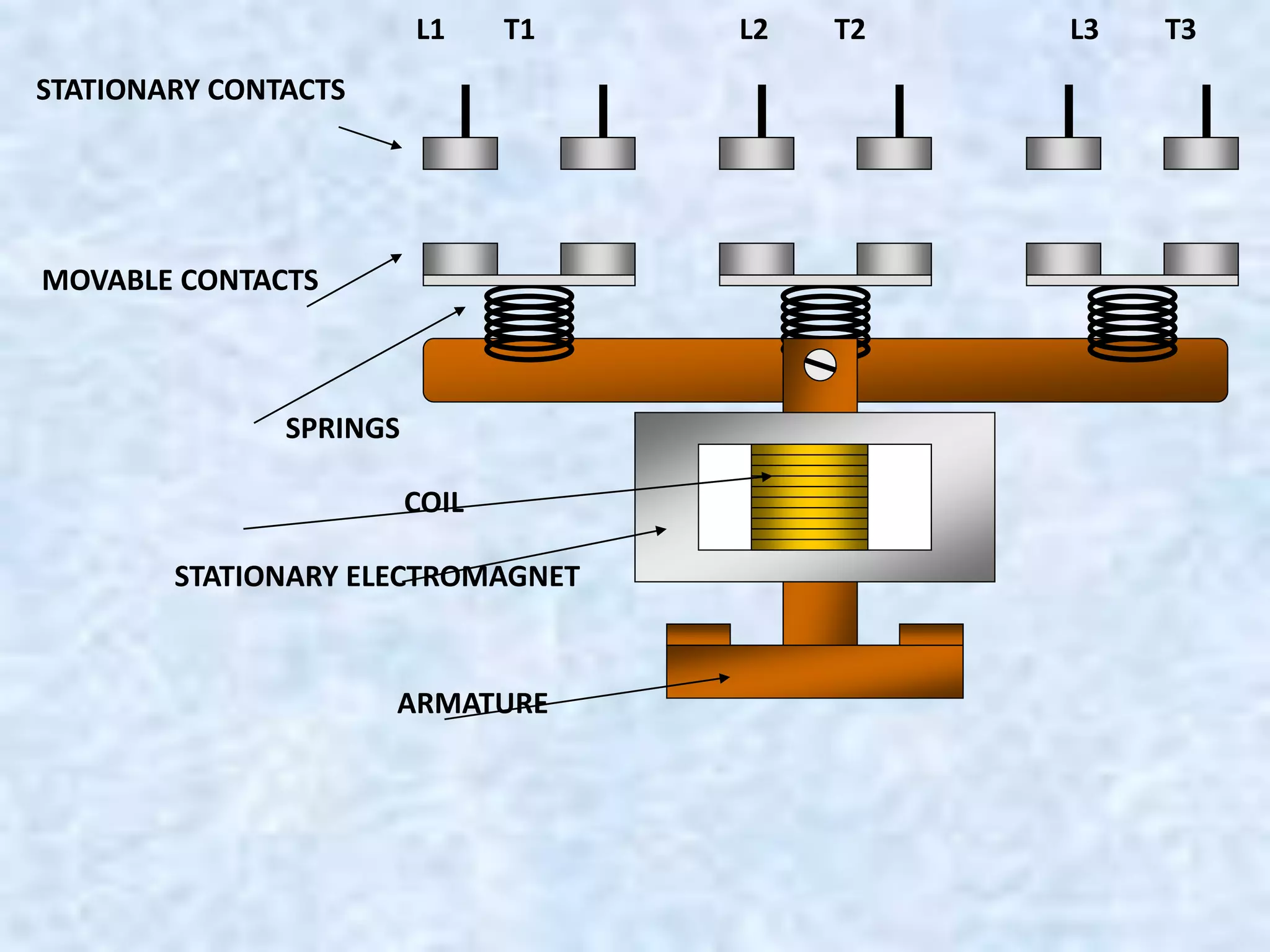
L1 T1 L2 T2 L3 T3
STATIONARY CONTACTS
MOVABLE CONTACTS
SPRINGS
COIL
STATIONARY ELECTROMAGNET
ARMATURE
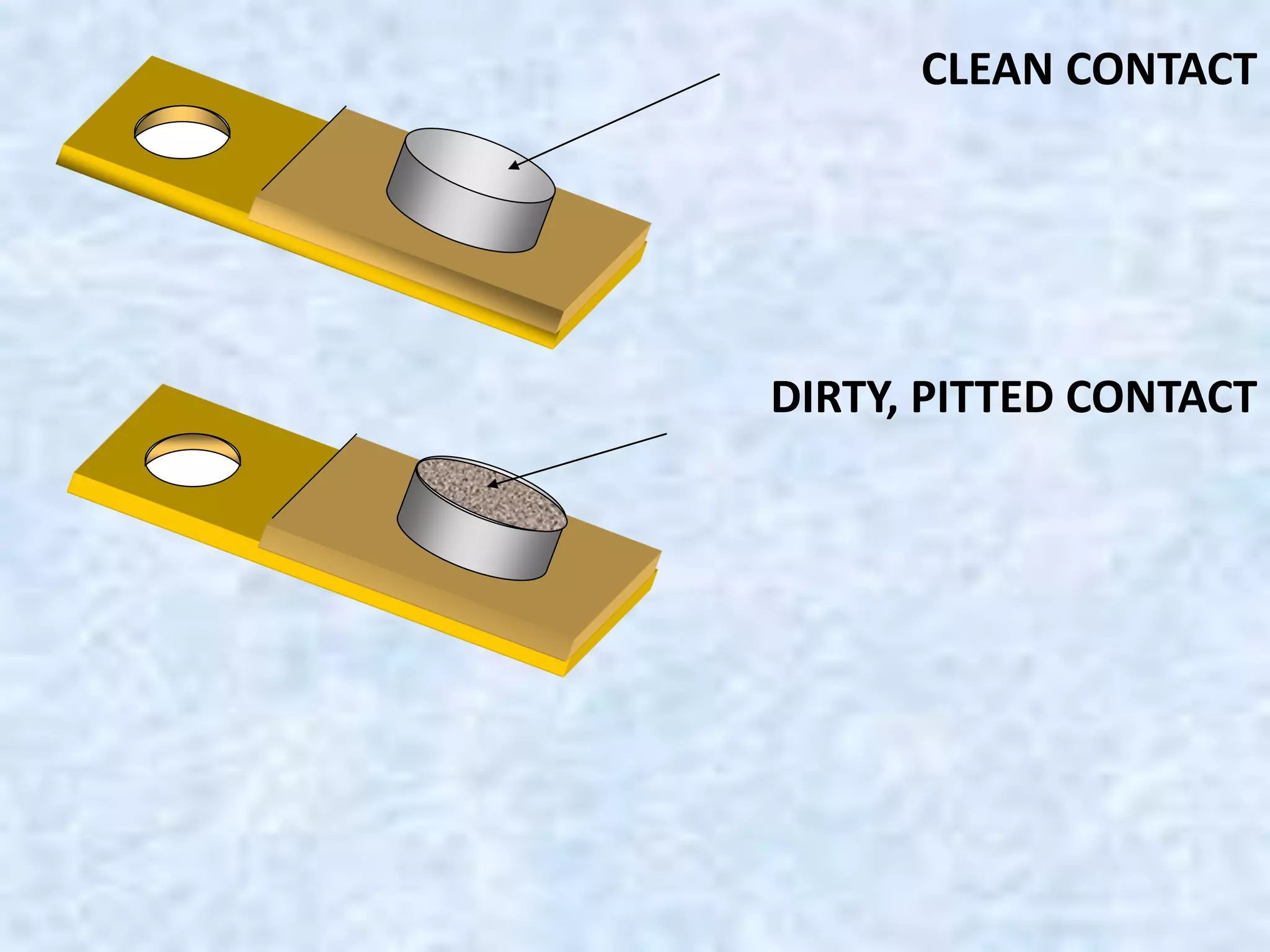
CLEAN CONTACT
DIRTY, PITTED CONTACT
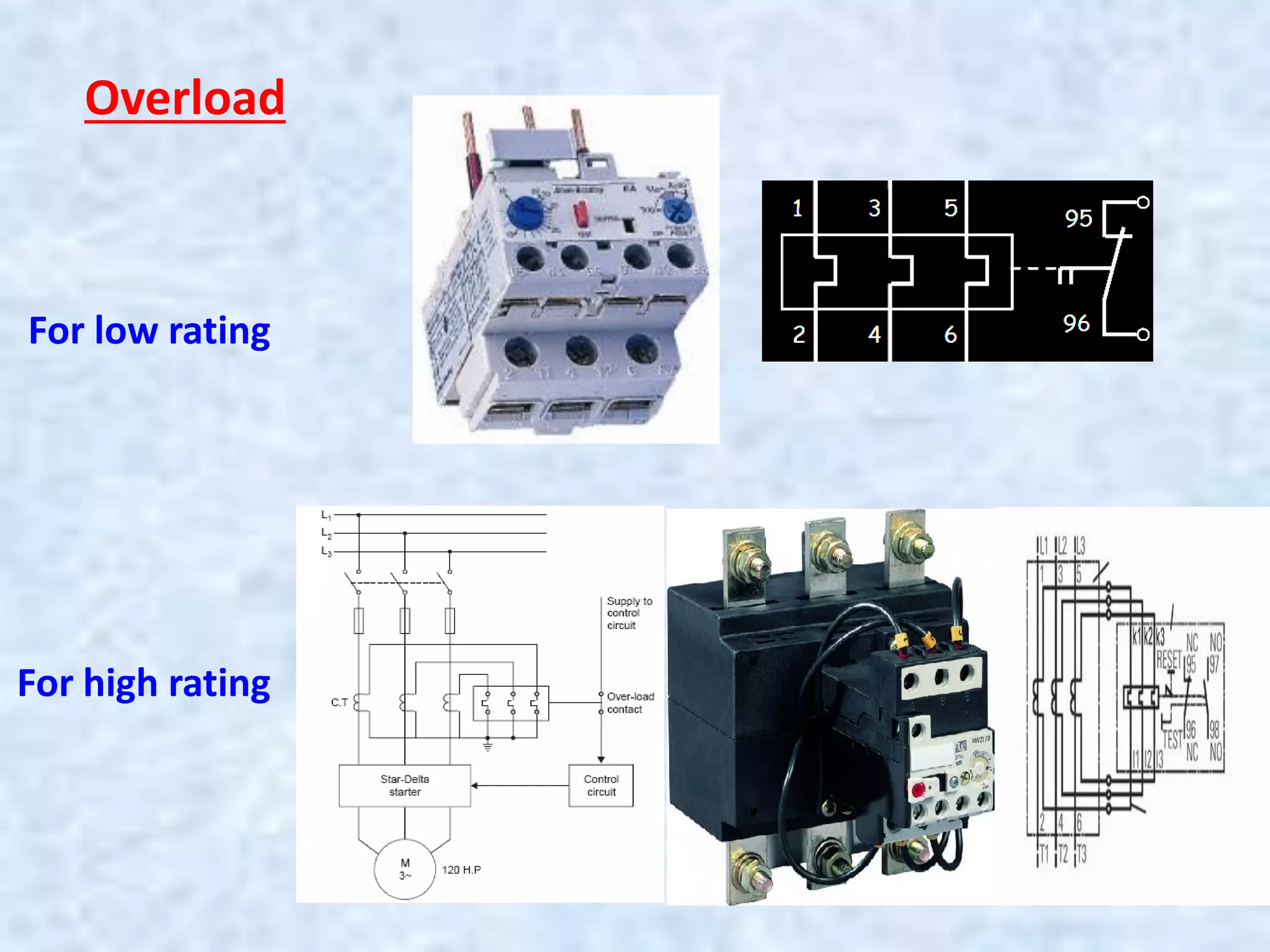
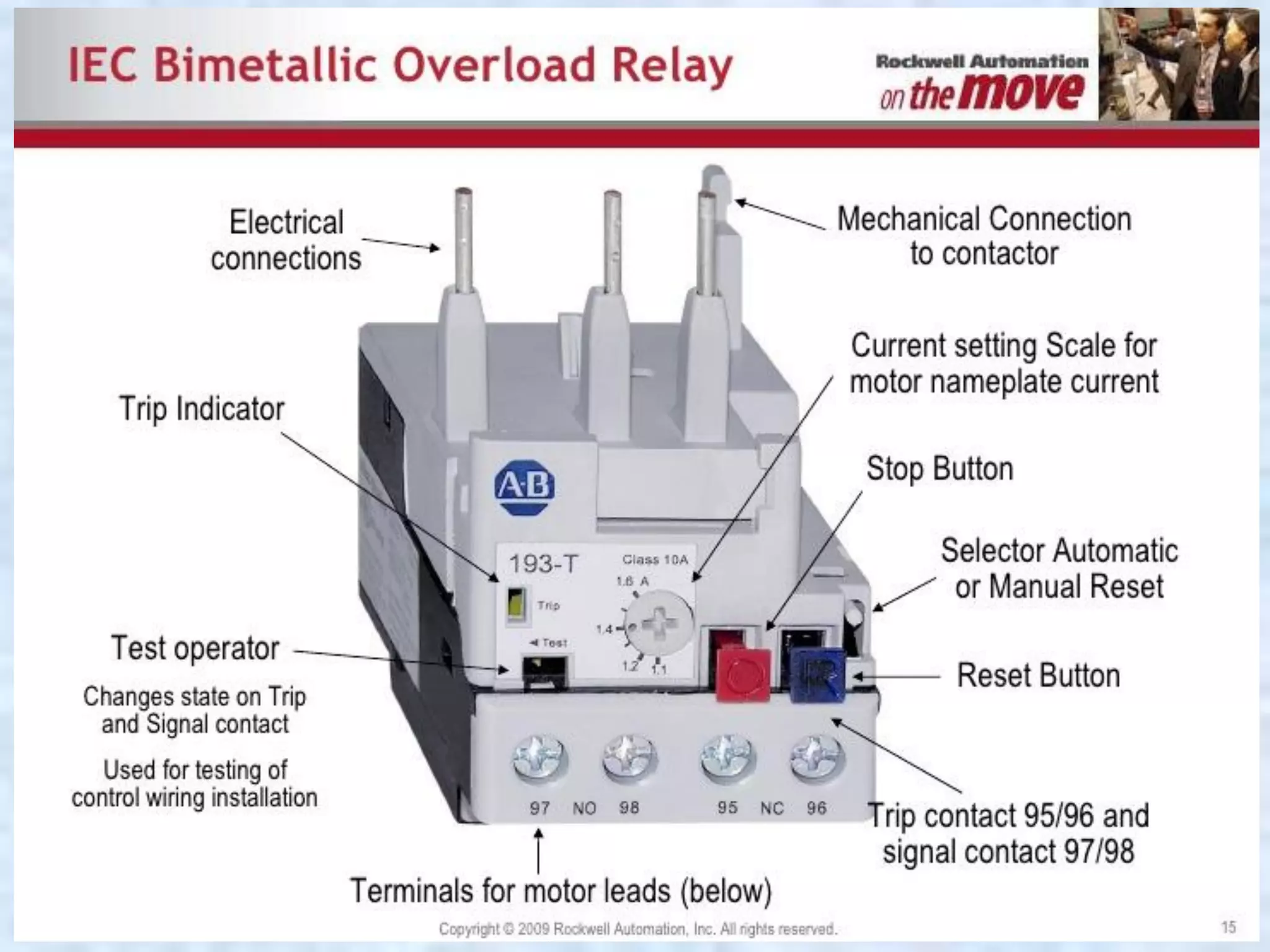
Overload
For low rating
For high rating
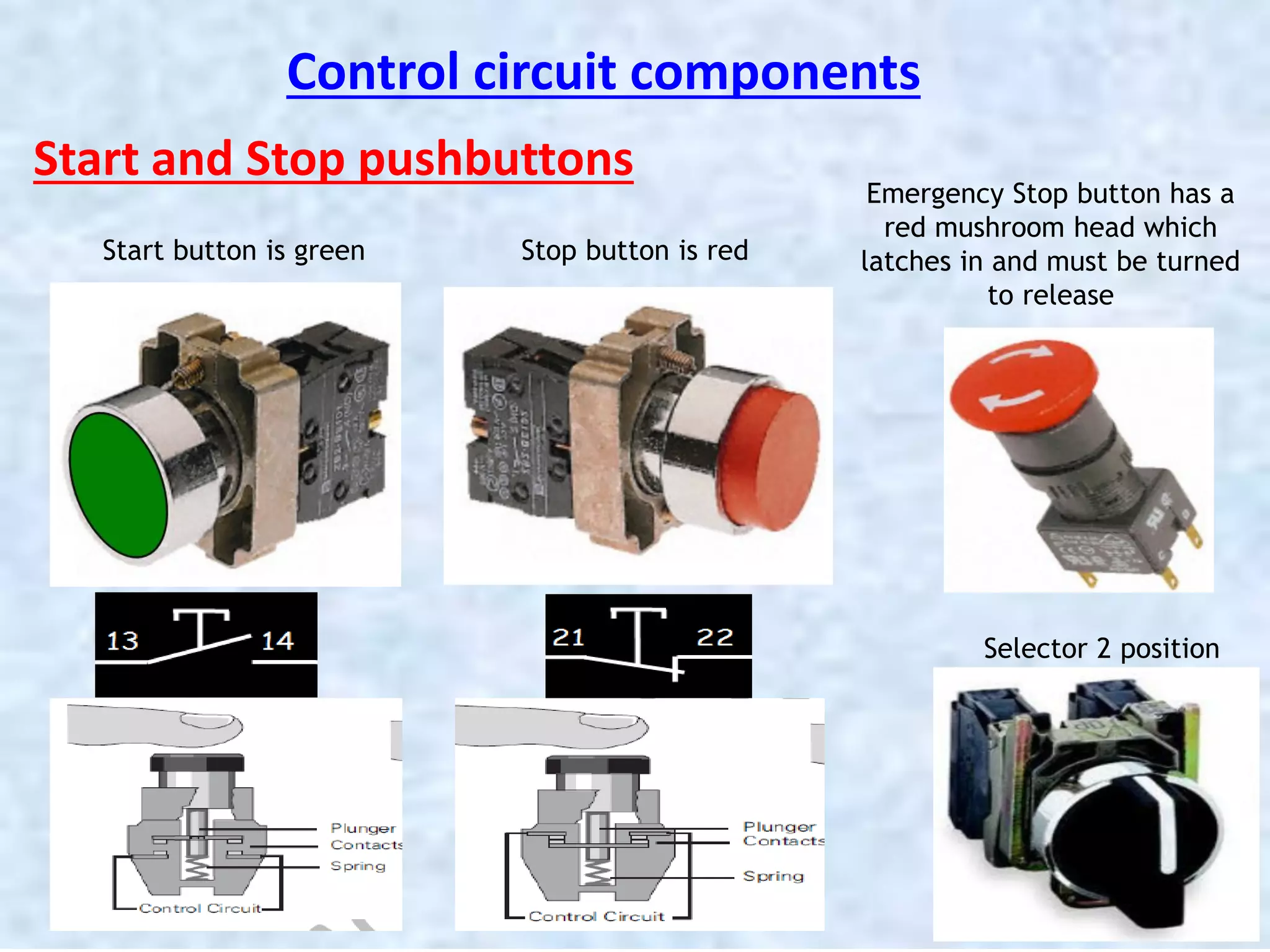
Start and Stop pushbuttons
Start button is green Stop button is red
N/C contact
Emergency Stop button has a
red mushroom head which
latches in and must be turned
to release
Control circuit components
Selector 2 position
67
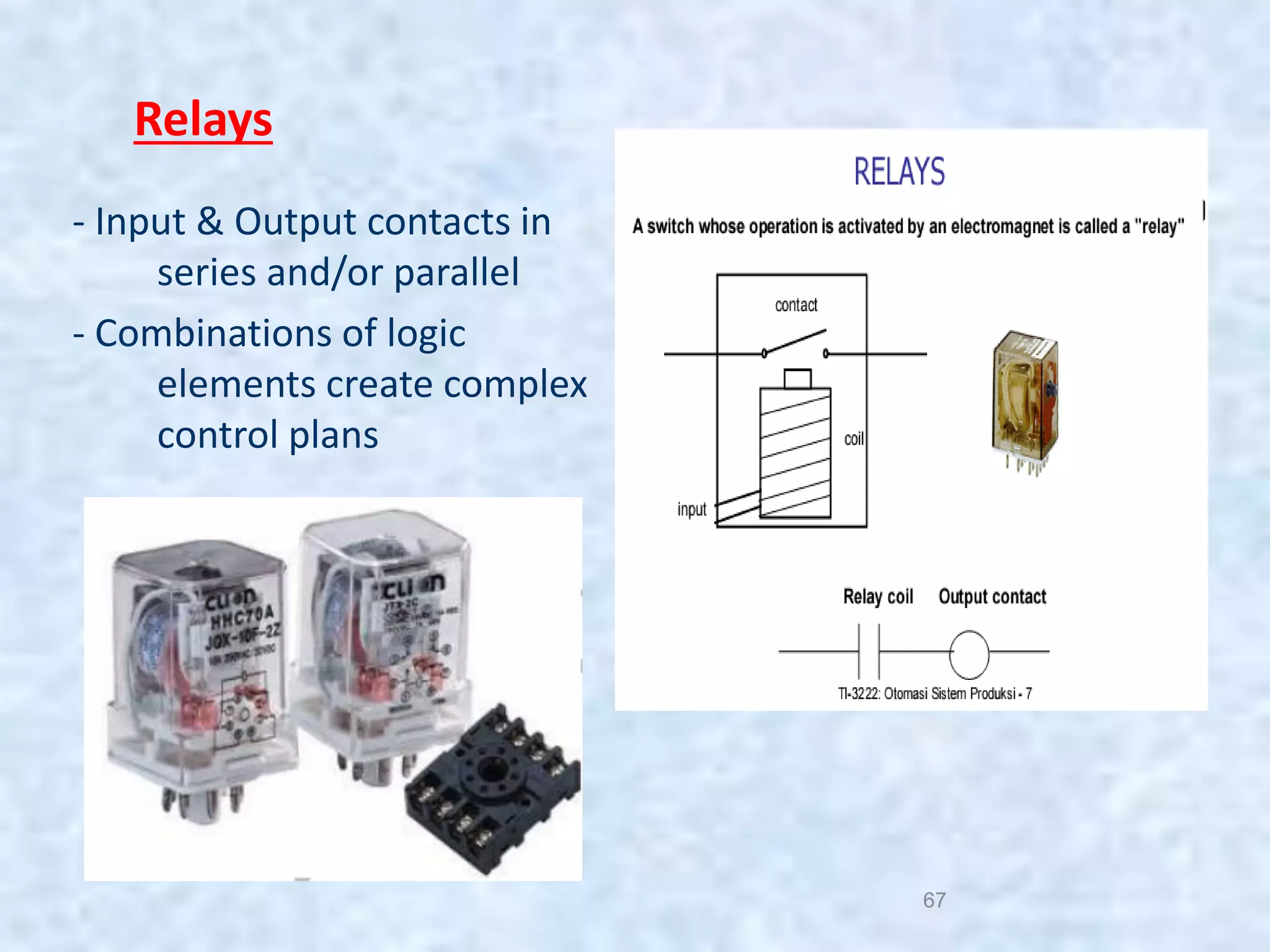
- Input & Output contacts in
series and/or parallel
- Combinations of logic
elements create complex
control plans
Relays
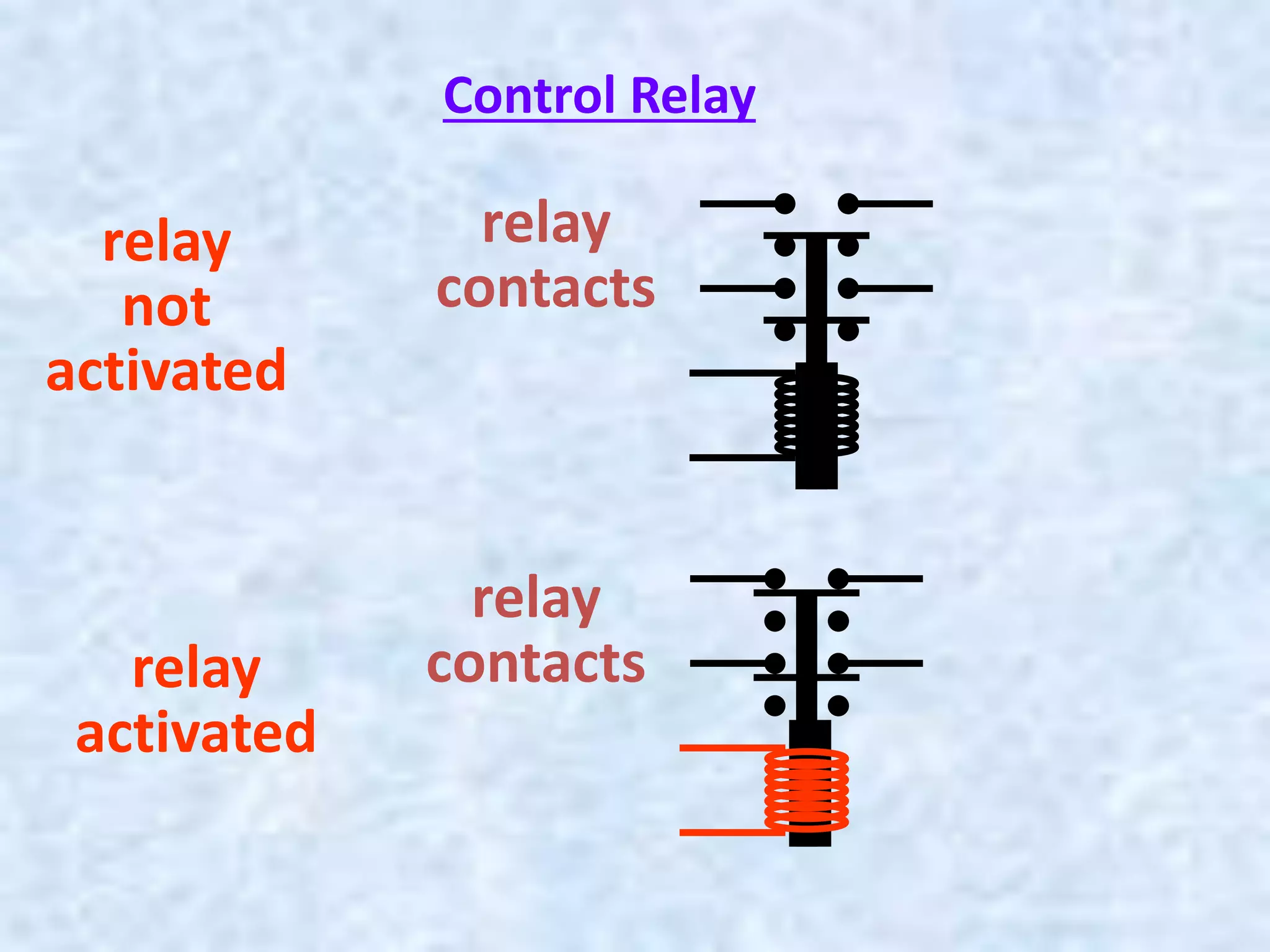
relay
contacts
relay
not
activated
Control Relay
relay
contacts
relay
activated
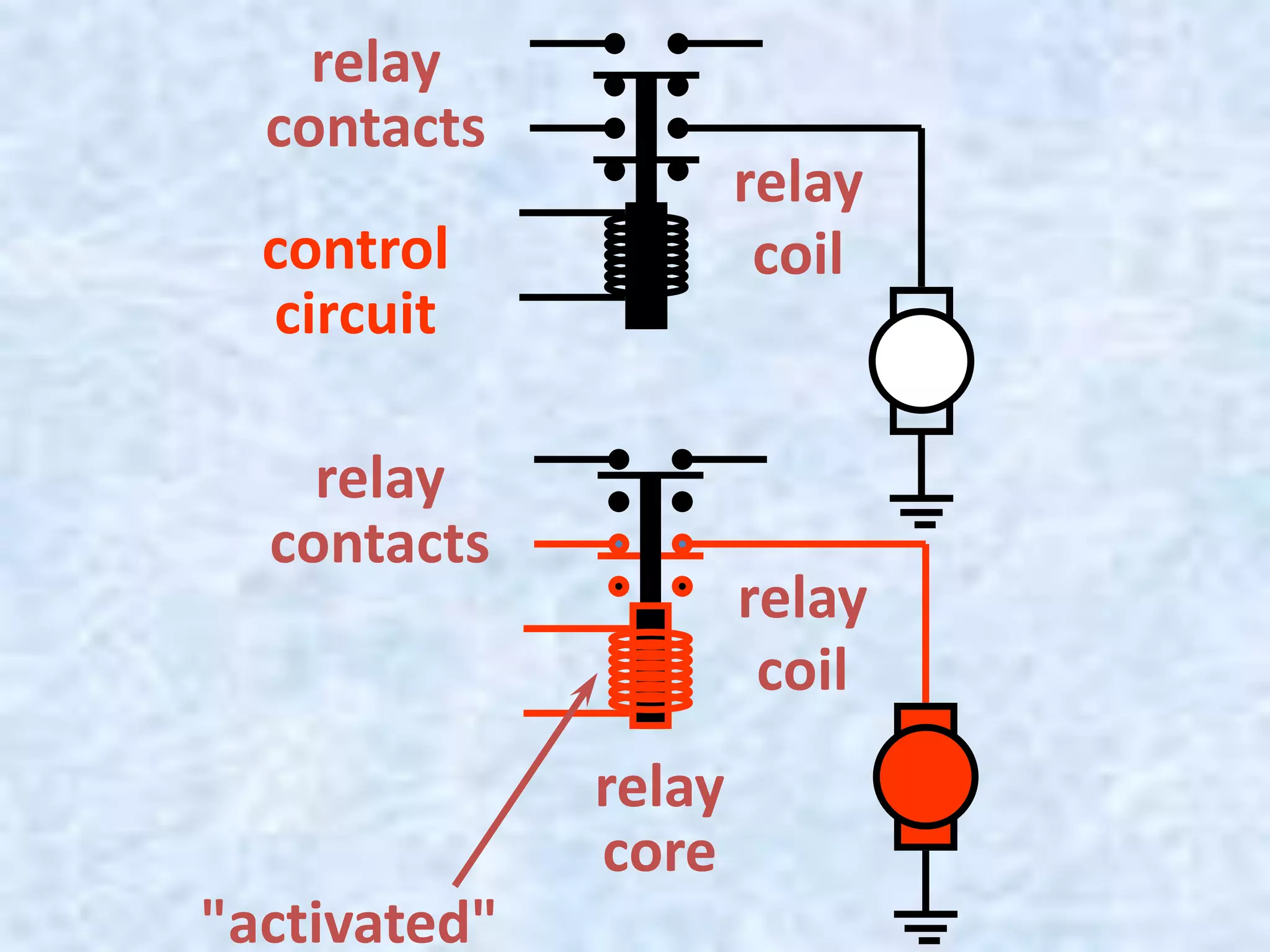
relay
coil
control
circuit
relay
contacts
relay
coil
relay
contacts
relay
core
relay
core
"activated"
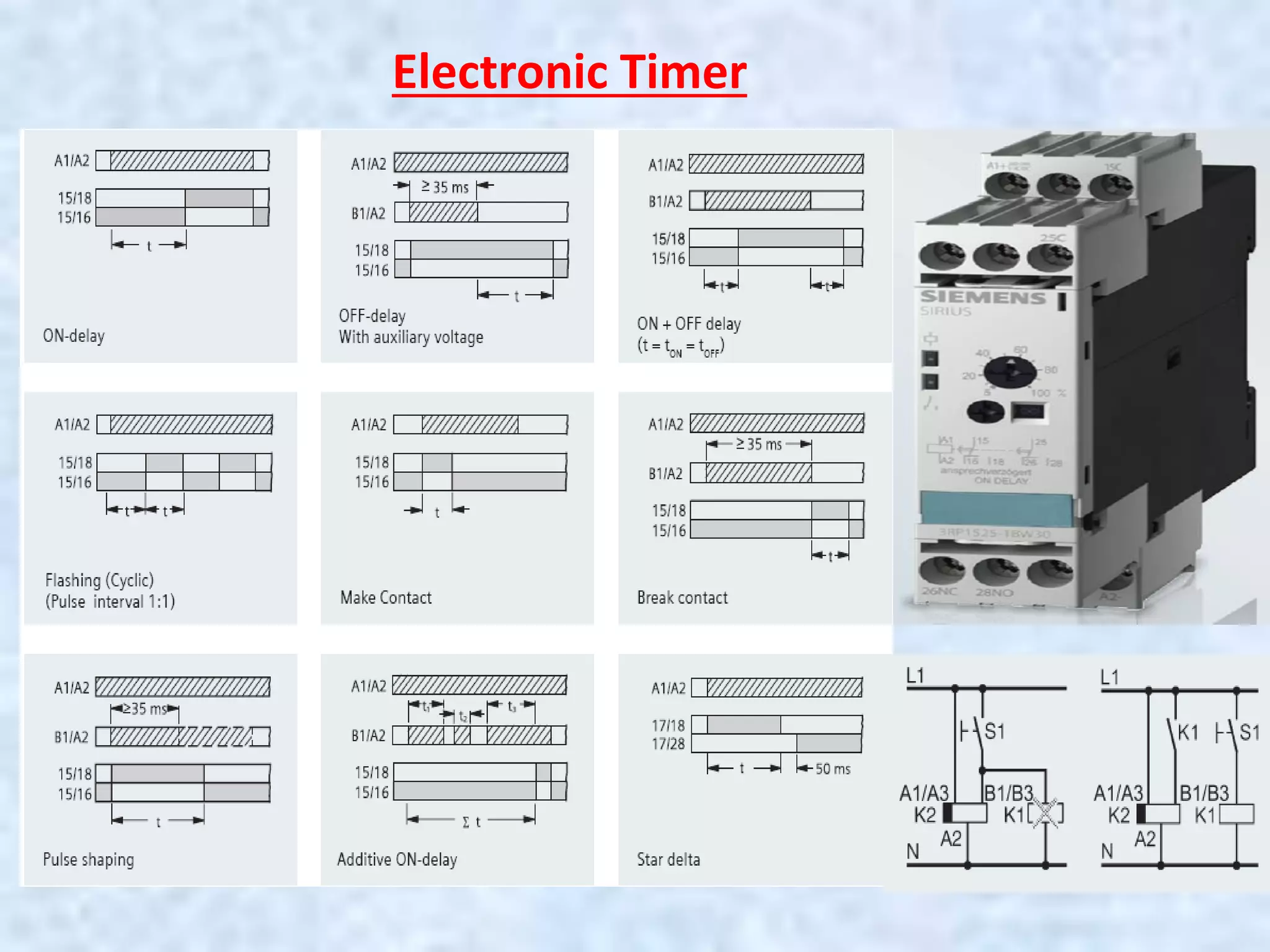
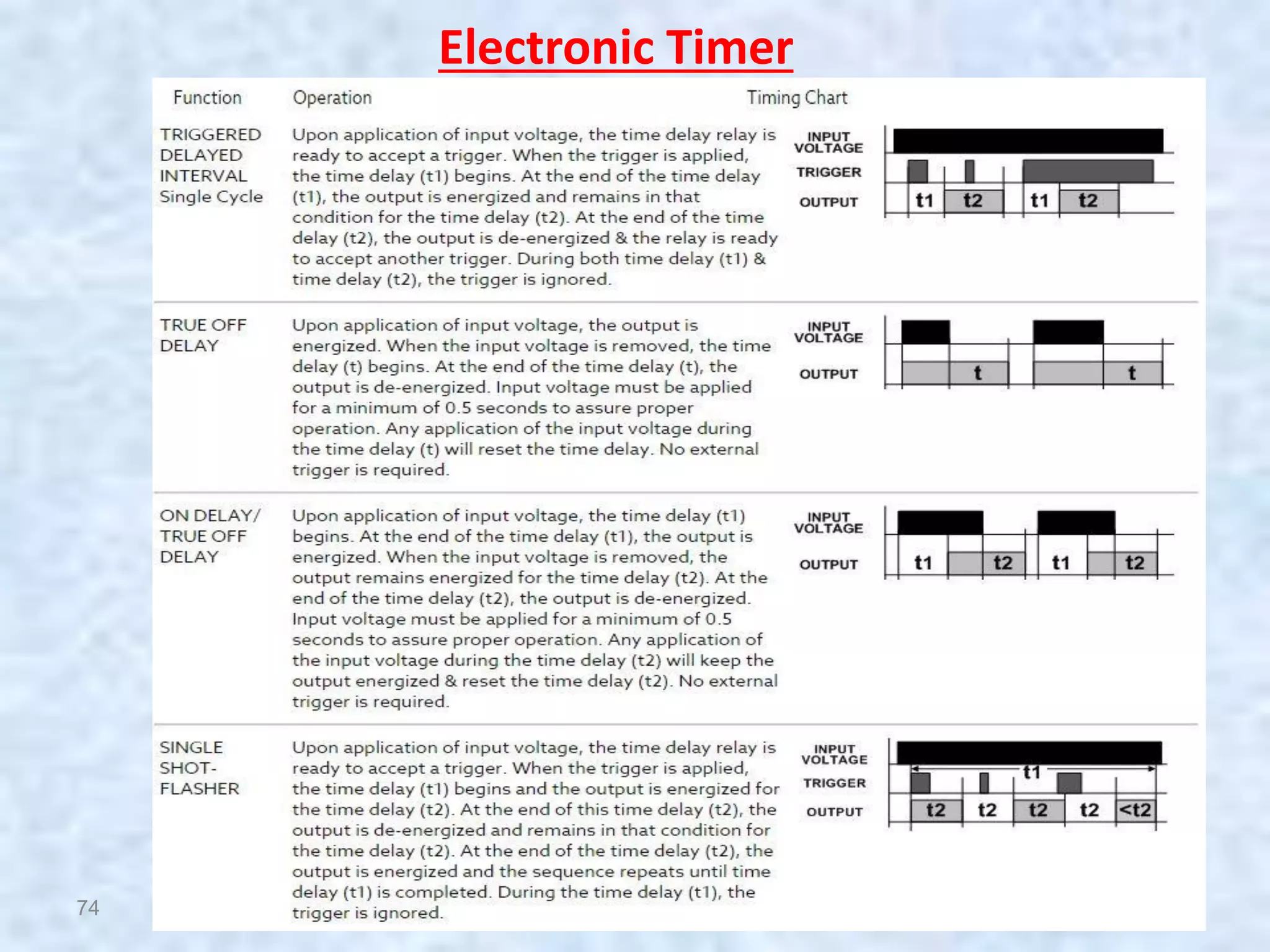
Electronic Timer
71
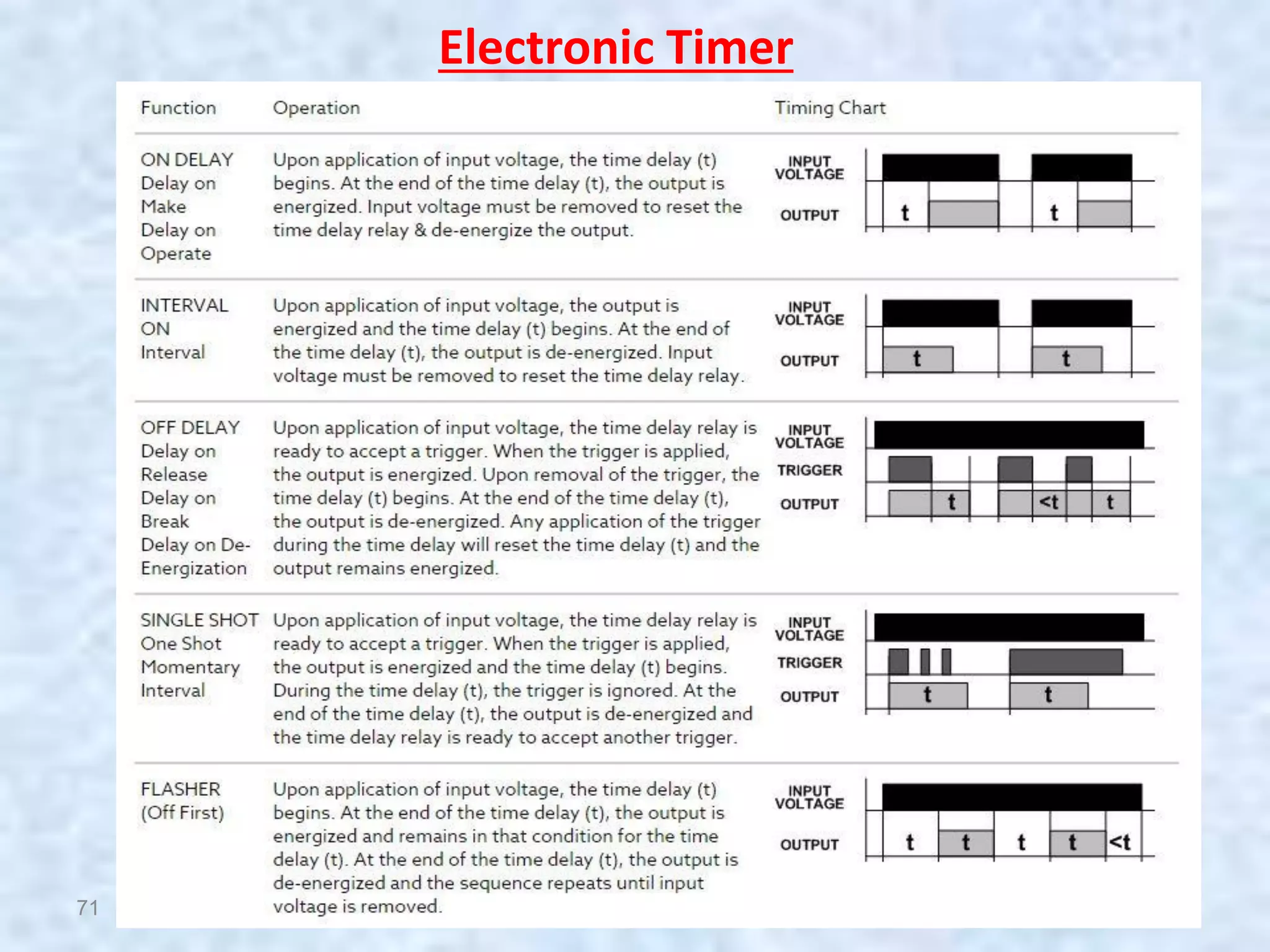
Electronic Timer
72
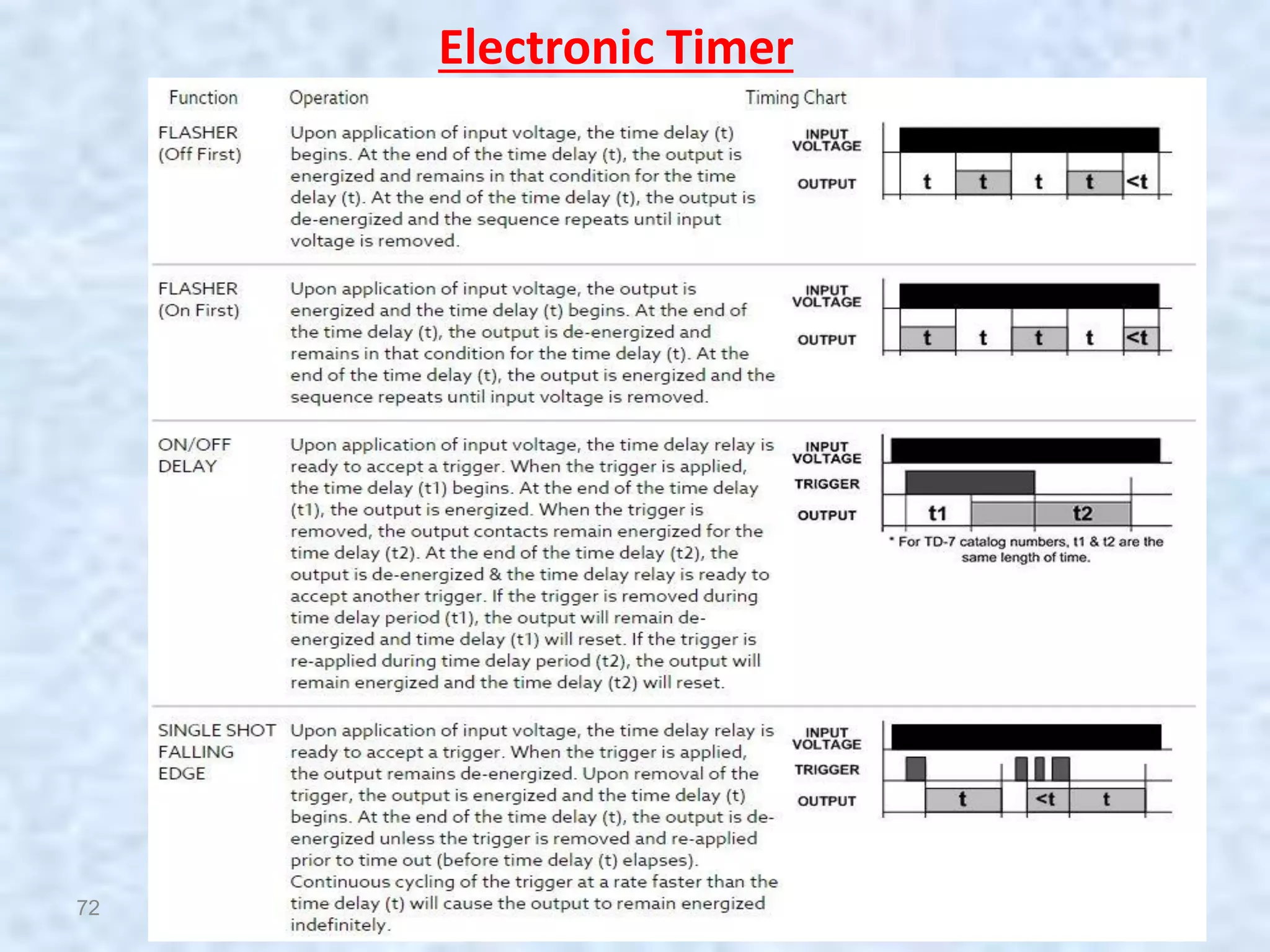
Electronic Timer
73
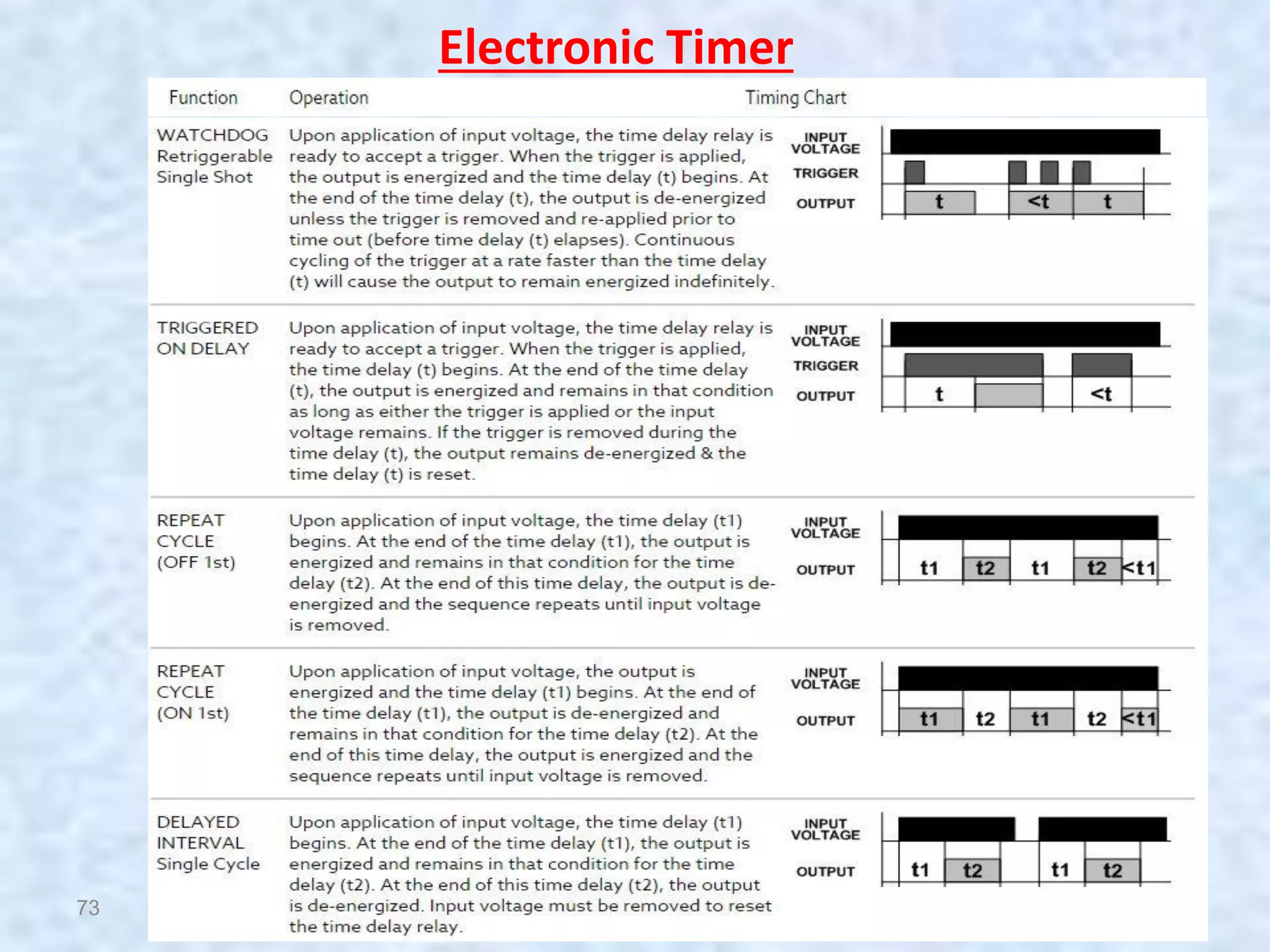
Electronic Timer
74
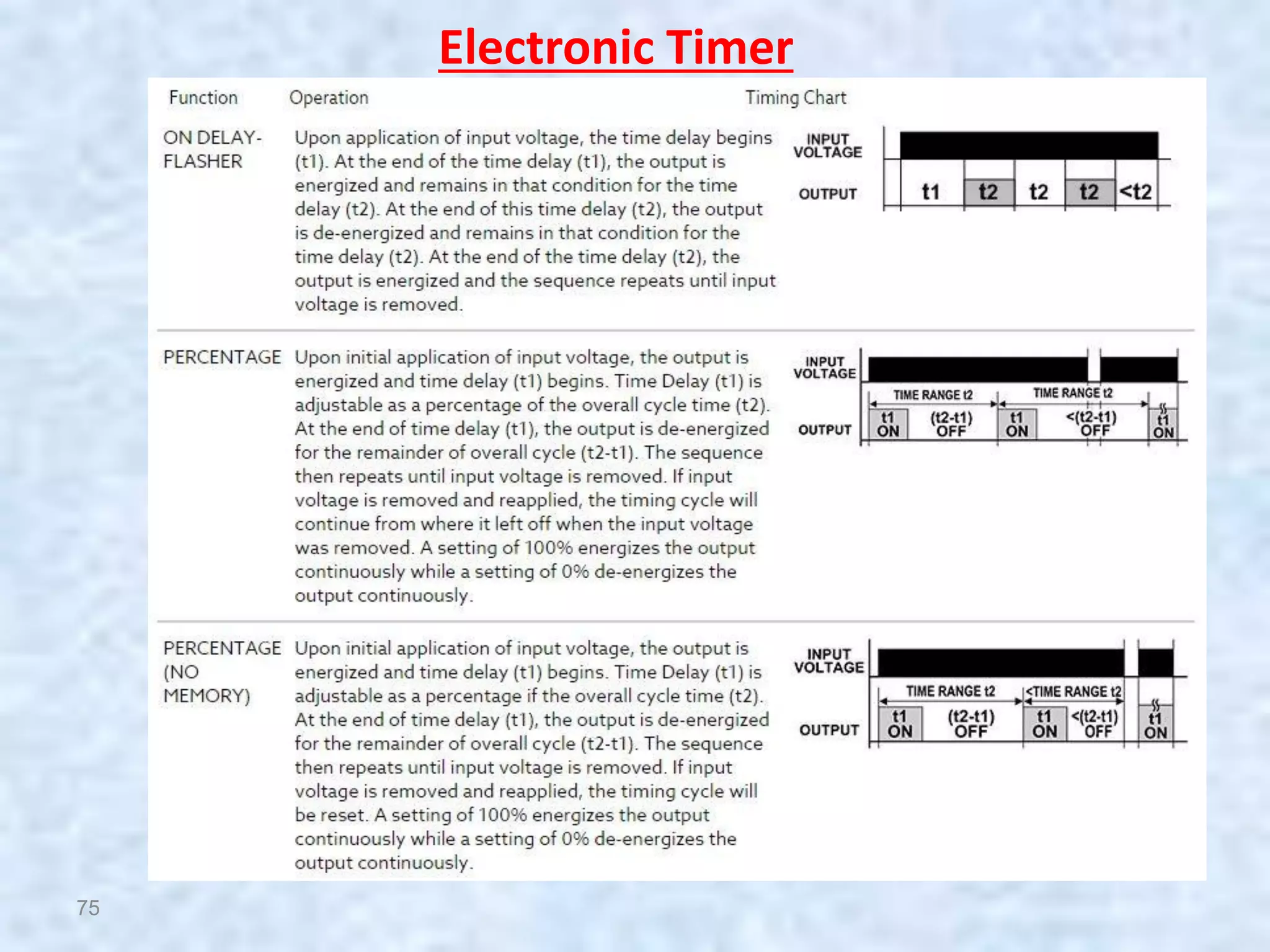
Electronic Timer
75
Electronic Timer
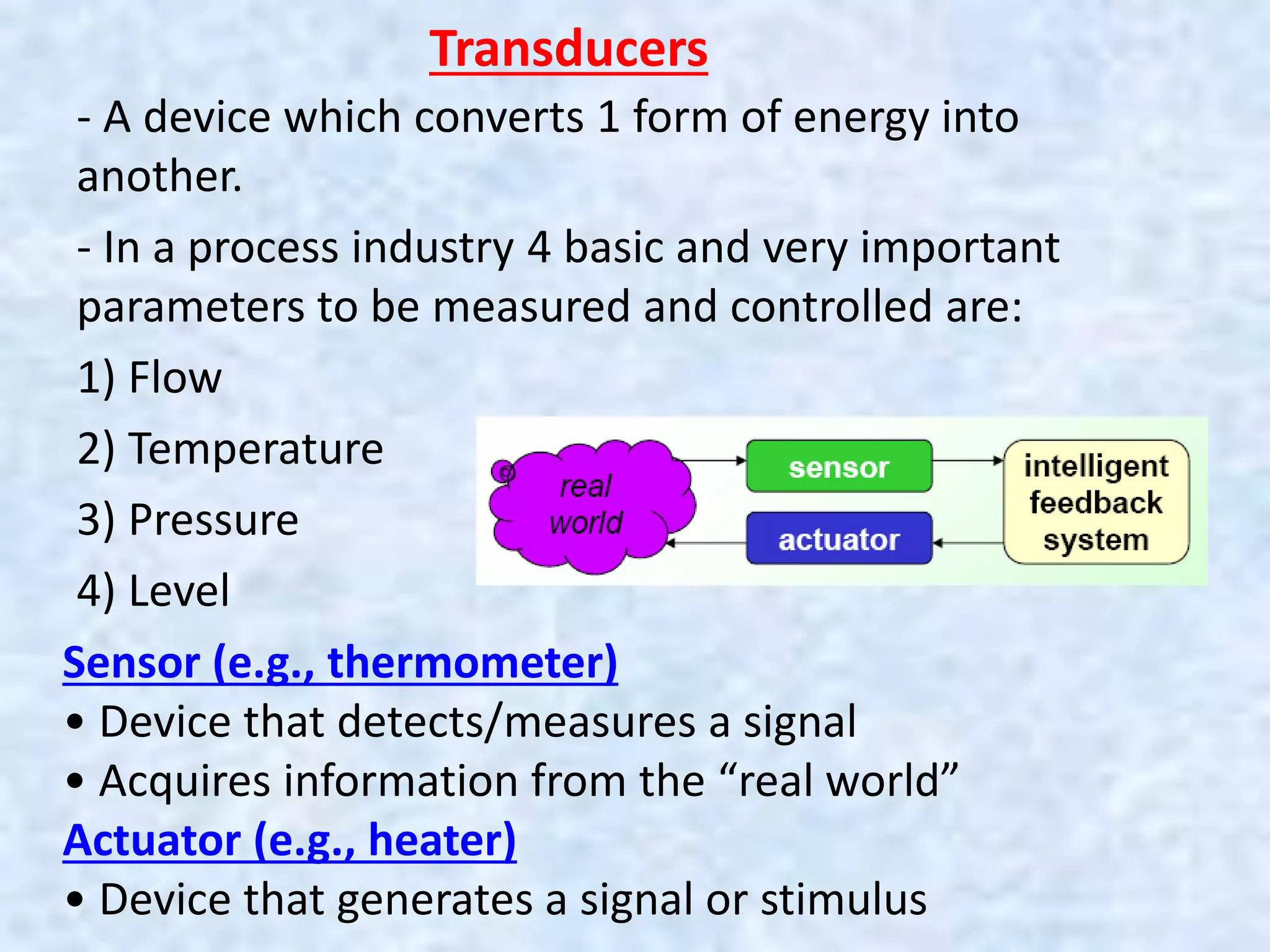
Transducers
- A device which converts 1 form of energy into
another.
- In a process industry 4 basic and very important
parameters to be measured and controlled are:
1) Flow
2) Temperature
3) Pressure
4) Level
Sensor (e.g., thermometer)
• Device that detects/measures a signal
• Acquires information from the “real world”
Actuator (e.g., heater)
• Device that generates a signal or stimulus
77
CHAPTER 4
Motor Name Plate
Manufacturer type
Rated horsepower
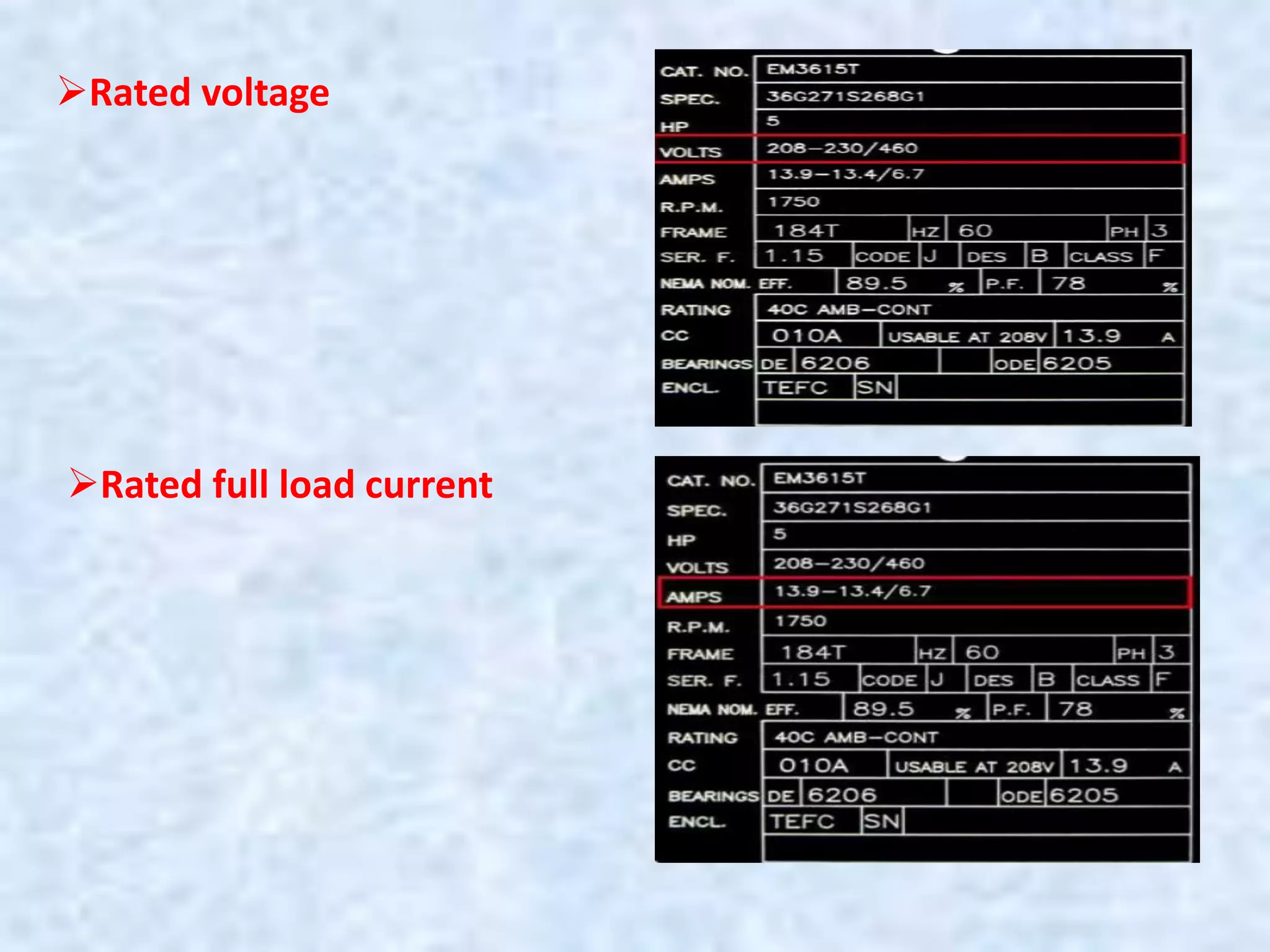
Rated voltage and amps
Rated full-load amps
Rated full-load speed
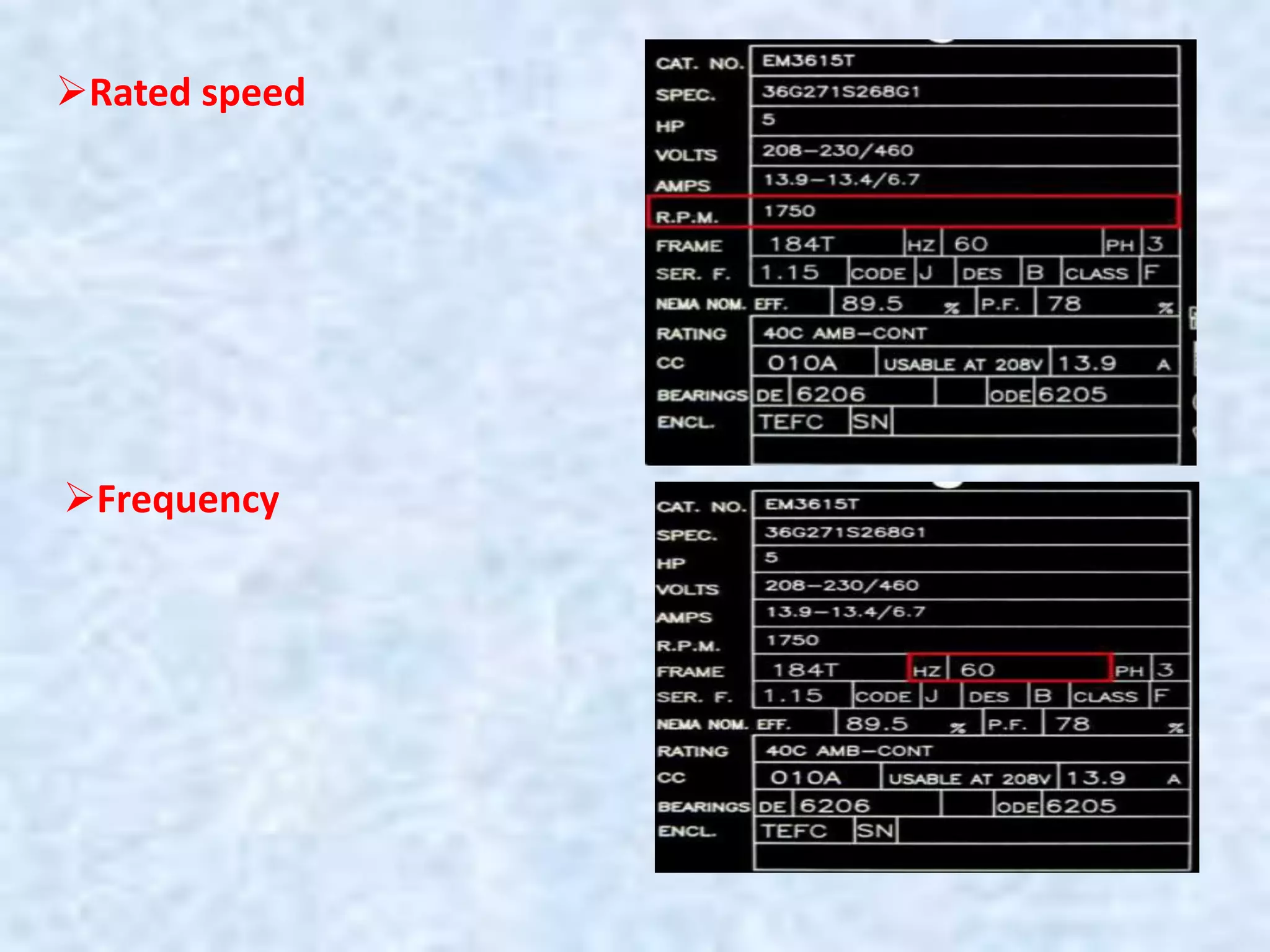
Frequency
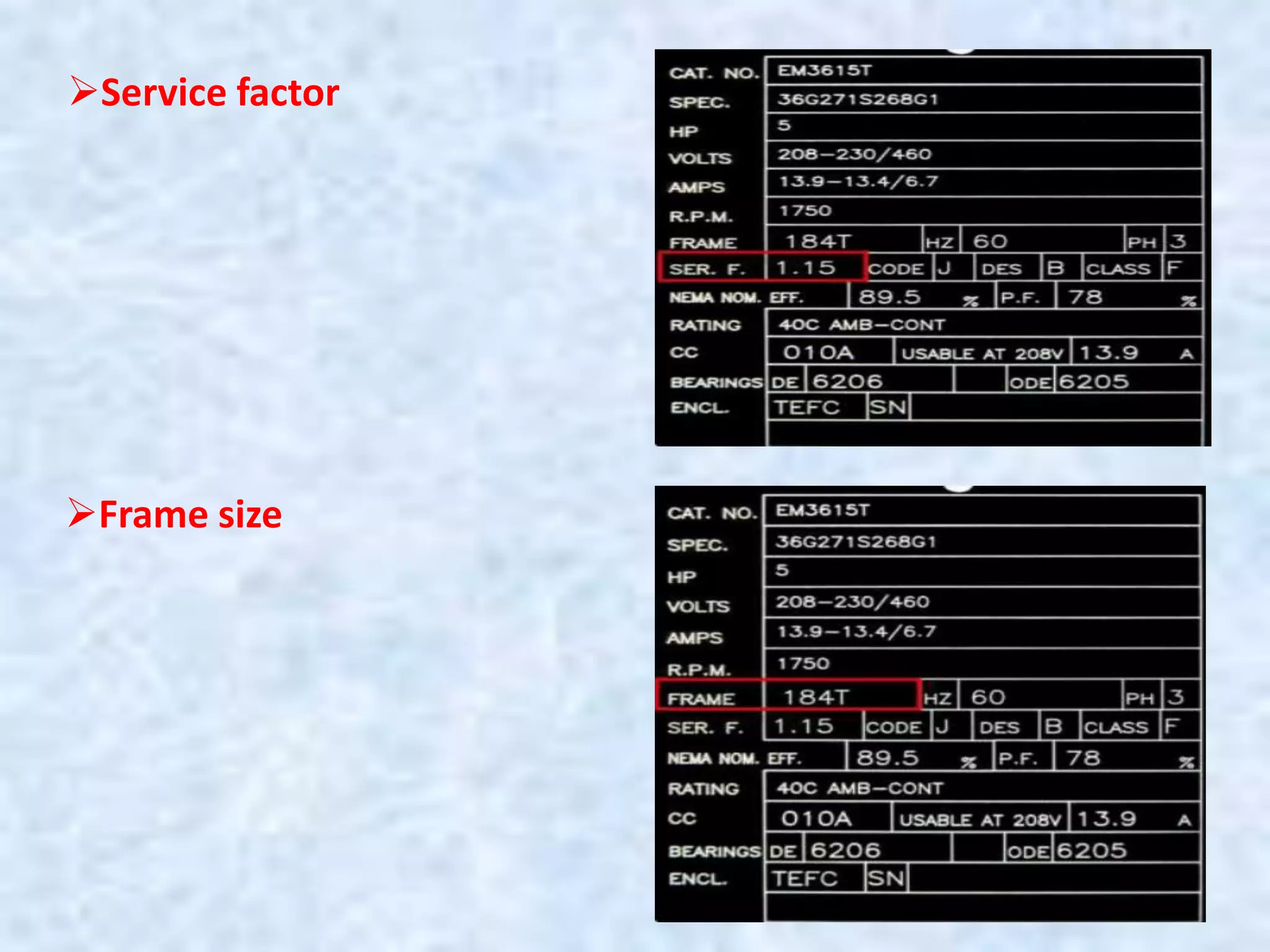
Service Factor
Frame Size
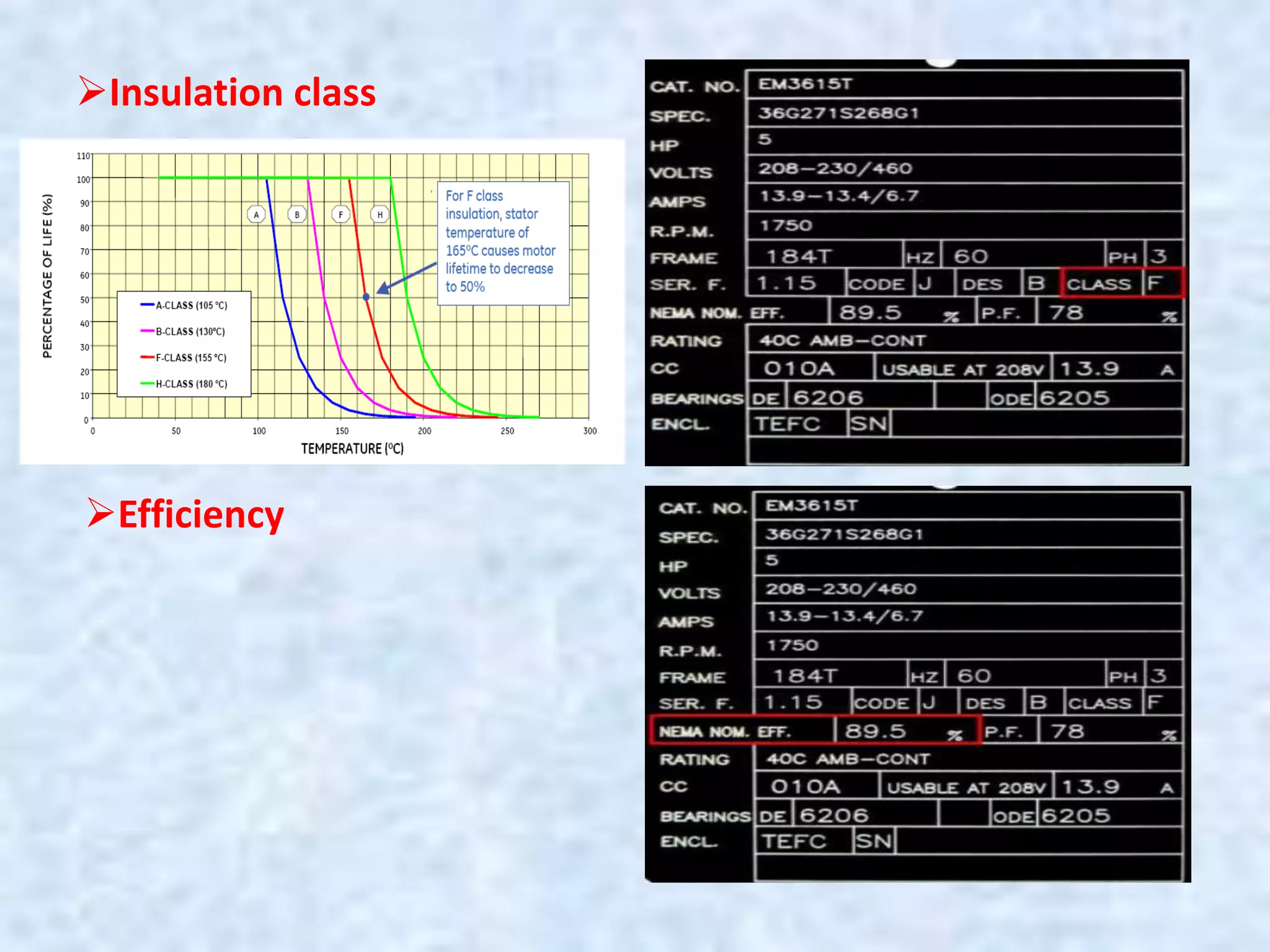
Insulation class
Efficiency
Manufacturer type
Rated horsepower
Rated voltage
Rated full load current
Rated speed
Frequency
Frame size
Service factor
Insulation class
Efficiency
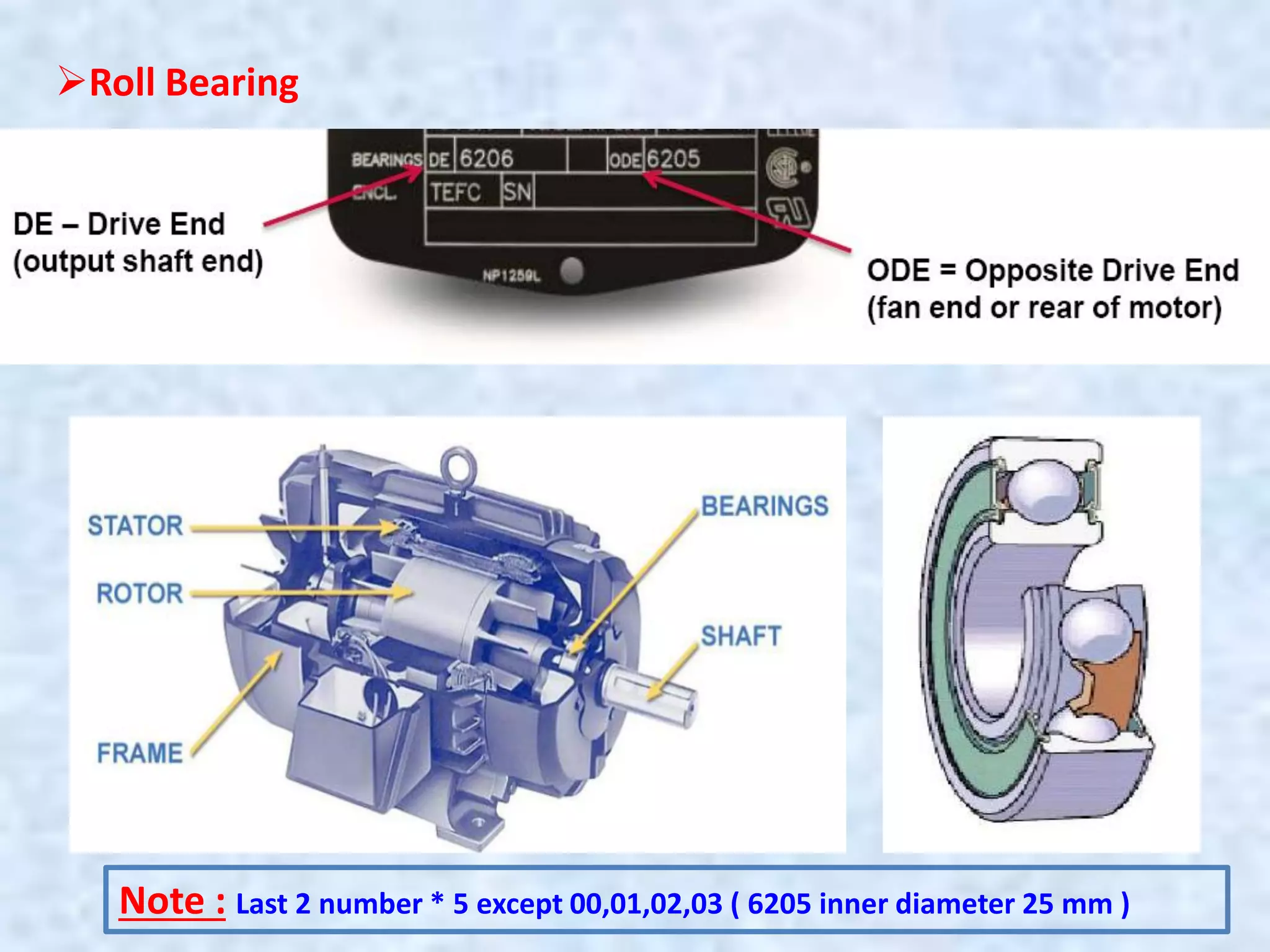
Roll Bearing
Note : Last 2 number * 5 except 00,01,02,03 ( 6205 inner diameter 25 mm )
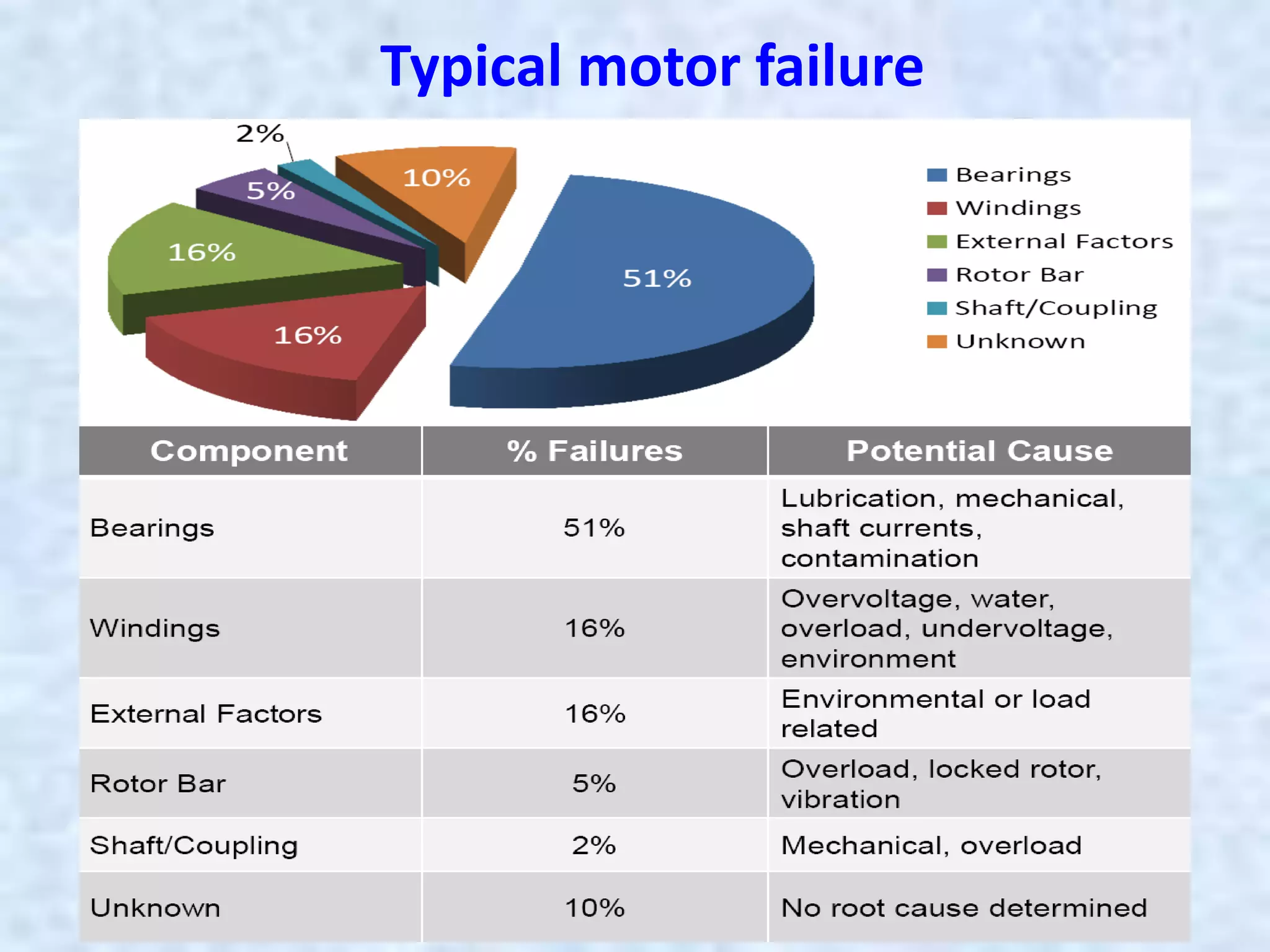
Typical motor failure
CHAPTER 5
Types of AC
Motors
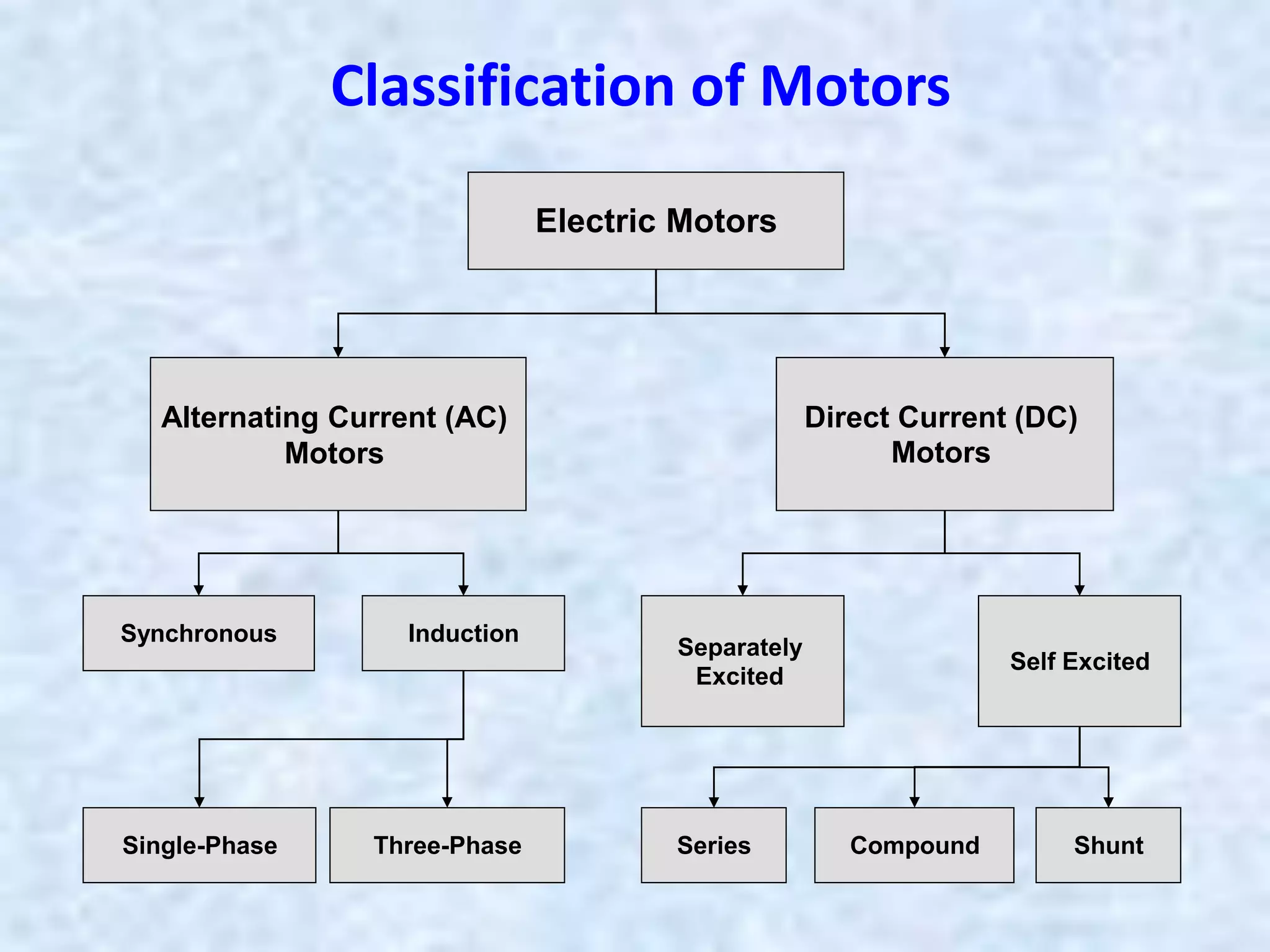
Classification of Motors
Electric Motors
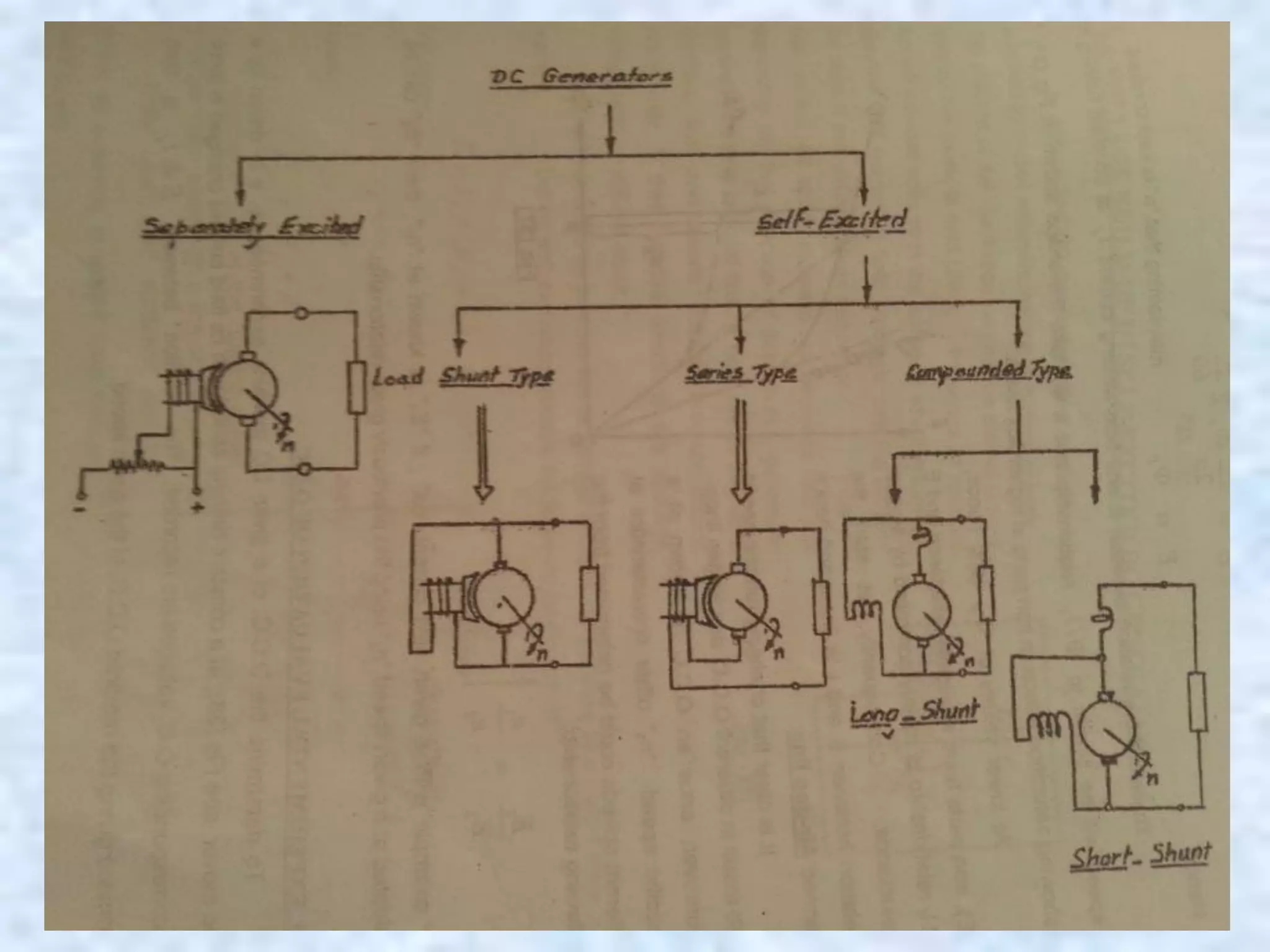
Alternating Current (AC)
Motors
Direct Current (DC)
Motors
Synchronous Induction
Three-Phase
Single-Phase
Self Excited
Separately
Excited
Series Shunt
Compound
While both A.C. and D.C. motors serve the same function of converting electrical
energy into mechanical energy, they are powered, constructed and controlled
differently. The most basic difference is the power source. A.C. motors are powered
from alternating current (A.C.) while D.C. motors are powered from direct current
(D.C.), such as batteries, D.C. power supplies or an AC-to-DC power converter. D.C
wound field motors are constructed with brushes and a commutator, which add to
the maintenance, limit the speed and usually reduce the life expectancy of brushed
D.C. motors.
A.C. induction motors do not use brushes; they are very rugged and have long life
expectancies. The final basic difference is speed control.
The speed of a D.C. motor is controlled by varying the armature winding’s current
while the speed of an A.C. motor is controlled by varying the frequency, which is
commonly done with an adjustable frequency drive control.
What is the difference between an AC motor and a
DC motor ?
92
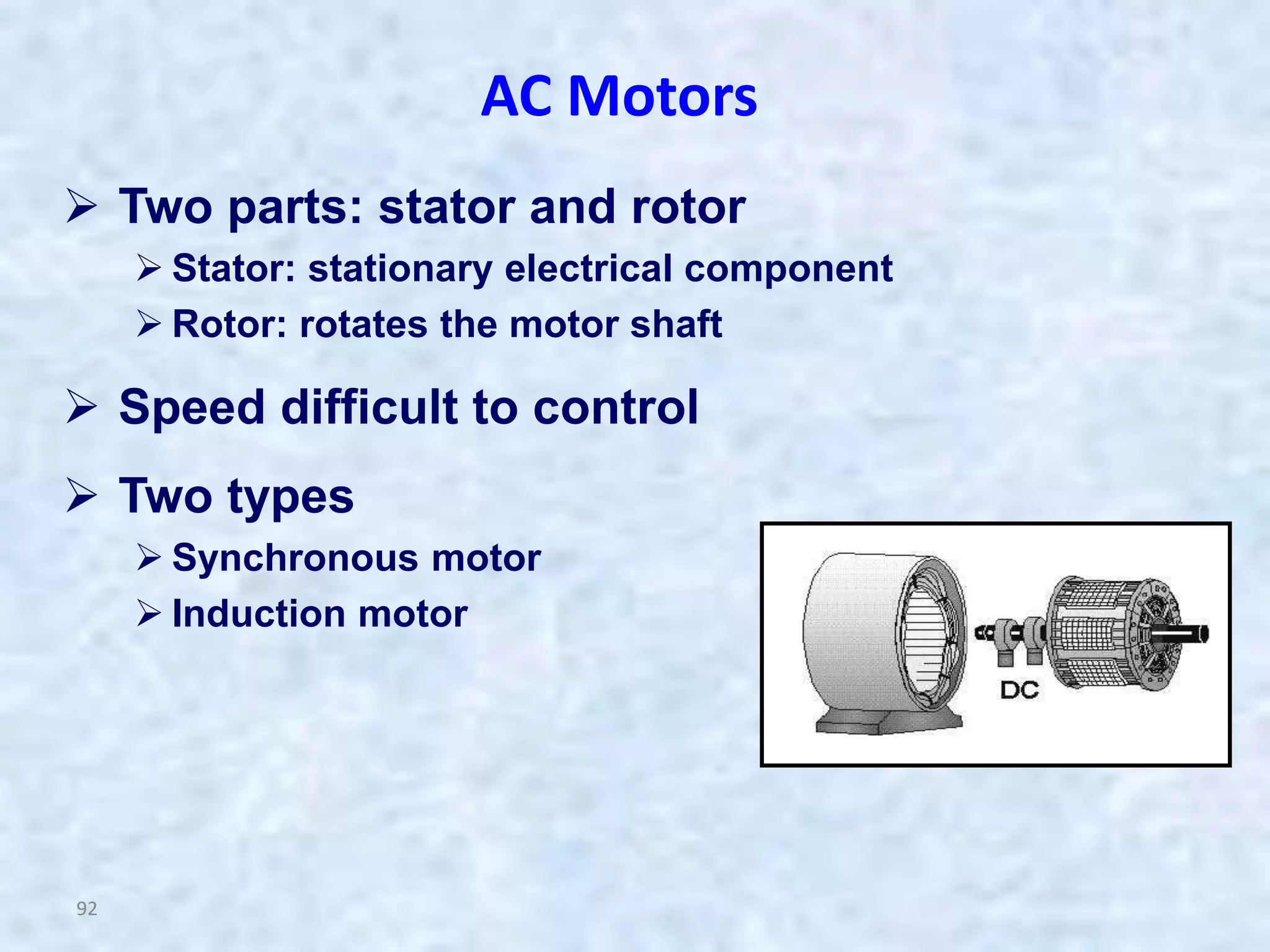
 Two parts: stator and rotor
 Stator: stationary electrical component
 Rotor: rotates the motor shaft
 Speed difficult to control
 Two types
 Synchronous motor
 Induction motor
AC Motors
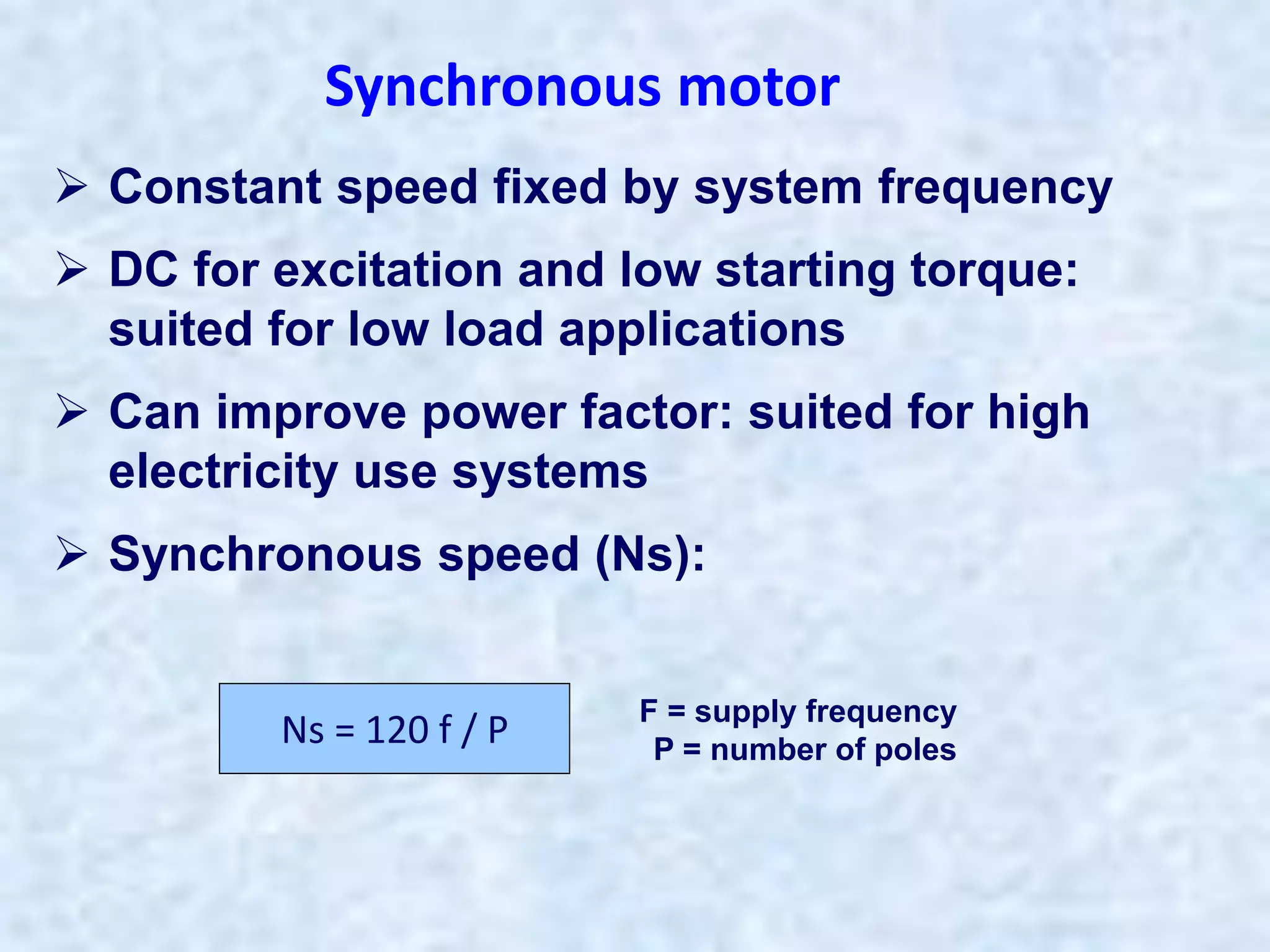
 Constant speed fixed by system frequency
 DC for excitation and low starting torque:
suited for low load applications
 Can improve power factor: suited for high
electricity use systems
 Synchronous speed (Ns):
Synchronous motor
Ns = 120 f / P F = supply frequency
P = number of poles
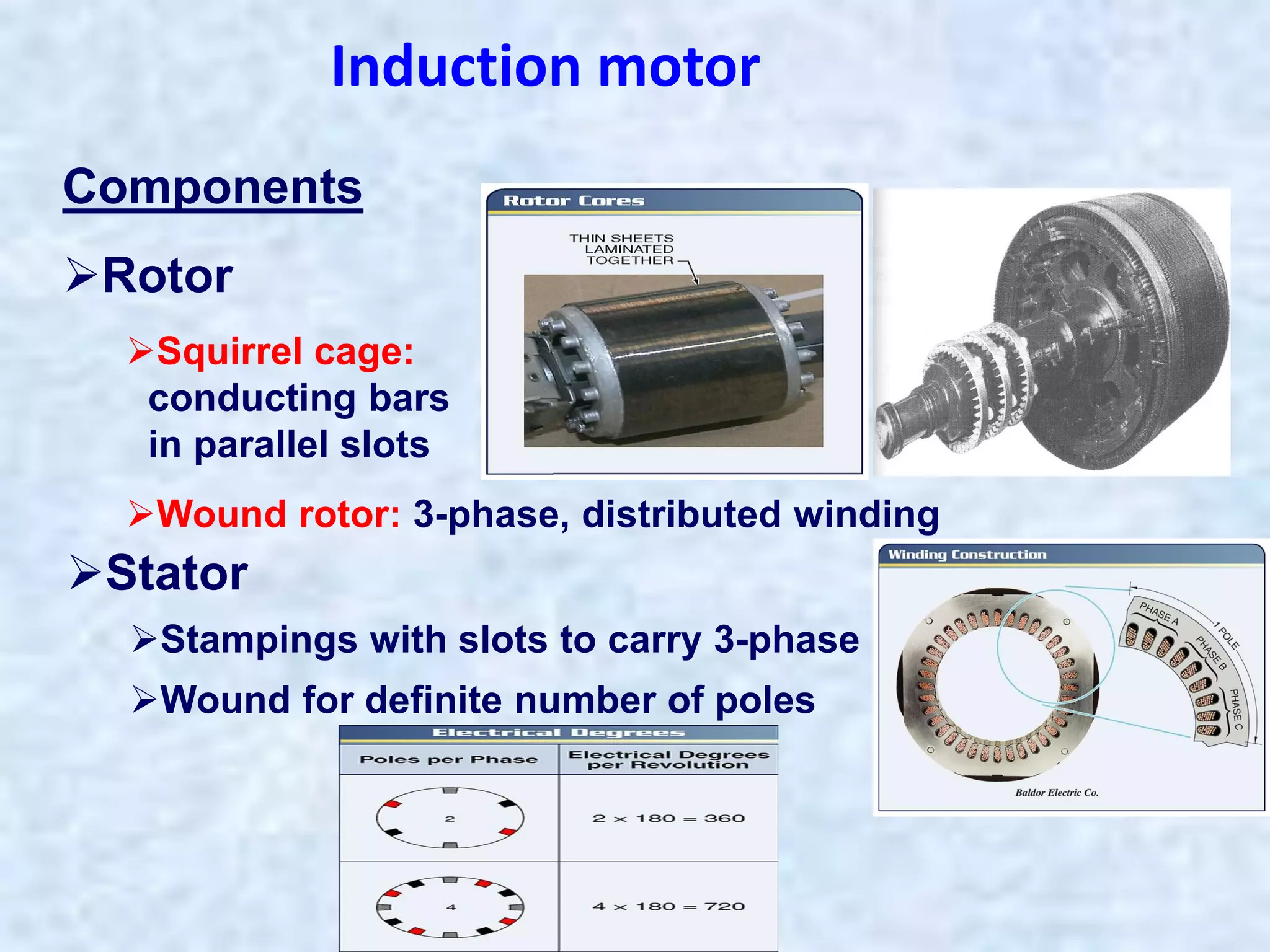
Components
Rotor
Squirrel cage:
conducting bars
in parallel slots
Wound rotor: 3-phase, distributed winding
Induction motor
Stator
Stampings with slots to carry 3-phase
Wound for definite number of poles
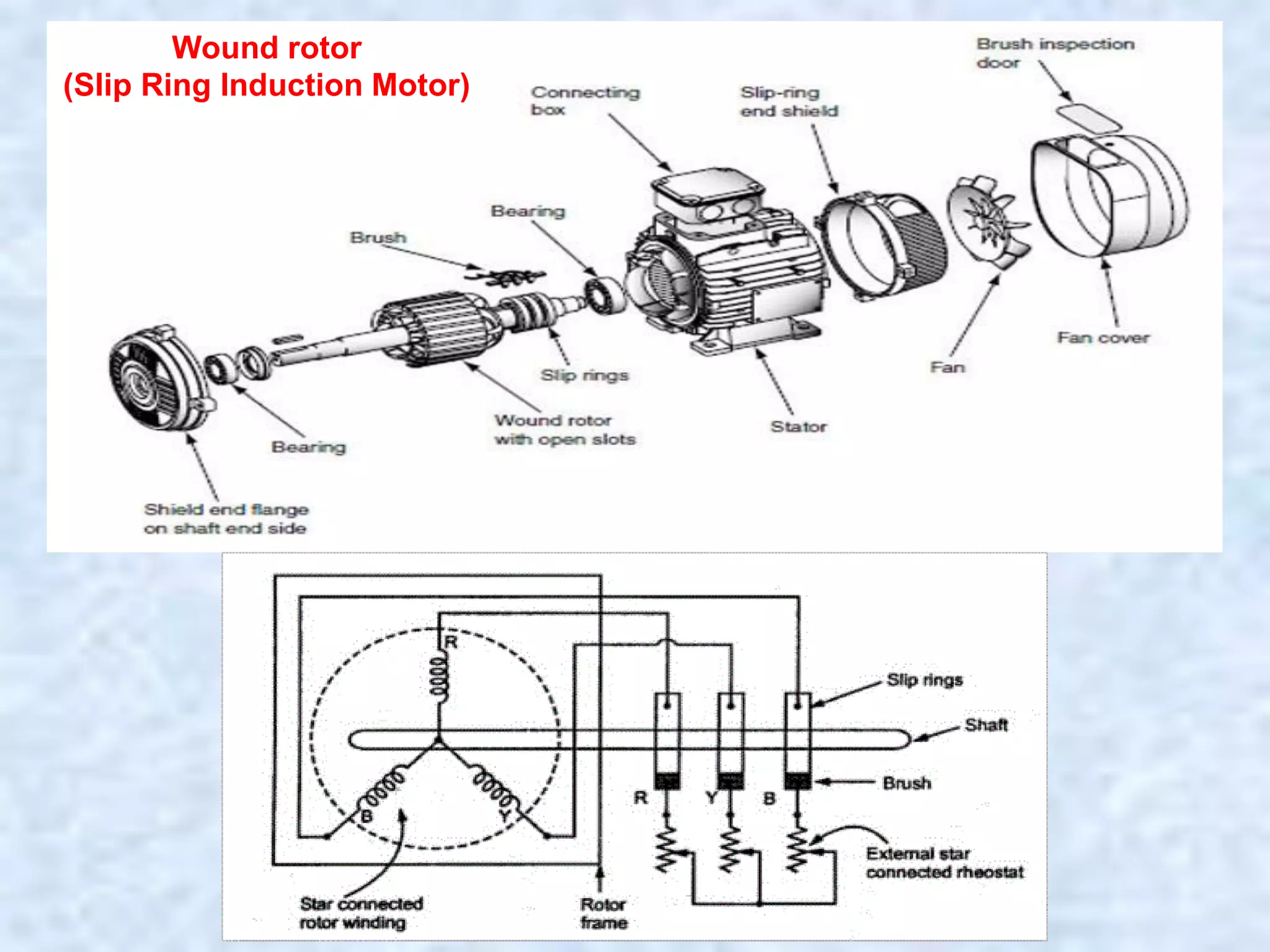
Wound rotor
(Slip Ring Induction Motor)
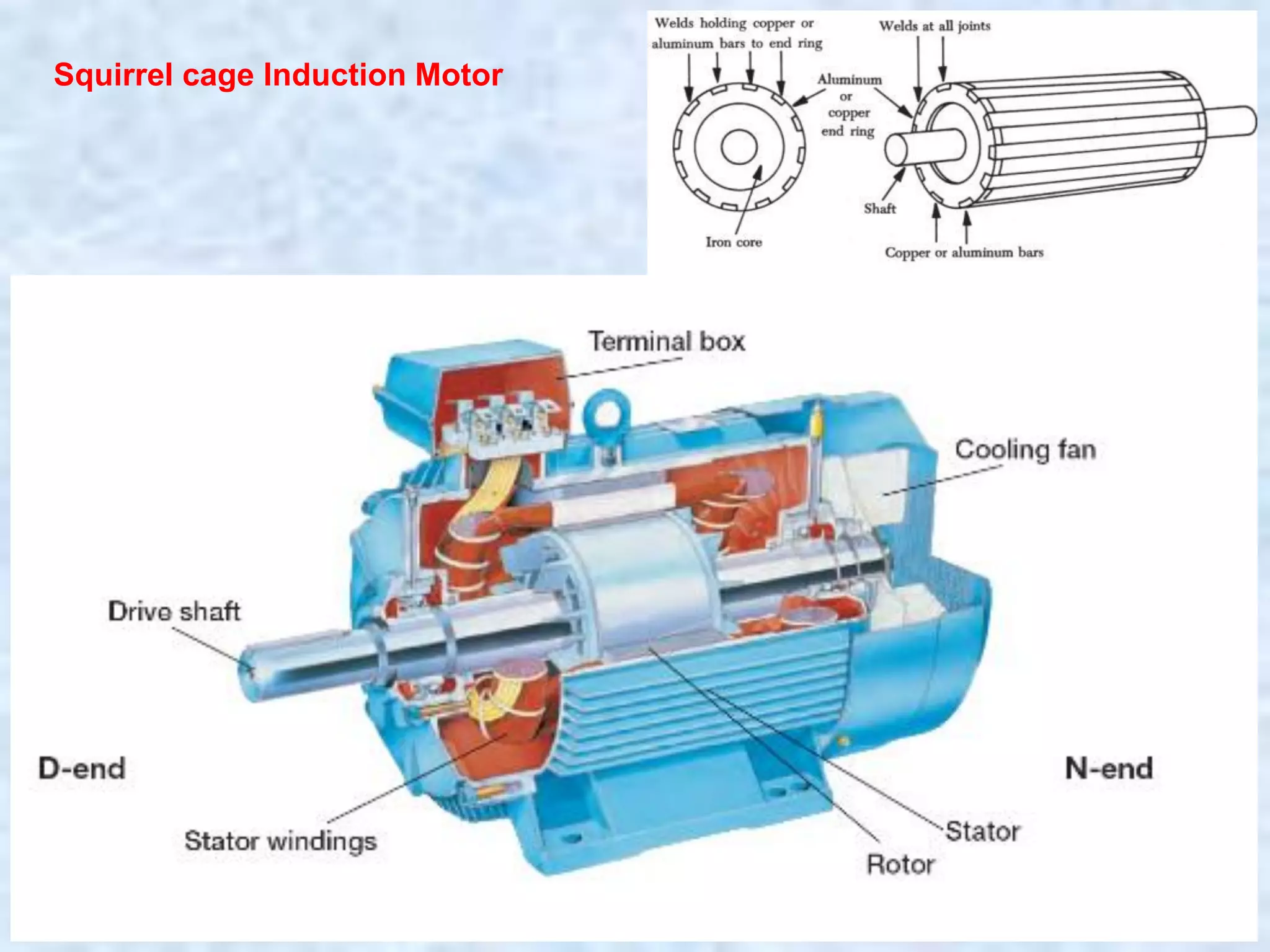
Squirrel cage Induction Motor
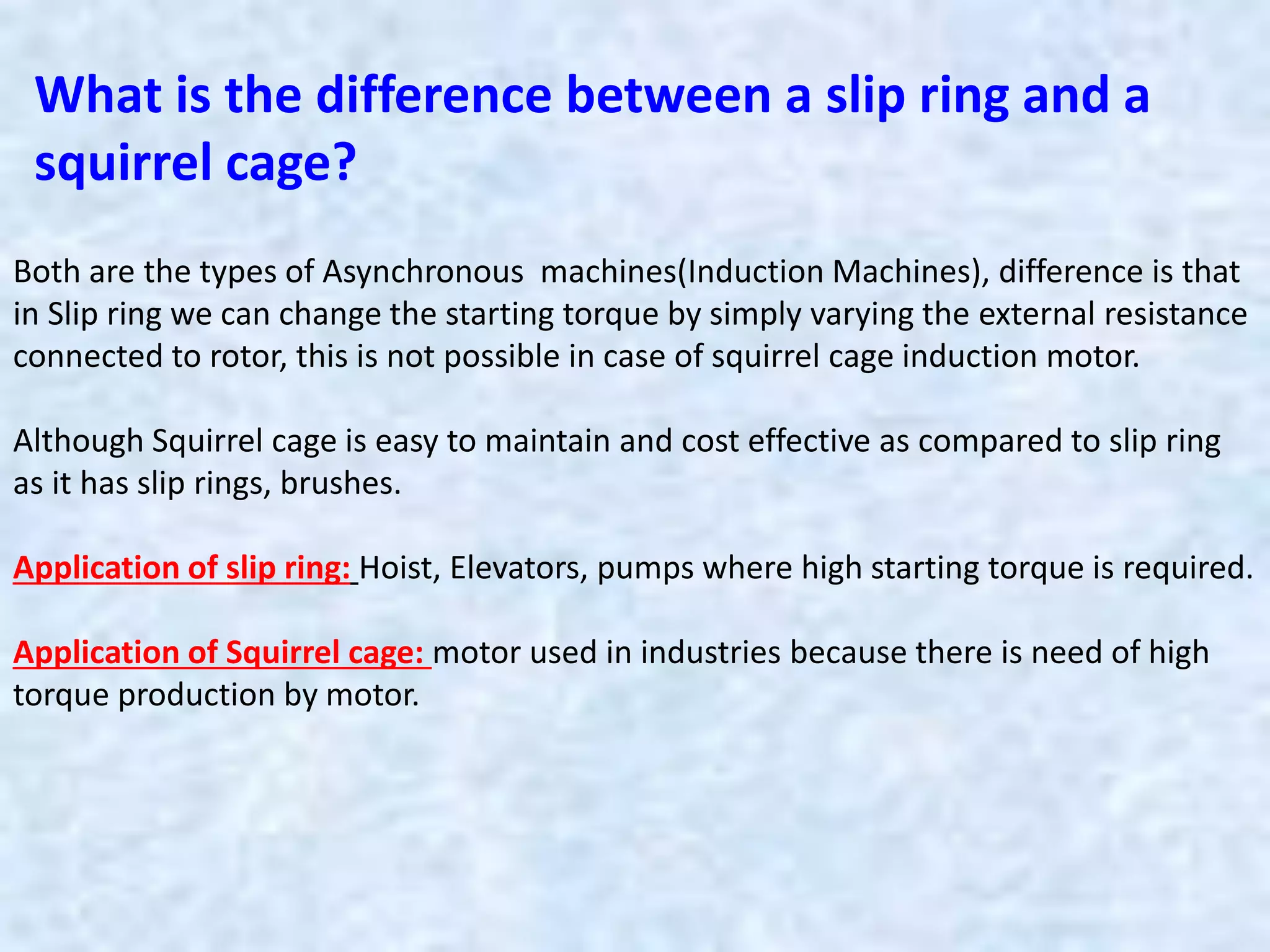
What is the difference between a slip ring and a
squirrel cage?
Both are the types of Asynchronous machines(Induction Machines), difference is that
in Slip ring we can change the starting torque by simply varying the external resistance
connected to rotor, this is not possible in case of squirrel cage induction motor.
Although Squirrel cage is easy to maintain and cost effective as compared to slip ring
as it has slip rings, brushes.
Application of slip ring: Hoist, Elevators, pumps where high starting torque is required.
Application of Squirrel cage: motor used in industries because there is need of high
torque production by motor.
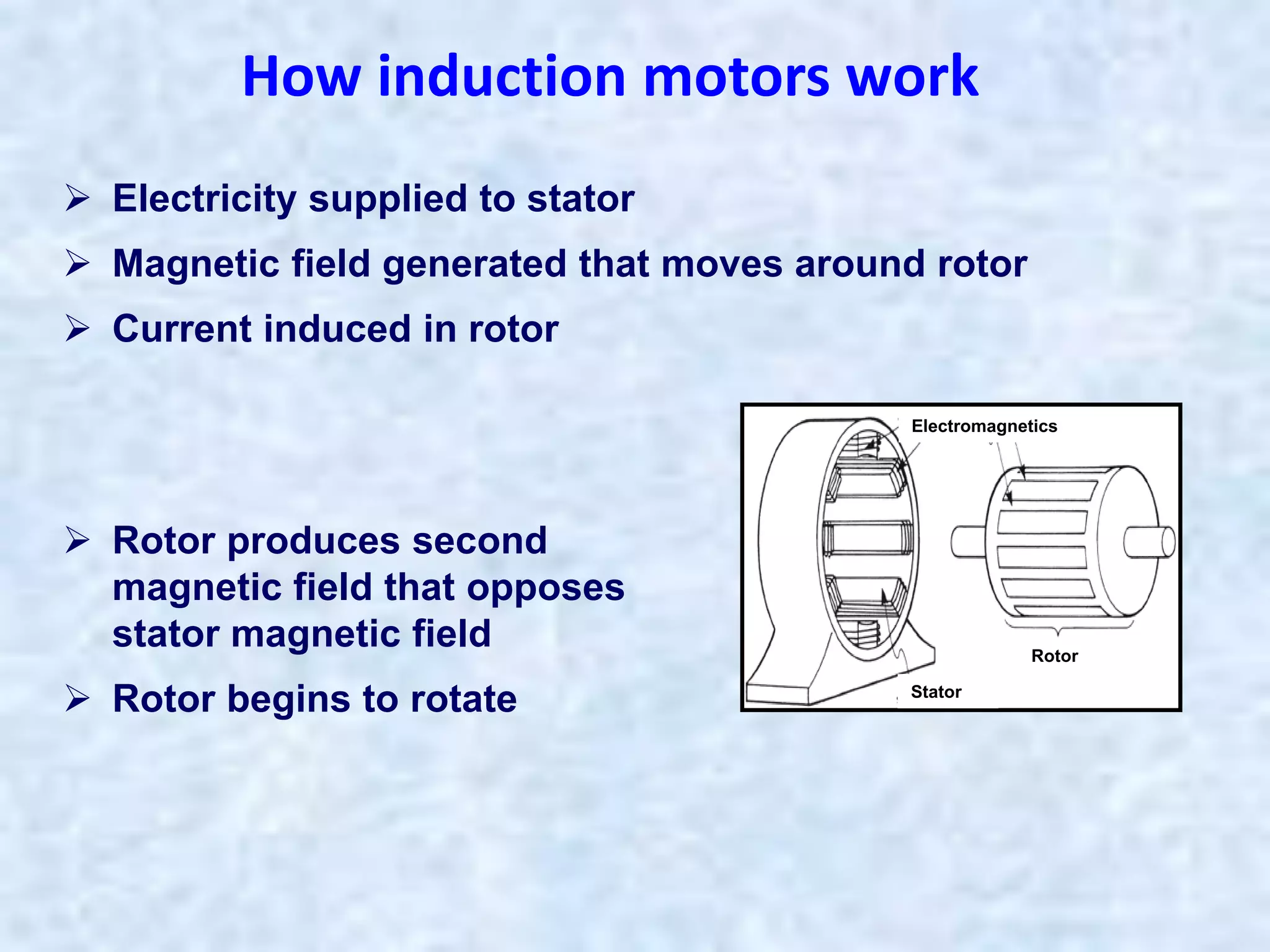
How induction motors work
 Electricity supplied to stator
 Magnetic field generated that moves around rotor
 Current induced in rotor
Electromagnetics
Stator
Rotor
 Rotor produces second
magnetic field that opposes
stator magnetic field
 Rotor begins to rotate
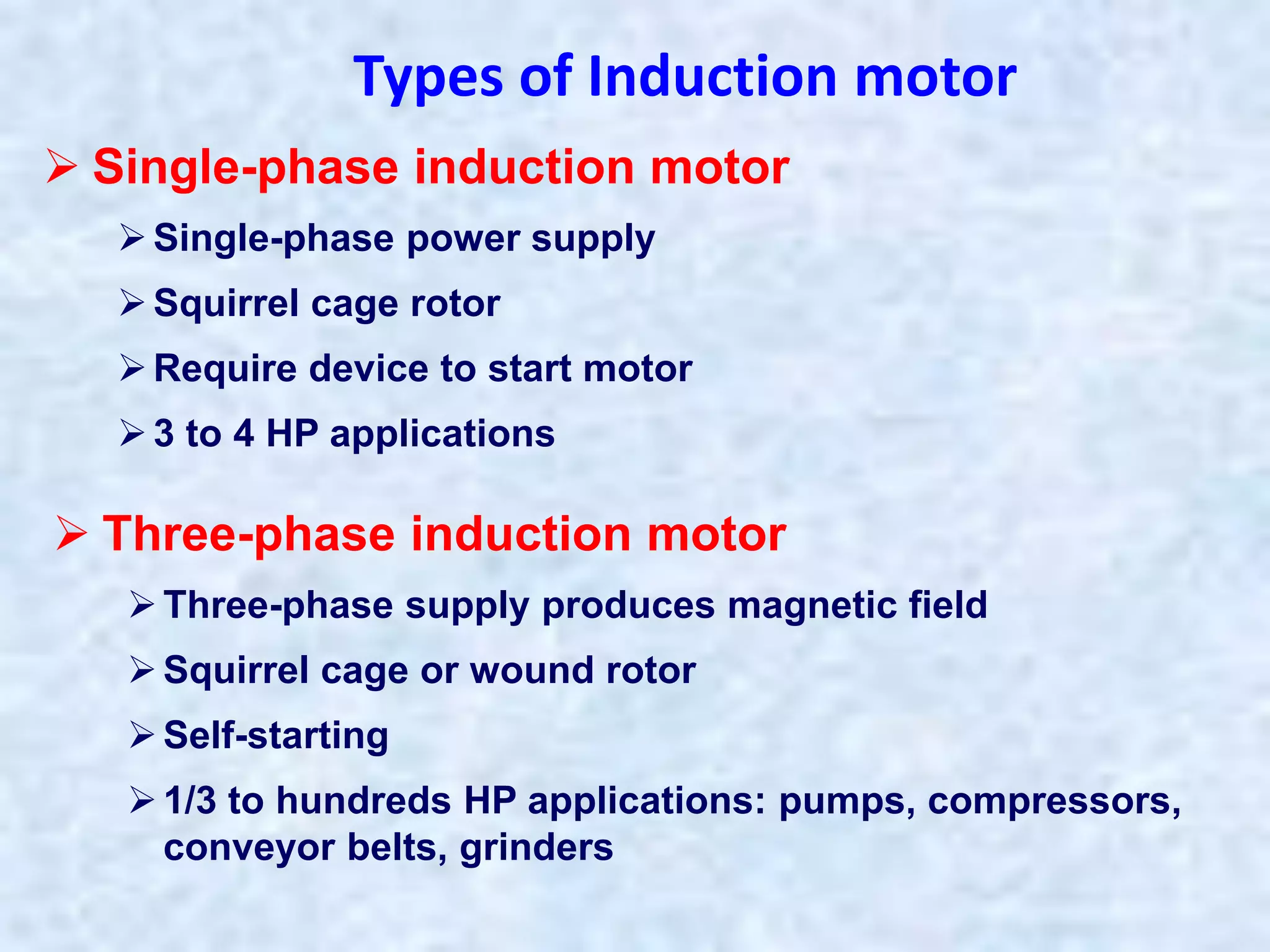
Types of Induction motor
 Single-phase induction motor
Single-phase power supply
Squirrel cage rotor
Require device to start motor
3 to 4 HP applications
 Three-phase induction motor
Three-phase supply produces magnetic field
Squirrel cage or wound rotor
Self-starting
1/3 to hundreds HP applications: pumps, compressors,
conveyor belts, grinders
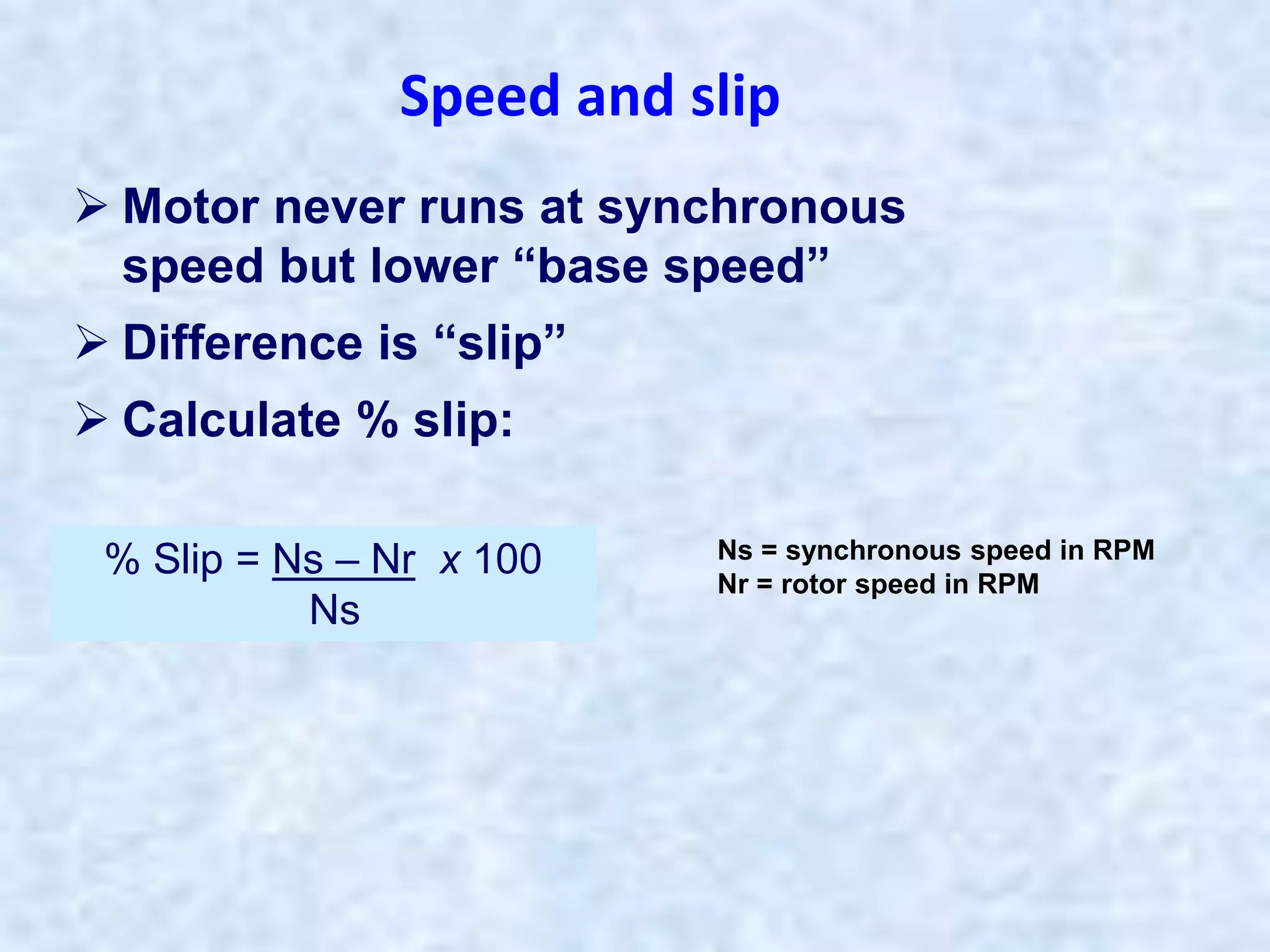
 Motor never runs at synchronous
speed but lower “base speed”
 Difference is “slip”
 Calculate % slip:
% Slip = Ns – Nr x 100
Ns
Ns = synchronous speed in RPM
Nr = rotor speed in RPM
Speed and slip
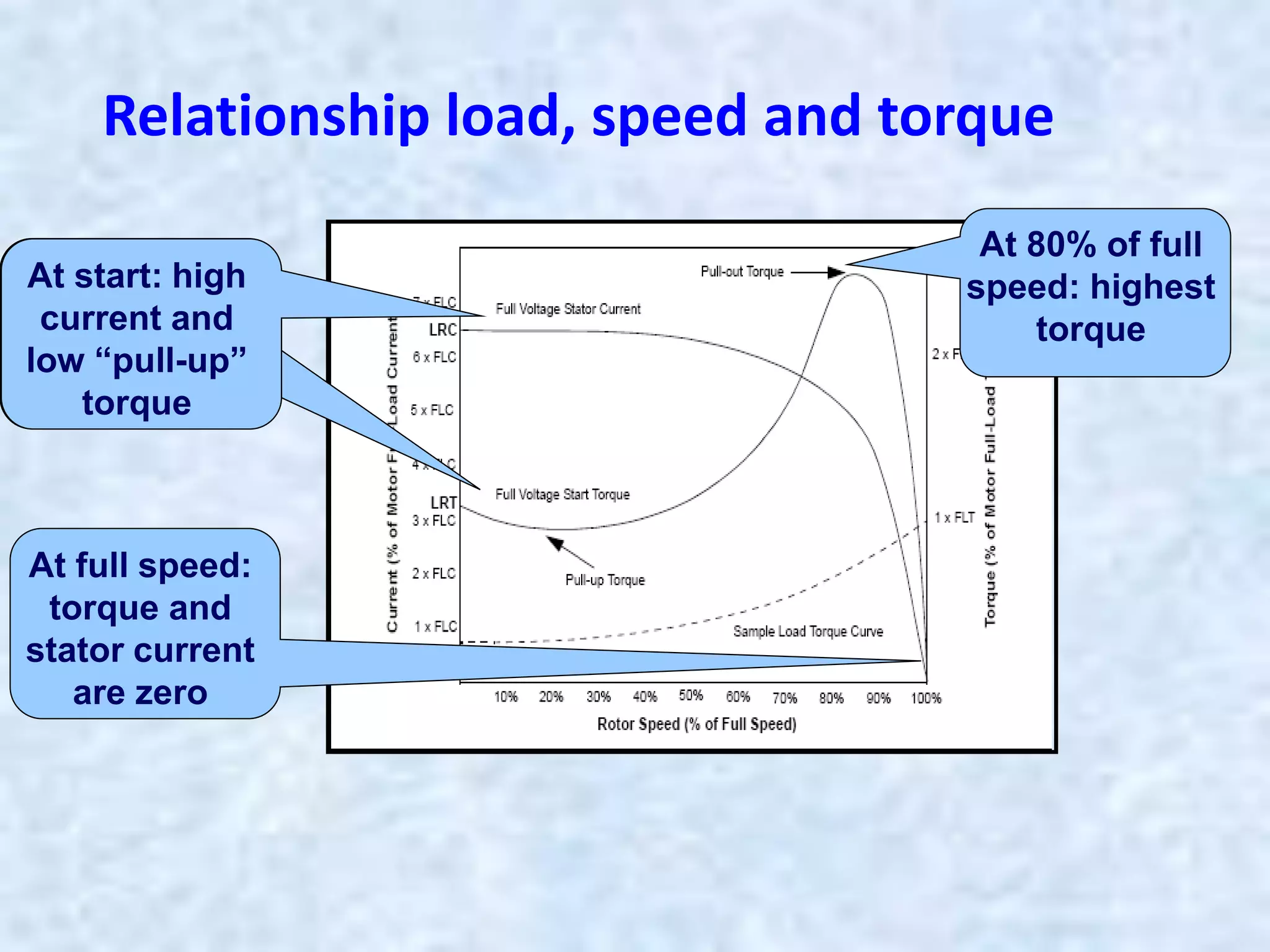
Relationship load, speed and torque
At start: high
current and
low “pull-up”
torque
At start: high
current and
low “pull-up”
torque
At 80% of full
speed: highest
torque
At full speed:
torque and
stator current
are zero
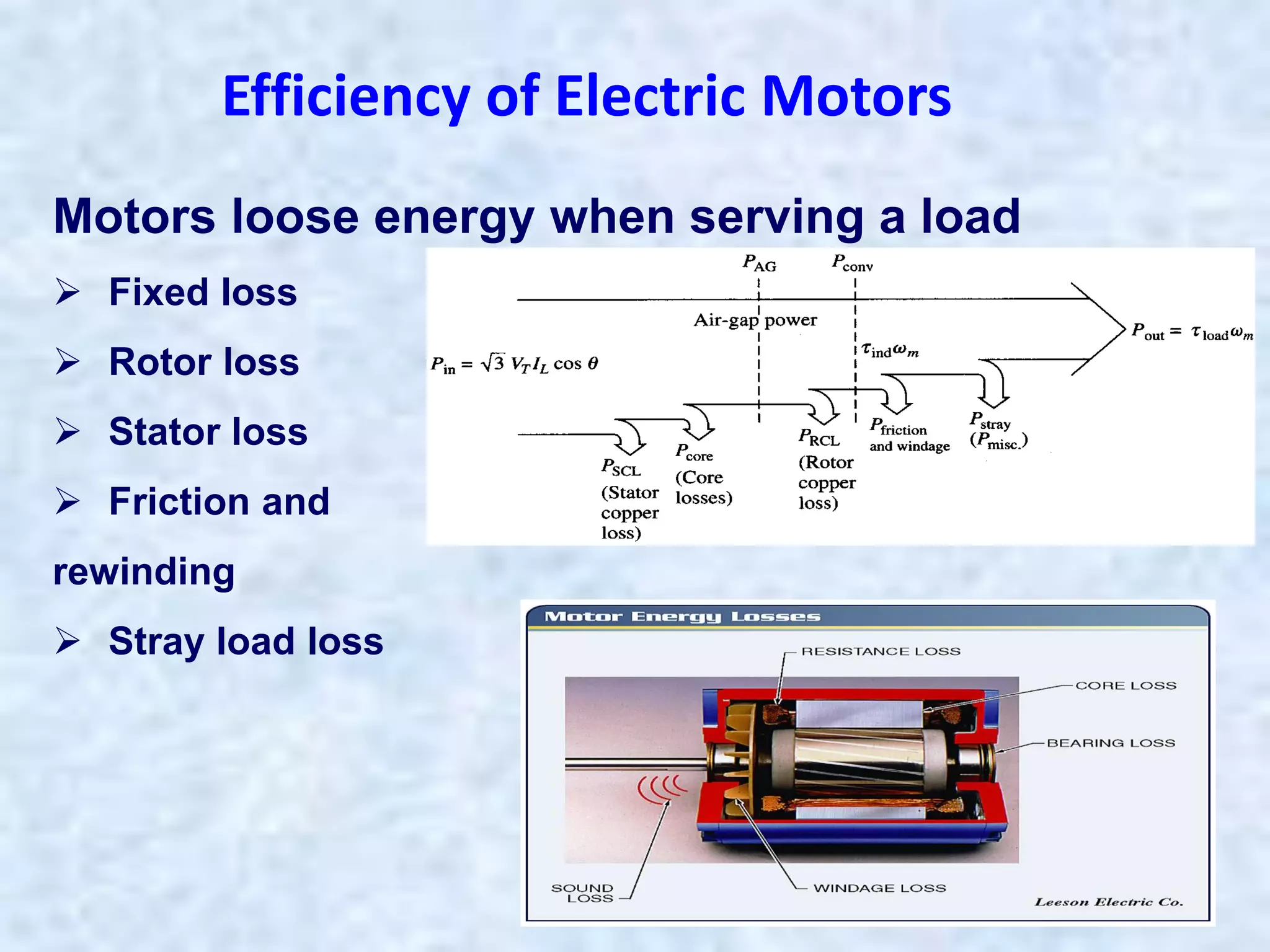
Motors loose energy when serving a load
 Fixed loss
 Rotor loss
 Stator loss
 Friction and
rewinding
 Stray load loss
Efficiency of Electric Motors
Checklist to maintain motor efficiency
Inspect motors regularly for wear, dirt/dust
Checking motor loads for over loading
Lubricate appropriately
Check alignment of motor and equipment
Ensure supply wiring and terminal box and properly sized
and installed
Provide adequate ventilation
Maintenance
 Multi-speed motors
Limited speed control: 2 – 4 fixed speeds
 Wound rotor motor drives
Variable resistors to control torque performance
Speed & Torque control of Induction Motor
 Variable speed drives (VSDs)
Reduce electricity by >50% in fans and pumps
Convert 50Hz incoming power to variable
frequency and voltage: change speed
CHAPTER 6
Different types of
Motor Control
Circuit
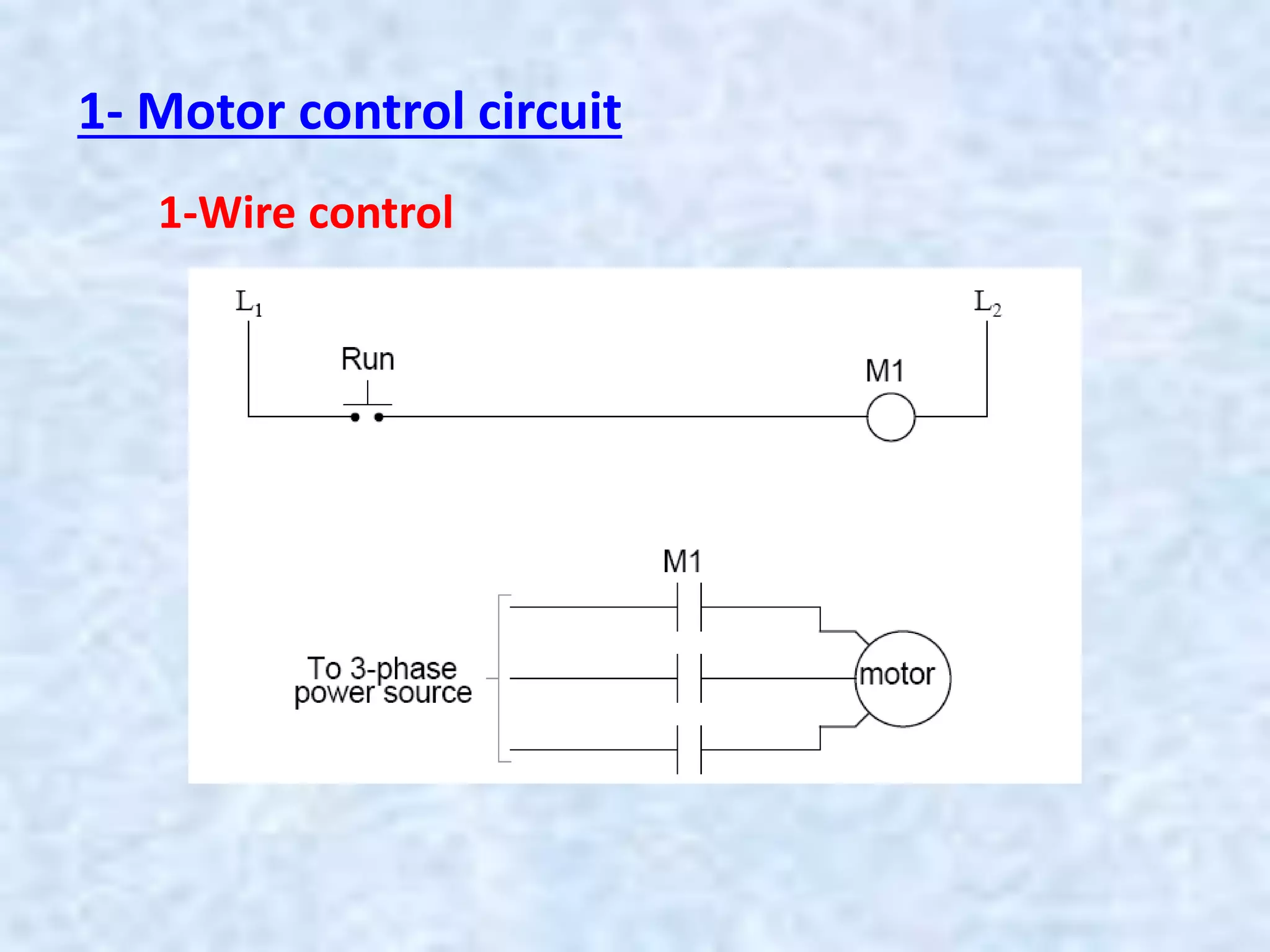
1- Motor control circuit
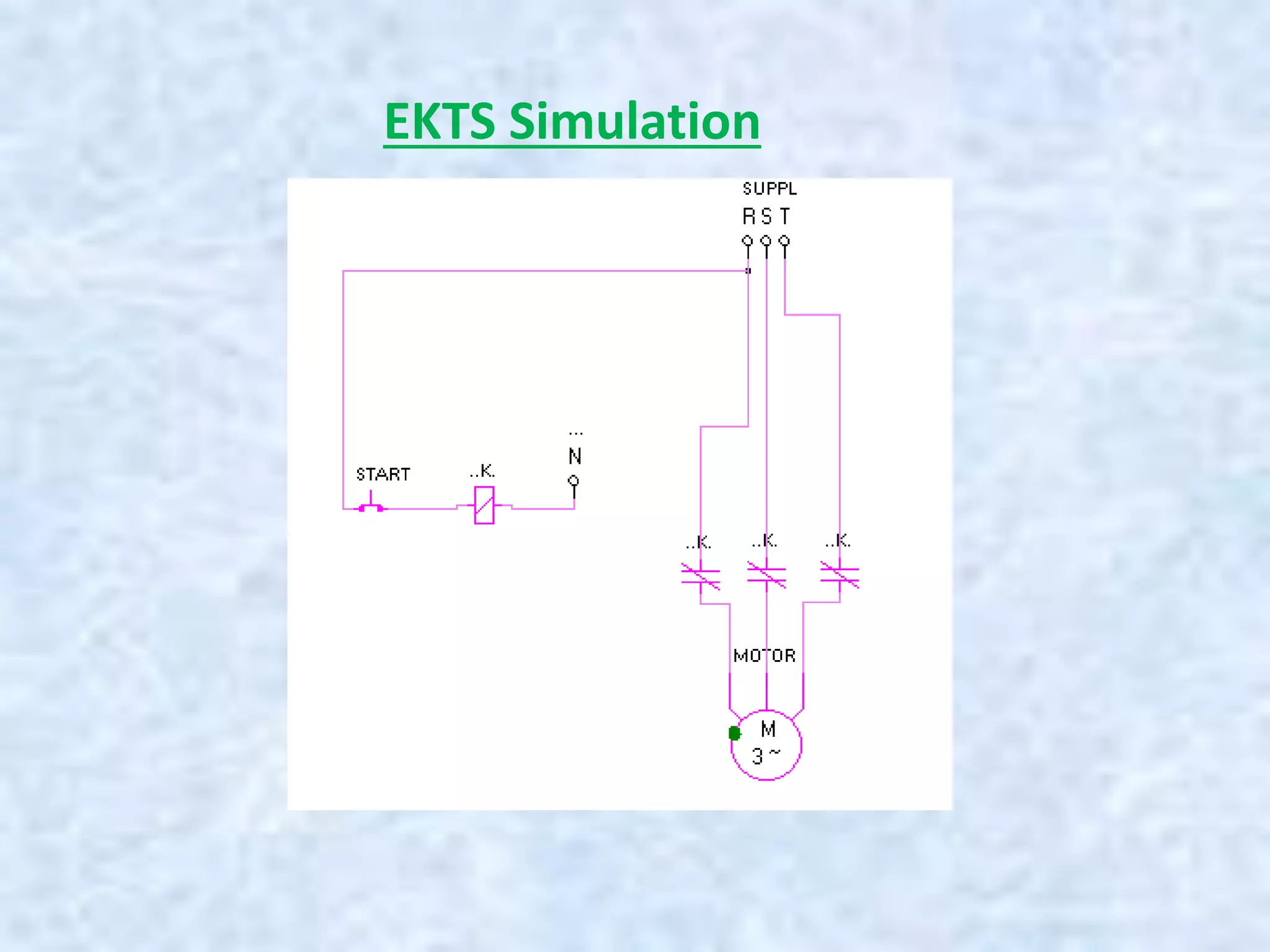
1-Wire control
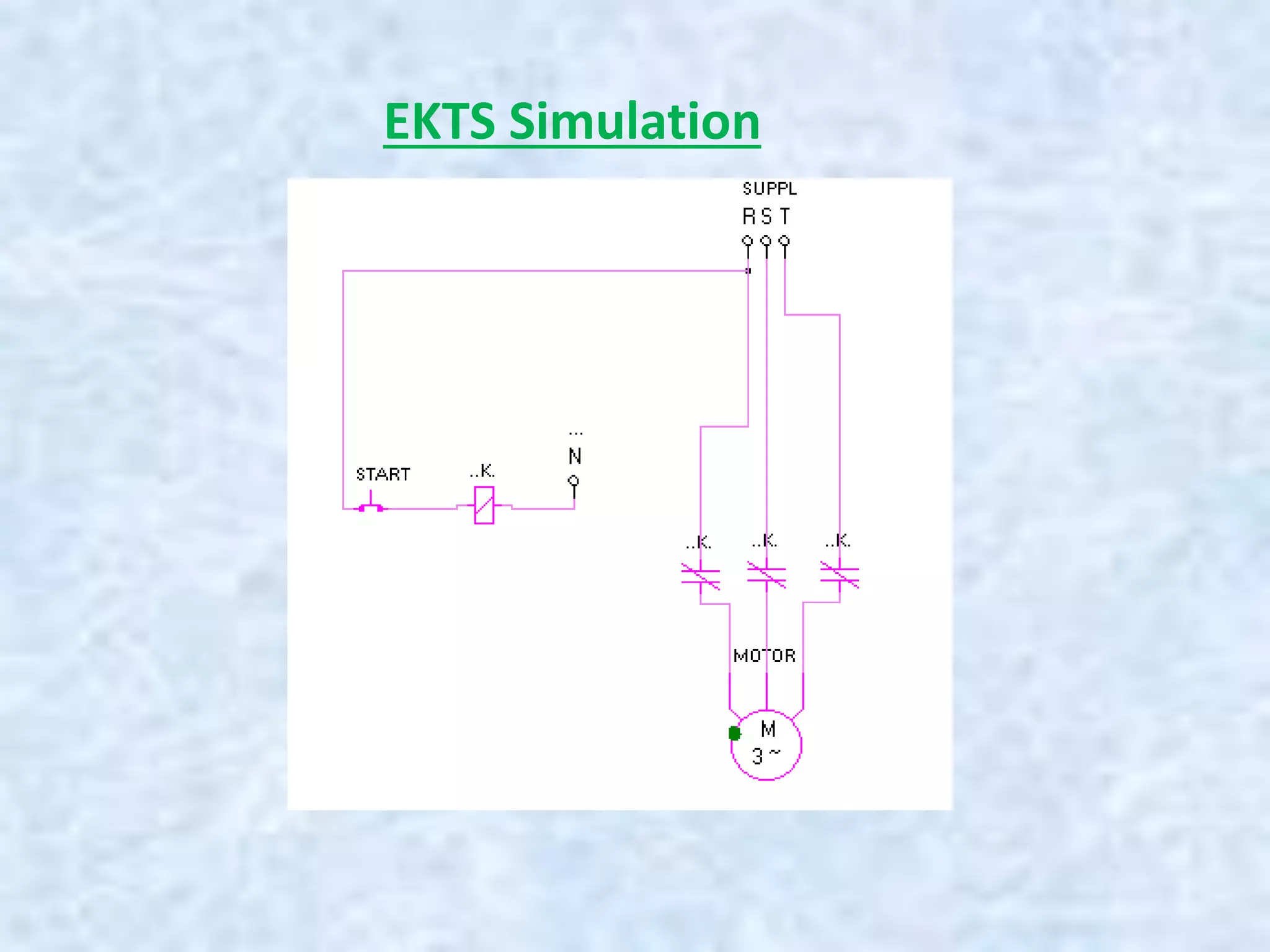
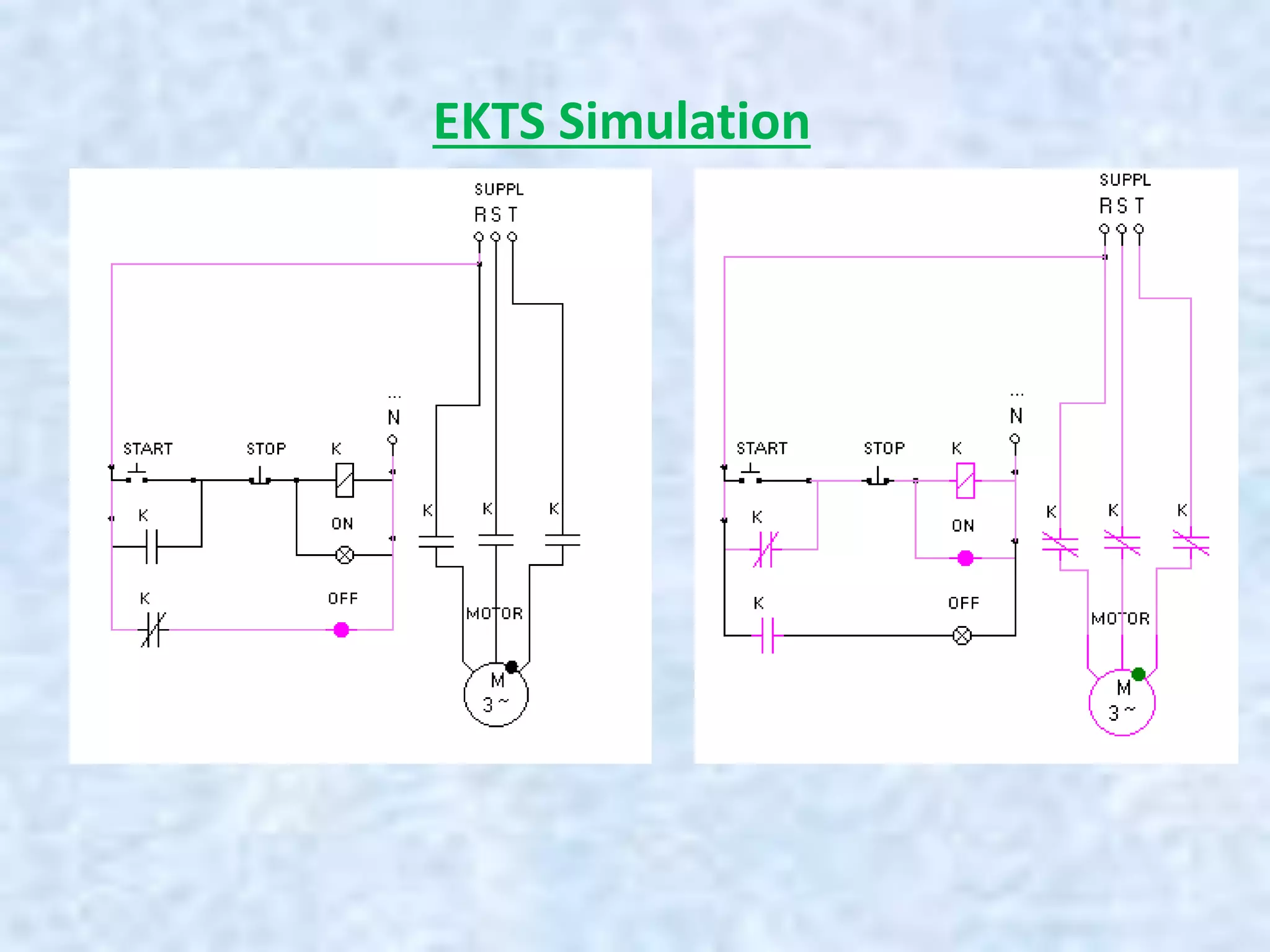
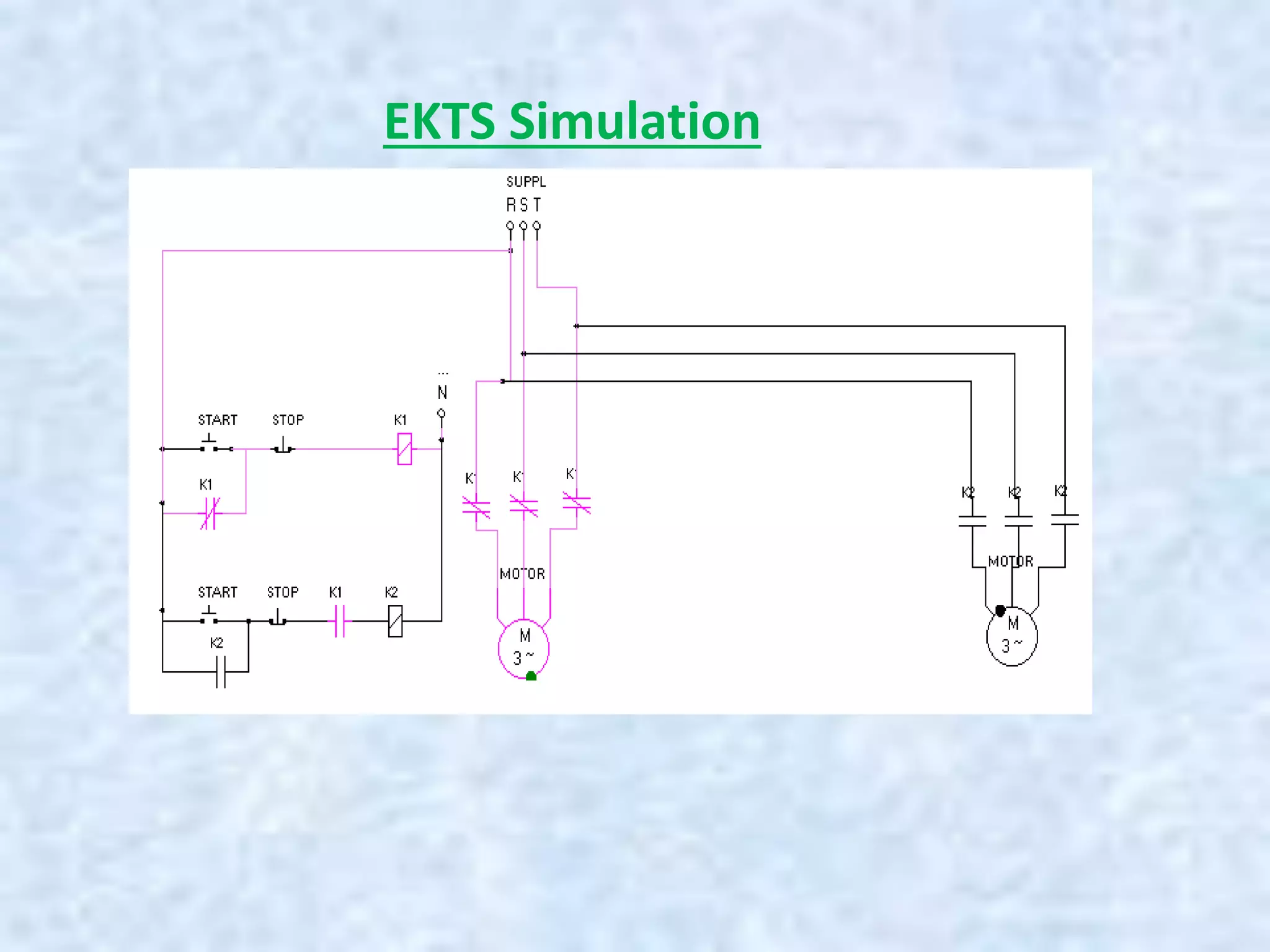
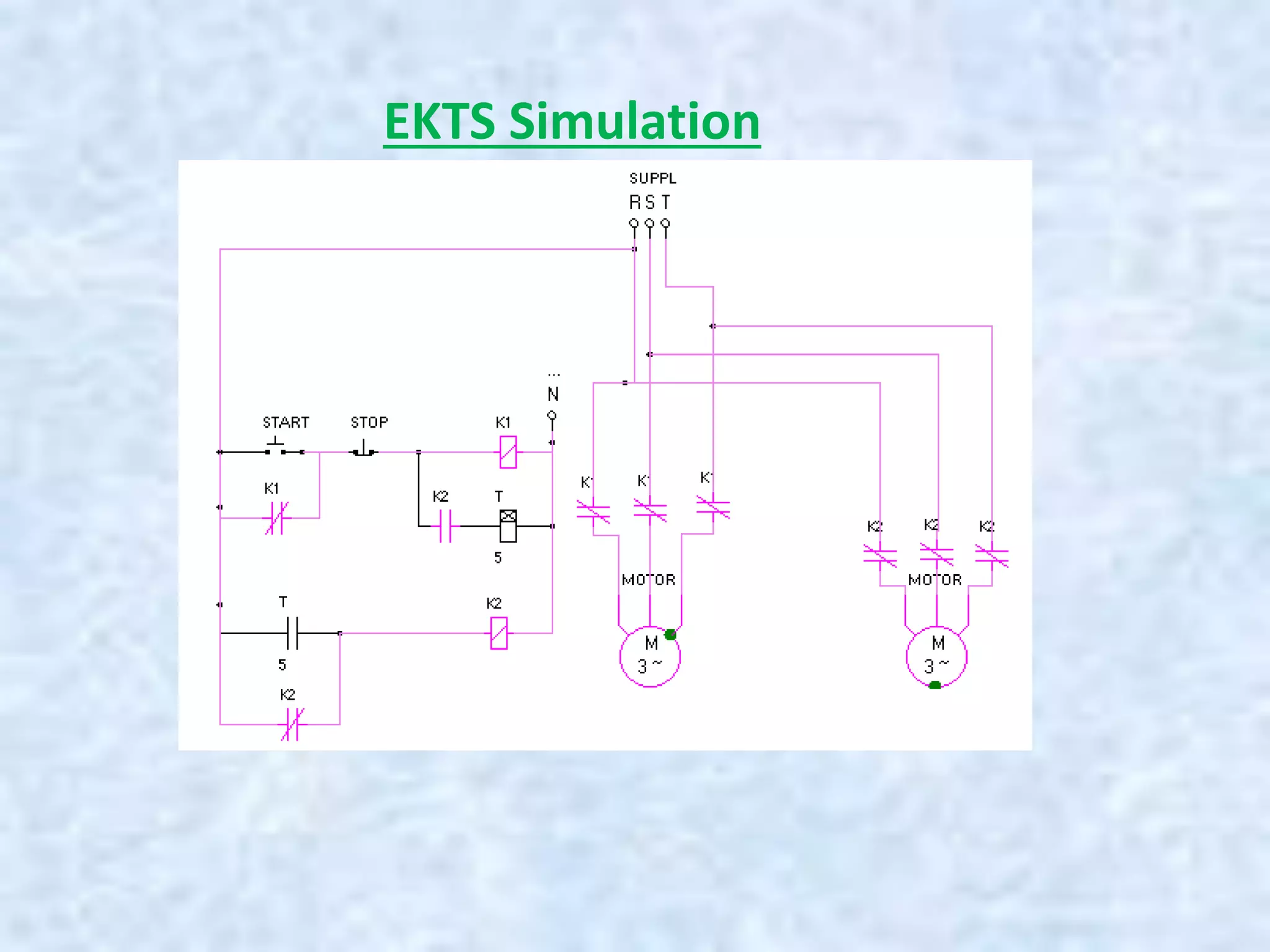
EKTS Simulation
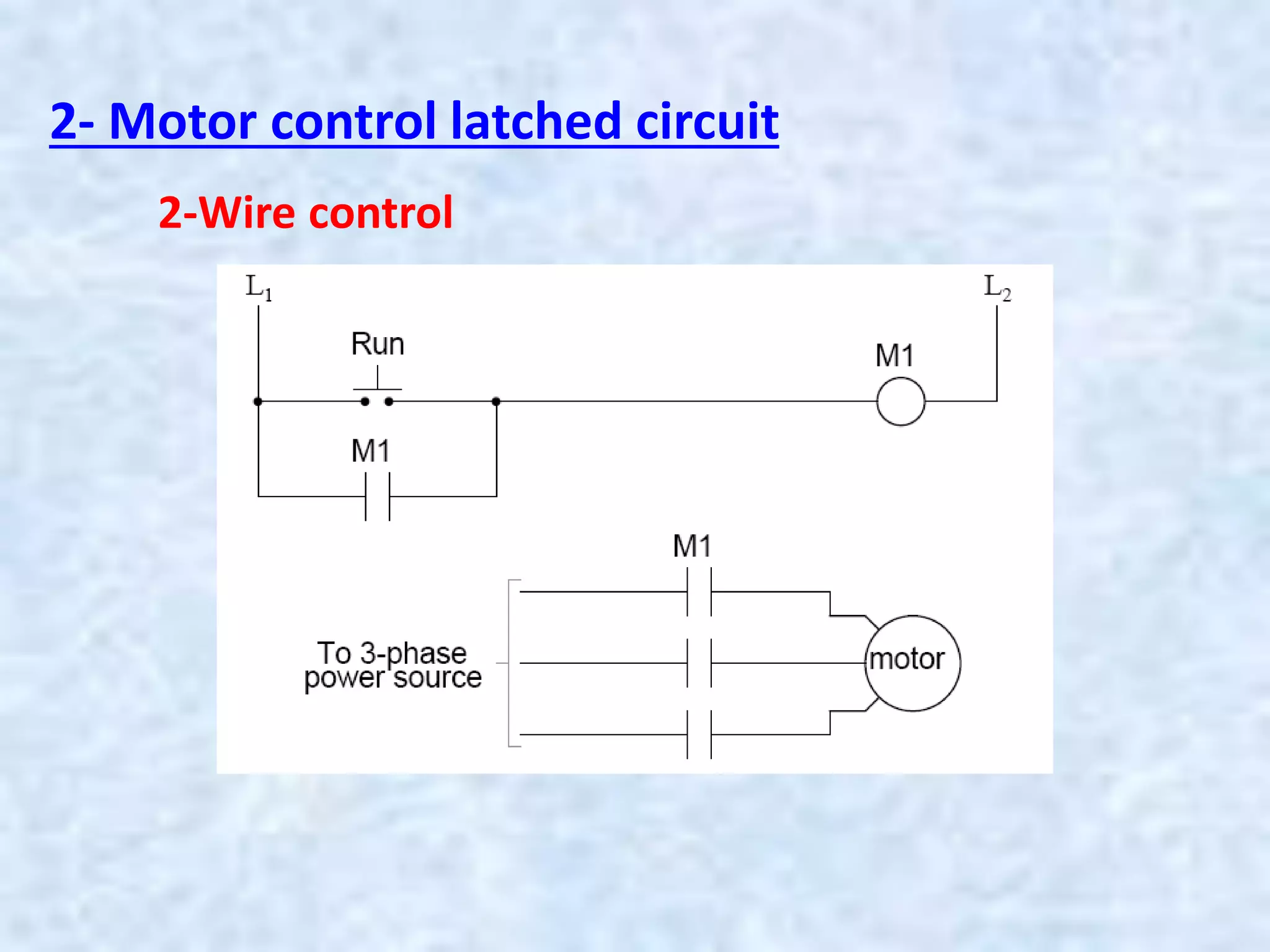
2- Motor control latched circuit
2-Wire control
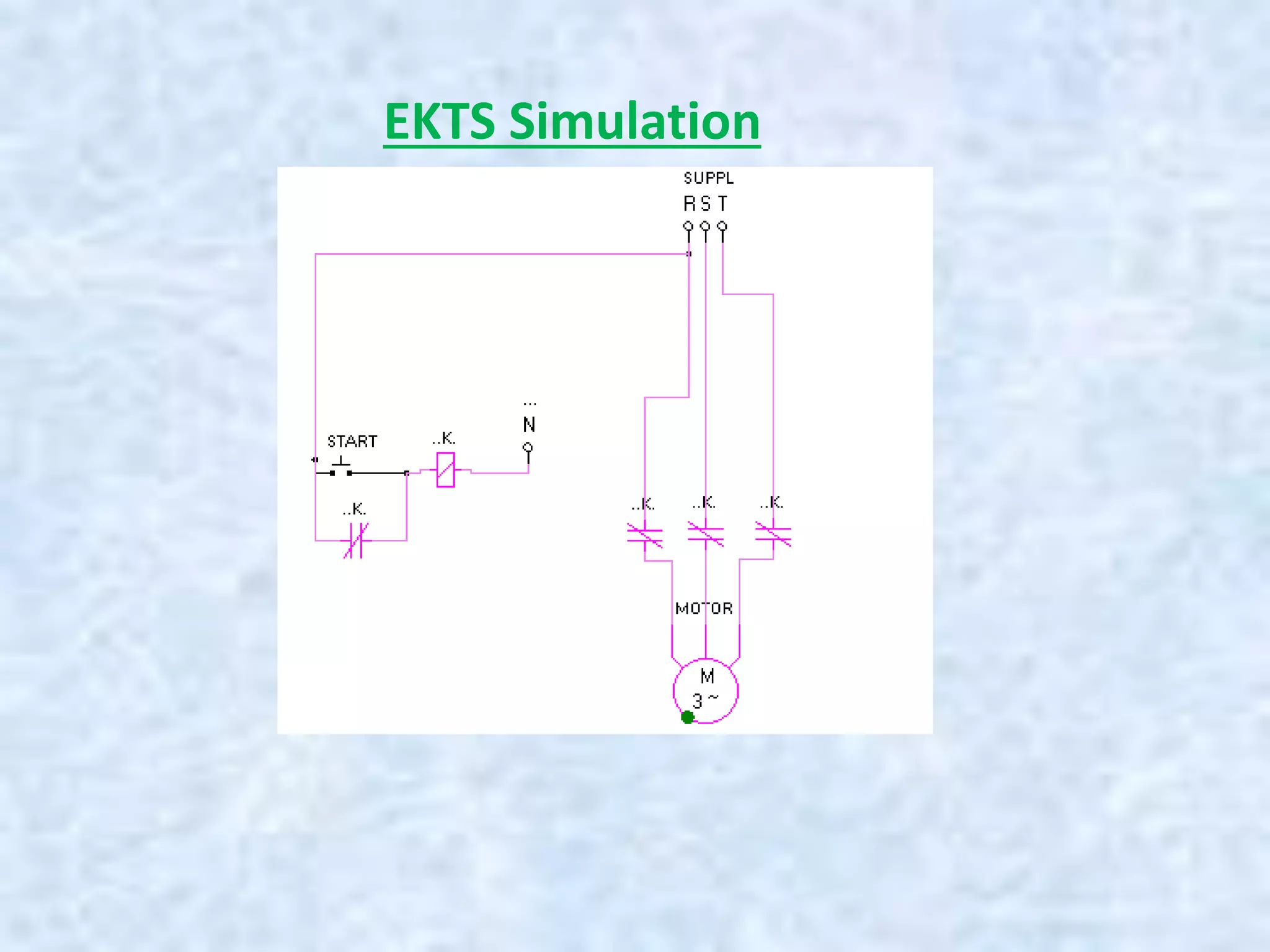
EKTS Simulation
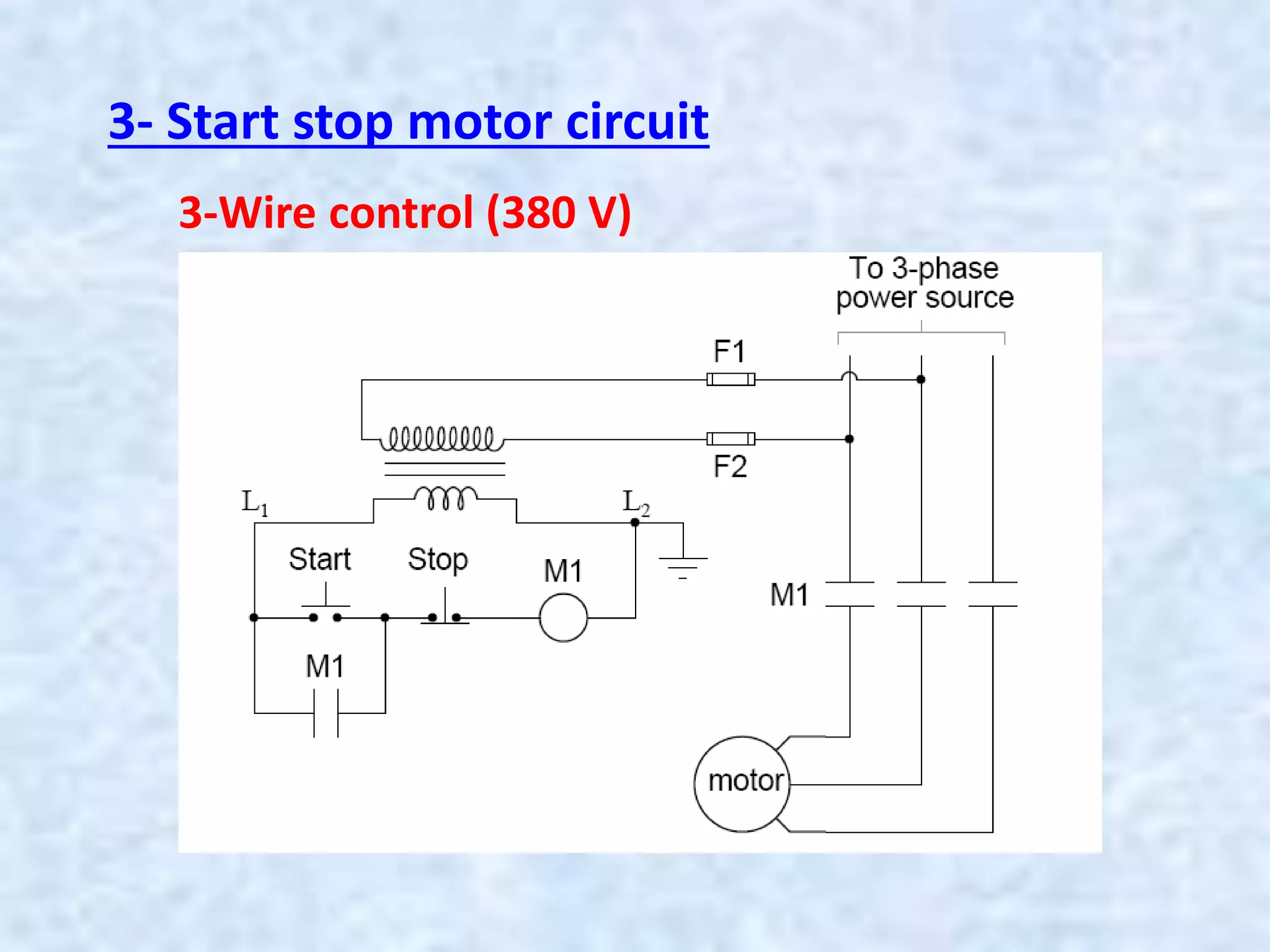
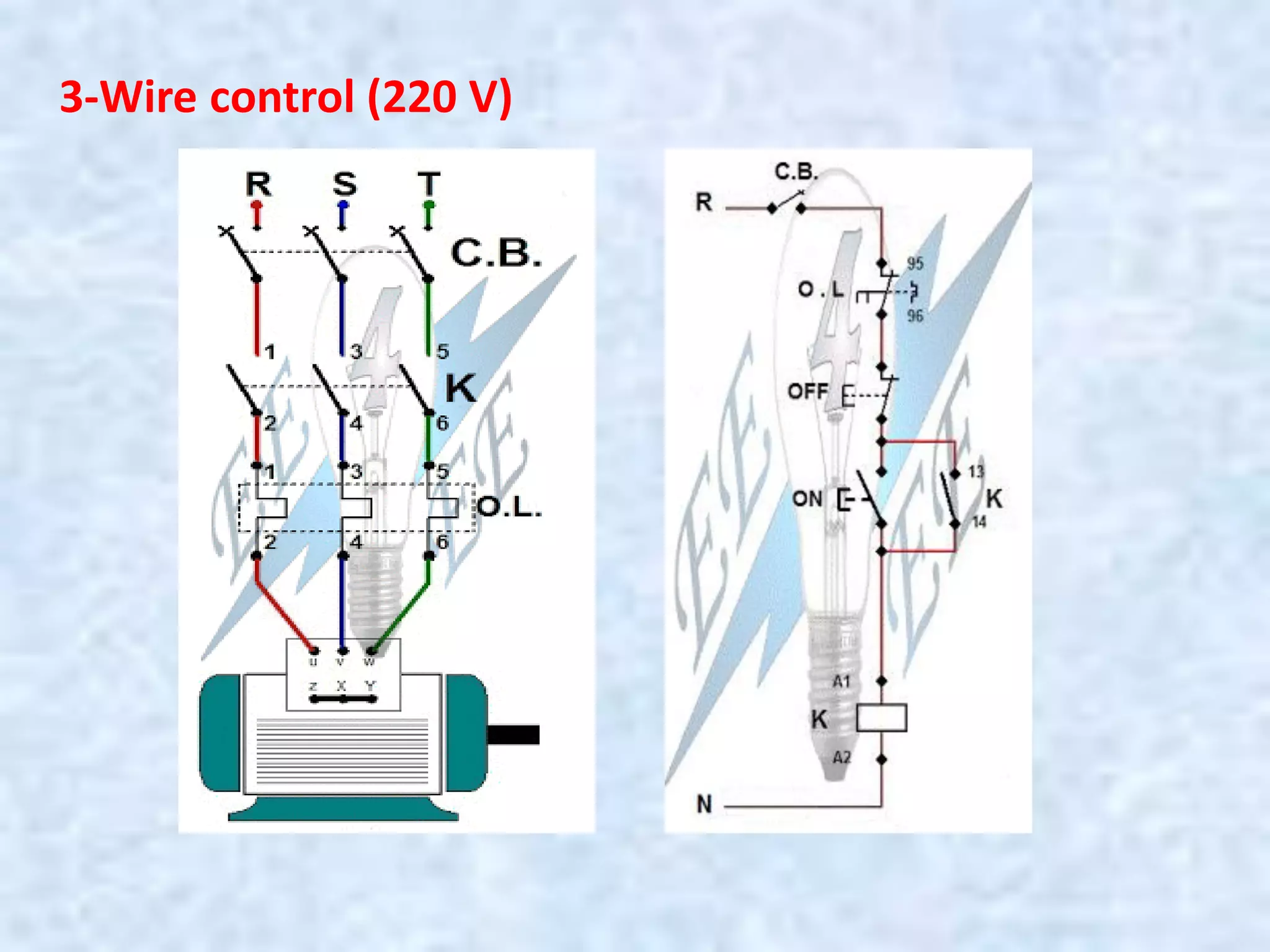
3- Start stop motor circuit
3-Wire control (380 V)
3-Wire control (220 V)
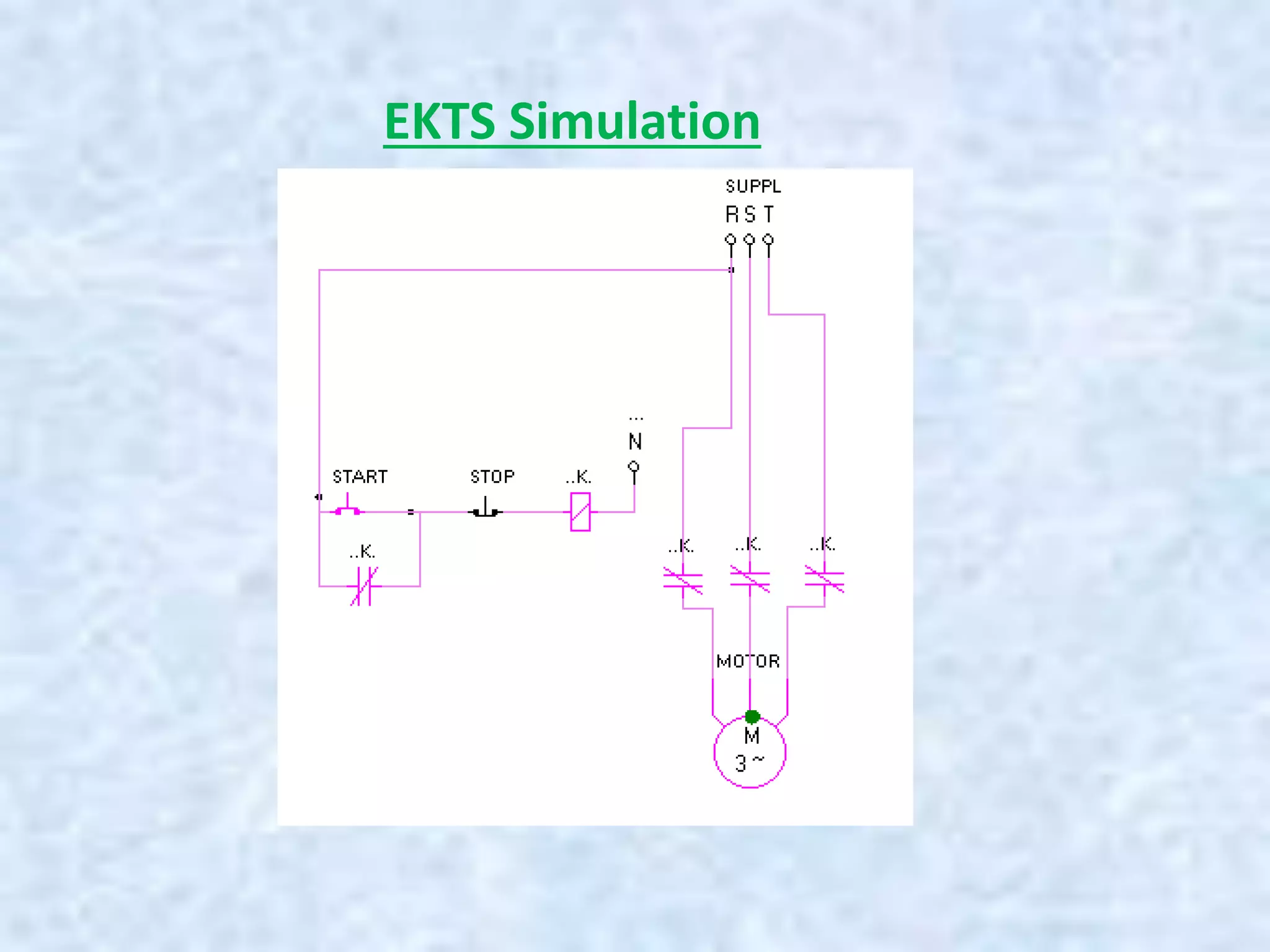
EKTS Simulation
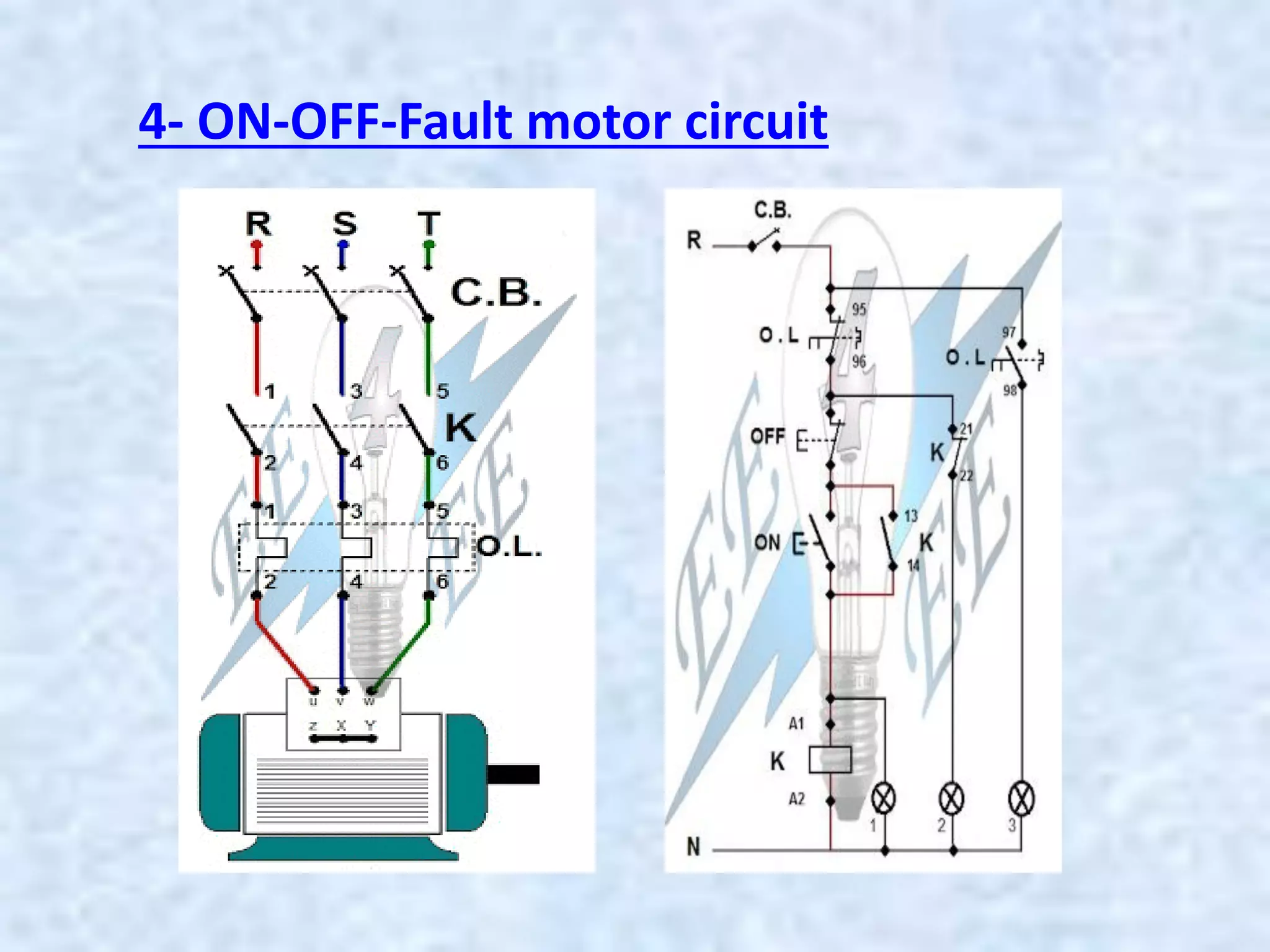
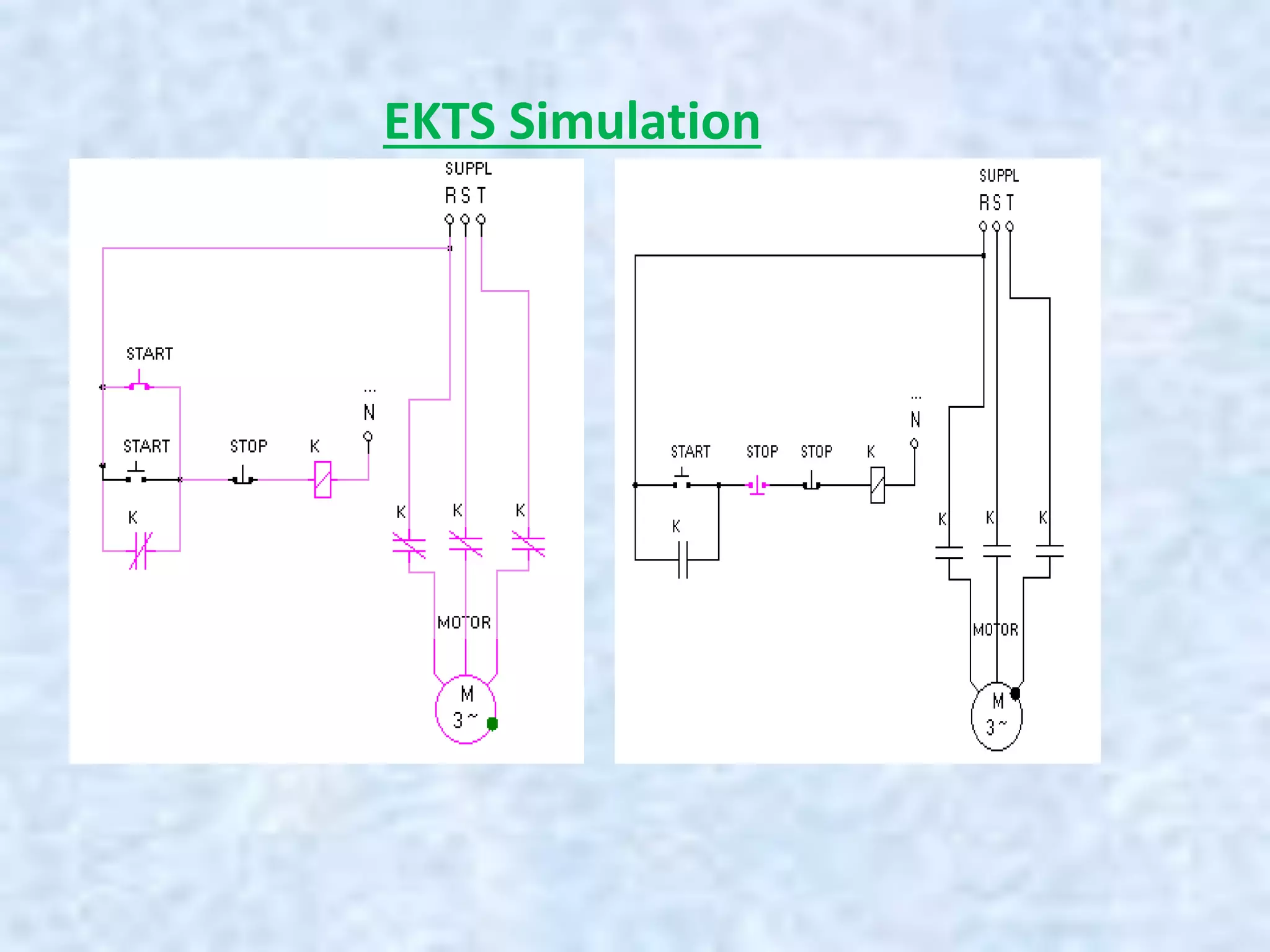
4- ON-OFF-Fault motor circuit
EKTS Simulation
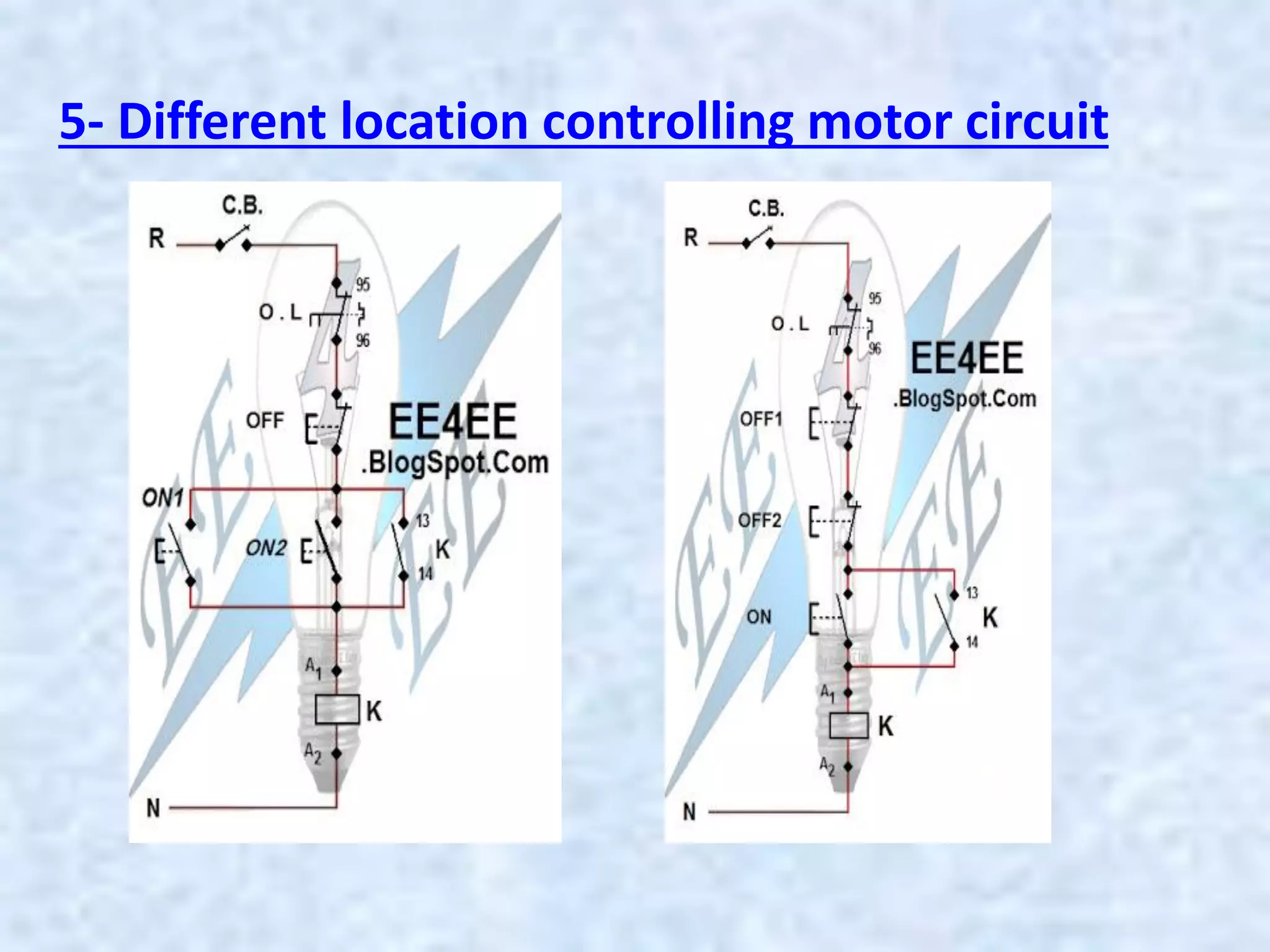
5- Different location controlling motor circuit
EKTS Simulation
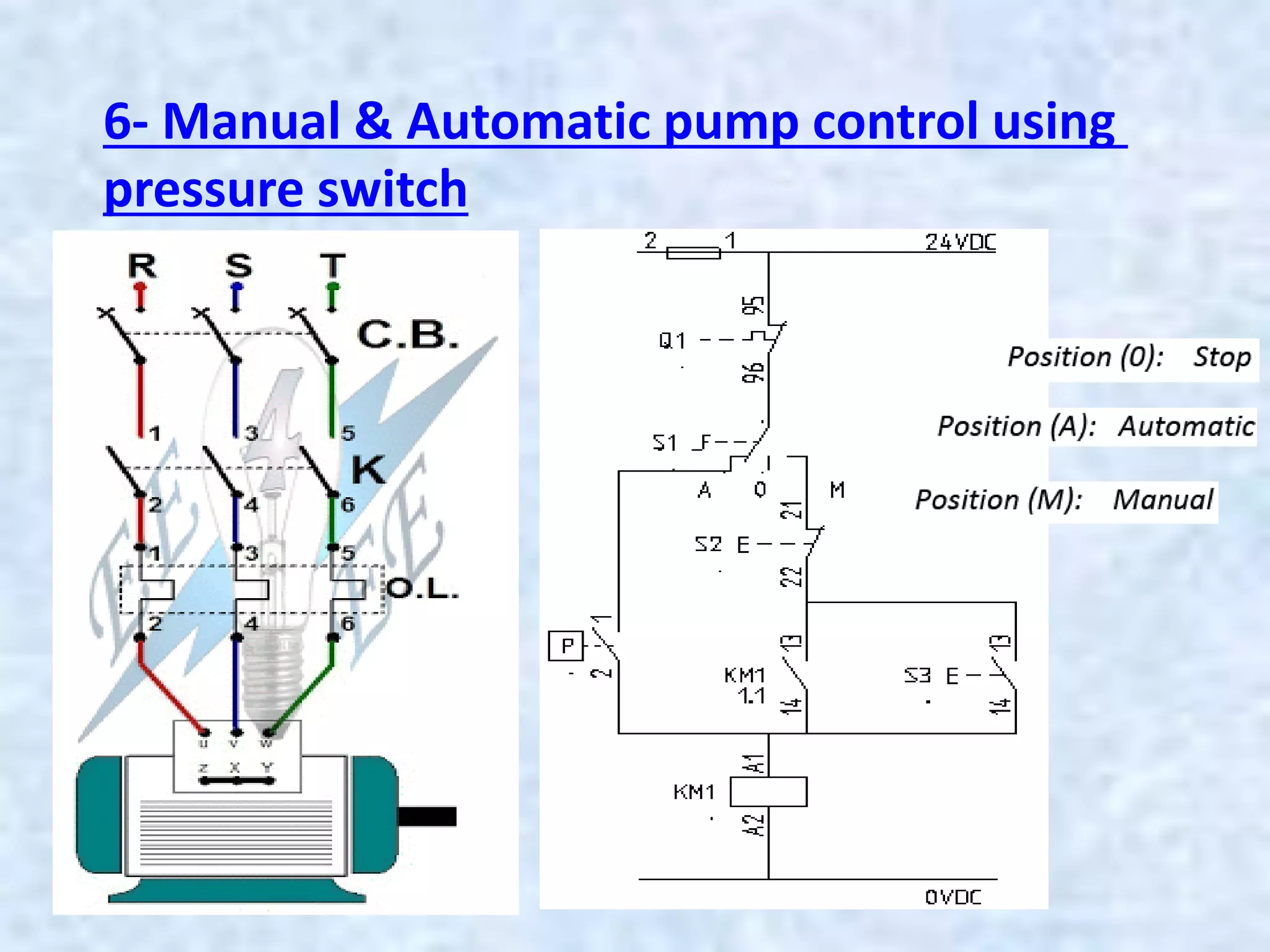
6- Manual & Automatic pump control using
pressure switch
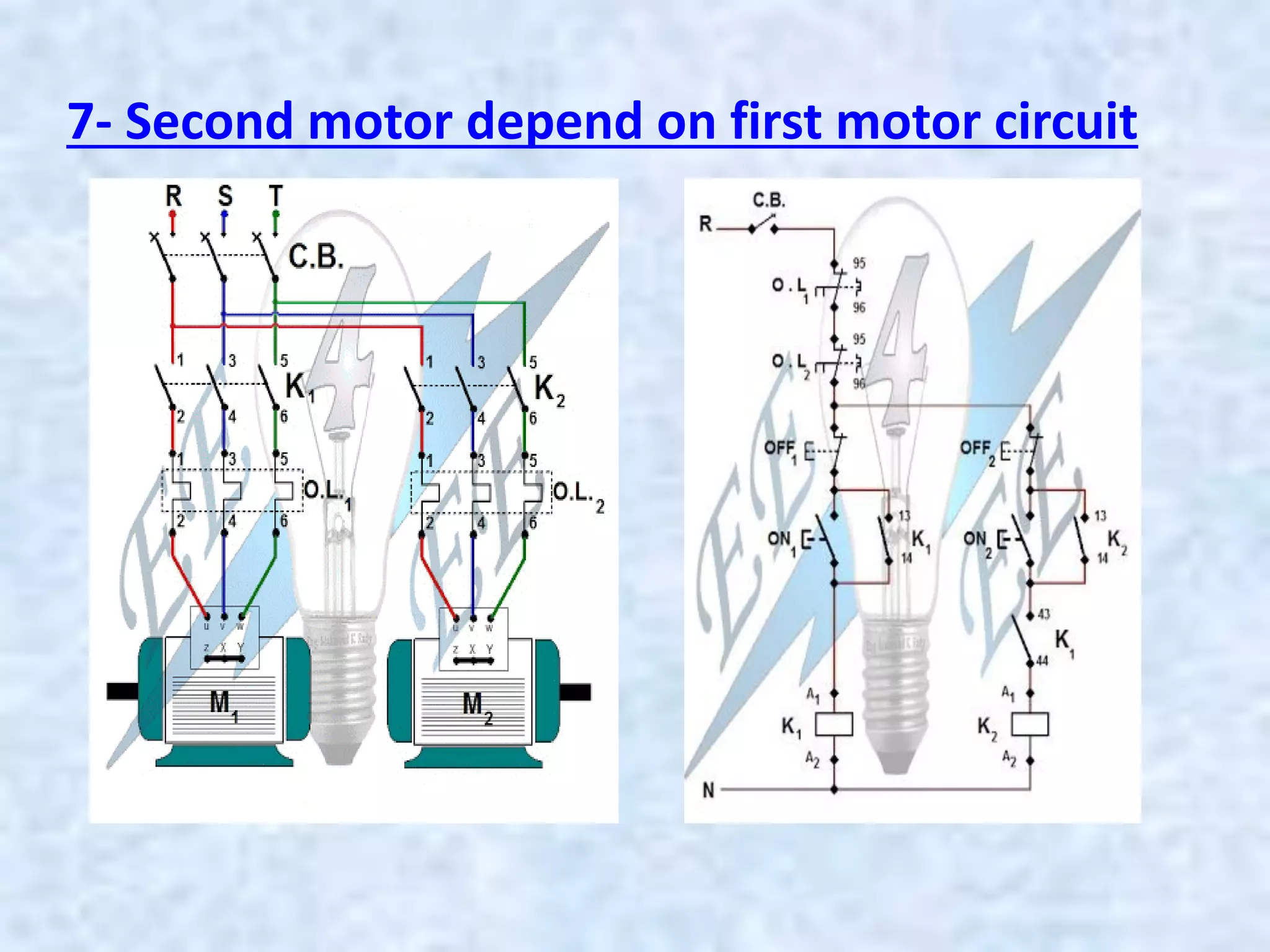
7- Second motor depend on first motor circuit
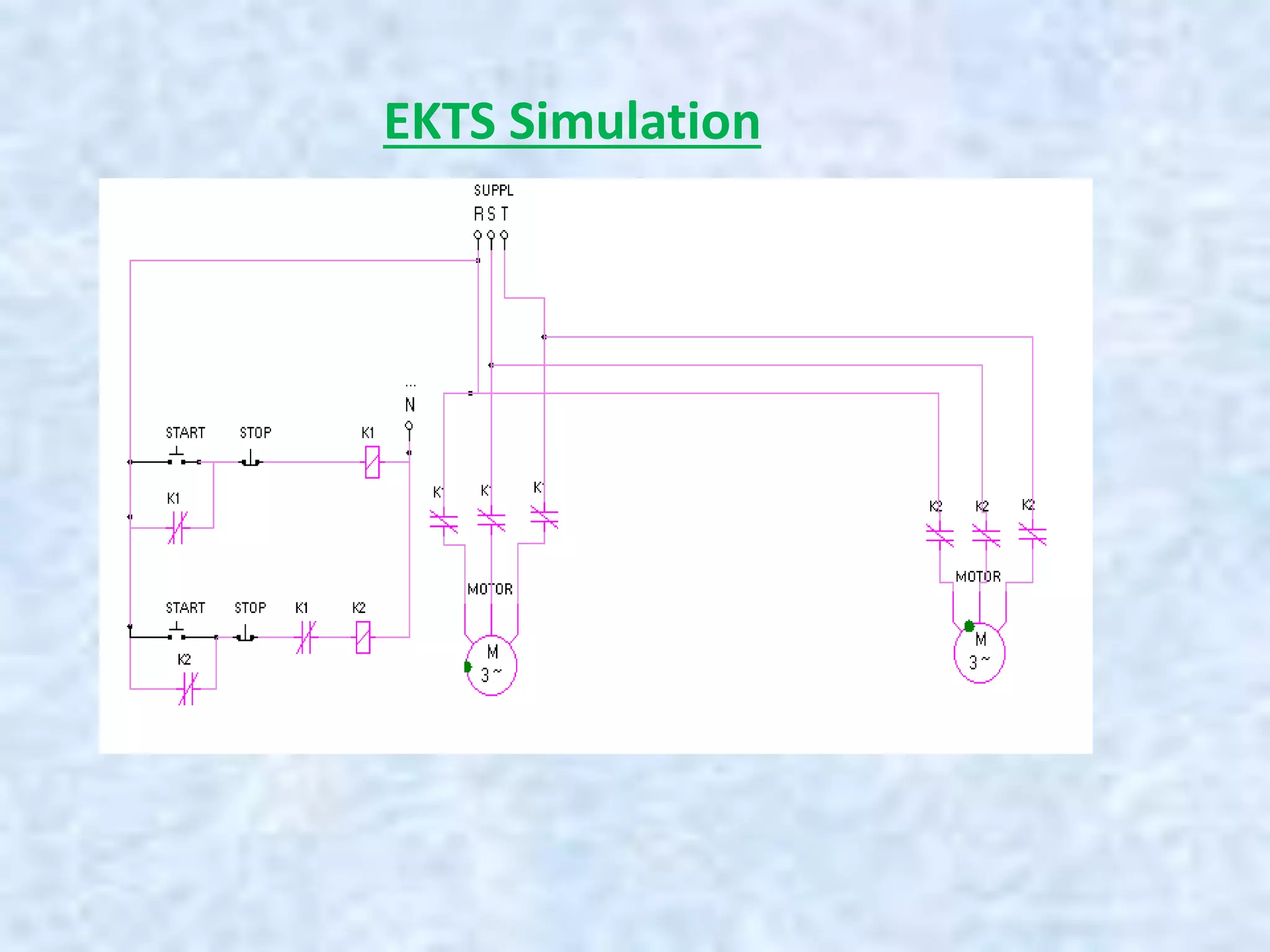
EKTS Simulation
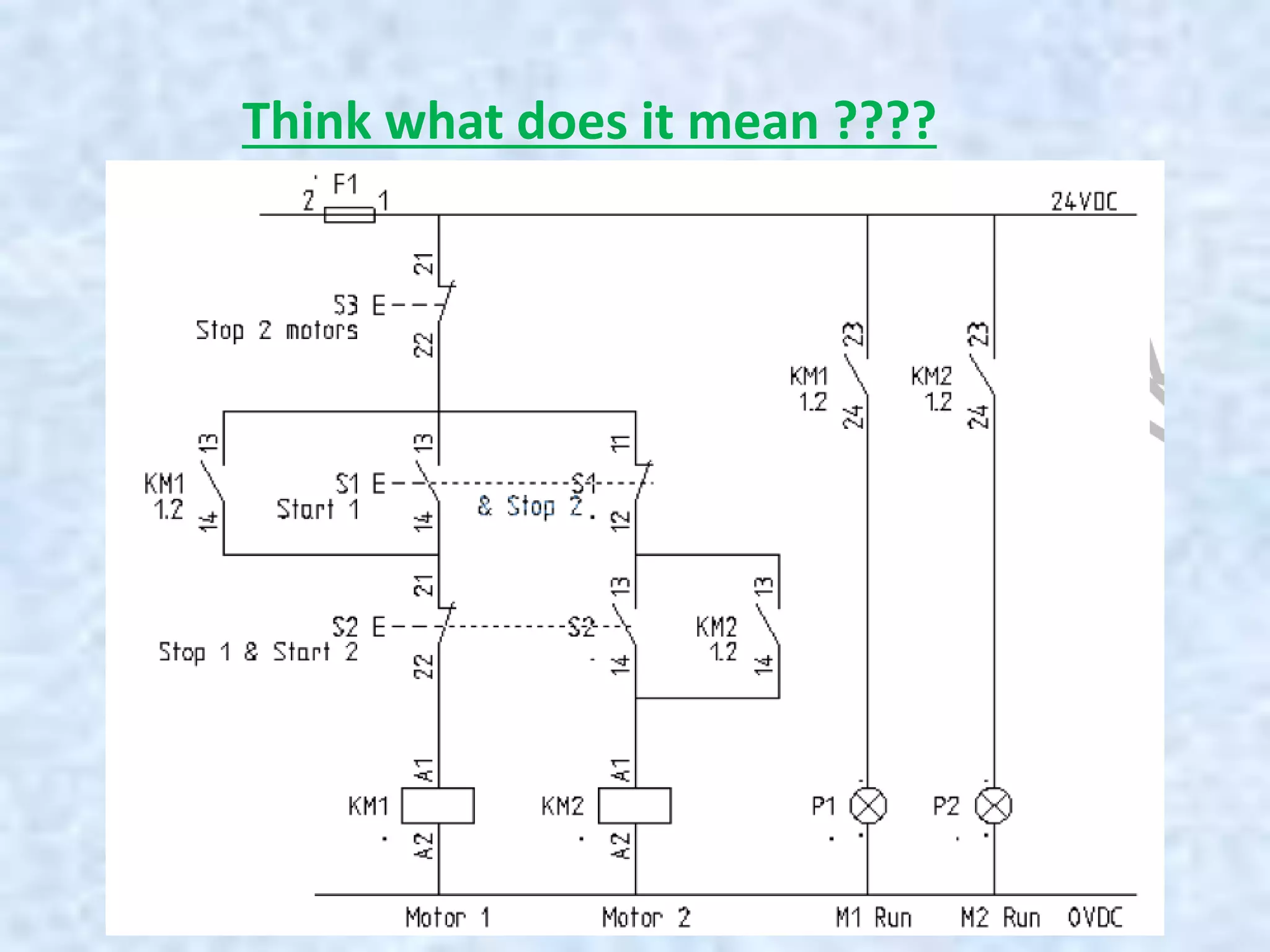
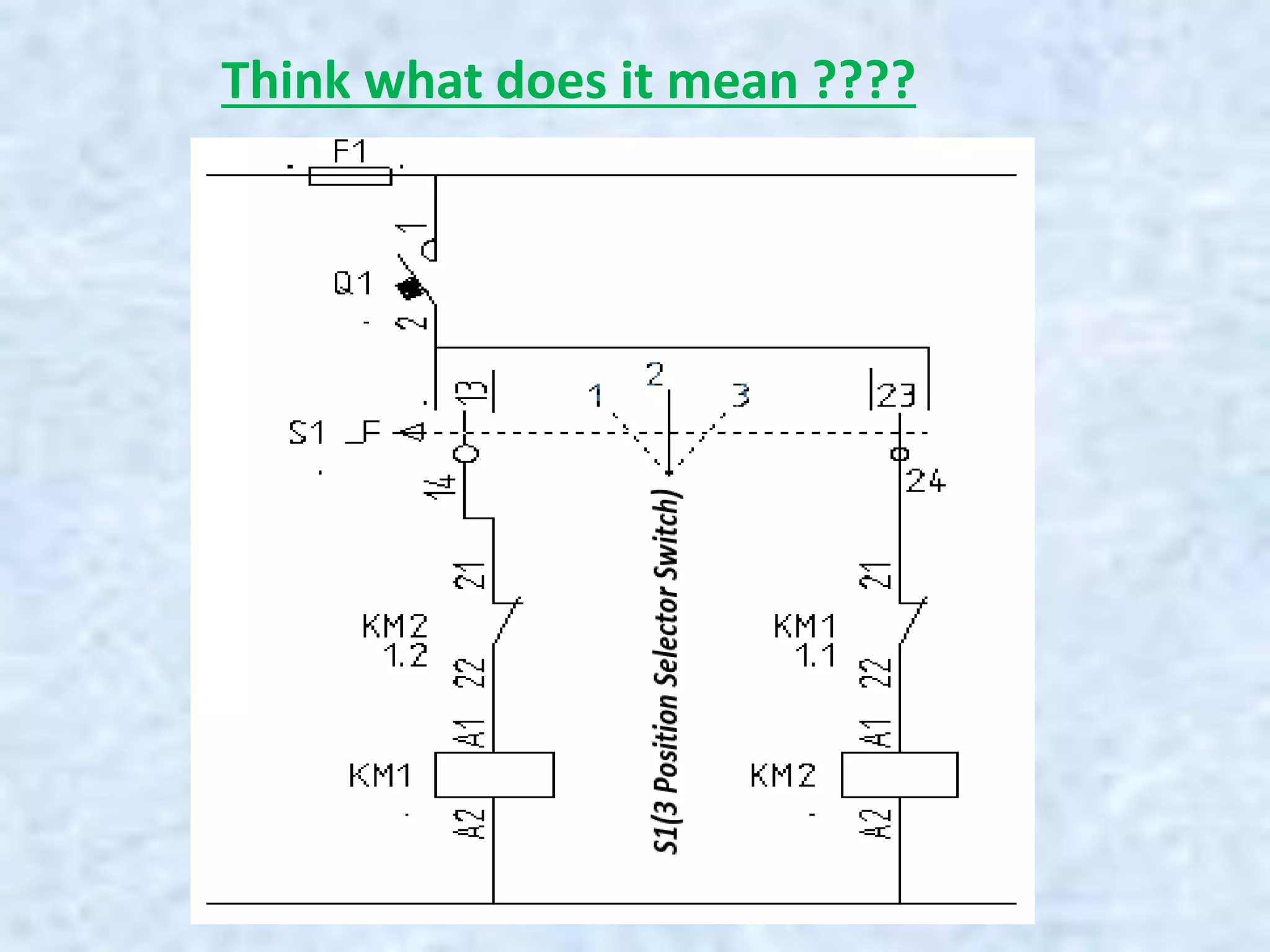
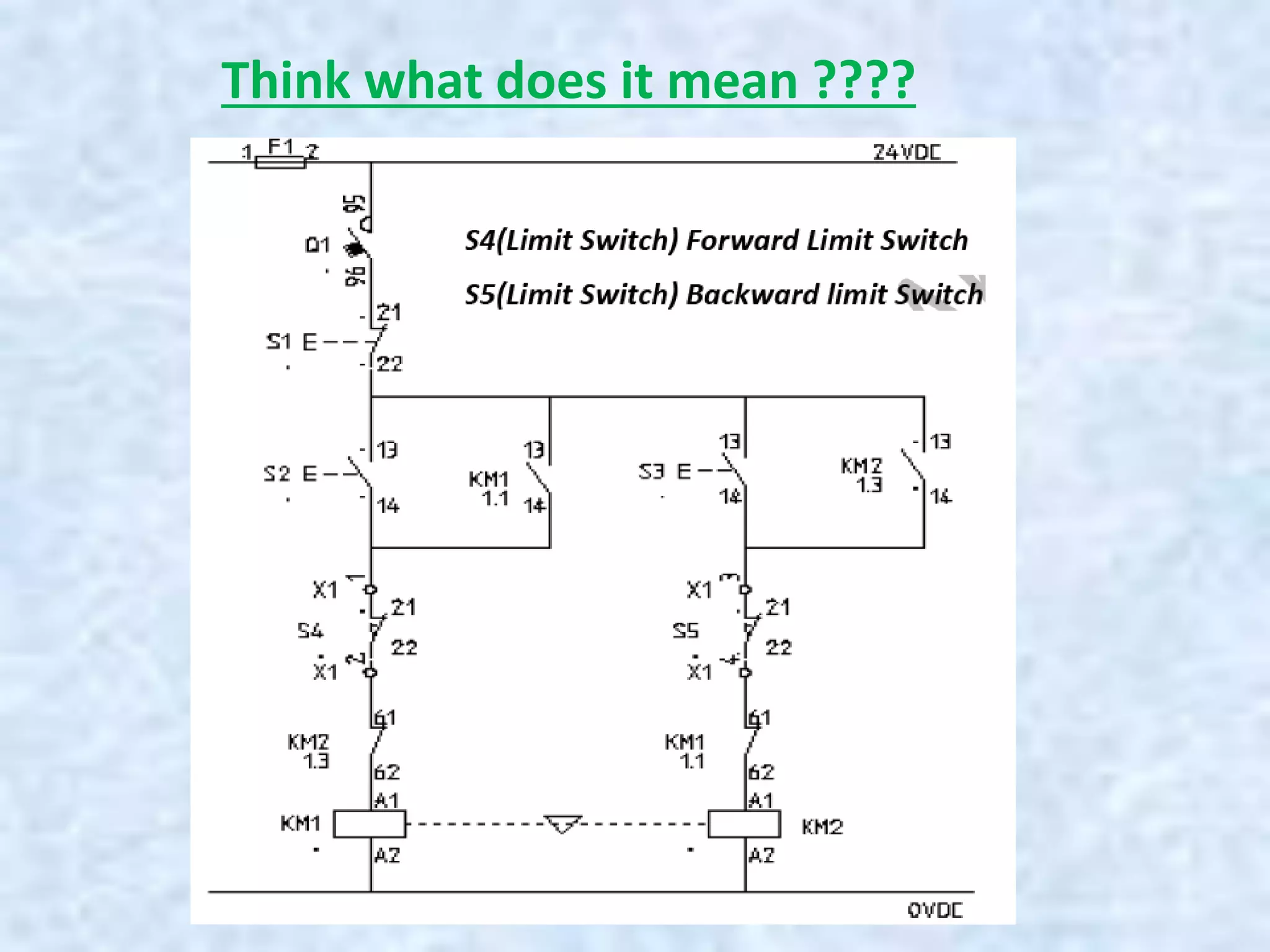
Think what does it mean ????
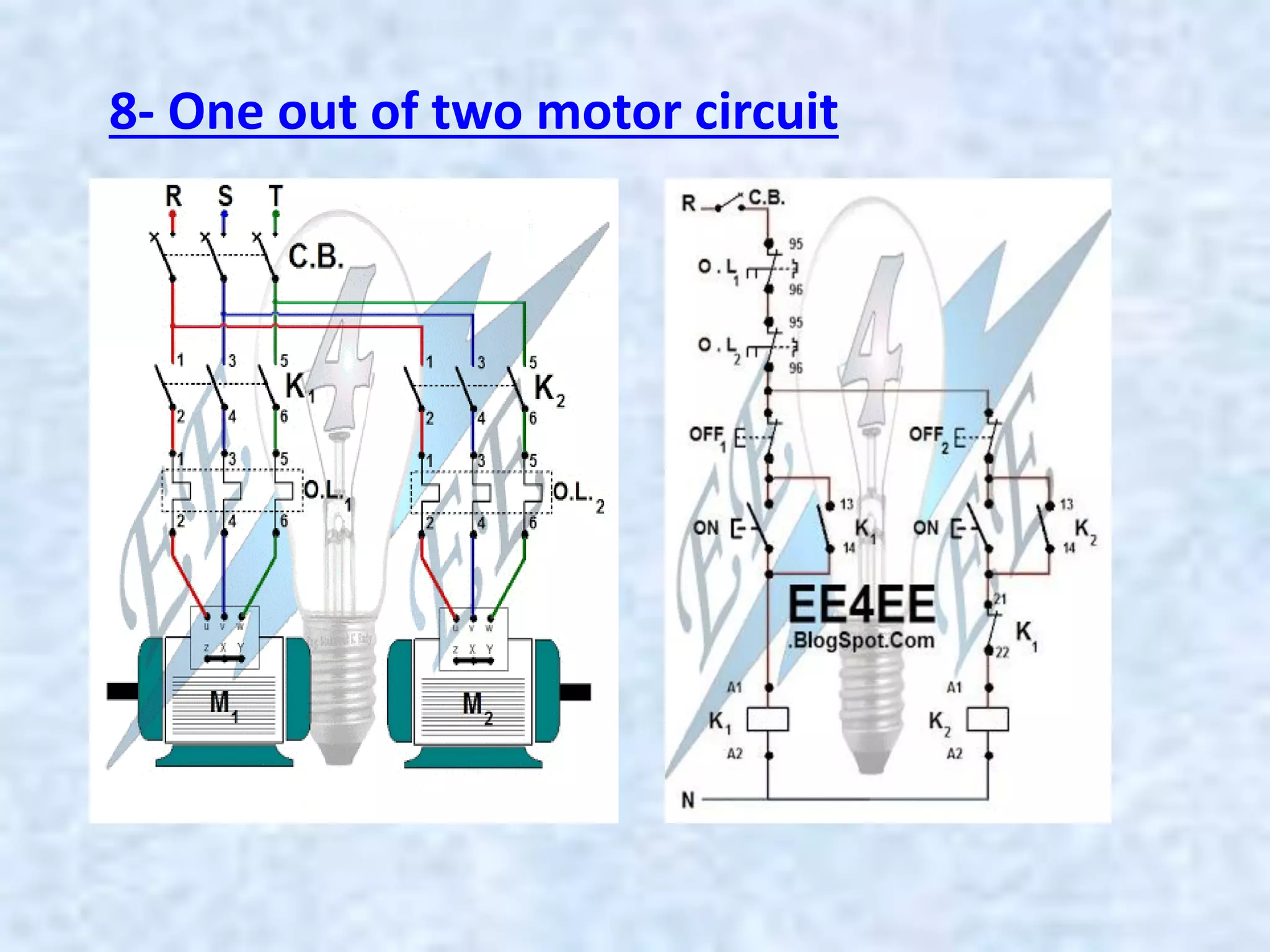
8- One out of two motor circuit
EKTS Simulation
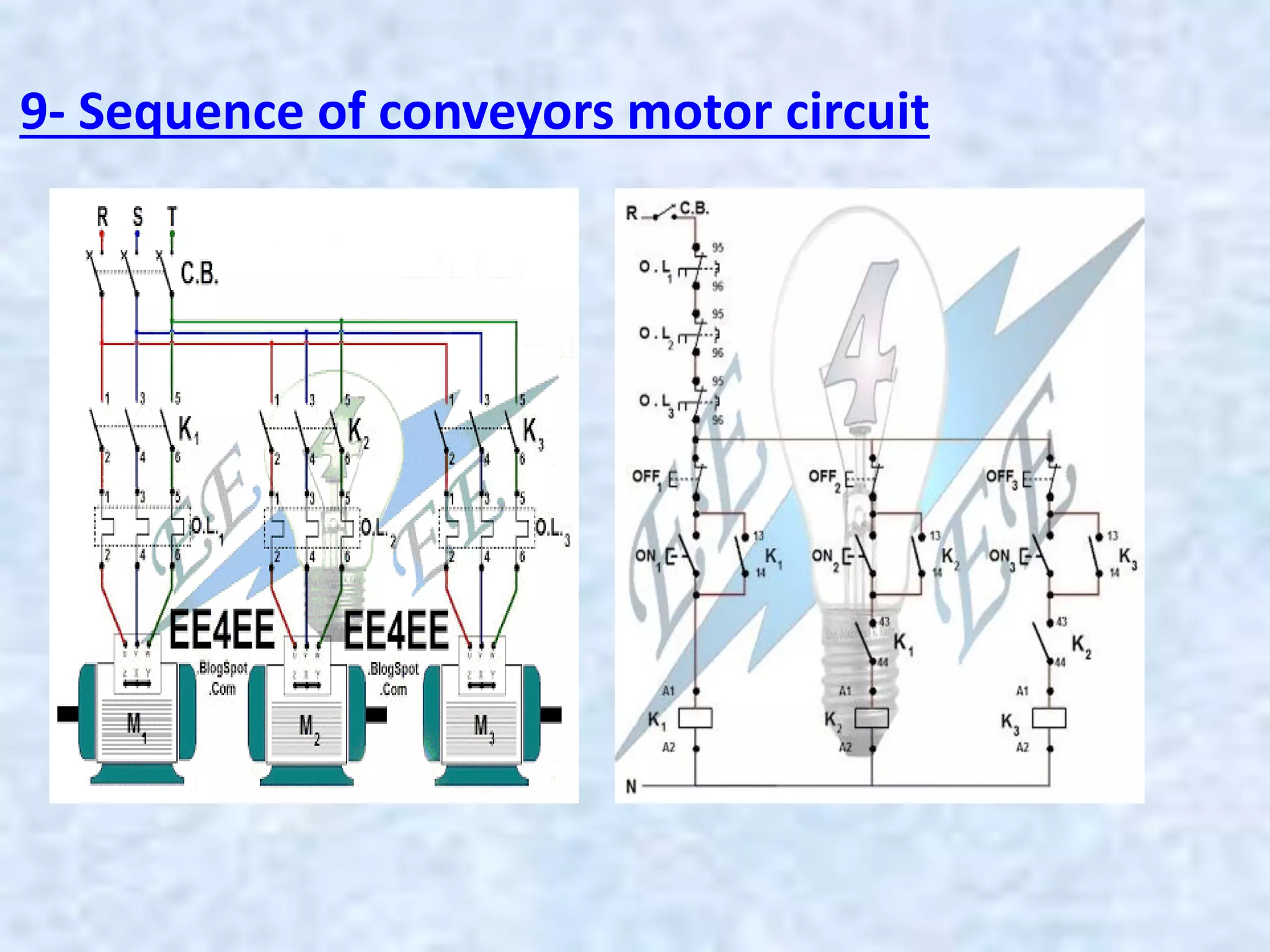
9- Sequence of conveyors motor circuit
EKTS Simulation
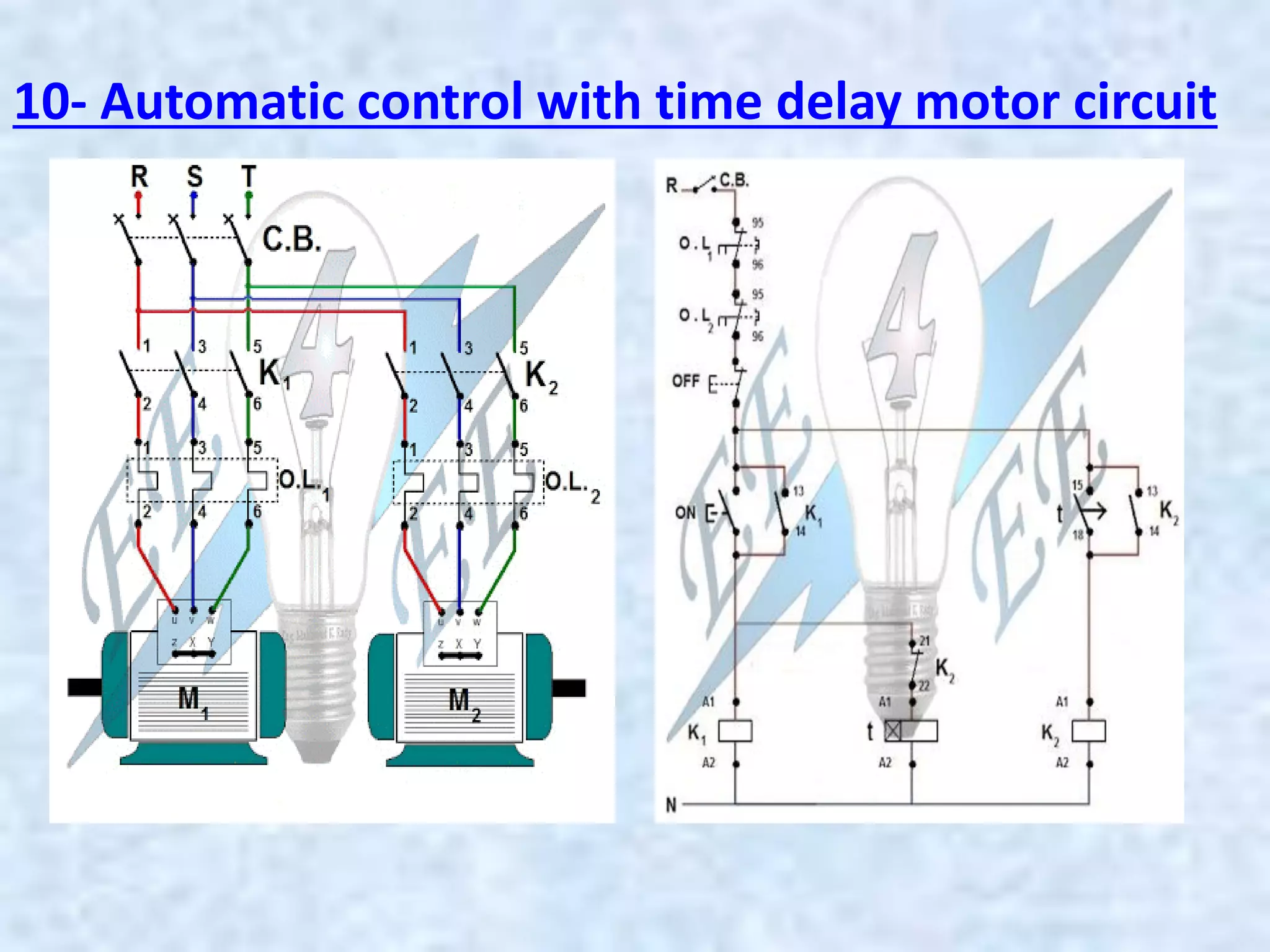
10- Automatic control with time delay motor circuit
EKTS Simulation
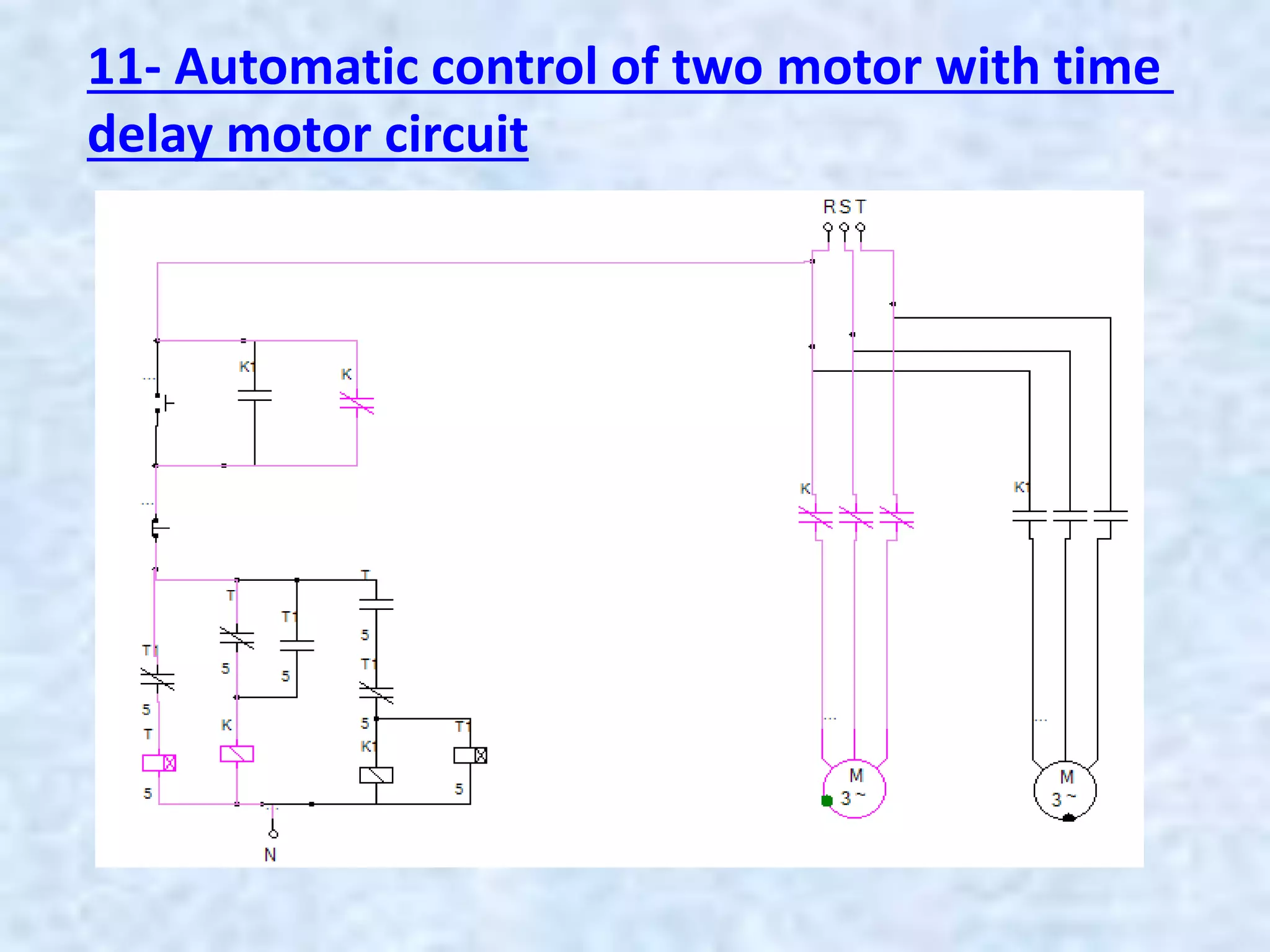
11- Automatic control of two motor with time
delay motor circuit
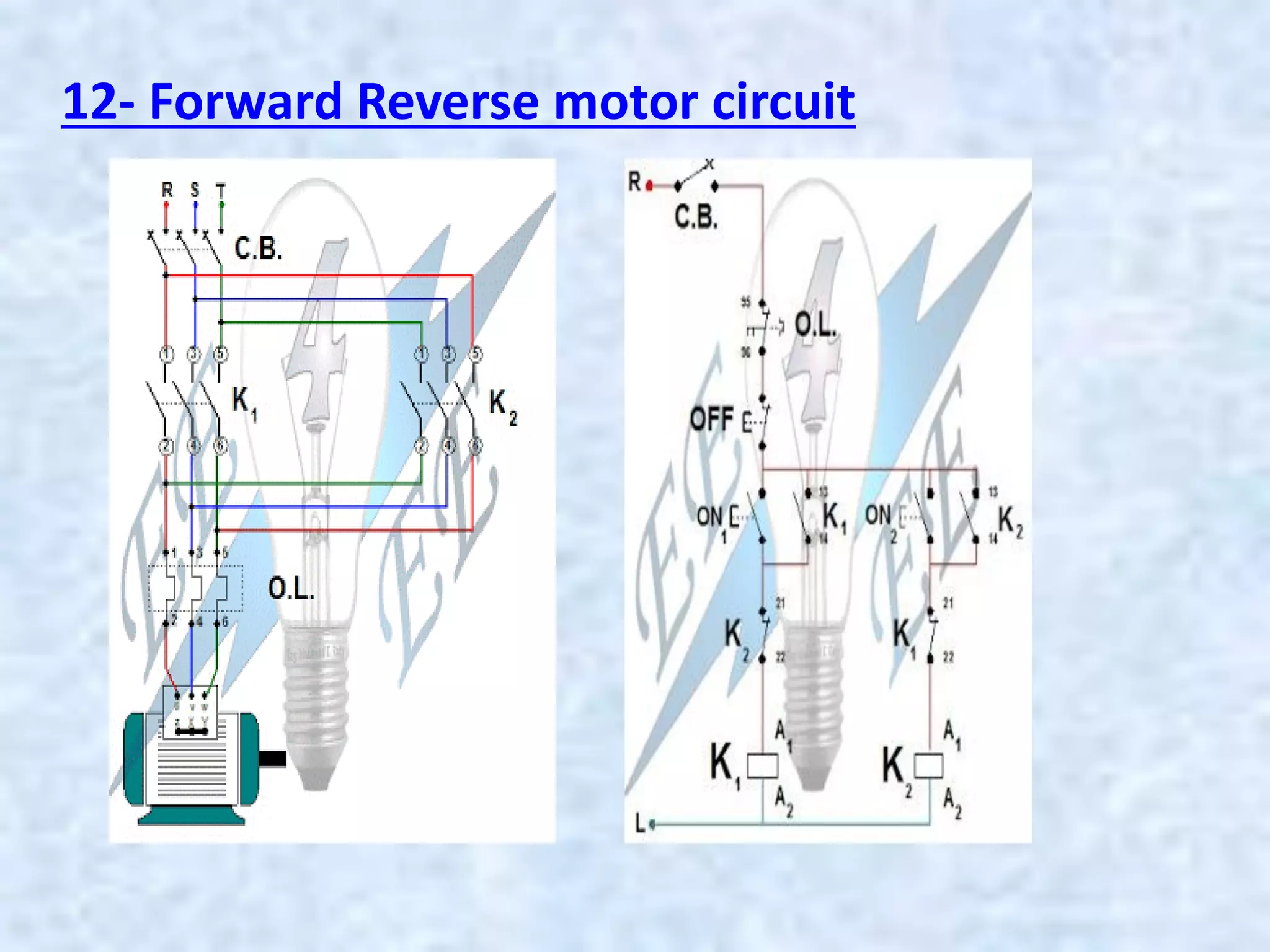
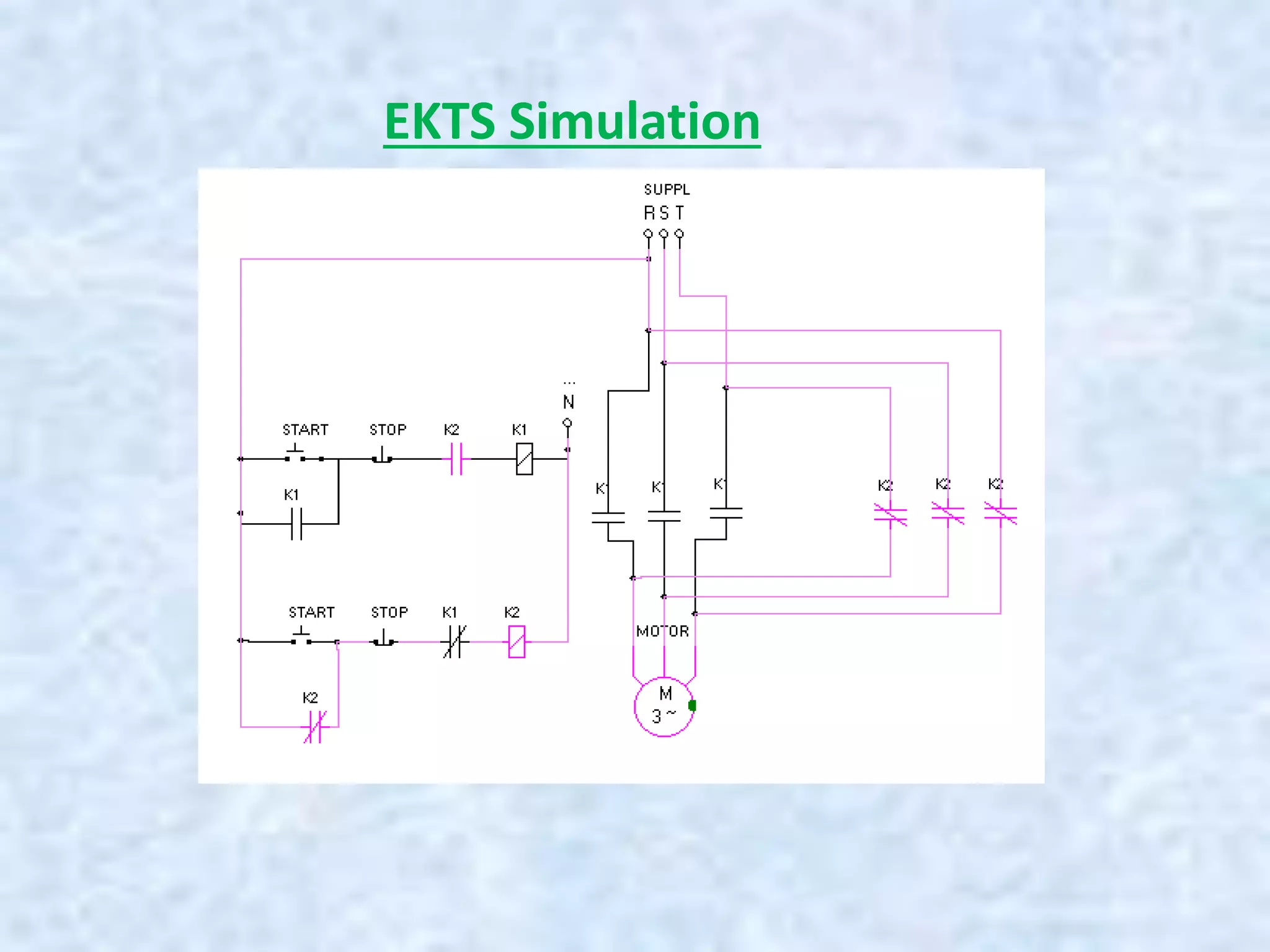
12- Forward Reverse motor circuit
EKTS Simulation
Think what does it mean ????
CHAPTER 7
Types of Starter
for Induction
motors
Function of starter
Start and stop the motor.
Limit inrush current where necessary.
Permit automatic control when required
Protect motor and other connected equipments from
over voltage, no voltage, under voltage, single
phasing etc.
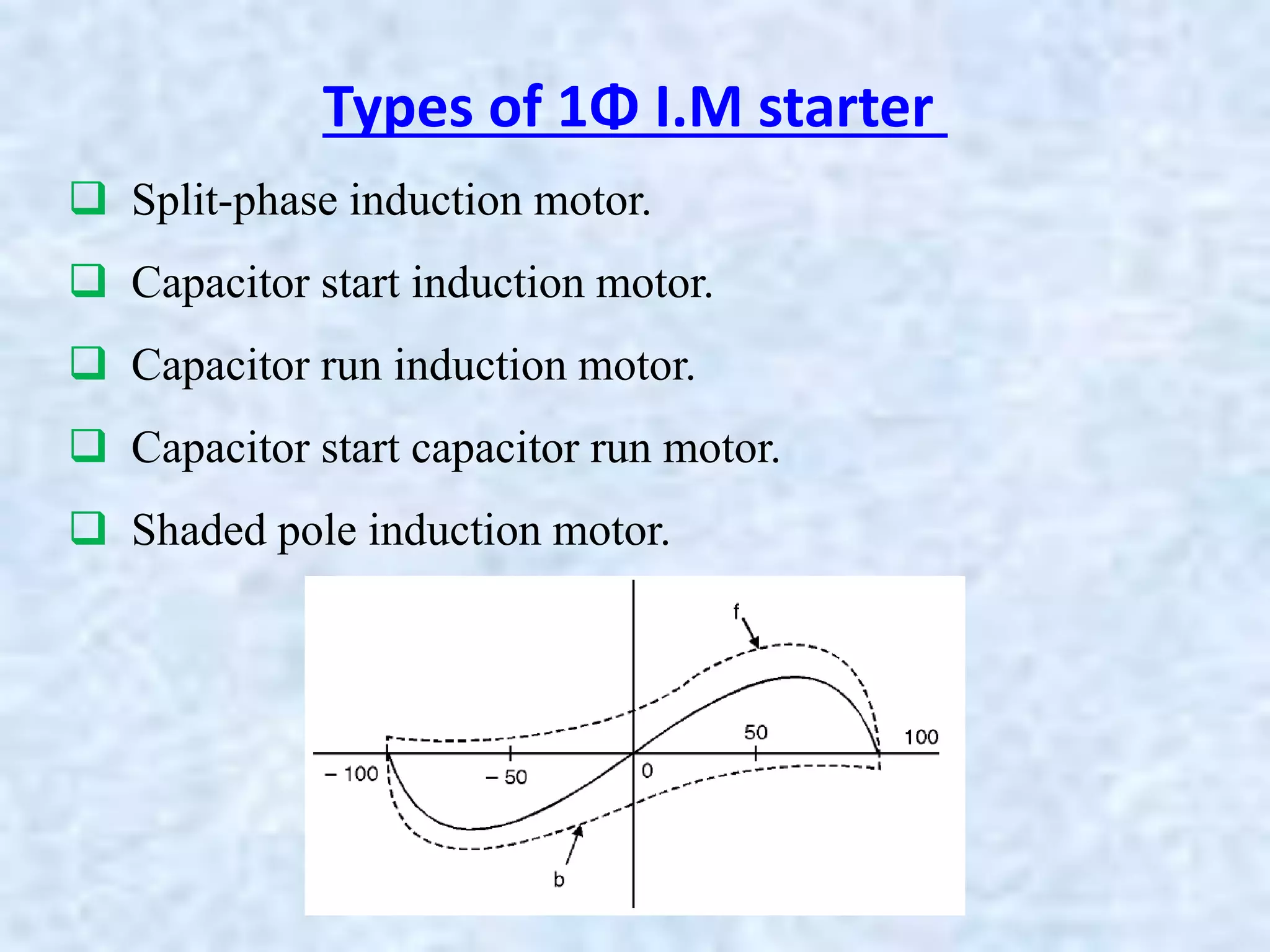
Types of 1Φ I.M starter
 Split-phase induction motor.
 Capacitor start induction motor.
 Capacitor run induction motor.
 Capacitor start capacitor run motor.
 Shaded pole induction motor.
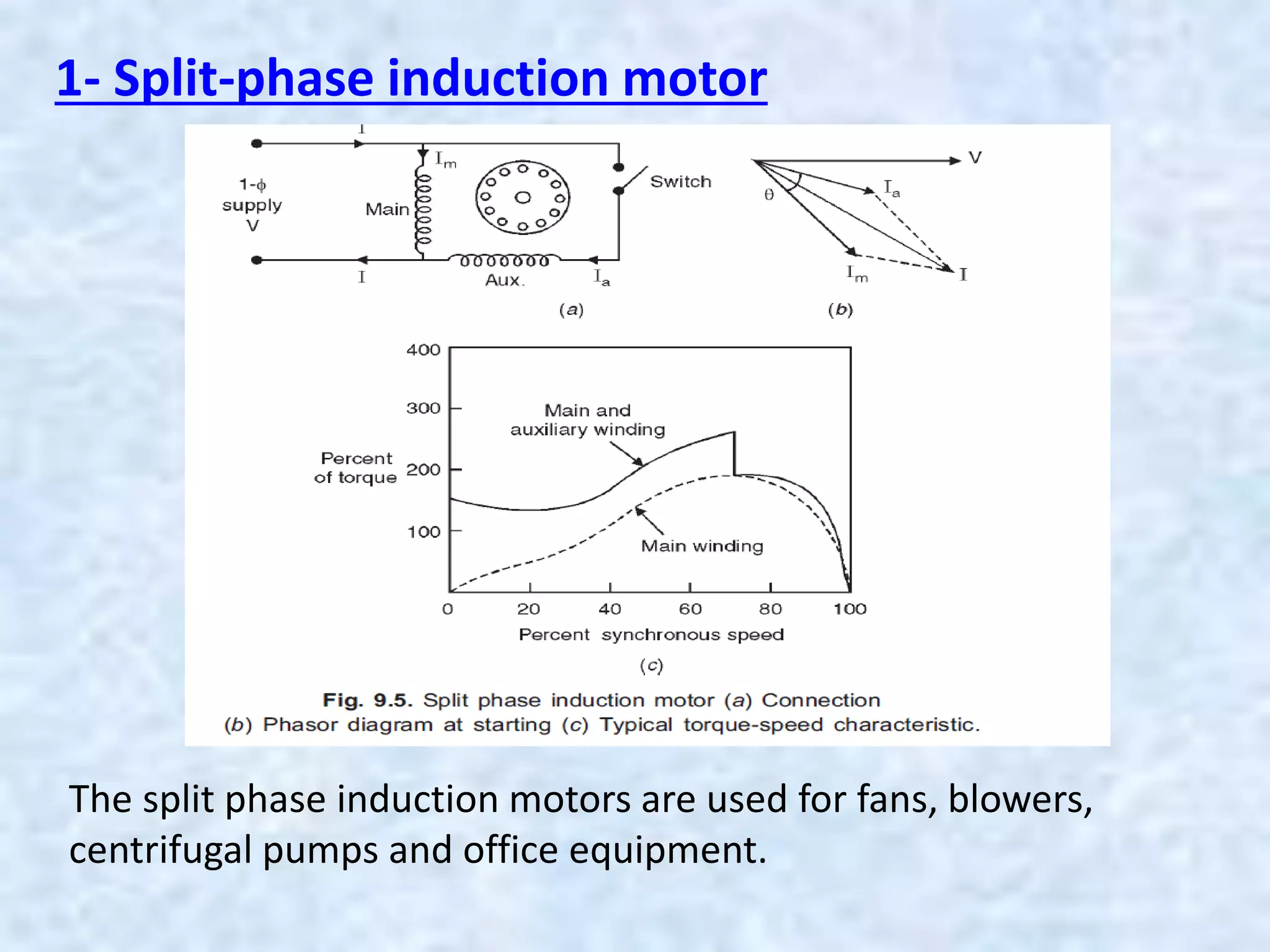
1- Split-phase induction motor
The split phase induction motors are used for fans, blowers,
centrifugal pumps and office equipment.
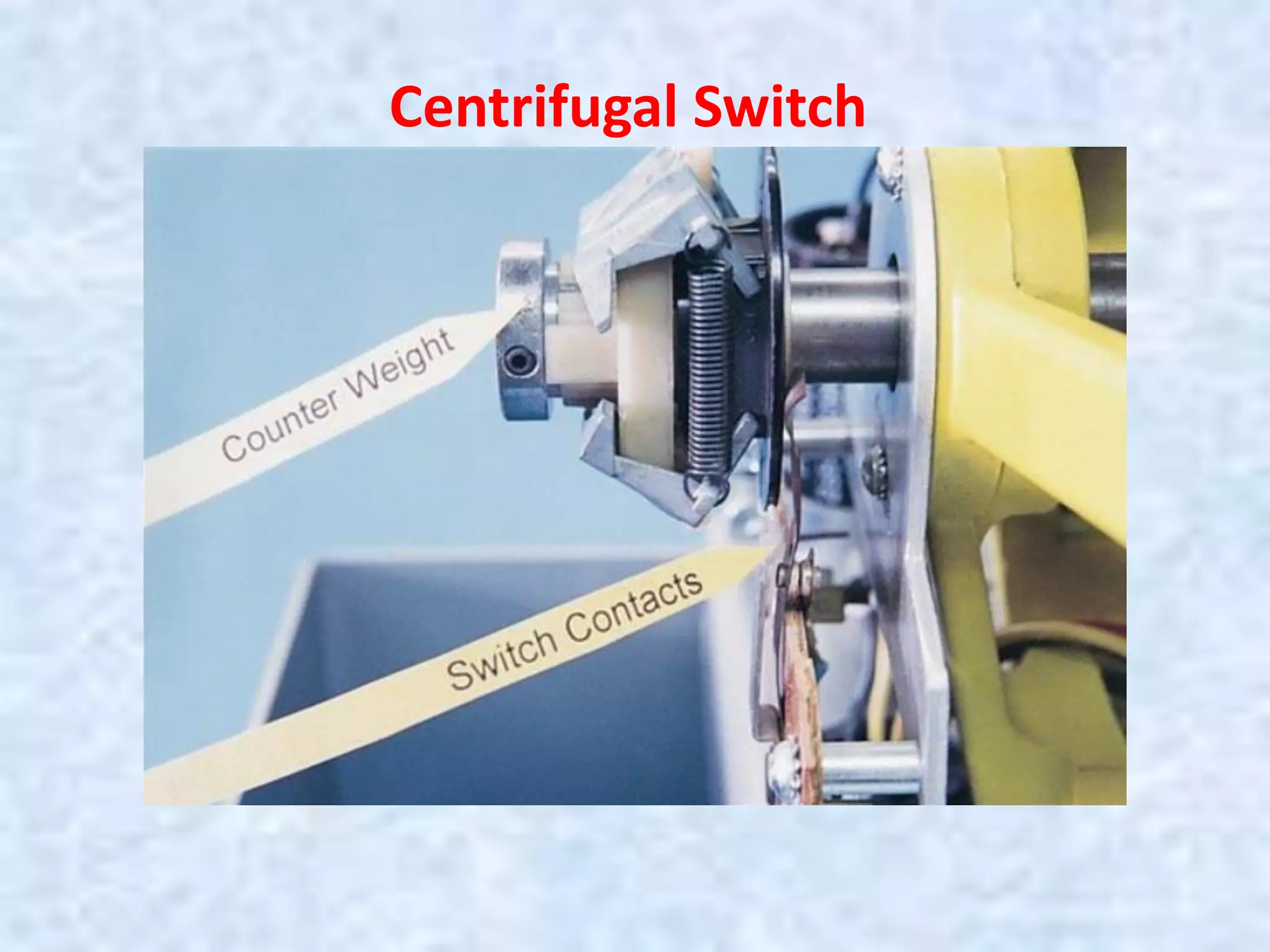
Centrifugal Switch
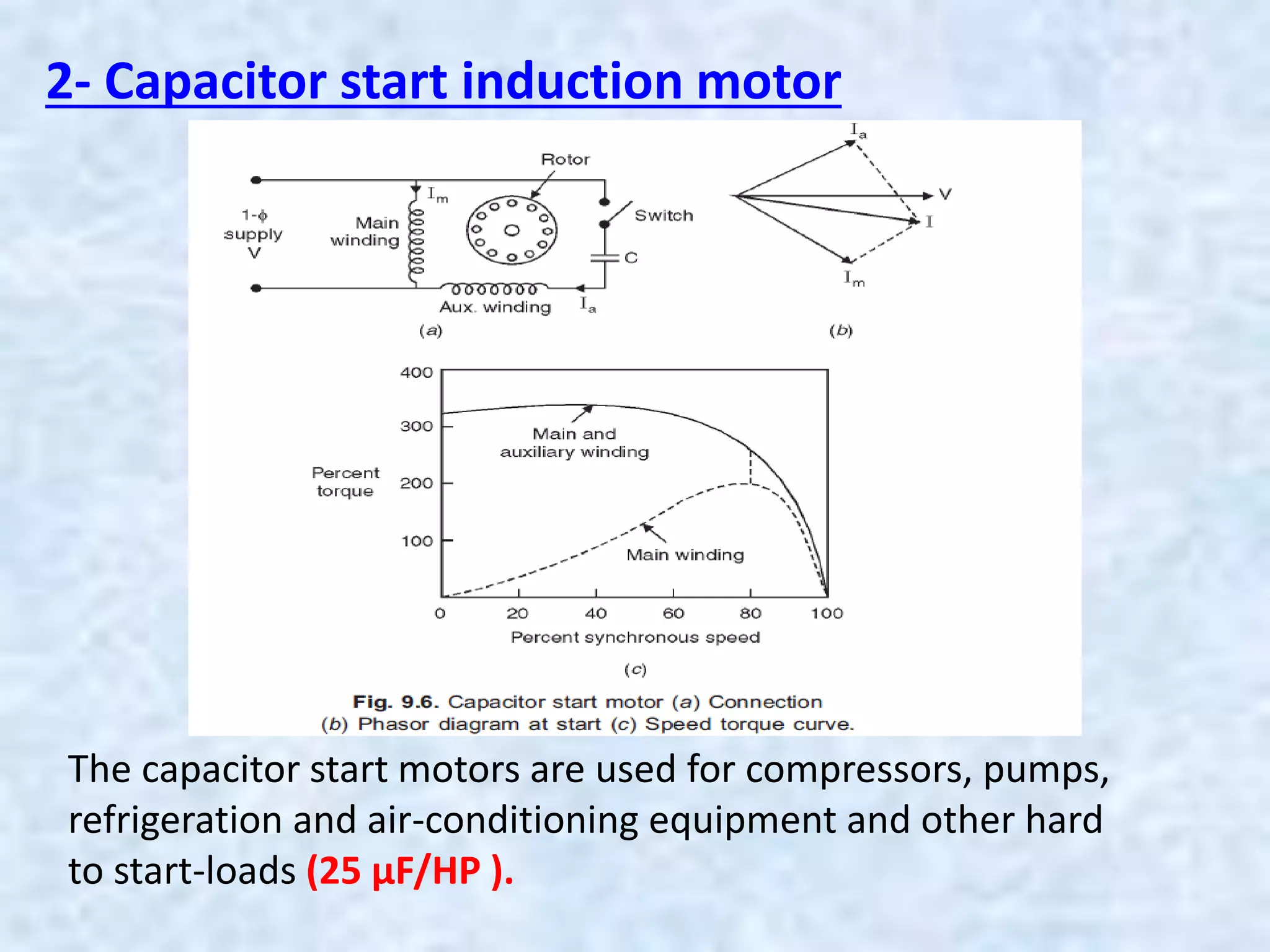
2- Capacitor start induction motor
The capacitor start motors are used for compressors, pumps,
refrigeration and air-conditioning equipment and other hard
to start-loads (25 µF/HP ).
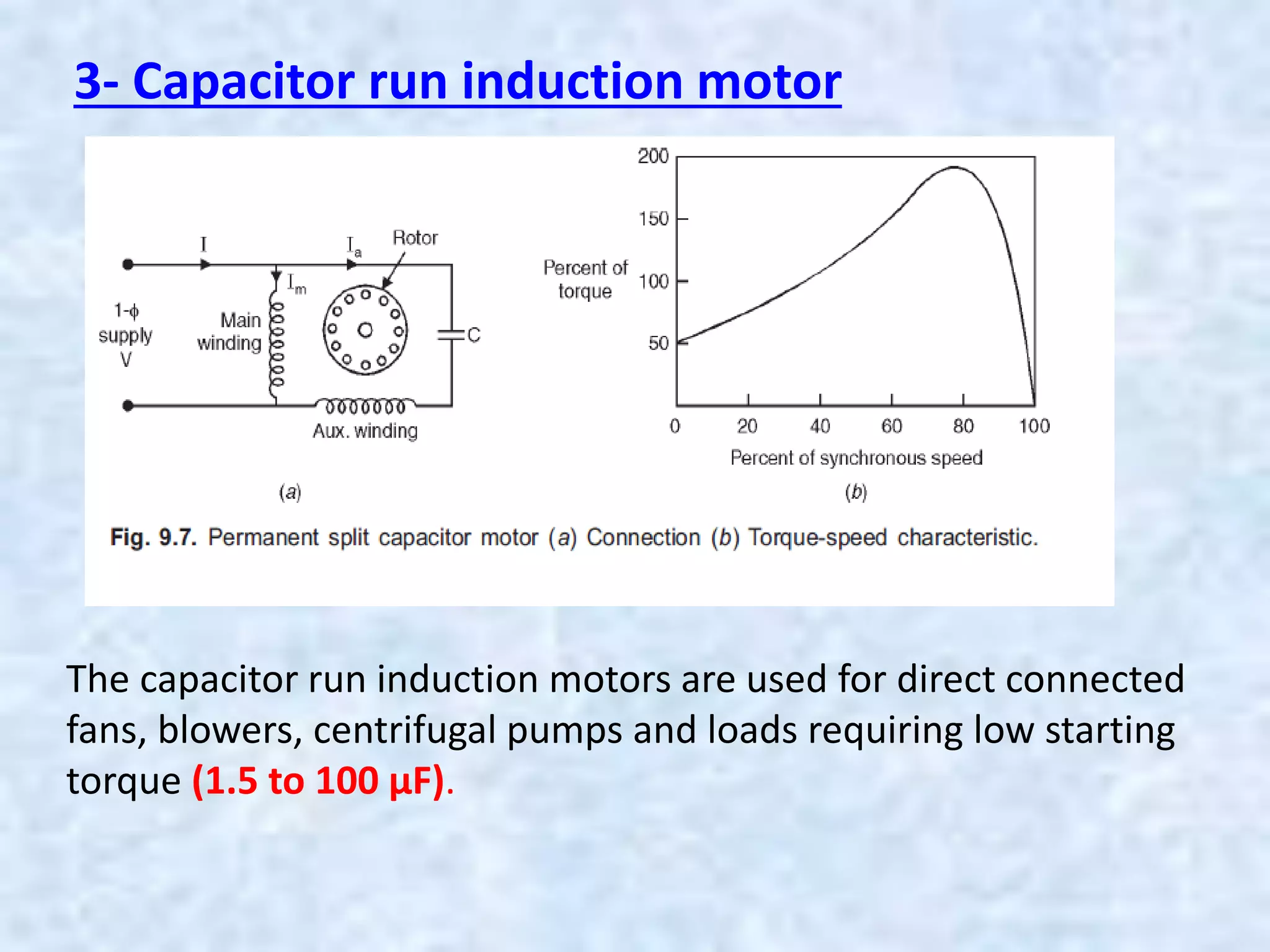
3- Capacitor run induction motor
The capacitor run induction motors are used for direct connected
fans, blowers, centrifugal pumps and loads requiring low starting
torque (1.5 to 100 µF).
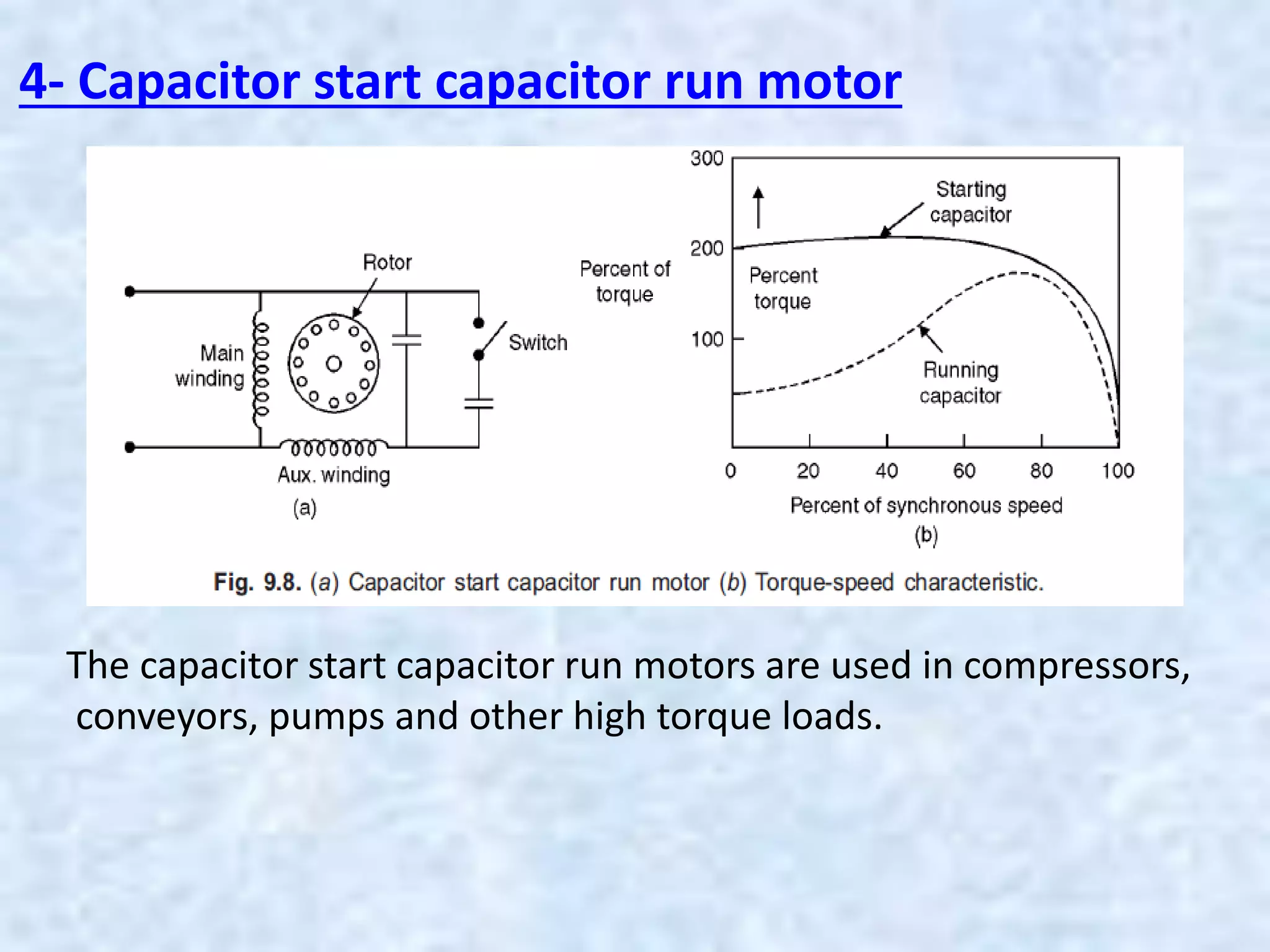
4- Capacitor start capacitor run motor
The capacitor start capacitor run motors are used in compressors,
conveyors, pumps and other high torque loads.
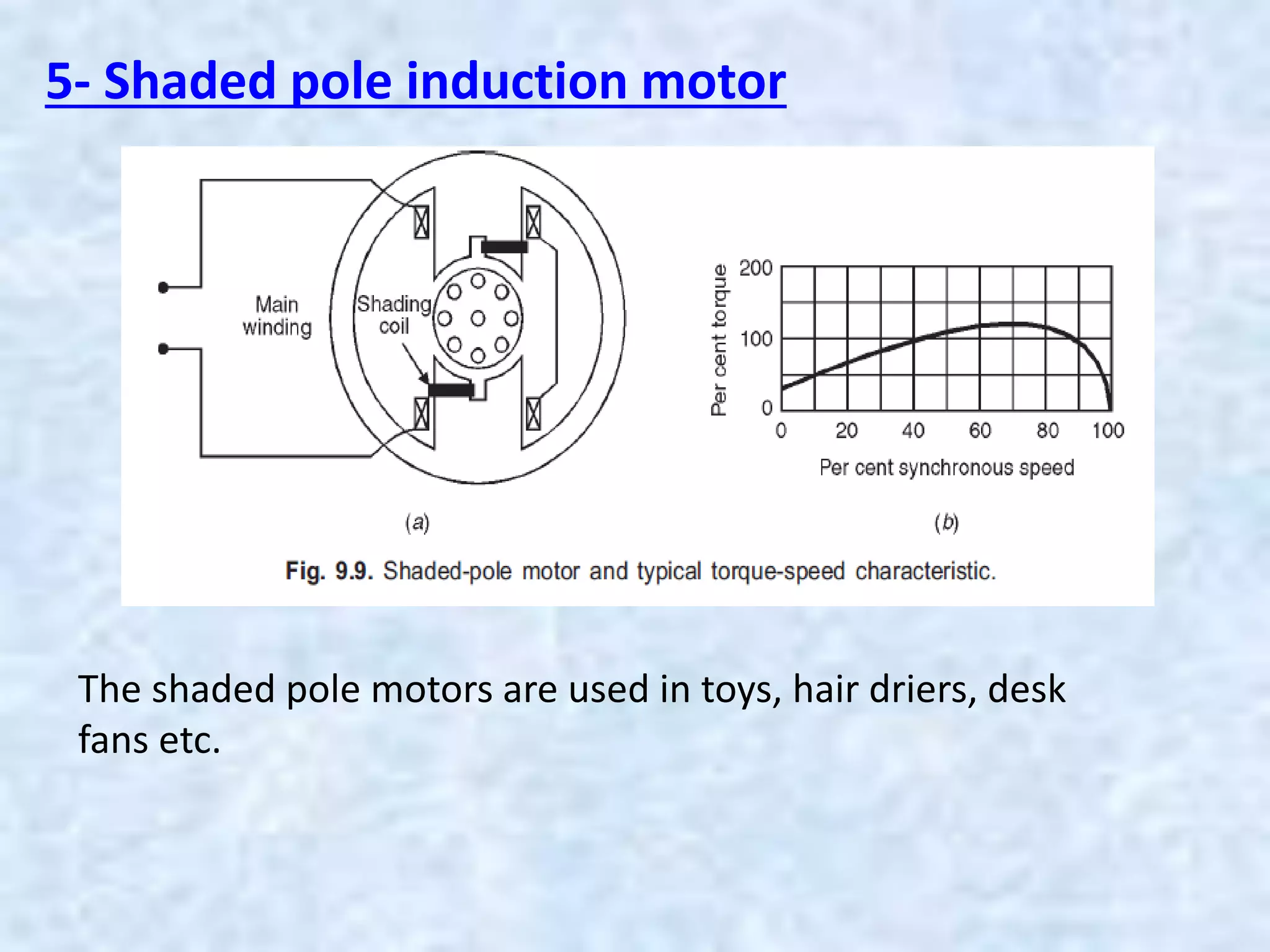
5- Shaded pole induction motor
The shaded pole motors are used in toys, hair driers, desk
fans etc.
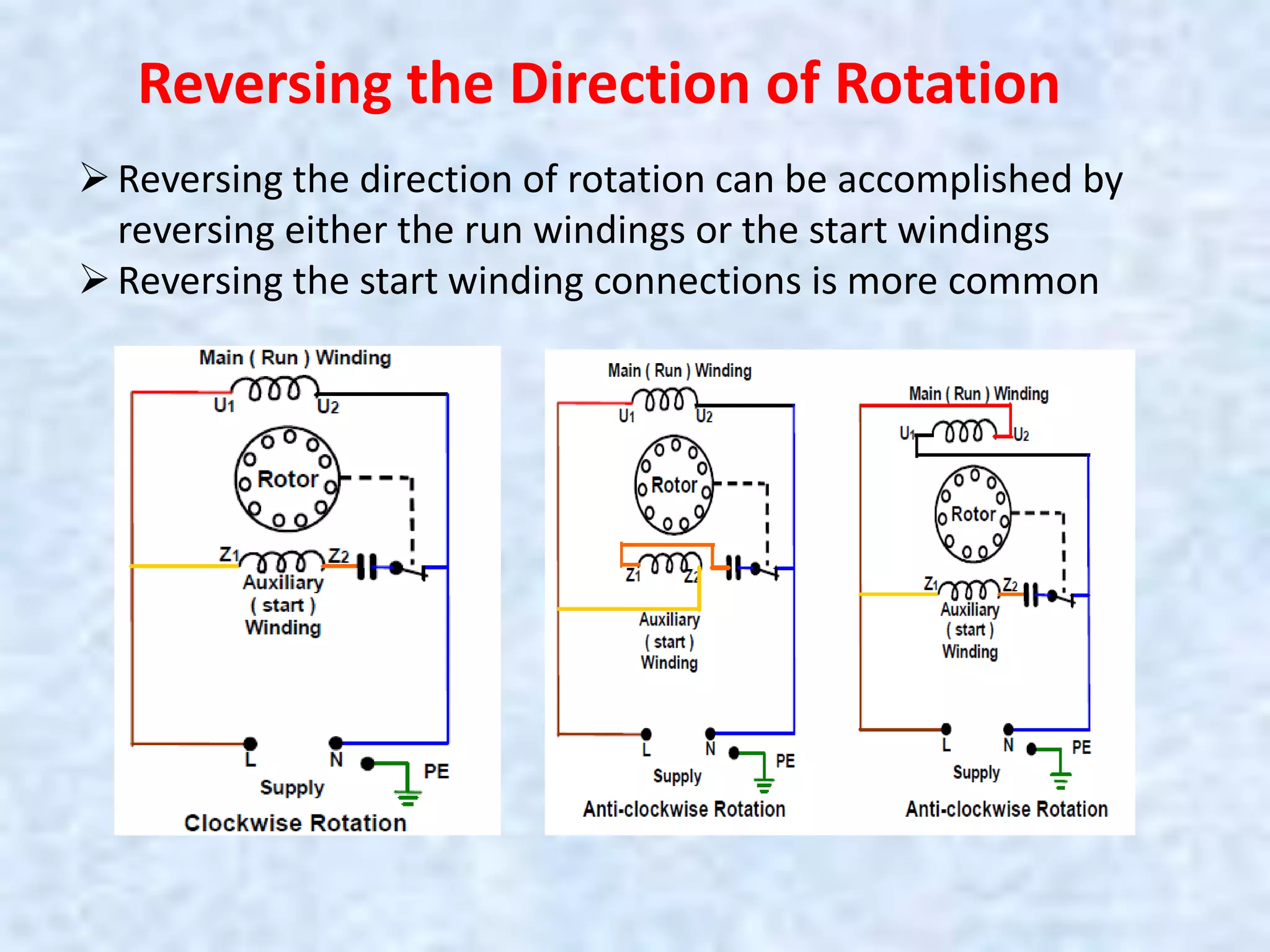
Reversing the Direction of Rotation
Reversing the direction of rotation can be accomplished by
reversing either the run windings or the start windings
Reversing the start winding connections is more common
 For slip-ring induction motors:
 Rotor rheostat starter
 For squirrel cage induction motors:
 D.O.L starter
 Primary resistance starter
 Auto transformer starter
 Star delta starter
 Other starters:
 Soft starters
 Variable speed drive
Types of 3Φ I.M starter
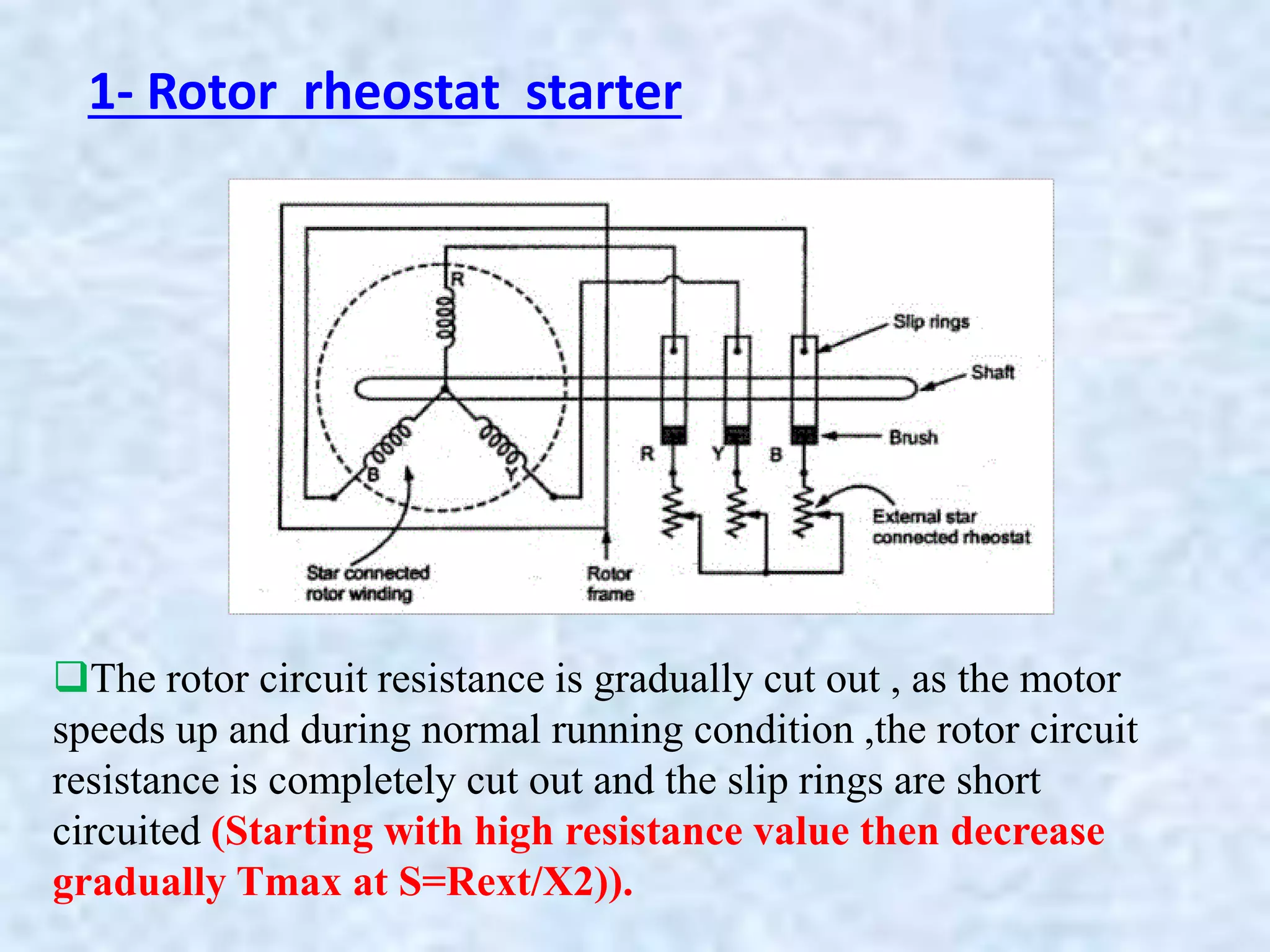
1- Rotor rheostat starter
The rotor circuit resistance is gradually cut out , as the motor
speeds up and during normal running condition ,the rotor circuit
resistance is completely cut out and the slip rings are short
circuited (Starting with high resistance value then decrease
gradually Tmax at S=Rext/X2)).
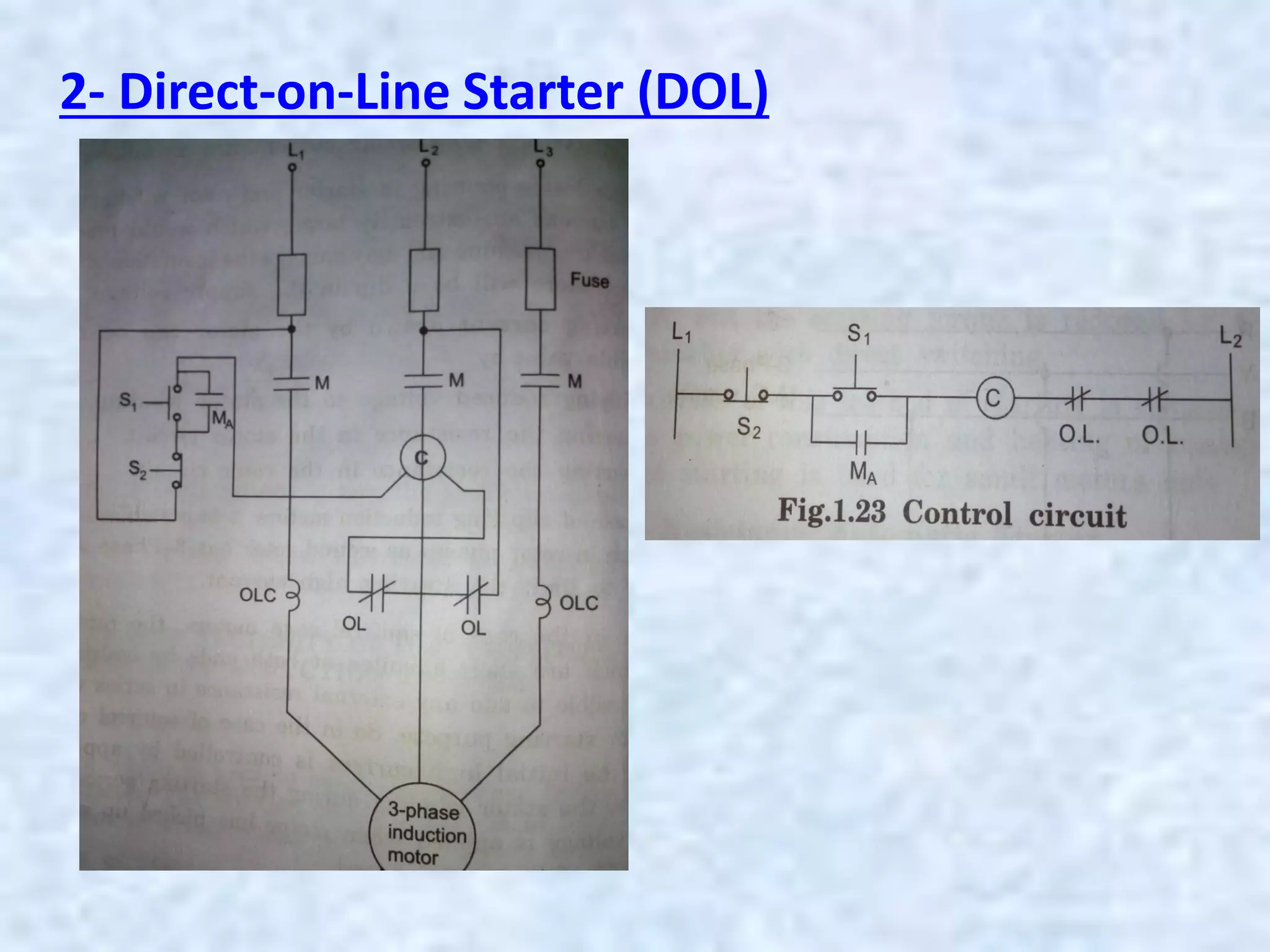
2- Direct-on-Line Starter (DOL)
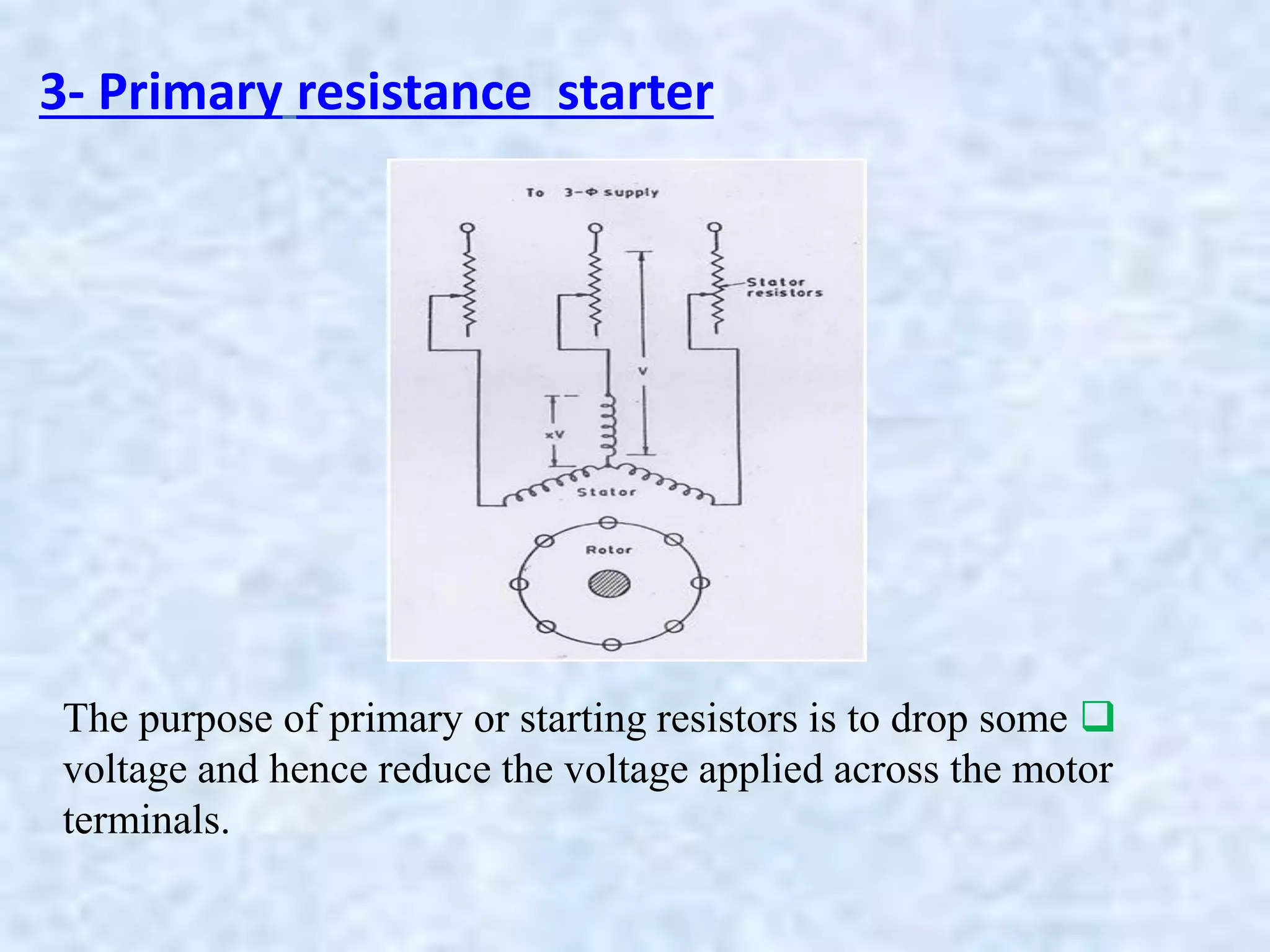
3- Primary resistance starter

The purpose of primary or starting resistors is to drop some
voltage and hence reduce the voltage applied across the motor
terminals.
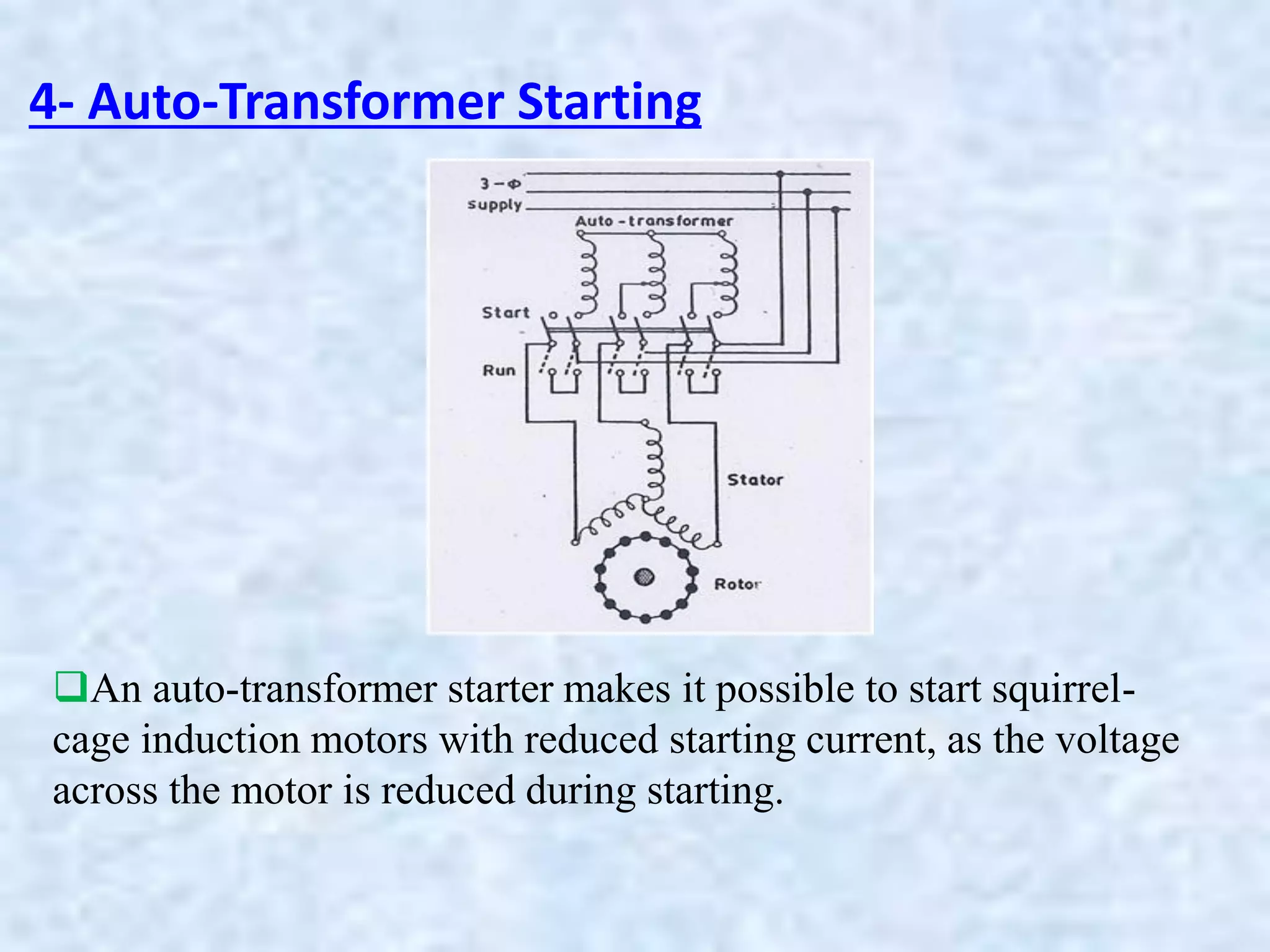
4- Auto-Transformer Starting
An auto-transformer starter makes it possible to start squirrel-
cage induction motors with reduced starting current, as the voltage
across the motor is reduced during starting.
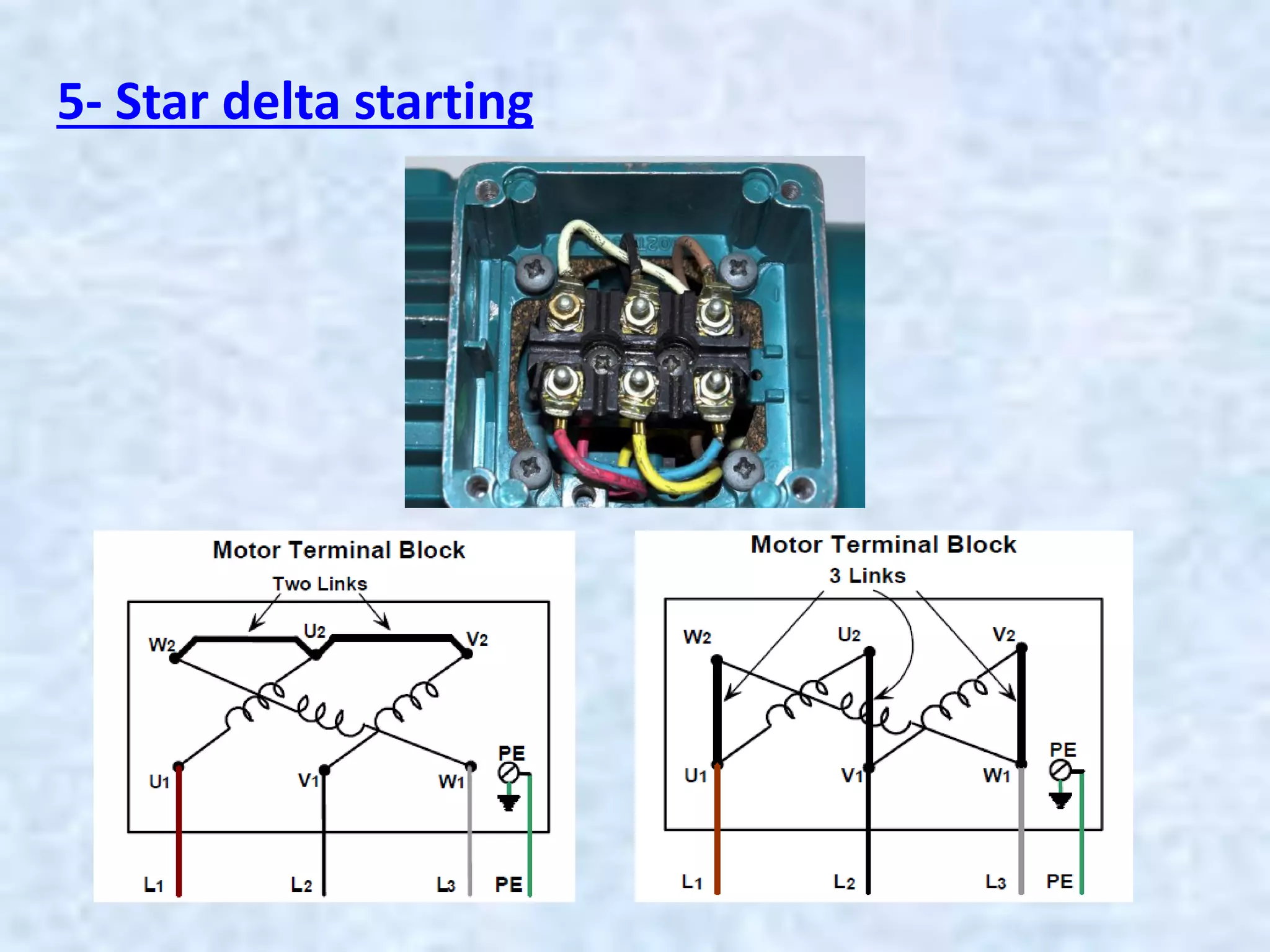
5- Star delta starting
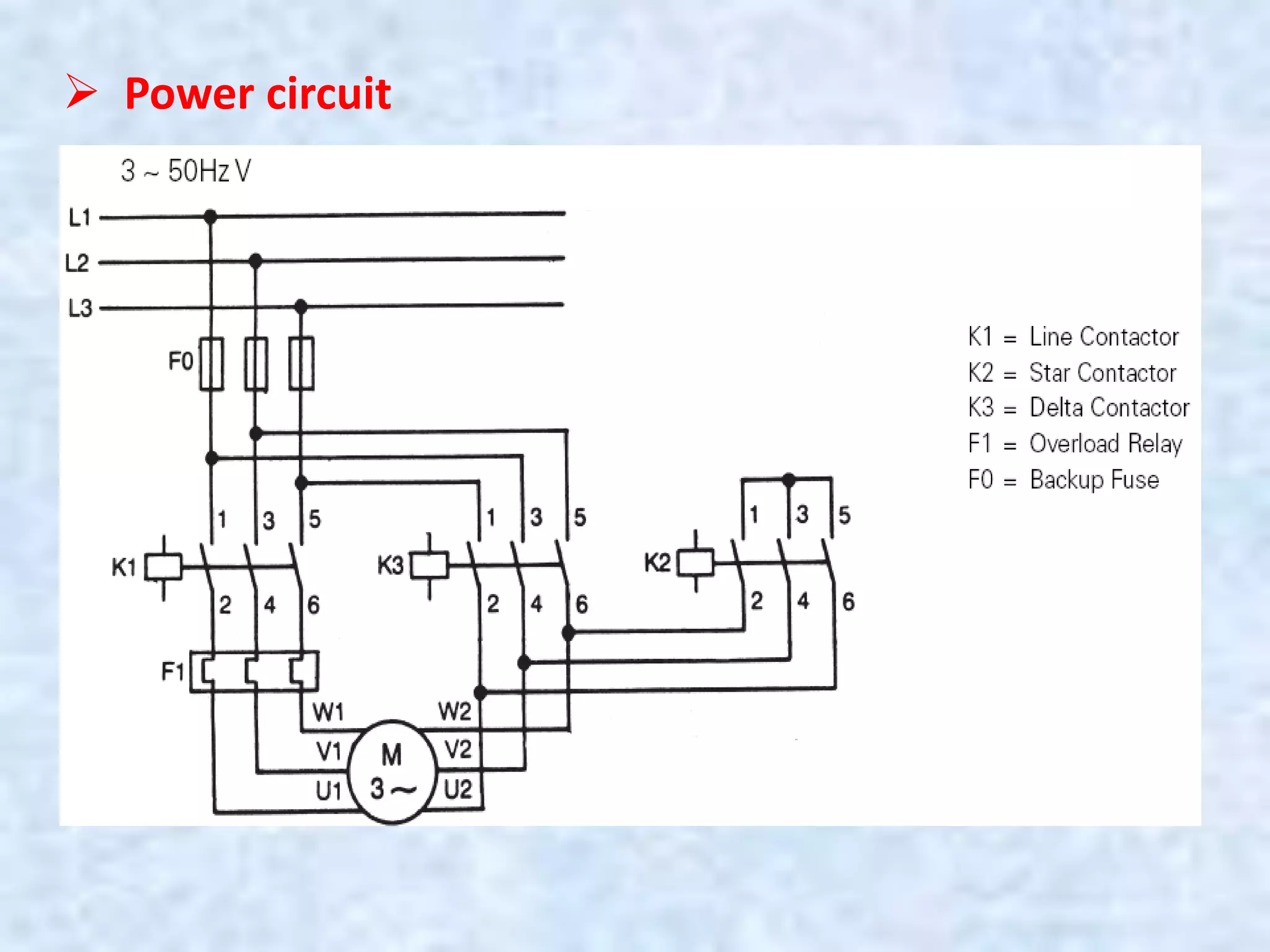
 Power circuit
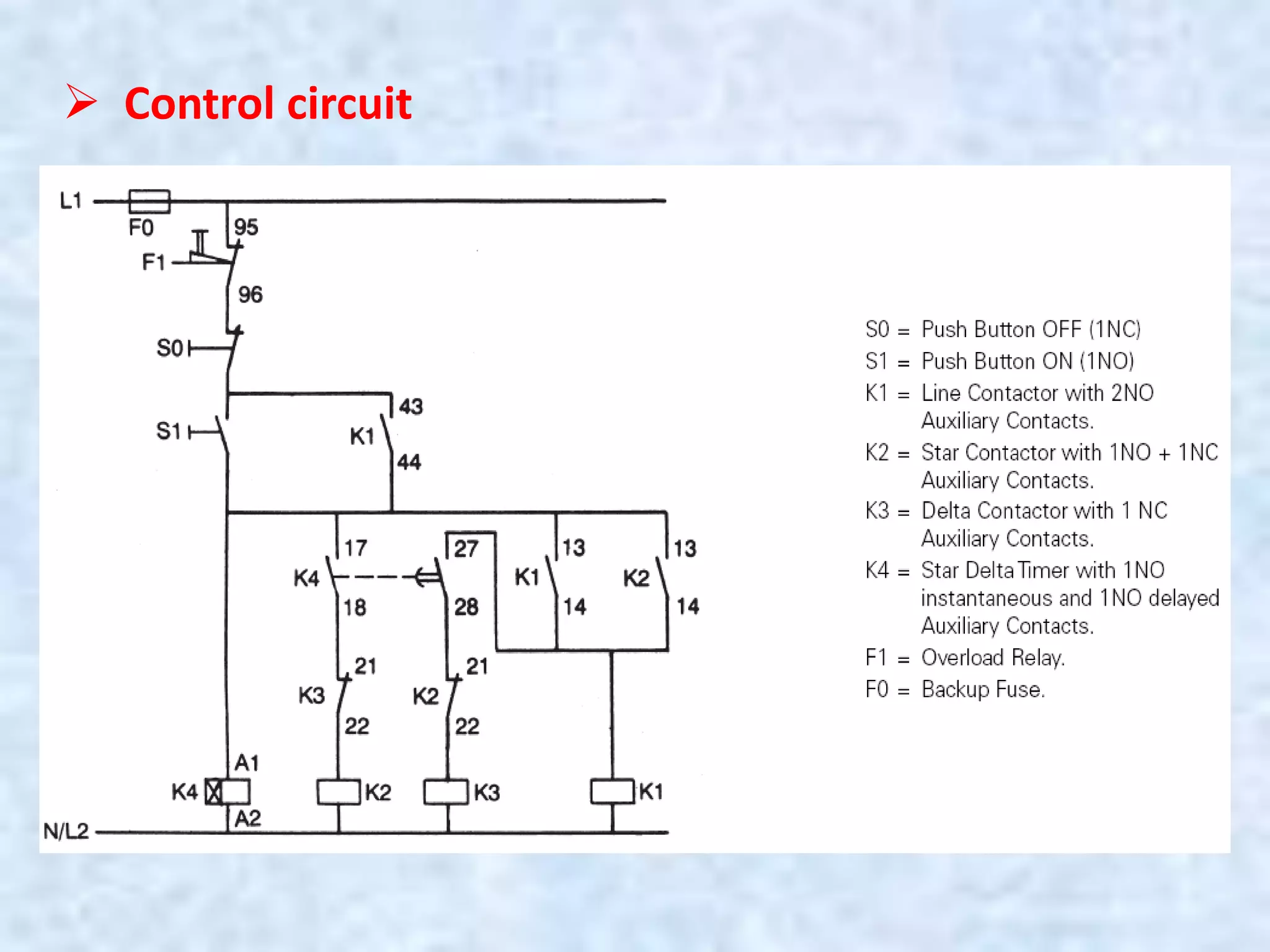
 Control circuit
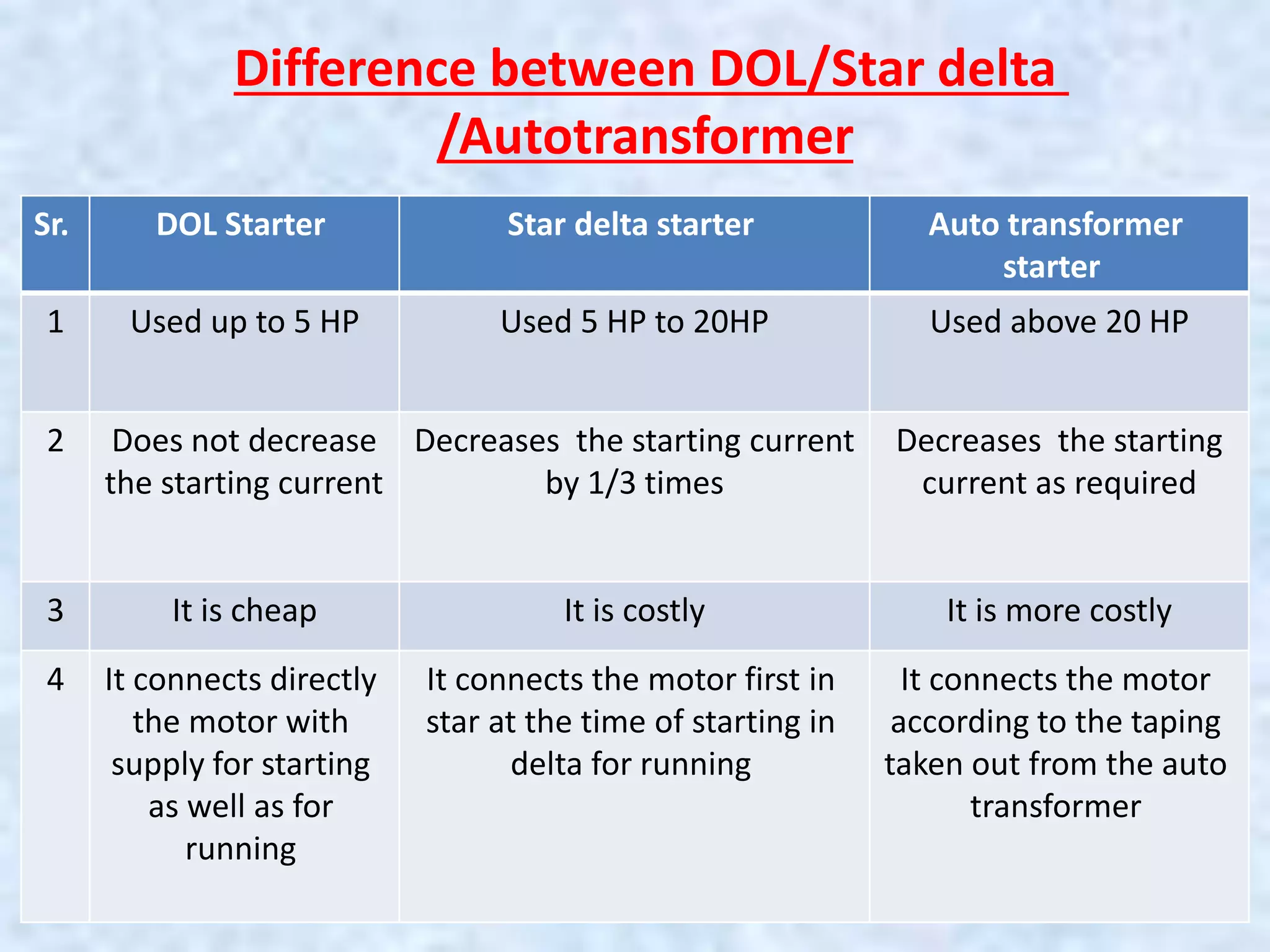
Difference between DOL/Star delta
/Autotransformer
Sr. DOL Starter Star delta starter Auto transformer
starter
1 Used up to 5 HP Used 5 HP to 20HP Used above 20 HP
2 Does not decrease
the starting current
Decreases the starting current
by 1/3 times
Decreases the starting
current as required
3 It is cheap It is costly It is more costly
4 It connects directly
the motor with
supply for starting
as well as for
running
It connects the motor first in
star at the time of starting in
delta for running
It connects the motor
according to the taping
taken out from the auto
transformer
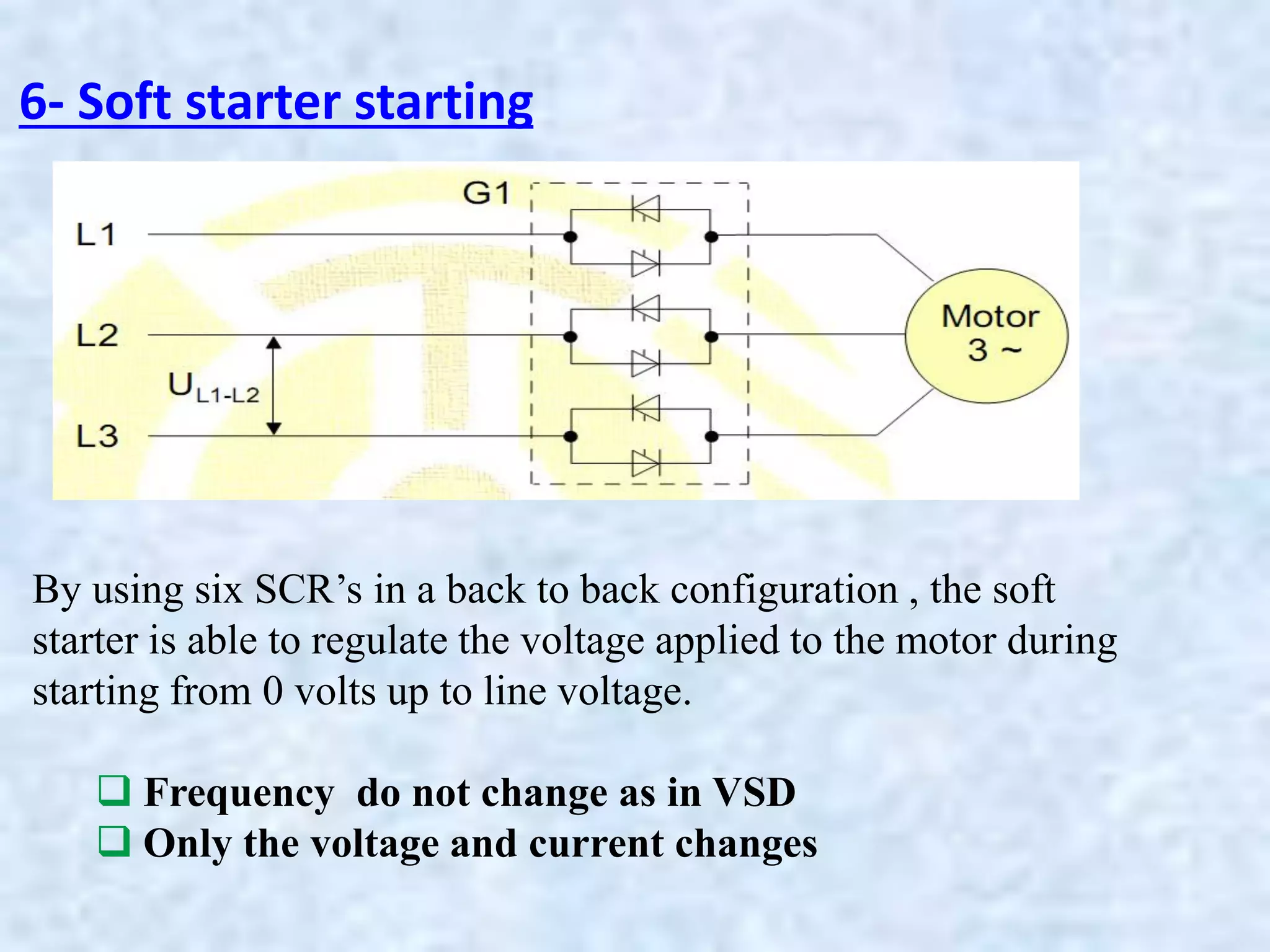
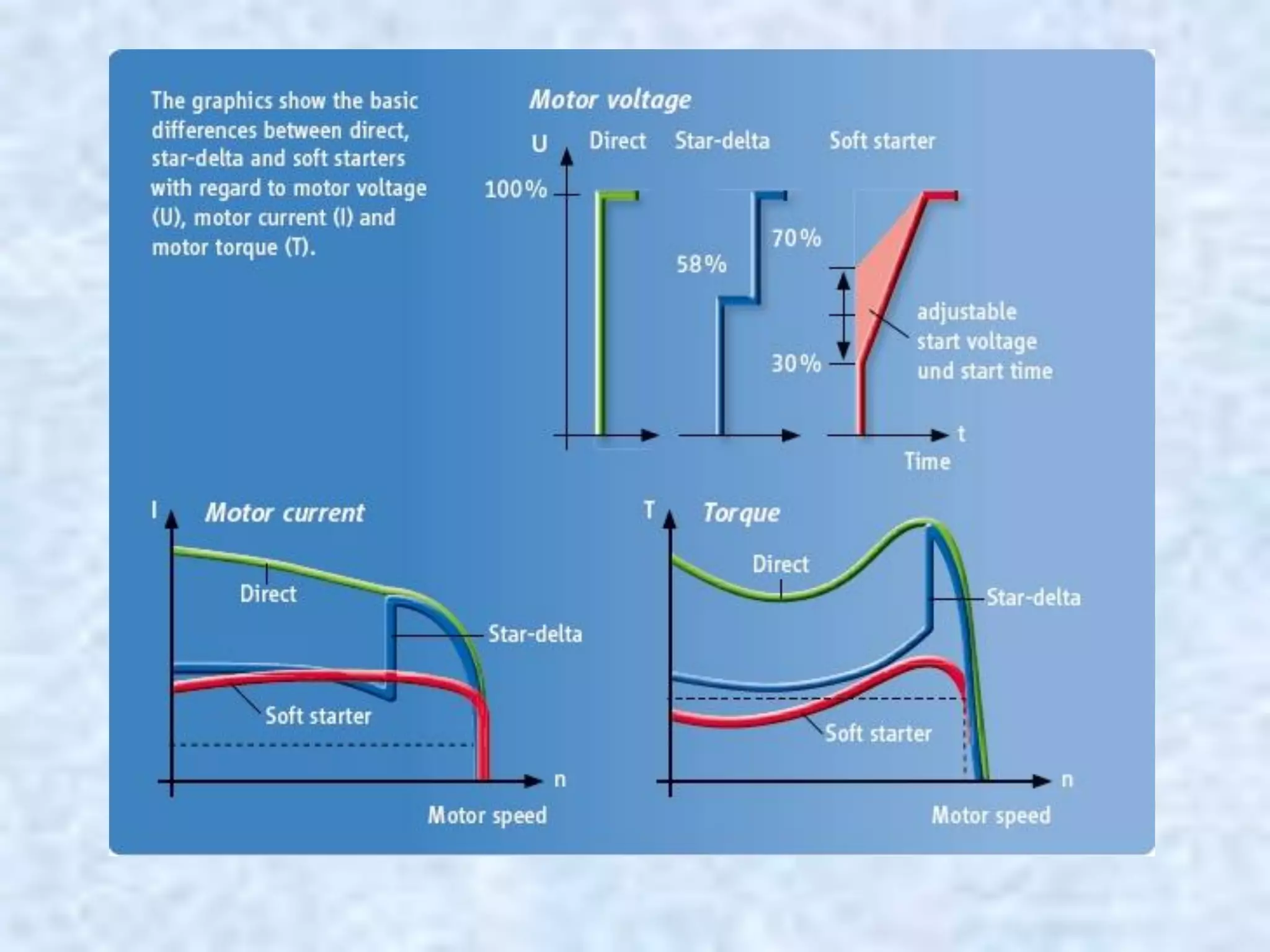
6- Soft starter starting
By using six SCR’s in a back to back configuration , the soft
starter is able to regulate the voltage applied to the motor during
starting from 0 volts up to line voltage.
 Frequency do not change as in VSD
 Only the voltage and current changes
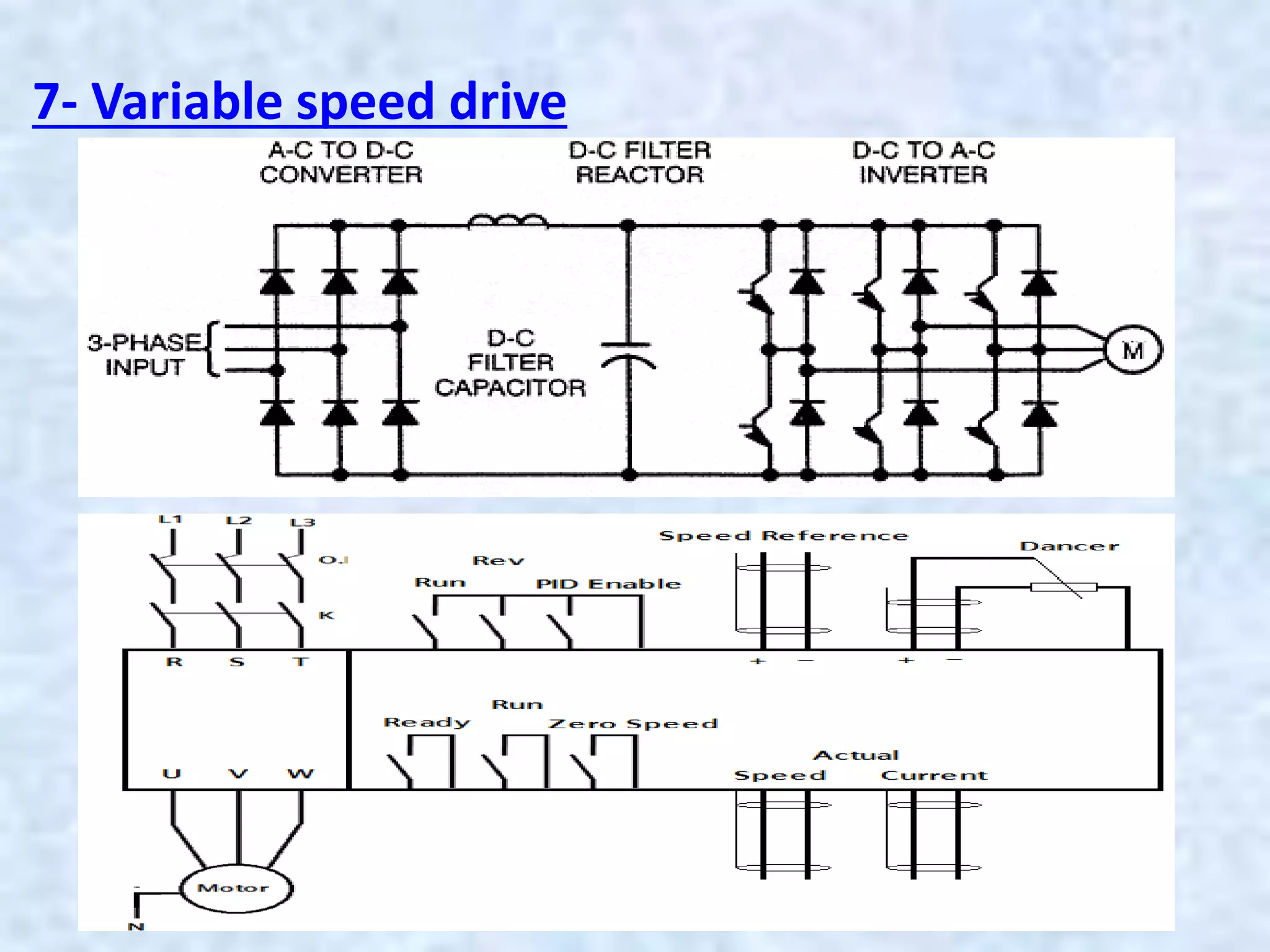
7- Variable speed drive
CHAPTER 8
Testing of
Induction Motor
Visual Tests
 Check that motor frame is mechanically sound.
 Remove terminal cover plate and check for ingress of foreign
material, moisture etc.
 Check for signs of overheating, arcing or burning.
 Check ventilation is clear.
Electrical Tests
 Identify windings using a continuity tester.
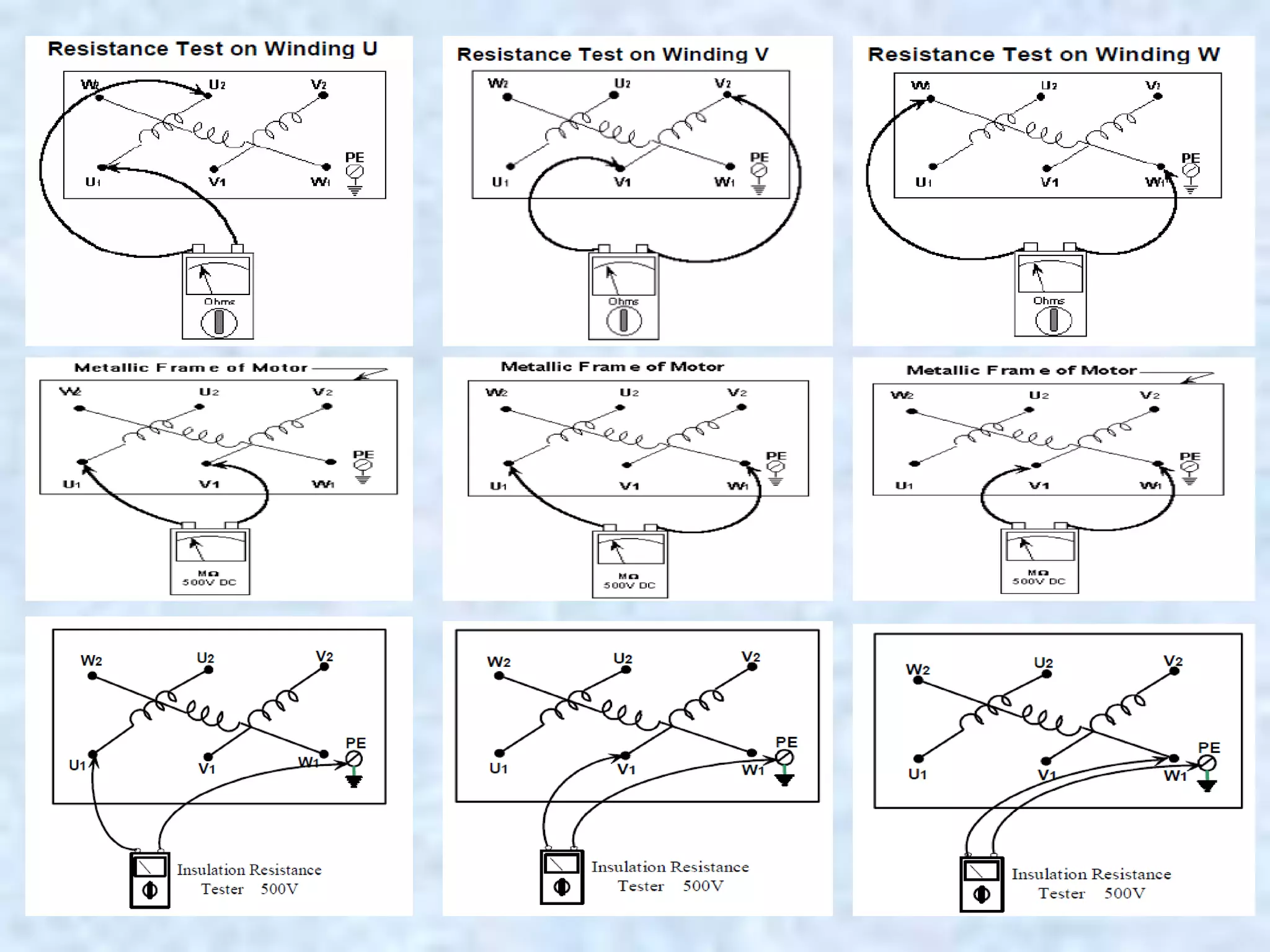
 Measure the resistance of the windings ( 3 identical readings ).
 Measure the insulation resistance between each winding and
between windings and frame.
Mechanical Tests
 Check that the rotor is free to rotate and does so smoothly / quietly.
 Check that motor interior is free of dirt, dust, water and oil.
 Check for play in bearings.
Tests when Running
 Check run currents ( If uneven check voltage at motor terminals ).
 Check speed of motor at no load and full load.
 Check vibration levels and noise levels.
 Check for temperature hot spots.
Testing of Induction Motor
Testing of Three-Phase Stator Windings
 Step 1: Isolate the motor electrically, and if
necessary, mechanically.
 Step 2: Identify the way the motor terminal block is
connected.
 Step 3: Identify the 3 stator windings - usually
labelled U1-U2, V1-V2, and W1-W2.
 Step 4: Measure and record the resistance of each
winding.
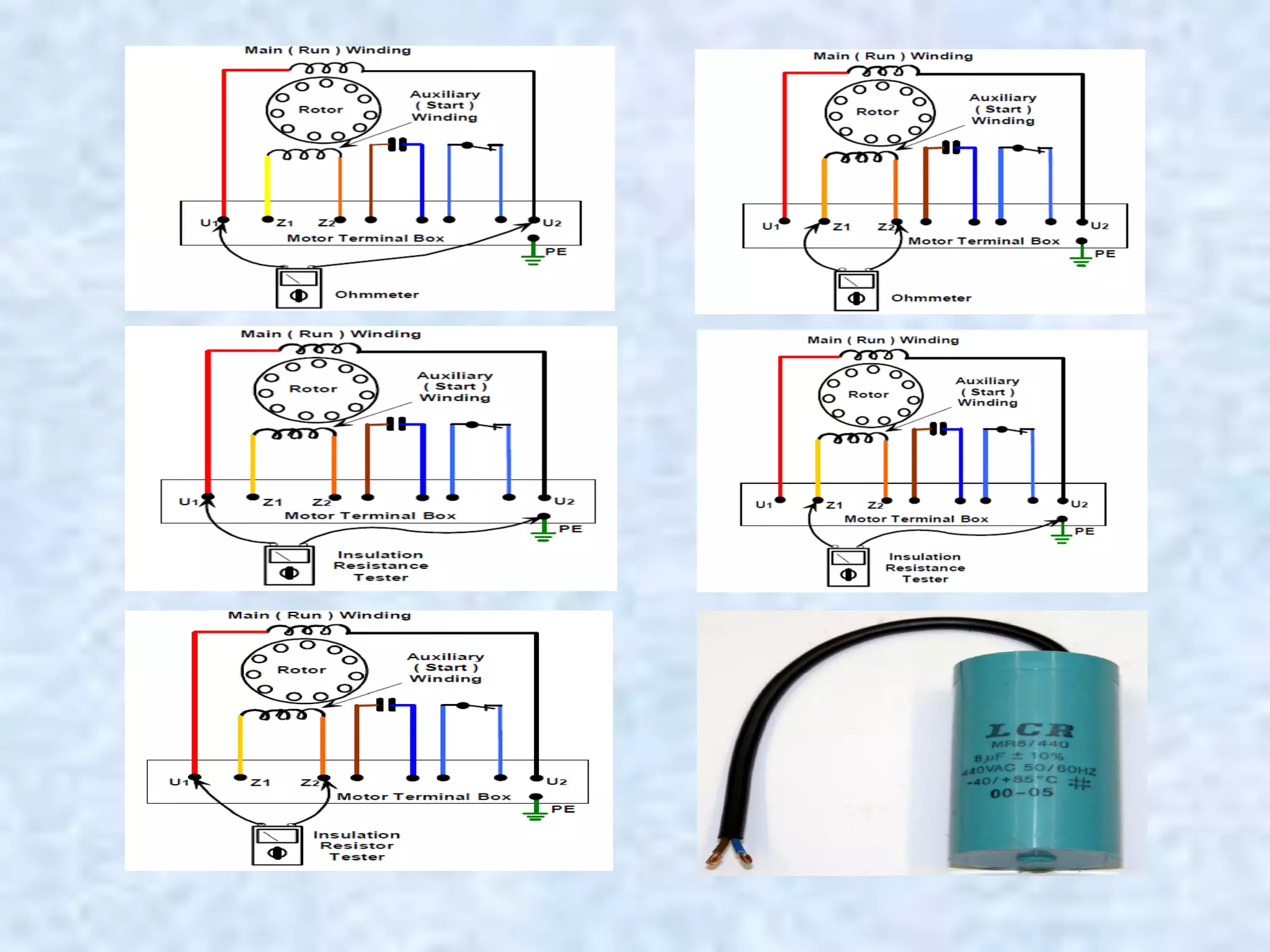
Testing of Single Phase Stator Windings
 Step 1: Isolate the motor electrically, and if
necessary, mechanically.
 Step 2: Identify the way the motor terminal
block is connected.
 Step 3: Identify the 2 stator windings - usually
labelled U1-U2 and Z1-Z2.
 Step 4: Measure and record the resistance of
each winding.
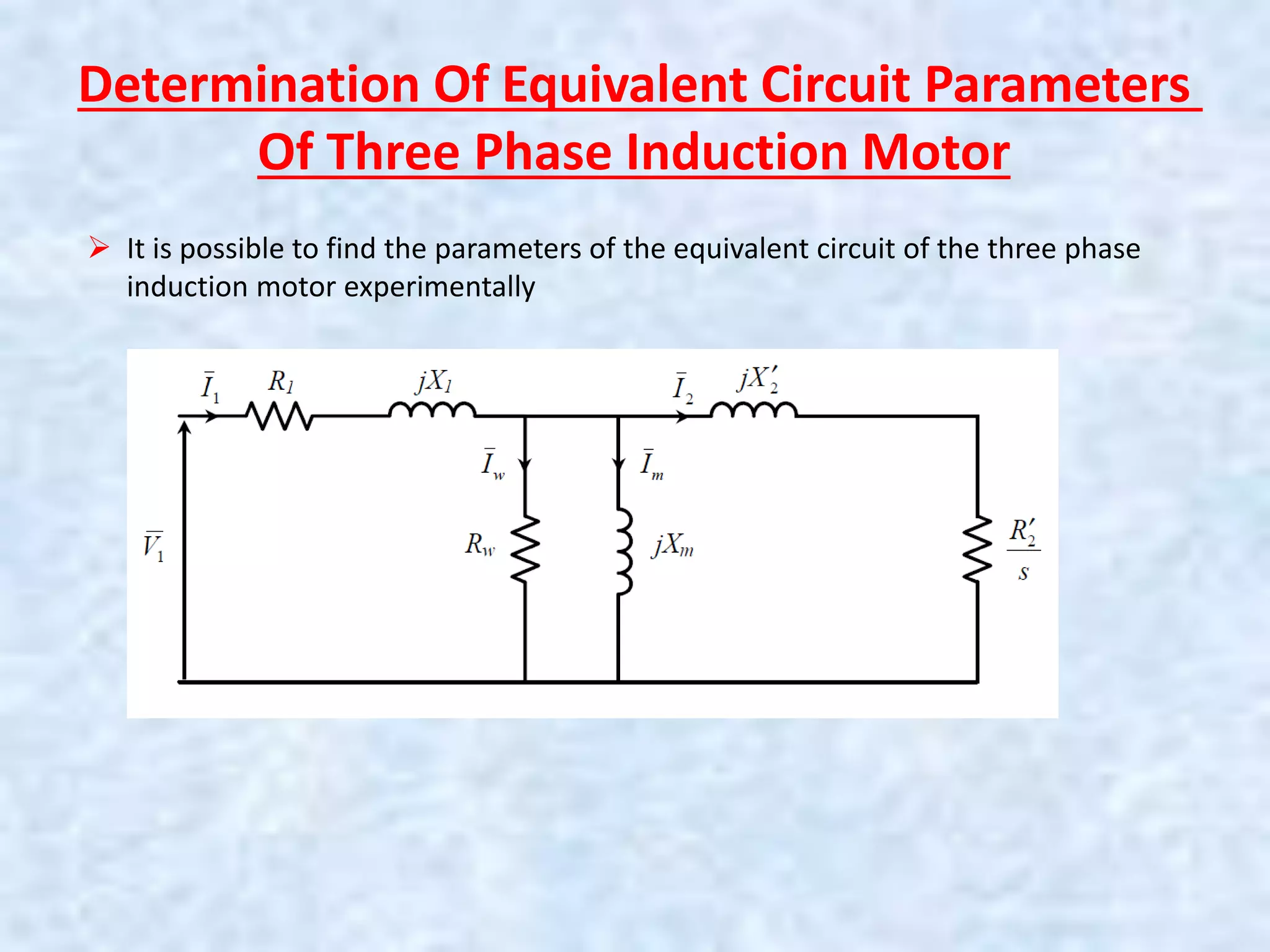
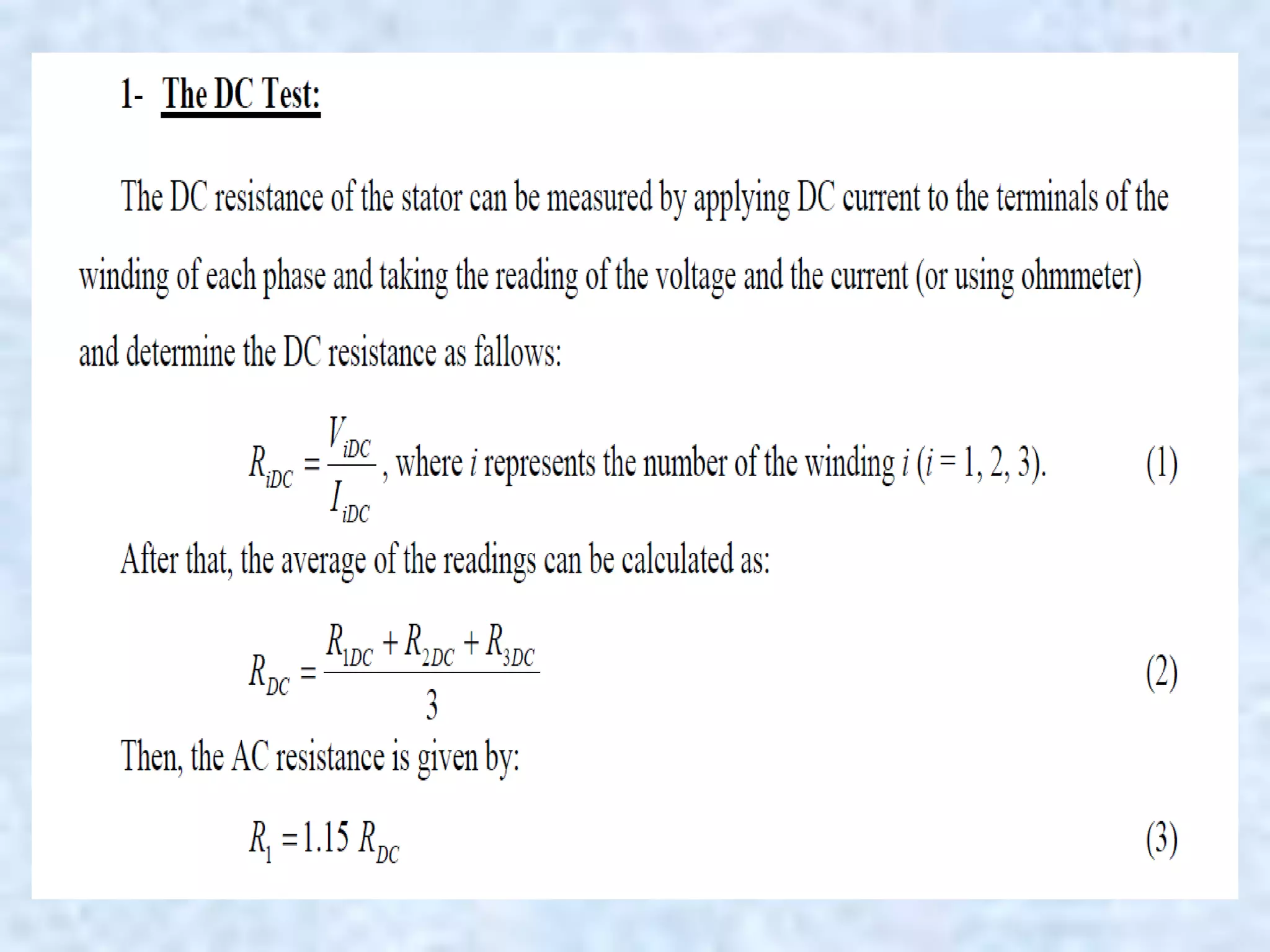
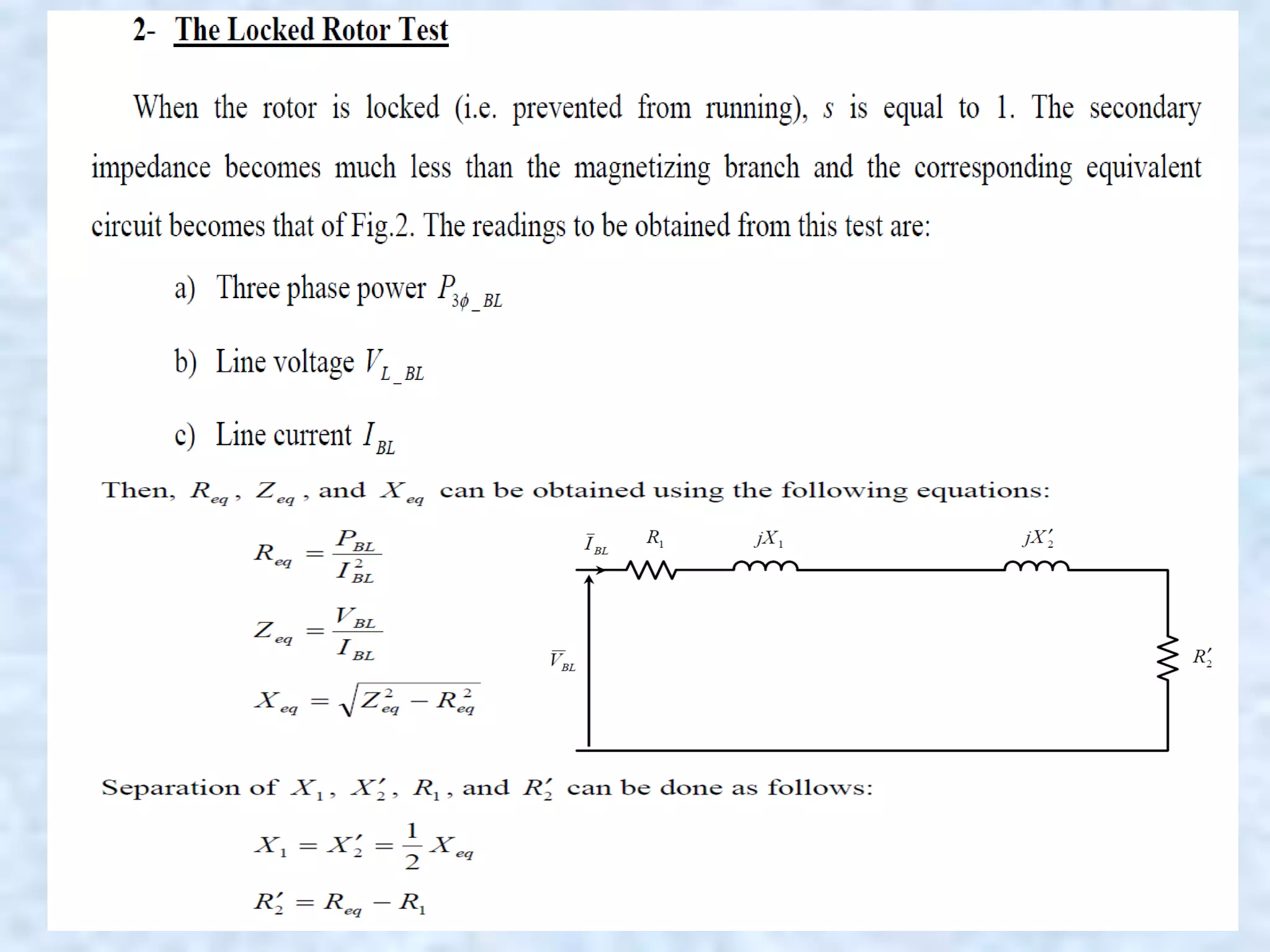
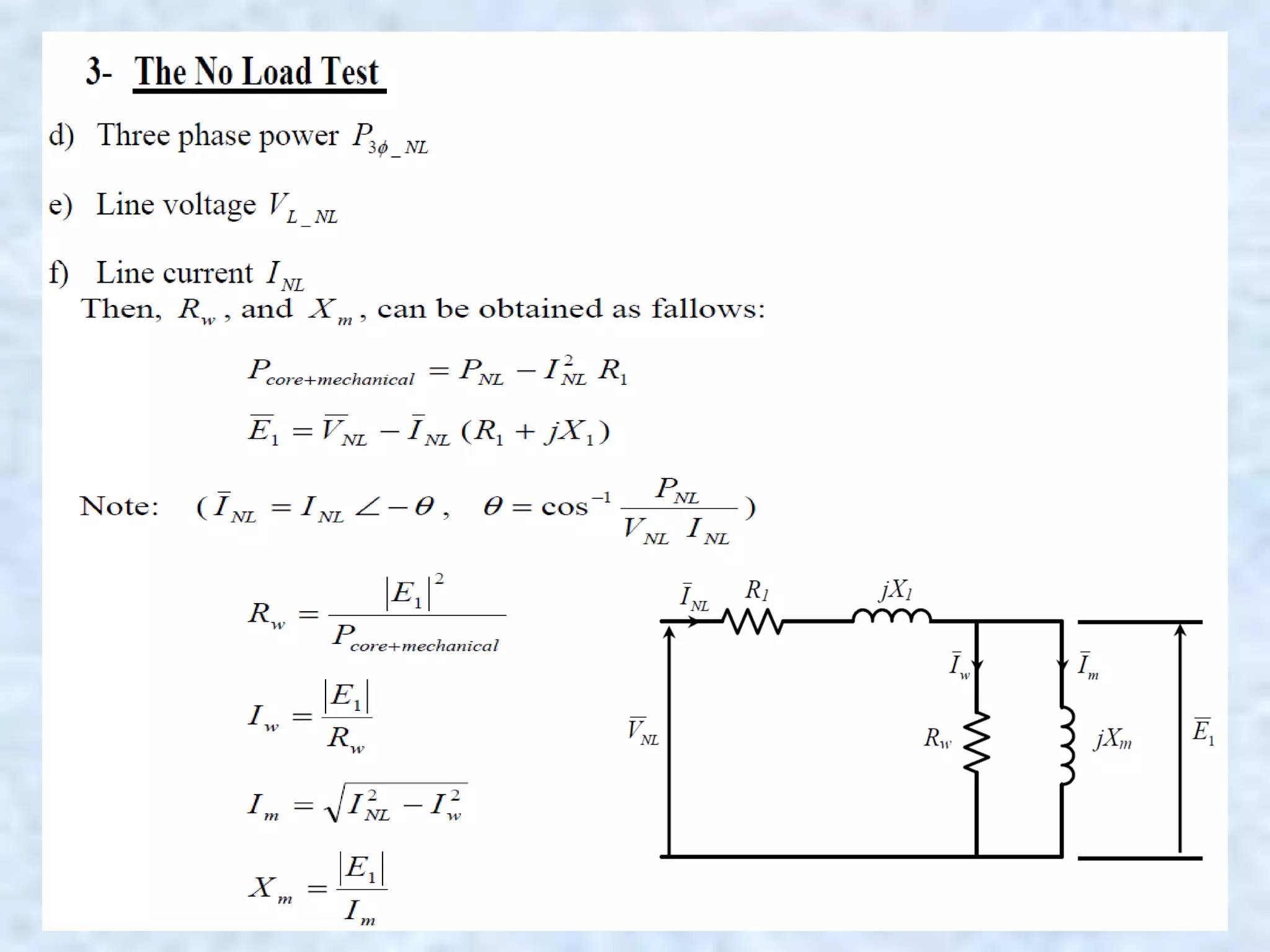
Determination Of Equivalent Circuit Parameters
Of Three Phase Induction Motor
 It is possible to find the parameters of the equivalent circuit of the three phase
induction motor experimentally
CHAPTER 9
Typical Motor Failure
& Protection
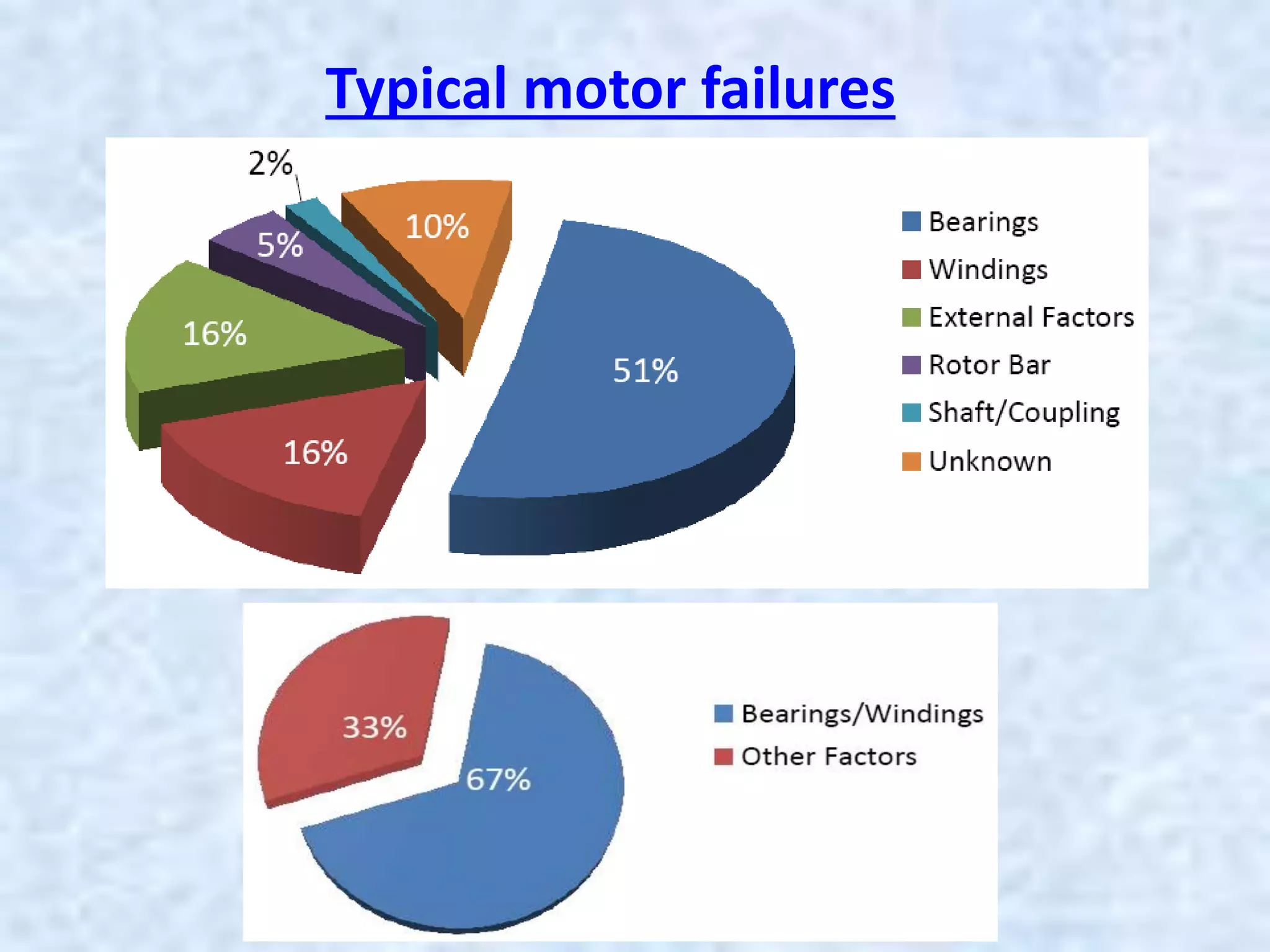
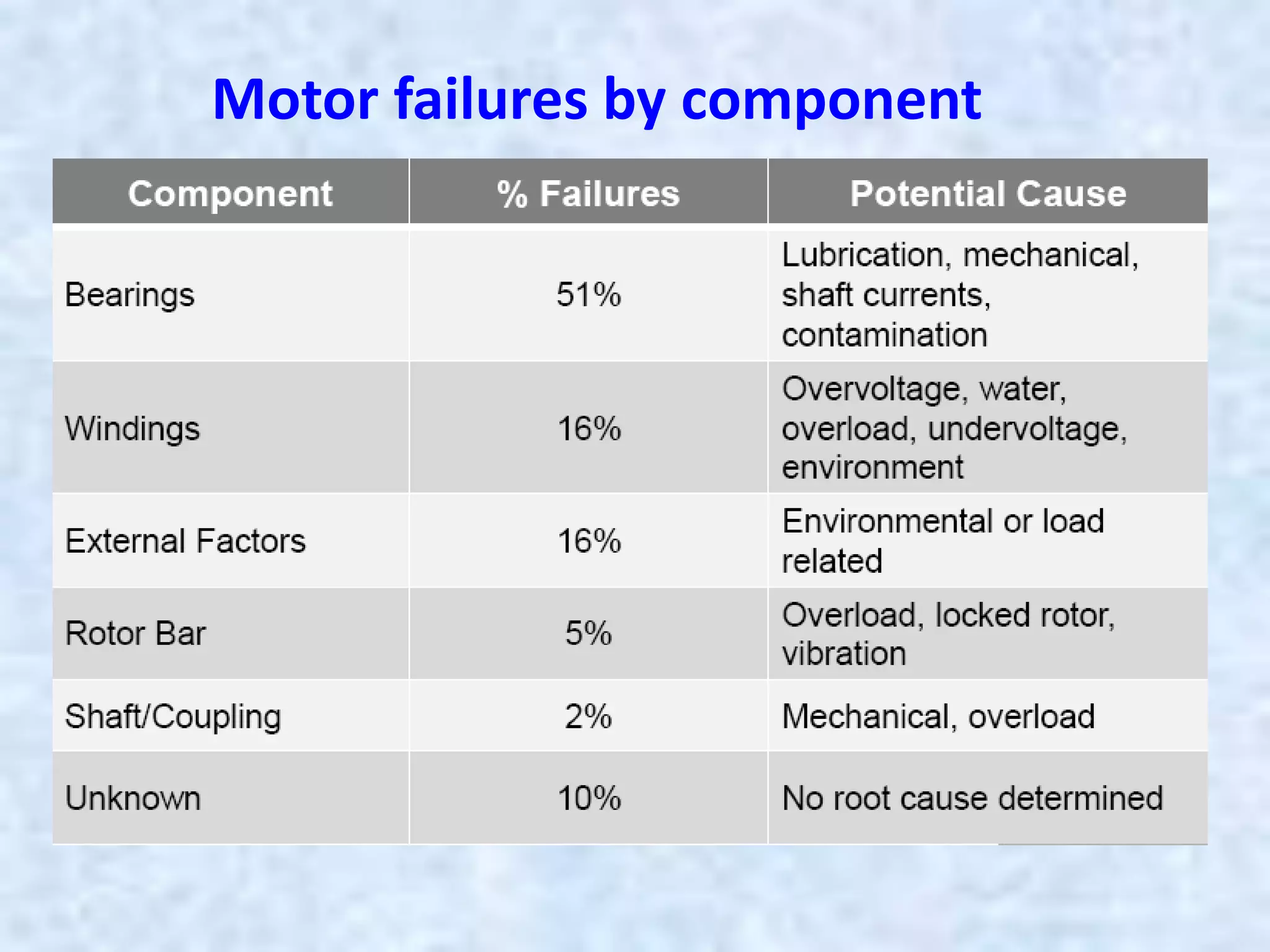
Typical motor failures
Motor failures by component
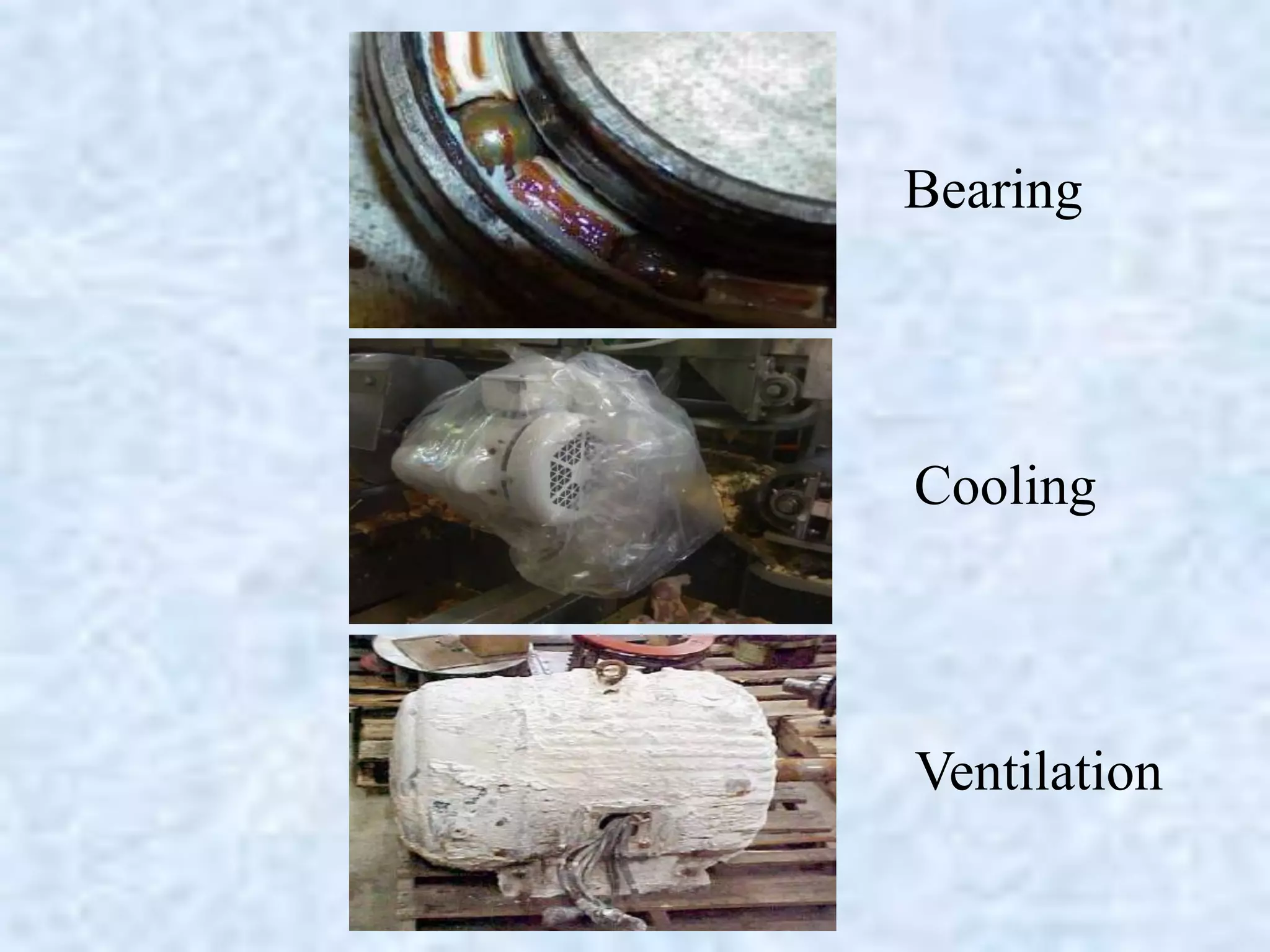
Bearing
Ventilation
Cooling
Motor Protection
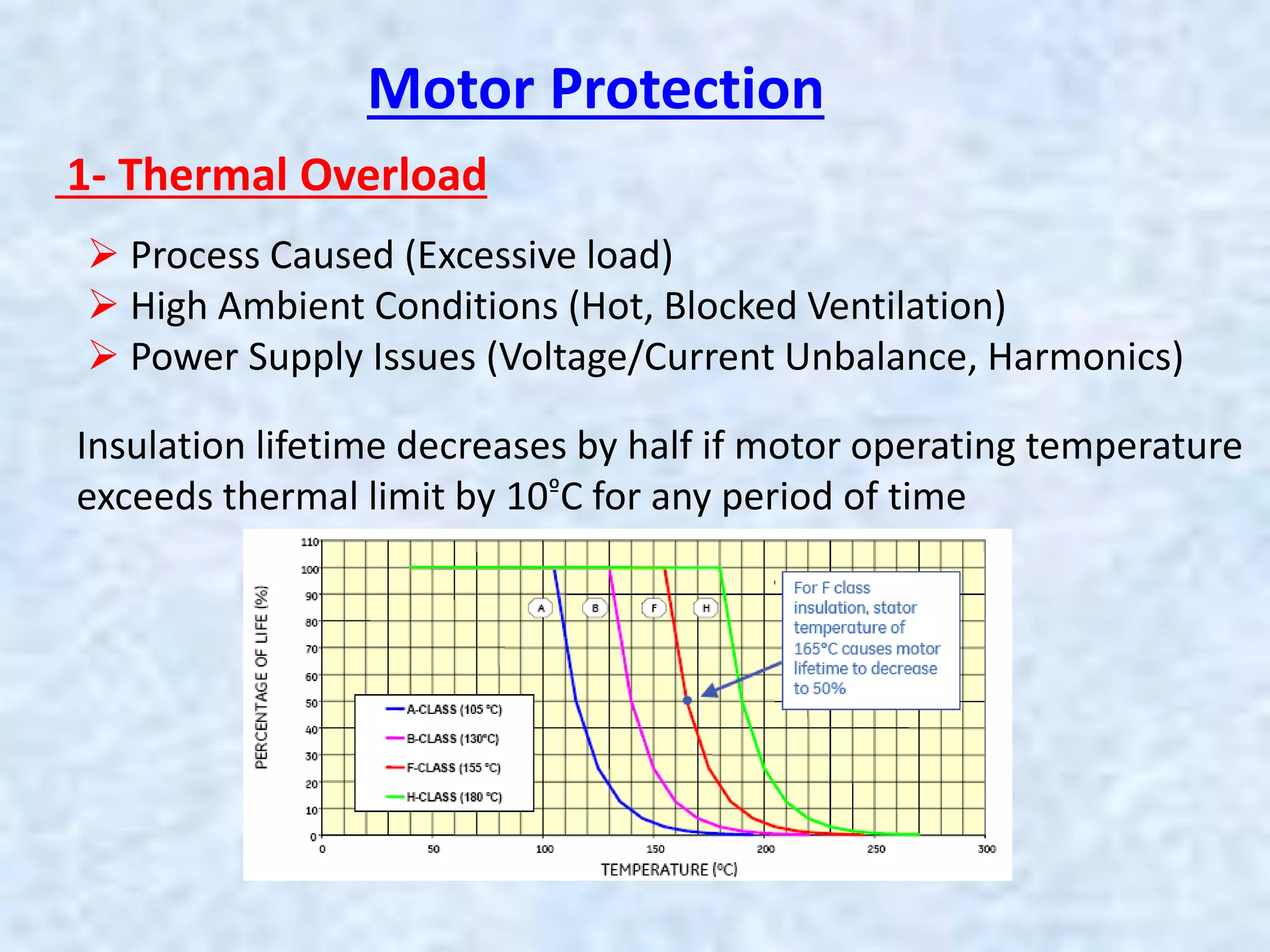
1- Thermal Overload
Insulation lifetime decreases by half if motor operating temperature
exceeds thermal limit by 10ºC for any period of time
 Process Caused (Excessive load)
 High Ambient Conditions (Hot, Blocked Ventilation)
 Power Supply Issues (Voltage/Current Unbalance, Harmonics)
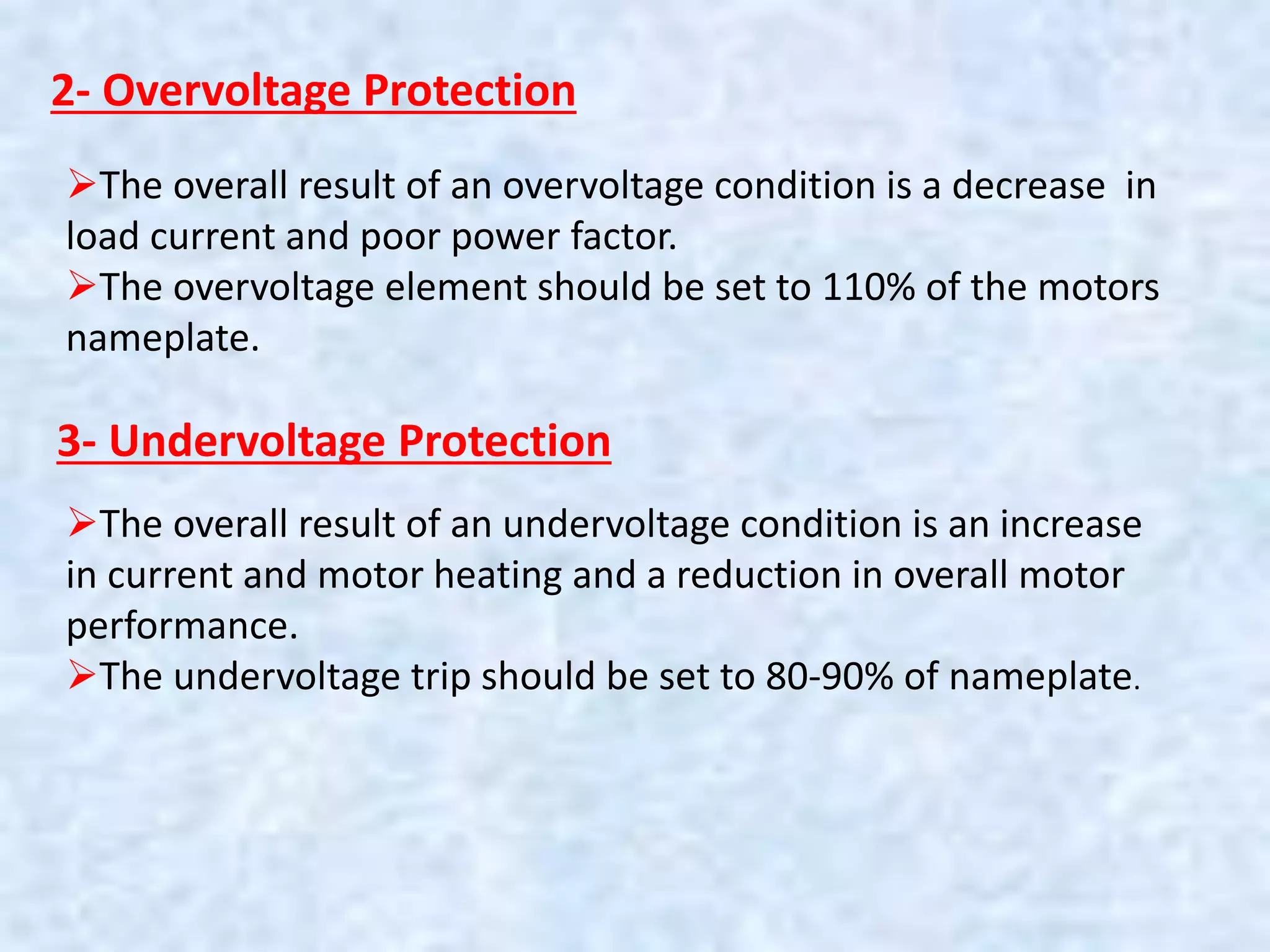
2- Overvoltage Protection
The overall result of an overvoltage condition is a decrease in
load current and poor power factor.
The overvoltage element should be set to 110% of the motors
nameplate.
3- Undervoltage Protection
The overall result of an undervoltage condition is an increase
in current and motor heating and a reduction in overall motor
performance.
The undervoltage trip should be set to 80-90% of nameplate.
170
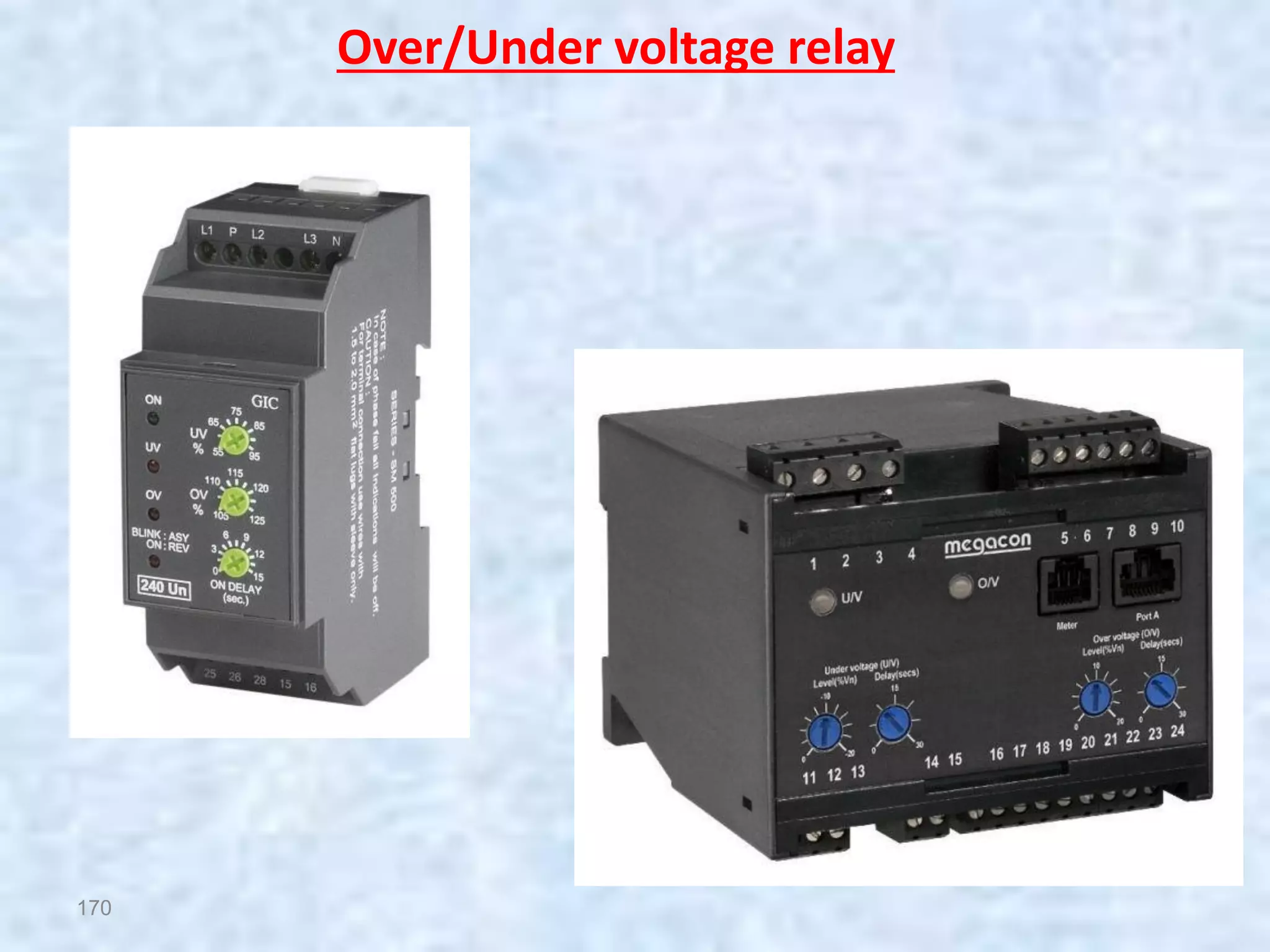
Over/Under voltage relay
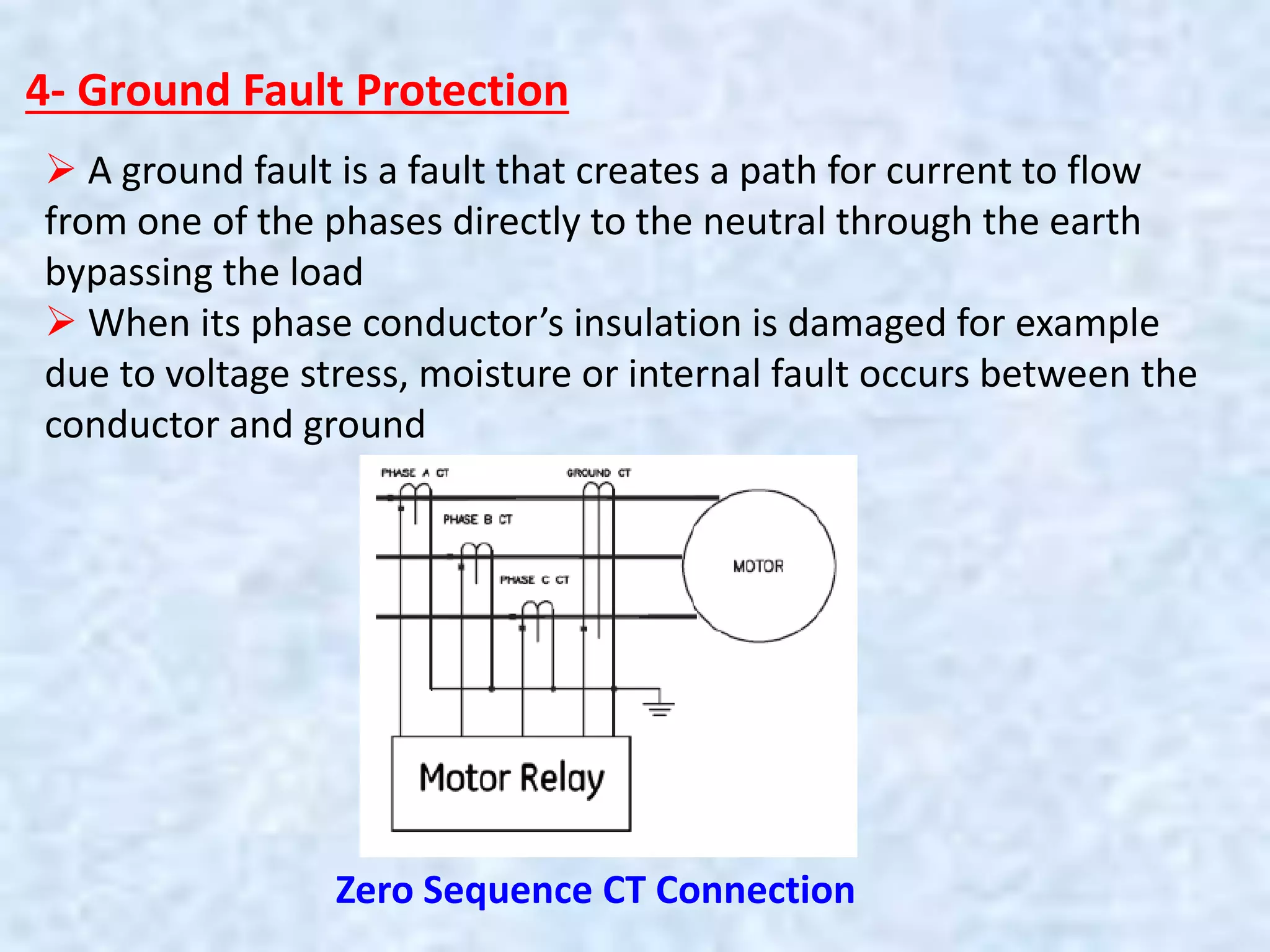
4- Ground Fault Protection
 A ground fault is a fault that creates a path for current to flow
from one of the phases directly to the neutral through the earth
bypassing the load
 When its phase conductor’s insulation is damaged for example
due to voltage stress, moisture or internal fault occurs between the
conductor and ground
Zero Sequence CT Connection
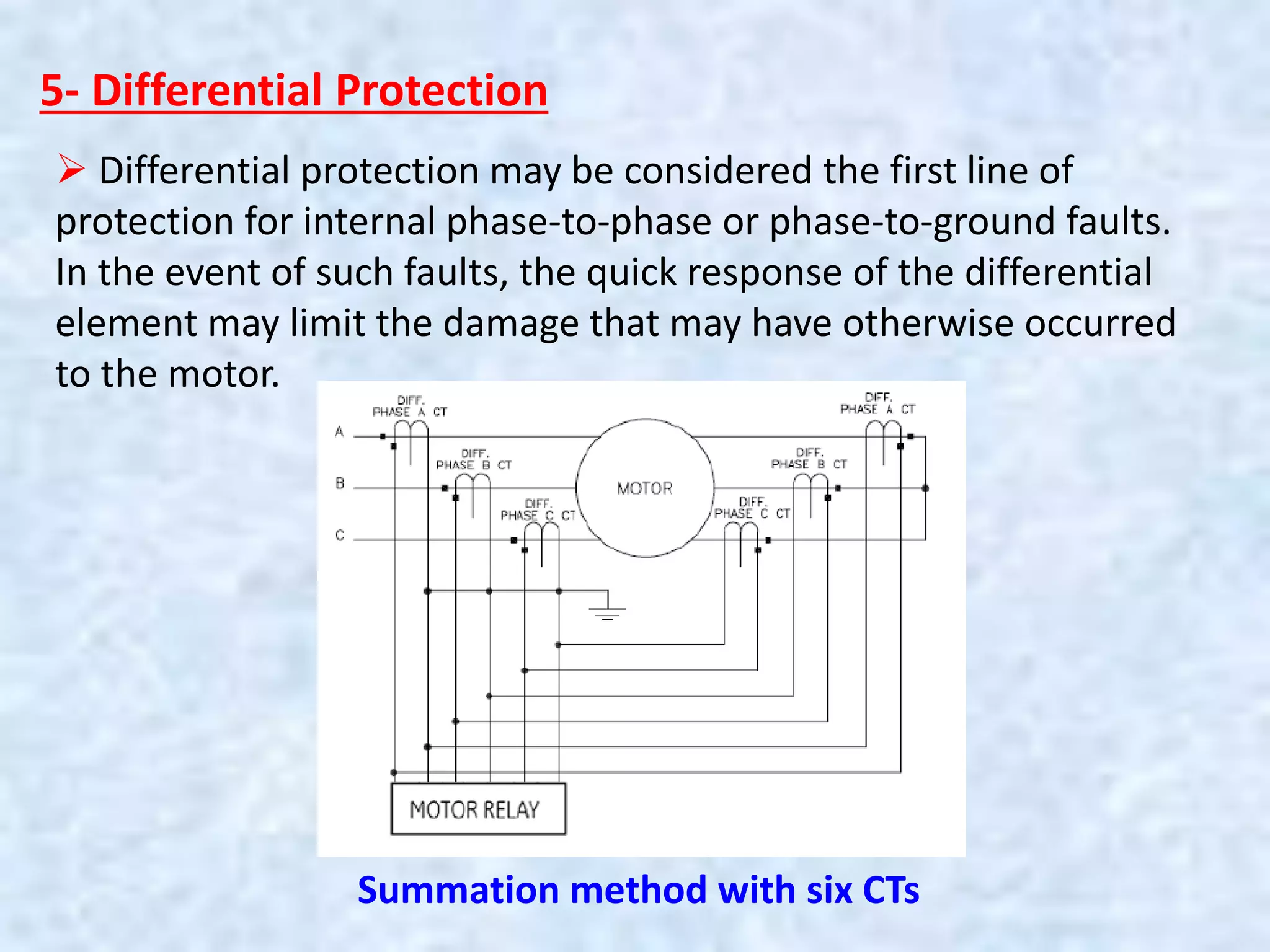
5- Differential Protection
 Differential protection may be considered the first line of
protection for internal phase-to-phase or phase-to-ground faults.
In the event of such faults, the quick response of the differential
element may limit the damage that may have otherwise occurred
to the motor.
Summation method with six CTs
173
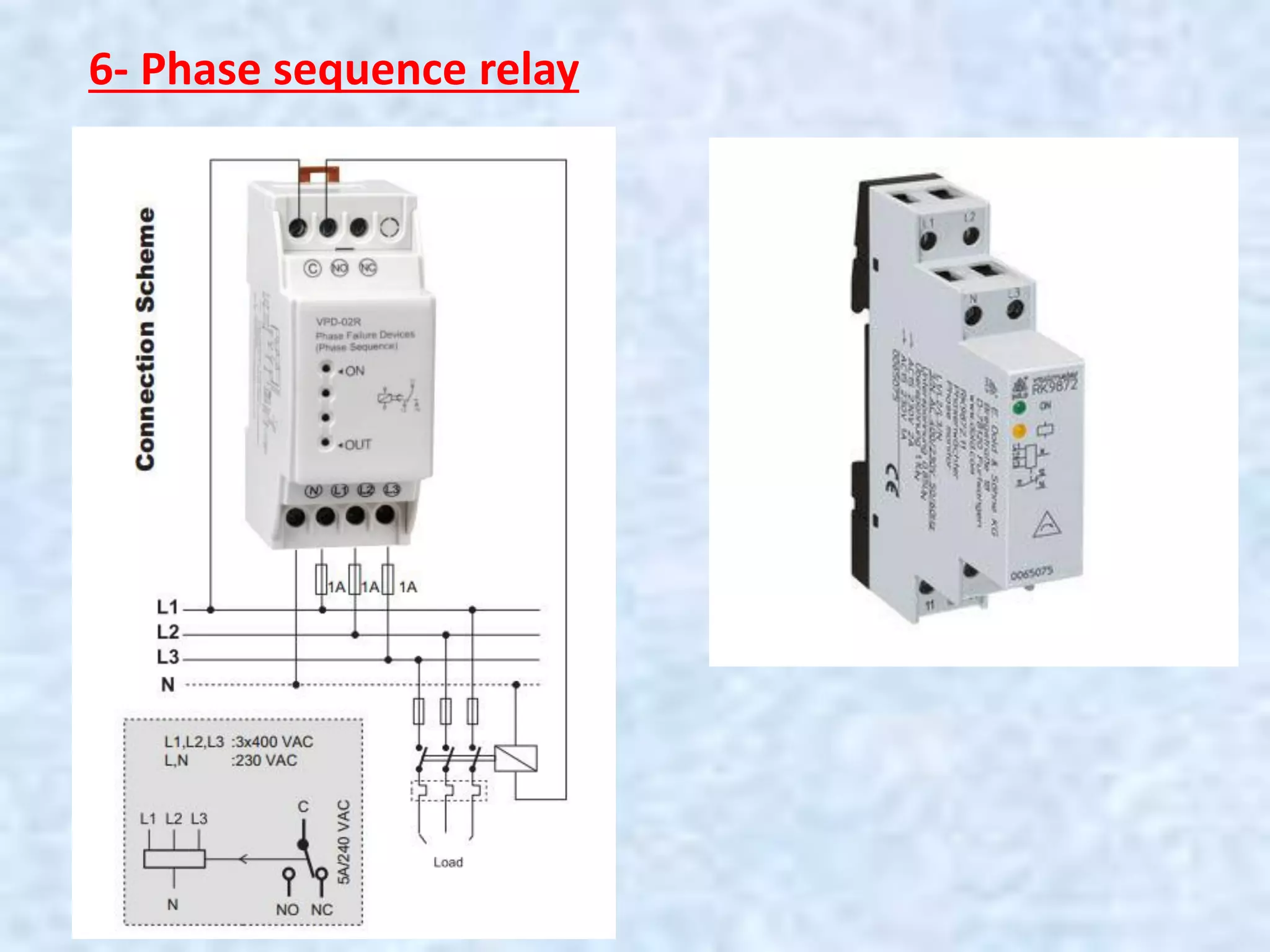
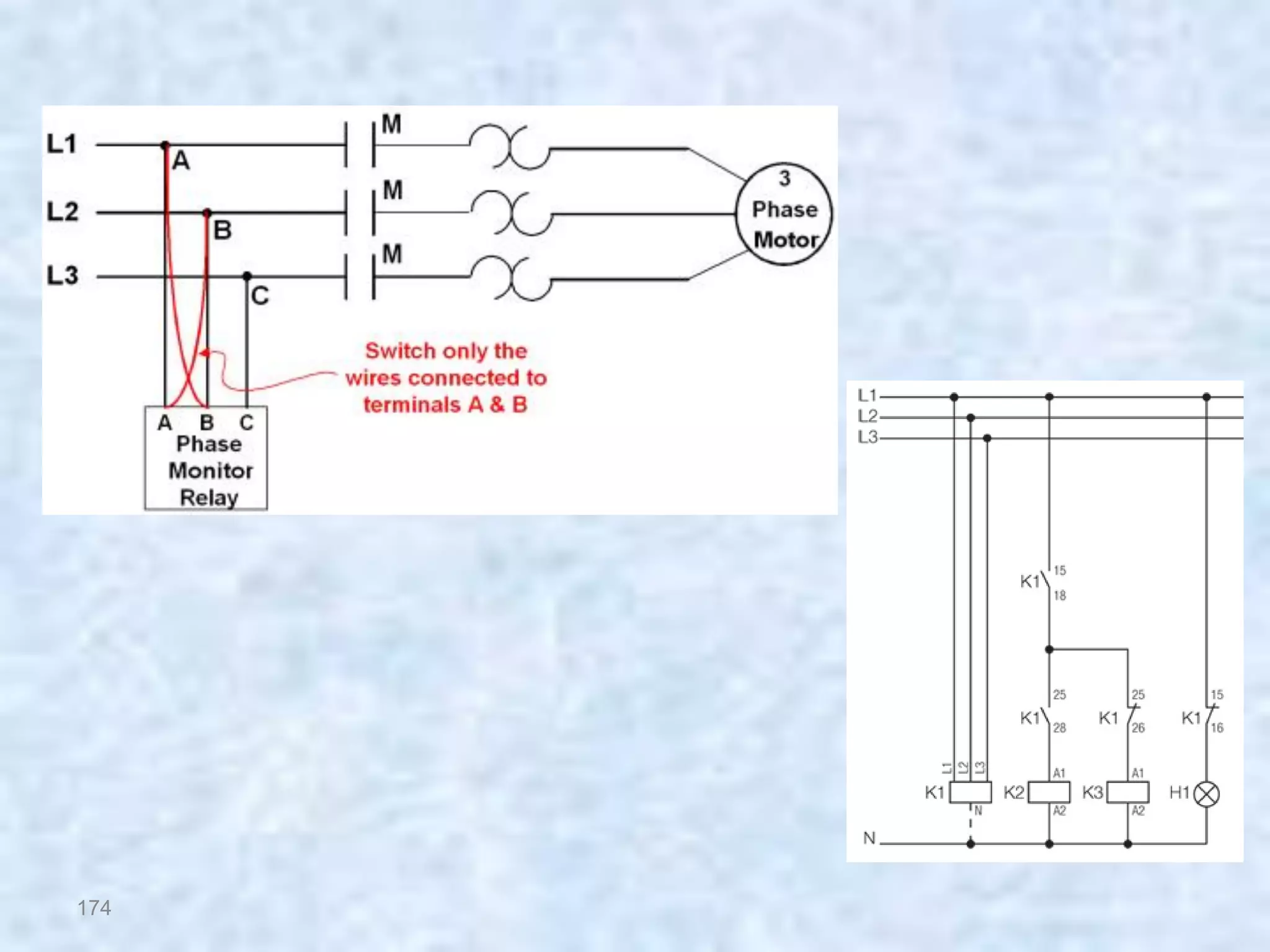
6- Phase sequence relay
174
175
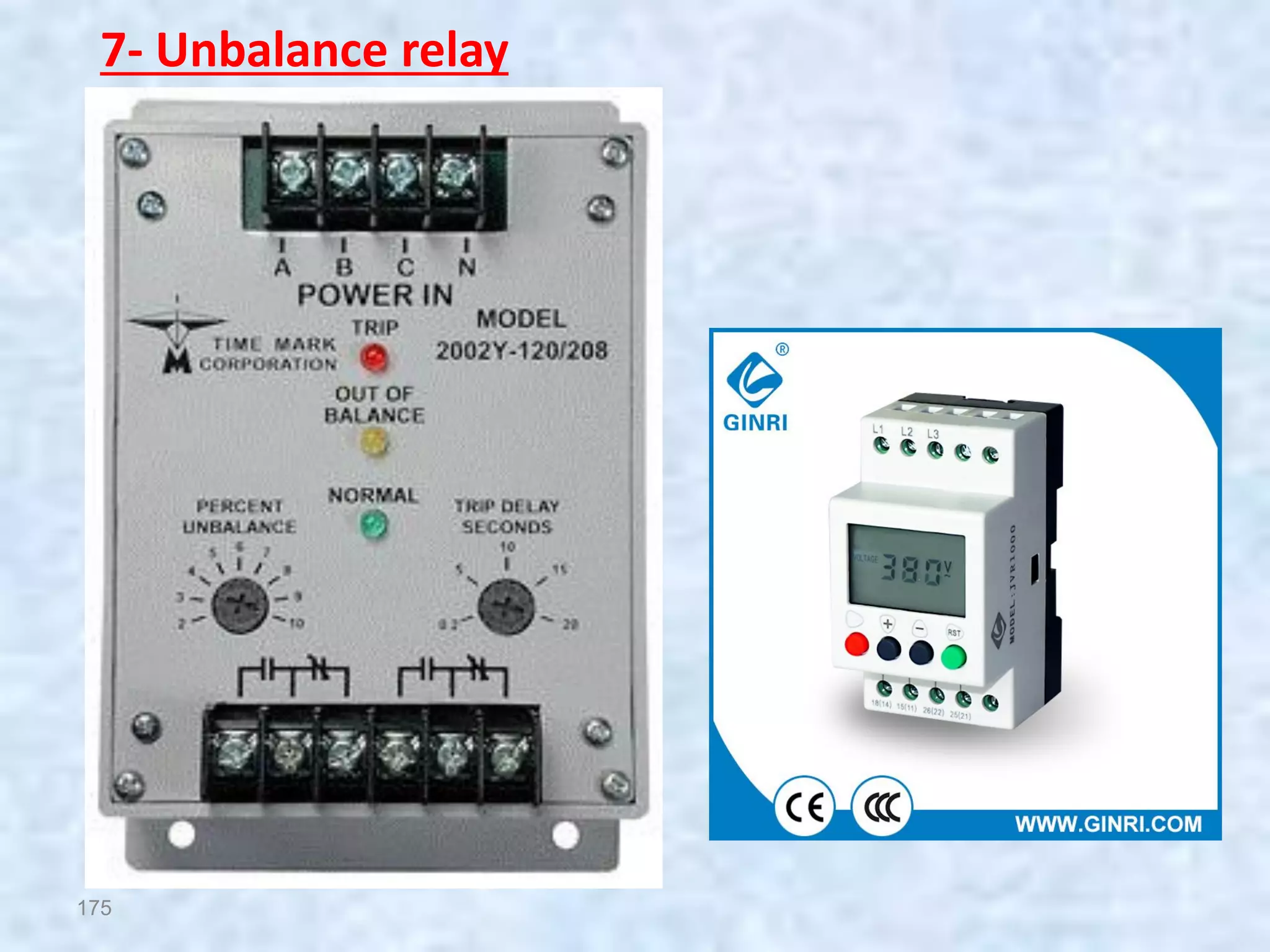
7- Unbalance relay
Electrical Basic and Classic Control

Electrical Basic and Classic Control

  • 1.
  • 2.
    2 COURSE CONTENTS Part One ElectricalBasics & Control Circuits Chapter 1 Electrical Basics Chapter 2 Types of Control System Chapter 3 Classic control components Chapter 4 Motor Name Plate Chapter 5 Types of AC Motors Chapter 6 Different types of Control Circuits Chapter 7 Types of Starter for Induction motors Chapter 8 Testing of Induction Motor Chapter 9 Typical Motor Failure & Protection
  • 3.
  • 4.
    Electric Circuit A simpleelectric circuit consists of a voltage source, some type of loads, and conductors to allow electrons to flow between the voltage source and the load.
  • 5.
    Direct & Alternatingcurrent There are two methods that voltage forces current to flow:  Direct Current  Alternating Current peak = RMS x 1.414
  • 6.
    Direct & Alternatingcurrent DC (Thomas Edison) Unidirectional (one way street) AC (Nicolas Tesla) Bidirectional (HZ) ( number of alternating in a second 50 HZ === It is alternated 50 times in a second.
  • 7.
    Electric Power The apparentpower is a combination of both reactive power and true power. True power is a result of resistive components and reactive power is a result of capacitive and inductive components.
  • 11.
    Magnetic fields arecreated whenever there is a flow of electric current. This can also be thought of as the flow of water in a garden hose. As the amount of current flowing increases, the level of magnetic field increases. Magnetic fields are measured in milliGauss (mG). An electric field occurs wherever a voltage is present. Electric fields are created around appliances and wires wherever a voltage exists. You can think of electric voltage as the pressure of water in a garden hose – the higher the voltage, the stronger the electric field strength. Electric field strength is measured in volts per meter (V/m). The strength of an electric field decreases rapidly as you move away from the source. Electric fields can also be shielded by many objects, such as trees or the walls of a building. Magnetic field VS Electric field
  • 13.
  • 14.
  • 15.
  • 16.
  • 17.
  • 18.
  • 19.
    Power factor Power Factoris the ratio of Active Power to Total Power P Q S
  • 20.
    The effect ofPF on current drawn is shown below: Decreasing size of conductors required to carry the same 100kW load at P.F. ranging from 70% to 100%
  • 21.
    Why is PowerFactor Important? Consider the following example: A generator is rated at 600 V and supplies one of two possible loads. Load 1: P = 120 kW, PF = 1 Load 2: P = 120 kW, PF = 0.6 How much current (I) is the generator required to supply in each case? Load 600 V + - I 120 kW
  • 22.
    Why is PowerFactor Important? For the load with PF = 0.6, the generator had to supply 133 more amperes in order to do the same work (P)! Larger current means larger equipment (wires, transformers, generators) which cost more. Larger current also means larger transmission losses (think I2R).
  • 23.
    Is it possibleto change the power factor of the load?
  • 24.
    Power Factor Correction Demonstratingthe impact of power-factor correction on the power triangle of a network.
  • 25.
    Power Factor Correction Almostall loads are inductive. In order to cancel the reactive component of power, we must add reactance of the opposite type . This is called power factor correction. Capacitor bank in shipboard power panel for PF correction P.F Regulator
  • 26.
  • 27.
    Power Factor Correction Inpractice, almost all loads (commercial, industrial and residential) look inductive (due to motors, fluorescent lamp ballasts, etc.). Hence, almost all power factor correction consists of adding capacitance.
  • 28.
    Power Factor CorrectionSolution Steps - Calculate the reactive power (Q) of the load - Insert a component in parallel of the load that will cancel out that reactive power e.g. If the load has QLD=512 VAR, insert a capacitor with QC=-512 VAR. - Calculate the reactance (X) that will give this value of Q Normally the Q=V2/X formula will work - Calculate the component value (F or H) required to provide that reactance.
  • 29.
    Power Factor Correction Qc= P (tan (cos-1 Ө1) - tan (cos-1 Ө2) ) Qc = P * Multiplier (get from table 0.536 if 0.7 to be 0.9) Formula
  • 30.
    Power Factor penalty IfPF desire is 0,9 Actual PF = 0,87 D(PF) =0,03 Penalty (LE) = D(PF) x LE/KWH x (KWH)
  • 31.
    Example The 600 V(60 Hz) generator is connected to a load with PLD = 120 kW and QLD = 160 kVAR. a. Determine the power factor of the load. b. Determine the Capacitance (in Farads) required to correct the power factor to unity. Other Examples http://www.electricaltechnology.org/2013/11/How-to-Calculate-Suitable-Capacitor- Size-for-Power-factor-Improvement.html
  • 32.
    CHAPTER 2 Types ofControl System
  • 33.
  • 34.
    1- Classic control Anindustrial control system, whether it is magnetic control or static control can be divided into three (i) input section (ii) logic section (iii) output section
  • 35.
    A- Relay controlSystem A relay is defined as a device in which predefined changes occur rapidly in single or multiple electrical output circuits, when the control electrical input circuit fulfills a certain condition
  • 36.
    B- Digital controlSystem • Digital ICs processing information through various logic gates • Operate at much higher speeds & less power than relay circuit • Advantage of small size but it cannot switch higher power signal AND Gate OR Gate NOT Gate
  • 37.
  • 38.
  • 39.
    2- Modern control Theearly history of the PLC & DCS goes back to the 1960’s when control systems were still handled using relay control. During this time the control rooms consisted of several walls containing many relays, terminal blocks and mass of wires. The problems related to such kind of systems were many, among those one could mention: • The lack of flexibility • Troubleshooting. ”necessity is the mother of invention”
  • 40.
    The SIMATIC S7System Family
  • 41.
  • 42.
    1- Classic control thedesigner constructs a mathematical model of the system. This model contains all the dynamics of the plant that affects controlling it. A- Open loop B- Closed loop
  • 43.
  • 44.
  • 45.
  • 46.
  • 47.
  • 48.
  • 49.
  • 50.
  • 51.
  • 52.
    Power & controlcircuit Control circuit Power circuit
  • 53.
    Power circuit components Fuses Thefuse element can sustain small overloads for longer duration but in case of large overloads and short circuits the small cross- section of the fuse element melts quickly and opens the circuit.
  • 54.
    Circuit Breaker An MCCBautomatically isolates an electrical circuit under sustained overloads or short circuits. Video
  • 55.
  • 56.
  • 57.
  • 58.
  • 59.
  • 60.
  • 62.
    L1 T1 L2T2 L3 T3 STATIONARY CONTACTS MOVABLE CONTACTS SPRINGS COIL STATIONARY ELECTROMAGNET ARMATURE
  • 63.
  • 64.
  • 66.
    Start and Stoppushbuttons Start button is green Stop button is red N/C contact Emergency Stop button has a red mushroom head which latches in and must be turned to release Control circuit components Selector 2 position
  • 67.
    67 - Input &Output contacts in series and/or parallel - Combinations of logic elements create complex control plans Relays
  • 68.
  • 69.
  • 70.
  • 71.
  • 72.
  • 73.
  • 74.
  • 75.
  • 76.
    Transducers - A devicewhich converts 1 form of energy into another. - In a process industry 4 basic and very important parameters to be measured and controlled are: 1) Flow 2) Temperature 3) Pressure 4) Level Sensor (e.g., thermometer) • Device that detects/measures a signal • Acquires information from the “real world” Actuator (e.g., heater) • Device that generates a signal or stimulus
  • 77.
  • 80.
    Manufacturer type Rated horsepower Ratedvoltage and amps Rated full-load amps Rated full-load speed Frequency Service Factor Frame Size Insulation class Efficiency
  • 81.
  • 82.
  • 83.
  • 84.
  • 85.
  • 86.
    Roll Bearing Note :Last 2 number * 5 except 00,01,02,03 ( 6205 inner diameter 25 mm )
  • 87.
  • 88.
  • 89.
    Classification of Motors ElectricMotors Alternating Current (AC) Motors Direct Current (DC) Motors Synchronous Induction Three-Phase Single-Phase Self Excited Separately Excited Series Shunt Compound
  • 91.
    While both A.C.and D.C. motors serve the same function of converting electrical energy into mechanical energy, they are powered, constructed and controlled differently. The most basic difference is the power source. A.C. motors are powered from alternating current (A.C.) while D.C. motors are powered from direct current (D.C.), such as batteries, D.C. power supplies or an AC-to-DC power converter. D.C wound field motors are constructed with brushes and a commutator, which add to the maintenance, limit the speed and usually reduce the life expectancy of brushed D.C. motors. A.C. induction motors do not use brushes; they are very rugged and have long life expectancies. The final basic difference is speed control. The speed of a D.C. motor is controlled by varying the armature winding’s current while the speed of an A.C. motor is controlled by varying the frequency, which is commonly done with an adjustable frequency drive control. What is the difference between an AC motor and a DC motor ?
  • 92.
    92  Two parts:stator and rotor  Stator: stationary electrical component  Rotor: rotates the motor shaft  Speed difficult to control  Two types  Synchronous motor  Induction motor AC Motors
  • 93.
     Constant speedfixed by system frequency  DC for excitation and low starting torque: suited for low load applications  Can improve power factor: suited for high electricity use systems  Synchronous speed (Ns): Synchronous motor Ns = 120 f / P F = supply frequency P = number of poles
  • 94.
    Components Rotor Squirrel cage: conducting bars inparallel slots Wound rotor: 3-phase, distributed winding Induction motor Stator Stampings with slots to carry 3-phase Wound for definite number of poles
  • 95.
    Wound rotor (Slip RingInduction Motor)
  • 96.
  • 97.
    What is thedifference between a slip ring and a squirrel cage? Both are the types of Asynchronous machines(Induction Machines), difference is that in Slip ring we can change the starting torque by simply varying the external resistance connected to rotor, this is not possible in case of squirrel cage induction motor. Although Squirrel cage is easy to maintain and cost effective as compared to slip ring as it has slip rings, brushes. Application of slip ring: Hoist, Elevators, pumps where high starting torque is required. Application of Squirrel cage: motor used in industries because there is need of high torque production by motor.
  • 98.
    How induction motorswork  Electricity supplied to stator  Magnetic field generated that moves around rotor  Current induced in rotor Electromagnetics Stator Rotor  Rotor produces second magnetic field that opposes stator magnetic field  Rotor begins to rotate
  • 99.
    Types of Inductionmotor  Single-phase induction motor Single-phase power supply Squirrel cage rotor Require device to start motor 3 to 4 HP applications  Three-phase induction motor Three-phase supply produces magnetic field Squirrel cage or wound rotor Self-starting 1/3 to hundreds HP applications: pumps, compressors, conveyor belts, grinders
  • 100.
     Motor neverruns at synchronous speed but lower “base speed”  Difference is “slip”  Calculate % slip: % Slip = Ns – Nr x 100 Ns Ns = synchronous speed in RPM Nr = rotor speed in RPM Speed and slip
  • 101.
    Relationship load, speedand torque At start: high current and low “pull-up” torque At start: high current and low “pull-up” torque At 80% of full speed: highest torque At full speed: torque and stator current are zero
  • 102.
    Motors loose energywhen serving a load  Fixed loss  Rotor loss  Stator loss  Friction and rewinding  Stray load loss Efficiency of Electric Motors
  • 103.
    Checklist to maintainmotor efficiency Inspect motors regularly for wear, dirt/dust Checking motor loads for over loading Lubricate appropriately Check alignment of motor and equipment Ensure supply wiring and terminal box and properly sized and installed Provide adequate ventilation Maintenance
  • 104.
     Multi-speed motors Limitedspeed control: 2 – 4 fixed speeds  Wound rotor motor drives Variable resistors to control torque performance Speed & Torque control of Induction Motor  Variable speed drives (VSDs) Reduce electricity by >50% in fans and pumps Convert 50Hz incoming power to variable frequency and voltage: change speed
  • 105.
    CHAPTER 6 Different typesof Motor Control Circuit
  • 106.
    1- Motor controlcircuit 1-Wire control
  • 107.
  • 108.
    2- Motor controllatched circuit 2-Wire control
  • 109.
  • 110.
    3- Start stopmotor circuit 3-Wire control (380 V)
  • 111.
  • 112.
  • 113.
  • 114.
  • 115.
    5- Different locationcontrolling motor circuit
  • 116.
  • 117.
    6- Manual &Automatic pump control using pressure switch
  • 118.
    7- Second motordepend on first motor circuit
  • 119.
  • 120.
    Think what doesit mean ????
  • 121.
    8- One outof two motor circuit
  • 122.
  • 123.
    9- Sequence ofconveyors motor circuit
  • 124.
  • 125.
    10- Automatic controlwith time delay motor circuit
  • 126.
  • 127.
    11- Automatic controlof two motor with time delay motor circuit
  • 128.
    12- Forward Reversemotor circuit
  • 129.
  • 130.
    Think what doesit mean ????
  • 131.
    Think what doesit mean ????
  • 132.
    CHAPTER 7 Types ofStarter for Induction motors
  • 133.
    Function of starter Startand stop the motor. Limit inrush current where necessary. Permit automatic control when required Protect motor and other connected equipments from over voltage, no voltage, under voltage, single phasing etc.
  • 134.
    Types of 1ΦI.M starter  Split-phase induction motor.  Capacitor start induction motor.  Capacitor run induction motor.  Capacitor start capacitor run motor.  Shaded pole induction motor.
  • 135.
    1- Split-phase inductionmotor The split phase induction motors are used for fans, blowers, centrifugal pumps and office equipment.
  • 136.
  • 137.
    2- Capacitor startinduction motor The capacitor start motors are used for compressors, pumps, refrigeration and air-conditioning equipment and other hard to start-loads (25 µF/HP ).
  • 138.
    3- Capacitor runinduction motor The capacitor run induction motors are used for direct connected fans, blowers, centrifugal pumps and loads requiring low starting torque (1.5 to 100 µF).
  • 139.
    4- Capacitor startcapacitor run motor The capacitor start capacitor run motors are used in compressors, conveyors, pumps and other high torque loads.
  • 140.
    5- Shaded poleinduction motor The shaded pole motors are used in toys, hair driers, desk fans etc.
  • 141.
    Reversing the Directionof Rotation Reversing the direction of rotation can be accomplished by reversing either the run windings or the start windings Reversing the start winding connections is more common
  • 142.
     For slip-ringinduction motors:  Rotor rheostat starter  For squirrel cage induction motors:  D.O.L starter  Primary resistance starter  Auto transformer starter  Star delta starter  Other starters:  Soft starters  Variable speed drive Types of 3Φ I.M starter
  • 143.
    1- Rotor rheostatstarter The rotor circuit resistance is gradually cut out , as the motor speeds up and during normal running condition ,the rotor circuit resistance is completely cut out and the slip rings are short circuited (Starting with high resistance value then decrease gradually Tmax at S=Rext/X2)).
  • 144.
  • 145.
    3- Primary resistancestarter  The purpose of primary or starting resistors is to drop some voltage and hence reduce the voltage applied across the motor terminals.
  • 146.
    4- Auto-Transformer Starting Anauto-transformer starter makes it possible to start squirrel- cage induction motors with reduced starting current, as the voltage across the motor is reduced during starting.
  • 147.
    5- Star deltastarting
  • 148.
  • 149.
  • 150.
    Difference between DOL/Stardelta /Autotransformer Sr. DOL Starter Star delta starter Auto transformer starter 1 Used up to 5 HP Used 5 HP to 20HP Used above 20 HP 2 Does not decrease the starting current Decreases the starting current by 1/3 times Decreases the starting current as required 3 It is cheap It is costly It is more costly 4 It connects directly the motor with supply for starting as well as for running It connects the motor first in star at the time of starting in delta for running It connects the motor according to the taping taken out from the auto transformer
  • 151.
    6- Soft starterstarting By using six SCR’s in a back to back configuration , the soft starter is able to regulate the voltage applied to the motor during starting from 0 volts up to line voltage.  Frequency do not change as in VSD  Only the voltage and current changes
  • 153.
  • 154.
  • 155.
    Visual Tests  Checkthat motor frame is mechanically sound.  Remove terminal cover plate and check for ingress of foreign material, moisture etc.  Check for signs of overheating, arcing or burning.  Check ventilation is clear. Electrical Tests  Identify windings using a continuity tester.  Measure the resistance of the windings ( 3 identical readings ).  Measure the insulation resistance between each winding and between windings and frame. Mechanical Tests  Check that the rotor is free to rotate and does so smoothly / quietly.  Check that motor interior is free of dirt, dust, water and oil.  Check for play in bearings. Tests when Running  Check run currents ( If uneven check voltage at motor terminals ).  Check speed of motor at no load and full load.  Check vibration levels and noise levels.  Check for temperature hot spots. Testing of Induction Motor
  • 156.
    Testing of Three-PhaseStator Windings  Step 1: Isolate the motor electrically, and if necessary, mechanically.  Step 2: Identify the way the motor terminal block is connected.  Step 3: Identify the 3 stator windings - usually labelled U1-U2, V1-V2, and W1-W2.  Step 4: Measure and record the resistance of each winding.
  • 158.
    Testing of SinglePhase Stator Windings  Step 1: Isolate the motor electrically, and if necessary, mechanically.  Step 2: Identify the way the motor terminal block is connected.  Step 3: Identify the 2 stator windings - usually labelled U1-U2 and Z1-Z2.  Step 4: Measure and record the resistance of each winding.
  • 160.
    Determination Of EquivalentCircuit Parameters Of Three Phase Induction Motor  It is possible to find the parameters of the equivalent circuit of the three phase induction motor experimentally
  • 164.
    CHAPTER 9 Typical MotorFailure & Protection
  • 165.
  • 166.
  • 167.
  • 168.
    Motor Protection 1- ThermalOverload Insulation lifetime decreases by half if motor operating temperature exceeds thermal limit by 10ºC for any period of time  Process Caused (Excessive load)  High Ambient Conditions (Hot, Blocked Ventilation)  Power Supply Issues (Voltage/Current Unbalance, Harmonics)
  • 169.
    2- Overvoltage Protection Theoverall result of an overvoltage condition is a decrease in load current and poor power factor. The overvoltage element should be set to 110% of the motors nameplate. 3- Undervoltage Protection The overall result of an undervoltage condition is an increase in current and motor heating and a reduction in overall motor performance. The undervoltage trip should be set to 80-90% of nameplate.
  • 170.
  • 171.
    4- Ground FaultProtection  A ground fault is a fault that creates a path for current to flow from one of the phases directly to the neutral through the earth bypassing the load  When its phase conductor’s insulation is damaged for example due to voltage stress, moisture or internal fault occurs between the conductor and ground Zero Sequence CT Connection
  • 172.
    5- Differential Protection Differential protection may be considered the first line of protection for internal phase-to-phase or phase-to-ground faults. In the event of such faults, the quick response of the differential element may limit the damage that may have otherwise occurred to the motor. Summation method with six CTs
  • 173.
  • 174.
  • 175.