MODAL VERBS
WHAT ARE MODAL VERBS?
• Modal verbs help “modify”the main verb and changes
its meaning
• Modal verbs express
necessity e.g. You must drink this bottle of coke
or possibility e.g. He could go to football practice
MODAL VERBS GO BEFORE
OTHER VERBS
Modal verbs
can
could
would
will
shall
must
should
might
may
Other verbs
do
learn
cook
practise
swim
come
drink
see
obey
+
SOME EXAMPLES
You could try to cook fried chicken.
She really must go to the optician.
Will she come by car tomorrow?
WE USE MODAL VERBS TO
SHOW:
1. Whether someone is able to do something:
Katy can speak English fluently.
2. How likely something is:
Peter is eating three plates of chips. He must be very hungry.
I may come home late today.
3. Advice
They should pick up all the rubbish.
4. Permission
May I come to your wedding?
You can go to the cinema with your brother.
5. Obligation
They must finish the project by Tuesday.
6. Habits:
Boys will always like football.
FIND THE MODAL VERBS
AND WRITE THEM DOWN
“Can I have another burger?”
“You should really eat some salad with it.”
“I usually just eat burgers.”
“You must be putting on a lot of weight.”
“No, I can eat whatever I want
and it makes no difference.”
“Well, you will get fat if you keep on eating like that.”
YOU CAN MAKE MODAL
VERBS NEGATIVE• I must see the doctor tomorrow.
-> I must not see the doctor
tomorrow OR
I mustn’t see the doctor
tomorrow
• I c
• I could eat a whole plate of
pasta.
-> I could not eat a whole plate
of pasta OR
I couldn’t eat a whole plate of
TRY MAKING THE MODAL
VERB NEGATIVE
1. You will stay in at break.
2. They could catch a cold.
3. Will you believe me?
4. Should I go to the park with my friends?
5. I must turn off the TV.
USING THE RIGHT MODAL
VERBS
1. He plays football really well. He must
practise a lot.
2. It was so dark I couldn’t see the path.
3. May I sit here?
4. I tried to eat it, but I couldn’t.
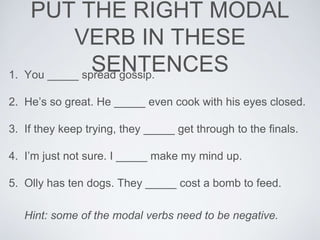
PUT THE RIGHT MODAL
VERB IN THESE
SENTENCES1. You _____ spread gossip.
2. He’s so great. He _____ even cook with his eyes closed.
3. If they keep trying, they _____ get through to the finals.
4. I’m just not sure. I _____ make my mind up.
5. Olly has ten dogs. They _____ cost a bomb to feed.
Hint: some of the modal verbs need to be negative.
MATCH THE PICTURES
WITH THE SENTENCES
1. You should put things back in the right
place.
2. Go here if you have lost something.
3. You must walk in this place.
4. These students do not have a lesson.
5. You cannot go in through here.

Modal verbs

  • 1.
  • 2.
    WHAT ARE MODALVERBS? • Modal verbs help “modify”the main verb and changes its meaning • Modal verbs express necessity e.g. You must drink this bottle of coke or possibility e.g. He could go to football practice
  • 3.
    MODAL VERBS GOBEFORE OTHER VERBS Modal verbs can could would will shall must should might may Other verbs do learn cook practise swim come drink see obey +
  • 4.
    SOME EXAMPLES You couldtry to cook fried chicken. She really must go to the optician. Will she come by car tomorrow?
  • 5.
    WE USE MODALVERBS TO SHOW: 1. Whether someone is able to do something: Katy can speak English fluently. 2. How likely something is: Peter is eating three plates of chips. He must be very hungry. I may come home late today. 3. Advice They should pick up all the rubbish.
  • 6.
    4. Permission May Icome to your wedding? You can go to the cinema with your brother. 5. Obligation They must finish the project by Tuesday. 6. Habits: Boys will always like football.
  • 7.
    FIND THE MODALVERBS AND WRITE THEM DOWN “Can I have another burger?” “You should really eat some salad with it.” “I usually just eat burgers.” “You must be putting on a lot of weight.” “No, I can eat whatever I want and it makes no difference.” “Well, you will get fat if you keep on eating like that.”
  • 8.
    YOU CAN MAKEMODAL VERBS NEGATIVE• I must see the doctor tomorrow. -> I must not see the doctor tomorrow OR I mustn’t see the doctor tomorrow • I c • I could eat a whole plate of pasta. -> I could not eat a whole plate of pasta OR I couldn’t eat a whole plate of
  • 9.
    TRY MAKING THEMODAL VERB NEGATIVE 1. You will stay in at break. 2. They could catch a cold. 3. Will you believe me? 4. Should I go to the park with my friends? 5. I must turn off the TV.
  • 10.
    USING THE RIGHTMODAL VERBS 1. He plays football really well. He must practise a lot. 2. It was so dark I couldn’t see the path. 3. May I sit here? 4. I tried to eat it, but I couldn’t.
  • 11.
    PUT THE RIGHTMODAL VERB IN THESE SENTENCES1. You _____ spread gossip. 2. He’s so great. He _____ even cook with his eyes closed. 3. If they keep trying, they _____ get through to the finals. 4. I’m just not sure. I _____ make my mind up. 5. Olly has ten dogs. They _____ cost a bomb to feed. Hint: some of the modal verbs need to be negative.
  • 12.
  • 13.
    1. You shouldput things back in the right place. 2. Go here if you have lost something. 3. You must walk in this place. 4. These students do not have a lesson. 5. You cannot go in through here.