RELATIVE CLAUSES

  By Esther Curiel
Relative clauses
are used to tell us
which person or
thing we are
talking about.
It makes it
 possible to give
more information
about the person
  on thing being
  spoken about
The boy has gone into hospital
• Which boy?
• The boy who lives next door
  has gone into hospital.
The book is very good.
• Which book?

• The book that I bought
  yesterday is very good.
This is a photo of the hotel.
• Which hotel?

• This is a photo of the
  hotel where we stayed.
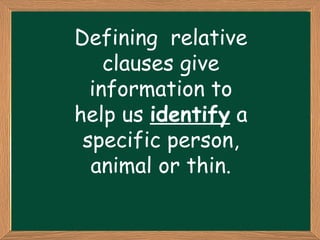
Defining relative
    clauses give
  information to
help us identify a
 specific person,
  animal or thin.
Defining Relative Clauses
Relative            Examples
pronoun


Who/         That   People: The book is about a girl who / that
                    marries a millionaire.
                    It can be left out when who/that is the
whom                object.
                    The person (whom) you need to talk to is on
                    holiday

Which        That   Objects: Have you found the keys
                    (which/that/nothing) you lost?

Whose               Possession. That’s the woman whose son won
                    the lottery.

When         That   Time: I’ll never forget the day when/ that we
                    first met

Where               Places: The hotel where we stayed was right
                    on the beach.
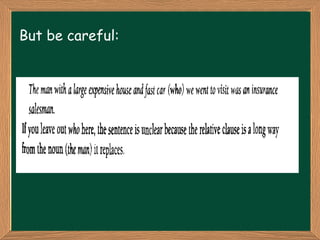
You can leave out the relative pronoun
when it refers to the object of the verb.
But be careful:
But be careful:
Non-defining relative clauses

• Give extra information.

• Are separated from the main clause
  by commas.

• Do not use that
Non-Defining Relative Clauses
Pronouns   Examples. Note the commas. Extra
           information.

           People: Peter, who had been driving all day,
Who/       suggested stopping at the next town.
           Mr Jones, for whom I was working, was very
whom       generous.


Which      Objects: This machine, which I have looked after for
           20 years, is still working perfectly.

Whose      Possession. His house, whose windows were all broken,
           was a depressing sight.

Where      Places: Jill has just been to Sweden, where her
           daughter lives.
Notice how the meaning of a
sentence changes according to the
type of relative clause.
• The man, who was wearing a lime
  green hat, seemed a little strange
  (thhere is only 1 man)
• The man who was wearing a lime
  green hat seemed a little strange.
• (there is more than one man)

Relative clauses.pptx

  • 1.
    RELATIVE CLAUSES By Esther Curiel
  • 2.
    Relative clauses are usedto tell us which person or thing we are talking about.
  • 3.
    It makes it possible to give more information about the person on thing being spoken about
  • 4.
    The boy hasgone into hospital • Which boy? • The boy who lives next door has gone into hospital.
  • 5.
    The book isvery good. • Which book? • The book that I bought yesterday is very good.
  • 6.
    This is aphoto of the hotel. • Which hotel? • This is a photo of the hotel where we stayed.
  • 7.
    Defining relative clauses give information to help us identify a specific person, animal or thin.
  • 8.
    Defining Relative Clauses Relative Examples pronoun Who/ That People: The book is about a girl who / that marries a millionaire. It can be left out when who/that is the whom object. The person (whom) you need to talk to is on holiday Which That Objects: Have you found the keys (which/that/nothing) you lost? Whose Possession. That’s the woman whose son won the lottery. When That Time: I’ll never forget the day when/ that we first met Where Places: The hotel where we stayed was right on the beach.
  • 9.
    You can leaveout the relative pronoun when it refers to the object of the verb.
  • 10.
  • 11.
  • 12.
    Non-defining relative clauses •Give extra information. • Are separated from the main clause by commas. • Do not use that
  • 13.
    Non-Defining Relative Clauses Pronouns Examples. Note the commas. Extra information. People: Peter, who had been driving all day, Who/ suggested stopping at the next town. Mr Jones, for whom I was working, was very whom generous. Which Objects: This machine, which I have looked after for 20 years, is still working perfectly. Whose Possession. His house, whose windows were all broken, was a depressing sight. Where Places: Jill has just been to Sweden, where her daughter lives.
  • 14.
    Notice how themeaning of a sentence changes according to the type of relative clause. • The man, who was wearing a lime green hat, seemed a little strange (thhere is only 1 man) • The man who was wearing a lime green hat seemed a little strange. • (there is more than one man)