PHRASAL
VERBS
By :A.Delfani
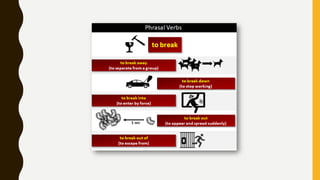
PHRASAL VERBS:
THEY ARE VERY COMMON IN
SPOKEN AND INFORMAL ENGLISH.
PHRASAL VERBS :
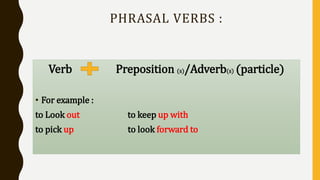
Verb Preposition (s)/Adverb(s) (particle)
• For example :
to Look out to keep up with
to pick up to look forward to
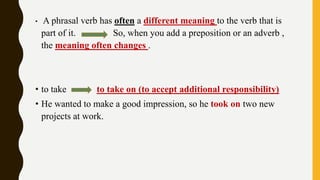
• A phrasal verb has often a different meaning to the verb that is
part of it. So, when you add a preposition or an adverb ,
the meaning often changes .
• to take to take on (to accept additional responsibility)
• He wanted to make a good impression, so he took on two new
projects at work.
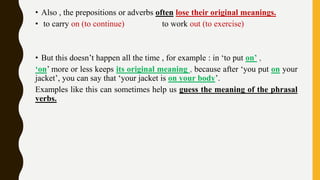
• Also , the prepositions or adverbs often lose their original meanings.
• to carry on (to continue) to work out (to exercise)
• But this doesn’t happen all the time , for example : in ‘to put on’ ,
‘on’ more or less keeps its original meaning , because after ‘you put on your
jacket’, you can say that ‘your jacket is on your body’.
Examples like this can sometimes help us guess the meaning of the phrasal
verbs.
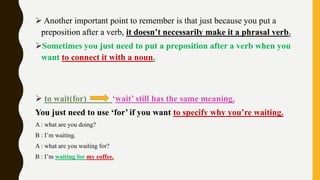
 Another important point to remember is that just because you put a
preposition after a verb, it doesn’t necessarily make it a phrasal verb.
Sometimes you just need to put a preposition after a verb when you
want to connect it with a noun.
 to wait(for) ‘wait’ still has the same meaning.
You just need to use ‘for’ if you want to specify why you’re waiting.
A : what are you doing?
B : I’m waiting.
A : what are you waiting for?
B : I’m waiting for my coffee.
• Some more examples:
• to listen(to) to think(about) to care(for)
• to trip(over)
• These aren’t technically phrasal verbs , because we’re only placing
a preposition after the verb to connect it to a noun.
• For example: He doesn’t care for his mother’s opinion.
• When to use phrasal verbs:
• Phrasal verbs are rarely used in formal language.
• They are used mainly in spoken language.
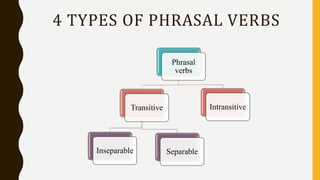
4 TYPES OF PHRASAL VERBS
Phrasal
verbs
Transitive
Inseparable Separable
Intransitive
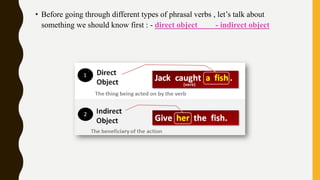
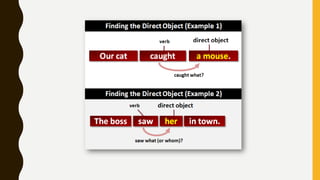
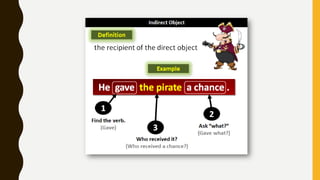
• Before going through different types of phrasal verbs , let’s talk about
something we should know first : - direct object - indirect object
• Now , lets go back to phrasal verbs!
• Intransitive Phrasal Verbs:
• These verbs have no direct object.
For example :
• I woke up at 8:30 this morning.
• You can come over to my house after school.
• He is going back to Russia next month.
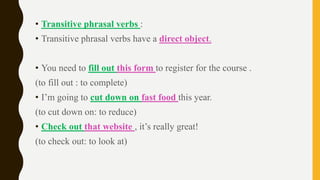
• Transitive phrasal verbs :
• Transitive phrasal verbs have a direct object.
• You need to fill out this form to register for the course .
(to fill out : to complete)
• I’m going to cut down on fast food this year.
(to cut down on: to reduce)
• Check out that website , it’s really great!
(to check out: to look at)
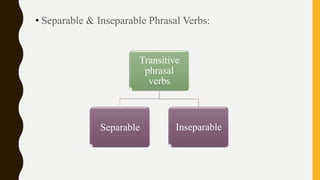
• Separable & Inseparable Phrasal Verbs:
Transitive
phrasal
verbs
Separable Inseparable
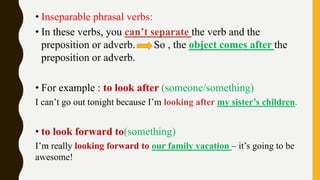
• Inseparable phrasal verbs:
• In these verbs, you can’t separate the verb and the
preposition or adverb. So , the object comes after the
preposition or adverb.
• For example : to look after (someone/something)
I can’t go out tonight because I’m looking after my sister’s children.
• to look forward to(something)
I’m really looking forward to our family vacation – it’s going to be
awesome!
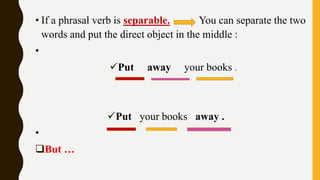
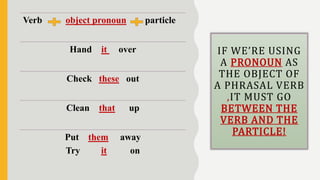
• If a phrasal verb is separable. You can separate the two
words and put the direct object in the middle :
•
Put away your books .
Put your books away .
•
But …
IF WE’RE USING
A PRONOUN AS
THE OBJECT OF
A PHRASAL VERB
,IT MUST GO
BETWEEN THE
VERB AND THE
PARTICLE!
Verb object pronoun particle
Hand it over
Check these out
Clean that up
Put them away
Try it on
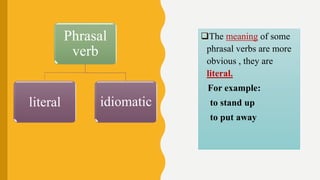
The meaning of some
phrasal verbs are more
obvious , they are
literal.
For example:
to stand up
to put away
Phrasal
verb
literal idiomatic
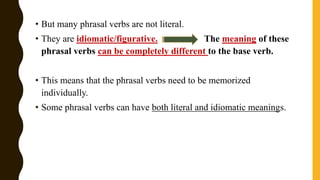
• But many phrasal verbs are not literal.
• They are idiomatic/figurative. The meaning of these
phrasal verbs can be completely different to the base verb.
• This means that the phrasal verbs need to be memorized
individually.
• Some phrasal verbs can have both literal and idiomatic meanings.
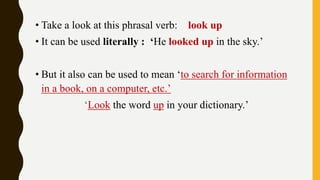
• Take a look at this phrasal verb: look up
• It can be used literally : ‘He looked up in the sky.’
• But it also can be used to mean ‘to search for information
in a book, on a computer, etc.’
‘Look the word up in your dictionary.’
When you find a phrasal verb that you don’t know,
try looking for clues in the sentence to help you
guess what it might mean . You might be surprised
how often you can find the correct meaning!

Phrasal verbs

  • 1.
  • 2.
    PHRASAL VERBS: THEY AREVERY COMMON IN SPOKEN AND INFORMAL ENGLISH.
  • 3.
    PHRASAL VERBS : VerbPreposition (s)/Adverb(s) (particle) • For example : to Look out to keep up with to pick up to look forward to
  • 4.
    • A phrasalverb has often a different meaning to the verb that is part of it. So, when you add a preposition or an adverb , the meaning often changes . • to take to take on (to accept additional responsibility) • He wanted to make a good impression, so he took on two new projects at work.
  • 5.
    • Also ,the prepositions or adverbs often lose their original meanings. • to carry on (to continue) to work out (to exercise) • But this doesn’t happen all the time , for example : in ‘to put on’ , ‘on’ more or less keeps its original meaning , because after ‘you put on your jacket’, you can say that ‘your jacket is on your body’. Examples like this can sometimes help us guess the meaning of the phrasal verbs.
  • 7.
     Another importantpoint to remember is that just because you put a preposition after a verb, it doesn’t necessarily make it a phrasal verb. Sometimes you just need to put a preposition after a verb when you want to connect it with a noun.  to wait(for) ‘wait’ still has the same meaning. You just need to use ‘for’ if you want to specify why you’re waiting. A : what are you doing? B : I’m waiting. A : what are you waiting for? B : I’m waiting for my coffee.
  • 8.
    • Some moreexamples: • to listen(to) to think(about) to care(for) • to trip(over) • These aren’t technically phrasal verbs , because we’re only placing a preposition after the verb to connect it to a noun. • For example: He doesn’t care for his mother’s opinion.
  • 9.
    • When touse phrasal verbs: • Phrasal verbs are rarely used in formal language. • They are used mainly in spoken language.
  • 10.
    4 TYPES OFPHRASAL VERBS Phrasal verbs Transitive Inseparable Separable Intransitive
  • 11.
    • Before goingthrough different types of phrasal verbs , let’s talk about something we should know first : - direct object - indirect object
  • 14.
    • Now ,lets go back to phrasal verbs! • Intransitive Phrasal Verbs: • These verbs have no direct object. For example : • I woke up at 8:30 this morning. • You can come over to my house after school. • He is going back to Russia next month.
  • 15.
    • Transitive phrasalverbs : • Transitive phrasal verbs have a direct object. • You need to fill out this form to register for the course . (to fill out : to complete) • I’m going to cut down on fast food this year. (to cut down on: to reduce) • Check out that website , it’s really great! (to check out: to look at)
  • 16.
    • Separable &Inseparable Phrasal Verbs: Transitive phrasal verbs Separable Inseparable
  • 17.
    • Inseparable phrasalverbs: • In these verbs, you can’t separate the verb and the preposition or adverb. So , the object comes after the preposition or adverb. • For example : to look after (someone/something) I can’t go out tonight because I’m looking after my sister’s children. • to look forward to(something) I’m really looking forward to our family vacation – it’s going to be awesome!
  • 18.
    • If aphrasal verb is separable. You can separate the two words and put the direct object in the middle : • Put away your books . Put your books away . • But …
  • 19.
    IF WE’RE USING APRONOUN AS THE OBJECT OF A PHRASAL VERB ,IT MUST GO BETWEEN THE VERB AND THE PARTICLE! Verb object pronoun particle Hand it over Check these out Clean that up Put them away Try it on
  • 20.
    The meaning ofsome phrasal verbs are more obvious , they are literal. For example: to stand up to put away Phrasal verb literal idiomatic
  • 21.
    • But manyphrasal verbs are not literal. • They are idiomatic/figurative. The meaning of these phrasal verbs can be completely different to the base verb. • This means that the phrasal verbs need to be memorized individually. • Some phrasal verbs can have both literal and idiomatic meanings.
  • 22.
    • Take alook at this phrasal verb: look up • It can be used literally : ‘He looked up in the sky.’ • But it also can be used to mean ‘to search for information in a book, on a computer, etc.’ ‘Look the word up in your dictionary.’
  • 23.
    When you finda phrasal verb that you don’t know, try looking for clues in the sentence to help you guess what it might mean . You might be surprised how often you can find the correct meaning!