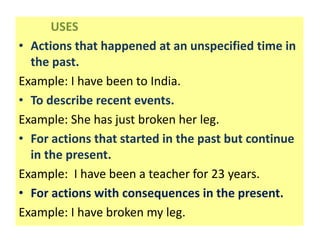
PRESENT PERFECT SIMPLE TENSE
USES
• Actions that happened at an unspecified time in
the past.
Example: I have been to India.
• To describe recent events.
Example: She has just broken her leg.
• For actions that started in the past but continue
in the present.
Example: I have been a teacher for 23 years.
• For actions with consequences in the present.
Example: I have broken my leg.
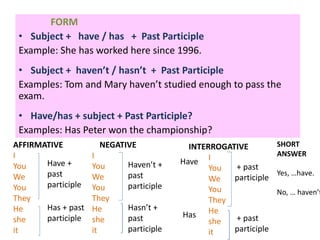
FORM
• Subject + have / has + Past Participle
Example: She has worked here since 1996.
• Subject + haven’t / hasn’t + Past Participle
Examples: Tom and Mary haven’t studied enough to pass the
exam.
• Have/has + subject + Past Participle?
Examples: Has Peter won the championship?
AFFIRMATIVE
I
You
We
You
They
He
she
it
NEGATIVE INTERROGATIVE
Has + past
participle
SHORT
ANSWER
Yes, …have.
No, … haven’t
Have +
past
participle
I
You
We
You
They
He
she
it
Haven’t +
past
participle
Hasn’t +
past
participle
Have
Has
I
You
We
You
They
He
she
it
+ past
participle
+ past
participle
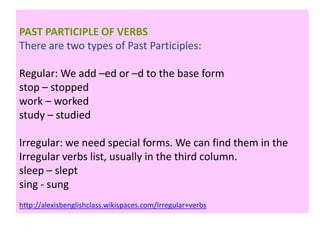
PAST PARTICIPLE OF VERBS
There are two types of Past Participles:
Regular: We add –ed or –d to the base form
stop – stopped
work – worked
study – studied
Irregular: we need special forms. We can find them in the
Irregular verbs list, usually in the third column.
sleep – slept
sing - sung
http://alexisbenglishclass.wikispaces.com/Irregular+verbs
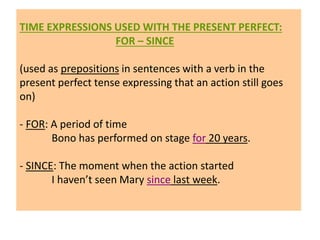
TIME EXPRESSIONS USED WITH THE PRESENT PERFECT:
FOR – SINCE
(used as prepositions in sentences with a verb in the
present perfect tense expressing that an action still goes
on)
- FOR: A period of time
Bono has performed on stage for 20 years.
- SINCE: The moment when the action started
I haven’t seen Mary since last week.
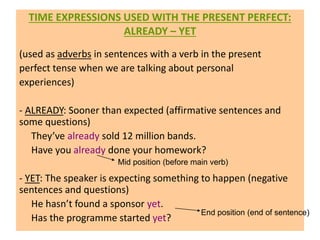
TIME EXPRESSIONS USED WITH THE PRESENT PERFECT:
ALREADY – YET
(used as adverbs in sentences with a verb in the present
perfect tense when we are talking about personal
experiences)
- ALREADY: Sooner than expected (affirmative sentences and
some questions)
They’ve already sold 12 million bands.
Have you already done your homework?
- YET: The speaker is expecting something to happen (negative
sentences and questions)
He hasn’t found a sponsor yet.
Has the programme started yet?
Mid position (before main verb)
End position (end of sentence)
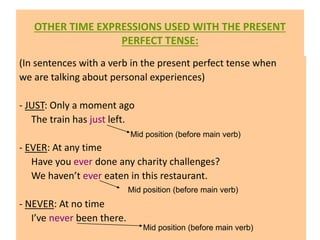
OTHER TIME EXPRESSIONS USED WITH THE PRESENT
PERFECT TENSE:
(In sentences with a verb in the present perfect tense when
we are talking about personal experiences)
- JUST: Only a moment ago
The train has just left.
- EVER: At any time
Have you ever done any charity challenges?
We haven’t ever eaten in this restaurant.
- NEVER: At no time
I’ve never been there.
Mid position (before main verb)
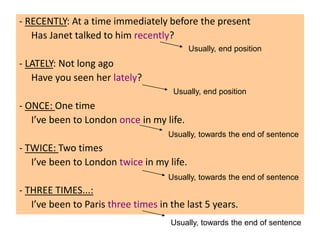
- RECENTLY: At a time immediately before the present
Has Janet talked to him recently?
- LATELY: Not long ago
Have you seen her lately?
- ONCE: One time
I’ve been to London once in my life.
- TWICE: Two times
I’ve been to London twice in my life.
- THREE TIMES...:
I’ve been to Paris three times in the last 5 years.
Usually, end position
Usually, towards the end of sentence
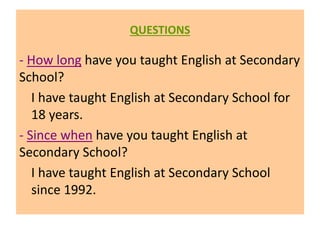
QUESTIONS
- How long have you taught English at Secondary
School?
I have taught English at Secondary School for
18 years.
- Since when have you taught English at
Secondary School?
I have taught English at Secondary School
since 1992.

Present perfect simple tense

  • 1.
  • 2.
    USES • Actions thathappened at an unspecified time in the past. Example: I have been to India. • To describe recent events. Example: She has just broken her leg. • For actions that started in the past but continue in the present. Example: I have been a teacher for 23 years. • For actions with consequences in the present. Example: I have broken my leg.
  • 3.
    FORM • Subject +have / has + Past Participle Example: She has worked here since 1996. • Subject + haven’t / hasn’t + Past Participle Examples: Tom and Mary haven’t studied enough to pass the exam. • Have/has + subject + Past Participle? Examples: Has Peter won the championship? AFFIRMATIVE I You We You They He she it NEGATIVE INTERROGATIVE Has + past participle SHORT ANSWER Yes, …have. No, … haven’t Have + past participle I You We You They He she it Haven’t + past participle Hasn’t + past participle Have Has I You We You They He she it + past participle + past participle
  • 4.
    PAST PARTICIPLE OFVERBS There are two types of Past Participles: Regular: We add –ed or –d to the base form stop – stopped work – worked study – studied Irregular: we need special forms. We can find them in the Irregular verbs list, usually in the third column. sleep – slept sing - sung http://alexisbenglishclass.wikispaces.com/Irregular+verbs
  • 5.
    TIME EXPRESSIONS USEDWITH THE PRESENT PERFECT: FOR – SINCE (used as prepositions in sentences with a verb in the present perfect tense expressing that an action still goes on) - FOR: A period of time Bono has performed on stage for 20 years. - SINCE: The moment when the action started I haven’t seen Mary since last week.
  • 6.
    TIME EXPRESSIONS USEDWITH THE PRESENT PERFECT: ALREADY – YET (used as adverbs in sentences with a verb in the present perfect tense when we are talking about personal experiences) - ALREADY: Sooner than expected (affirmative sentences and some questions) They’ve already sold 12 million bands. Have you already done your homework? - YET: The speaker is expecting something to happen (negative sentences and questions) He hasn’t found a sponsor yet. Has the programme started yet? Mid position (before main verb) End position (end of sentence)
  • 7.
    OTHER TIME EXPRESSIONSUSED WITH THE PRESENT PERFECT TENSE: (In sentences with a verb in the present perfect tense when we are talking about personal experiences) - JUST: Only a moment ago The train has just left. - EVER: At any time Have you ever done any charity challenges? We haven’t ever eaten in this restaurant. - NEVER: At no time I’ve never been there. Mid position (before main verb) Mid position (before main verb) Mid position (before main verb)
  • 8.
    - RECENTLY: Ata time immediately before the present Has Janet talked to him recently? - LATELY: Not long ago Have you seen her lately? - ONCE: One time I’ve been to London once in my life. - TWICE: Two times I’ve been to London twice in my life. - THREE TIMES...: I’ve been to Paris three times in the last 5 years. Usually, end position Usually, end position Usually, towards the end of sentence Usually, towards the end of sentence Usually, towards the end of sentence
  • 9.
    QUESTIONS - How longhave you taught English at Secondary School? I have taught English at Secondary School for 18 years. - Since when have you taught English at Secondary School? I have taught English at Secondary School since 1992.