
Modal verbs are used to modify
other verbs and to express if an
action is recommended,
possible, obligatory, prohibited,
etc.

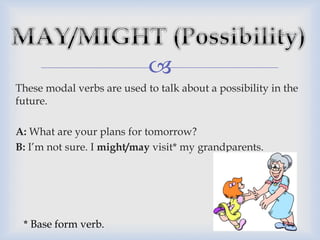
These modal verbs are used to talk about a possibility in the
future.
A: What are your plans for tomorrow?
B: I’m not sure. I might/may visit* my grandparents.
* Base form verb.

You can use may and might in a
negative form by writing not
after the modal verb.
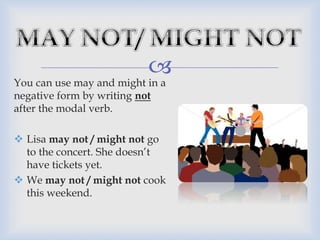
 Lisa may not / might not go
to the concert. She doesn’t
have tickets yet.
 We may not / might not cook
this weekend.

An additional use of may is to
give or ask for permission (in a
formal way).
May I sit here?
You may have a cookie when
you finish your lunch.
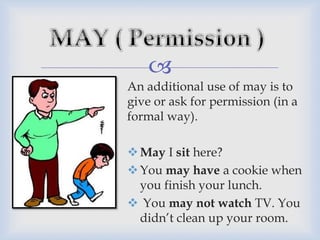
 You may not watch TV. You
didn’t clean up your room.

These modal verbs have the same
form for all the pronouns.
Use a base form verb after modal
verbs.
May and might are never contracted.

We often use have to to say that something is
obligatory.
e.g.
Children have to go to school.

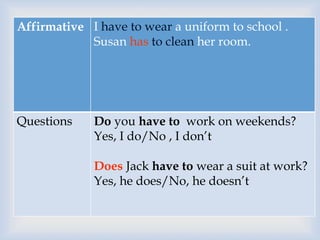
Affirmative I have to wear a uniform to school .
Susan has to clean her room.
Questions Do you have to work on weekends?
Yes, I do/No , I don’t
Does Jack have to wear a suit at work?
Yes, he does/No, he doesn’t

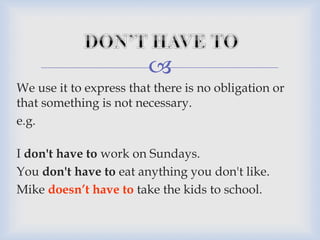
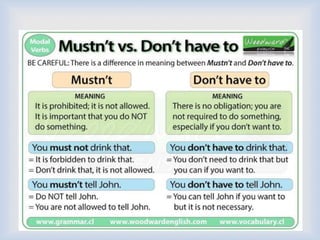
We use it to express that there is no obligation or
that something is not necessary.
e.g.
I don't have to work on Sundays.
You don't have to eat anything you don't like.
Mike doesn’t have to take the kids to school.

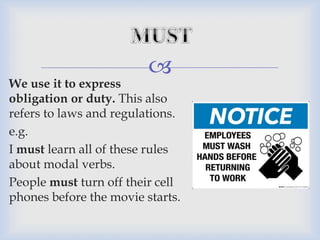
We use it to express
obligation or duty. This also
refers to laws and regulations.
e.g.
I must learn all of these rules
about modal verbs.
People must turn off their cell
phones before the movie starts.

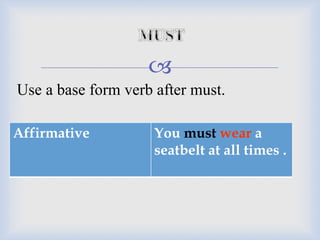
Use a base form verb after must.
Affirmative You must wear a
seatbelt at all times .
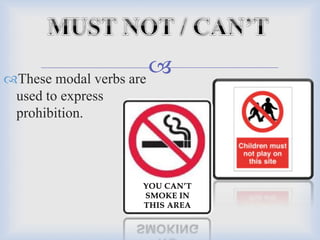
These modal verbs are
used to express
prohibition.

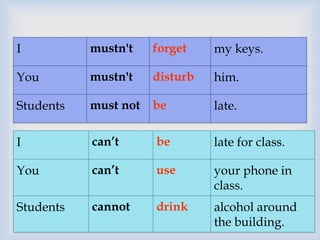
I mustn't forget my keys.
You mustn't disturb him.
Students must not be late.
I can’t be late for class.
You can’t use your phone in
class.
Students cannot drink alcohol around
the building.



Modal verbs A2

  • 2.
     Modal verbs areused to modify other verbs and to express if an action is recommended, possible, obligatory, prohibited, etc.
  • 3.
     These modal verbsare used to talk about a possibility in the future. A: What are your plans for tomorrow? B: I’m not sure. I might/may visit* my grandparents. * Base form verb.
  • 4.
     You can usemay and might in a negative form by writing not after the modal verb.  Lisa may not / might not go to the concert. She doesn’t have tickets yet.  We may not / might not cook this weekend.
  • 5.
     An additional useof may is to give or ask for permission (in a formal way). May I sit here? You may have a cookie when you finish your lunch.  You may not watch TV. You didn’t clean up your room.
  • 6.
     These modal verbshave the same form for all the pronouns. Use a base form verb after modal verbs. May and might are never contracted.
  • 7.
     We often usehave to to say that something is obligatory. e.g. Children have to go to school.
  • 8.
     Affirmative I haveto wear a uniform to school . Susan has to clean her room. Questions Do you have to work on weekends? Yes, I do/No , I don’t Does Jack have to wear a suit at work? Yes, he does/No, he doesn’t
  • 9.
     We use itto express that there is no obligation or that something is not necessary. e.g. I don't have to work on Sundays. You don't have to eat anything you don't like. Mike doesn’t have to take the kids to school.
  • 10.
     We use itto express obligation or duty. This also refers to laws and regulations. e.g. I must learn all of these rules about modal verbs. People must turn off their cell phones before the movie starts.
  • 11.
     Use a baseform verb after must. Affirmative You must wear a seatbelt at all times .
  • 12.
    These modal verbsare used to express prohibition.
  • 13.
     I mustn't forgetmy keys. You mustn't disturb him. Students must not be late. I can’t be late for class. You can’t use your phone in class. Students cannot drink alcohol around the building.
  • 14.
  • 15.

Editor's Notes

  • #2 Modal verbs are used to modify other verbs and to express if an action is recommended, possible, obligatory, prohibited, etc.
  • #11 Have to is more common than must. Must is more commonly used in notices and official signs
  • #12 Have to is more common than must. Must is more commonly used in notices and official signs
  • #14 Have to is more common than must. Must is more commonly used in notices and official signs
  • #15 Have to is more common than must. Must is more commonly used in notices and official signs
  • #16 Have to is more common than must. Must is more commonly used in notices and official signs