Relative
Pronouns
SWOOSH
Cidália Sousa  Cláudia Regina Abreu  Vanessa Reis Esteves
Relative
Pronouns
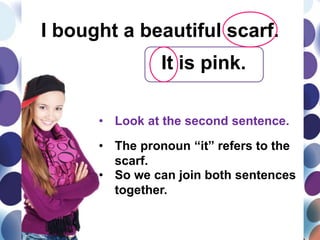
I bought a beautiful scarf.
It is pink.
• Look at the second sentence.
• The pronoun “it” refers to the
scarf.
• So we can join both sentences
together.
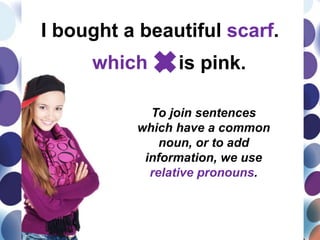
I bought a beautiful scarf.
which It is pink.
To join sentences
which have a common
noun, or to add
information, we use
relative pronouns.
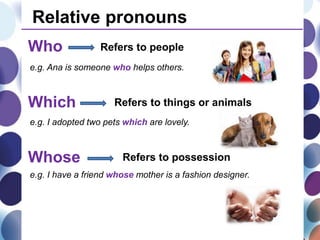
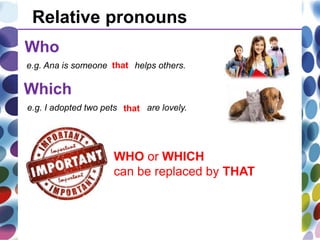
Relative pronouns
Who Refers to people
Which Refers to things or animals
e.g. Ana is someone who helps others.
e.g. I adopted two pets which are lovely.
Whose Refers to possession
e.g. I have a friend whose mother is a fashion designer.
Let’s do some
exercises!
Complete with an
appropriate relative
pronoun.
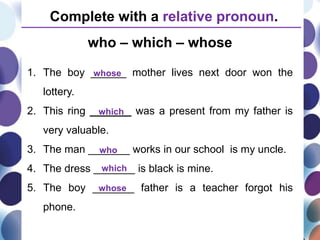
1. The boy ______ mother lives next door won the
lottery.
2. This ring _______ was a present from my father is
very valuable.
3. The man _______ works in our school is my uncle.
4. The dress _______ is black is mine.
5. The boy _______ father is a teacher forgot his
phone.
Complete with a relative pronoun.
whose
which
who
who – which – whose
which
whose
A relative pronoun can be
used to join two different
sentences together.
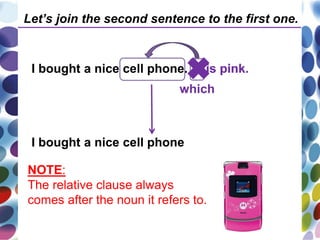
I bought a nice cell phone. It is pink.
I bought a nice cell phone
which
is pink.
Let’s join the second sentence to the first one.
NOTE:
The relative clause always
comes after the noun it refers to.
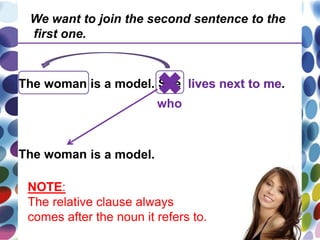
The woman is a model. She lives next to me.
The woman is a model.
who
lives next to me
We want to join the second sentence to the
first one.
NOTE:
The relative clause always
comes after the noun it refers to.
Let’s do some
exercises!
Join the sentences using a
relative pronoun.
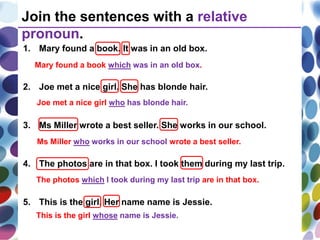
1. Mary found a book. It was in an old box.
2. Joe met a nice girl. She has blonde hair.
3. Ms Miller wrote a best seller. She works in our school.
4. The photos are in that box. I took them during my last trip.
5. This is the girl. Her name name is Jessie.
Join the sentences with a relative
pronoun.
Mary found a book which was in an old box.
Joe met a nice girl who has blonde hair.
Ms Miller who works in our school wrote a best seller.
The photos which I took during my last trip are in that box.
This is the girl whose name is Jessie.
Relative pronouns
Who
Which
e.g. Ana is someone who helps others.
e.g. I adopted two pets which are lovely.
WHO or WHICH
can be replaced by THAT
that
that
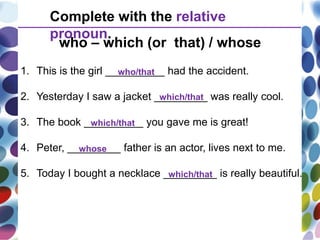
1. This is the girl __________ had the accident.
2. Yesterday I saw a jacket _________ was really cool.
3. The book __________ you gave me is great!
4. Peter, _________ father is an actor, lives next to me.
5. Today I bought a necklace _________ is really beautiful.
Complete with the relative
pronoun.
who/that
who – which (or that) / whose
which/that
which/that
whose
which/that
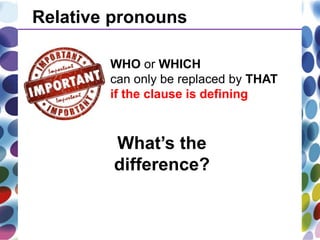
Relative pronouns
WHO or WHICH
can only be replaced by THAT
if the clause is defining
What’s the
difference?
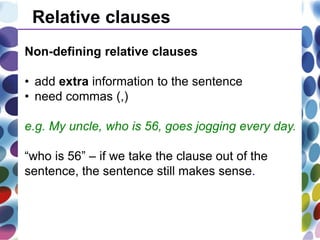
Relative clauses
Non-defining relative clauses
• add extra information to the sentence
• need commas (,)
e.g. My uncle, who is 56, goes jogging every day.
“who is 56” – if we take the clause out of the
sentence, the sentence still makes sense.
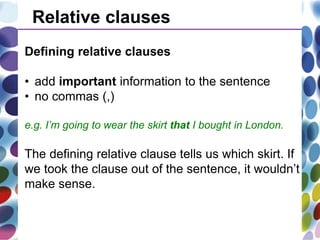
Relative clauses
Defining relative clauses
• add important information to the sentence
• no commas (,)
e.g. I’m going to wear the skirt that I bought in London.
The defining relative clause tells us which skirt. If
we took the clause out of the sentence, it wouldn’t
make sense.
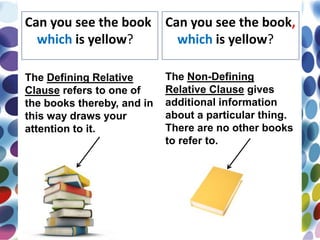
Can you see the book
which is yellow?
The Defining Relative
Clause refers to one of
the books thereby, and in
this way draws your
attention to it.
The Non-Defining
Relative Clause gives
additional information
about a particular thing.
There are no other books
to refer to.
Can you see the book,
which is yellow?
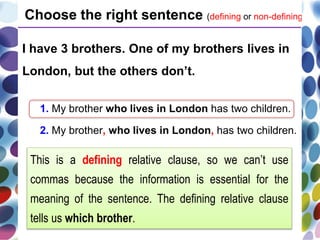
I have 3 brothers. One of my brothers lives in
London, but the others don’t.
1. My brother who lives in London has two children.
2. My brother, who lives in London, has two children.
Choose the right sentence (defining or non-defining).
This is a defining relative clause, so we can’t use
commas because the information is essential for the
meaning of the sentence. The defining relative clause
tells us which brother.
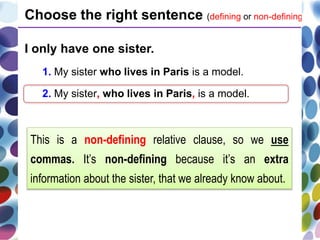
I only have one sister.
1. My sister who lives in Paris is a model.
2. My sister, who lives in Paris, is a model.
Choose the right sentence (defining or non-defining).
This is a non-defining relative clause, so we use
commas. It’s non-defining because it’s an extra
information about the sister, that we already know about.
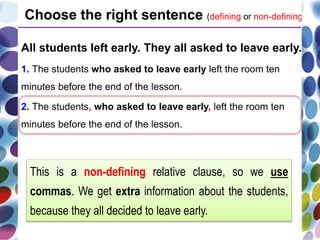
All students left early. They all asked to leave early.
1. The students who asked to leave early left the room ten
minutes before the end of the lesson.
2. The students, who asked to leave early, left the room ten
minutes before the end of the lesson.
Choose the right sentence (defining or non-defining).
This is a non-defining relative clause, so we use
commas. We get extra information about the students,
because they all decided to leave early.
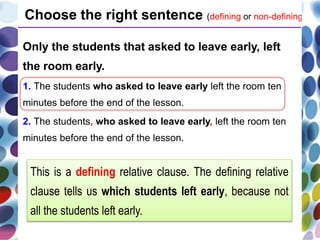
Only the students that asked to leave early, left
the room early.
1. The students who asked to leave early left the room ten
minutes before the end of the lesson.
2. The students, who asked to leave early, left the room ten
minutes before the end of the lesson.
Choose the right sentence (defining or non-defining).
This is a defining relative clause. The defining relative
clause tells us which students left early, because not
all the students left early.
Now open your book
on page 62.

Sw8 relative pronouns

  • 1.
    Relative Pronouns SWOOSH Cidália Sousa Cláudia Regina Abreu  Vanessa Reis Esteves
  • 2.
  • 3.
    I bought abeautiful scarf. It is pink. • Look at the second sentence. • The pronoun “it” refers to the scarf. • So we can join both sentences together.
  • 4.
    I bought abeautiful scarf. which It is pink. To join sentences which have a common noun, or to add information, we use relative pronouns.
  • 5.
    Relative pronouns Who Refersto people Which Refers to things or animals e.g. Ana is someone who helps others. e.g. I adopted two pets which are lovely. Whose Refers to possession e.g. I have a friend whose mother is a fashion designer.
  • 6.
    Let’s do some exercises! Completewith an appropriate relative pronoun.
  • 7.
    1. The boy______ mother lives next door won the lottery. 2. This ring _______ was a present from my father is very valuable. 3. The man _______ works in our school is my uncle. 4. The dress _______ is black is mine. 5. The boy _______ father is a teacher forgot his phone. Complete with a relative pronoun. whose which who who – which – whose which whose
  • 8.
    A relative pronouncan be used to join two different sentences together.
  • 9.
    I bought anice cell phone. It is pink. I bought a nice cell phone which is pink. Let’s join the second sentence to the first one. NOTE: The relative clause always comes after the noun it refers to.
  • 10.
    The woman isa model. She lives next to me. The woman is a model. who lives next to me We want to join the second sentence to the first one. NOTE: The relative clause always comes after the noun it refers to.
  • 11.
    Let’s do some exercises! Jointhe sentences using a relative pronoun.
  • 12.
    1. Mary founda book. It was in an old box. 2. Joe met a nice girl. She has blonde hair. 3. Ms Miller wrote a best seller. She works in our school. 4. The photos are in that box. I took them during my last trip. 5. This is the girl. Her name name is Jessie. Join the sentences with a relative pronoun. Mary found a book which was in an old box. Joe met a nice girl who has blonde hair. Ms Miller who works in our school wrote a best seller. The photos which I took during my last trip are in that box. This is the girl whose name is Jessie.
  • 13.
    Relative pronouns Who Which e.g. Anais someone who helps others. e.g. I adopted two pets which are lovely. WHO or WHICH can be replaced by THAT that that
  • 14.
    1. This isthe girl __________ had the accident. 2. Yesterday I saw a jacket _________ was really cool. 3. The book __________ you gave me is great! 4. Peter, _________ father is an actor, lives next to me. 5. Today I bought a necklace _________ is really beautiful. Complete with the relative pronoun. who/that who – which (or that) / whose which/that which/that whose which/that
  • 15.
    Relative pronouns WHO orWHICH can only be replaced by THAT if the clause is defining What’s the difference?
  • 16.
    Relative clauses Non-defining relativeclauses • add extra information to the sentence • need commas (,) e.g. My uncle, who is 56, goes jogging every day. “who is 56” – if we take the clause out of the sentence, the sentence still makes sense.
  • 17.
    Relative clauses Defining relativeclauses • add important information to the sentence • no commas (,) e.g. I’m going to wear the skirt that I bought in London. The defining relative clause tells us which skirt. If we took the clause out of the sentence, it wouldn’t make sense.
  • 18.
    Can you seethe book which is yellow? The Defining Relative Clause refers to one of the books thereby, and in this way draws your attention to it. The Non-Defining Relative Clause gives additional information about a particular thing. There are no other books to refer to. Can you see the book, which is yellow?
  • 19.
    I have 3brothers. One of my brothers lives in London, but the others don’t. 1. My brother who lives in London has two children. 2. My brother, who lives in London, has two children. Choose the right sentence (defining or non-defining). This is a defining relative clause, so we can’t use commas because the information is essential for the meaning of the sentence. The defining relative clause tells us which brother.
  • 20.
    I only haveone sister. 1. My sister who lives in Paris is a model. 2. My sister, who lives in Paris, is a model. Choose the right sentence (defining or non-defining). This is a non-defining relative clause, so we use commas. It’s non-defining because it’s an extra information about the sister, that we already know about.
  • 21.
    All students leftearly. They all asked to leave early. 1. The students who asked to leave early left the room ten minutes before the end of the lesson. 2. The students, who asked to leave early, left the room ten minutes before the end of the lesson. Choose the right sentence (defining or non-defining). This is a non-defining relative clause, so we use commas. We get extra information about the students, because they all decided to leave early.
  • 22.
    Only the studentsthat asked to leave early, left the room early. 1. The students who asked to leave early left the room ten minutes before the end of the lesson. 2. The students, who asked to leave early, left the room ten minutes before the end of the lesson. Choose the right sentence (defining or non-defining). This is a defining relative clause. The defining relative clause tells us which students left early, because not all the students left early.
  • 23.
    Now open yourbook on page 62.