DEFINING AND NON-
DEFINING
RELATIVE CLAUSES
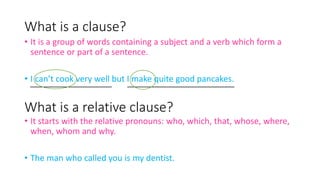
What is a clause?
• It is a group of words containing a subject and a verb which form a
sentence or part of a sentence.
• I can’t cook very well but I make quite good pancakes.
What is a relative clause?
• It starts with the relative pronouns: who, which, that, whose, where,
when, whom and why.
• The man who called you is my dentist.
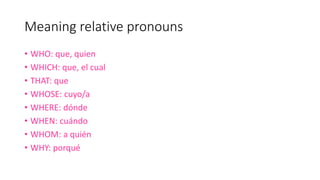
Meaning relative pronouns
• WHO: que, quien
• WHICH: que, el cual
• THAT: que
• WHOSE: cuyo/a
• WHERE: dónde
• WHEN: cuándo
• WHOM: a quién
• WHY: porqué
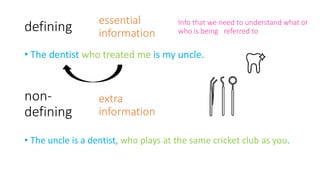
defining
• The dentist who treated me is my uncle.
essential
information
Info that we need to understand what or
who is being referred to
non-
defining
extra
information
• The uncle is a dentist, who plays at the same cricket club as you.
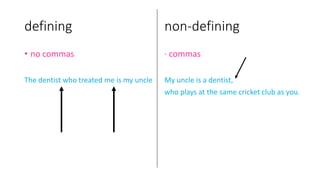
• no commas
The dentist who treated me is my uncle
· commas
My uncle is a dentist,
who plays at the same cricket club as you.
defining non-defining
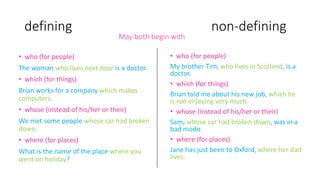
• who (for people)
My brother Tim, who lives in Scotland, is a
doctor.
• which (for things)
Brian told me about his new job, which he
is not enjoying very much.
• whose (instead of his/her or their)
Sam, whose car had broken down, was in a
bad modo.
• where (for places)
Jane has just been to Oxford, where her dad
lives.
defining non-defining
May both begin with
• who (for people)
The woman who lives next door is a doctor.
• which (for things)
Brian works for a company which makes
computers.
• whose (instead of his/her or their)
We met some people whose car had broken
down.
• where (for places)
What is the name of the place where you
went on holiday?
defining non-defining
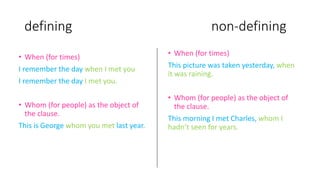
• When (for times)
I remember the day when I met you
I remember the day I met you.
• Whom (for people) as the object of
the clause.
This is George whom you met last year.
• When (for times)
This picture was taken yesterday, when
it was raining.
• Whom (for people) as the object of
the clause.
This morning I met Charles, whom I
hadn’t seen for years.
defining non-defining
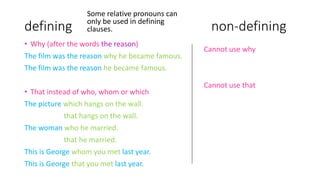
• Why (after the words the reason)
The film was the reason why he became famous.
The film was the reason he became famous.
• That instead of who, whom or which
The picture which hangs on the wall.
that hangs on the wall.
The woman who he married.
that he married.
This is George whom you met last year.
This is George that you met last year.
Some relative pronouns can
only be used in defining
clauses.
Cannot use why
Cannot use that
defining non-defining
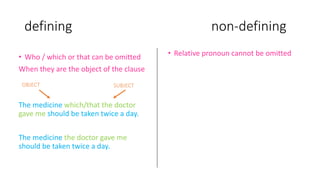
• Who / which or that can be omitted
When they are the object of the clause
The medicine which/that the doctor
gave me should be taken twice a day.
The medicine the doctor gave me
should be taken twice a day.
• Relative pronoun cannot be omitted
OBJECT SUBJECT
defining non-defining
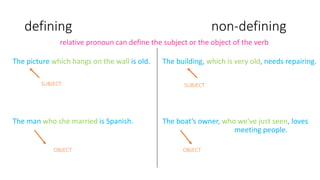
The picture which hangs on the wall is old.
The man who she married is Spanish.
relative pronoun can define the subject or the object of the verb
OBJECT
SUBJECT
The building, which is very old, needs repairing.
The boat’s owner, who we’ve just seen, loves
meeting people.
SUBJECT
OBJECT
defining non-defining
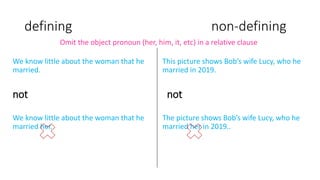
We know little about the woman that he
married.
We know little about the woman that he
married her.
Omit the object pronoun (her, him, it, etc) in a relative clause
This picture shows Bob’s wife Lucy, who he
married in 2019.
The picture shows Bob’s wife Lucy, who he
married her in 2019..
not not
defining non-defining
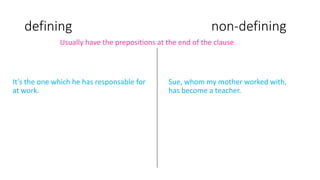
It’s the one which he has responsable for
at work.
Usually have the prepositions at the end of the clause
Sue, whom my mother worked with,
has become a teacher.
defining non-defining
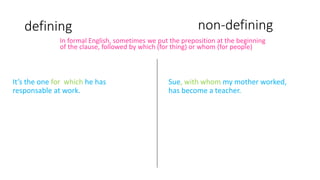
It’s the one for which he has
responsable at work.
In formal English, sometimes we put the preposition at the beginning
of the clause, followed by which (for thing) or whom (for people)
Sue, with whom my mother worked,
has become a teacher.
defining non-defining
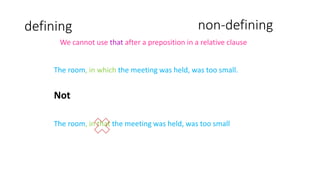
The room, in which the meeting was held, was too small.
Not
The room, in that the meeting was held, was too small
We cannot use that after a preposition in a relative clause
defining non-defining
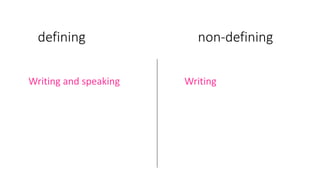
Writing
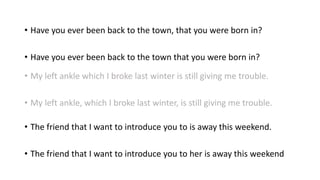
Writing and speaking
• Have you ever been back to the town, that you were born in?
• Have you ever been back to the town that you were born in?
• My left ankle which I broke last winter is still giving me trouble.
• My left ankle, which I broke last winter, is still giving me trouble.
• The friend that I want to introduce you to is away this weekend.
• The friend that I want to introduce you to her is away this weekend

Defining and nondefining relative clauses.pptx

  • 1.
  • 2.
    What is aclause? • It is a group of words containing a subject and a verb which form a sentence or part of a sentence. • I can’t cook very well but I make quite good pancakes. What is a relative clause? • It starts with the relative pronouns: who, which, that, whose, where, when, whom and why. • The man who called you is my dentist.
  • 3.
    Meaning relative pronouns •WHO: que, quien • WHICH: que, el cual • THAT: que • WHOSE: cuyo/a • WHERE: dónde • WHEN: cuándo • WHOM: a quién • WHY: porqué
  • 4.
    defining • The dentistwho treated me is my uncle. essential information Info that we need to understand what or who is being referred to non- defining extra information • The uncle is a dentist, who plays at the same cricket club as you.
  • 5.
    • no commas Thedentist who treated me is my uncle · commas My uncle is a dentist, who plays at the same cricket club as you. defining non-defining
  • 6.
    • who (forpeople) My brother Tim, who lives in Scotland, is a doctor. • which (for things) Brian told me about his new job, which he is not enjoying very much. • whose (instead of his/her or their) Sam, whose car had broken down, was in a bad modo. • where (for places) Jane has just been to Oxford, where her dad lives. defining non-defining May both begin with • who (for people) The woman who lives next door is a doctor. • which (for things) Brian works for a company which makes computers. • whose (instead of his/her or their) We met some people whose car had broken down. • where (for places) What is the name of the place where you went on holiday?
  • 7.
    defining non-defining • When(for times) I remember the day when I met you I remember the day I met you. • Whom (for people) as the object of the clause. This is George whom you met last year. • When (for times) This picture was taken yesterday, when it was raining. • Whom (for people) as the object of the clause. This morning I met Charles, whom I hadn’t seen for years.
  • 8.
    defining non-defining • Why(after the words the reason) The film was the reason why he became famous. The film was the reason he became famous. • That instead of who, whom or which The picture which hangs on the wall. that hangs on the wall. The woman who he married. that he married. This is George whom you met last year. This is George that you met last year. Some relative pronouns can only be used in defining clauses. Cannot use why Cannot use that
  • 9.
    defining non-defining • Who/ which or that can be omitted When they are the object of the clause The medicine which/that the doctor gave me should be taken twice a day. The medicine the doctor gave me should be taken twice a day. • Relative pronoun cannot be omitted OBJECT SUBJECT
  • 10.
    defining non-defining The picturewhich hangs on the wall is old. The man who she married is Spanish. relative pronoun can define the subject or the object of the verb OBJECT SUBJECT The building, which is very old, needs repairing. The boat’s owner, who we’ve just seen, loves meeting people. SUBJECT OBJECT
  • 11.
    defining non-defining We knowlittle about the woman that he married. We know little about the woman that he married her. Omit the object pronoun (her, him, it, etc) in a relative clause This picture shows Bob’s wife Lucy, who he married in 2019. The picture shows Bob’s wife Lucy, who he married her in 2019.. not not
  • 12.
    defining non-defining It’s theone which he has responsable for at work. Usually have the prepositions at the end of the clause Sue, whom my mother worked with, has become a teacher.
  • 13.
    defining non-defining It’s theone for which he has responsable at work. In formal English, sometimes we put the preposition at the beginning of the clause, followed by which (for thing) or whom (for people) Sue, with whom my mother worked, has become a teacher.
  • 14.
    defining non-defining The room,in which the meeting was held, was too small. Not The room, in that the meeting was held, was too small We cannot use that after a preposition in a relative clause
  • 15.
  • 16.
    • Have youever been back to the town, that you were born in? • Have you ever been back to the town that you were born in? • My left ankle which I broke last winter is still giving me trouble. • My left ankle, which I broke last winter, is still giving me trouble. • The friend that I want to introduce you to is away this weekend. • The friend that I want to introduce you to her is away this weekend