RELATIVE CLAUSES 
We can use relative clauses to join two sentences, or to give 
more information about something.
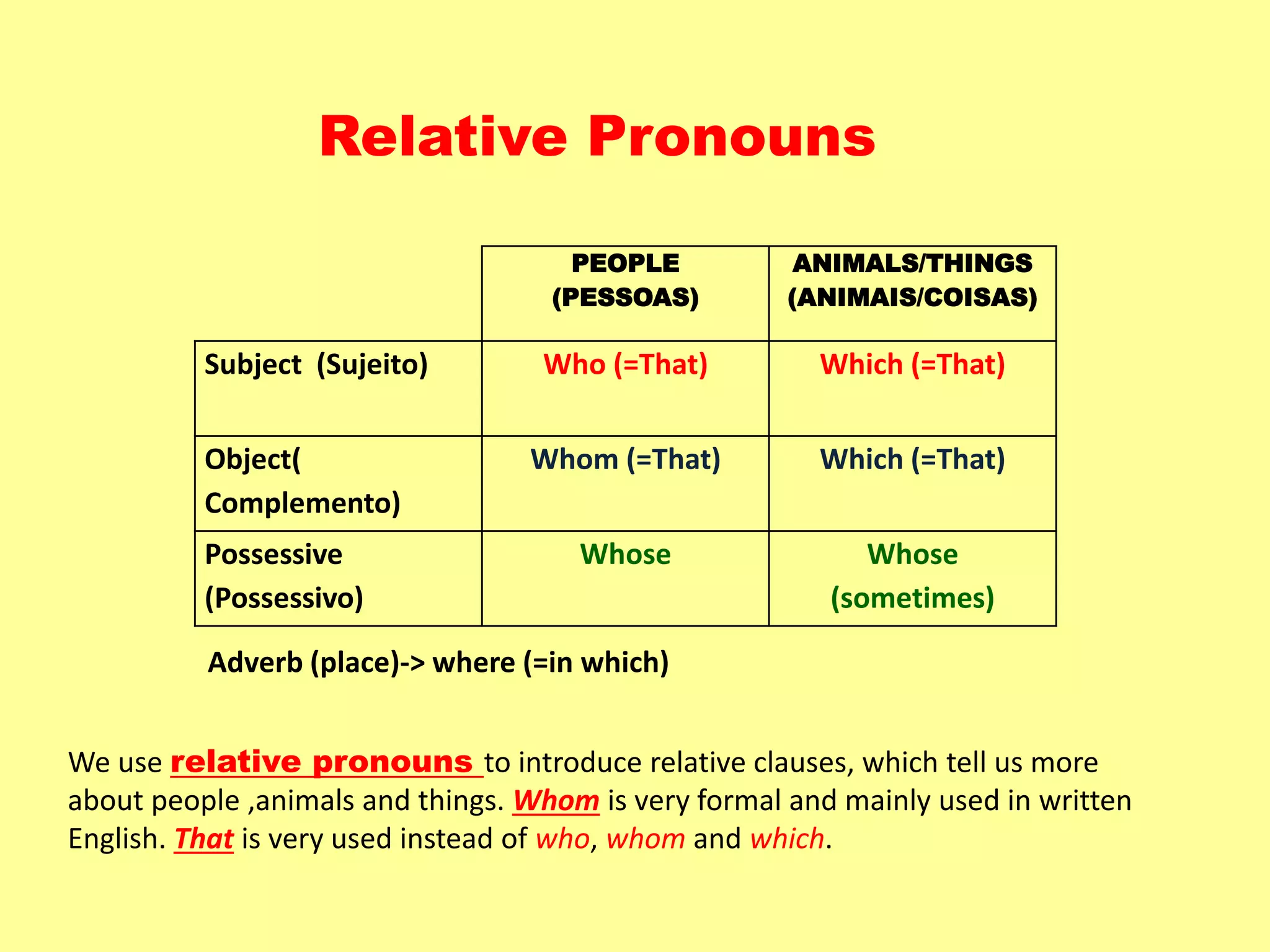
Relative Pronouns 
PEOPLE 
(PESSOAS) 
ANIMALS/THINGS 
(ANIMAIS/COISAS) 
Subject (Sujeito) Who (=That) Which (=That) 
Object( 
Complemento) 
Whom (=That) Which (=That) 
Possessive 
(Possessivo) 
Whose Whose 
(sometimes) 
Adverb (place)-> where (=in which) 
We use relative pronouns to introduce relative clauses, which tell us more 
about people ,animals and things. Whom is very formal and mainly used in written 
English. That is very used instead of who, whom and which.
A.Defining relative clauses 
Subject (people) 
• This is the man. He lives in Boston. 
subject verb 
• This is the man who(/that lives in Boston. 
• This is the man who/that he lives in Boston.
A.Defining relative clauses 
Subject (things) 
• The invitation card was sent by post. It arrived 
yesterday. Subj. verb 
• The invitation card which/that arrived 
yesterday was sent by post.
A.Defining relative clauses 
Object (people) 
• That’s the girl. I saw her at the party. 
subj. verb 
• That’s the girl (whom/that) I saw at the party. 
subj. verb 
Note: we can leave out the relative pronoun.
A.Defining relative clauses 
Object (animals+things) 
• That’s the DVD.I watched it last night. 
subj. verb 
• That’s the DVD (which/that) I watched last 
night. subj. verb
A.Defining relative clauses 
Posssession (people+animals+things) 
• That’s the student. His homework was the 
best. 
• That’s the student whose homework was the 
best.
A.Defining relative clauses 
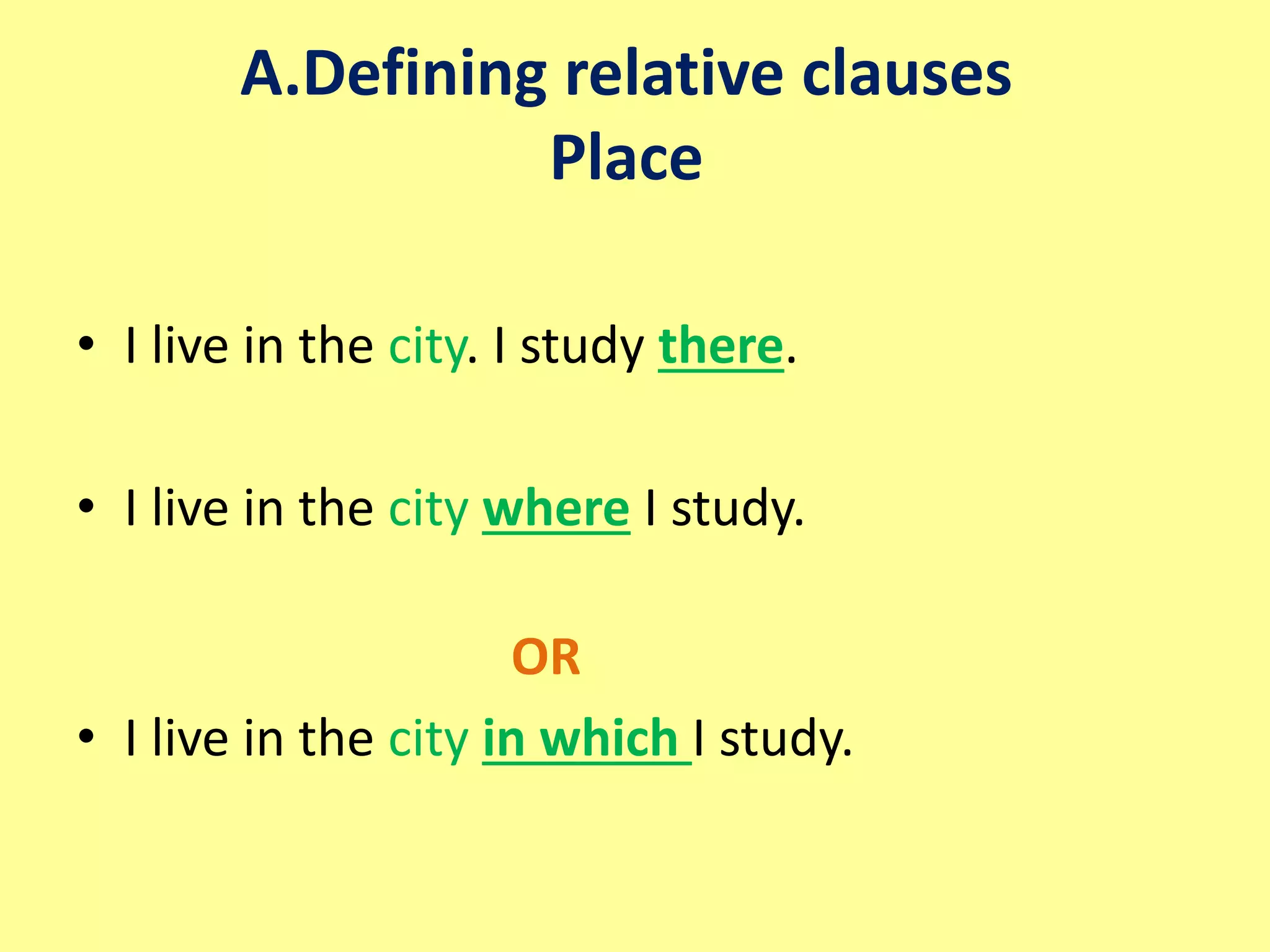
Place 
• I live in the city. I study there. 
• I live in the city where I study. 
OR 
• I live in the city in which I study.
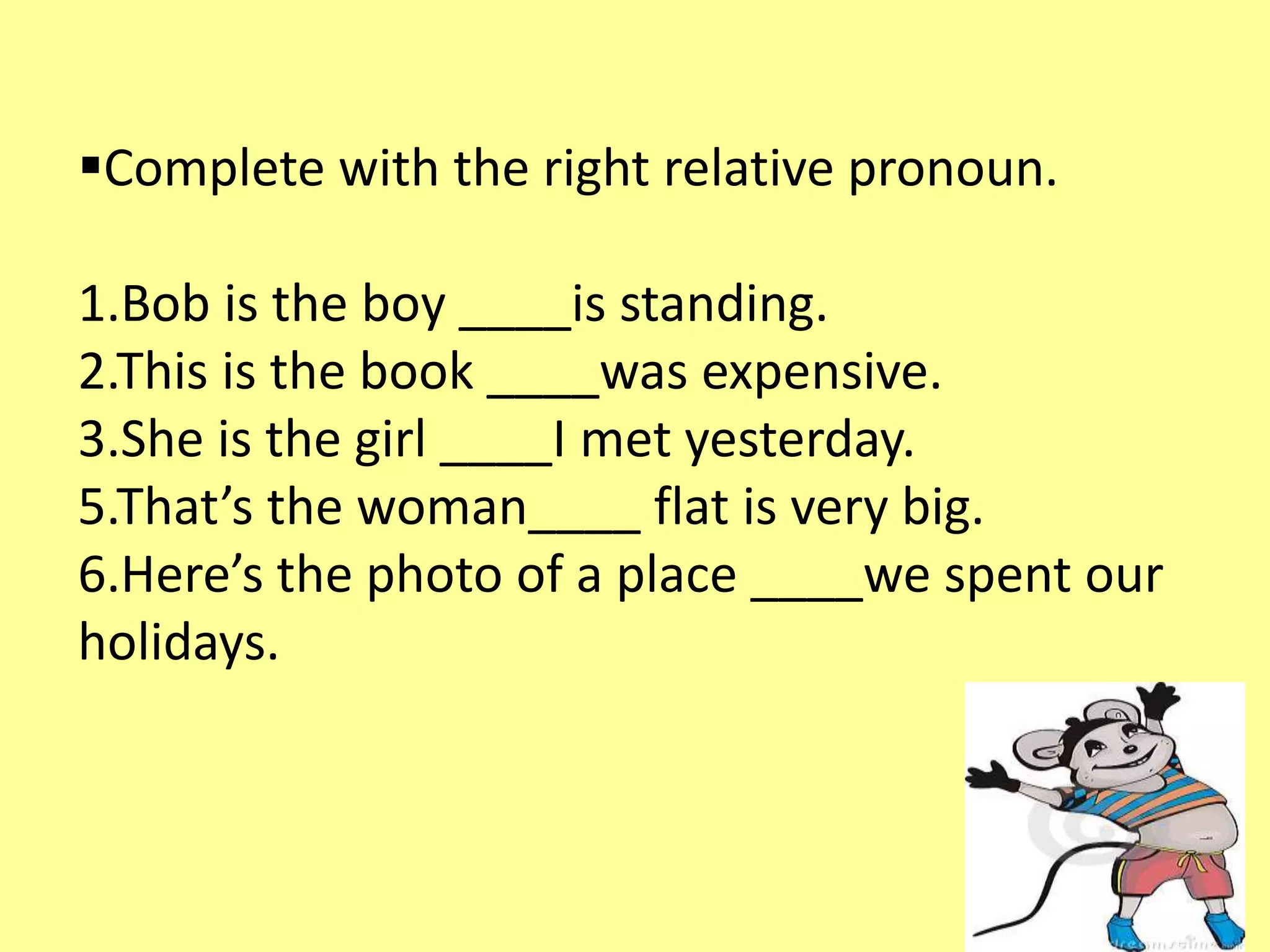
Complete with the right relative pronoun. 
1.Bob is the boy ____is standing. 
2.This is the book ____was expensive. 
3.She is the girl ____I met yesterday. 
5.That’s the woman____ flat is very big. 
6.Here’s the photo of a place ____we spent our 
holidays.
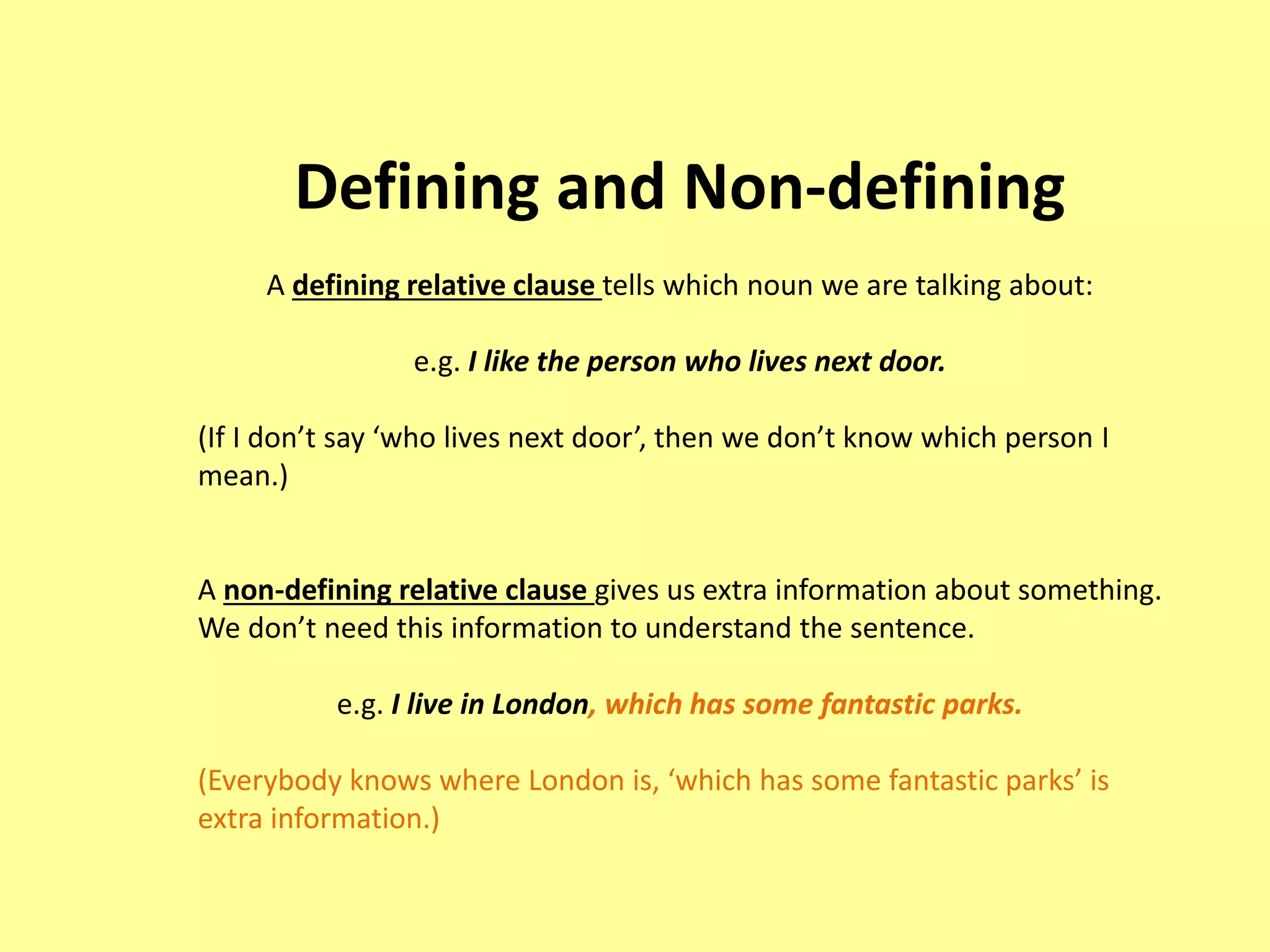
Defining and Non-defining 
A defining relative clause tells which noun we are talking about: 
e.g. I like the person who lives next door. 
(If I don’t say ‘who lives next door’, then we don’t know which person I 
mean.) 
A non-defining relative clause gives us extra information about something. 
We don’t need this information to understand the sentence. 
e.g. I live in London, which has some fantastic parks. 
(Everybody knows where London is, ‘which has some fantastic parks’ is 
extra information.)
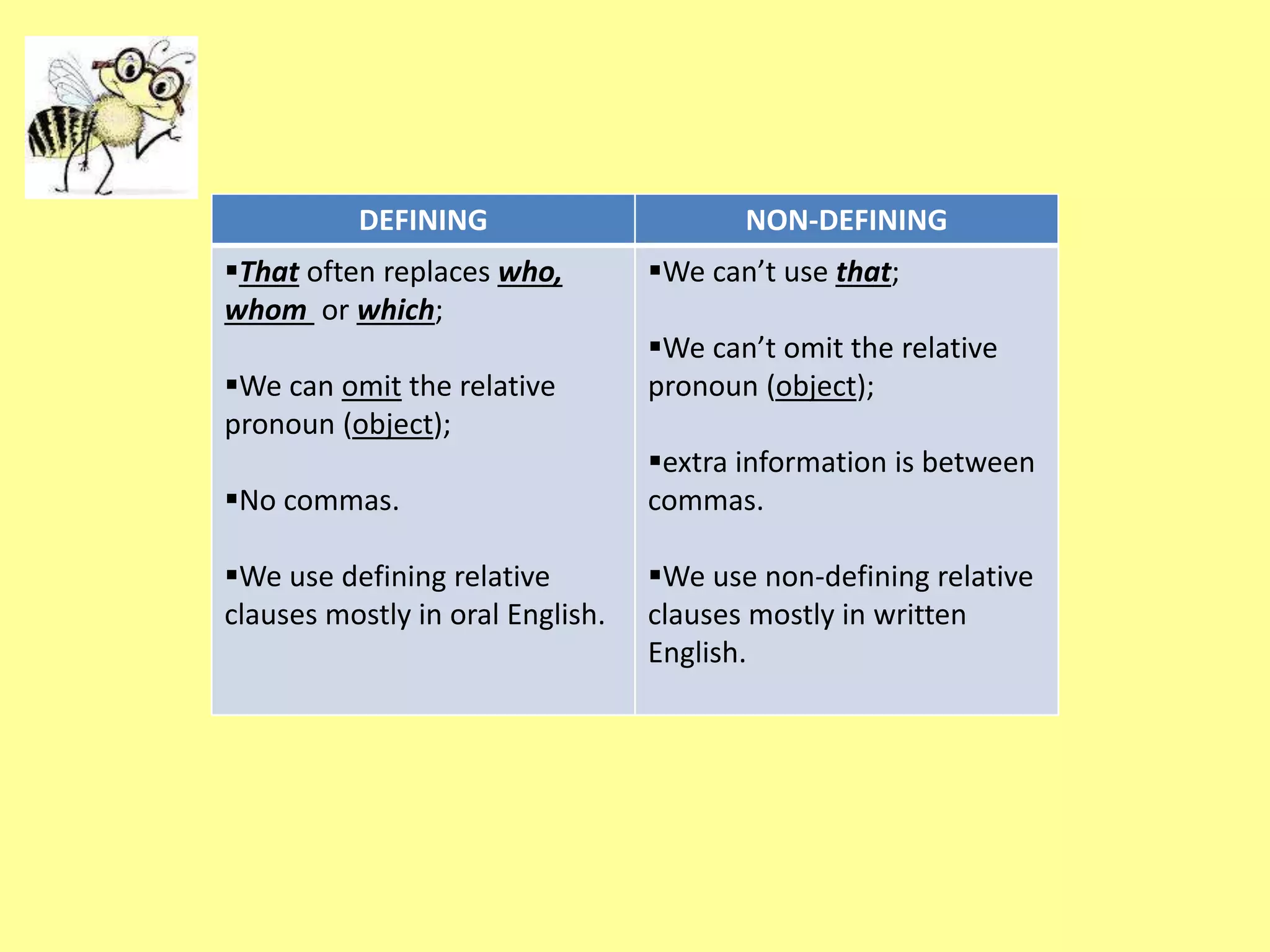
DEFINING NON-DEFINING 
That often replaces who, 
whom or which; 
We can omit the relative 
pronoun (object); 
No commas. 
We use defining relative 
clauses mostly in oral English. 
We can’t use that; 
We can’t omit the relative 
pronoun (object); 
extra information is between 
commas. 
We use non-defining relative 
clauses mostly in written 
English.
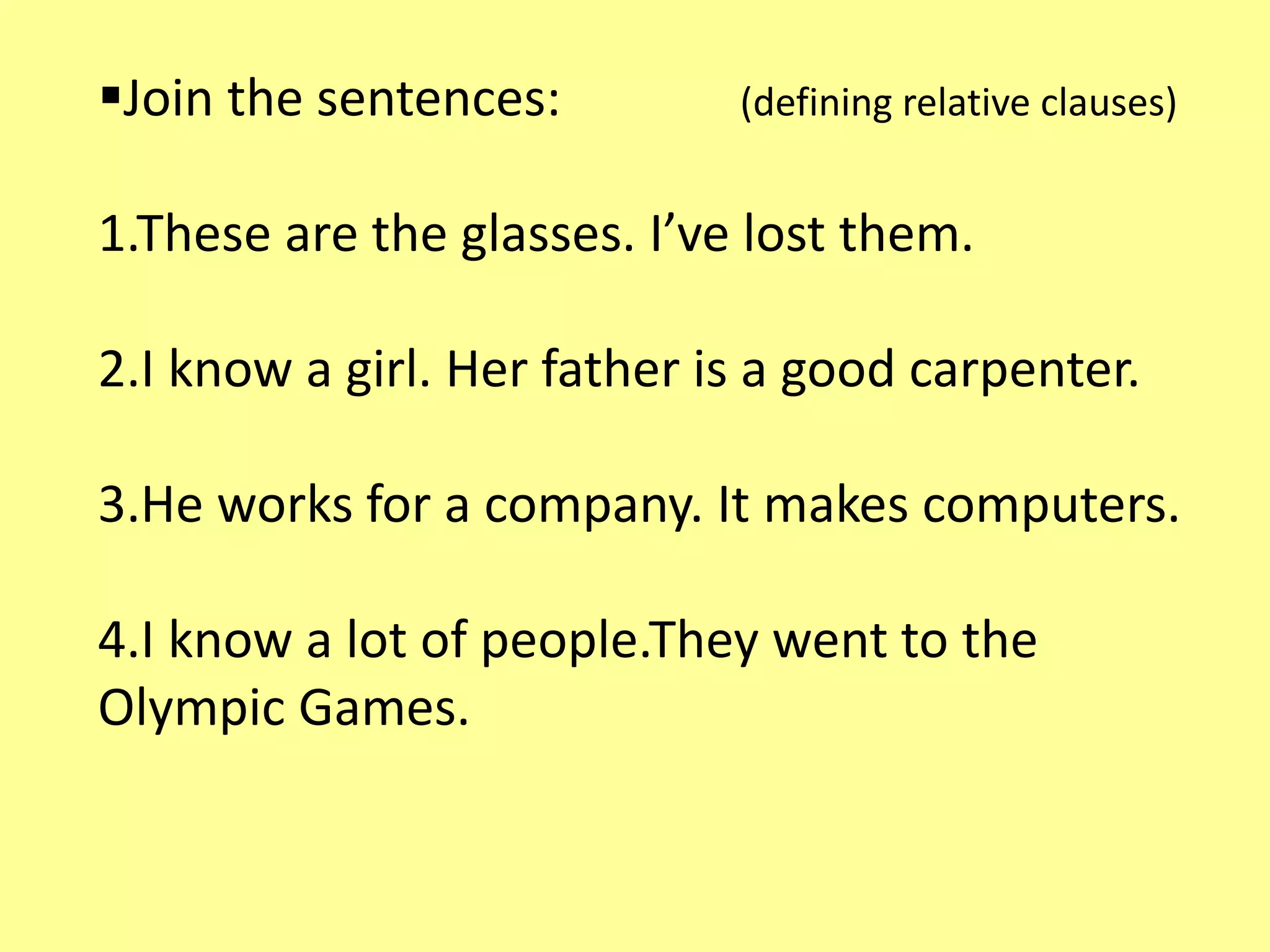
Join the sentences: (defining relative clauses) 
1.These are the glasses. I’ve lost them. 
2.I know a girl. Her father is a good carpenter. 
3.He works for a company. It makes computers. 
4.I know a lot of people.They went to the 
Olympic Games.
Join the sentences: (defining and non-defining relative clauses) 
1.She saw the man.He bought her bike. 
2.The gentleman must be rich.His car is an Aston 
Martin. 
3.Their house was completely ruined.It could be 
seen from distance. 
4.Mr Murphey has just returned from Paris.He is a 
well-known politician.
Study and have fun with: 
http://learnenglish.britishcouncil.org/en/english-grammar/clause-phrase-and-sentence/ 
verb-patterns/relative-clauses

Defining relative clauses - Inglês 10ºano

  • 1.
    RELATIVE CLAUSES Wecan use relative clauses to join two sentences, or to give more information about something.
  • 2.
    Relative Pronouns PEOPLE (PESSOAS) ANIMALS/THINGS (ANIMAIS/COISAS) Subject (Sujeito) Who (=That) Which (=That) Object( Complemento) Whom (=That) Which (=That) Possessive (Possessivo) Whose Whose (sometimes) Adverb (place)-> where (=in which) We use relative pronouns to introduce relative clauses, which tell us more about people ,animals and things. Whom is very formal and mainly used in written English. That is very used instead of who, whom and which.
  • 3.
    A.Defining relative clauses Subject (people) • This is the man. He lives in Boston. subject verb • This is the man who(/that lives in Boston. • This is the man who/that he lives in Boston.
  • 4.
    A.Defining relative clauses Subject (things) • The invitation card was sent by post. It arrived yesterday. Subj. verb • The invitation card which/that arrived yesterday was sent by post.
  • 5.
    A.Defining relative clauses Object (people) • That’s the girl. I saw her at the party. subj. verb • That’s the girl (whom/that) I saw at the party. subj. verb Note: we can leave out the relative pronoun.
  • 6.
    A.Defining relative clauses Object (animals+things) • That’s the DVD.I watched it last night. subj. verb • That’s the DVD (which/that) I watched last night. subj. verb
  • 7.
    A.Defining relative clauses Posssession (people+animals+things) • That’s the student. His homework was the best. • That’s the student whose homework was the best.
  • 8.
    A.Defining relative clauses Place • I live in the city. I study there. • I live in the city where I study. OR • I live in the city in which I study.
  • 9.
    Complete with theright relative pronoun. 1.Bob is the boy ____is standing. 2.This is the book ____was expensive. 3.She is the girl ____I met yesterday. 5.That’s the woman____ flat is very big. 6.Here’s the photo of a place ____we spent our holidays.
  • 10.
    Defining and Non-defining A defining relative clause tells which noun we are talking about: e.g. I like the person who lives next door. (If I don’t say ‘who lives next door’, then we don’t know which person I mean.) A non-defining relative clause gives us extra information about something. We don’t need this information to understand the sentence. e.g. I live in London, which has some fantastic parks. (Everybody knows where London is, ‘which has some fantastic parks’ is extra information.)
  • 11.
    DEFINING NON-DEFINING Thatoften replaces who, whom or which; We can omit the relative pronoun (object); No commas. We use defining relative clauses mostly in oral English. We can’t use that; We can’t omit the relative pronoun (object); extra information is between commas. We use non-defining relative clauses mostly in written English.
  • 12.
    Join the sentences:(defining relative clauses) 1.These are the glasses. I’ve lost them. 2.I know a girl. Her father is a good carpenter. 3.He works for a company. It makes computers. 4.I know a lot of people.They went to the Olympic Games.
  • 13.
    Join the sentences:(defining and non-defining relative clauses) 1.She saw the man.He bought her bike. 2.The gentleman must be rich.His car is an Aston Martin. 3.Their house was completely ruined.It could be seen from distance. 4.Mr Murphey has just returned from Paris.He is a well-known politician.
  • 14.
    Study and havefun with: http://learnenglish.britishcouncil.org/en/english-grammar/clause-phrase-and-sentence/ verb-patterns/relative-clauses