BASIC Relative clauses


         Based on A. Aguado’s examples.
         Changed, Revised, and Completed
                 by Nur Garriga
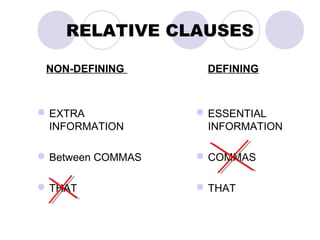
RELATIVE CLAUSES

 NON-DEFINING       DEFINING


 EXTRA             ESSENTIAL
  INFORMATION        INFORMATION

 Between COMMAS    COMMAS

 THAT              THAT
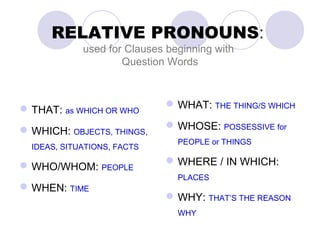
RELATIVE PRONOUNS:
             used for Clauses beginning with
                     Question Words


 THAT: as WHICH OR WHO       WHAT: THE THING/S WHICH

 WHICH: OBJECTS, THINGS,     WHOSE: POSSESSIVE for
                                PEOPLE or THINGS
  IDEAS, SITUATIONS, FACTS

 WHO/WHOM: PEOPLE            WHERE / IN WHICH:
                                PLACES
 WHEN: TIME
                              WHY: THAT’S THE REASON
                                WHY
OTHER RELATIVES
WHATEVER: ANYTHING THAT…
   E.g. Let’s do whatever you like, it’s your birthday!

WHENEVER: ANYTIME THAT…
   E.g. Visit us whenever you can.

WHEREVER: ANYWHERE
   E.g. With this cell phone you’ll have coverage anywhere, wherever you
    are.

ANYHOW/ANYWAY: THE WAY IN WHICH…
   E.g. I’ll do that anyhow, I’m determined to do it.

WHOEVER: ANYBODY/ANYONE WHO…
   E.g. Whoever you see and whatever you hear, pretend you are talking
    to me on the phone.
Defining clauses
      give essential information about the noun/clause.


Examples:
   She’s the teacher.  this is incomplete, it needs a defining clause.
• She’s the teacher who gave me interesting lessons.
• Math is the subject.  this is incomplete, it needs a defining clause.
• Math is the subject that gives me most problems.

•   The girl who/that works at the library is very friendly.
•   You’re the person who/that gets the highest marks.
•   School is a place which/that gives you education & knowledge.
•   There are times when my mind goes completely blank during his lessons.
•   You need to find a room where you can study properly.
•   That’s the girl whose brother plays basketball.
Whose               versus        Who’s

Whose refers to possession.
 Examples:
   He’s the person whose book I lost.
   They held a meeting whose target I did not understand.

Who’s is the contracted form of
       who is or who has.
 Examples:
   He’s the one who’s very intelligent. (who is)
   He’s the boy who’s lived in Boston for many years. (who has).
Omission of object pronouns

We can omit the relative pronoun if it
 connects the object with the relative
 clause.
 Examples:
   That’s the film (that/which) we saw.
   He’s the teacher (that/who) I can’t stand.
   That’s the person (that/who) I truly love.

We often omit the relative pronouns: that,
 which and who in speech.
We can’t omit the relative pronoun
 whose.
 whose
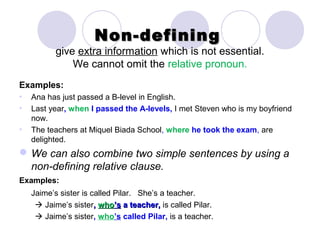
Non-defining
          give extra information which is not essential.
              We cannot omit the relative pronoun.
Examples:
•   Ana has just passed a B-level in English.
•   Last year, when I passed the A-levels, I met Steven who is my boyfriend
    now.
•   The teachers at Miquel Biada School, where he took the exam, are
    delighted.
 We can also combine two simple sentences by using a
  non-defining relative clause.
Examples:
    Jaime’s sister is called Pilar. She’s a teacher.
      Jaime’s sister, who’s a teacher, is called Pilar.
      Jaime’s sister, who’s called Pilar, is a teacher.
BASIC
RELATIVE PRONOUNS & CLAUSES


        THE END
BASIC
RELATIVE PRONOUNS & CLAUSES


        THE END

Relative clauses

  • 1.
    BASIC Relative clauses Based on A. Aguado’s examples. Changed, Revised, and Completed by Nur Garriga
  • 2.
    RELATIVE CLAUSES NON-DEFINING DEFINING  EXTRA  ESSENTIAL INFORMATION INFORMATION  Between COMMAS  COMMAS  THAT  THAT
  • 3.
    RELATIVE PRONOUNS: used for Clauses beginning with Question Words  THAT: as WHICH OR WHO  WHAT: THE THING/S WHICH  WHICH: OBJECTS, THINGS,  WHOSE: POSSESSIVE for PEOPLE or THINGS IDEAS, SITUATIONS, FACTS  WHO/WHOM: PEOPLE  WHERE / IN WHICH: PLACES  WHEN: TIME  WHY: THAT’S THE REASON WHY
  • 4.
    OTHER RELATIVES WHATEVER: ANYTHINGTHAT…  E.g. Let’s do whatever you like, it’s your birthday! WHENEVER: ANYTIME THAT…  E.g. Visit us whenever you can. WHEREVER: ANYWHERE  E.g. With this cell phone you’ll have coverage anywhere, wherever you are. ANYHOW/ANYWAY: THE WAY IN WHICH…  E.g. I’ll do that anyhow, I’m determined to do it. WHOEVER: ANYBODY/ANYONE WHO…  E.g. Whoever you see and whatever you hear, pretend you are talking to me on the phone.
  • 5.
    Defining clauses give essential information about the noun/clause. Examples: She’s the teacher.  this is incomplete, it needs a defining clause. • She’s the teacher who gave me interesting lessons. • Math is the subject.  this is incomplete, it needs a defining clause. • Math is the subject that gives me most problems. • The girl who/that works at the library is very friendly. • You’re the person who/that gets the highest marks. • School is a place which/that gives you education & knowledge. • There are times when my mind goes completely blank during his lessons. • You need to find a room where you can study properly. • That’s the girl whose brother plays basketball.
  • 6.
    Whose versus Who’s Whose refers to possession. Examples:  He’s the person whose book I lost.  They held a meeting whose target I did not understand. Who’s is the contracted form of who is or who has. Examples:  He’s the one who’s very intelligent. (who is)  He’s the boy who’s lived in Boston for many years. (who has).
  • 7.
    Omission of objectpronouns We can omit the relative pronoun if it connects the object with the relative clause. Examples:  That’s the film (that/which) we saw.  He’s the teacher (that/who) I can’t stand.  That’s the person (that/who) I truly love. We often omit the relative pronouns: that, which and who in speech. We can’t omit the relative pronoun whose. whose
  • 8.
    Non-defining give extra information which is not essential. We cannot omit the relative pronoun. Examples: • Ana has just passed a B-level in English. • Last year, when I passed the A-levels, I met Steven who is my boyfriend now. • The teachers at Miquel Biada School, where he took the exam, are delighted.  We can also combine two simple sentences by using a non-defining relative clause. Examples: Jaime’s sister is called Pilar. She’s a teacher.  Jaime’s sister, who’s a teacher, is called Pilar.  Jaime’s sister, who’s called Pilar, is a teacher.
  • 9.
  • 10.