RELATIVE
CLAUSES
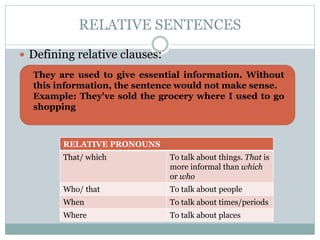
RELATIVE SENTENCES
 Defining relative clauses:
They are used to give essential information. Without
this information, the sentence would not make sense.
Example: They've sold the grocery where I used to go
shopping
RELATIVE PRONOUNS
That/ which To talk about things. That is
more informal than which
or who
Who/ that To talk about people
When To talk about times/periods
Where To talk about places
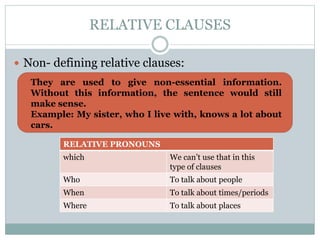
RELATIVE CLAUSES
 Non- defining relative clauses:
They are used to give non-essential information.
Without this information, the sentence would still
make sense.
Example: My sister, who I live with, knows a lot about
cars.
RELATIVE PRONOUNS
which We can’t use that in this
type of clauses
Who To talk about people
When To talk about times/periods
Where To talk about places
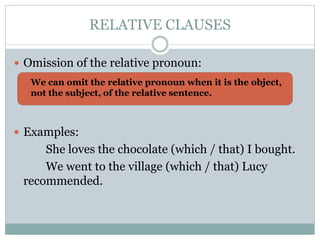
RELATIVE CLAUSES
 Omission of the relative pronoun:
 Examples:
She loves the chocolate (which / that) I bought.
We went to the village (which / that) Lucy
recommended.
We can omit the relative pronoun when it is the object,
not the subject, of the relative sentence.

Relative clauses.

  • 1.
  • 2.
    RELATIVE SENTENCES  Definingrelative clauses: They are used to give essential information. Without this information, the sentence would not make sense. Example: They've sold the grocery where I used to go shopping RELATIVE PRONOUNS That/ which To talk about things. That is more informal than which or who Who/ that To talk about people When To talk about times/periods Where To talk about places
  • 3.
    RELATIVE CLAUSES  Non-defining relative clauses: They are used to give non-essential information. Without this information, the sentence would still make sense. Example: My sister, who I live with, knows a lot about cars. RELATIVE PRONOUNS which We can’t use that in this type of clauses Who To talk about people When To talk about times/periods Where To talk about places
  • 4.
    RELATIVE CLAUSES  Omissionof the relative pronoun:  Examples: She loves the chocolate (which / that) I bought. We went to the village (which / that) Lucy recommended. We can omit the relative pronoun when it is the object, not the subject, of the relative sentence.