

ISE II (B2)
EXAM STRUCTURE
PART 1: PORTFOLIO TASKS (20%)
Section
1:
Correspondence
(between 120 – 150 words): E-mail,
letter. (20%)

◦ 3 sections

Section
2:
Factual
writing
(between 170 – 220 words): Article,
review, report. (40%)
Section 3: Creative / descriptive
wirting (between 170 – 200 words):
Description, story, diary. (40%)

◦ The portfolio needs to be ready by mid-June
PART 2: CONTROLLED WRITING
(30%)
a.

Reading into writing task: writing of a
composition from a little text. (50%).
Approximately 250 words.

b.

Writing task: composition about a topic.
Similar to the porfolio. (50%). Approximately
250 words.

You have 2 hours to complete these two tasks.
This part of the exam will take place the 2nd July
at 10:00 a.m.
PART 3: INTERVIEW (50%)
a.
b.

c.

d.

Introductions.
Topic discussion: each student prepares a
topic to talk about with the examiner.
(50%). Up to 4 minutes.
Interactive task: conversation with the
examiner about a topic. (25%). Up to 4
minutes.
Discussion of the portfolio and
conversation. Up to 4 minutes.(25%)

You can see videos of real exams in the web
page of Trinity College.
MORE INFORMATION:





For ISE II (B2) the price of the exam is
130€. You need to pay for the exam in MAY.
If you want to leave this course, you will
have to warn your teacher the previous
month because the bill will be charged
between the 1st and 5th of each month.
If you have any doubt, do not hesitate to
contact Aula Abierta:
◦ Email: aulaabiertacordoba@gmail.com
◦ Telephone number: 658 034 555
MATERIALS:
You’ll need to buy a book: NEW PASS
TRINITY 7-8. Publishing House: BLACK
CAT.
 The rest of the materials needed will be
provided by the teacher in paper or
online:


http://anabelblascomartin.blogspot.com.es/
LANGUAGE
REQUIREMENTS FOR ISE
II
Language functions:
Giving advice and highlighting advantages and
 Disadvantages
 Making suggestions
 Describing past habits
 Eliciting further information and expansion of
ideas and opinions.
 Expressing agreement and disagreement,
feelings and emotions, impossibility, possibility
and uncertainty.
 Reporting the conversation of others
 Speculating
 Persuading and discouraging

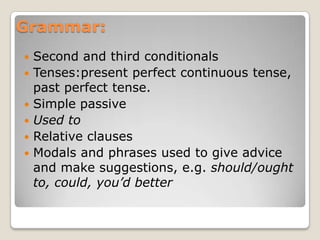
Grammar:








Second and third conditionals
Tenses:present perfect continuous tense,
past perfect tense.
Simple passive
Used to
Relative clauses
Modals and phrases used to give advice
and make suggestions, e.g. should/ought
to, could, you’d better
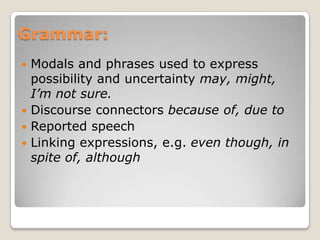
Grammar:
Modals and phrases used to express
possibility and uncertainty may, might,
I’m not sure.
 Discourse connectors because of, due to
 Reported speech
 Linking expressions, e.g. even though, in
spite of, although

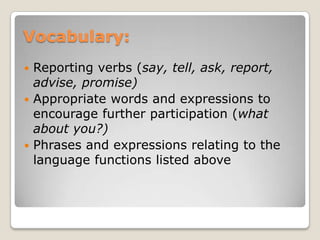
Vocabulary:
Reporting verbs (say, tell, ask, report,
advise, promise)
 Appropriate words and expressions to
encourage further participation (what
about you?)
 Phrases and expressions relating to the
language functions listed above

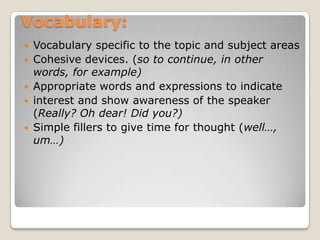
Vocabulary:
Vocabulary specific to the topic and subject areas
 Cohesive devices. (so to continue, in other
words, for example)
 Appropriate words and expressions to indicate
 interest and show awareness of the speaker
(Really? Oh dear! Did you?)
 Simple fillers to give time for thought (well…,
um…)

ISE II (B2)

ISE II (B2)

  • 1.
  • 2.
  • 3.
    PART 1: PORTFOLIOTASKS (20%) Section 1: Correspondence (between 120 – 150 words): E-mail, letter. (20%) ◦ 3 sections Section 2: Factual writing (between 170 – 220 words): Article, review, report. (40%) Section 3: Creative / descriptive wirting (between 170 – 200 words): Description, story, diary. (40%) ◦ The portfolio needs to be ready by mid-June
  • 4.
    PART 2: CONTROLLEDWRITING (30%) a. Reading into writing task: writing of a composition from a little text. (50%). Approximately 250 words. b. Writing task: composition about a topic. Similar to the porfolio. (50%). Approximately 250 words. You have 2 hours to complete these two tasks. This part of the exam will take place the 2nd July at 10:00 a.m.
  • 5.
    PART 3: INTERVIEW(50%) a. b. c. d. Introductions. Topic discussion: each student prepares a topic to talk about with the examiner. (50%). Up to 4 minutes. Interactive task: conversation with the examiner about a topic. (25%). Up to 4 minutes. Discussion of the portfolio and conversation. Up to 4 minutes.(25%) You can see videos of real exams in the web page of Trinity College.
  • 6.
    MORE INFORMATION:    For ISEII (B2) the price of the exam is 130€. You need to pay for the exam in MAY. If you want to leave this course, you will have to warn your teacher the previous month because the bill will be charged between the 1st and 5th of each month. If you have any doubt, do not hesitate to contact Aula Abierta: ◦ Email: aulaabiertacordoba@gmail.com ◦ Telephone number: 658 034 555
  • 7.
    MATERIALS: You’ll need tobuy a book: NEW PASS TRINITY 7-8. Publishing House: BLACK CAT.  The rest of the materials needed will be provided by the teacher in paper or online:  http://anabelblascomartin.blogspot.com.es/
  • 8.
  • 9.
    Language functions: Giving adviceand highlighting advantages and  Disadvantages  Making suggestions  Describing past habits  Eliciting further information and expansion of ideas and opinions.  Expressing agreement and disagreement, feelings and emotions, impossibility, possibility and uncertainty.  Reporting the conversation of others  Speculating  Persuading and discouraging 
  • 10.
    Grammar:       Second and thirdconditionals Tenses:present perfect continuous tense, past perfect tense. Simple passive Used to Relative clauses Modals and phrases used to give advice and make suggestions, e.g. should/ought to, could, you’d better
  • 11.
    Grammar: Modals and phrasesused to express possibility and uncertainty may, might, I’m not sure.  Discourse connectors because of, due to  Reported speech  Linking expressions, e.g. even though, in spite of, although 
  • 12.
    Vocabulary: Reporting verbs (say,tell, ask, report, advise, promise)  Appropriate words and expressions to encourage further participation (what about you?)  Phrases and expressions relating to the language functions listed above 
  • 13.
    Vocabulary: Vocabulary specific tothe topic and subject areas  Cohesive devices. (so to continue, in other words, for example)  Appropriate words and expressions to indicate  interest and show awareness of the speaker (Really? Oh dear! Did you?)  Simple fillers to give time for thought (well…, um…) 