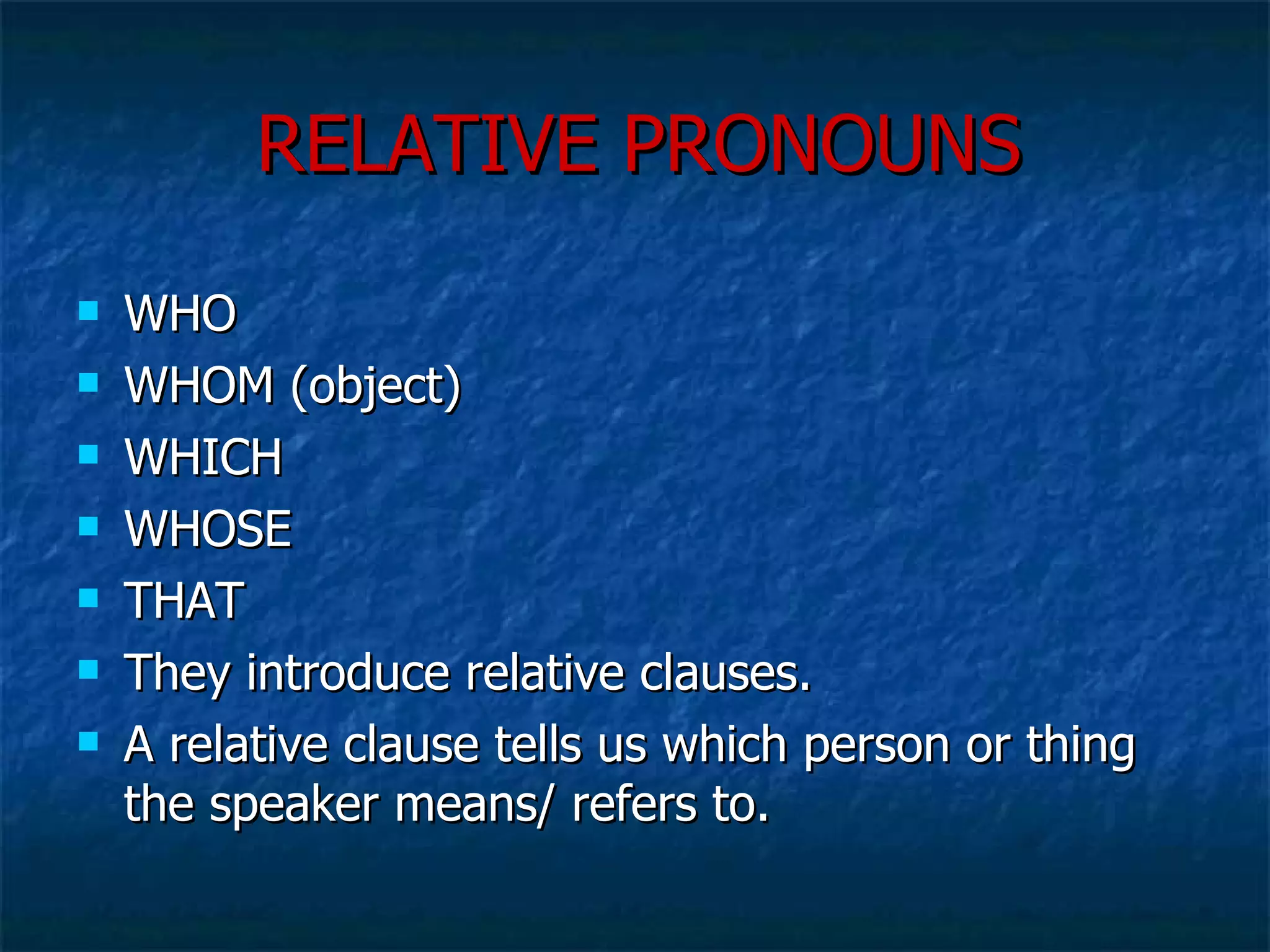
RELATIVE PRONOUNS WHO  WHOM (object) WHICH WHOSE THAT They introduce relative clauses.  A relative clause tells us which person or thing the speaker means/ refers to.
Who / that: refer to people Those people  live next door.  They  have 16 children. The people  who /that  live next door have 16 children.
Which / that: refer to things A turtle  is an animal.  It  lives in the sea. A turtle is an animal  which / that  lives in the sea.
SUBJECT OF RELATIVE CLAUSE I know a man.  He  is a lawyer. I know a man  who / that  is a lawyer. A dog ran away.  A dog  is mine. The dog  which /that  ran away is mine. CAN NEVER BE OMITTED
OBJECT OF RELATIVE CLAUSE I spoke to  a man . I had met  him  before. I spoke to a man  (whom/who/that/--)  I had met before. That’s the book. I read  it  last summer. That’s the book  (which/that/ --)  I read last summer. CAN BE OMITTED IN DEFINING RELATIVE CLAUSES.
WHOSE=possessive adjectives with people, objects and animals That’s the woman-  her  house caught fire yesterday. That’s the woman  whose  house caught fire yesterday. That’s the house-  its  entrance is guarded. That’s the house  whose  entrance is guarded. CAN NEVER BE OMITTED
PREPOSITIONS(usually avoid prep. Before relative pronouns) That’s the car for which I paid $2,000.  ( more formal) That’s the car which / that  I paid $2,000 for. (more usual) That’s the car I paid $2,000 for. (everyday English)
RELATIVE CLAUSES DEFINING RELATIVE CLAUSES WHO WHOM WHICH THAT WHEN, WHERE NON-DEFINING RELATIVE CLAUSES WHO WHOM WHICH WHEN, WHERE
DEFINING RELATIVE CLAUSES Necessary information Essential to the meaning of the main sentence Relative pronouns can be omitted when they are the object of the relative clause The relative clause is not put in commas
. People are fined. (Which people?) People  who /that  park illegally are fined. (Which people? Those who park illegally) . The film was boring (Which film?) The film  (which/ that)  I watched yesterday was boring. (Which film? The one I watched yesterday)
NON-DEFINING RELATIVE CLAUSES They give extra information Not essential to the meaning of the sentence RELATIVE PRONOUNS CANNOT BE OMITTED THAT  CANNOT BE USED THE RELATIVE CLAUSE IS PUT IN COMMAS
. The Jeffersons live next door. The Jeffersons,  who  own a Jaguar, live next door. My cat is called Monty. My cat,  which  I found on the street, is called Monty.
RELATIVE ADVERBS WHERE WHEN WHY: THE REASON WHY I didn’t get a pay rise – that was the reason why I left. I didn’t get a pay rise – that was the reason (that) I left.
DEFINING RELATIVE CLAUSES WHERE: refers to place, after nouns like: place, house, street, town and country. The street  where  we used to play is very busy now. The street  (which   /that)  we used to play  in  is very busy now
WHEN: refers to time, after nouns like: time, period, moment, day… I’ll never forget the day when I first met him. I’ll never forget the day (that) I first met him.
NON-DEFINING WHERE: always after a named place. WHEN: always after a named time. I stopped in Dallas, where my sister lives. Come back at 3:30, when I won’t be busy.

RELATIVE CLAUSES

  • 1.
    RELATIVE PRONOUNS WHO WHOM (object) WHICH WHOSE THAT They introduce relative clauses. A relative clause tells us which person or thing the speaker means/ refers to.
  • 2.
    Who / that:refer to people Those people live next door. They have 16 children. The people who /that live next door have 16 children.
  • 3.
    Which / that:refer to things A turtle is an animal. It lives in the sea. A turtle is an animal which / that lives in the sea.
  • 4.
    SUBJECT OF RELATIVECLAUSE I know a man. He is a lawyer. I know a man who / that is a lawyer. A dog ran away. A dog is mine. The dog which /that ran away is mine. CAN NEVER BE OMITTED
  • 5.
    OBJECT OF RELATIVECLAUSE I spoke to a man . I had met him before. I spoke to a man (whom/who/that/--) I had met before. That’s the book. I read it last summer. That’s the book (which/that/ --) I read last summer. CAN BE OMITTED IN DEFINING RELATIVE CLAUSES.
  • 6.
    WHOSE=possessive adjectives withpeople, objects and animals That’s the woman- her house caught fire yesterday. That’s the woman whose house caught fire yesterday. That’s the house- its entrance is guarded. That’s the house whose entrance is guarded. CAN NEVER BE OMITTED
  • 7.
    PREPOSITIONS(usually avoid prep.Before relative pronouns) That’s the car for which I paid $2,000. ( more formal) That’s the car which / that I paid $2,000 for. (more usual) That’s the car I paid $2,000 for. (everyday English)
  • 8.
    RELATIVE CLAUSES DEFININGRELATIVE CLAUSES WHO WHOM WHICH THAT WHEN, WHERE NON-DEFINING RELATIVE CLAUSES WHO WHOM WHICH WHEN, WHERE
  • 9.
    DEFINING RELATIVE CLAUSESNecessary information Essential to the meaning of the main sentence Relative pronouns can be omitted when they are the object of the relative clause The relative clause is not put in commas
  • 10.
    . People arefined. (Which people?) People who /that park illegally are fined. (Which people? Those who park illegally) . The film was boring (Which film?) The film (which/ that) I watched yesterday was boring. (Which film? The one I watched yesterday)
  • 11.
    NON-DEFINING RELATIVE CLAUSESThey give extra information Not essential to the meaning of the sentence RELATIVE PRONOUNS CANNOT BE OMITTED THAT CANNOT BE USED THE RELATIVE CLAUSE IS PUT IN COMMAS
  • 12.
    . The Jeffersonslive next door. The Jeffersons, who own a Jaguar, live next door. My cat is called Monty. My cat, which I found on the street, is called Monty.
  • 13.
    RELATIVE ADVERBS WHEREWHEN WHY: THE REASON WHY I didn’t get a pay rise – that was the reason why I left. I didn’t get a pay rise – that was the reason (that) I left.
  • 14.
    DEFINING RELATIVE CLAUSESWHERE: refers to place, after nouns like: place, house, street, town and country. The street where we used to play is very busy now. The street (which /that) we used to play in is very busy now
  • 15.
    WHEN: refers totime, after nouns like: time, period, moment, day… I’ll never forget the day when I first met him. I’ll never forget the day (that) I first met him.
  • 16.
    NON-DEFINING WHERE: alwaysafter a named place. WHEN: always after a named time. I stopped in Dallas, where my sister lives. Come back at 3:30, when I won’t be busy.