Relative clauses
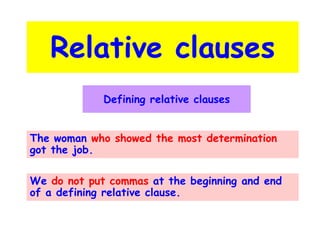
Defining relative clauses
The woman who showed the most determination
got the job.
We do not put commas at the beginning and end
of a defining relative clause.
Relative clauses
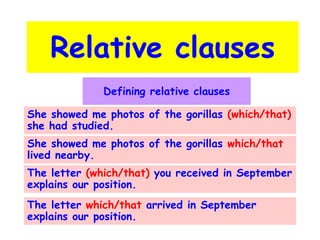
Defining relative clauses

She showed me photos of the gorillas (which/that)
she had studied.
She showed me photos of the gorillas which/that
lived nearby.
The letter (which/that) you received in September
explains our position.
The letter which/that arrived in September
explains our position.
Relative clauses
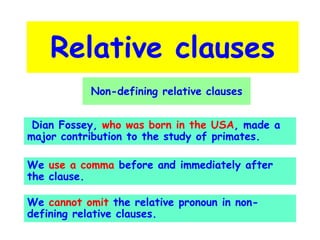
Non-defining relative clauses
Dian Fossey, who was born in the USA, made a
major contribution to the study of primates.

We use a comma before and immediately after
the clause.
We cannot omit the relative pronoun in nondefining relative clauses.
Relative pronouns
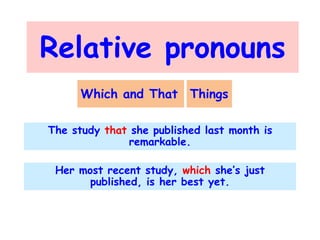
Which and That Things
The study that she published last month is
remarkable.
Her most recent study, which she’s just
published, is her best yet.
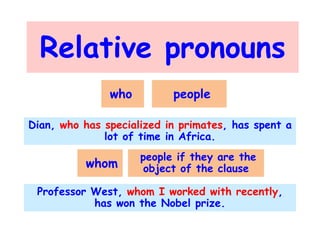
Relative pronouns
who

people

Dian, who has specialized in primates, has spent a
lot of time in Africa.

whom

people if they are the
object of the clause

Professor West, whom I worked with recently,
has won the Nobel prize.
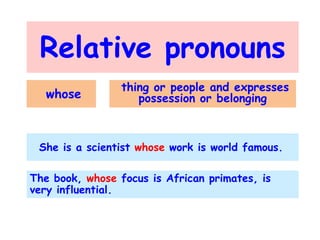
Relative pronouns
whose

thing or people and expresses
possession or belonging

She is a scientist whose work is world famous.
The book, whose focus is African primates, is
very influential.
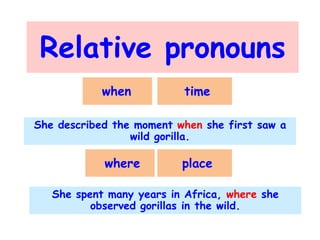
Relative pronouns
when

time

She described the moment when she first saw a
wild gorilla.

where

place

She spent many years in Africa, where she
observed gorillas in the wild.
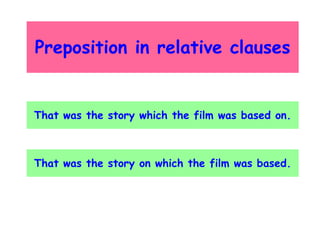
Preposition in relative clauses

That was the story which the film was based on.

That was the story on which the film was based.
Preposition in relative clauses
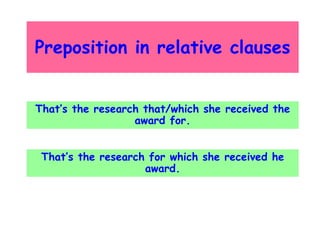
That’s the research that/which she received the
award for.
That’s the research for which she received he
award.
Preposition in relative clauses
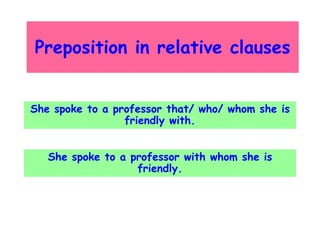
She spoke to a professor that/ who/ whom she is
friendly with.
She spoke to a professor with whom she is
friendly.

Relative clauses

  • 1.
    Relative clauses Defining relativeclauses The woman who showed the most determination got the job. We do not put commas at the beginning and end of a defining relative clause.
  • 2.
    Relative clauses Defining relativeclauses She showed me photos of the gorillas (which/that) she had studied. She showed me photos of the gorillas which/that lived nearby. The letter (which/that) you received in September explains our position. The letter which/that arrived in September explains our position.
  • 3.
    Relative clauses Non-defining relativeclauses Dian Fossey, who was born in the USA, made a major contribution to the study of primates. We use a comma before and immediately after the clause. We cannot omit the relative pronoun in nondefining relative clauses.
  • 4.
    Relative pronouns Which andThat Things The study that she published last month is remarkable. Her most recent study, which she’s just published, is her best yet.
  • 5.
    Relative pronouns who people Dian, whohas specialized in primates, has spent a lot of time in Africa. whom people if they are the object of the clause Professor West, whom I worked with recently, has won the Nobel prize.
  • 6.
    Relative pronouns whose thing orpeople and expresses possession or belonging She is a scientist whose work is world famous. The book, whose focus is African primates, is very influential.
  • 7.
    Relative pronouns when time She describedthe moment when she first saw a wild gorilla. where place She spent many years in Africa, where she observed gorillas in the wild.
  • 8.
    Preposition in relativeclauses That was the story which the film was based on. That was the story on which the film was based.
  • 9.
    Preposition in relativeclauses That’s the research that/which she received the award for. That’s the research for which she received he award.
  • 10.
    Preposition in relativeclauses She spoke to a professor that/ who/ whom she is friendly with. She spoke to a professor with whom she is friendly.