
Adjective Clauses
GRAMMAR THAT MAKES YOU CRAZY!
Where does the clause begin?
Adjective clauses begin with a relative pronoun (subordinator) that functions as the subject of
the clause.
Subject Pronouns:
◦ For people: use “who” or “that”
◦ For things or places: use “which” or “that”
Examples:
The people who were at the amusement park were having a great time!
The banana that I ate today was bad.
Last year, I visited the Taj Mahal, which was bigger than I thought it would be.
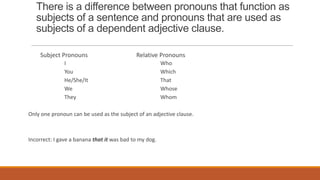
There is a difference between pronouns that function as
subjects of a sentence and pronouns that are used as
subjects of a dependent adjective clause.
Subject Pronouns Relative Pronouns
I Who
You Which
He/She/It That
We Whose
They Whom
Only one pronoun can be used as the subject of an adjective clause.
Incorrect: I gave a banana that it was bad to my dog.
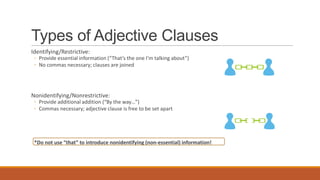
Types of Adjective Clauses
Identifying/Restrictive:
◦ Provide essential information (“That’s the one I’m talking about”)
◦ No commas necessary; clauses are joined
Nonidentifying/Nonrestrictive:
◦ Provide additional addition (“By the way…”)
◦ Commas necessary; adjective clause is free to be set apart
*Do not use “that” to introduce nonidentifying (non-essential) information!
Examples
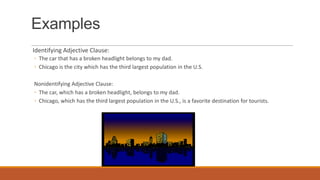
Identifying Adjective Clause:
◦ The car that has a broken headlight belongs to my dad.
◦ Chicago is the city which has the third largest population in the U.S.
Nonidentifying Adjective Clause:
◦ The car, which has a broken headlight, belongs to my dad.
◦ Chicago, which has the third largest population in the U.S., is a favorite destination for tourists.
More Examples
Identifying or nonidentifying?
◦ She is the teacher whose class I enjoy the most.
◦ The teacher, whose class I enjoy, is the youngest teacher in the Engineering Department.
◦ President Obama, who loves his family, eats dinner with his wife and daughters every night.
◦ President Obama is a man who loves his family and makes time for them every night.
Where does the clause begin?
Adjective clauses can begin with a relative pronoun that functions as the object of the clause.
◦ For people: use “whom” or “that”
◦ Robert, whom I met last week, has agreed to be my research partner.
◦ The owner of the new coffee shop is the same woman that I used to see at Starbucks.
◦ For things or places: use “which” or “that”
◦ I loved the book that you recommended to me.
◦ The book I just finished, which you recommended to me, was the best book I have read.
What’s missing?
“I read the book she wrote.”
You can leave out a relative pronoun in an adjective clause IF:
◦ the pronoun functions as the object of the clause, AND
◦ The adjective clause is an identifying clause.
I read the book which she wrote. → I read the book she wrote.
He is the singer whom I met at the concert. → He is the singer I met at the concert.
More Adjective Phrases
An adjective clause can be shortened to an adjective phrase if:
◦ -the relative pronoun is the subject of the dependent clause, AND
◦ -the verb of the clause is a form of the “be” verb
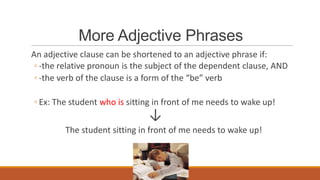
◦ Ex: The student who is sitting in front of me needs to wake up!
↓
The student sitting in front of me needs to wake up!
When and Where
Adjective clauses may begin with “when” and “where”:
◦ That’s the restaurant where I got sick.
◦ I remember the day when I met my husband.
*You may leave out “when” and “that” in identifying adjective clauses referring to a time:
That was the day when I broke my arm. → That was the day I broke my arm.
Resources:
Information and examples can be found in:
Fuchs, Marjorie, and Margaret Bonner. Focus on Grammar: An Integrated Skills Approach. 3rd ed.
White Plains, NY: Pearson Longman, 2006. Print.
And at: http://faculty.deanza.edu/flemingjohn/stories/storyReader$20

Adjective clauses

  • 1.
  • 2.
    Where does theclause begin? Adjective clauses begin with a relative pronoun (subordinator) that functions as the subject of the clause. Subject Pronouns: ◦ For people: use “who” or “that” ◦ For things or places: use “which” or “that”
  • 3.
    Examples: The people whowere at the amusement park were having a great time! The banana that I ate today was bad. Last year, I visited the Taj Mahal, which was bigger than I thought it would be.
  • 4.
    There is adifference between pronouns that function as subjects of a sentence and pronouns that are used as subjects of a dependent adjective clause. Subject Pronouns Relative Pronouns I Who You Which He/She/It That We Whose They Whom Only one pronoun can be used as the subject of an adjective clause. Incorrect: I gave a banana that it was bad to my dog.
  • 5.
    Types of AdjectiveClauses Identifying/Restrictive: ◦ Provide essential information (“That’s the one I’m talking about”) ◦ No commas necessary; clauses are joined Nonidentifying/Nonrestrictive: ◦ Provide additional addition (“By the way…”) ◦ Commas necessary; adjective clause is free to be set apart *Do not use “that” to introduce nonidentifying (non-essential) information!
  • 6.
    Examples Identifying Adjective Clause: ◦The car that has a broken headlight belongs to my dad. ◦ Chicago is the city which has the third largest population in the U.S. Nonidentifying Adjective Clause: ◦ The car, which has a broken headlight, belongs to my dad. ◦ Chicago, which has the third largest population in the U.S., is a favorite destination for tourists.
  • 7.
    More Examples Identifying ornonidentifying? ◦ She is the teacher whose class I enjoy the most. ◦ The teacher, whose class I enjoy, is the youngest teacher in the Engineering Department. ◦ President Obama, who loves his family, eats dinner with his wife and daughters every night. ◦ President Obama is a man who loves his family and makes time for them every night.
  • 8.
    Where does theclause begin? Adjective clauses can begin with a relative pronoun that functions as the object of the clause. ◦ For people: use “whom” or “that” ◦ Robert, whom I met last week, has agreed to be my research partner. ◦ The owner of the new coffee shop is the same woman that I used to see at Starbucks. ◦ For things or places: use “which” or “that” ◦ I loved the book that you recommended to me. ◦ The book I just finished, which you recommended to me, was the best book I have read.
  • 9.
    What’s missing? “I readthe book she wrote.” You can leave out a relative pronoun in an adjective clause IF: ◦ the pronoun functions as the object of the clause, AND ◦ The adjective clause is an identifying clause. I read the book which she wrote. → I read the book she wrote. He is the singer whom I met at the concert. → He is the singer I met at the concert.
  • 10.
    More Adjective Phrases Anadjective clause can be shortened to an adjective phrase if: ◦ -the relative pronoun is the subject of the dependent clause, AND ◦ -the verb of the clause is a form of the “be” verb ◦ Ex: The student who is sitting in front of me needs to wake up! ↓ The student sitting in front of me needs to wake up!
  • 11.
    When and Where Adjectiveclauses may begin with “when” and “where”: ◦ That’s the restaurant where I got sick. ◦ I remember the day when I met my husband. *You may leave out “when” and “that” in identifying adjective clauses referring to a time: That was the day when I broke my arm. → That was the day I broke my arm.
  • 12.
    Resources: Information and examplescan be found in: Fuchs, Marjorie, and Margaret Bonner. Focus on Grammar: An Integrated Skills Approach. 3rd ed. White Plains, NY: Pearson Longman, 2006. Print. And at: http://faculty.deanza.edu/flemingjohn/stories/storyReader$20