Relative Clause
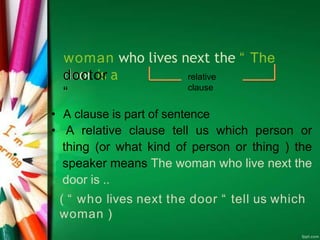
“ The
woman who lives next the
door is a
doctor
“
relative
clause
• A clause is part of sentence
• A relative clause tell us which person or
thing (or what kind of person or thing ) the
speaker means The woman who live next the
door is ..
( “ who lives next the door “ tell us which
woman )
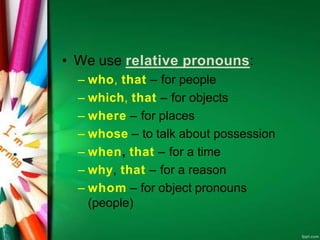
• We use relative pronouns:
– who, that – for people
– which, that – for objects
– where – for places
– whose – to talk about possession
– when, that – for a time
– why, that – for a reason
– whom – for object pronouns
(people)
• That is more formal than which,
but sometimes you have to use
which
• What = ‘ the thing (s)that’. Compare
what and that , look at these example :
- What happened was my fault. ( = the
thing that happened )
- Everything that happened was my fault (
not everything what happened )
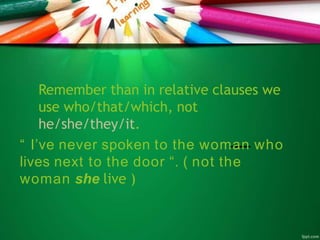
Remember than in relative clauses we
use who/that/which, not
he/she/they/it.
“ I’ve never spoken to the woman who
lives next to the door “. ( not the
woman she live )
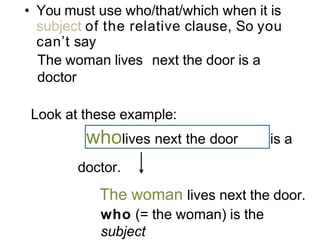
• You must use who/that/which when it is
subject of the relative clause, So you
can’t say
The woman lives next the door is a
doctor
Look at these example:
wholives next the door is a
doctor.
The woman lives next the door.
who (= the woman) is the
subject
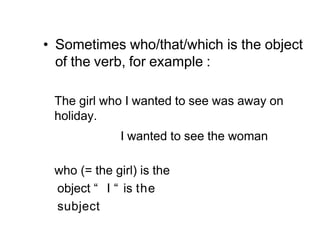
• Sometimes who/that/which is the object
of the verb, for example :
The girl who I wanted to see was away on
holiday.
I wanted to see the woman
who (= the girl) is the
object “ I “ is the
subject
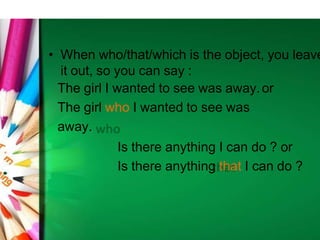
• When who/that/which is the object, you leave
it out, so you can say :
The girl I wanted to see was away.or
The girl who I wanted to see was
away.
Is there anything I can do ? or
Is there anything that I can do ?
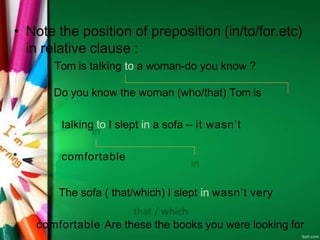
• Note the position of preposition (in/to/for.etc)
in relative clause :
Tom is talking to a woman-do you know ?
Do you know the woman (who/that) Tom is
talking to I slept in a sofa – it wasn’t
comfortable
The sofa ( that/which) I slept in wasn’t very
comfortable Are these the books you were looking for
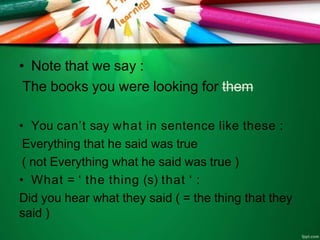
• Note that we say :
The books you were looking for them
• You can’t say what in sentence like these :
Everything that he said was true
( not Everything what he said was true )
• What = ‘ the thing (s) that ‘ :
Did you hear what they said ( = the thing that they
said )
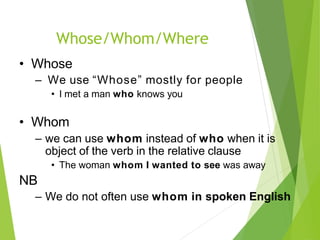
Whose/Whom/Where
• Whose
– We use “Whose” mostly for people
• I met a man who knows you
• Whom
– we can use whom instead of who when it is
object of the verb in the relative clause
• The woman whom I wanted to see was away
NB
– We do not often use whom in spoken English
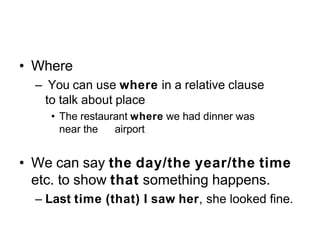
• Where
– You can use where in a relative clause
to talk about place
• The restaurant where we had dinner was
near the airport
• We can say the day/the year/the time
etc. to show that something happens.
– Last time (that) I saw her, she looked fine.
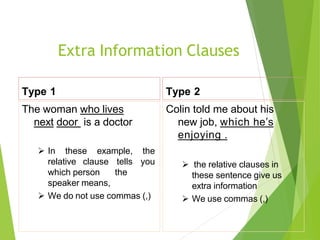
Extra Information Clauses
Type 1
The woman who lives
next door is a doctor
 In these example, the
relative clause tells you
which person the
speaker means,
 We do not use commas (,)
Type 2
Colin told me about his
new job, which he’s
enjoying .
 the relative clauses in
these sentence give us
extra information
 We use commas (,)
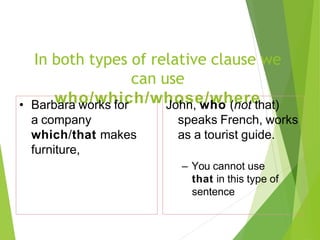
In both types of relative clause we
can use
who/which/whose/where
• Barbara works for
a company
which/that makes
furniture,
John, who (not that)
speaks French, works
as a tourist guide.
– You cannot use
that in this type of
sentence
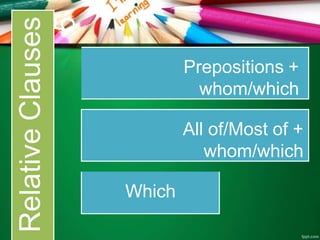
Relative
Clauses
5 Prepositions +
whom/which
All of/Most of +
whom/which
Which
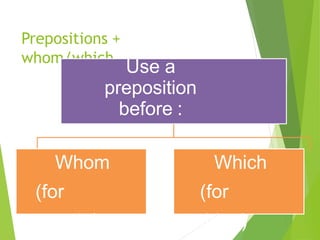
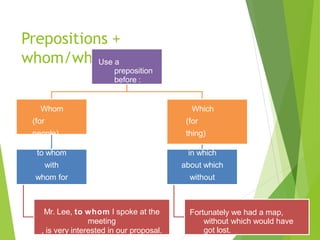
Prepositions +
whom/which
Use a
preposition
before :
Whom
(for
people)
Which
(for
thing)
Prepositions +
whom/which
Use a
preposition
before :
Whom
(for
people)
to whom
with
whom for
whom
Mr. Lee, to whom I spoke at the
meeting
, is very interested in our proposal.
Which
(for
thing)
in which
about which
without
which
Fortunately we had a map,
without which would have
got lost.
Prepositions +
whom/which
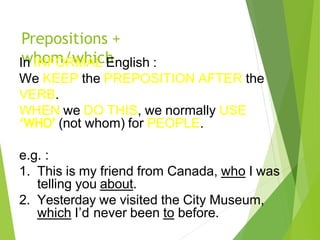
In INFORMAL English :
We KEEP the PREPOSITION AFTER the
VERB.
WHEN we DO THIS, we normally USE
‘WHO’ (not whom) for PEOPLE.
e.g. :
1. This is my friend from Canada, who I was
telling you about.
2. Yesterday we visited the City Museum,
which I’d never been to before.
All of/Most of, etc. +
whom/which
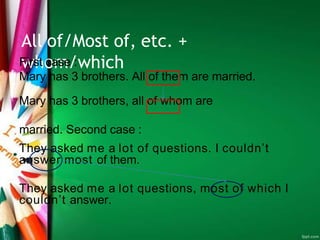
First case :
Mary has 3 brothers. All of them are married.
Mary has 3 brothers, all of whom are
married. Second case :
They asked me a lot of questions. I couldn’t
answer most of them.
They asked me a lot questions, most of which I
couldn’t answer.
All of/Most of, etc. +
whom/which
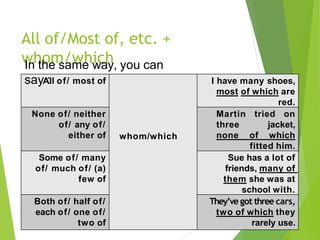
All of/ most of
whom/which
I have many shoes,
most of which are
red.
None of/ neither
of/ any of/
either of
Martin tried on
three jacket,
none of which
fitted him.
Some of/ many
of/ much of/ (a)
few of
Sue has a lot of
friends, many of
them she was at
school with.
Both of/ half of/
each of/ one of/
two of
They’ve got three cars,
two of which they
rarely use.
In the same way, you can
say :
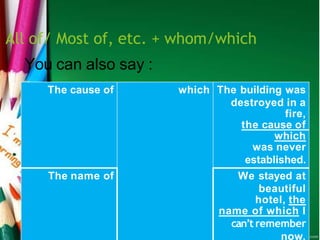
All of/ Most of, etc. + whom/which
The cause of which The building was
destroyed in a
fire,
the cause of
which
was never
established.
The name of We stayed at
beautiful
hotel, the
name of which I
can’t remember
now.
You can also say :
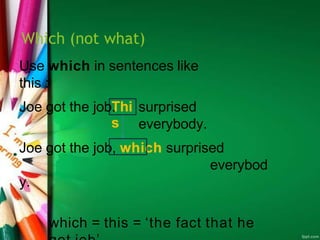
Which (not what)
Use which in sentences like
this :
Thi
s
Joe got the job. surprised
everybody.
Joe got the job, which surprised
everybod
y.
which = this = ‘the fact that he
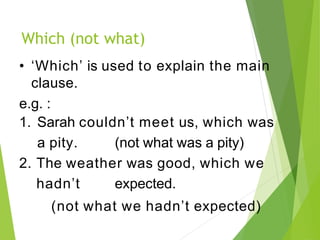
Which (not what)
• ‘Which’ is used to explain the main
clause.
e.g. :
1. Sarah couldn’t meet us, which was
a pity. (not what was a pity)
2. The weather was good, which we
hadn’t expected.
(not what we hadn’t expected)
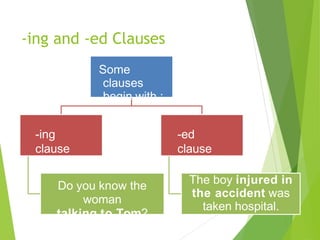
-ing and –ed Clauses
-ing and -ed Clauses
Some
clauses
begin with :
-ing
clause
Do you know the
woman
talking to Tom?
-ed
clause
The boy injured in
the accident was
taken hospital.
-ing and -ed Clauses
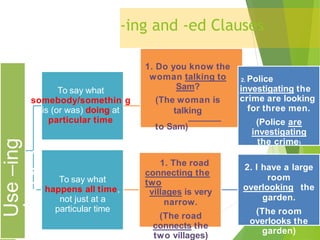
Use
–ing
clauses
To say what
somebody/somethin g
is (or was) doing at
particular time
1. Do you know the
woman talking to
Sam?
(The woman is
talking
to Sam)
2. Police
investigating the
crime are looking
for three men.
(Police are
investigating
the crime)
To say what
happens all time,
not just at a
particular time
1. The road
connecting the
two
villages is very
narrow.
(The road
connects the
two villages)
2. I have a large
room
overlooking the
garden.
(The room
overlooks the
garden)
Use –ing and –ed Clauses
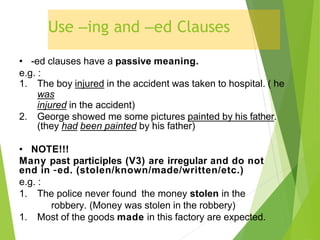
• -ed clauses have a passive meaning.
e.g. :
1. The boy injured in the accident was taken to hospital. ( he
was
injured in the accident)
2. George showed me some pictures painted by his father.
(they had been painted by his father)
• NOTE!!!
Many past participles (V3) are irregular and do not
end in –ed. (stolen/known/made/written/etc.)
e.g. :
1. The police never found the money stolen in the
robbery. (Money was stolen in the robbery)
1. Most of the goods made in this factory are expected.
Use –ing and –ed Clauses
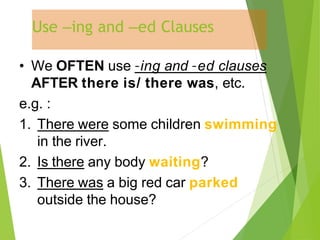
• We OFTEN use –ing and –ed clauses
AFTER there is/ there was, etc.
e.g. :
1. There were some children swimming
in the river.
2. Is there any body waiting?
3. There was a big red car parked
outside the house?

relativeclauses5-140415015521-phpapp02 (1) (1).pptx

  • 1.
  • 2.
    “ The woman wholives next the door is a doctor “ relative clause • A clause is part of sentence • A relative clause tell us which person or thing (or what kind of person or thing ) the speaker means The woman who live next the door is .. ( “ who lives next the door “ tell us which woman )
  • 3.
    • We userelative pronouns: – who, that – for people – which, that – for objects – where – for places – whose – to talk about possession – when, that – for a time – why, that – for a reason – whom – for object pronouns (people)
  • 4.
    • That ismore formal than which, but sometimes you have to use which • What = ‘ the thing (s)that’. Compare what and that , look at these example : - What happened was my fault. ( = the thing that happened ) - Everything that happened was my fault ( not everything what happened )
  • 5.
    Remember than inrelative clauses we use who/that/which, not he/she/they/it. “ I’ve never spoken to the woman who lives next to the door “. ( not the woman she live )
  • 6.
    • You mustuse who/that/which when it is subject of the relative clause, So you can’t say The woman lives next the door is a doctor Look at these example: wholives next the door is a doctor. The woman lives next the door. who (= the woman) is the subject
  • 7.
    • Sometimes who/that/whichis the object of the verb, for example : The girl who I wanted to see was away on holiday. I wanted to see the woman who (= the girl) is the object “ I “ is the subject
  • 8.
    • When who/that/whichis the object, you leave it out, so you can say : The girl I wanted to see was away.or The girl who I wanted to see was away. Is there anything I can do ? or Is there anything that I can do ?
  • 9.
    • Note theposition of preposition (in/to/for.etc) in relative clause : Tom is talking to a woman-do you know ? Do you know the woman (who/that) Tom is talking to I slept in a sofa – it wasn’t comfortable The sofa ( that/which) I slept in wasn’t very comfortable Are these the books you were looking for
  • 10.
    • Note thatwe say : The books you were looking for them • You can’t say what in sentence like these : Everything that he said was true ( not Everything what he said was true ) • What = ‘ the thing (s) that ‘ : Did you hear what they said ( = the thing that they said )
  • 11.
    Whose/Whom/Where • Whose – Weuse “Whose” mostly for people • I met a man who knows you • Whom – we can use whom instead of who when it is object of the verb in the relative clause • The woman whom I wanted to see was away NB – We do not often use whom in spoken English
  • 12.
    • Where – Youcan use where in a relative clause to talk about place • The restaurant where we had dinner was near the airport • We can say the day/the year/the time etc. to show that something happens. – Last time (that) I saw her, she looked fine.
  • 13.
    Extra Information Clauses Type1 The woman who lives next door is a doctor  In these example, the relative clause tells you which person the speaker means,  We do not use commas (,) Type 2 Colin told me about his new job, which he’s enjoying .  the relative clauses in these sentence give us extra information  We use commas (,)
  • 14.
    In both typesof relative clause we can use who/which/whose/where • Barbara works for a company which/that makes furniture, John, who (not that) speaks French, works as a tourist guide. – You cannot use that in this type of sentence
  • 15.
  • 16.
    Prepositions + whom/which Use a preposition before: Whom (for people) Which (for thing)
  • 17.
    Prepositions + whom/which Use a preposition before: Whom (for people) to whom with whom for whom Mr. Lee, to whom I spoke at the meeting , is very interested in our proposal. Which (for thing) in which about which without which Fortunately we had a map, without which would have got lost.
  • 18.
    Prepositions + whom/which In INFORMALEnglish : We KEEP the PREPOSITION AFTER the VERB. WHEN we DO THIS, we normally USE ‘WHO’ (not whom) for PEOPLE. e.g. : 1. This is my friend from Canada, who I was telling you about. 2. Yesterday we visited the City Museum, which I’d never been to before.
  • 19.
    All of/Most of,etc. + whom/which First case : Mary has 3 brothers. All of them are married. Mary has 3 brothers, all of whom are married. Second case : They asked me a lot of questions. I couldn’t answer most of them. They asked me a lot questions, most of which I couldn’t answer.
  • 20.
    All of/Most of,etc. + whom/which All of/ most of whom/which I have many shoes, most of which are red. None of/ neither of/ any of/ either of Martin tried on three jacket, none of which fitted him. Some of/ many of/ much of/ (a) few of Sue has a lot of friends, many of them she was at school with. Both of/ half of/ each of/ one of/ two of They’ve got three cars, two of which they rarely use. In the same way, you can say :
  • 21.
    All of/ Mostof, etc. + whom/which The cause of which The building was destroyed in a fire, the cause of which was never established. The name of We stayed at beautiful hotel, the name of which I can’t remember now. You can also say :
  • 22.
    Which (not what) Usewhich in sentences like this : Thi s Joe got the job. surprised everybody. Joe got the job, which surprised everybod y. which = this = ‘the fact that he
  • 23.
    Which (not what) •‘Which’ is used to explain the main clause. e.g. : 1. Sarah couldn’t meet us, which was a pity. (not what was a pity) 2. The weather was good, which we hadn’t expected. (not what we hadn’t expected)
  • 24.
  • 25.
    -ing and -edClauses Some clauses begin with : -ing clause Do you know the woman talking to Tom? -ed clause The boy injured in the accident was taken hospital.
  • 26.
    -ing and -edClauses Use –ing clauses To say what somebody/somethin g is (or was) doing at particular time 1. Do you know the woman talking to Sam? (The woman is talking to Sam) 2. Police investigating the crime are looking for three men. (Police are investigating the crime) To say what happens all time, not just at a particular time 1. The road connecting the two villages is very narrow. (The road connects the two villages) 2. I have a large room overlooking the garden. (The room overlooks the garden)
  • 27.
    Use –ing and–ed Clauses • -ed clauses have a passive meaning. e.g. : 1. The boy injured in the accident was taken to hospital. ( he was injured in the accident) 2. George showed me some pictures painted by his father. (they had been painted by his father) • NOTE!!! Many past participles (V3) are irregular and do not end in –ed. (stolen/known/made/written/etc.) e.g. : 1. The police never found the money stolen in the robbery. (Money was stolen in the robbery) 1. Most of the goods made in this factory are expected.
  • 28.
    Use –ing and–ed Clauses • We OFTEN use –ing and –ed clauses AFTER there is/ there was, etc. e.g. : 1. There were some children swimming in the river. 2. Is there any body waiting? 3. There was a big red car parked outside the house?