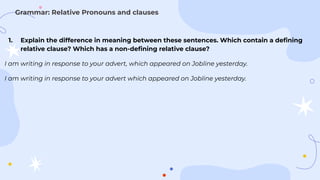
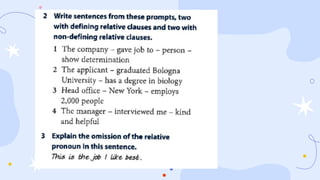
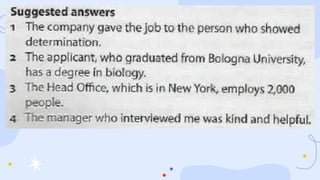
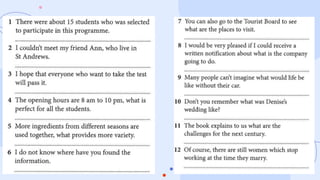
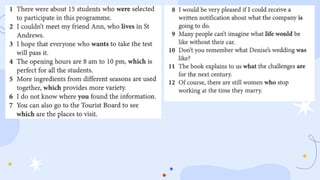
1. Explain thedifference in meaning between these sentences. Which contain a defining
relative clause? Which has a non-defining relative clause?
I am writing in response to your advert, which appeared on Jobline yesterday.
I am writing in response to your advert which appeared on Jobline yesterday.
Grammar: Relative Pronouns and clauses
4.
• Understand theuse of who, that, which in relative clauses.
• Learn the difference between clauses for people and things.
• Identify when to include or omit who/that/which.
• Compare the use of what versus that.
NSDE Foundation | 2024
OBJECTIVES
1
5.
NSDE Foundation |2024
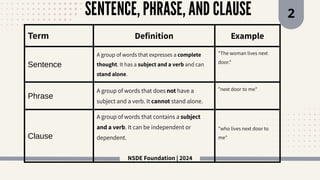
SENTENCE, PHRASE, AND CLAUSE 2
Term Definition Example
Sentence
A group of words that expresses a complete
thought. It has a subject and a verb and can
stand alone.
"The woman lives next
door."
Phrase
A group of words that does not have a
subject and a verb. It cannot stand alone.
"next door to me"
Clause
A group of words that contains a subject
and a verb. It can be independent or
dependent.
"who lives next door to
me"
6.
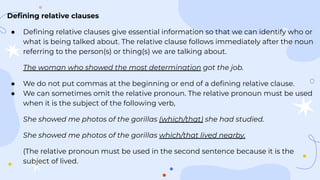
Defining relative clauses
●Defining relative clauses give essential information so that we can identify who or
what is being talked about. The relative clause follows immediately after the noun
referring to the person(s) or thing(s) we are talking about.
The woman who showed the most determination got the job.
● We do not put commas at the beginning or end of a defining relative clause.
● We can sometimes omit the relative pronoun. The relative pronoun must be used
when it is the subject of the following verb,
She showed me photos of the gorillas (which/that) she had studied.
She showed me photos of the gorillas which/that lived nearby.
(The relative pronoun must be used in the second sentence because it is the
subject of lived.
7.
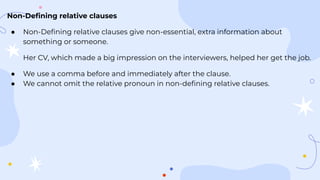
Non-Defining relative clauses
●Non-Defining relative clauses give non-essential, extra information about
something or someone.
Her CV, which made a big impression on the interviewers, helped her get the job.
● We use a comma before and immediately after the clause.
● We cannot omit the relative pronoun in non-defining relative clauses.
10.
NSDE Foundation |2024
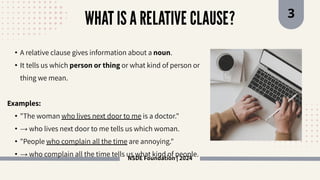
WHAT IS A RELATIVE CLAUSE? 3
• A relative clause gives information about a noun.
• It tells us which person or thing or what kind of person or
thing we mean.
Examples:
• "The woman who lives next door to me is a doctor."
• → who lives next door to me tells us which woman.
• "People who complain all the time are annoying."
• → who complain all the time tells us what kind of people.
11.
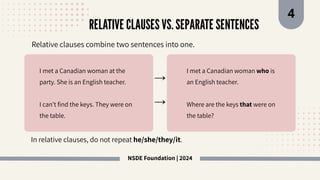
RELATIVE CLAUSES VS.SEPARATE SENTENCES
NSDE Foundation | 2024
I met a Canadian woman at the
party. She is an English teacher.
I can’t find the keys. They were on
the table.
I met a Canadian woman who is
an English teacher.
Where are the keys that were on
the table?
4
Relative clauses combine two sentences into one.
→
→
In relative clauses, do not repeat he/she/they/it.
12.
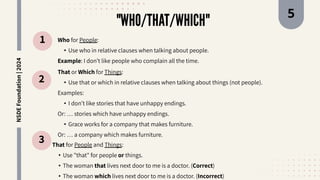
"WHO/THAT/WHICH"
1
2
3
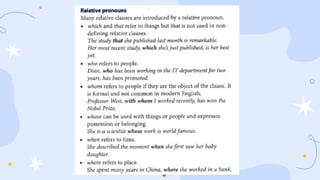
Who for People:
•Use who in relative clauses when talking about people.
Example: I don’t like people who complain all the time.
That or Which for Things:
• Use that or which in relative clauses when talking about things (not people).
Examples:
• I don’t like stories that have unhappy endings.
Or: … stories which have unhappy endings.
• Grace works for a company that makes furniture.
Or: … a company which makes furniture.
That for People and Things:
• Use "that" for people or things.
• The woman that lives next door to me is a doctor. (Correct)
• The woman which lives next door to me is a doctor. (Incorrect)
NSDE
Foundation
|
2024 5
13.
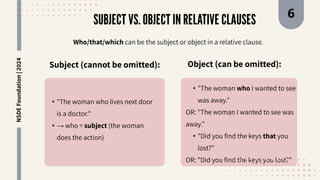
SUBJECT VS. OBJECTIN RELATIVE CLAUSES
Subject (cannot be omitted):
• "The woman who lives next door
is a doctor."
• → who = subject (the woman
does the action)
Object (can be omitted):
• "The woman who I wanted to see
was away."
OR: "The woman I wanted to see was
away."
• "Did you find the keys that you
lost?"
OR: "Did you find the keys you lost?"
6
NSDE
Foundation
|
2024
Who/that/which can be the subject or object in a relative clause.
14.
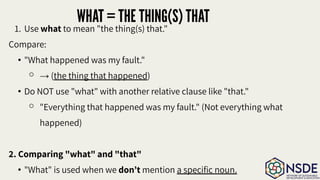
WHAT = THETHING(S) THAT
1. Use what to mean "the thing(s) that."
Compare:
• "What happened was my fault."
⚬ → (the thing that happened)
• Do NOT use "what" with another relative clause like "that."
⚬ "Everything that happened was my fault." (Not everything what
happened)
2. Comparing "what" and "that"
• "What" is used when we don’t mention a specific noun.
15.
NSDE Foundation |2024
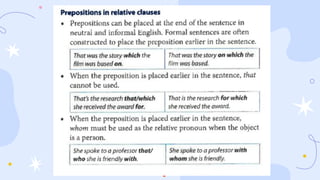
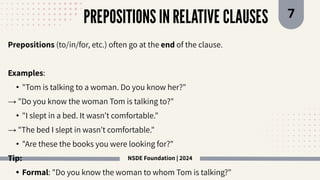
PREPOSITIONS IN RELATIVE CLAUSES 7
Prepositions (to/in/for, etc.) often go at the end of the clause.
Examples:
• "Tom is talking to a woman. Do you know her?"
→ "Do you know the woman Tom is talking to?"
• "I slept in a bed. It wasn’t comfortable."
→ "The bed I slept in wasn’t comfortable."
• "Are these the books you were looking for?"
Tip:
• Formal: "Do you know the woman to whom Tom is talking?"
16.
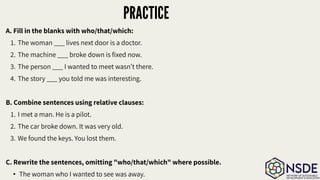
PRACTICE
A. Fill inthe blanks with who/that/which:
1. The woman ___ lives next door is a doctor.
2. The machine ___ broke down is fixed now.
3. The person ___ I wanted to meet wasn’t there.
4. The story ___ you told me was interesting.
B. Combine sentences using relative clauses:
1. I met a man. He is a pilot.
2. The car broke down. It was very old.
3. We found the keys. You lost them.
C. Rewrite the sentences, omitting "who/that/which" where possible.
• The woman who I wanted to see was away.
17.
NSDE Foundation |2024
COMMON MISTAKES 9
• Incorrect: The woman which lives next door is a doctor.
Correct: The woman who/that lives next door is a doctor.
• Incorrect: Everything what happened was true.
Correct: Everything that happened was true.
• Incorrect: The books you were looking for them are on the shelf.
Correct: The books you were looking for are on the shelf.( without them)
• Incorrect: Do you know the woman to whom Tom is talking?
Correct: Do you know the woman (whom) Tom is talking to?