PRE
PRE
ASSESSMENT
ASSESSMENT
GENERAL MATHEMATICS
JUNE 23,2025
PRAYER
LEADER: LET US PAUSE FOR A MOMENT AND PLACE OURSELVES IN
THE PRESENCE OF GOD.
ALL: IN THE NAME OF THE FATHER, AND OF THE SON, AND OF
THE HOLY SPIRIT. AMEN.
L: OUR FATHER, WHO ART IN HEAVEN, HALLOWED BE THY NAME.
THY KINGDOM COME, THY WILL BE DONE, ON EARTH AS IT IS IN
HEAVEN.
R: GIVE US THIS DAY OUR DAILY BREAD. AND FORGIVE US OUR
TRESPASSES, AS WE FORGIVE THOSE WHO TRESPASS AGAINST US.
AND LEAD US NOT INTO TEMPTATION, BUT DELIVER US FROM
EVIL.
AMEN.
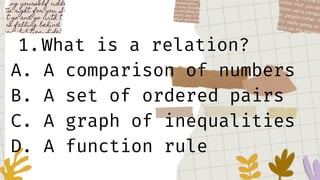
1.What is a relation?
A. A comparison of numbers
B. A set of ordered pairs
C. A graph of inequalities
D. A function rule
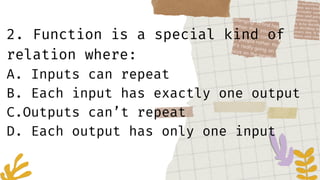
2. Function is a special kind of
relation where:
A. Inputs can repeat
B. Each input has exactly one output
C.Outputs can’t repeat
D. Each output has only one input
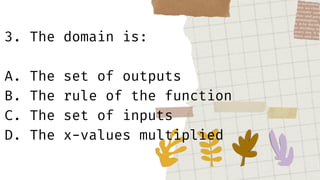
3. The domain is:
A. The set of outputs
B. The rule of the function
C. The set of inputs
D. The x-values multiplied
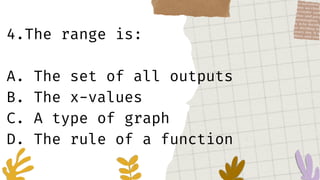
4.The range is:
A. The set of all outputs
B. The x-values
C. A type of graph
D. The rule of a function
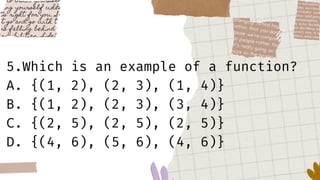
5.Which is an example of a function?
A. {(1, 2), (2, 3), (1, 4)}
B. {(1, 2), (2, 3), (3, 4)}
C. {(2, 5), (2, 5), (2, 5)}
D. {(4, 6), (5, 6), (4, 6)}
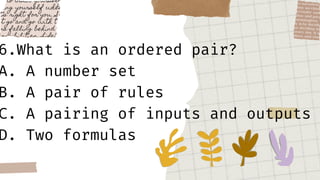
6.What is an ordered pair?
A. A number set
B. A pair of rules
C. A pairing of inputs and outputs
D. Two formulas
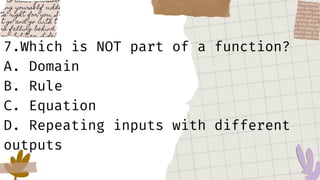
7.Which is NOT part of a function?
A. Domain
B. Rule
C. Equation
D. Repeating inputs with different
outputs
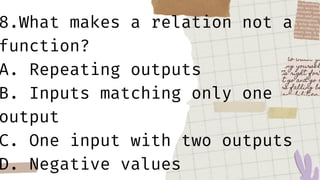
8.What makes a relation not a
function?
A. Repeating outputs
B. Inputs matching only one
output
C. One input with two outputs
D. Negative values
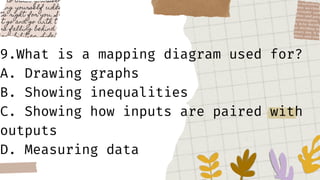
9.What is a mapping diagram used for?
A. Drawing graphs
B. Showing inequalities
C. Showing how inputs are paired with
outputs
D. Measuring data
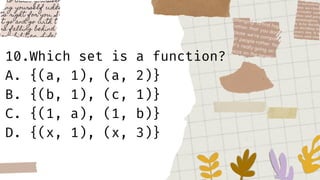
10.Which set is a function?
A. {(a, 1), (a, 2)}
B. {(b, 1), (c, 1)}
C. {(1, a), (1, b)}
D. {(x, 1), (x, 3)}
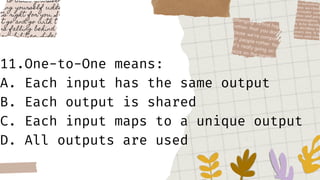
11.One-to-One means:
A. Each input has the same output
B. Each output is shared
C. Each input maps to a unique output
D. All outputs are used
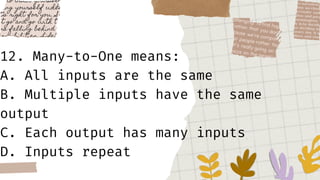
12. Many-to-One means:
A. All inputs are the same
B. Multiple inputs have the same
output
C. Each output has many inputs
D. Inputs repeat
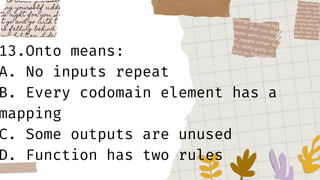
13.Onto means:
A. No inputs repeat
B. Every codomain element has a
mapping
C. Some outputs are unused
D. Function has two rules
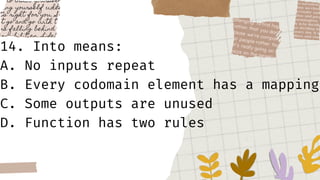
14. Into means:
A. No inputs repeat
B. Every codomain element has a mapping
C. Some outputs are unused
D. Function has two rules
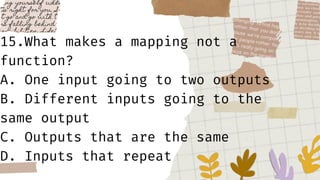
15.What makes a mapping not a
function?
A. One input going to two outputs
B. Different inputs going to the
same output
C. Outputs that are the same
D. Inputs that repeat
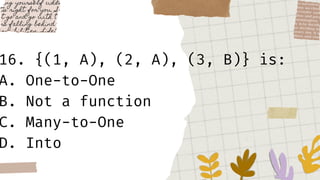
16. {(1, A), (2, A), (3, B)} is:
A. One-to-One
B. Not a function
C. Many-to-One
D. Into
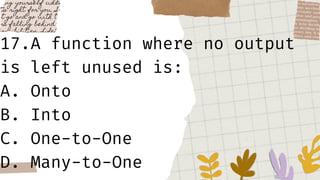
17.A function where no output
is left unused is:
A. Onto
B. Into
C. One-to-One
D. Many-to-One
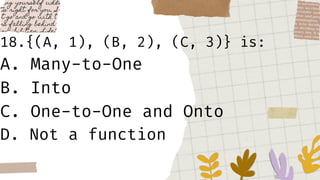
18.{(A, 1), (B, 2), (C, 3)} is:
A. Many-to-One
B. Into
C. One-to-One and Onto
D. Not a function
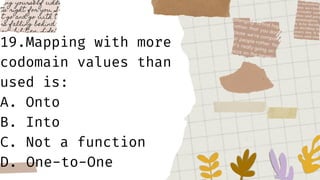
19.Mapping with more
codomain values than
used is:
A. Onto
B. Into
C. Not a function
D. One-to-One
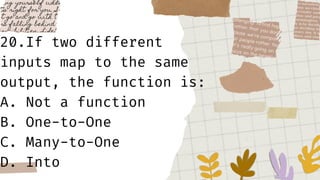
20.If two different
inputs map to the same
output, the function is:
A. Not a function
B. One-to-One
C. Many-to-One
D. Into
RELATION
RELATION
AND
AND
FUNCTION
FUNCTION
GENERAL MATHEMATICS
JUNE 23,2025
PICTURE
PICTURE
ANALYSIS
ANALYSIS
GENERAL MATHEMATICS
JUNE 23,2025
JUNE 23,2025
JUNE 23,2025
JUNE 23,2025
JUNE 24,2025
FIREMAN
1. Why is it important to identify the roles of
one’s person in the community?
2. How does the role of one’s person in the
community affect their behevior towards the
other persons?
FUNCTION
FUNCTION
or
or NOT
NOT ?
?
Students stand up and move to the side they
believe is correct.
Ask for volunteers to explain their choice.
Clarify the answer, review the concept briefly,
and move to the next round.
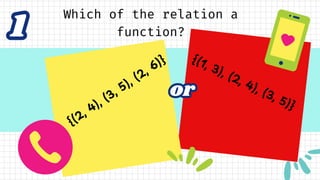
{(2, 4), (3, 5), (2, 6)}
or
or
1
1
Which of the relation a
function?
{(1, 3), (2, 4), (3, 5)}
1
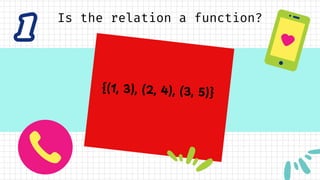
1 Is the relation a function?
{(1, 3), (2, 4), (3, 5)}
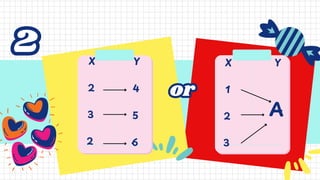
X
2
3
2
or
or
Y
4
5
6
2
2 X
1
2
3
Y
A
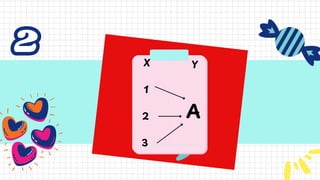
2
2 X
1
2
3
Y
A
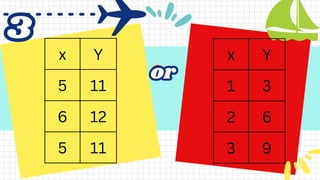
x Y
5 11
6 12
5 11
3
3
or
or
x Y
1 3
2 6
3 9
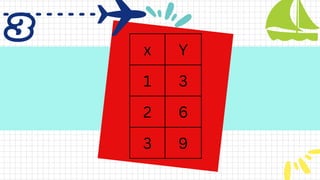
3
3
x Y
1 3
2 6
3 9
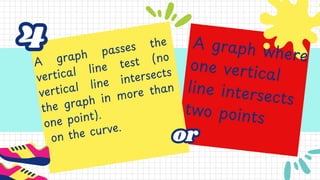
A graph passes the
vertical line test (no
vertical line intersects
the graph in more than
one point).
on the curve.
A graph where
one vertical
line intersects
two points
4
4
or
or
A graph passes the
vertical line test (no
vertical line intersects
the graph in more than
one point).
on the curve.
4
4
RELATION
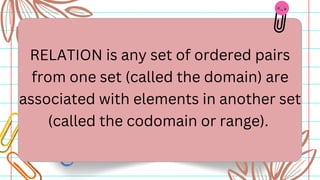
RELATION is any set of ordered pairs
from one set (called the domain) are
associated with elements in another set
(called the codomain or range).
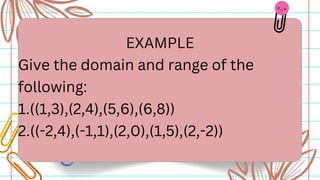
EXAMPLE
Give the domain and range of the
following:
1.((1,3),(2,4),(5,6),(6,8))
2.((-2,4),(-1,1),(2,0),(1,5),(2,-2))
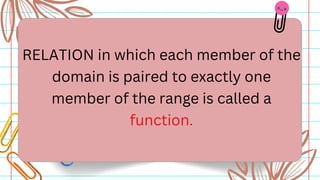
RELATION in which each member of the
domain is paired to exactly one
member of the range is called a
function.
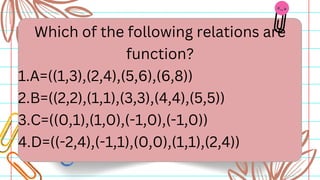
Which of the following relations are
function?
1.A=((1,3),(2,4),(5,6),(6,8))
2.B=((2,2),(1,1),(3,3),(4,4),(5,5))
3.C=((0,1),(1,0),(-1,0),(-1,0))
4.D=((-2,4),(-1,1),(0,0),(1,1),(2,4))
FUNCTION
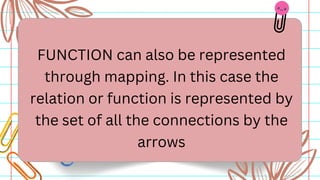
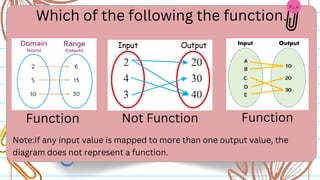
FUNCTION can also be represented
through mapping. In this case the
relation or function is represented by
the set of all the connections by the
arrows
Which of the following the function.
Function Not Function Function
Note:If any input value is mapped to more than one output value, the
diagram does not represent a function.
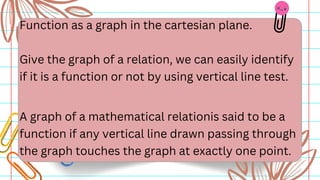
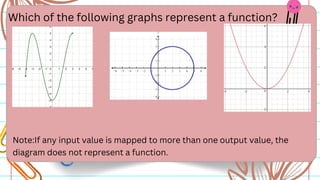
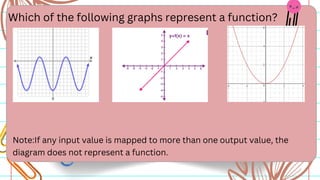
Function as a graph in the cartesian plane.
Give the graph of a relation, we can easily identify
if it is a function or not by using vertical line test.
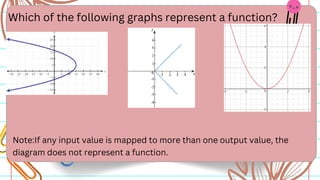
A graph of a mathematical relationis said to be a
function if any vertical line drawn passing through
the graph touches the graph at exactly one point.
Which of the following graphs represent a function?
Note:If any input value is mapped to more than one output value, the
diagram does not represent a function.
Which of the following graphs represent a function?
Note:If any input value is mapped to more than one output value, the
diagram does not represent a function.
Which of the following graphs represent a function?
Note:If any input value is mapped to more than one output value, the
diagram does not represent a function.
EVALUATING
FUNCTIONS
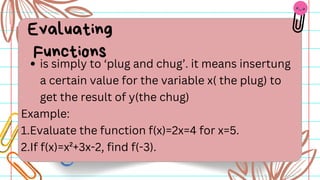
is simply to ‘plug and chug’. it means insertung
a certain value for the variable x( the plug) to
get the result of y(the chug)
Example:
1.Evaluate the function f(x)=2x=4 for x=5.
2.If f(x)=x²+3x-2, find f(-3).
Evaluating
Functions
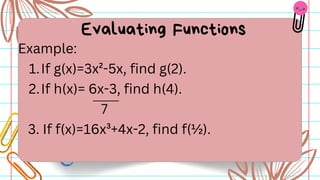
Example:
1.If g(x)=3x²-5x, find g(2).
2.If h(x)= 6x-3, find h(4).
7
3. If f(x)=16x³+4x-2, find f(½).
Evaluating Functions

Grade 11 Relation and Function learning.pdf

  • 1.
  • 2.
    PRAYER LEADER: LET USPAUSE FOR A MOMENT AND PLACE OURSELVES IN THE PRESENCE OF GOD. ALL: IN THE NAME OF THE FATHER, AND OF THE SON, AND OF THE HOLY SPIRIT. AMEN. L: OUR FATHER, WHO ART IN HEAVEN, HALLOWED BE THY NAME. THY KINGDOM COME, THY WILL BE DONE, ON EARTH AS IT IS IN HEAVEN. R: GIVE US THIS DAY OUR DAILY BREAD. AND FORGIVE US OUR TRESPASSES, AS WE FORGIVE THOSE WHO TRESPASS AGAINST US. AND LEAD US NOT INTO TEMPTATION, BUT DELIVER US FROM EVIL. AMEN.
  • 3.
    1.What is arelation? A. A comparison of numbers B. A set of ordered pairs C. A graph of inequalities D. A function rule
  • 4.
    2. Function isa special kind of relation where: A. Inputs can repeat B. Each input has exactly one output C.Outputs can’t repeat D. Each output has only one input
  • 5.
    3. The domainis: A. The set of outputs B. The rule of the function C. The set of inputs D. The x-values multiplied
  • 6.
    4.The range is: A.The set of all outputs B. The x-values C. A type of graph D. The rule of a function
  • 7.
    5.Which is anexample of a function? A. {(1, 2), (2, 3), (1, 4)} B. {(1, 2), (2, 3), (3, 4)} C. {(2, 5), (2, 5), (2, 5)} D. {(4, 6), (5, 6), (4, 6)}
  • 8.
    6.What is anordered pair? A. A number set B. A pair of rules C. A pairing of inputs and outputs D. Two formulas
  • 9.
    7.Which is NOTpart of a function? A. Domain B. Rule C. Equation D. Repeating inputs with different outputs
  • 10.
    8.What makes arelation not a function? A. Repeating outputs B. Inputs matching only one output C. One input with two outputs D. Negative values
  • 11.
    9.What is amapping diagram used for? A. Drawing graphs B. Showing inequalities C. Showing how inputs are paired with outputs D. Measuring data
  • 12.
    10.Which set isa function? A. {(a, 1), (a, 2)} B. {(b, 1), (c, 1)} C. {(1, a), (1, b)} D. {(x, 1), (x, 3)}
  • 13.
    11.One-to-One means: A. Eachinput has the same output B. Each output is shared C. Each input maps to a unique output D. All outputs are used
  • 14.
    12. Many-to-One means: A.All inputs are the same B. Multiple inputs have the same output C. Each output has many inputs D. Inputs repeat
  • 15.
    13.Onto means: A. Noinputs repeat B. Every codomain element has a mapping C. Some outputs are unused D. Function has two rules
  • 16.
    14. Into means: A.No inputs repeat B. Every codomain element has a mapping C. Some outputs are unused D. Function has two rules
  • 17.
    15.What makes amapping not a function? A. One input going to two outputs B. Different inputs going to the same output C. Outputs that are the same D. Inputs that repeat
  • 18.
    16. {(1, A),(2, A), (3, B)} is: A. One-to-One B. Not a function C. Many-to-One D. Into
  • 19.
    17.A function whereno output is left unused is: A. Onto B. Into C. One-to-One D. Many-to-One
  • 20.
    18.{(A, 1), (B,2), (C, 3)} is: A. Many-to-One B. Into C. One-to-One and Onto D. Not a function
  • 21.
    19.Mapping with more codomainvalues than used is: A. Onto B. Into C. Not a function D. One-to-One
  • 22.
    20.If two different inputsmap to the same output, the function is: A. Not a function B. One-to-One C. Many-to-One D. Into
  • 23.
  • 24.
  • 25.
  • 26.
  • 27.
  • 28.
    JUNE 24,2025 FIREMAN 1. Whyis it important to identify the roles of one’s person in the community? 2. How does the role of one’s person in the community affect their behevior towards the other persons?
  • 29.
  • 30.
    Students stand upand move to the side they believe is correct. Ask for volunteers to explain their choice. Clarify the answer, review the concept briefly, and move to the next round.
  • 31.
    {(2, 4), (3,5), (2, 6)} or or 1 1 Which of the relation a function? {(1, 3), (2, 4), (3, 5)}
  • 32.
    1 1 Is therelation a function? {(1, 3), (2, 4), (3, 5)}
  • 33.
  • 34.
  • 35.
    x Y 5 11 612 5 11 3 3 or or x Y 1 3 2 6 3 9
  • 36.
  • 37.
    A graph passesthe vertical line test (no vertical line intersects the graph in more than one point). on the curve. A graph where one vertical line intersects two points 4 4 or or
  • 38.
    A graph passesthe vertical line test (no vertical line intersects the graph in more than one point). on the curve. 4 4
  • 39.
  • 40.
    RELATION is anyset of ordered pairs from one set (called the domain) are associated with elements in another set (called the codomain or range).
  • 41.
    EXAMPLE Give the domainand range of the following: 1.((1,3),(2,4),(5,6),(6,8)) 2.((-2,4),(-1,1),(2,0),(1,5),(2,-2))
  • 42.
    RELATION in whicheach member of the domain is paired to exactly one member of the range is called a function.
  • 43.
    Which of thefollowing relations are function? 1.A=((1,3),(2,4),(5,6),(6,8)) 2.B=((2,2),(1,1),(3,3),(4,4),(5,5)) 3.C=((0,1),(1,0),(-1,0),(-1,0)) 4.D=((-2,4),(-1,1),(0,0),(1,1),(2,4))
  • 44.
  • 45.
    FUNCTION can alsobe represented through mapping. In this case the relation or function is represented by the set of all the connections by the arrows
  • 46.
    Which of thefollowing the function. Function Not Function Function Note:If any input value is mapped to more than one output value, the diagram does not represent a function.
  • 47.
    Function as agraph in the cartesian plane. Give the graph of a relation, we can easily identify if it is a function or not by using vertical line test. A graph of a mathematical relationis said to be a function if any vertical line drawn passing through the graph touches the graph at exactly one point.
  • 48.
    Which of thefollowing graphs represent a function? Note:If any input value is mapped to more than one output value, the diagram does not represent a function.
  • 49.
    Which of thefollowing graphs represent a function? Note:If any input value is mapped to more than one output value, the diagram does not represent a function.
  • 50.
    Which of thefollowing graphs represent a function? Note:If any input value is mapped to more than one output value, the diagram does not represent a function.
  • 51.
  • 52.
    is simply to‘plug and chug’. it means insertung a certain value for the variable x( the plug) to get the result of y(the chug) Example: 1.Evaluate the function f(x)=2x=4 for x=5. 2.If f(x)=x²+3x-2, find f(-3). Evaluating Functions
  • 53.
    Example: 1.If g(x)=3x²-5x, findg(2). 2.If h(x)= 6x-3, find h(4). 7 3. If f(x)=16x³+4x-2, find f(½). Evaluating Functions