PROBABILITY
EXPERIMENT, OUTCOMES, AND SAMPLE SPACE
Definition An experiment is a process that,
when performed, results in one and only one of
many observations. These observations are called
the outcomes of the experiment. The collection
of all outcomes for an experiment is called a
sample space
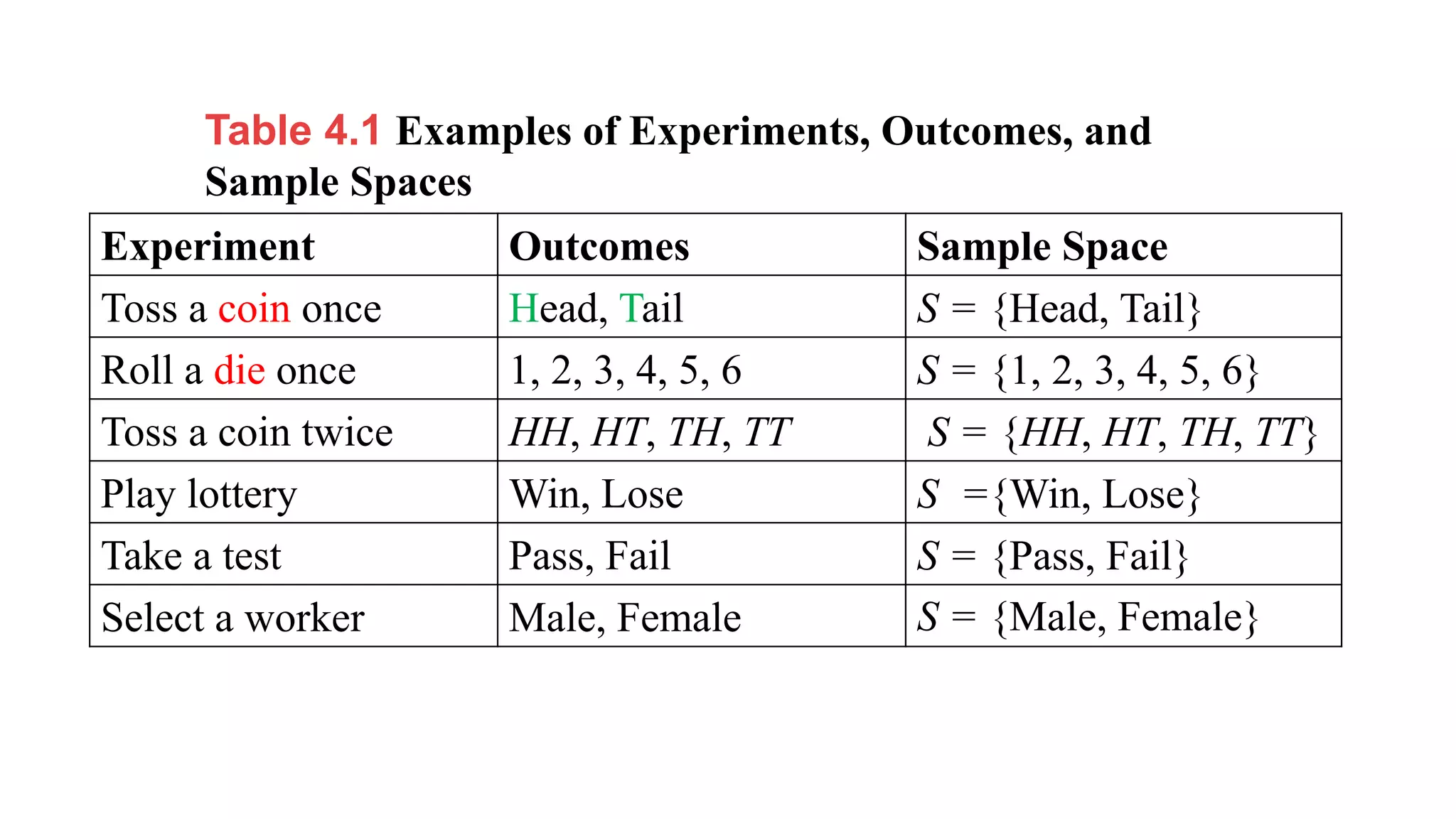
Table 4.1 Examples of Experiments, Outcomes, and
Sample Spaces
Experiment Outcomes Sample Space
Toss a coin once Head, Tail S = {Head, Tail}
Roll a die once 1, 2, 3, 4, 5, 6 S = {1, 2, 3, 4, 5, 6}
Toss a coin twice HH, HT, TH, TT S = {HH, HT, TH, TT}
Play lottery Win, Lose S ={Win, Lose}
Take a test Pass, Fail S = {Pass, Fail}
Select a worker Male, Female S = {Male, Female}
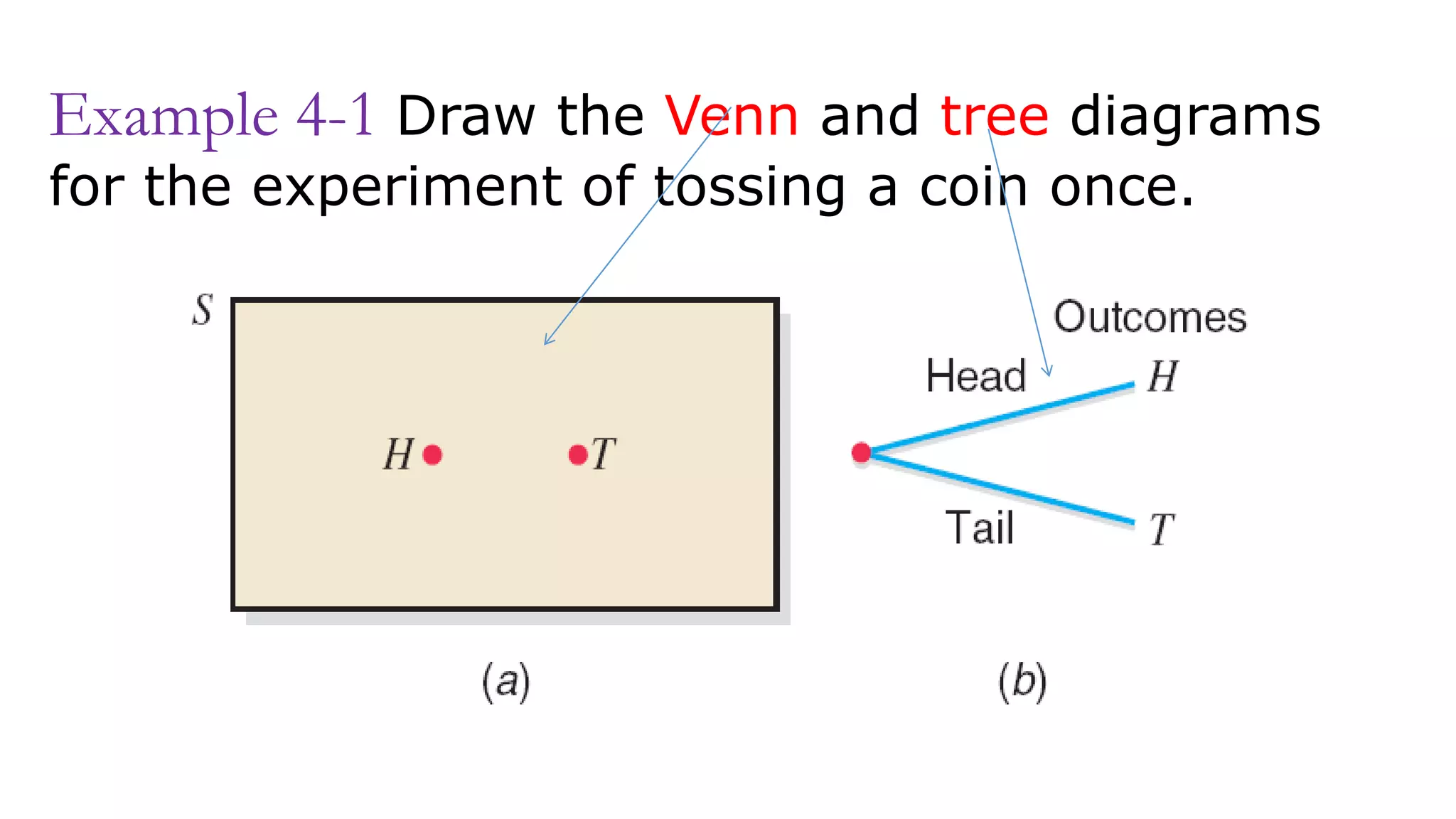
Example 4-1 Draw the Venn and tree diagrams
for the experiment of tossing a coin once.
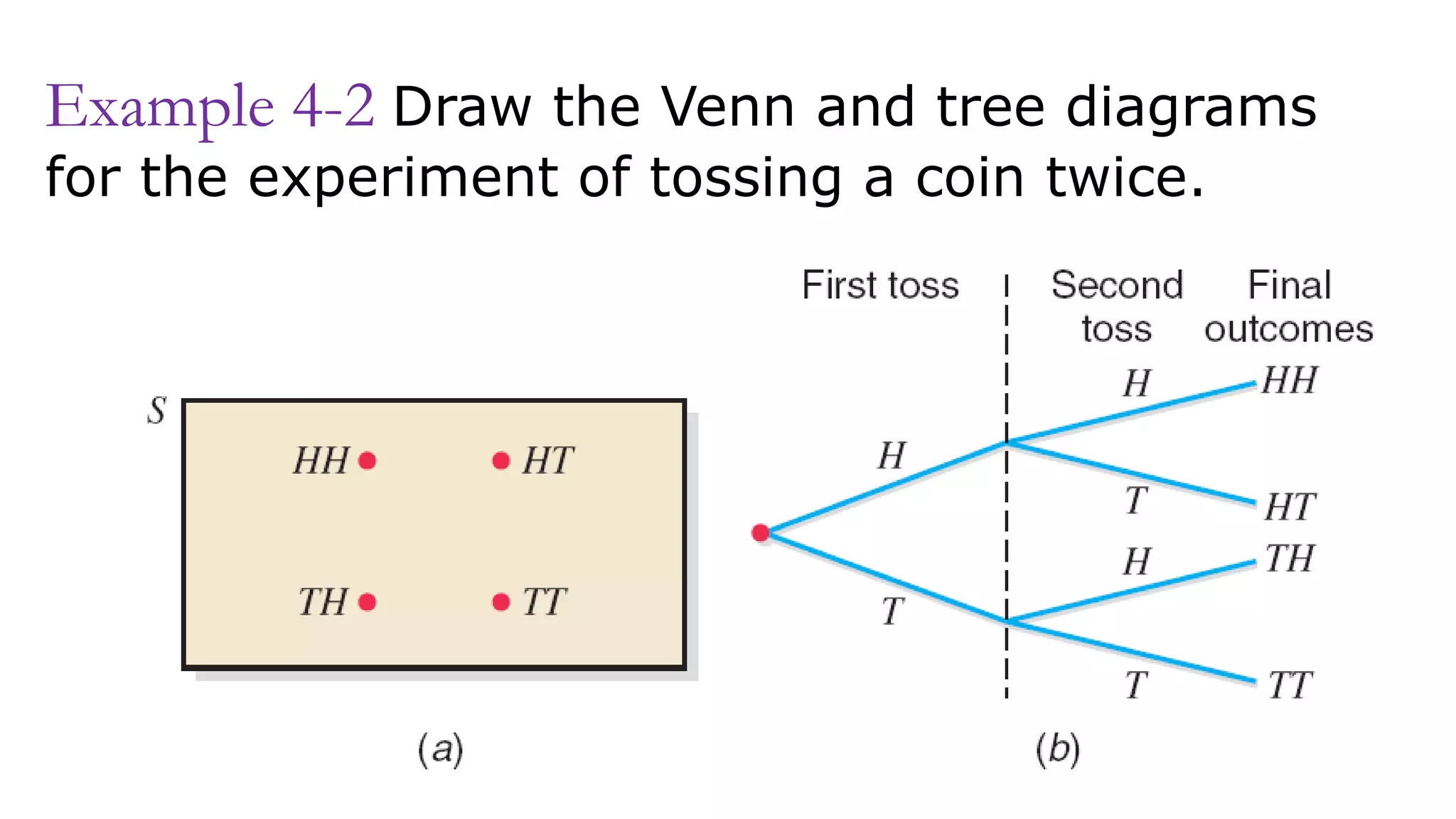
Example 4-2 Draw the Venn and tree diagrams
for the experiment of tossing a coin twice.
Example 4-3 Suppose we randomly select two workers from
a company and observe whether the worker selected each
time is a man or a woman. Write all the outcomes for this
experiment. Draw the Venn and tree diagrams for this
experiment. { MM, MW, WM, WW }.
Simple and Compound Events
Definition: An event is a collection of one or more
of the outcomes of an experiment.
Definition
Simple Event An event that includes one and only
one of the (final) outcomes for an experiment is
called a simple event and is denoted by Ei
Example 4-4
Reconsider Example 4-3 on selecting two workers from
a company and observing whether the worker selected
each time is a man or a woman. Each of the final four
outcomes (MM, MW, WM, and WW) for this experiment
is a simple event. These four events can be denoted
by E1, E2, E3, and E4, respectively. Thus, E1 = (MM), E2 =
(MW), E3 = (WM), and E4 = (WW)
Definition A compound event is a collection of
more than one outcome for an experiment
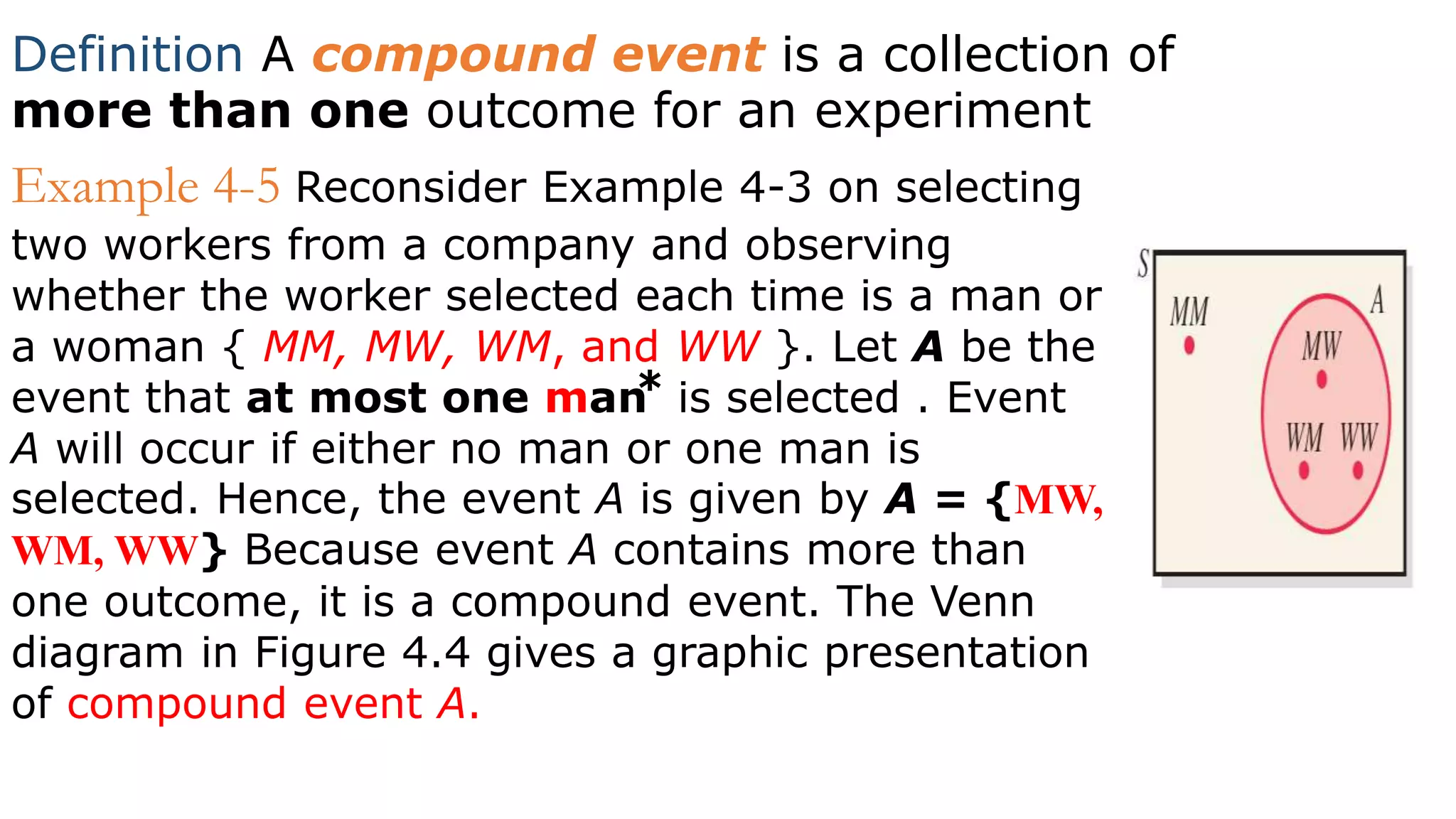
Example 4-5 Reconsider Example 4-3 on selecting
two workers from a company and observing
whether the worker selected each time is a man or
a woman { MM, MW, WM, and WW }. Let A be the
event that at most one man ⃰ is selected . Event
A will occur if either no man or one man is
selected. Hence, the event A is given by A = {MW,
WM, WW} Because event A contains more than
one outcome, it is a compound event. The Venn
diagram in Figure 4.4 gives a graphic presentation
of compound event A.
Example 4-6 In a group of a people, some are in favor(F) of
genetic engineering and others are against(A) it. Two persons
are selected at random from this group and asked whether they
are in favor of or against genetic engineering. How many
distinct outcomes are possible? Draw a Venn diagram and a
tree diagram for this experiment. List all the outcomes
included in each of the following events and state whether they
are simple or compound events.
(a) Both persons are in favor of the genetic engineering.
(b) At most one person is against genetic engineering.
(c) Exactly one person is in favor of genetic engineering.
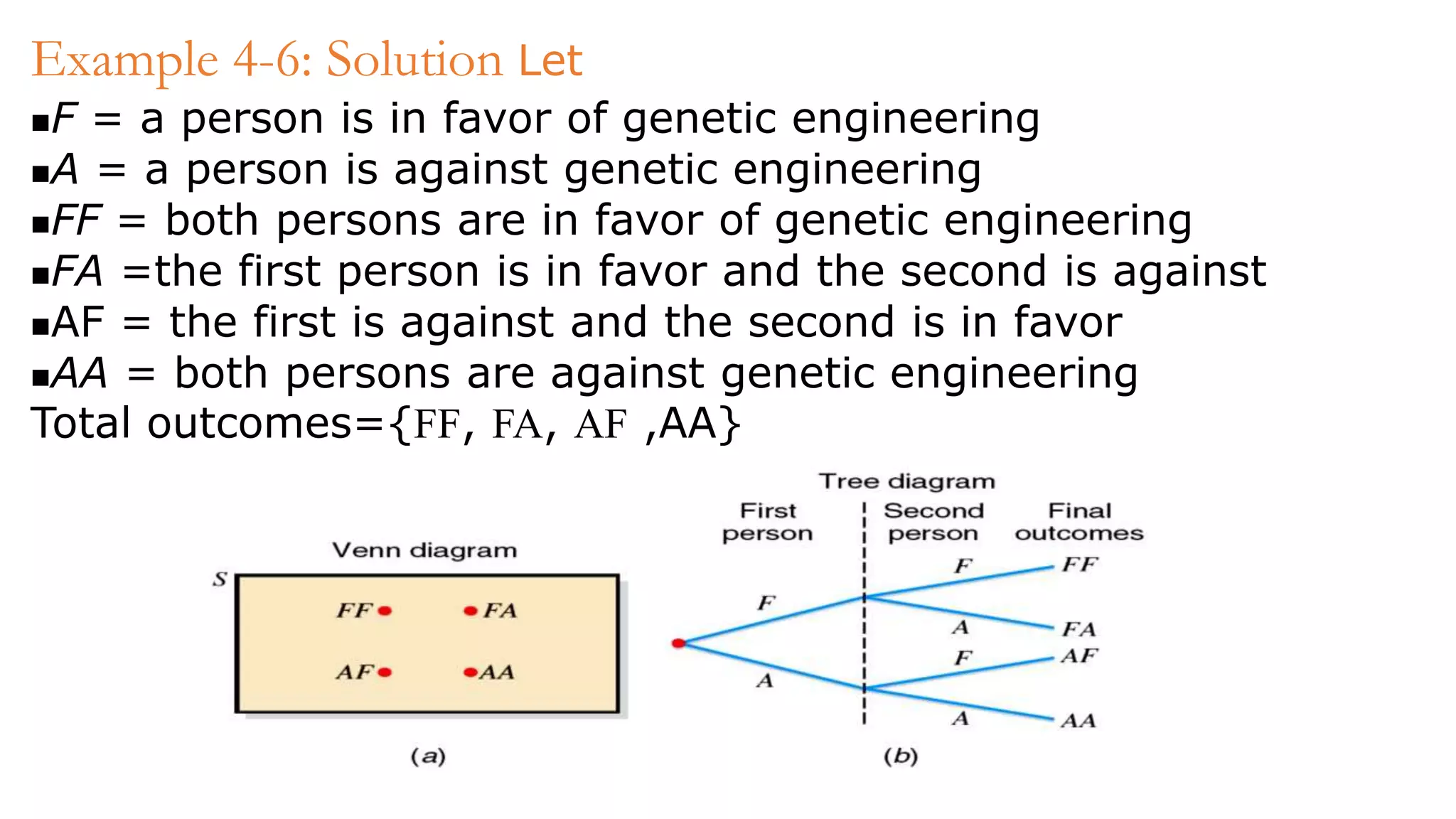
Example 4-6: Solution Let
F = a person is in favor of genetic engineering
A = a person is against genetic engineering
FF = both persons are in favor of genetic engineering
FA =the first person is in favor and the second is against
AF = the first is against and the second is in favor
AA = both persons are against genetic engineering
Total outcomes={FF, FA, AF ,AA}
Example 4-6: Solution
a) Both persons are in favor of genetic engineering = {FF}
Because this event includes only one of the final four outcomes,
it is a simple event.
b) At most one person is against genetic engineering=
{FF, FA, AF}
Because this event includes more than one outcome, it is a
compound event.
c) Exactly one person is in favor of genetic engineering =
{FA, AF} It is a compound event.
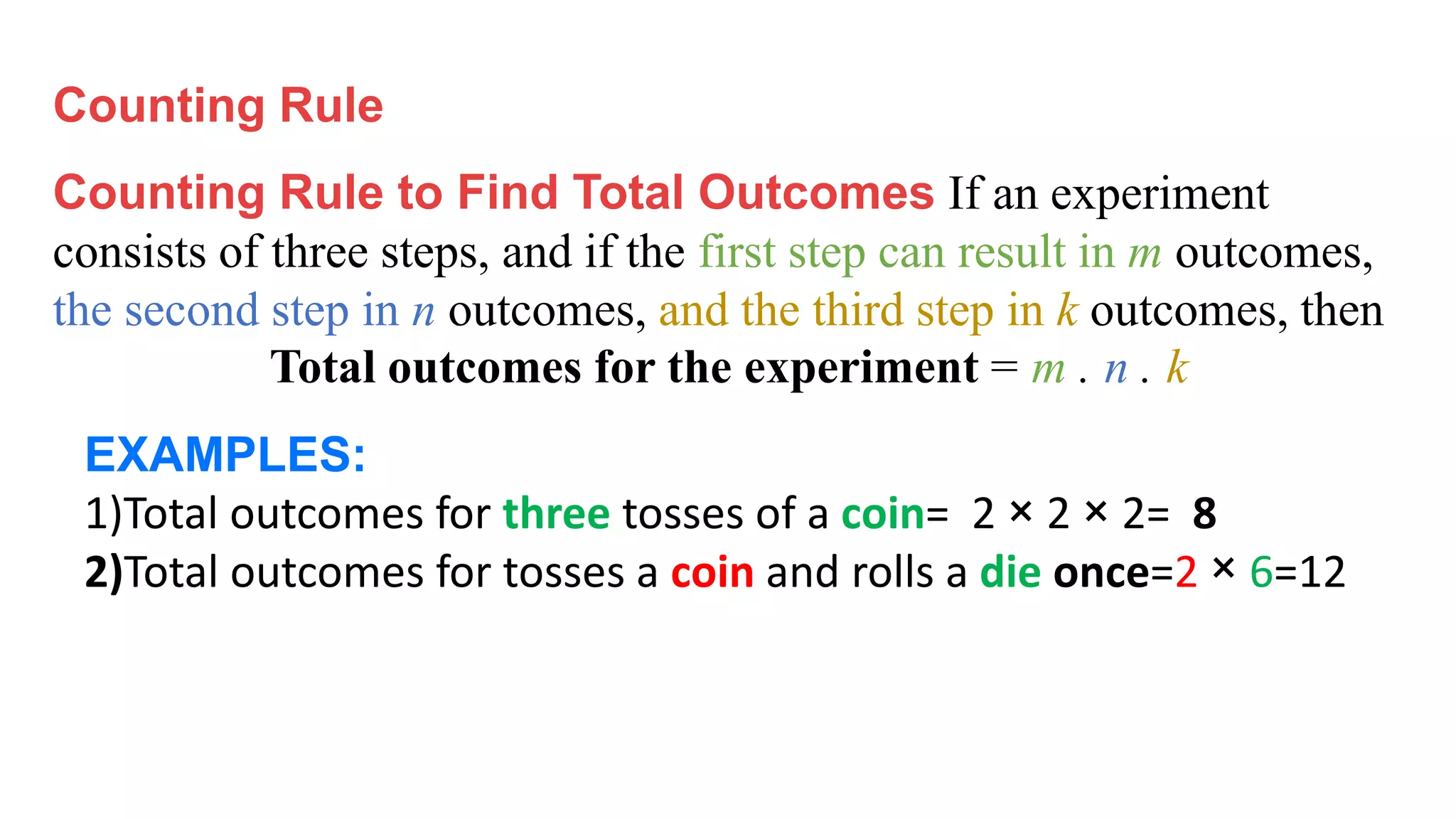
Counting Rule to Find Total Outcomes If an experiment
consists of three steps, and if the first step can result in m outcomes,
the second step in n outcomes, and the third step in k outcomes, then
Total outcomes for the experiment = m . n . k
Counting Rule
EXAMPLES:
1)Total outcomes for three tosses of a coin= 2 × 2 × 2= 8
2)Total outcomes for tosses a coin and rolls a die once=2 × 6=12
CALCULATING PROBABLITY
Definition
Probability is a numerical measure of the
likelihood that a specific event will occur.
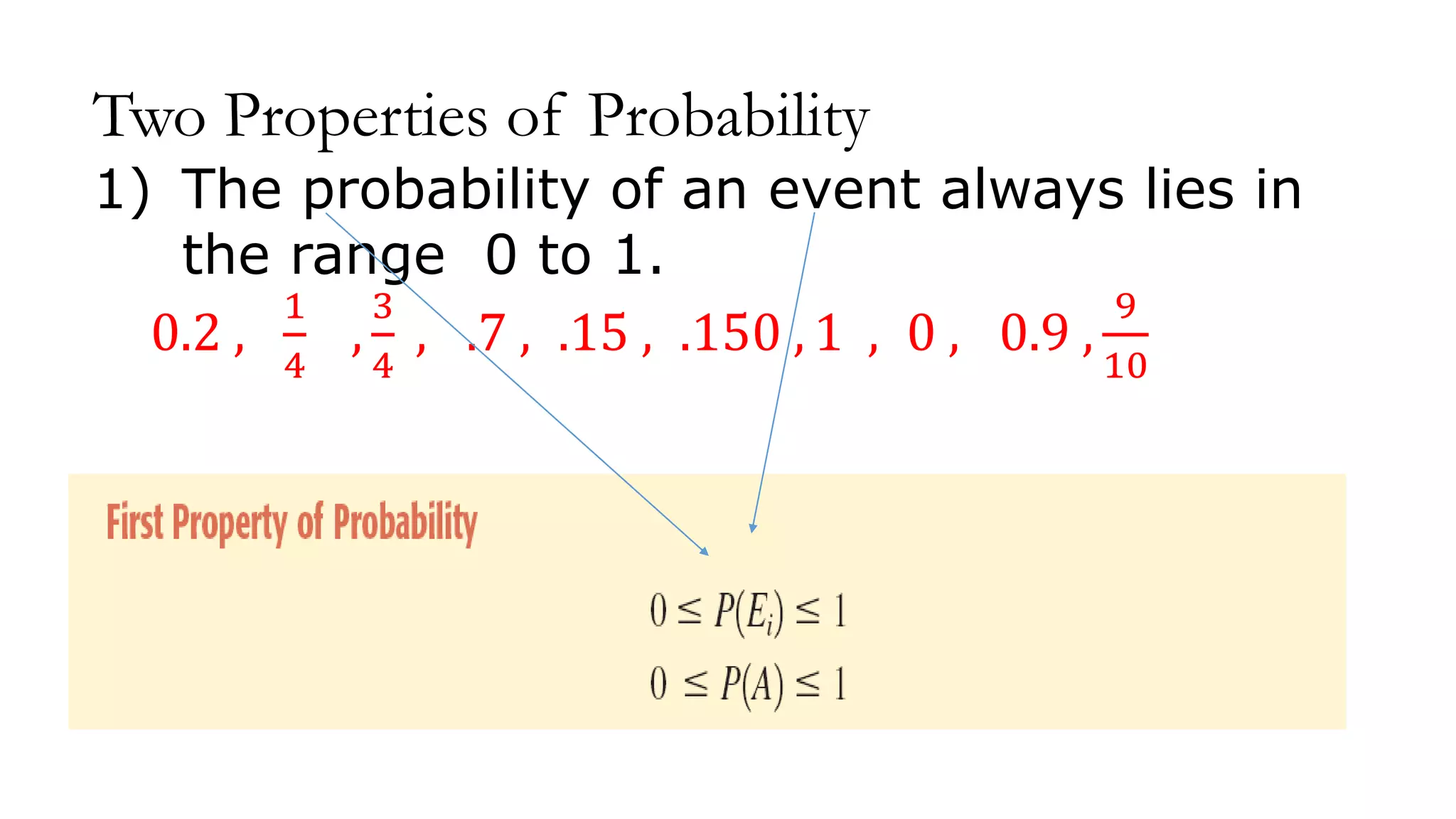
Two Properties of Probability
1) The probability of an event always lies in
the range 0 to 1.
0.2 ,
1
4
,
3
4
, .7 , .15 , .150 , 1 , 0 , 0.9 ,
9
10
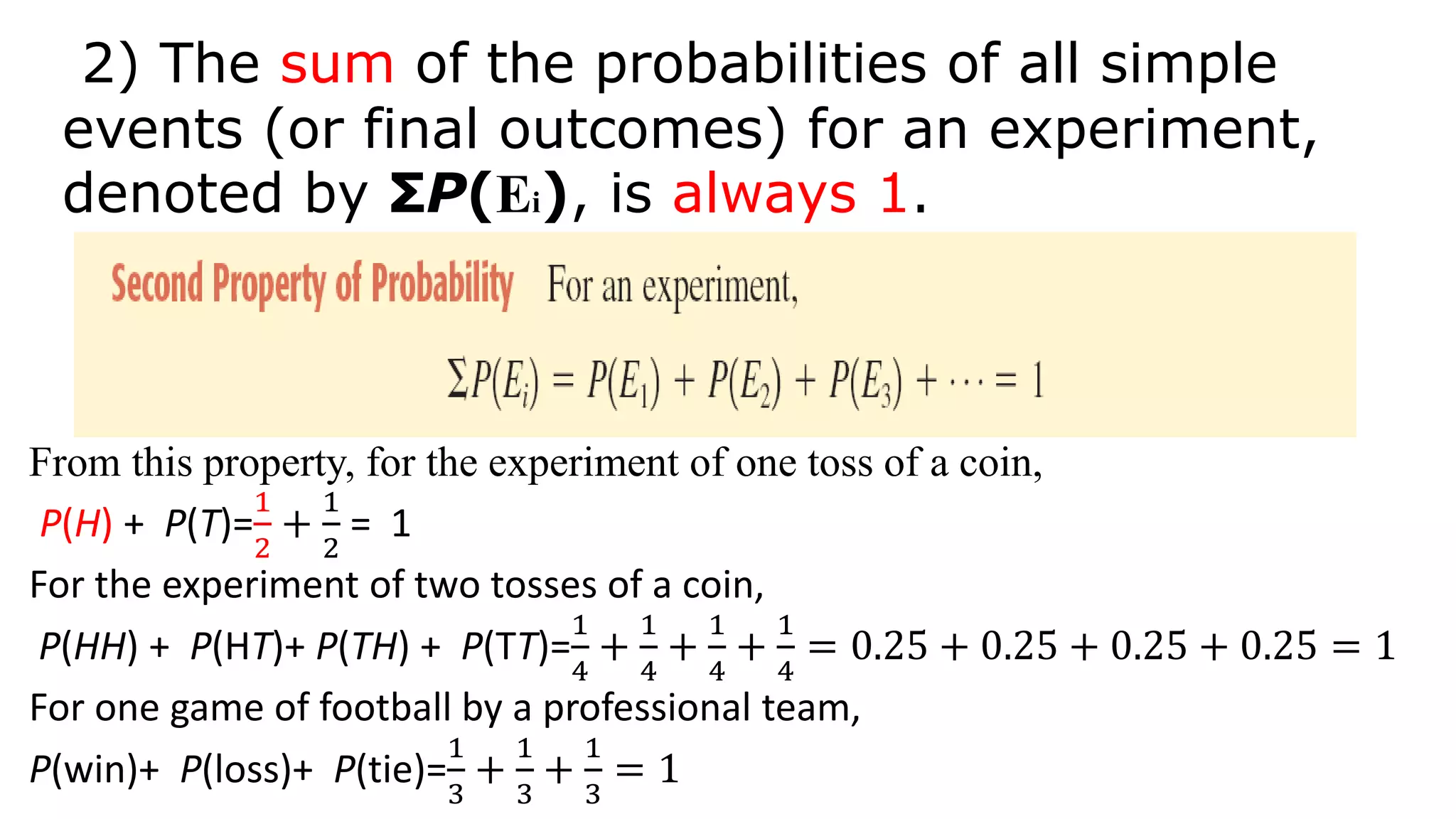
2) The sum of the probabilities of all simple
events (or final outcomes) for an experiment,
denoted by ΣP(Ei), is always 1.
From this property, for the experiment of one toss of a coin,
P(H) + P(T)=
1
2
+
1
2
= 1
For the experiment of two tosses of a coin,
P(HH) + P(HT)+ P(TH) + P(TT)=
1
4
+
1
4
+
1
4
+
1
4
= 0.25 + 0.25 + 0.25 + 0.25 = 1
For one game of football by a professional team,
P(win)+ P(loss)+ P(tie)=
1
3
+
1
3
+
1
3
= 1
6
7
+
1
7
=
7
7
= 1
Three Conceptual Approaches to Probability
(1)classical probability,
(2)the relative frequency concept of probability
(3)the subjective probability concept
Three Conceptual Approaches to Probability
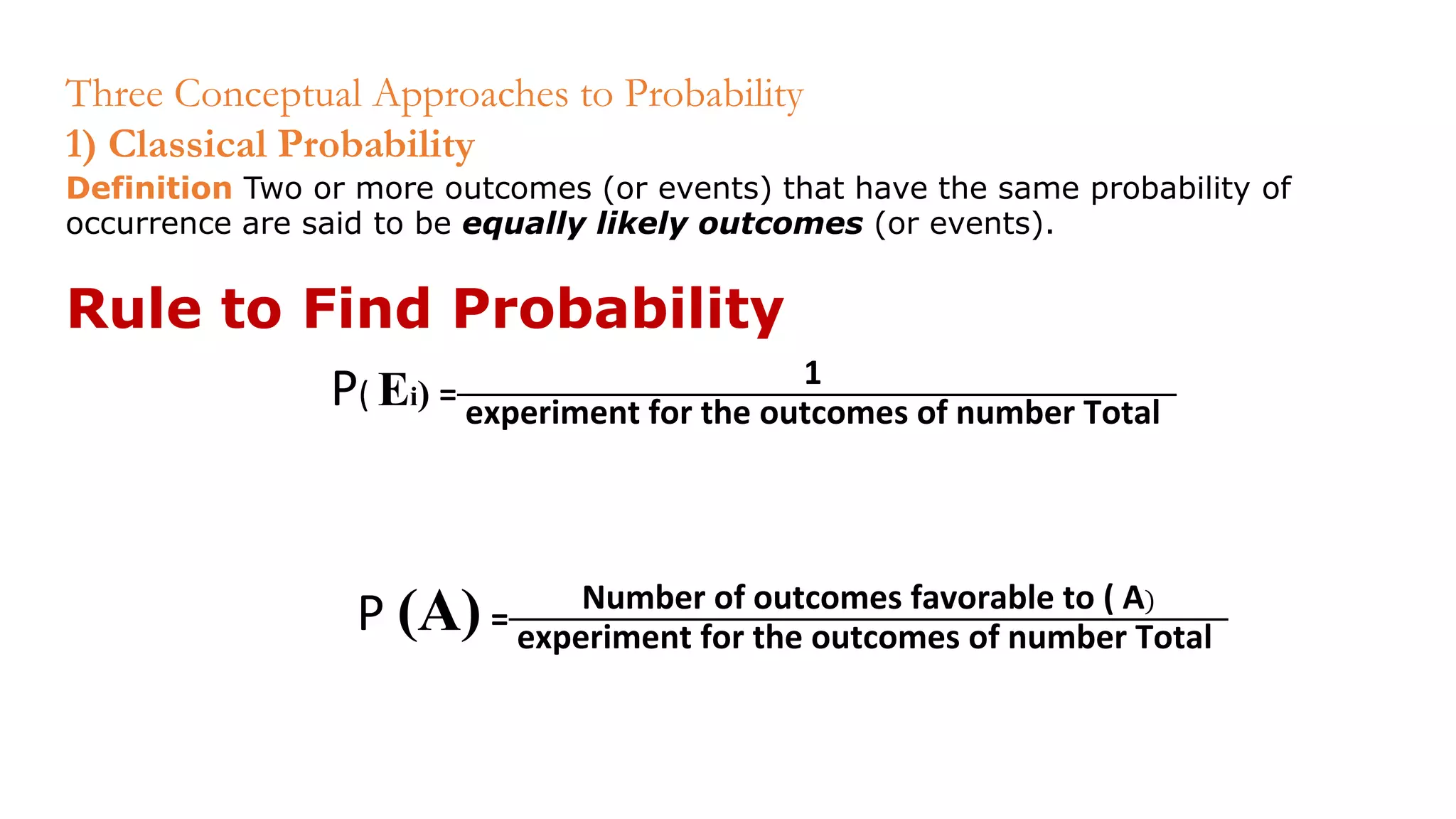
1) Classical Probability
Definition Two or more outcomes (or events) that have the same probability of
occurrence are said to be equally likely outcomes (or events).
Rule to Find Probability
P( Ei) =
1
experiment for the outcomes of number Total
P (A) =
Number of outcomes favorable to ( A)
experiment for the outcomes of number Total
Example 4-7 Find the probability of obtaining
a head and the probability of obtaining a tail
for one toss of a coin.
Example 4-7: Solution
P( Ei) =
1
experiment for the outcomes of number Total
P( head) =
1
2
= 0.5
P( tail) =
1
2
= 0.5
Example 4-8:Find the probability of obtaining
an even number in one roll of a die.
Solution: even number (A) = {2, 4, 6}. If any
one of these three numbers is obtained,
event A is said to occur. Hence
P (A) =
Number of outcomes favorable to ( A )
experiment for the outcomes of number Total
=
3
6
= 0.5
Example 4-9 In a group of 500 men, 120 have
played golf at least once. Suppose one of these
500 men is randomly selected. What is the
probability that he has played golf at least once?
Example 4-9: Solution 120 of these 500 outcomes
are included in the event that the selected man
has played golf at least once. Hence,
P(selected man has played golf at least once)=
120
500
= 0.24
Three Conceptual Approaches to Probability
2)Relative Frequency Concept of Probability
Using Relative Frequency as an Approximation of Probability
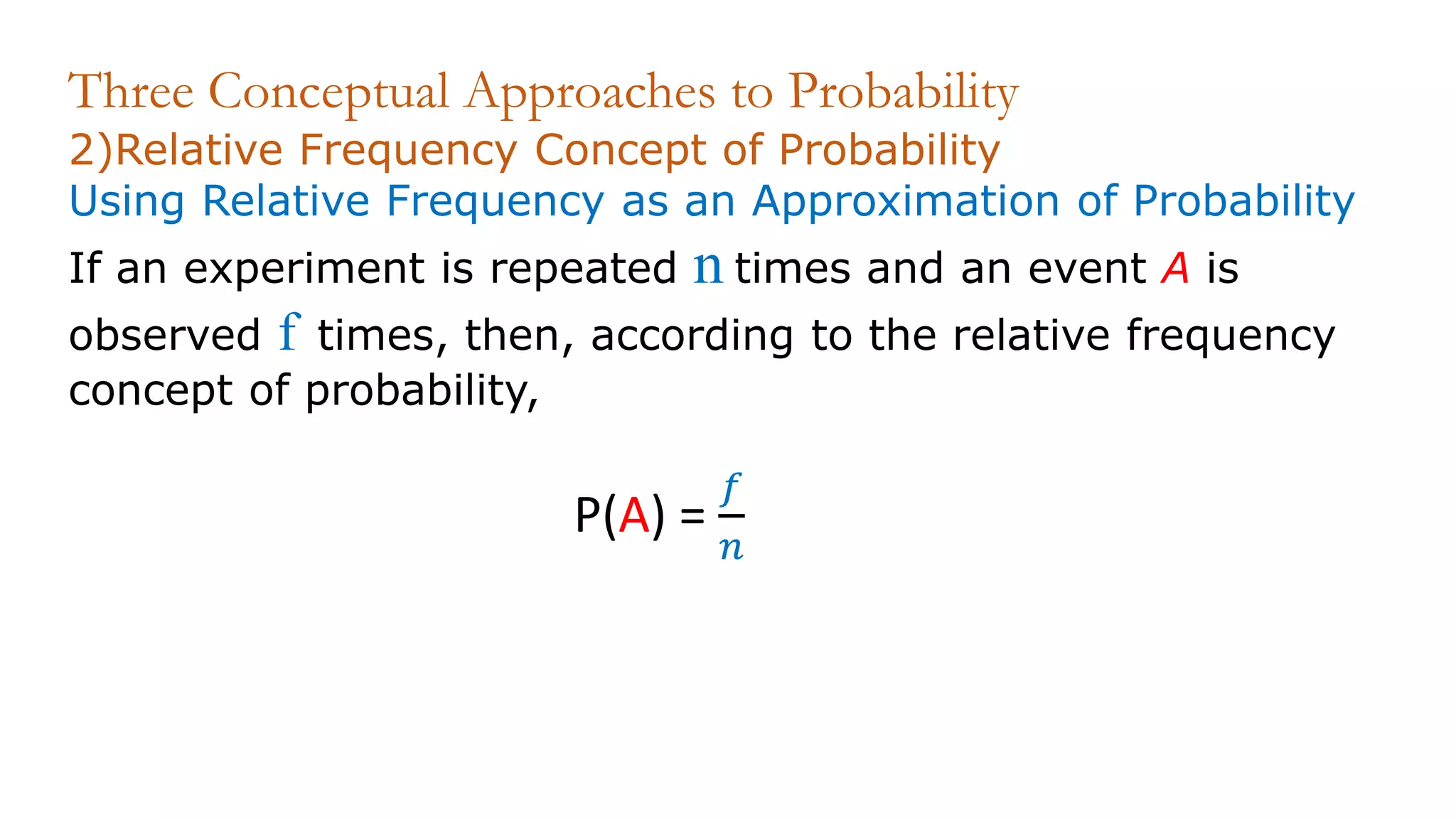
If an experiment is repeated n times and an event A is
observed f times, then, according to the relative frequency
concept of probability,
P(A) =
𝑓
𝑛
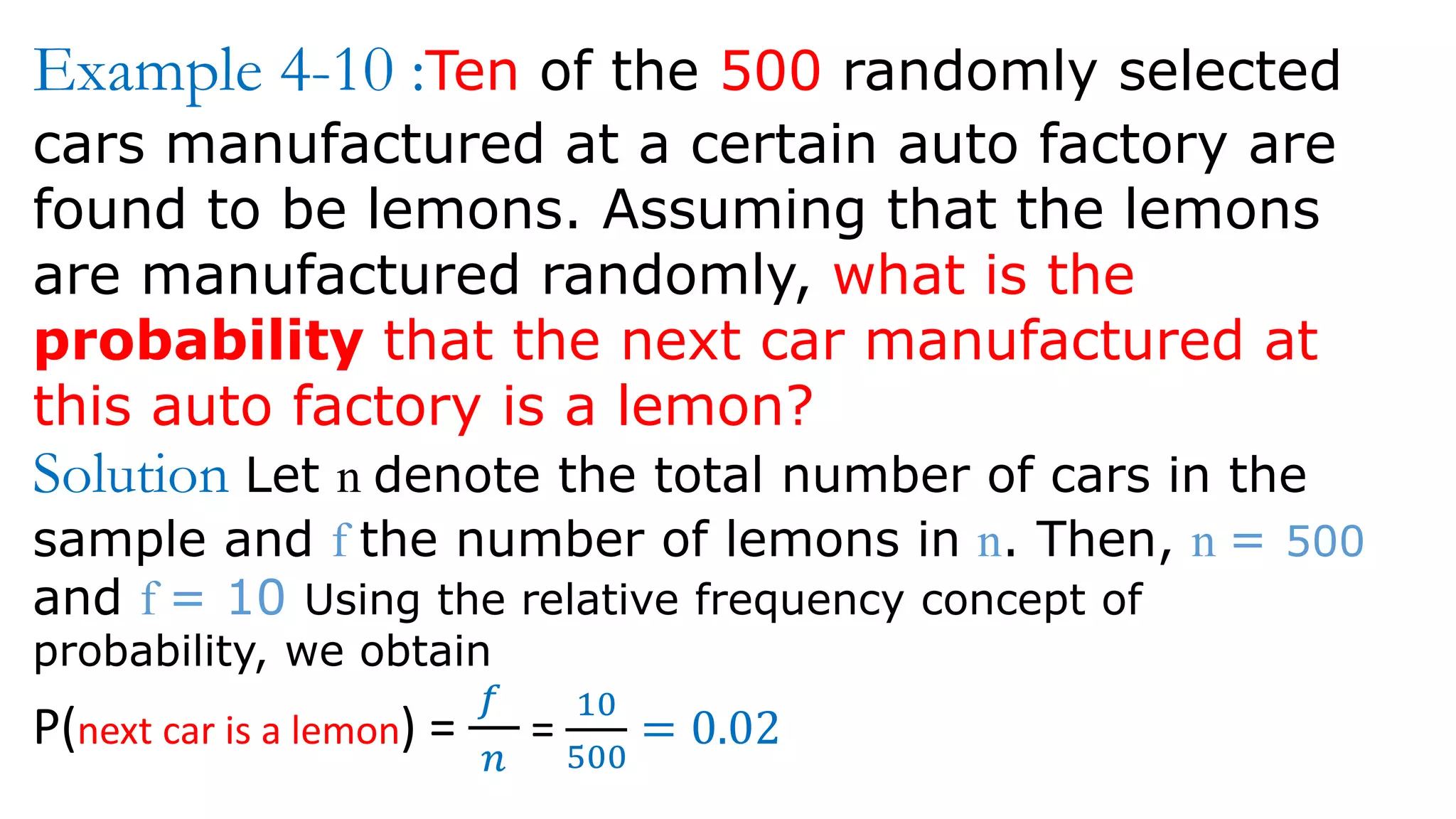
Example 4-10 :Ten of the 500 randomly selected
cars manufactured at a certain auto factory are
found to be lemons. Assuming that the lemons
are manufactured randomly, what is the
probability that the next car manufactured at
this auto factory is a lemon?
Solution Let n denote the total number of cars in the
sample and f the number of lemons in n. Then, n = 500
and f = 10 Using the relative frequency concept of
probability, we obtain
P(next car is a lemon) =
𝑓
𝑛
=
10
500
= 0.02
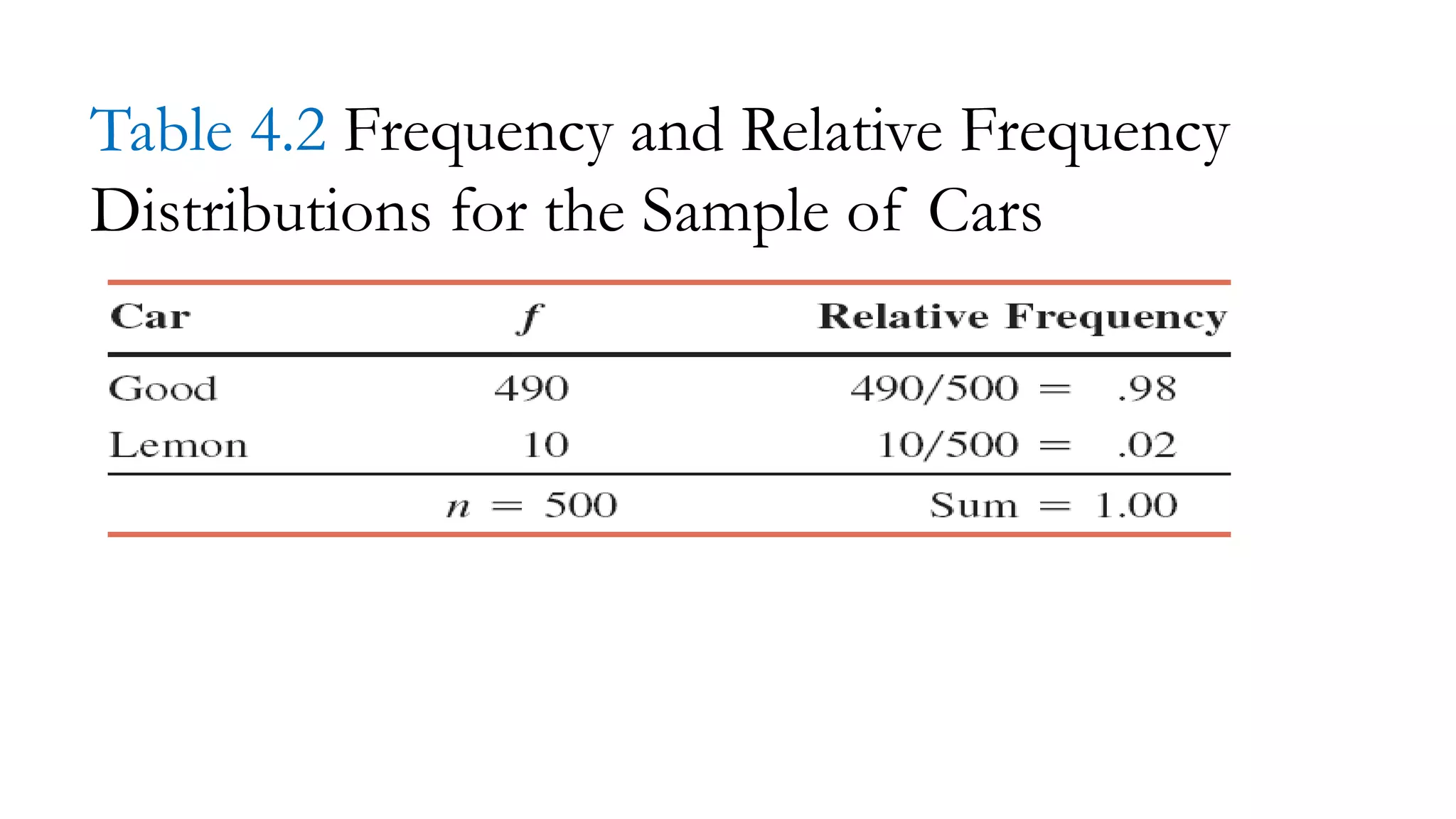
Table 4.2 Frequency and Relative Frequency
Distributions for the Sample of Cars
Law of Large Numbers
Definition
Law of Large Numbers If an experiment
is repeated again and again, the probability
of an event obtained from the relative
frequency approaches the actual or
theoretical probability.
Example 4-11 Allison wants to determine the
probability that a randomly selected family
from New York State owns a home. How can
she determine this probability
Example 4-11: Solution There are two outcomes
for a randomly selected family from New York
State: “This family owns a home” and “This
family does not own a home.” These two events
are not equally likely. Hence, the classical
probability rule cannot be applied. However, we
can repeat this experiment again and again.
Hence, we will use the relative frequency
approach to probability.
Suppose Allison selects a random sample of 1000 families from New
York State and observes that 730 of them own homes and 270 do not
own homes. Then,
n = sample size = 1000
f =number of families who own homes = 730
P(a randomly selected family owns a home) =
𝑓
𝑛
=
730
1000
= 0.730
P(a randomly selected family not owns a home)=……
270
1000
……..
Three Conceptual Approaches to Probability
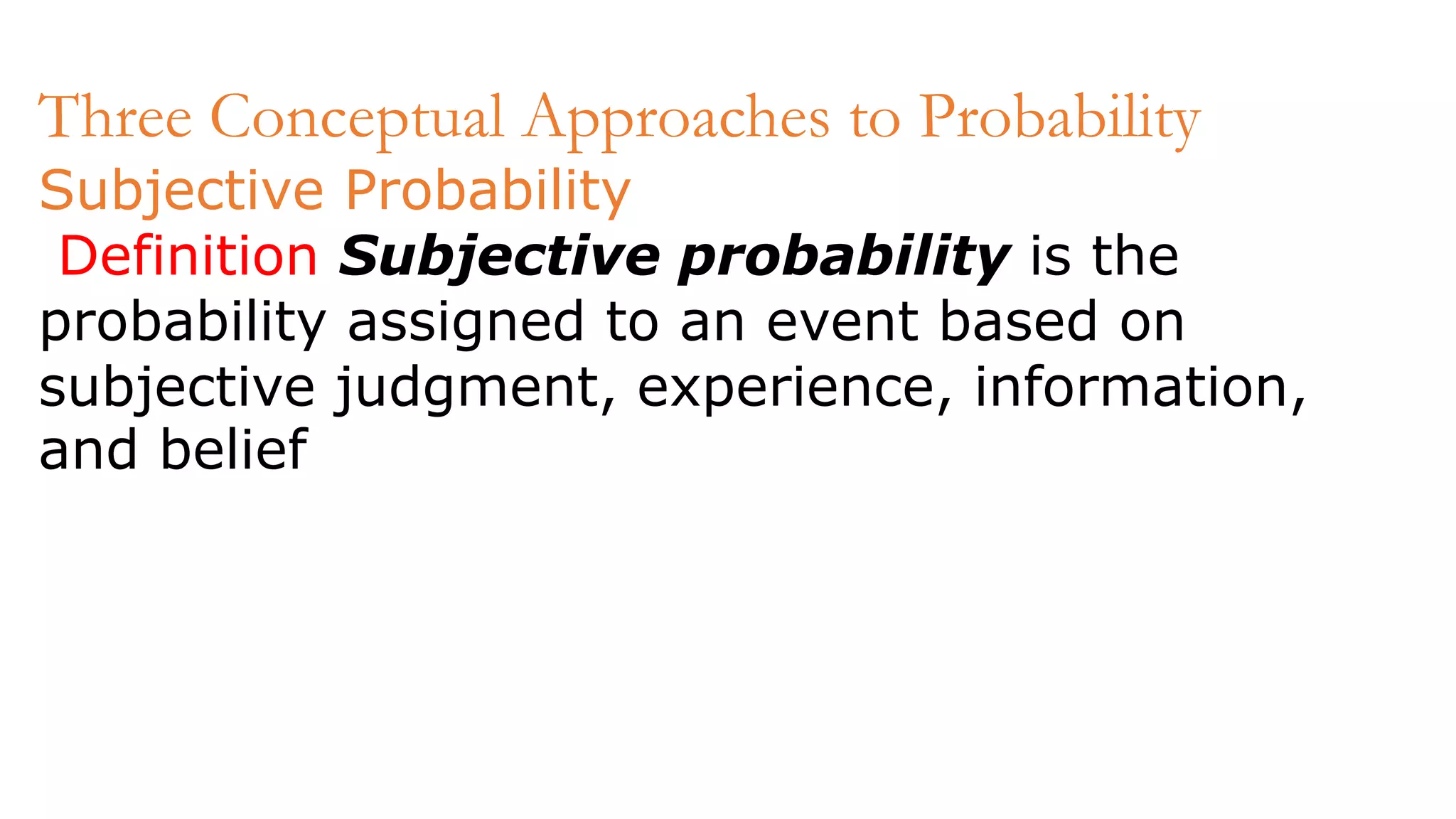
Subjective Probability
Definition Subjective probability is the
probability assigned to an event based on
subjective judgment, experience, information,
and belief
H.w.7
1) Which of the following values cannot be probabilities of events and why?
1
5
.97 − .55 1.56
5
3
0.0 −
2
7
1.0
2) Which of the following values can be probabilities of events and why?
. 46
2
3
− .09 1.42 − .96
9
4
−
1
4
.02
3) A die is rolled once. What is the probability that
a. a number less than 4 is obtained?
b. a number 3 to 6 is obtained?

7-Experiment, Outcome and Sample Space.pptx

  • 1.
    PROBABILITY EXPERIMENT, OUTCOMES, ANDSAMPLE SPACE Definition An experiment is a process that, when performed, results in one and only one of many observations. These observations are called the outcomes of the experiment. The collection of all outcomes for an experiment is called a sample space
  • 2.
    Table 4.1 Examplesof Experiments, Outcomes, and Sample Spaces Experiment Outcomes Sample Space Toss a coin once Head, Tail S = {Head, Tail} Roll a die once 1, 2, 3, 4, 5, 6 S = {1, 2, 3, 4, 5, 6} Toss a coin twice HH, HT, TH, TT S = {HH, HT, TH, TT} Play lottery Win, Lose S ={Win, Lose} Take a test Pass, Fail S = {Pass, Fail} Select a worker Male, Female S = {Male, Female}
  • 3.
    Example 4-1 Drawthe Venn and tree diagrams for the experiment of tossing a coin once.
  • 4.
    Example 4-2 Drawthe Venn and tree diagrams for the experiment of tossing a coin twice.
  • 5.
    Example 4-3 Supposewe randomly select two workers from a company and observe whether the worker selected each time is a man or a woman. Write all the outcomes for this experiment. Draw the Venn and tree diagrams for this experiment. { MM, MW, WM, WW }.
  • 6.
    Simple and CompoundEvents Definition: An event is a collection of one or more of the outcomes of an experiment. Definition Simple Event An event that includes one and only one of the (final) outcomes for an experiment is called a simple event and is denoted by Ei
  • 7.
    Example 4-4 Reconsider Example4-3 on selecting two workers from a company and observing whether the worker selected each time is a man or a woman. Each of the final four outcomes (MM, MW, WM, and WW) for this experiment is a simple event. These four events can be denoted by E1, E2, E3, and E4, respectively. Thus, E1 = (MM), E2 = (MW), E3 = (WM), and E4 = (WW)
  • 8.
    Definition A compoundevent is a collection of more than one outcome for an experiment Example 4-5 Reconsider Example 4-3 on selecting two workers from a company and observing whether the worker selected each time is a man or a woman { MM, MW, WM, and WW }. Let A be the event that at most one man ⃰ is selected . Event A will occur if either no man or one man is selected. Hence, the event A is given by A = {MW, WM, WW} Because event A contains more than one outcome, it is a compound event. The Venn diagram in Figure 4.4 gives a graphic presentation of compound event A.
  • 9.
    Example 4-6 Ina group of a people, some are in favor(F) of genetic engineering and others are against(A) it. Two persons are selected at random from this group and asked whether they are in favor of or against genetic engineering. How many distinct outcomes are possible? Draw a Venn diagram and a tree diagram for this experiment. List all the outcomes included in each of the following events and state whether they are simple or compound events. (a) Both persons are in favor of the genetic engineering. (b) At most one person is against genetic engineering. (c) Exactly one person is in favor of genetic engineering.
  • 10.
    Example 4-6: SolutionLet F = a person is in favor of genetic engineering A = a person is against genetic engineering FF = both persons are in favor of genetic engineering FA =the first person is in favor and the second is against AF = the first is against and the second is in favor AA = both persons are against genetic engineering Total outcomes={FF, FA, AF ,AA}
  • 11.
    Example 4-6: Solution a)Both persons are in favor of genetic engineering = {FF} Because this event includes only one of the final four outcomes, it is a simple event. b) At most one person is against genetic engineering= {FF, FA, AF} Because this event includes more than one outcome, it is a compound event. c) Exactly one person is in favor of genetic engineering = {FA, AF} It is a compound event.
  • 12.
    Counting Rule toFind Total Outcomes If an experiment consists of three steps, and if the first step can result in m outcomes, the second step in n outcomes, and the third step in k outcomes, then Total outcomes for the experiment = m . n . k Counting Rule EXAMPLES: 1)Total outcomes for three tosses of a coin= 2 × 2 × 2= 8 2)Total outcomes for tosses a coin and rolls a die once=2 × 6=12
  • 13.
    CALCULATING PROBABLITY Definition Probability isa numerical measure of the likelihood that a specific event will occur.
  • 14.
    Two Properties ofProbability 1) The probability of an event always lies in the range 0 to 1. 0.2 , 1 4 , 3 4 , .7 , .15 , .150 , 1 , 0 , 0.9 , 9 10
  • 15.
    2) The sumof the probabilities of all simple events (or final outcomes) for an experiment, denoted by ΣP(Ei), is always 1. From this property, for the experiment of one toss of a coin, P(H) + P(T)= 1 2 + 1 2 = 1 For the experiment of two tosses of a coin, P(HH) + P(HT)+ P(TH) + P(TT)= 1 4 + 1 4 + 1 4 + 1 4 = 0.25 + 0.25 + 0.25 + 0.25 = 1 For one game of football by a professional team, P(win)+ P(loss)+ P(tie)= 1 3 + 1 3 + 1 3 = 1
  • 16.
  • 17.
    Three Conceptual Approachesto Probability (1)classical probability, (2)the relative frequency concept of probability (3)the subjective probability concept
  • 18.
    Three Conceptual Approachesto Probability 1) Classical Probability Definition Two or more outcomes (or events) that have the same probability of occurrence are said to be equally likely outcomes (or events). Rule to Find Probability P( Ei) = 1 experiment for the outcomes of number Total P (A) = Number of outcomes favorable to ( A) experiment for the outcomes of number Total
  • 19.
    Example 4-7 Findthe probability of obtaining a head and the probability of obtaining a tail for one toss of a coin. Example 4-7: Solution P( Ei) = 1 experiment for the outcomes of number Total P( head) = 1 2 = 0.5 P( tail) = 1 2 = 0.5
  • 20.
    Example 4-8:Find theprobability of obtaining an even number in one roll of a die. Solution: even number (A) = {2, 4, 6}. If any one of these three numbers is obtained, event A is said to occur. Hence P (A) = Number of outcomes favorable to ( A ) experiment for the outcomes of number Total = 3 6 = 0.5
  • 21.
    Example 4-9 Ina group of 500 men, 120 have played golf at least once. Suppose one of these 500 men is randomly selected. What is the probability that he has played golf at least once? Example 4-9: Solution 120 of these 500 outcomes are included in the event that the selected man has played golf at least once. Hence, P(selected man has played golf at least once)= 120 500 = 0.24
  • 22.
    Three Conceptual Approachesto Probability 2)Relative Frequency Concept of Probability Using Relative Frequency as an Approximation of Probability If an experiment is repeated n times and an event A is observed f times, then, according to the relative frequency concept of probability, P(A) = 𝑓 𝑛
  • 23.
    Example 4-10 :Tenof the 500 randomly selected cars manufactured at a certain auto factory are found to be lemons. Assuming that the lemons are manufactured randomly, what is the probability that the next car manufactured at this auto factory is a lemon? Solution Let n denote the total number of cars in the sample and f the number of lemons in n. Then, n = 500 and f = 10 Using the relative frequency concept of probability, we obtain P(next car is a lemon) = 𝑓 𝑛 = 10 500 = 0.02
  • 24.
    Table 4.2 Frequencyand Relative Frequency Distributions for the Sample of Cars
  • 25.
    Law of LargeNumbers Definition Law of Large Numbers If an experiment is repeated again and again, the probability of an event obtained from the relative frequency approaches the actual or theoretical probability.
  • 26.
    Example 4-11 Allisonwants to determine the probability that a randomly selected family from New York State owns a home. How can she determine this probability
  • 27.
    Example 4-11: SolutionThere are two outcomes for a randomly selected family from New York State: “This family owns a home” and “This family does not own a home.” These two events are not equally likely. Hence, the classical probability rule cannot be applied. However, we can repeat this experiment again and again. Hence, we will use the relative frequency approach to probability.
  • 28.
    Suppose Allison selectsa random sample of 1000 families from New York State and observes that 730 of them own homes and 270 do not own homes. Then, n = sample size = 1000 f =number of families who own homes = 730 P(a randomly selected family owns a home) = 𝑓 𝑛 = 730 1000 = 0.730 P(a randomly selected family not owns a home)=…… 270 1000 ……..
  • 29.
    Three Conceptual Approachesto Probability Subjective Probability Definition Subjective probability is the probability assigned to an event based on subjective judgment, experience, information, and belief
  • 30.
    H.w.7 1) Which ofthe following values cannot be probabilities of events and why? 1 5 .97 − .55 1.56 5 3 0.0 − 2 7 1.0 2) Which of the following values can be probabilities of events and why? . 46 2 3 − .09 1.42 − .96 9 4 − 1 4 .02 3) A die is rolled once. What is the probability that a. a number less than 4 is obtained? b. a number 3 to 6 is obtained?