Definition:-
Substances that are formed by the combination of two or
more materials having different physical and chemical
properties is what is called a composite.

•Constituents remain separate and distinct, but at the
same time work together to give the composite
properties.
•They do not dissolve or blend into each other.

Hence composites are engineered materials that satisfy
the requirement of modern technology, as they have
several advantageous features like high specific strength,
high specific modulus and other desired properties.
CONSTITUENTS OF COMPOSITES
   Composites consists minimum of two parts, a bulk or a
   continuous phase called matrix and dispersed phase called the
   reinforcement.
MATRIX:-
1. Surrounds the individual reinforcing elements protecting
    against surface damage.
2. It maintains their relative positions.
3. Prevents the propagation of brittle cracks between individual
    reinforcing elements .
e.g-thermoplastic and thermo setting polymers, metal, carbon
    etc.
REINFORCEMENT:-
    It imparts special electrical and mechanical properties to
    enhance the matrix properties.
e.g-gravel, ceramics etc.
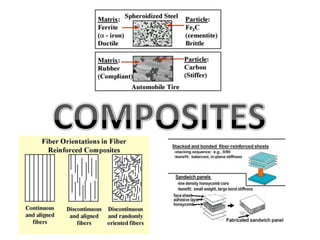
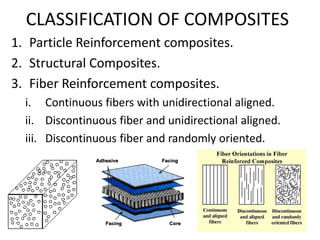
CLASSIFICATION OF COMPOSITES
1. Particle Reinforcement composites.
2. Structural Composites.
3. Fiber Reinforcement composites.
  i. Continuous fibers with unidirectional aligned.
  ii. Discontinuous fiber and unidirectional aligned.
  iii. Discontinuous fiber and randomly oriented.
PARTICLE REINFORCED COMPOSITE
These are the cheapest and most widely used.
They fall in two categories depending on the size of the
  particles:-
1. Large-Particle Composites
    Consist of a high volume fraction of large sized hard particles
   embedded in a relatively soft matrix. e.g- concrete, ceramics,
   filled polymers etc.
2. Dispersion-Strengthened Composites
      Contains extremely small sized particles dispersed in the
   matrix at low concentration which increases the particle
   matrix attractions at the atomic level thereby enhancing the
   strength of the matrix against deformation. e.g- TDNickel
   with 3% of Thoria.

Composites

  • 2.
    Definition:- Substances that areformed by the combination of two or more materials having different physical and chemical properties is what is called a composite. •Constituents remain separate and distinct, but at the same time work together to give the composite properties. •They do not dissolve or blend into each other. Hence composites are engineered materials that satisfy the requirement of modern technology, as they have several advantageous features like high specific strength, high specific modulus and other desired properties.
  • 3.
    CONSTITUENTS OF COMPOSITES Composites consists minimum of two parts, a bulk or a continuous phase called matrix and dispersed phase called the reinforcement. MATRIX:- 1. Surrounds the individual reinforcing elements protecting against surface damage. 2. It maintains their relative positions. 3. Prevents the propagation of brittle cracks between individual reinforcing elements . e.g-thermoplastic and thermo setting polymers, metal, carbon etc. REINFORCEMENT:- It imparts special electrical and mechanical properties to enhance the matrix properties. e.g-gravel, ceramics etc.
  • 4.
    CLASSIFICATION OF COMPOSITES 1.Particle Reinforcement composites. 2. Structural Composites. 3. Fiber Reinforcement composites. i. Continuous fibers with unidirectional aligned. ii. Discontinuous fiber and unidirectional aligned. iii. Discontinuous fiber and randomly oriented.
  • 5.
    PARTICLE REINFORCED COMPOSITE Theseare the cheapest and most widely used. They fall in two categories depending on the size of the particles:- 1. Large-Particle Composites Consist of a high volume fraction of large sized hard particles embedded in a relatively soft matrix. e.g- concrete, ceramics, filled polymers etc. 2. Dispersion-Strengthened Composites Contains extremely small sized particles dispersed in the matrix at low concentration which increases the particle matrix attractions at the atomic level thereby enhancing the strength of the matrix against deformation. e.g- TDNickel with 3% of Thoria.