1st M.Pharm
Dept. of Pharmaceutics
AL – AMEEN COLLEGE OF PHARMACY
1
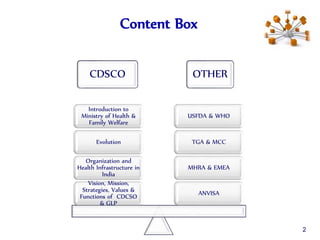
Content Box
CDSCO OTHER
ANVISA
MHRA & EMEA
TGA & MCC
USFDA & WHO
Vision, Mission,
Strategies, Values &
Functions of CDCSO
& GLP
Organization and
Health Infrastructure in
India
Evolution
Introduction to
Ministry of Health &
Family Welfare
2
CDSCO
3
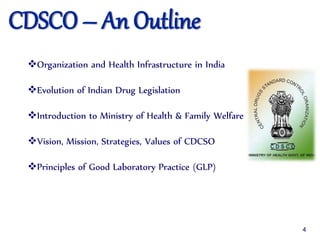
CDSCO – An Outline
Organization and Health Infrastructure in India
Evolution of Indian Drug Legislation
Introduction to Ministry of Health & Family Welfare
Vision, Mission, Strategies, Values of CDCSO
Principles of Good Laboratory Practice (GLP)
4
Organization and Health Infrastructure in
India
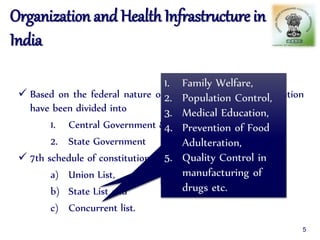
 Based on the federal nature of constitution, areas of operation
have been divided into
1. Central Government &
2. State Government
 7th schedule of constitution describes 3 items namely:
a) Union List,
b) State List and
c) Concurrent list.
1. Public health,
2. Hospitals,
3. Sanitization etc.
1. Family Welfare,
2. Population Control,
3. Medical Education,
4. Prevention of Food
Adulteration,
5. Quality Control in
manufacturing of
drugs etc.
5
Evolution of Indian Drug Legislation
PREAMBLE
 To regulate manufacture, sale, distribution and import of drugs,
cosmetics, biological, medical devices and other products.
OBJECTIVE
 The Objective of Drugs & Cosmetics Act is to ensure that public are
supplied with safety, efficacy and quality of drugs (Sec. 3b).
6
Evolution of Indian Drug Legislation
BASIC PHILOSOPHY
The basic philosophy of Drugs & Cosmetics Act is that:-
1. The manufacturer is responsible for the quality of drugs
manufactured by them &
2. The government/Regulatory Agencies will monitor the quality of
drugs by
 Periodic inspections
 Monitoring – Post market surveillance.
7
PRINCIPLE
 A System – manufacture , sale and distribution of Drugs &
Cosmetics are controlled.
DRUG REGULATORY SYSTEM IN INDIA
 Drug is in concurrent list of Indian Constitution.
 It is governed by both Central and State Governments under the
Drugs & Cosmetics Act, 1940 and Rules 1945 thereunder.
Evolution of Indian Drug Legislation
8
Indian Drug Regulatory System:
Government of India
Ministry of Health
& Family Welfare
DGHS
Central Drugs
Standard
Control
Organization
(CDSCO)
Ministry of Science
& Technology
Indian
Council of
Medical
Research
(ICMR)
Council of
Scientific &
Industrial
Research
(CSIR)
BARC
(Radioactive)
Ministry of
Chemicals &
Petrochemicals
National
Pharmaceutical
Pricing Authority
(NPPA)
Department of
Chemical &
Petrochemicals
(DCP)
Department of
Pharmaceuticals
Ministry of
Commerce &
Industry
Patent
Office
Dept. of
Commerce &
Pharmexil
Controller
General of
Patent
DGFT
Ministry of
Environment &
Forest
GEAC-
[Genetic
Engineering
Approval
Committee]
Department of
Biotechnology
r-DNA
Advisory
Committee
Review
Committee
Genetic
Manipulation
9
• CDSCO
• ICMR
• GEAC
• DBT
• AERB
• BARC
• DTAB
• RCGM
• DCC
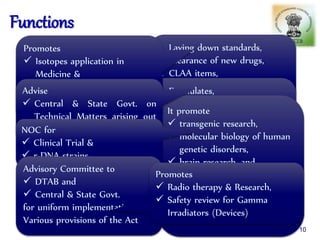
1. Laying down standards,
2. Clearance of new drugs,
3. CLAA items,
4. Banning Drugs,
5. Clinical Trails etc.
1. Formulates,
2. Coordinates and
3. Promotes biomedical research
&
4. Ethical Principles
1. Manufacture, Use, Import of
 Hazards Microorganisms
 Genetically Engineered
 Organisms or Cells
It promote
 transgenic research,
 molecular biology of human
genetic disorders,
 brain research, and
commercialization of
diagnostic kits and
 vaccines for communicable
diseases
Promotes
 Isotopes application in
Medicine &
 monitoring usage of
radioactive materials
Advise
 Central & State Govt. on
Technical Matters arising out
of the Drugs & CosmeticsNOC for
 Clinical Trial &
 r-DNA strains,
Advisory Committee to
 DTAB and
 Central & State Govt.
for uniform implementation of
Various provisions of the Act
Promotes
 Radio therapy & Research,
 Safety review for Gamma
Irradiators (Devices)
Functions
10
Introduction to Ministry of Health & Family Welfare
(MOH&FW)
• MOH&FW comprises 04 departments each of which is headed by a
Secretary to the Govt. of India
i. Department of Health & Family welfare
ii. Department of AYUSH
iii. Department of Health Research
iv. Department of AIDS Control
NOTE: CDSCO is a separate division comes under DGHS, headed
by DCG(I).
• Public health is one of the major objectives of Govt. of India and to
achieve this
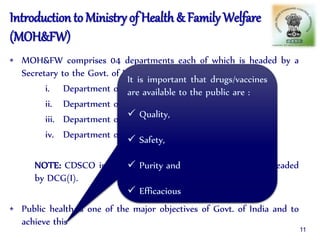
It is important that drugs/vaccines
are available to the public are :
 Quality,
 Safety,
 Purity and
 Efficacious
11
12
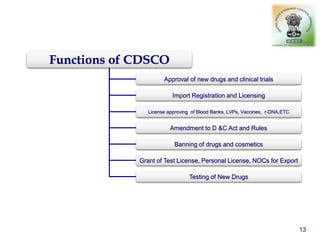
Functions of CDSCO
Approval of new drugs and clinical trials
Import Registration and Licensing
License approving of Blood Banks, LVPs, Vaccines, r-DNA,ETC
Amendment to D &C Act and Rules
Banning of drugs and cosmetics
Grant of Test License, Personal License, NOCs for Export
Testing of New Drugs
13
Principles of GLP andRegulatory requirements
Objectives of GLP
 GLP makes sure that the data submitted are a true reflection of the results
that are obtained during the study.
 GLP also makes sure that data is traceable.
 Promotes international acceptance of tests.
14
What is GLP?
• Good Laboratory Practice (GLP) deals with the –
 organization,
 process and
 conditions
under which laboratory studies are –
 planned,
 performed,
 monitored, recorded,
 reported &
 archived.
• Intended to promote the quality and validity of test data (part 58 CFR
2).
15
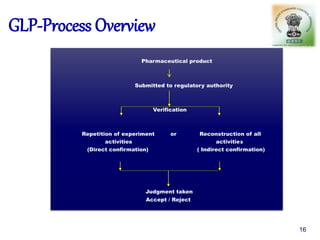
GLP-Process Overview
Pharmaceutical product
Submitted to regulatory authority
Verification
Repetition of experiment or Reconstruction of all
activities activities
(Direct confirmation) ( Indirect confirmation)
Judgment taken
Accept / Reject
16
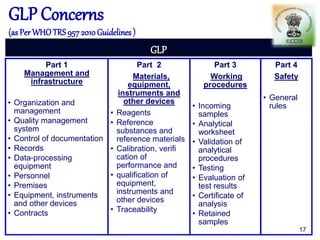
GLP Concerns
(as Per WHOTRS957 2010Guidelines )
GLP
Part 1
Management and
infrastructure
• Organization and
management
• Quality management
system
• Control of documentation
• Records
• Data-processing
equipment
• Personnel
• Premises
• Equipment, instruments
and other devices
• Contracts
Part 2
Materials,
equipment,
instruments and
other devices
• Reagents
• Reference
substances and
reference materials
• Calibration, verifi
cation of
performance and
• qualification of
equipment,
instruments and
other devices
• Traceability
Part 3
Working
procedures
• Incoming
samples
• Analytical
worksheet
• Validation of
analytical
procedures
• Testing
• Evaluation of
test results
• Certificate of
analysis
• Retained
samples
Part 4
Safety
• General
rules
17
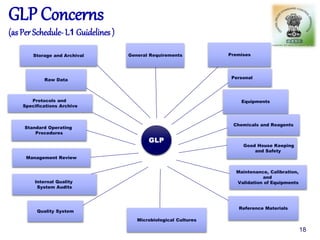
GLP Concerns
(as Per Schedule- L1 Guidelines )
Internal Quality
System Audits
Premises
Personal
Equipments
Chemicals and Reagents
Quality System
Microbiological Cultures
Reference Materials
Maintenance, Calibration,
and
Validation of Equipments
Good House Keeping
and Safety
General Requirements
Management Review
Standard Operating
Procedures
Protocols and
Specifications Archive
Raw Data
Storage and Archival
GLP
18
WHO
19
WHO
• Specialized agency for health for US Nations.
• Established on 7th April, 1948.
• Governed by 192 states.
NOTE: States which are members of United Nations,
may become members of WHO.
NOTE: This day, 7th april, also known as the World
Health Day.
20
Responsibilities
• Global health matters.
• Shaping the health research agenda.
• Setting norms and standards.
• Articulating evidence based policy option.
• Providing technical support to countries.
• Monitoring and assessing health trends.
21
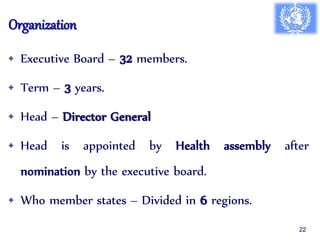
Organization
• Executive Board – 32 members.
• Term – 3 years.
• Head – Director General
• Head is appointed by Health assembly after
nomination by the executive board.
• Who member states – Divided in 6 regions.
22
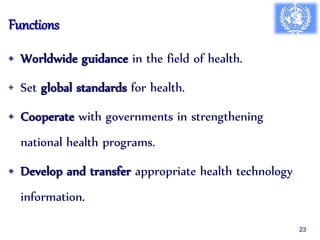
Functions
• Worldwide guidance in the field of health.
• Set global standards for health.
• Cooperate with governments in strengthening
national health programs.
• Develop and transfer appropriate health technology
information.
23
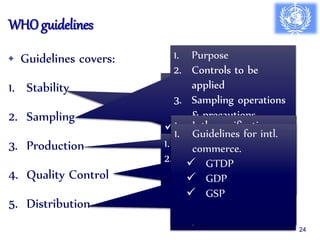
WHO guidelines
• Guidelines covers:
1. Stability
2. Sampling
3. Production
4. Quality Control
5. Distribution
1. Stability studies of:
 Final product
 Test samples
 Test conditions
 Frequency of testing
& evaluation
1. Purpose
2. Controls to be
applied
3. Sampling operations
& precautions.
4. Storage & retention
5. Sampling for
regulatory purpose
6. Sampling plans for
starting material,
packaging, & final
product.
1. GMP
2. cGMP
1. Intl. specifications
2. WHO Model COA
3. Considersation for
sampling request
4. QC Lab
1. Guidelines for intl.
commerce.
 GTDP
 GDP
 GSP
24
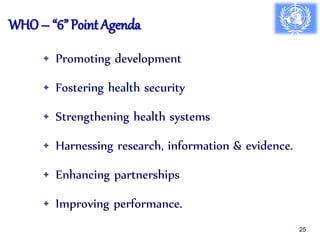
WHO – “6” Point Agenda
• Promoting development
• Fostering health security
• Strengthening health systems
• Harnessing research, information & evidence.
• Enhancing partnerships
• Improving performance.
25
US-FDA
26
US-FDA (Responsibilities)
• FDA is responsible for protecting the public health by
assuring the
 safety,
 efficacy and
 security of human and veterinary drugs,
 biological products,
 medical devices,
 US nation’s food supply,
 cosmetics, and
 products that emit radiation.
27
US-FDA (Responsibilities)…..
• FDA is also responsible for advancing the public health:-
1. By helping to speed innovations that make medicines more
 effective,
 safer, and
 more affordable
2. By helping the public get the
 accurate,
 science-based information they need to use medicines
and
 foods to maintain and improve their health.
28
US-FDA (What it Regulates)…..
• Foods
 safety and truthful labelling - food products including
dietary supplements (except - livestock meat & poultry
products)
 venison and other game meat
 bottled water, food additives & infant formulas
29
US-FDA (What it Regulates)…..
• Human Prescription and Non-prescription Drugs
 safety, effectiveness, quality, and labeling
 manufacturing standards
 Vaccines, Blood Products, and Other Biologics
 product and manufacturing establishment licensing
 safety of the nation's blood supply
 research to establish product standards and develop
improved testing methods
30
US-FDA (What it Regulates)…..
• Medical Devices
 from simple items like tongue depressors, to complex
technologies such as heart pacemakers
 premarket approval of new devices
 manufacturing and performance standards
 tracking reports of device malfunctioning and serious
adverse reactions
31
US-FDA (What it Regulates)…..
• Electronic Products
 products that give off radiation, such as microwave
ovens and X-ray equipment
 radiation safety performance standards for microwave
ovens, television receivers, diagnostic
 x-ray equipment, cabinet x-ray systems (such as
baggage x-rays at airports), laser products,
 ultrasonic therapy equipment, mercury vapor lamps,
and sunlamps
 accrediting and inspecting mammography facilities
32
US-FDA (What it Regulates)…..
• Cosmetics
 safety
 labelling
• Veterinary Products
 livestock feeds
 pet foods
 veterinary drugs and devices
 veterinary biologics not regulated by USDA are
considered new animal drugs
• Tobacco Product
33
US-FDA (What it NOT Regulates)…..
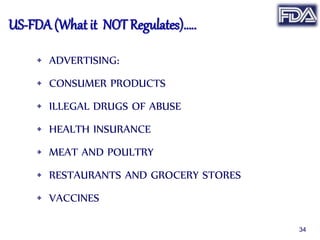
• ADVERTISING:
• CONSUMER PRODUCTS
• ILLEGAL DRUGS OF ABUSE
• HEALTH INSURANCE
• MEAT AND POULTRY
• RESTAURANTS AND GROCERY STORES
• VACCINES
34
EMEA
35
EMEA
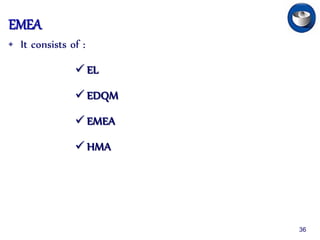
• It consists of :
 EL
 EDQM
 EMEA
 HMA
36
EMEA
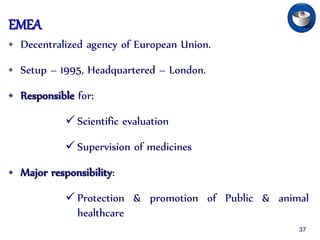
• Decentralized agency of European Union.
• Setup – 1995, Headquartered – London.
• Responsible for:
 Scientific evaluation
 Supervision of medicines
• Major responsibility:
 Protection & promotion of Public & animal
healthcare
37
EMEA
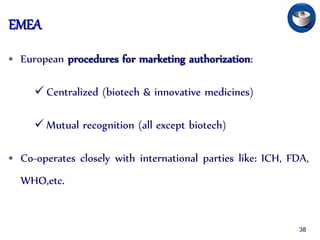
• European procedures for marketing authorization:
 Centralized (biotech & innovative medicines)
 Mutual recognition (all except biotech)
• Co-operates closely with international parties like: ICH, FDA,
WHO,etc.
38
EMEA - Committee
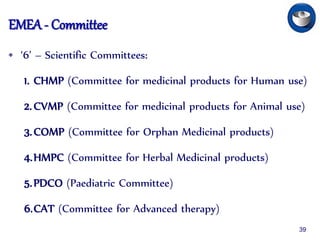
• ‘6’ – Scientific Committees:
1. CHMP (Committee for medicinal products for Human use)
2.CVMP (Committee for medicinal products for Animal use)
3.COMP (Committee for Orphan Medicinal products)
4.HMPC (Committee for Herbal Medicinal products)
5.PDCO (Paediatric Committee)
6.CAT (Committee for Advanced therapy)
39
EMEA - Functions
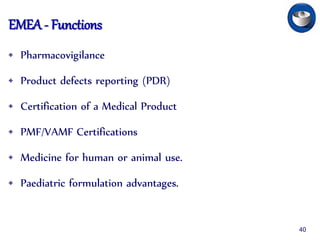
• Pharmacovigilance
• Product defects reporting (PDR)
• Certification of a Medical Product
• PMF/VAMF Certifications
• Medicine for human or animal use.
• Paediatric formulation advantages.
40
MHRA
41
MHRA
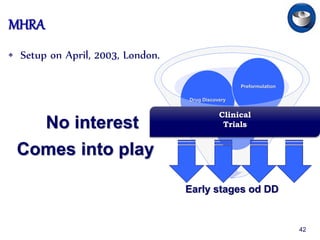
• Setup on April, 2003, London.
Early stages od DD
MOA
Drug Discovery
Preformulation
No interest
Clinical
Trials
Comes into play
42
MHRA - Regulates
1. Protecting public health through regulation
2. Promoting public health
3. Improving public health
43
MHRA - Objectives
1. Safeguard public health
2. Carry out the communication role (accurate, timely and
authoritative information)
3. Support research,
4. Influence the shape of the future regulatory framework (Intl.)
5. Organization - skilled and equipped workforce
44
MHRA – Objectives (Achieve)
1. Authorising medicines before they can be marketed, (safety +
Efficacy)
2. Ensuring clinical trials (meet robust standards and safeguard
patient’s interests)
3. Inspecting the quality of medicines
4. Overseeing UK-Notified Bodies(medical device manufacturers)
5. Encouraging everyone to report suspected problems
6. Investigating, and prosecuting (cases of non-compliance +
advertising claims) 45
ANVISA
46
ANVISA
• The Brazilian Health Surveillance Agency (ANVISA) was
created by Law 9782, enacted in 1999.
• It is a governmental regulatory agency characterized by its
 administrative
 independence,
 financial autonomy, and
 the stability of its directors.
NOTE: Ruled by a Collegiate Board of Directors composed of
five members.
47
MCC
48
MCC
• The Medicines Control Council applies standards laid down
by the Medicines and Related Substances Control Act, (Act
101 of 1965)
• It governs the –
 manufacture,
 distribution,
 sale, and
 marketing of medicines.
• The prescribing and dispensing of medicines – controlled -
the determination of schedules. 49
References
50
References
• Official websites of:
1. CDSCO
2. WHO
3. MCC
4. ANVISA
5. MHRA
51
Contract Research Organizations
52
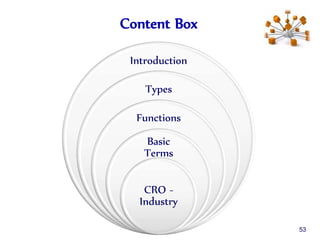
Content Box
Introduction
Types
Functions
Basic
Terms
CRO -
Industry
53
Introduction
54
CRO
• CROs are the companies that execute most of the
outsourced R&D activities.
• Takes on several tasks - drug development process, -
not explicitly limited clinical trials.
• CROs are generally recognised as performing clinical
trial management.
55
Types of CRO’s
56
CRO - functions
1. Functional outsourcing: fee-for-service model.
2. Full-service model, where CROs functions as a ‘one-
stop shop’ across the development cycle.
57
Functions
58
CRO - functions
• This includes activities such as:
design of study protocol,
case report
form design,
trial site and
investigator recruitment,
patient enrolment,
study monitoring and
Data collection, data management, report writing &
 medical services 59
CRO – Additional functions
 preclinical services,
 laboratory services,
 filing of Investigational New Drugs (INDs),
 formulation, manufacturing and packaging services,
 regulatory affairs services,
 medical and safety reviews and
 post-marketing studies
60
Basic Terms
61
Outsourcing
• The strategic use of outside resources to perform
activities.
• traditionally handled by internal staff and resources.
• ADVANTAGES:
more effective
less time consuming
lower cost
62
Off-shoring
• The relocation by a company of a business process
from one country to another
• Typically an operational process, such as
manufacturing, or
supporting processes
• The economic logic here is to reduce costs by
lowering labour costs or tax advantages.
63
Selection of a Country for Outsourcing
• high patient enrolment rate
• profits of patent exclusivity (faster processing)
• broad spectrum of diseases,
• a more rapid approval of trials,
• availability of human resources and technical skills,
• differing ethnic responses to drugs and
• cost advantages
64
CRO - Industry
65
Ethical considerations
• how well trials in non traditional regions are
conducted.
• This includes
1. compliance with good clinical practice (GCP,
guidelines, as well as
2. adherence to the available framework for the
supervision of these trials
66
CRO- Industry
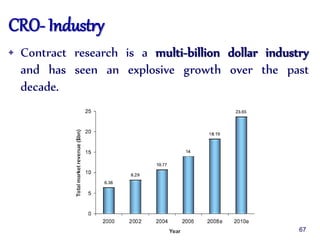
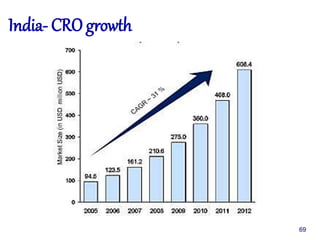
• Contract research is a multi-billion dollar industry
and has seen an explosive growth over the past
decade.
67
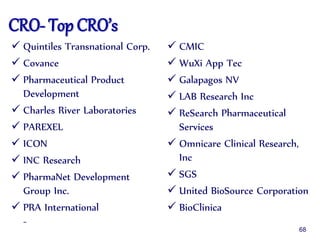
CRO- Top CRO’s
 Quintiles Transnational Corp.
 Covance
 Pharmaceutical Product
Development
 Charles River Laboratories
 PAREXEL
 ICON
 INC Research
 PharmaNet Development
Group Inc.
 PRA International
-
 CMIC
 WuXi App Tec
 Galapagos NV
 LAB Research Inc
 ReSearch Pharmaceutical
Services
 Omnicare Clinical Research,
Inc
 SGS
 United BioSource Corporation
 BioClinica
68
India- CRO growth
69
References
70
References
• Mariëtte van Huijstee & Irene Schipper. Putting Contract
Research Organisations on the Radar. SOMO, 2011.
• Report- Top 20 Contract Research Organizations (CRO) -
Asia-Pacific, Especially India and China, Positioned to Benefit
from Rising Financial and Regulatory Pressures in Western
Pharmaceutical Markets. GBI RESEARCH, 2011.
71

Regulatory bodies & CRO

  • 1.
    1st M.Pharm Dept. ofPharmaceutics AL – AMEEN COLLEGE OF PHARMACY 1
  • 2.
    Content Box CDSCO OTHER ANVISA MHRA& EMEA TGA & MCC USFDA & WHO Vision, Mission, Strategies, Values & Functions of CDCSO & GLP Organization and Health Infrastructure in India Evolution Introduction to Ministry of Health & Family Welfare 2
  • 3.
  • 4.
    CDSCO – AnOutline Organization and Health Infrastructure in India Evolution of Indian Drug Legislation Introduction to Ministry of Health & Family Welfare Vision, Mission, Strategies, Values of CDCSO Principles of Good Laboratory Practice (GLP) 4
  • 5.
    Organization and HealthInfrastructure in India  Based on the federal nature of constitution, areas of operation have been divided into 1. Central Government & 2. State Government  7th schedule of constitution describes 3 items namely: a) Union List, b) State List and c) Concurrent list. 1. Public health, 2. Hospitals, 3. Sanitization etc. 1. Family Welfare, 2. Population Control, 3. Medical Education, 4. Prevention of Food Adulteration, 5. Quality Control in manufacturing of drugs etc. 5
  • 6.
    Evolution of IndianDrug Legislation PREAMBLE  To regulate manufacture, sale, distribution and import of drugs, cosmetics, biological, medical devices and other products. OBJECTIVE  The Objective of Drugs & Cosmetics Act is to ensure that public are supplied with safety, efficacy and quality of drugs (Sec. 3b). 6
  • 7.
    Evolution of IndianDrug Legislation BASIC PHILOSOPHY The basic philosophy of Drugs & Cosmetics Act is that:- 1. The manufacturer is responsible for the quality of drugs manufactured by them & 2. The government/Regulatory Agencies will monitor the quality of drugs by  Periodic inspections  Monitoring – Post market surveillance. 7
  • 8.
    PRINCIPLE  A System– manufacture , sale and distribution of Drugs & Cosmetics are controlled. DRUG REGULATORY SYSTEM IN INDIA  Drug is in concurrent list of Indian Constitution.  It is governed by both Central and State Governments under the Drugs & Cosmetics Act, 1940 and Rules 1945 thereunder. Evolution of Indian Drug Legislation 8
  • 9.
    Indian Drug RegulatorySystem: Government of India Ministry of Health & Family Welfare DGHS Central Drugs Standard Control Organization (CDSCO) Ministry of Science & Technology Indian Council of Medical Research (ICMR) Council of Scientific & Industrial Research (CSIR) BARC (Radioactive) Ministry of Chemicals & Petrochemicals National Pharmaceutical Pricing Authority (NPPA) Department of Chemical & Petrochemicals (DCP) Department of Pharmaceuticals Ministry of Commerce & Industry Patent Office Dept. of Commerce & Pharmexil Controller General of Patent DGFT Ministry of Environment & Forest GEAC- [Genetic Engineering Approval Committee] Department of Biotechnology r-DNA Advisory Committee Review Committee Genetic Manipulation 9
  • 10.
    • CDSCO • ICMR •GEAC • DBT • AERB • BARC • DTAB • RCGM • DCC 1. Laying down standards, 2. Clearance of new drugs, 3. CLAA items, 4. Banning Drugs, 5. Clinical Trails etc. 1. Formulates, 2. Coordinates and 3. Promotes biomedical research & 4. Ethical Principles 1. Manufacture, Use, Import of  Hazards Microorganisms  Genetically Engineered  Organisms or Cells It promote  transgenic research,  molecular biology of human genetic disorders,  brain research, and commercialization of diagnostic kits and  vaccines for communicable diseases Promotes  Isotopes application in Medicine &  monitoring usage of radioactive materials Advise  Central & State Govt. on Technical Matters arising out of the Drugs & CosmeticsNOC for  Clinical Trial &  r-DNA strains, Advisory Committee to  DTAB and  Central & State Govt. for uniform implementation of Various provisions of the Act Promotes  Radio therapy & Research,  Safety review for Gamma Irradiators (Devices) Functions 10
  • 11.
    Introduction to Ministryof Health & Family Welfare (MOH&FW) • MOH&FW comprises 04 departments each of which is headed by a Secretary to the Govt. of India i. Department of Health & Family welfare ii. Department of AYUSH iii. Department of Health Research iv. Department of AIDS Control NOTE: CDSCO is a separate division comes under DGHS, headed by DCG(I). • Public health is one of the major objectives of Govt. of India and to achieve this It is important that drugs/vaccines are available to the public are :  Quality,  Safety,  Purity and  Efficacious 11
  • 12.
  • 13.
    Functions of CDSCO Approvalof new drugs and clinical trials Import Registration and Licensing License approving of Blood Banks, LVPs, Vaccines, r-DNA,ETC Amendment to D &C Act and Rules Banning of drugs and cosmetics Grant of Test License, Personal License, NOCs for Export Testing of New Drugs 13
  • 14.
    Principles of GLPandRegulatory requirements Objectives of GLP  GLP makes sure that the data submitted are a true reflection of the results that are obtained during the study.  GLP also makes sure that data is traceable.  Promotes international acceptance of tests. 14
  • 15.
    What is GLP? •Good Laboratory Practice (GLP) deals with the –  organization,  process and  conditions under which laboratory studies are –  planned,  performed,  monitored, recorded,  reported &  archived. • Intended to promote the quality and validity of test data (part 58 CFR 2). 15
  • 16.
    GLP-Process Overview Pharmaceutical product Submittedto regulatory authority Verification Repetition of experiment or Reconstruction of all activities activities (Direct confirmation) ( Indirect confirmation) Judgment taken Accept / Reject 16
  • 17.
    GLP Concerns (as PerWHOTRS957 2010Guidelines ) GLP Part 1 Management and infrastructure • Organization and management • Quality management system • Control of documentation • Records • Data-processing equipment • Personnel • Premises • Equipment, instruments and other devices • Contracts Part 2 Materials, equipment, instruments and other devices • Reagents • Reference substances and reference materials • Calibration, verifi cation of performance and • qualification of equipment, instruments and other devices • Traceability Part 3 Working procedures • Incoming samples • Analytical worksheet • Validation of analytical procedures • Testing • Evaluation of test results • Certificate of analysis • Retained samples Part 4 Safety • General rules 17
  • 18.
    GLP Concerns (as PerSchedule- L1 Guidelines ) Internal Quality System Audits Premises Personal Equipments Chemicals and Reagents Quality System Microbiological Cultures Reference Materials Maintenance, Calibration, and Validation of Equipments Good House Keeping and Safety General Requirements Management Review Standard Operating Procedures Protocols and Specifications Archive Raw Data Storage and Archival GLP 18
  • 19.
  • 20.
    WHO • Specialized agencyfor health for US Nations. • Established on 7th April, 1948. • Governed by 192 states. NOTE: States which are members of United Nations, may become members of WHO. NOTE: This day, 7th april, also known as the World Health Day. 20
  • 21.
    Responsibilities • Global healthmatters. • Shaping the health research agenda. • Setting norms and standards. • Articulating evidence based policy option. • Providing technical support to countries. • Monitoring and assessing health trends. 21
  • 22.
    Organization • Executive Board– 32 members. • Term – 3 years. • Head – Director General • Head is appointed by Health assembly after nomination by the executive board. • Who member states – Divided in 6 regions. 22
  • 23.
    Functions • Worldwide guidancein the field of health. • Set global standards for health. • Cooperate with governments in strengthening national health programs. • Develop and transfer appropriate health technology information. 23
  • 24.
    WHO guidelines • Guidelinescovers: 1. Stability 2. Sampling 3. Production 4. Quality Control 5. Distribution 1. Stability studies of:  Final product  Test samples  Test conditions  Frequency of testing & evaluation 1. Purpose 2. Controls to be applied 3. Sampling operations & precautions. 4. Storage & retention 5. Sampling for regulatory purpose 6. Sampling plans for starting material, packaging, & final product. 1. GMP 2. cGMP 1. Intl. specifications 2. WHO Model COA 3. Considersation for sampling request 4. QC Lab 1. Guidelines for intl. commerce.  GTDP  GDP  GSP 24
  • 25.
    WHO – “6”Point Agenda • Promoting development • Fostering health security • Strengthening health systems • Harnessing research, information & evidence. • Enhancing partnerships • Improving performance. 25
  • 26.
  • 27.
    US-FDA (Responsibilities) • FDAis responsible for protecting the public health by assuring the  safety,  efficacy and  security of human and veterinary drugs,  biological products,  medical devices,  US nation’s food supply,  cosmetics, and  products that emit radiation. 27
  • 28.
    US-FDA (Responsibilities)….. • FDAis also responsible for advancing the public health:- 1. By helping to speed innovations that make medicines more  effective,  safer, and  more affordable 2. By helping the public get the  accurate,  science-based information they need to use medicines and  foods to maintain and improve their health. 28
  • 29.
    US-FDA (What itRegulates)….. • Foods  safety and truthful labelling - food products including dietary supplements (except - livestock meat & poultry products)  venison and other game meat  bottled water, food additives & infant formulas 29
  • 30.
    US-FDA (What itRegulates)….. • Human Prescription and Non-prescription Drugs  safety, effectiveness, quality, and labeling  manufacturing standards  Vaccines, Blood Products, and Other Biologics  product and manufacturing establishment licensing  safety of the nation's blood supply  research to establish product standards and develop improved testing methods 30
  • 31.
    US-FDA (What itRegulates)….. • Medical Devices  from simple items like tongue depressors, to complex technologies such as heart pacemakers  premarket approval of new devices  manufacturing and performance standards  tracking reports of device malfunctioning and serious adverse reactions 31
  • 32.
    US-FDA (What itRegulates)….. • Electronic Products  products that give off radiation, such as microwave ovens and X-ray equipment  radiation safety performance standards for microwave ovens, television receivers, diagnostic  x-ray equipment, cabinet x-ray systems (such as baggage x-rays at airports), laser products,  ultrasonic therapy equipment, mercury vapor lamps, and sunlamps  accrediting and inspecting mammography facilities 32
  • 33.
    US-FDA (What itRegulates)….. • Cosmetics  safety  labelling • Veterinary Products  livestock feeds  pet foods  veterinary drugs and devices  veterinary biologics not regulated by USDA are considered new animal drugs • Tobacco Product 33
  • 34.
    US-FDA (What itNOT Regulates)….. • ADVERTISING: • CONSUMER PRODUCTS • ILLEGAL DRUGS OF ABUSE • HEALTH INSURANCE • MEAT AND POULTRY • RESTAURANTS AND GROCERY STORES • VACCINES 34
  • 35.
  • 36.
    EMEA • It consistsof :  EL  EDQM  EMEA  HMA 36
  • 37.
    EMEA • Decentralized agencyof European Union. • Setup – 1995, Headquartered – London. • Responsible for:  Scientific evaluation  Supervision of medicines • Major responsibility:  Protection & promotion of Public & animal healthcare 37
  • 38.
    EMEA • European proceduresfor marketing authorization:  Centralized (biotech & innovative medicines)  Mutual recognition (all except biotech) • Co-operates closely with international parties like: ICH, FDA, WHO,etc. 38
  • 39.
    EMEA - Committee •‘6’ – Scientific Committees: 1. CHMP (Committee for medicinal products for Human use) 2.CVMP (Committee for medicinal products for Animal use) 3.COMP (Committee for Orphan Medicinal products) 4.HMPC (Committee for Herbal Medicinal products) 5.PDCO (Paediatric Committee) 6.CAT (Committee for Advanced therapy) 39
  • 40.
    EMEA - Functions •Pharmacovigilance • Product defects reporting (PDR) • Certification of a Medical Product • PMF/VAMF Certifications • Medicine for human or animal use. • Paediatric formulation advantages. 40
  • 41.
  • 42.
    MHRA • Setup onApril, 2003, London. Early stages od DD MOA Drug Discovery Preformulation No interest Clinical Trials Comes into play 42
  • 43.
    MHRA - Regulates 1.Protecting public health through regulation 2. Promoting public health 3. Improving public health 43
  • 44.
    MHRA - Objectives 1.Safeguard public health 2. Carry out the communication role (accurate, timely and authoritative information) 3. Support research, 4. Influence the shape of the future regulatory framework (Intl.) 5. Organization - skilled and equipped workforce 44
  • 45.
    MHRA – Objectives(Achieve) 1. Authorising medicines before they can be marketed, (safety + Efficacy) 2. Ensuring clinical trials (meet robust standards and safeguard patient’s interests) 3. Inspecting the quality of medicines 4. Overseeing UK-Notified Bodies(medical device manufacturers) 5. Encouraging everyone to report suspected problems 6. Investigating, and prosecuting (cases of non-compliance + advertising claims) 45
  • 46.
  • 47.
    ANVISA • The BrazilianHealth Surveillance Agency (ANVISA) was created by Law 9782, enacted in 1999. • It is a governmental regulatory agency characterized by its  administrative  independence,  financial autonomy, and  the stability of its directors. NOTE: Ruled by a Collegiate Board of Directors composed of five members. 47
  • 48.
  • 49.
    MCC • The MedicinesControl Council applies standards laid down by the Medicines and Related Substances Control Act, (Act 101 of 1965) • It governs the –  manufacture,  distribution,  sale, and  marketing of medicines. • The prescribing and dispensing of medicines – controlled - the determination of schedules. 49
  • 50.
  • 51.
    References • Official websitesof: 1. CDSCO 2. WHO 3. MCC 4. ANVISA 5. MHRA 51
  • 52.
  • 53.
  • 54.
  • 55.
    CRO • CROs arethe companies that execute most of the outsourced R&D activities. • Takes on several tasks - drug development process, - not explicitly limited clinical trials. • CROs are generally recognised as performing clinical trial management. 55
  • 56.
  • 57.
    CRO - functions 1.Functional outsourcing: fee-for-service model. 2. Full-service model, where CROs functions as a ‘one- stop shop’ across the development cycle. 57
  • 58.
  • 59.
    CRO - functions •This includes activities such as: design of study protocol, case report form design, trial site and investigator recruitment, patient enrolment, study monitoring and Data collection, data management, report writing &  medical services 59
  • 60.
    CRO – Additionalfunctions  preclinical services,  laboratory services,  filing of Investigational New Drugs (INDs),  formulation, manufacturing and packaging services,  regulatory affairs services,  medical and safety reviews and  post-marketing studies 60
  • 61.
  • 62.
    Outsourcing • The strategicuse of outside resources to perform activities. • traditionally handled by internal staff and resources. • ADVANTAGES: more effective less time consuming lower cost 62
  • 63.
    Off-shoring • The relocationby a company of a business process from one country to another • Typically an operational process, such as manufacturing, or supporting processes • The economic logic here is to reduce costs by lowering labour costs or tax advantages. 63
  • 64.
    Selection of aCountry for Outsourcing • high patient enrolment rate • profits of patent exclusivity (faster processing) • broad spectrum of diseases, • a more rapid approval of trials, • availability of human resources and technical skills, • differing ethnic responses to drugs and • cost advantages 64
  • 65.
  • 66.
    Ethical considerations • howwell trials in non traditional regions are conducted. • This includes 1. compliance with good clinical practice (GCP, guidelines, as well as 2. adherence to the available framework for the supervision of these trials 66
  • 67.
    CRO- Industry • Contractresearch is a multi-billion dollar industry and has seen an explosive growth over the past decade. 67
  • 68.
    CRO- Top CRO’s Quintiles Transnational Corp.  Covance  Pharmaceutical Product Development  Charles River Laboratories  PAREXEL  ICON  INC Research  PharmaNet Development Group Inc.  PRA International -  CMIC  WuXi App Tec  Galapagos NV  LAB Research Inc  ReSearch Pharmaceutical Services  Omnicare Clinical Research, Inc  SGS  United BioSource Corporation  BioClinica 68
  • 69.
  • 70.
  • 71.
    References • Mariëtte vanHuijstee & Irene Schipper. Putting Contract Research Organisations on the Radar. SOMO, 2011. • Report- Top 20 Contract Research Organizations (CRO) - Asia-Pacific, Especially India and China, Positioned to Benefit from Rising Financial and Regulatory Pressures in Western Pharmaceutical Markets. GBI RESEARCH, 2011. 71

Editor's Notes

  • #25 1.Good distri and trading prac for pharm prod 2.Good distri prac 3.Good storage prac
  • #35 1. except for prescription drugs, medical devices, and tobacco products) 2. such as paint, child-resistant packages, baby toys, and household appliances (except for those that give off radiation 3. such as heroin and marijuana 4. 5. (except for game meats, such as venison, ostrich, and snake) 6. for infectious animal diseases
  • #37 European legislation European directorate for the Quality of medicine & healthcare European medicine agency Heads of medical agency
  • #44 1. 2. by helping people who use these products to understand their risks and benefits. 3. by encouraging and facilitating developments in products that will benefit people.
  • #45 regulate meet required standards, that they work and are acceptably safe
  • #46 regulate meet required standards, that they work and are acceptably safe