Presented By:-
Sridhar S
1st M.Pharmacy
Pharmaceutical Regulatory
Affairs
JSS College of Pharmacy
Mysuru-15
Definition
 MedWatch is the Food and Drug Administration’s Safety
Information and Adverse Event Reporting Program. MedWatch
is used for reporting an adverse event, founded in 1993
 this system of voluntary reporting allows such information to
be shared with the medical community or the general public.
The system includes publicly available databases and online
analysis tools for professionals.
 MedWatch also disseminates medical product safety alerts such
as recalls and other clinical safety communications via
its website, email list
Reporting Adverse Events to FDA
 Industry
 ICH E2B electronic standard (clinical safety data
management)
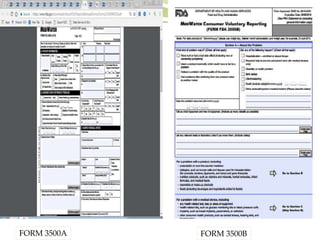
 MedWatch form 3500A
 Public
 MedWatch 3500
 MedWatch 3500B
Med Watch program goals
 Reporting IN
 Educate about importance of reporting
 Facilitate the reporting
 Improve the quality of the reports
 Safety Information OUT
 Disseminate clinically useful, new safety information to
providers and patients
Mission and History
 “Protecting the public health by assuring the safety, efficacy,
and security of human ... drugs, biological products, medical
devices, cosmetics, and products that emit radiation.”( from
FDA Mission Statement)
 Helping the public get the accurate, science-based information
they need to use medicines and foods to improve their health
How FDA Evaluates Medical Product Safety
 Pre-Market Review and Approval
• FDA does not develop or routinely test products itself
• FDA reviews the results of laboratory, animal, and human
clinical testing done by companies
 Post-Market Monitoring for Safety
• Careful review of adverse experiences with products once
they are marketed
Reporting In to MedWatch
 What, when, how and why to report
 What
 All clinical medical products
 When
 If serious and any adverse reaction
 How
 Online, or mail/fax/phone
 Why
 Every report can make a difference
What is a serious adverse event
 1) Death
 2) Life-threatening adverse drug experience
 3) Inpatient hospitalization or prolongation of existing
hospitalization (for > 24 hours)
 4) Persistent or significant incapacity or substantial
disruption of the ability to conduct normal life functions
 5) Congenital anomaly/birth defect
 6) Important Medical Event (IME) that may not result in
death, be life threatening, or require hospitalization may
be considered a serious adverse drug experience
Forms to reporting to FDA
 FORM FDA 3500-Voluentary reporting
 For use by healthcare professionals, consumers, and patients.
Submit the completed form using built-in postage-paid mailer,
or fax.
 FORM FDA 3500B-Voluentary reporting for consumers
 A consumer-friendly version of the 3500 reporting
form. Submit the completed form using address on page 3 of
the form, or fax.
 FORM FDA 3500A-Mandatory reporting
 For use by IND reporters, manufacturers, distributors,
importers, user facilities personnel
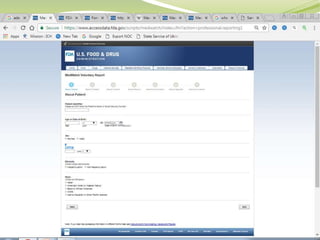
 Online Reporting Form (Voluntary Reporting)
 Report serious adverse events online for human medical
products, including potential and actual product use errors,
product quality problems, and therapeutic
inequivalence/failure. The introductory page features additional
information and instructions.
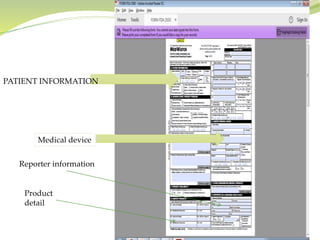
PATIENT INFORMATION
Medical device
Product
detail
Reporter information
FORM 3500A FORM 3500B
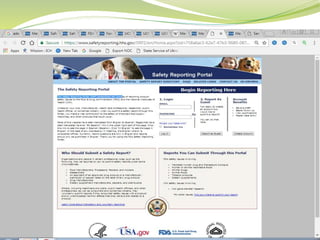
Safety reporting portal
 To report adverse events with tobacco products or dietary
supplements online, use the Safety Reporting Portal
 Tobacco
 If you experience a problem with a tobacco product, such as an
unexpected health or safety issue, report it online using the
Safety Reporting Portal.
 Dietary Supplements
 Dietary supplements include vitamins, minerals, herbs,
amino acids, whey protein, creatine, and weight loss pills
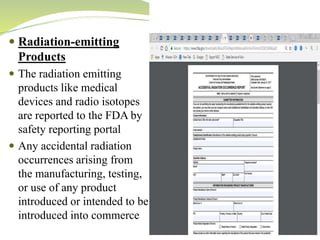
 Radiation-emitting
Products
 The radiation emitting
products like medical
devices and radio isotopes
are reported to the FDA by
safety reporting portal
 Any accidental radiation
occurrences arising from
the manufacturing, testing,
or use of any product
introduced or intended to be
introduced into commerce
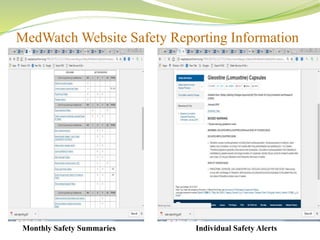
MedWatch Website Safety Reporting Information
Monthly Safety Summaries Individual Safety Alerts
Who Should Submit a Safety Report?
 Organizations and people in certain professional roles, such as
the following:-
 Food Manufacturers, Processors, Packers, and Holders
 Researchers
 An applicant of an approved drug product or a manufacturer,
distributor or packer listed on the label of any drug product
 Drug Manufacturers
 Dietary supplement manufacturers, packers, and distributors
 Others, including healthcare providers, public health
officials, and other professionals, as well as consumers
and concerned citizens, may voluntarily submit reports if
they encounter safety issues with a product and/or
unanticipated harmful effects that they believe are related
to a product.
What to Report to FDA MedWatch
 Use the MedWatch form to report adverse events that you
observe or suspect for human medical products, including
serious drug side effects, medication errors/product use errors,
product quality problems, and therapeutic failures for:-
 Prescription or over-the-counter medicines, as well as
medicines administered to hospital patients or at outpatient
infusion centers
 Biologics (including blood components, blood and plasma
derivatives, allergenic, human cells, tissues, and cellular and
tissue-based products (HCT)
 Medical devices (including in vitro diagnostic products)
 Combination products
 Special nutritional products
(infant formulas, and medical foods)
 Cosmetics
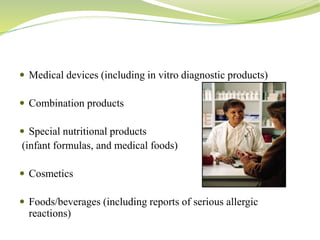
 Foods/beverages (including reports of serious allergic
reactions)
What Not to Report to FDA MedWatch
 Tobacco: Tobacco product problems should be reported to
the Safety Reporting Portal.
 Vaccines: Report vaccine events to the Vaccine Adverse
Event Reporting System (VAERS) online
at https://vaers.hhs.gov/esub/index
 Investigational (study) drugs: Report investigational
(study) drug adverse events as required in the study
protocol and send to the address and contact person listed
in the study protocol.
 Mandatory reporting by regulated industry:
 Drugs and Biologics
 Applicable Regulations
 Devices
 Reporting on Dietary Supplements
 Reporting on Veterinary Medicine Products
 Reports FDA Does Not Handle (e.g. CPSC, FTC, State Health
Departments) and Where to Send Them
What Happens to Your Report
 When you report a serious adverse event
 Report captured in a database
 Database monitored by an FDA professional
 Review of a case series
 Consultation with medical review division and manufacturer
 Further studies as needed are conducted
What Happens to Your Report
 When you provide information on a serious ADE
 Labeling or Educational Options
 Boxed Warning
• Drug-drug, drug-food interaction warnings
• Monitoring recommendations
• Dosage adjustments for sub-populations
 Contraindications, Warnings, Precautions or Adverse Reactions
 Medication Guide
What happens when you report a serious ADE
 Special programs
• Prescribing or dispensing limitations
• Laboratory testing documentation
• Registries for a particular product
 Product withdrawal or product recall
 This depends upon the Adverse event occurred
When you report a product quality problem
 For problems due to:
• Product design
• Manufacturing quality or distribution/storage
• Counterfeit product
 FDA can:
• Work with manufacturer to issue a recall of product
• Request a modification in product design
• Request a modification in manufacturing process
• Improve instructions or warnings for use
FDA MedWatch Summary
 Understand how the FDA monitors medical product safety
 Learn how to voluntarily report adverse events to FDA
 Understand how reports are used by the FDA to improve
product safety
 Know the methods used by FDA to send new safety
information about medical products to providers at the point of
care
Reference
 https://en.wikipedia.org/wiki/MedWatch
 https://www.fda.gov/Safety/MedWatch/SafetyInformation/defa
ult.htm
 https://www.fda.gov/Safety/MedWatch/SafetyInformation/Safe
tyAlertsforHumanMedicalProducts/ucm535957.htm
 https://www.accessdata.fda.gov/scripts/medwatch/index.cfm?a
ction=reporting.home
 https://www.fda.gov/TobaccoProducts/PublicHealthScienceRes
earch/ucm377563.htm
 https://www.safetyreporting.hhs.gov/SRP2/en/Home.aspx?sid=
ee0609ca-f995-4ca3-99db-aa1ce4d564ee
Fda med watch

Fda med watch

  • 1.
    Presented By:- Sridhar S 1stM.Pharmacy Pharmaceutical Regulatory Affairs JSS College of Pharmacy Mysuru-15
  • 2.
    Definition  MedWatch isthe Food and Drug Administration’s Safety Information and Adverse Event Reporting Program. MedWatch is used for reporting an adverse event, founded in 1993  this system of voluntary reporting allows such information to be shared with the medical community or the general public. The system includes publicly available databases and online analysis tools for professionals.  MedWatch also disseminates medical product safety alerts such as recalls and other clinical safety communications via its website, email list
  • 3.
    Reporting Adverse Eventsto FDA  Industry  ICH E2B electronic standard (clinical safety data management)  MedWatch form 3500A  Public  MedWatch 3500  MedWatch 3500B
  • 4.
    Med Watch programgoals  Reporting IN  Educate about importance of reporting  Facilitate the reporting  Improve the quality of the reports  Safety Information OUT  Disseminate clinically useful, new safety information to providers and patients
  • 5.
    Mission and History “Protecting the public health by assuring the safety, efficacy, and security of human ... drugs, biological products, medical devices, cosmetics, and products that emit radiation.”( from FDA Mission Statement)  Helping the public get the accurate, science-based information they need to use medicines and foods to improve their health
  • 6.
    How FDA EvaluatesMedical Product Safety  Pre-Market Review and Approval • FDA does not develop or routinely test products itself • FDA reviews the results of laboratory, animal, and human clinical testing done by companies  Post-Market Monitoring for Safety • Careful review of adverse experiences with products once they are marketed
  • 7.
    Reporting In toMedWatch  What, when, how and why to report  What  All clinical medical products  When  If serious and any adverse reaction  How  Online, or mail/fax/phone  Why  Every report can make a difference
  • 8.
    What is aserious adverse event  1) Death  2) Life-threatening adverse drug experience  3) Inpatient hospitalization or prolongation of existing hospitalization (for > 24 hours)  4) Persistent or significant incapacity or substantial disruption of the ability to conduct normal life functions
  • 9.
     5) Congenitalanomaly/birth defect  6) Important Medical Event (IME) that may not result in death, be life threatening, or require hospitalization may be considered a serious adverse drug experience
  • 10.
    Forms to reportingto FDA  FORM FDA 3500-Voluentary reporting  For use by healthcare professionals, consumers, and patients. Submit the completed form using built-in postage-paid mailer, or fax.  FORM FDA 3500B-Voluentary reporting for consumers  A consumer-friendly version of the 3500 reporting form. Submit the completed form using address on page 3 of the form, or fax.
  • 11.
     FORM FDA3500A-Mandatory reporting  For use by IND reporters, manufacturers, distributors, importers, user facilities personnel  Online Reporting Form (Voluntary Reporting)  Report serious adverse events online for human medical products, including potential and actual product use errors, product quality problems, and therapeutic inequivalence/failure. The introductory page features additional information and instructions.
  • 12.
  • 13.
  • 15.
    Safety reporting portal To report adverse events with tobacco products or dietary supplements online, use the Safety Reporting Portal  Tobacco  If you experience a problem with a tobacco product, such as an unexpected health or safety issue, report it online using the Safety Reporting Portal.  Dietary Supplements  Dietary supplements include vitamins, minerals, herbs, amino acids, whey protein, creatine, and weight loss pills
  • 16.
     Radiation-emitting Products  Theradiation emitting products like medical devices and radio isotopes are reported to the FDA by safety reporting portal  Any accidental radiation occurrences arising from the manufacturing, testing, or use of any product introduced or intended to be introduced into commerce
  • 18.
    MedWatch Website SafetyReporting Information Monthly Safety Summaries Individual Safety Alerts
  • 19.
    Who Should Submita Safety Report?  Organizations and people in certain professional roles, such as the following:-  Food Manufacturers, Processors, Packers, and Holders  Researchers  An applicant of an approved drug product or a manufacturer, distributor or packer listed on the label of any drug product  Drug Manufacturers  Dietary supplement manufacturers, packers, and distributors
  • 20.
     Others, includinghealthcare providers, public health officials, and other professionals, as well as consumers and concerned citizens, may voluntarily submit reports if they encounter safety issues with a product and/or unanticipated harmful effects that they believe are related to a product.
  • 21.
    What to Reportto FDA MedWatch  Use the MedWatch form to report adverse events that you observe or suspect for human medical products, including serious drug side effects, medication errors/product use errors, product quality problems, and therapeutic failures for:-  Prescription or over-the-counter medicines, as well as medicines administered to hospital patients or at outpatient infusion centers  Biologics (including blood components, blood and plasma derivatives, allergenic, human cells, tissues, and cellular and tissue-based products (HCT)
  • 22.
     Medical devices(including in vitro diagnostic products)  Combination products  Special nutritional products (infant formulas, and medical foods)  Cosmetics  Foods/beverages (including reports of serious allergic reactions)
  • 23.
    What Not toReport to FDA MedWatch  Tobacco: Tobacco product problems should be reported to the Safety Reporting Portal.  Vaccines: Report vaccine events to the Vaccine Adverse Event Reporting System (VAERS) online at https://vaers.hhs.gov/esub/index  Investigational (study) drugs: Report investigational (study) drug adverse events as required in the study protocol and send to the address and contact person listed in the study protocol.
  • 24.
     Mandatory reportingby regulated industry:  Drugs and Biologics  Applicable Regulations  Devices  Reporting on Dietary Supplements  Reporting on Veterinary Medicine Products  Reports FDA Does Not Handle (e.g. CPSC, FTC, State Health Departments) and Where to Send Them
  • 25.
    What Happens toYour Report  When you report a serious adverse event  Report captured in a database  Database monitored by an FDA professional  Review of a case series  Consultation with medical review division and manufacturer  Further studies as needed are conducted
  • 26.
    What Happens toYour Report  When you provide information on a serious ADE  Labeling or Educational Options  Boxed Warning • Drug-drug, drug-food interaction warnings • Monitoring recommendations • Dosage adjustments for sub-populations  Contraindications, Warnings, Precautions or Adverse Reactions  Medication Guide
  • 27.
    What happens whenyou report a serious ADE  Special programs • Prescribing or dispensing limitations • Laboratory testing documentation • Registries for a particular product  Product withdrawal or product recall  This depends upon the Adverse event occurred
  • 28.
    When you reporta product quality problem  For problems due to: • Product design • Manufacturing quality or distribution/storage • Counterfeit product  FDA can: • Work with manufacturer to issue a recall of product • Request a modification in product design • Request a modification in manufacturing process • Improve instructions or warnings for use
  • 29.
    FDA MedWatch Summary Understand how the FDA monitors medical product safety  Learn how to voluntarily report adverse events to FDA  Understand how reports are used by the FDA to improve product safety  Know the methods used by FDA to send new safety information about medical products to providers at the point of care
  • 30.
    Reference  https://en.wikipedia.org/wiki/MedWatch  https://www.fda.gov/Safety/MedWatch/SafetyInformation/defa ult.htm https://www.fda.gov/Safety/MedWatch/SafetyInformation/Safe tyAlertsforHumanMedicalProducts/ucm535957.htm  https://www.accessdata.fda.gov/scripts/medwatch/index.cfm?a ction=reporting.home  https://www.fda.gov/TobaccoProducts/PublicHealthScienceRes earch/ucm377563.htm  https://www.safetyreporting.hhs.gov/SRP2/en/Home.aspx?sid= ee0609ca-f995-4ca3-99db-aa1ce4d564ee