REGULATORY ISSUES
Dr. Siddhi Upadhyay (M.Pharm, Ph.D)
Associate Professor
HOD, Dept. of Pharmacognosy and Phytochemistry
Sigma Institute of Pharmacy
ROLE OF PHARMACISTS IN
DRUG REGULATORY AFFAIRS
Drug Regulatory Affairs
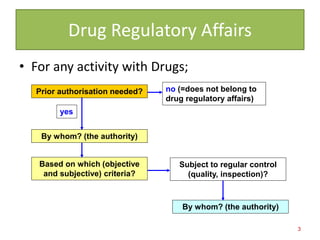
• For any activity with Drugs;
3
By whom? (the authority)
no (=does not belong to
drug regulatory affairs)
yes
Prior authorisation needed?
Based on which (objective
and subjective) criteria?
Subject to regular control
(quality, inspection)?
By whom? (the authority)
4
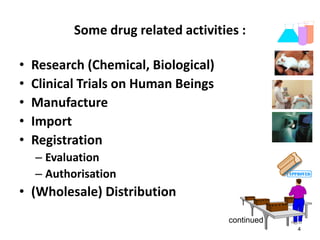
Some drug related activities :
• Research (Chemical, Biological)
• Clinical Trials on Human Beings
• Manufacture
• Import
• Registration
– Evaluation
– Authorisation
• (Wholesale) Distribution
continued
5
Some drug related activities (cont’d)…
• (Retail) Distribution
• Pricing
• Prescribing
• Reimbursement/Subsidy
• Advertising (if any)
• Special Control (eg. Narcotic Drugs)
• Post-marketing Surveillance
– Central Drug Control Lab
– Pharmacovigilance
(Adverse Effect Reporting System)
Organization and Regulations related to Health
in India
Based on the federal nature of constitution, areas of operation
have been divided into Central Government and State
Government
7th schedule of constitution describes 3 items namely:
Union List, State List and Concurrent list.
Some items like Public health, Hospitals, Sanitization etc fall in
the State list.
The items having wider ramification at the national level like
Family Welfare, Population Control, Medical Education,
Prevention of Food Adulteration, Quality Control in
manufacturing of drugs etc have been included in the
Concurrent list.
Drug Regulatory System in India
 Drug is in concurrent list of Indian
Constitution. It is governed by both Centre
and State Governments under the Drugs &
Cosmetics Act, 1940 and Rules 1945
thereunder.
 The principle on which the Drugs &
Cosmetics Act function is by a system of
licensing under which all the activities
involved in manufacture, sale and distribution
of Drugs & Cosmetics are controlled.
Indian Drug Regulatory System:
Government of India
Ministry of Health &
Family Welfare
DGHS
Central Drugs
Standard Control
Organization
(CDSCO)
Ministry of Science
& Technology
Indian Council
of Medical
Research
(ICMR)
Council of
Scientific &
Industrial
Research
(CSIR)
BARC
(Radioactive)
Ministry of Chemicals
& Petrochemicals
National
Pharmaceutical
Pricing Authority
(NPPA)
Department of
Chemical &
Petrochemicals
(DCP)
Department of
Pharmaceuticals
Ministry of
Commerce &
Industry
Patent
Office
Dept. of
Commerce &
Pharmexil
Controller
General of
Patent
DGFT
Ministry of
Environment &
Forest
GEAC-[Genetic
Engineering
Approval
Committee]
Department of
Biotechnology
r-DNA Advisory
Committee
Review
Committee
Genetic
Manipulation
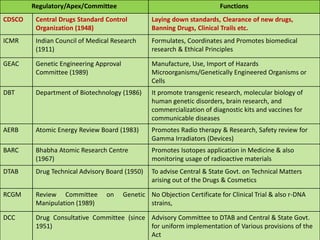
Regulatory/Apex/Committee Functions
CDSCO Central Drugs Standard Control
Organization (1948)
Laying down standards, Clearance of new drugs,
Banning Drugs, Clinical Trails etc.
ICMR Indian Council of Medical Research
(1911)
Formulates, Coordinates and Promotes biomedical
research & Ethical Principles
GEAC Genetic Engineering Approval
Committee (1989)
Manufacture, Use, Import of Hazards
Microorganisms/Genetically Engineered Organisms or
Cells
DBT Department of Biotechnology (1986) It promote transgenic research, molecular biology of
human genetic disorders, brain research, and
commercialization of diagnostic kits and vaccines for
communicable diseases
AERB Atomic Energy Review Board (1983) Promotes Radio therapy & Research, Safety review for
Gamma Irradiators (Devices)
BARC Bhabha Atomic Research Centre
(1967)
Promotes Isotopes application in Medicine & also
monitoring usage of radioactive materials
DTAB Drug Technical Advisory Board (1950) To advise Central & State Govt. on Technical Matters
arising out of the Drugs & Cosmetics
RCGM Review Committee on Genetic
Manipulation (1989)
No Objection Certificate for Clinical Trial & also r-DNA
strains,
DCC Drug Consultative Committee (since
1951)
Advisory Committee to DTAB and Central & State Govt.
for uniform implementation of Various provisions of the
Act
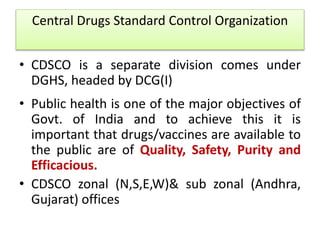
Central Drugs Standard Control Organization
• CDSCO is a separate division comes under
DGHS, headed by DCG(I)
• Public health is one of the major objectives of
Govt. of India and to achieve this it is
important that drugs/vaccines are available to
the public are of Quality, Safety, Purity and
Efficacious.
• CDSCO zonal (N,S,E,W)& sub zonal (Andhra,
Gujarat) offices
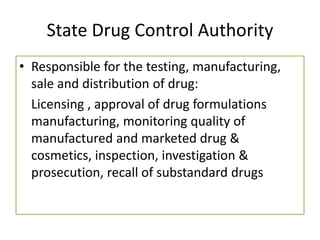
State Drug Control Authority
• Responsible for the testing, manufacturing,
sale and distribution of drug:
Licensing , approval of drug formulations
manufacturing, monitoring quality of
manufactured and marketed drug &
cosmetics, inspection, investigation &
prosecution, recall of substandard drugs
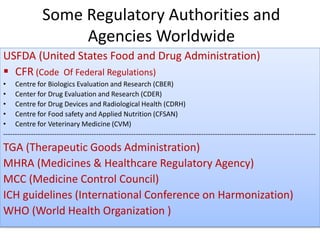
Some Regulatory Authorities and
Agencies Worldwide
USFDA (United States Food and Drug Administration)
 CFR (Code Of Federal Regulations)
• Centre for Biologics Evaluation and Research (CBER)
• Center for Drug Evaluation and Research (CDER)
• Centre for Drug Devices and Radiological Health (CDRH)
• Centre for Food safety and Applied Nutrition (CFSAN)
• Centre for Veterinary Medicine (CVM)
--------------------------------------------------------------------------------------------------------------------------------------
TGA (Therapeutic Goods Administration)
MHRA (Medicines & Healthcare Regulatory Agency)
MCC (Medicine Control Council)
ICH guidelines (International Conference on Harmonization)
WHO (World Health Organization )
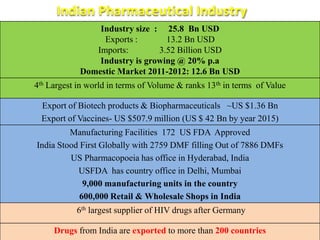
Indian Pharmaceutical Industry
Industry size : 25.8 Bn USD
Exports : 13.2 Bn USD
Imports: 3.52 Billion USD
Industry is growing @ 20% p.a
Domestic Market 2011-2012: 12.6 Bn USD
4th Largest in world in terms of Volume & ranks 13th in terms of Value
Export of Biotech products & Biopharmaceuticals ~US $1.36 Bn
Export of Vaccines- US $507.9 million (US $ 42 Bn by year 2015)
Manufacturing Facilities 172 US FDA Approved
India Stood First Globally with 2759 DMF filling Out of 7886 DMFs
US Pharmacopoeia has office in Hyderabad, India
USFDA has country office in Delhi, Mumbai
9,000 manufacturing units in the country
600,000 Retail & Wholesale Shops in India
6th largest supplier of HIV drugs after Germany
Drugs from India are exported to more than 200 countries
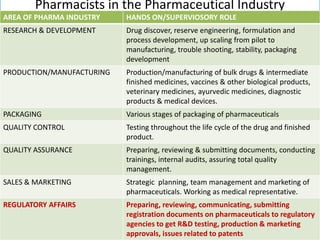
Pharmacists in the Pharmaceutical Industry
AREA OF PHARMA INDUSTRY HANDS ON/SUPERVIOSORY ROLE
RESEARCH & DEVELOPMENT Drug discover, reserve engineering, formulation and
process development, up scaling from pilot to
manufacturing, trouble shooting, stability, packaging
development
PRODUCTION/MANUFACTURING Production/manufacturing of bulk drugs & intermediate
finished medicines, vaccines & other biological products,
veterinary medicines, ayurvedic medicines, diagnostic
products & medical devices.
PACKAGING Various stages of packaging of pharmaceuticals
QUALITY CONTROL Testing throughout the life cycle of the drug and finished
product.
QUALITY ASSURANCE Preparing, reviewing & submitting documents, conducting
trainings, internal audits, assuring total quality
management.
SALES & MARKETING Strategic planning, team management and marketing of
pharmaceuticals. Working as medical representative.
REGULATORY AFFAIRS Preparing, reviewing, communicating, submitting
registration documents on pharmaceuticals to regulatory
agencies to get R&D testing, production & marketing
approvals, issues related to patents
REGULATIONS IN INDIA: ASU DTAB
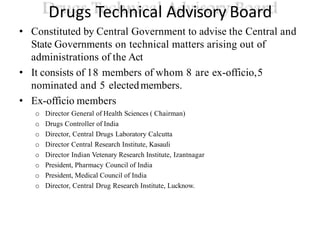
Drugs Technical Advisory Board
• Constituted by Central Government to advise the Central and
State Governments on technical matters arising out of
administrations of the Act
• It consists of 18 members of whom 8 are ex-officio,5
nominated and 5 electedmembers.
• Ex-officio members
o Director General of Health Sciences ( Chairman)
o Drugs Controller of India
o Director, Central Drugs Laboratory Calcutta
o Director Central Research Institute, Kasauli
o Director Indian Vetenary Research Institute, Izantnagar
o President, Pharmacy Council of India
o President, Medical Council of India
o Director, Central Drug Research Institute, Lucknow.
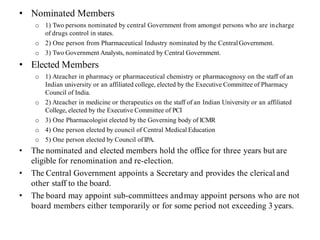
• Nominated Members
o 1) Two persons nominated by central Government from amongst persons who are incharge
of drugs control in states.
o 2) One person from Pharmaceutical Industry nominated by the CentralGovernment.
o 3) Two Government Analysts, nominated by Central Government.
• Elected Members
o 1) Ateacher in pharmacy or pharmaceutical chemistry or pharmacognosy on the staff of an
Indian university or an affiliated college, elected by the Executive Committee of Pharmacy
Council of India.
o 2) Ateacher in medicine or therapeutics on the staff of an Indian University or an affiliated
College, elected by the Executive Committee of PCI
o 3) One Pharmacologist elected by the Governing body of ICMR
o 4) One person elected by council of Central Medical Education
o 5) One person elected by Council ofIPA.
• The nominated and elected members hold the office for three years but are
eligible for renomination and re-election.
• The Central Government appoints a Secretary and provides the clerical and
other staff to the board.
• The board may appoint sub-committees andmay appoint persons who are not
board members either temporarily or for some period not exceeding 3 years.
REGULATIONS IN INDIA: ASU DCC
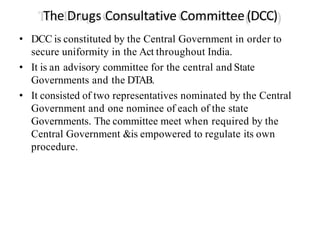
The Drugs Consultative Committee (DCC)
• DCC is constituted by the Central Government in order to
secure uniformity in the Act throughout India.
• It is an advisory committee for the central and State
Governments and the DTAB.
• It consisted of two representatives nominated by the Central
Government and one nominee of each of the state
Governments. The committee meet when required by the
Central Government &is empowered to regulate its own
procedure.
REGULATION OF MANUFACTURE OF
ASU DRUGS - SCHEDULE Z OF DRUGS &
COSMETICS ACT FOR ASU DRUGS
• Requirements and Guidelines for permission to
manufacture of ASU Drugs for Sale or to
undertake clinical trials [(Proposed) Schedule Z]:
Dept. of AYUSH, Ministry of Health & Family
Welfare, Govt. of India has drafted guidelines on
Good Clinical Practices (GCPs) for Clinical trials on
Ayurveda, Siddha, Unani (ASU) Medicines, which
have been circulated very recently in November
2011
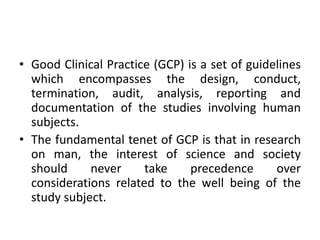
• Good Clinical Practice (GCP) is a set of guidelines
which encompasses the design, conduct,
termination, audit, analysis, reporting and
documentation of the studies involving human
subjects.
• The fundamental tenet of GCP is that in research
on man, the interest of science and society
should never take precedence over
considerations related to the well being of the
study subject.
• It aims to ensure that the studies are
scientifically and ethically sound and that the
clinical properties of the ASU medicine under
investigation are properly documented.
• The guidelines seek to establish two cardinal
principles: protection of the rights of human
subjects and authenticity of ASU medicine
clinical trial data generated.
• These guidelines should be followed for
carrying out all ASU medicines research in
India at all stages of drug development,
whether prior or subsequent to product
registration in India.
• In brief these guidelines consists of
information on the Protocol, Ethical issues,
Safety considerations, Informed consent
process, Responsibilities of the involved
personnel in research, Record keeping, Data
management, Quality assurance, Statistics and
areas on special concern like studies with
Contraceptives, Surgical procedures,
Panchakarma, Medical devices etc.
• Draft of this schedule is under consideration
and within few months it may come in to force

Regulatory Issues

  • 1.
    REGULATORY ISSUES Dr. SiddhiUpadhyay (M.Pharm, Ph.D) Associate Professor HOD, Dept. of Pharmacognosy and Phytochemistry Sigma Institute of Pharmacy
  • 2.
    ROLE OF PHARMACISTSIN DRUG REGULATORY AFFAIRS
  • 3.
    Drug Regulatory Affairs •For any activity with Drugs; 3 By whom? (the authority) no (=does not belong to drug regulatory affairs) yes Prior authorisation needed? Based on which (objective and subjective) criteria? Subject to regular control (quality, inspection)? By whom? (the authority)
  • 4.
    4 Some drug relatedactivities : • Research (Chemical, Biological) • Clinical Trials on Human Beings • Manufacture • Import • Registration – Evaluation – Authorisation • (Wholesale) Distribution continued
  • 5.
    5 Some drug relatedactivities (cont’d)… • (Retail) Distribution • Pricing • Prescribing • Reimbursement/Subsidy • Advertising (if any) • Special Control (eg. Narcotic Drugs) • Post-marketing Surveillance – Central Drug Control Lab – Pharmacovigilance (Adverse Effect Reporting System)
  • 6.
    Organization and Regulationsrelated to Health in India Based on the federal nature of constitution, areas of operation have been divided into Central Government and State Government 7th schedule of constitution describes 3 items namely: Union List, State List and Concurrent list. Some items like Public health, Hospitals, Sanitization etc fall in the State list. The items having wider ramification at the national level like Family Welfare, Population Control, Medical Education, Prevention of Food Adulteration, Quality Control in manufacturing of drugs etc have been included in the Concurrent list.
  • 7.
    Drug Regulatory Systemin India  Drug is in concurrent list of Indian Constitution. It is governed by both Centre and State Governments under the Drugs & Cosmetics Act, 1940 and Rules 1945 thereunder.  The principle on which the Drugs & Cosmetics Act function is by a system of licensing under which all the activities involved in manufacture, sale and distribution of Drugs & Cosmetics are controlled.
  • 8.
    Indian Drug RegulatorySystem: Government of India Ministry of Health & Family Welfare DGHS Central Drugs Standard Control Organization (CDSCO) Ministry of Science & Technology Indian Council of Medical Research (ICMR) Council of Scientific & Industrial Research (CSIR) BARC (Radioactive) Ministry of Chemicals & Petrochemicals National Pharmaceutical Pricing Authority (NPPA) Department of Chemical & Petrochemicals (DCP) Department of Pharmaceuticals Ministry of Commerce & Industry Patent Office Dept. of Commerce & Pharmexil Controller General of Patent DGFT Ministry of Environment & Forest GEAC-[Genetic Engineering Approval Committee] Department of Biotechnology r-DNA Advisory Committee Review Committee Genetic Manipulation
  • 9.
    Regulatory/Apex/Committee Functions CDSCO CentralDrugs Standard Control Organization (1948) Laying down standards, Clearance of new drugs, Banning Drugs, Clinical Trails etc. ICMR Indian Council of Medical Research (1911) Formulates, Coordinates and Promotes biomedical research & Ethical Principles GEAC Genetic Engineering Approval Committee (1989) Manufacture, Use, Import of Hazards Microorganisms/Genetically Engineered Organisms or Cells DBT Department of Biotechnology (1986) It promote transgenic research, molecular biology of human genetic disorders, brain research, and commercialization of diagnostic kits and vaccines for communicable diseases AERB Atomic Energy Review Board (1983) Promotes Radio therapy & Research, Safety review for Gamma Irradiators (Devices) BARC Bhabha Atomic Research Centre (1967) Promotes Isotopes application in Medicine & also monitoring usage of radioactive materials DTAB Drug Technical Advisory Board (1950) To advise Central & State Govt. on Technical Matters arising out of the Drugs & Cosmetics RCGM Review Committee on Genetic Manipulation (1989) No Objection Certificate for Clinical Trial & also r-DNA strains, DCC Drug Consultative Committee (since 1951) Advisory Committee to DTAB and Central & State Govt. for uniform implementation of Various provisions of the Act
  • 10.
    Central Drugs StandardControl Organization • CDSCO is a separate division comes under DGHS, headed by DCG(I) • Public health is one of the major objectives of Govt. of India and to achieve this it is important that drugs/vaccines are available to the public are of Quality, Safety, Purity and Efficacious. • CDSCO zonal (N,S,E,W)& sub zonal (Andhra, Gujarat) offices
  • 11.
    State Drug ControlAuthority • Responsible for the testing, manufacturing, sale and distribution of drug: Licensing , approval of drug formulations manufacturing, monitoring quality of manufactured and marketed drug & cosmetics, inspection, investigation & prosecution, recall of substandard drugs
  • 12.
    Some Regulatory Authoritiesand Agencies Worldwide USFDA (United States Food and Drug Administration)  CFR (Code Of Federal Regulations) • Centre for Biologics Evaluation and Research (CBER) • Center for Drug Evaluation and Research (CDER) • Centre for Drug Devices and Radiological Health (CDRH) • Centre for Food safety and Applied Nutrition (CFSAN) • Centre for Veterinary Medicine (CVM) -------------------------------------------------------------------------------------------------------------------------------------- TGA (Therapeutic Goods Administration) MHRA (Medicines & Healthcare Regulatory Agency) MCC (Medicine Control Council) ICH guidelines (International Conference on Harmonization) WHO (World Health Organization )
  • 13.
    Indian Pharmaceutical Industry Industrysize : 25.8 Bn USD Exports : 13.2 Bn USD Imports: 3.52 Billion USD Industry is growing @ 20% p.a Domestic Market 2011-2012: 12.6 Bn USD 4th Largest in world in terms of Volume & ranks 13th in terms of Value Export of Biotech products & Biopharmaceuticals ~US $1.36 Bn Export of Vaccines- US $507.9 million (US $ 42 Bn by year 2015) Manufacturing Facilities 172 US FDA Approved India Stood First Globally with 2759 DMF filling Out of 7886 DMFs US Pharmacopoeia has office in Hyderabad, India USFDA has country office in Delhi, Mumbai 9,000 manufacturing units in the country 600,000 Retail & Wholesale Shops in India 6th largest supplier of HIV drugs after Germany Drugs from India are exported to more than 200 countries
  • 14.
    Pharmacists in thePharmaceutical Industry AREA OF PHARMA INDUSTRY HANDS ON/SUPERVIOSORY ROLE RESEARCH & DEVELOPMENT Drug discover, reserve engineering, formulation and process development, up scaling from pilot to manufacturing, trouble shooting, stability, packaging development PRODUCTION/MANUFACTURING Production/manufacturing of bulk drugs & intermediate finished medicines, vaccines & other biological products, veterinary medicines, ayurvedic medicines, diagnostic products & medical devices. PACKAGING Various stages of packaging of pharmaceuticals QUALITY CONTROL Testing throughout the life cycle of the drug and finished product. QUALITY ASSURANCE Preparing, reviewing & submitting documents, conducting trainings, internal audits, assuring total quality management. SALES & MARKETING Strategic planning, team management and marketing of pharmaceuticals. Working as medical representative. REGULATORY AFFAIRS Preparing, reviewing, communicating, submitting registration documents on pharmaceuticals to regulatory agencies to get R&D testing, production & marketing approvals, issues related to patents
  • 15.
  • 16.
    Drugs Technical AdvisoryBoard • Constituted by Central Government to advise the Central and State Governments on technical matters arising out of administrations of the Act • It consists of 18 members of whom 8 are ex-officio,5 nominated and 5 electedmembers. • Ex-officio members o Director General of Health Sciences ( Chairman) o Drugs Controller of India o Director, Central Drugs Laboratory Calcutta o Director Central Research Institute, Kasauli o Director Indian Vetenary Research Institute, Izantnagar o President, Pharmacy Council of India o President, Medical Council of India o Director, Central Drug Research Institute, Lucknow.
  • 17.
    • Nominated Members o1) Two persons nominated by central Government from amongst persons who are incharge of drugs control in states. o 2) One person from Pharmaceutical Industry nominated by the CentralGovernment. o 3) Two Government Analysts, nominated by Central Government. • Elected Members o 1) Ateacher in pharmacy or pharmaceutical chemistry or pharmacognosy on the staff of an Indian university or an affiliated college, elected by the Executive Committee of Pharmacy Council of India. o 2) Ateacher in medicine or therapeutics on the staff of an Indian University or an affiliated College, elected by the Executive Committee of PCI o 3) One Pharmacologist elected by the Governing body of ICMR o 4) One person elected by council of Central Medical Education o 5) One person elected by Council ofIPA. • The nominated and elected members hold the office for three years but are eligible for renomination and re-election. • The Central Government appoints a Secretary and provides the clerical and other staff to the board. • The board may appoint sub-committees andmay appoint persons who are not board members either temporarily or for some period not exceeding 3 years.
  • 18.
  • 19.
    The Drugs ConsultativeCommittee (DCC) • DCC is constituted by the Central Government in order to secure uniformity in the Act throughout India. • It is an advisory committee for the central and State Governments and the DTAB. • It consisted of two representatives nominated by the Central Government and one nominee of each of the state Governments. The committee meet when required by the Central Government &is empowered to regulate its own procedure.
  • 20.
    REGULATION OF MANUFACTUREOF ASU DRUGS - SCHEDULE Z OF DRUGS & COSMETICS ACT FOR ASU DRUGS
  • 21.
    • Requirements andGuidelines for permission to manufacture of ASU Drugs for Sale or to undertake clinical trials [(Proposed) Schedule Z]: Dept. of AYUSH, Ministry of Health & Family Welfare, Govt. of India has drafted guidelines on Good Clinical Practices (GCPs) for Clinical trials on Ayurveda, Siddha, Unani (ASU) Medicines, which have been circulated very recently in November 2011
  • 22.
    • Good ClinicalPractice (GCP) is a set of guidelines which encompasses the design, conduct, termination, audit, analysis, reporting and documentation of the studies involving human subjects. • The fundamental tenet of GCP is that in research on man, the interest of science and society should never take precedence over considerations related to the well being of the study subject.
  • 23.
    • It aimsto ensure that the studies are scientifically and ethically sound and that the clinical properties of the ASU medicine under investigation are properly documented. • The guidelines seek to establish two cardinal principles: protection of the rights of human subjects and authenticity of ASU medicine clinical trial data generated.
  • 24.
    • These guidelinesshould be followed for carrying out all ASU medicines research in India at all stages of drug development, whether prior or subsequent to product registration in India.
  • 25.
    • In briefthese guidelines consists of information on the Protocol, Ethical issues, Safety considerations, Informed consent process, Responsibilities of the involved personnel in research, Record keeping, Data management, Quality assurance, Statistics and areas on special concern like studies with Contraceptives, Surgical procedures, Panchakarma, Medical devices etc.
  • 26.
    • Draft ofthis schedule is under consideration and within few months it may come in to force