Regular Expressions

   How do they work
Several important Facts
1. Everything in computing was discovered in
one form or another in the 70-80’s and was
probably thought about during the 60’s.
2. The easiest way to become a great computer
engineer in the 80’s was to work for Bell Labs
and have a beard.
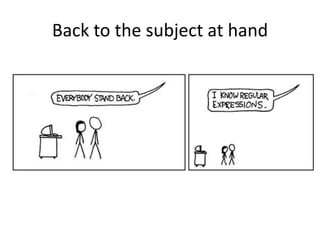
Back to the subject at hand
What are regular expressions?
From Wikipedia:
In computing, a regular expression provides a
concise and flexible means to "match" (specify
and recognize) strings of text, such as particular
characters, words, or patterns of characters.
Common abbreviations for "regular expression"
include regex and regexp.
Why do we need regular expressions
         (in programming)
Many reasons but most of them are in their base
finding strings in text .
Preferably without reading it

^(?("")(""[^""]+?""@)|(([0-9a-z]((.(?!.))|[-
!#$%&'*+/=?^`{}|~w])*)(?<=[0-9a-
z])@))(?([)([(d{1,3}.){3}d{1,3}])|(([0-9a-z][-
w]*[0-9a-z]*.)+[a-z0-9]{2,17}))$

^(?=.*[^a-zA-Z])(?=.*[a-z])(?=.*[A-Z])S{8,}$
Regular Expressions Syntax
            meta characters
 Grouping
     . – match any other character
     [ ] – grouping, match single character that is inside the group
     [^ ] – grouping, match single character that is not inside the group
     ( ) – sub expression, in Perl can be recalled later from special variables
 Quantifier
     {m,n} –specifies that the character/sub expression before need to be matched
      at least m times and no more than n times
     * - derived from Kleene star in formal logic, matches 0 or more amount of the
      character before it.
     ? –matches zero or one of the preceding elements
     + - derived from Kleene cross in formal logic, matches 1 or more of the
      character before it.
 Location
     ^ - Marking start of line
     $ - Marking end of line
Regular Expressions Syntax
               Character groups
 [:alpha:] - Any alphabetical character - [A-Za-z]
 [:alnum:] - Any alphanumeric character - [A-Za-z0-9]
 [:ascii:] - Any character in the ASCII character set.[:blank:] - A GNU
  extension, equal to a space or a horizontal tab ("t")
 [:cntrl:] - Any control character
 [:digit:] - Any decimal digit - [0-9], equivalent to "d“
 [:graph:] - Any printable character, excluding a space
 [:lower:] - Any lowercase character - [a-z]
 [:print:] - Any printable character, including a space
 [:punct:] - Any graphical character excluding "word" characters
 [:space:] - Any whitespace character. "s" plus the vertical tab ("cK")
 [:upper:] - Any uppercase character - [A-Z]
 [:word:] - A Perl extension - [A-Za-z0-9_], equivalent to "w“
 [:xdigit:] - Any hexadecimal digit - [0-9a-fA-F].
What is a regular expression engine
A regular expression engine is a program that takes
a set of constraints specified in a mini-
language, and then applies those constraints to a
target string, and determines whether or not the
string satisfies the constraints.

In less grandiose terms, the first part of the job is to
turn a pattern into something the computer can
efficiently use to find the matching point in the
string, and the second part is performing the search
itself.
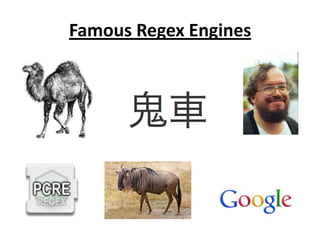
Famous Regex Engines
Part 2
How the Perl Regex engine works
• Unlike the army only two steps
  – Compilation
     • Parsing (Size, Construction)
     • Peep-hole optimization and analysis
  – Execution
     • Start position and no-match optimizations
     • Program execution
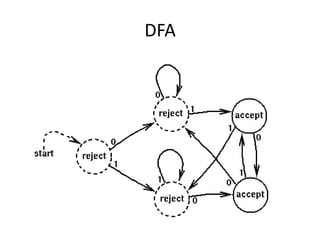
DFA
DFA
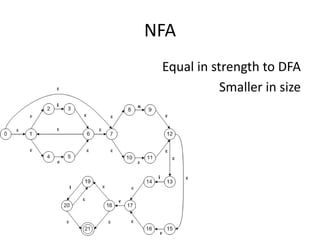
NFA
 Equal in strength to DFA
            Smaller in size
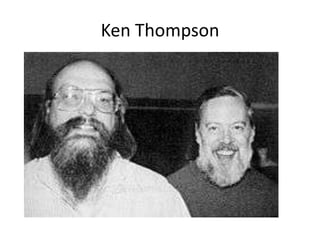
Ken Thompson
Thompson NFA method
• In 1968 Thompson wrote an article on how to
  convert a regular expression to still unnamed
  automata (NFA)
• The article included code to explain the point
Thompson NFA method
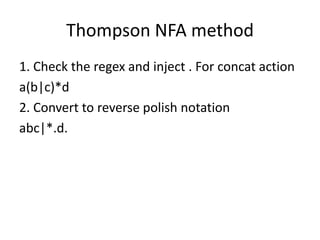
1. Check the regex and inject . For concat action
a(b|c)*d
2. Convert to reverse polish notation
abc|*.d.
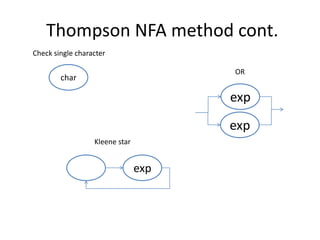
Thompson NFA method cont.
Check single character

                                      OR
        char

                                      exp
                                      exp
                  Kleene star


                                exp
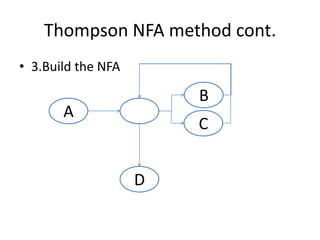
Thompson NFA method cont.
• 3.Build the NFA

                        B
       A
                        C


                    D
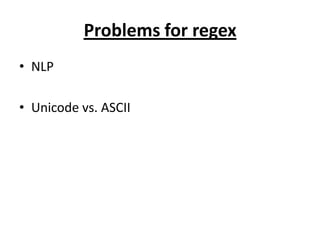
Problems for regex
• NLP

• Unicode vs. ASCII
Some examples of Regex
• ([^s]+(.(?i)(jpg|png|gif|bmp))$)
   – Match file with specific extentions
• ^(https?://)?([da-z.-]+).([a-z.]{2,6})([/w
  .-]*)*/?$
   – Match URL
• /^#?([a-f0-9]{6}|[a-f0-9]{3})$/
   – Match a hex value
• [ -~]
   – An interesting one.

Regular expressions

  • 1.
    Regular Expressions How do they work
  • 2.
    Several important Facts 1.Everything in computing was discovered in one form or another in the 70-80’s and was probably thought about during the 60’s. 2. The easiest way to become a great computer engineer in the 80’s was to work for Bell Labs and have a beard.
  • 3.
    Back to thesubject at hand
  • 4.
    What are regularexpressions? From Wikipedia: In computing, a regular expression provides a concise and flexible means to "match" (specify and recognize) strings of text, such as particular characters, words, or patterns of characters. Common abbreviations for "regular expression" include regex and regexp.
  • 5.
    Why do weneed regular expressions (in programming) Many reasons but most of them are in their base finding strings in text . Preferably without reading it ^(?("")(""[^""]+?""@)|(([0-9a-z]((.(?!.))|[- !#$%&'*+/=?^`{}|~w])*)(?<=[0-9a- z])@))(?([)([(d{1,3}.){3}d{1,3}])|(([0-9a-z][- w]*[0-9a-z]*.)+[a-z0-9]{2,17}))$ ^(?=.*[^a-zA-Z])(?=.*[a-z])(?=.*[A-Z])S{8,}$
  • 6.
    Regular Expressions Syntax meta characters  Grouping  . – match any other character  [ ] – grouping, match single character that is inside the group  [^ ] – grouping, match single character that is not inside the group  ( ) – sub expression, in Perl can be recalled later from special variables  Quantifier  {m,n} –specifies that the character/sub expression before need to be matched at least m times and no more than n times  * - derived from Kleene star in formal logic, matches 0 or more amount of the character before it.  ? –matches zero or one of the preceding elements  + - derived from Kleene cross in formal logic, matches 1 or more of the character before it.  Location  ^ - Marking start of line  $ - Marking end of line
  • 7.
    Regular Expressions Syntax Character groups  [:alpha:] - Any alphabetical character - [A-Za-z]  [:alnum:] - Any alphanumeric character - [A-Za-z0-9]  [:ascii:] - Any character in the ASCII character set.[:blank:] - A GNU extension, equal to a space or a horizontal tab ("t")  [:cntrl:] - Any control character  [:digit:] - Any decimal digit - [0-9], equivalent to "d“  [:graph:] - Any printable character, excluding a space  [:lower:] - Any lowercase character - [a-z]  [:print:] - Any printable character, including a space  [:punct:] - Any graphical character excluding "word" characters  [:space:] - Any whitespace character. "s" plus the vertical tab ("cK")  [:upper:] - Any uppercase character - [A-Z]  [:word:] - A Perl extension - [A-Za-z0-9_], equivalent to "w“  [:xdigit:] - Any hexadecimal digit - [0-9a-fA-F].
  • 8.
    What is aregular expression engine A regular expression engine is a program that takes a set of constraints specified in a mini- language, and then applies those constraints to a target string, and determines whether or not the string satisfies the constraints. In less grandiose terms, the first part of the job is to turn a pattern into something the computer can efficiently use to find the matching point in the string, and the second part is performing the search itself.
  • 9.
  • 10.
  • 11.
    How the PerlRegex engine works • Unlike the army only two steps – Compilation • Parsing (Size, Construction) • Peep-hole optimization and analysis – Execution • Start position and no-match optimizations • Program execution
  • 12.
  • 13.
  • 14.
    NFA Equal instrength to DFA Smaller in size
  • 15.
  • 16.
    Thompson NFA method •In 1968 Thompson wrote an article on how to convert a regular expression to still unnamed automata (NFA) • The article included code to explain the point
  • 17.
    Thompson NFA method 1.Check the regex and inject . For concat action a(b|c)*d 2. Convert to reverse polish notation abc|*.d.
  • 18.
    Thompson NFA methodcont. Check single character OR char exp exp Kleene star exp
  • 19.
    Thompson NFA methodcont. • 3.Build the NFA B A C D
  • 20.
    Problems for regex •NLP • Unicode vs. ASCII
  • 21.
    Some examples ofRegex • ([^s]+(.(?i)(jpg|png|gif|bmp))$) – Match file with specific extentions • ^(https?://)?([da-z.-]+).([a-z.]{2,6})([/w .-]*)*/?$ – Match URL • /^#?([a-f0-9]{6}|[a-f0-9]{3})$/ – Match a hex value • [ -~] – An interesting one.

Editor's Notes

  • #3 Where they worked on MULTICS which later became unix
  • #4 From XKCD
  • #6 The first is for email from MSDN the second is for a password of 8 characters with atleast one lowercase upper case and other symbol
  • #7 This is from the POSIX specification
  • #8 Again those are the POSIX groups which are not implemented everywhere the examples are for Perl regex
  • #10 Camel for Perl, Japaneas for Onigurama (Devil Chariot), Henry Spencers picture, PCRE logo, google for RE2 and a gnu for the GNU REGEX
  • #12 In compiler theory, peephole optimization is a kind of optimization performed over a very small set of instructions in a segment of generated code. The set is called a &quot;peephole&quot; or a &quot;window&quot;. It works by recognising sets of instructions that can be replaced by shorter or faster set of instructions.The execution is including other algorithms like Bayer-Moore and other ways to shorten execution timeFunctions – compilationReg() for parsingReg_branch() Reg_piece()Reg_atom()Reg_tail()Study_chunk() for optimizationFunctions – ExecutionRe_intuit_start() – for starting locationsReg_try()Regmatch()
  • #13 Not the department of foreign affairs
  • #14 Accepts the language of all numbers ends with 10 or 01
  • #15 NFA’s transition table for the regex (l|e)*n?(i|e)el*
  • #16 Thompson on the left and ritchy on the rightThompson invented B helped inventing CAlso created worked on QED and ed, and invented regular expressionsHelped develop utf8 and the go language
  • #17 The original article included algol code for the IBM mainframe and was implanted in QED editor
  • #18 Reverse polish notation is used to remove ambiguity and make it easier to work with stack
  • #21 Natural language processing is becoming common due to computer speed and massive amounts of data, using statistical tools.UNICODE VS ASCII is a problem for developer due to characters that might be cought as the same while being different
  • #22 Notice it doesn’t use the xdigit which is not supported in all engines