Callbacks & Promises in JS
Presentation by
Hung Nguyen Huy
Contents
1. Introduction
2. Asynchronous processing in JavaScript
3. Callbacks & Callback hell
4. Promises arrive in JavaScript!
5. Constructing a Promise
6. Promise states
7. Promises chaining & transformation
8. Error handling
9. Promise.all() & Promise.race()
10. Summary
Introduction
JavaScript is a single-threaded and asynchronous programming language.
one thread == one call stack == one thing at a time
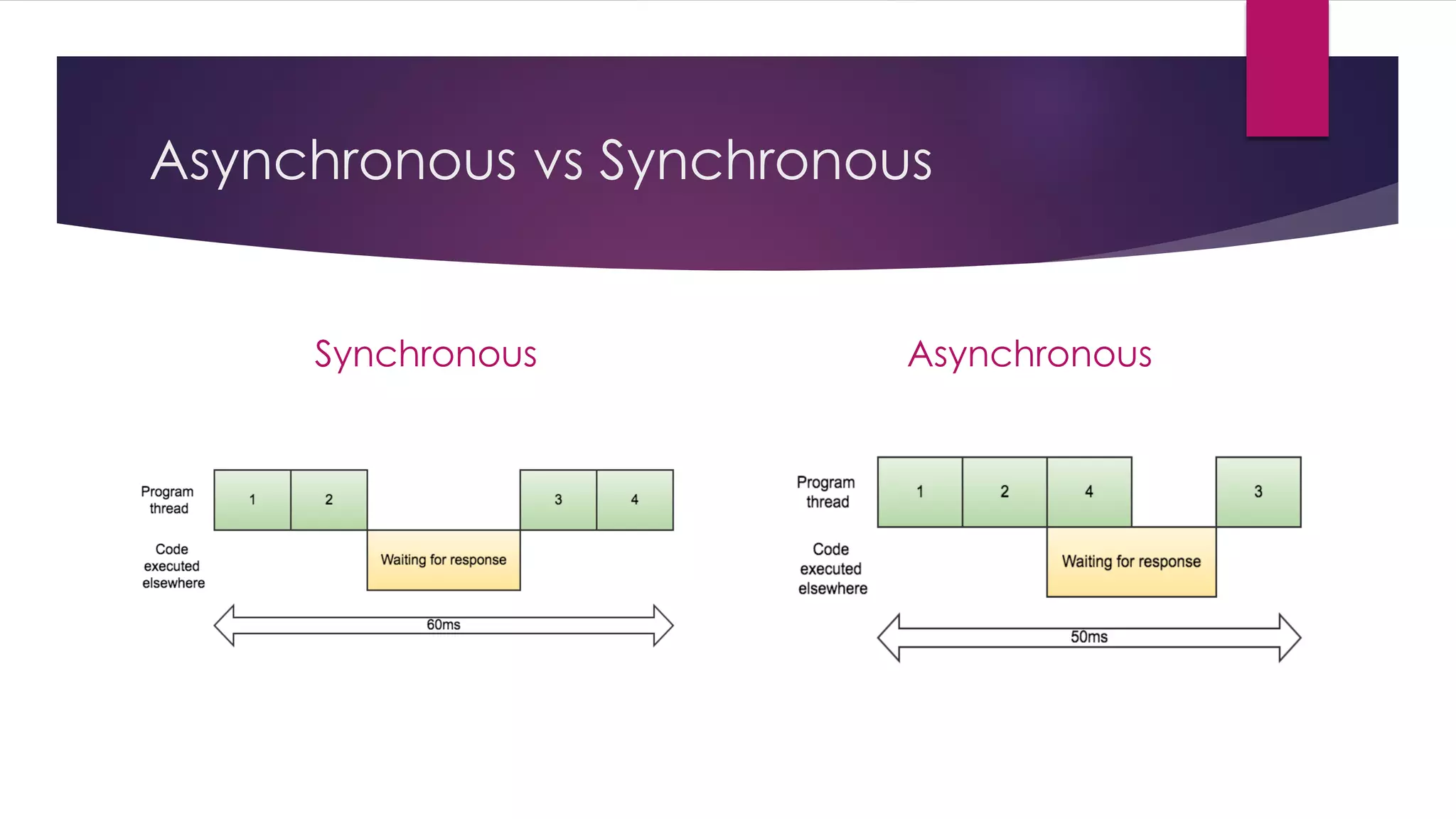
Asynchronous vs Synchronous
 Synchronous Processing
In synchronous programs, if you have two lines of code (L1 followed by L2), then L2
can not begin running until L1 has finished executing.
 Asynchronous Processing
In asynchronous programs, you can have two lines of code (L1 followed by L2),
where L1 schedules some task to be run in the future, but L2 runs before that task
completes.
Asynchronous vs Synchronous
Synchronous Asynchronous
Callbacks
A callback function is a function passed into another function as an argument,
which is then invoked inside the outer function to complete some kind of
routine or action.
Async callbacks & Callback hell
 Asynchronous callback
Callbacks are often used to continue code execution after
an asynchronous operation has completed - these are called asynchronous
callbacks.
 Callback hell
Chain of asynchronous operations
=> Hard to read & debug code.
Promises arrive in JavaScript!
Getting rid of callback hell!
What is Promise?
Promise is an object which represents the eventual completion or failure of an
asynchronous operation, and its resulting value.
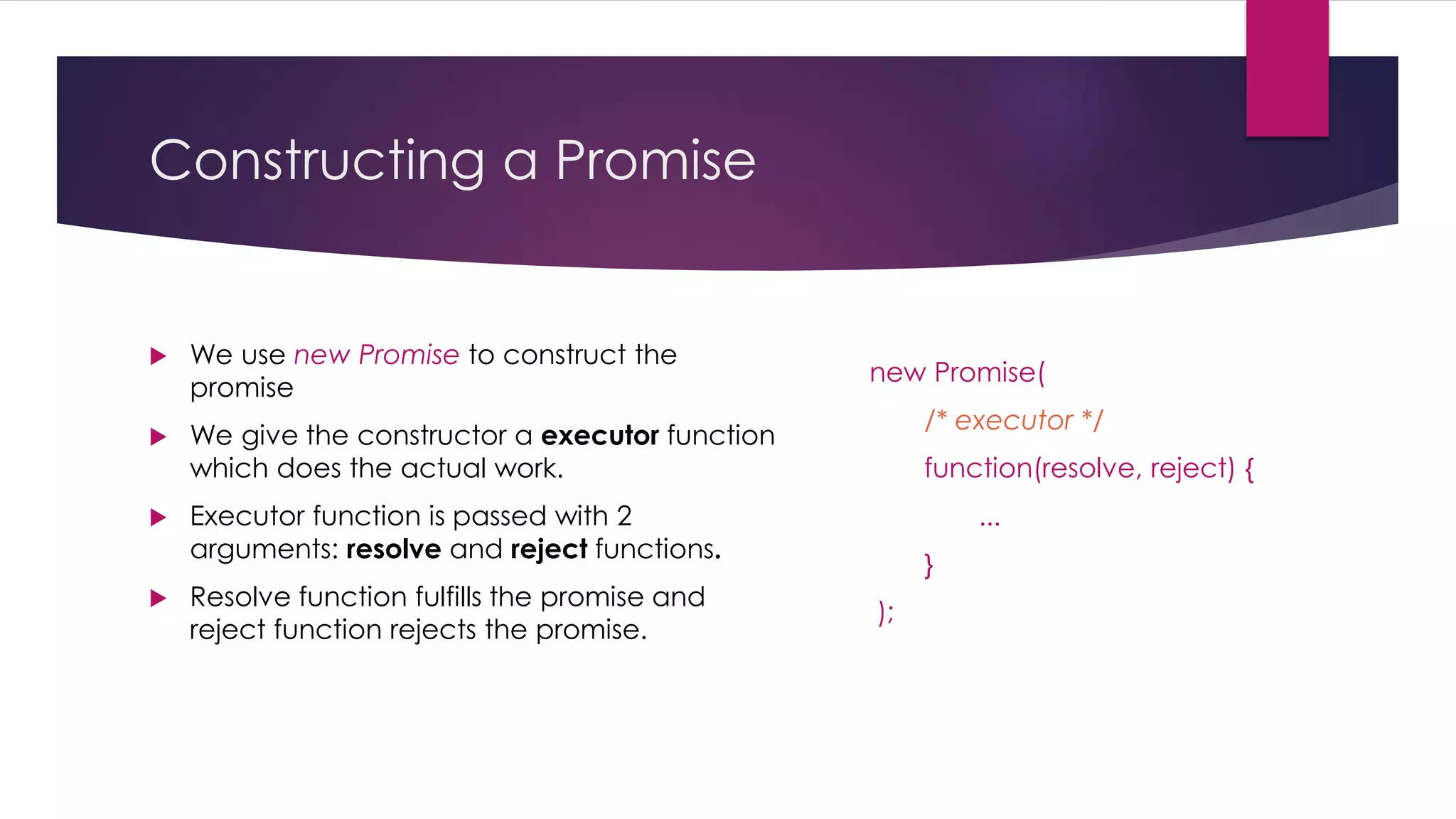
Constructing a Promise
 We use new Promise to construct the
promise
 We give the constructor a executor function
which does the actual work.
 Executor function is passed with 2
arguments: resolve and reject functions.
 Resolve function fulfills the promise and
reject function rejects the promise.
new Promise(
/* executor */
function(resolve, reject) {
...
}
);
Promise states
A Promise is in one of these 3 states:
 pending: initial state, neither fulfilled nor rejected.
 fulfilled: meaning that the operation completed successfully.
 rejected: meaning that the operation failed.
Using the Promise object
 A pending promise can either be fulfilled with a value, or rejected with a
reason (error).
 When either of these options happens, the associated handlers queued
up by a promise's then method are called.
then() and catch()
 then()
Takes up to two arguments: callback
functions for the success and failure cases of
the Promise. It returns a Promise.
p.then(onFulfilled[, onRejected]);
p.then(function(value) {
// fulfillment
}, function(reason) {
// rejection
});
 catch()
Take only one argument to deal with rejected
cases only. It returns a Promise.
p.catch(onRejected);
p.catch(function(reason) {
// rejection
});
Promises chaining & transformation
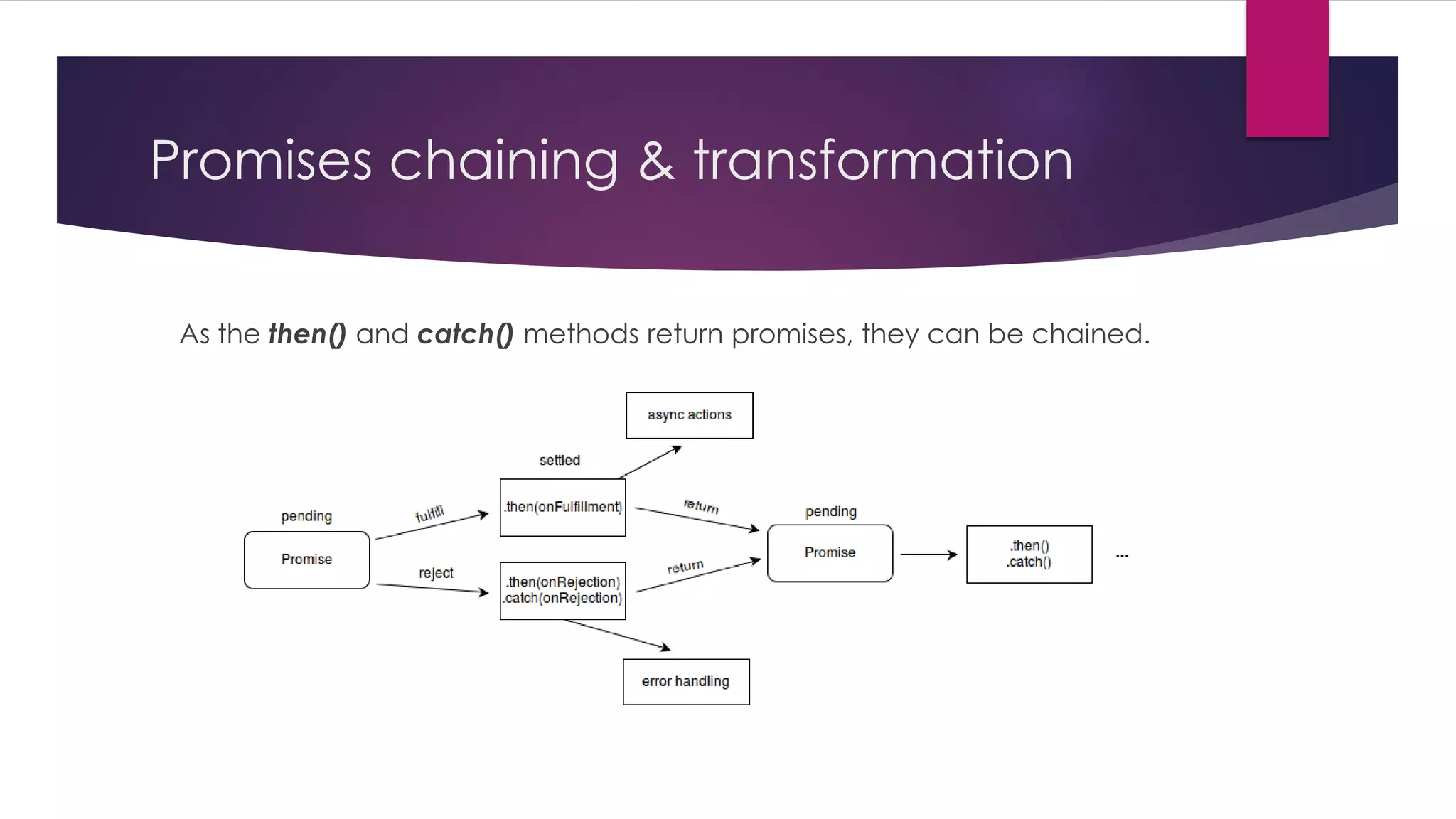
As the then() and catch() methods return promises, they can be chained.
Error handling
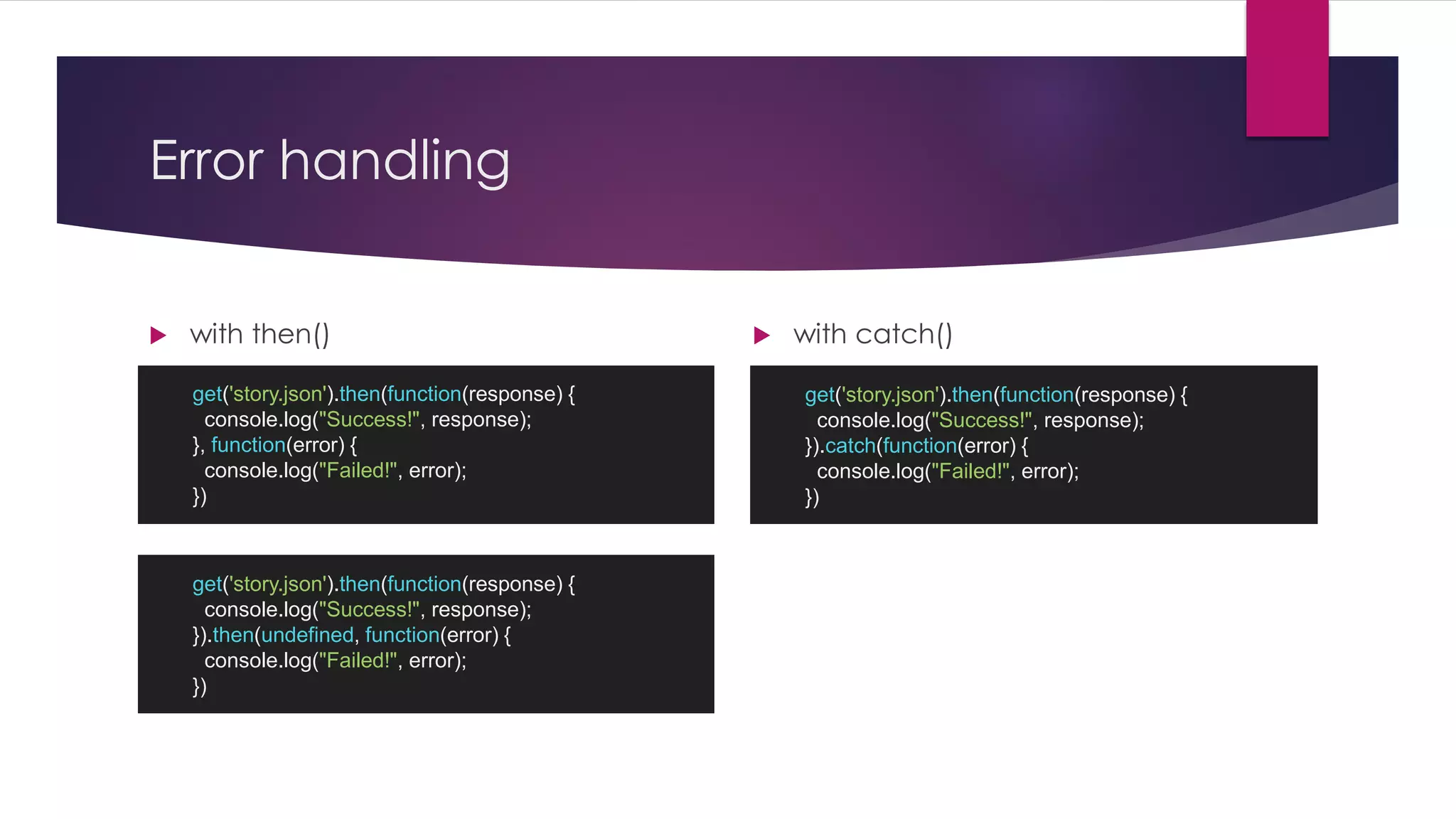
 with then()  with catch()
get('story.json').then(function(response) {
console.log("Success!", response);
}, function(error) {
console.log("Failed!", error);
})
get('story.json').then(function(response) {
console.log("Success!", response);
}).catch(function(error) {
console.log("Failed!", error);
})
get('story.json').then(function(response) {
console.log("Success!", response);
}).then(undefined, function(error) {
console.log("Failed!", error);
})
Error handling
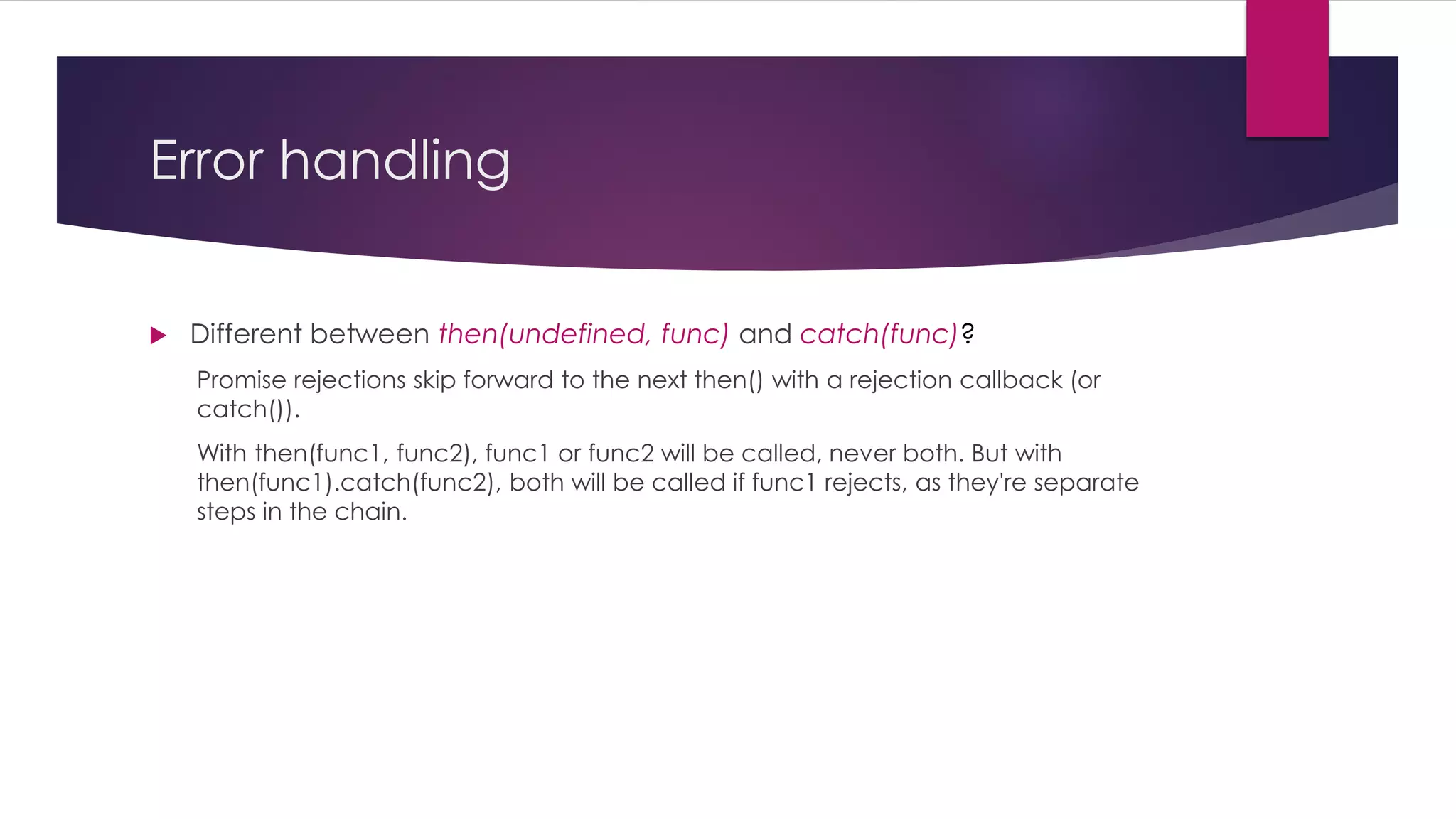
 Different between then(undefined, func) and catch(func)?
Promise rejections skip forward to the next then() with a rejection callback (or
catch()).
With then(func1, func2), func1 or func2 will be called, never both. But with
then(func1).catch(func2), both will be called if func1 rejects, as they're separate
steps in the chain.
Error handling
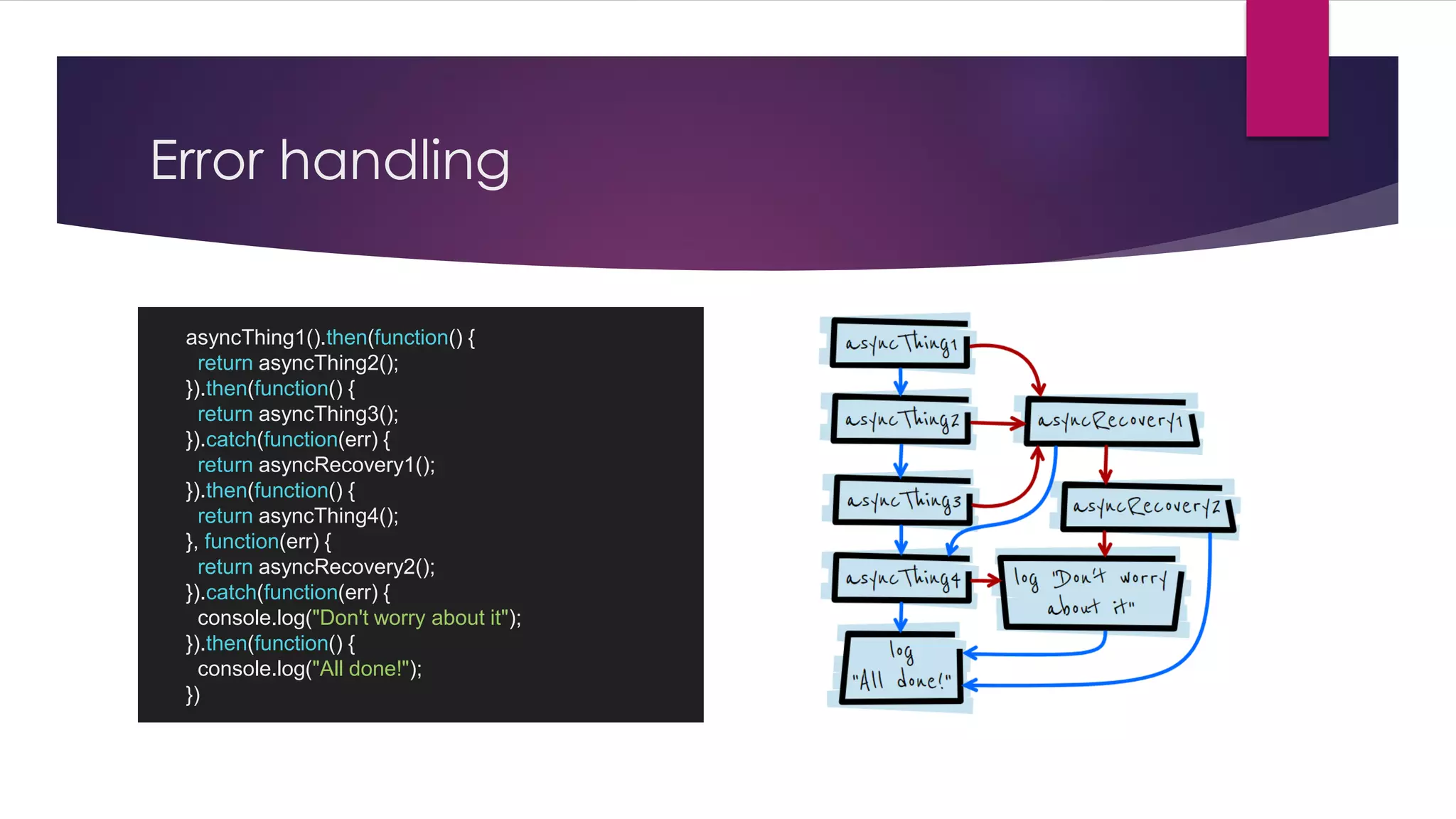
asyncThing1().then(function() {
return asyncThing2();
}).then(function() {
return asyncThing3();
}).catch(function(err) {
return asyncRecovery1();
}).then(function() {
return asyncThing4();
}, function(err) {
return asyncRecovery2();
}).catch(function(err) {
console.log("Don't worry about it");
}).then(function() {
console.log("All done!");
})
Promise.all()
Returns a promise that either fulfills when all of the promises in the iterable
argument have fulfilled or rejects as soon as one of the promises in the
iterable argument rejects.
Promise.race()
Returns a promise that fulfills or rejects as soon as one of the promises in the
iterable fulfills or rejects, with the value or reason from that promise.
SUMMARY

Asynchronous JavaScript Programming with Callbacks & Promises

  • 1.
    Callbacks & Promisesin JS Presentation by Hung Nguyen Huy
  • 2.
    Contents 1. Introduction 2. Asynchronousprocessing in JavaScript 3. Callbacks & Callback hell 4. Promises arrive in JavaScript! 5. Constructing a Promise 6. Promise states 7. Promises chaining & transformation 8. Error handling 9. Promise.all() & Promise.race() 10. Summary
  • 3.
    Introduction JavaScript is asingle-threaded and asynchronous programming language. one thread == one call stack == one thing at a time
  • 4.
    Asynchronous vs Synchronous Synchronous Processing In synchronous programs, if you have two lines of code (L1 followed by L2), then L2 can not begin running until L1 has finished executing.  Asynchronous Processing In asynchronous programs, you can have two lines of code (L1 followed by L2), where L1 schedules some task to be run in the future, but L2 runs before that task completes.
  • 5.
  • 6.
    Callbacks A callback functionis a function passed into another function as an argument, which is then invoked inside the outer function to complete some kind of routine or action.
  • 7.
    Async callbacks &Callback hell  Asynchronous callback Callbacks are often used to continue code execution after an asynchronous operation has completed - these are called asynchronous callbacks.  Callback hell Chain of asynchronous operations => Hard to read & debug code.
  • 8.
    Promises arrive inJavaScript! Getting rid of callback hell!
  • 9.
    What is Promise? Promiseis an object which represents the eventual completion or failure of an asynchronous operation, and its resulting value.
  • 10.
    Constructing a Promise We use new Promise to construct the promise  We give the constructor a executor function which does the actual work.  Executor function is passed with 2 arguments: resolve and reject functions.  Resolve function fulfills the promise and reject function rejects the promise. new Promise( /* executor */ function(resolve, reject) { ... } );
  • 11.
    Promise states A Promiseis in one of these 3 states:  pending: initial state, neither fulfilled nor rejected.  fulfilled: meaning that the operation completed successfully.  rejected: meaning that the operation failed.
  • 12.
    Using the Promiseobject  A pending promise can either be fulfilled with a value, or rejected with a reason (error).  When either of these options happens, the associated handlers queued up by a promise's then method are called.
  • 13.
    then() and catch() then() Takes up to two arguments: callback functions for the success and failure cases of the Promise. It returns a Promise. p.then(onFulfilled[, onRejected]); p.then(function(value) { // fulfillment }, function(reason) { // rejection });  catch() Take only one argument to deal with rejected cases only. It returns a Promise. p.catch(onRejected); p.catch(function(reason) { // rejection });
  • 14.
    Promises chaining &transformation As the then() and catch() methods return promises, they can be chained.
  • 15.
    Error handling  withthen()  with catch() get('story.json').then(function(response) { console.log("Success!", response); }, function(error) { console.log("Failed!", error); }) get('story.json').then(function(response) { console.log("Success!", response); }).catch(function(error) { console.log("Failed!", error); }) get('story.json').then(function(response) { console.log("Success!", response); }).then(undefined, function(error) { console.log("Failed!", error); })
  • 16.
    Error handling  Differentbetween then(undefined, func) and catch(func)? Promise rejections skip forward to the next then() with a rejection callback (or catch()). With then(func1, func2), func1 or func2 will be called, never both. But with then(func1).catch(func2), both will be called if func1 rejects, as they're separate steps in the chain.
  • 17.
    Error handling asyncThing1().then(function() { returnasyncThing2(); }).then(function() { return asyncThing3(); }).catch(function(err) { return asyncRecovery1(); }).then(function() { return asyncThing4(); }, function(err) { return asyncRecovery2(); }).catch(function(err) { console.log("Don't worry about it"); }).then(function() { console.log("All done!"); })
  • 18.
    Promise.all() Returns a promisethat either fulfills when all of the promises in the iterable argument have fulfilled or rejects as soon as one of the promises in the iterable argument rejects.
  • 19.
    Promise.race() Returns a promisethat fulfills or rejects as soon as one of the promises in the iterable fulfills or rejects, with the value or reason from that promise.
  • 20.