Automata Theory and Logic
Regular Language & Regular Expression
A TUTORIAL
BY
ANIMESH CHATURVEDI
AT
INDIAN INSTITUTE OF TECHNOLOGY INDORE (IIT-I)
DFA, NFA, Regular Expression (RegEx)
and Regular Language (RegLang)
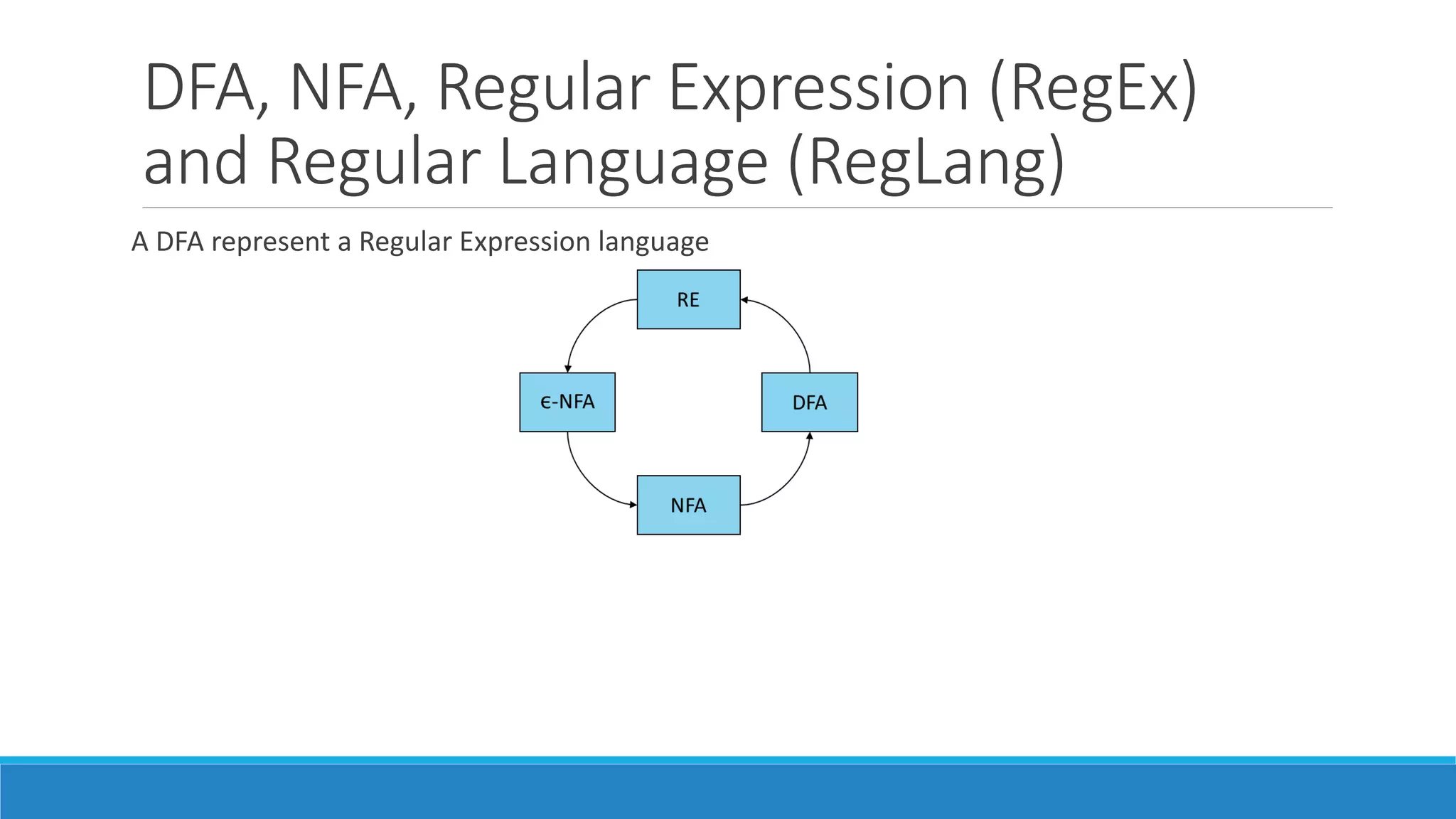
A DFA represent a Regular Expression language
Regular Expression Regular Language
(0 + 10∗)
(0∗ 10∗)
(0 + ε)(1 + ε)
(a + b)*
(a + b)* abb
(11)*
(aa)*(bb)*b
(aa + ab + ba +bb)*
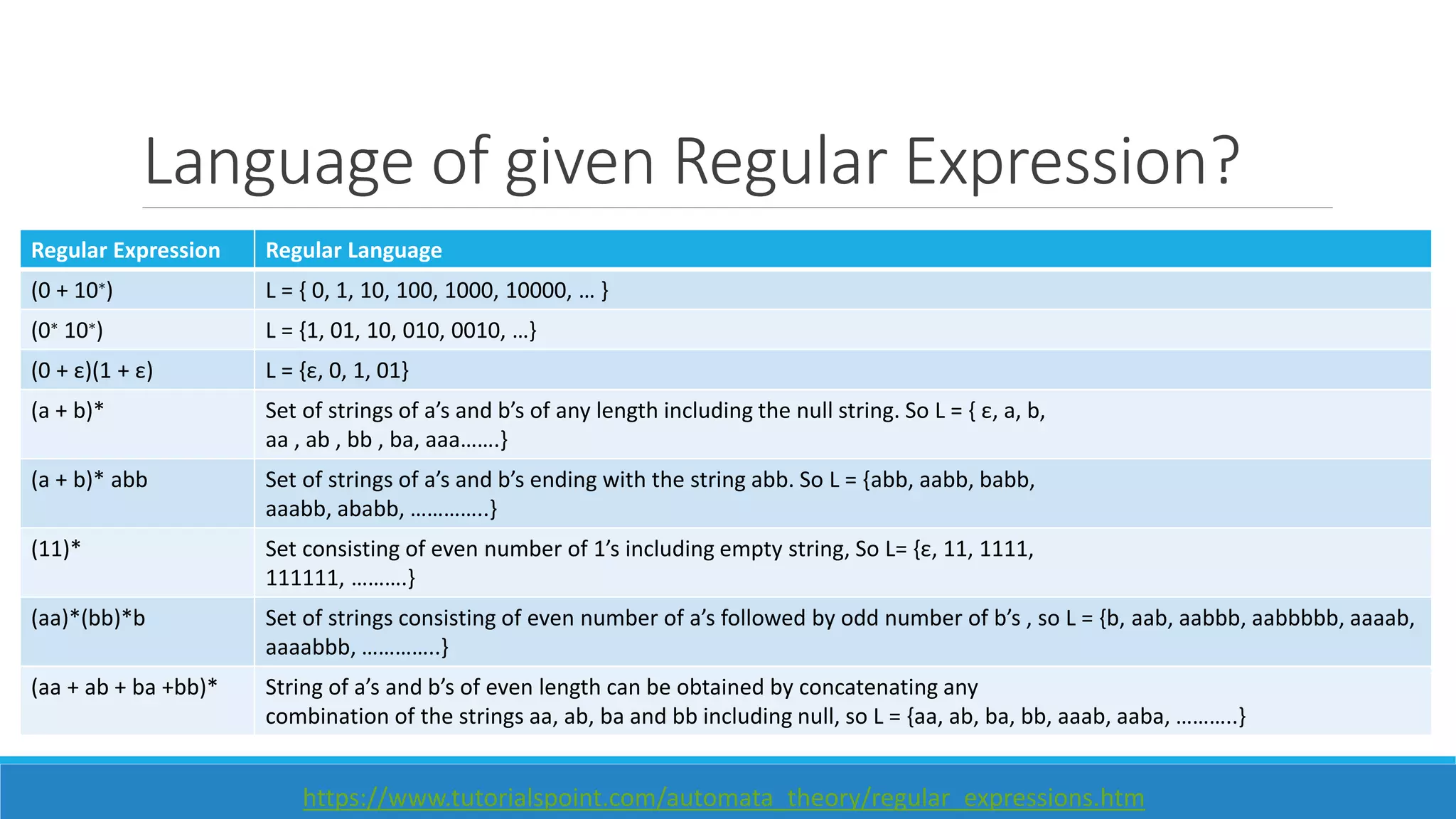
Language of given Regular Expression?
https://www.tutorialspoint.com/automata_theory/regular_expressions.htm
Regular Expression Regular Language
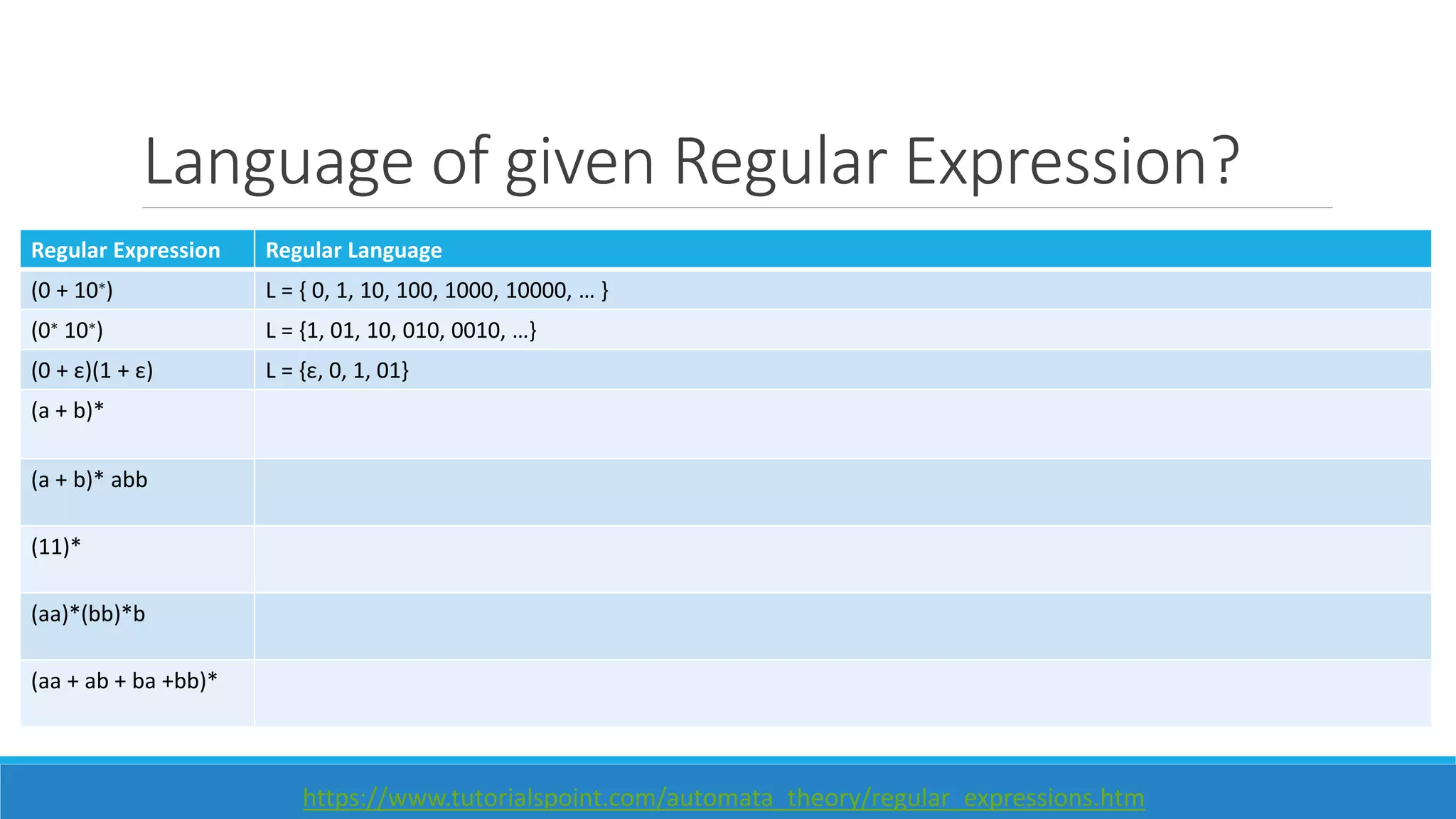
(0 + 10∗) L = { 0, 1, 10, 100, 1000, 10000, … }
(0∗ 10∗) L = {1, 01, 10, 010, 0010, …}
(0 + ε)(1 + ε) L = {ε, 0, 1, 01}
(a + b)*
(a + b)* abb
(11)*
(aa)*(bb)*b
(aa + ab + ba +bb)*
Language of given Regular Expression?
https://www.tutorialspoint.com/automata_theory/regular_expressions.htm
Regular Expression Regular Language
(0 + 10∗) L = { 0, 1, 10, 100, 1000, 10000, … }
(0∗ 10∗) L = {1, 01, 10, 010, 0010, …}
(0 + ε)(1 + ε) L = {ε, 0, 1, 01}
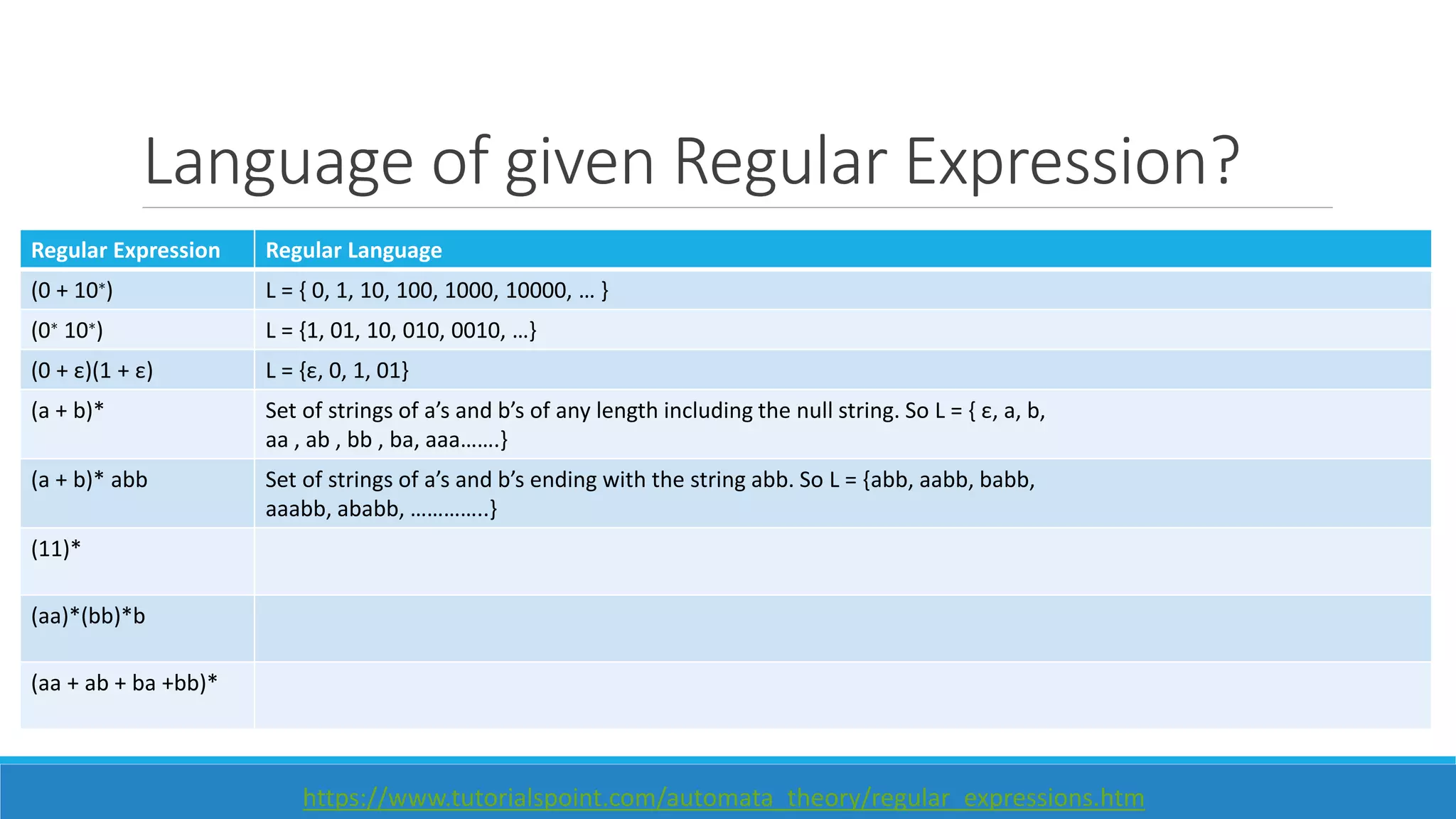
(a + b)* Set of strings of a’s and b’s of any length including the null string. So L = { ε, a, b,
aa , ab , bb , ba, aaa…….}
(a + b)* abb Set of strings of a’s and b’s ending with the string abb. So L = {abb, aabb, babb,
aaabb, ababb, …………..}
(11)*
(aa)*(bb)*b
(aa + ab + ba +bb)*
Language of given Regular Expression?
https://www.tutorialspoint.com/automata_theory/regular_expressions.htm
Regular Expression Regular Language
(0 + 10∗) L = { 0, 1, 10, 100, 1000, 10000, … }
(0∗ 10∗) L = {1, 01, 10, 010, 0010, …}
(0 + ε)(1 + ε) L = {ε, 0, 1, 01}
(a + b)* Set of strings of a’s and b’s of any length including the null string. So L = { ε, a, b,
aa , ab , bb , ba, aaa…….}
(a + b)* abb Set of strings of a’s and b’s ending with the string abb. So L = {abb, aabb, babb,
aaabb, ababb, …………..}
(11)* Set consisting of even number of 1’s including empty string, So L= {ε, 11, 1111,
111111, ……….}
(aa)*(bb)*b Set of strings consisting of even number of a’s followed by odd number of b’s , so L = {b, aab, aabbb, aabbbbb, aaaab,
aaaabbb, …………..}
(aa + ab + ba +bb)* String of a’s and b’s of even length can be obtained by concatenating any
combination of the strings aa, ab, ba and bb including null, so L = {aa, ab, ba, bb, aaab, aaba, ………..}
Language of given Regular Expression?
https://www.tutorialspoint.com/automata_theory/regular_expressions.htm
Number of states for a given language
Definition of a language L with alphabet {a} is given as following
L = {ank | k > 0, and n is a positive integer constant}
What is the minimum number of states needed in a DFA to recognize L?
Computer Science GATE 2011
Number of states for a given language
Definition of a language L with alphabet {a} is given as following
L = {ank | k > 0, and n is a positive integer constant}
What is the minimum number of states needed in a DFA to recognize L?
n+1 states are needed in a DFA to recognize L
Let n = 3 and k=1
3+1 = 4 states
Computer Science GATE 2011
Minimal DFA for a given language
Draw a minimal DFA which accepts the same language as a DFA with alphabet ∑ = {0, 1} is given
below {0, 1} ∪ {x ∈ {0, 1}∗ | len(x) ≥ 3}
Konrad Slind Notes on Computation Theory, September 21, 2010
Minimal DFA for a given language
Draw a minimal DFA which accepts the same language as a DFA with alphabet ∑ = {0, 1} is given
below {0, 1} ∪ {x ∈ {0, 1}∗ | len(x) ≥ 3}
Konrad Slind Notes on Computation Theory, September 21, 2010
Minimal DFA for a given language
Draw a minimal DFA which accepts the same language as a DFA with alphabet ∑ = {0, 1} is given
below {0, 1} ∪ {x ∈ {0, 1}∗ | len(x) ≥ 3}
Konrad Slind Notes on Computation Theory, September 21, 2010
Minimal DFA for a given language
Draw a minimal DFA which accepts the same language as a DFA with alphabet ∑ = {0, 1} is given
below {0, 1} ∪ {x ∈ {0, 1}∗ | len(x) ≥ 3}
Konrad Slind Notes on Computation Theory, September 21, 2010
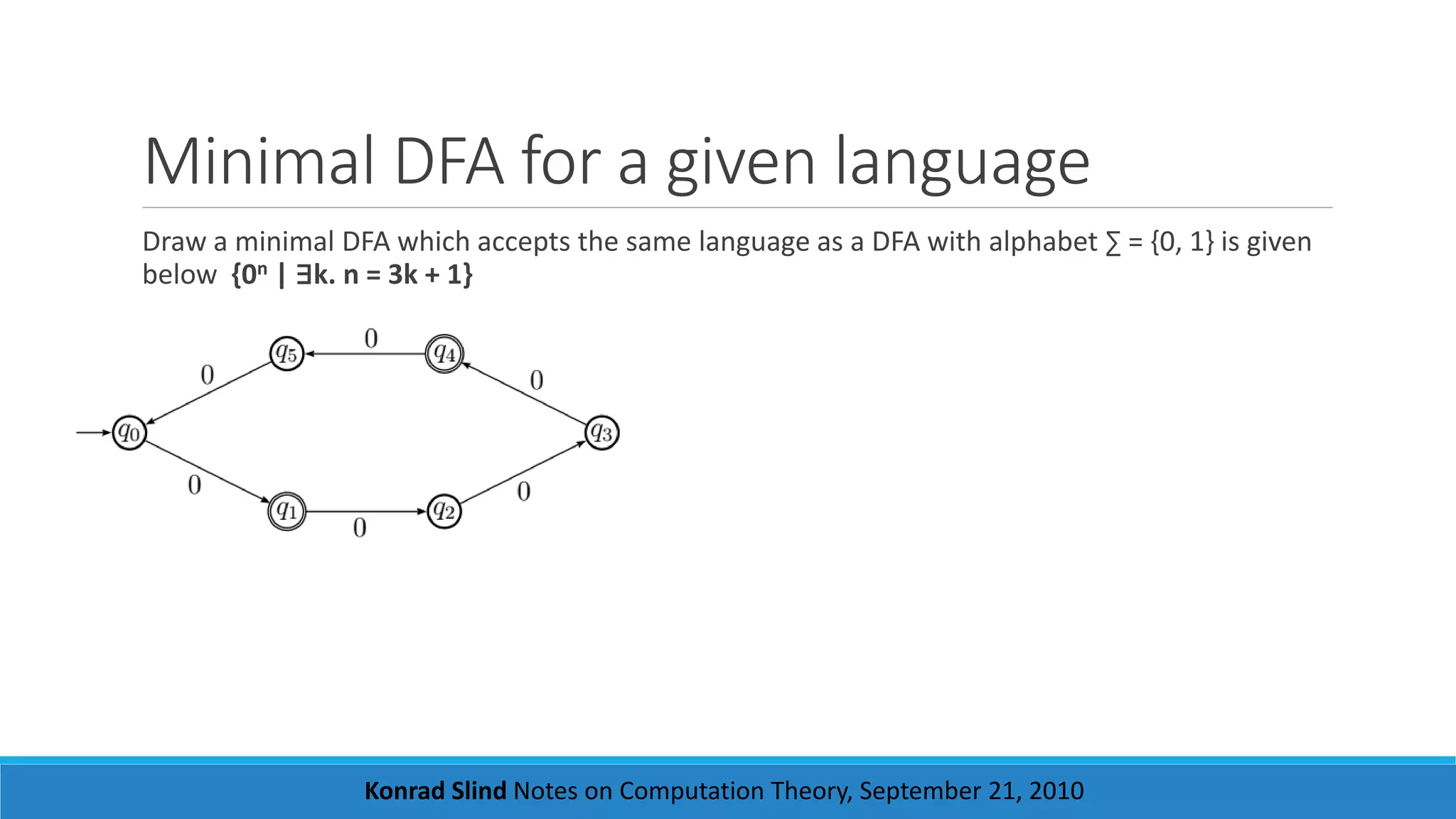
Minimal DFA for a given language
Draw a minimal DFA which accepts the same language as a DFA with alphabet ∑ = {0, 1} is given
below {0n | ∃k. n = 3k + 1}
Konrad Slind Notes on Computation Theory, September 21, 2010
Minimal DFA for a given language
Draw a minimal DFA which accepts the same language as a DFA with alphabet ∑ = {0, 1} is given
below {0n | ∃k. n = 3k + 1}
Konrad Slind Notes on Computation Theory, September 21, 2010
Minimal DFA for a given language
Draw a minimal DFA which accepts the same language as a DFA with alphabet ∑ = {0, 1} is given
below {0n | ∃k. n = 3k + 1}
Konrad Slind Notes on Computation Theory, September 21, 2010
Convert NFA to DFA for a given RegEx
Construct DFA to accept 00(0+1)*
Dr. Ding-Zhu Du http://www.utdallas.edu/~dzdu/cs4384/lect7.ppt
Convert NFA to DFA for a given RegEx
Construct DFA to accept 00(0+1)*
Dr. Ding-Zhu Du http://www.utdallas.edu/~dzdu/cs4384/lect7.ppt
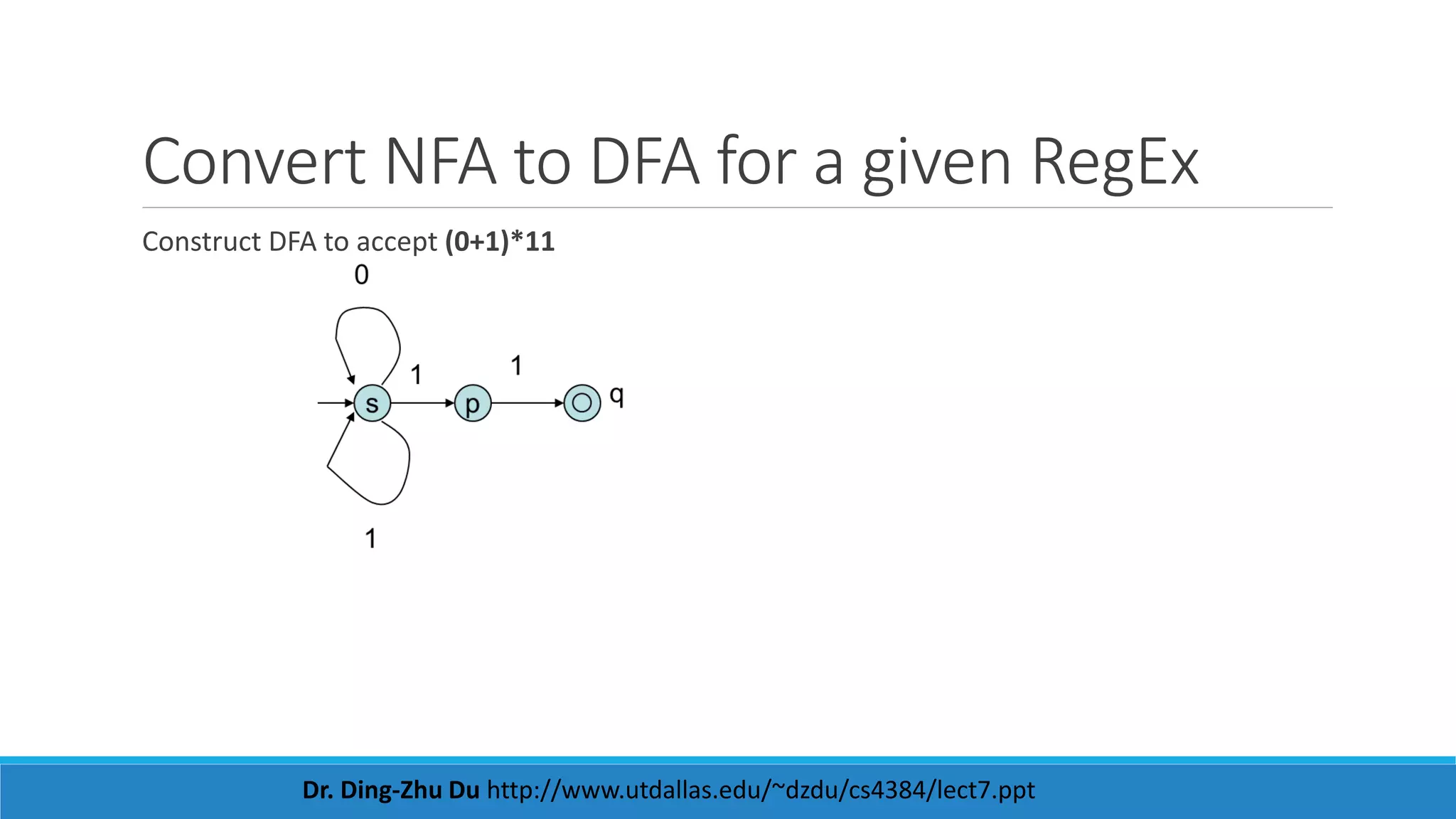
Convert NFA to DFA for a given RegEx
Construct DFA to accept (0+1)*11
Dr. Ding-Zhu Du http://www.utdallas.edu/~dzdu/cs4384/lect7.ppt
Convert NFA to DFA for a given RegEx
Construct DFA to accept (0+1)*11
Dr. Ding-Zhu Du http://www.utdallas.edu/~dzdu/cs4384/lect7.ppt
Convert NFA to DFA for a given RegEx
Construct DFA to accept 00(0+1)*11
Dr. Ding-Zhu Du http://www.utdallas.edu/~dzdu/cs4384/lect7.ppt
Convert NFA to DFA for a given RegEx
Construct DFA to accept 00(0+1)*11
Dr. Ding-Zhu Du http://www.utdallas.edu/~dzdu/cs4384/lect7.ppt
Convert NFA to DFA for a given RegLang
Construct DFA to accept L(M)=ε
Dr. Ding-Zhu Du http://www.utdallas.edu/~dzdu/cs4384/lect7.ppt
Convert NFA to DFA for a given RegLang
Construct DFA to accept L(M)=ε
Dr. Ding-Zhu Du http://www.utdallas.edu/~dzdu/cs4384/lect7.ppt
Convert NFA to DFA for a given RegLang
Construct DFA to accept L(M)=Ǿ
Dr. Ding-Zhu Du http://www.utdallas.edu/~dzdu/cs4384/lect7.ppt
Convert NFA to DFA for a given RegLang
Construct DFA to accept L(M)=Ǿ
Dr. Ding-Zhu Du http://www.utdallas.edu/~dzdu/cs4384/lect7.ppt
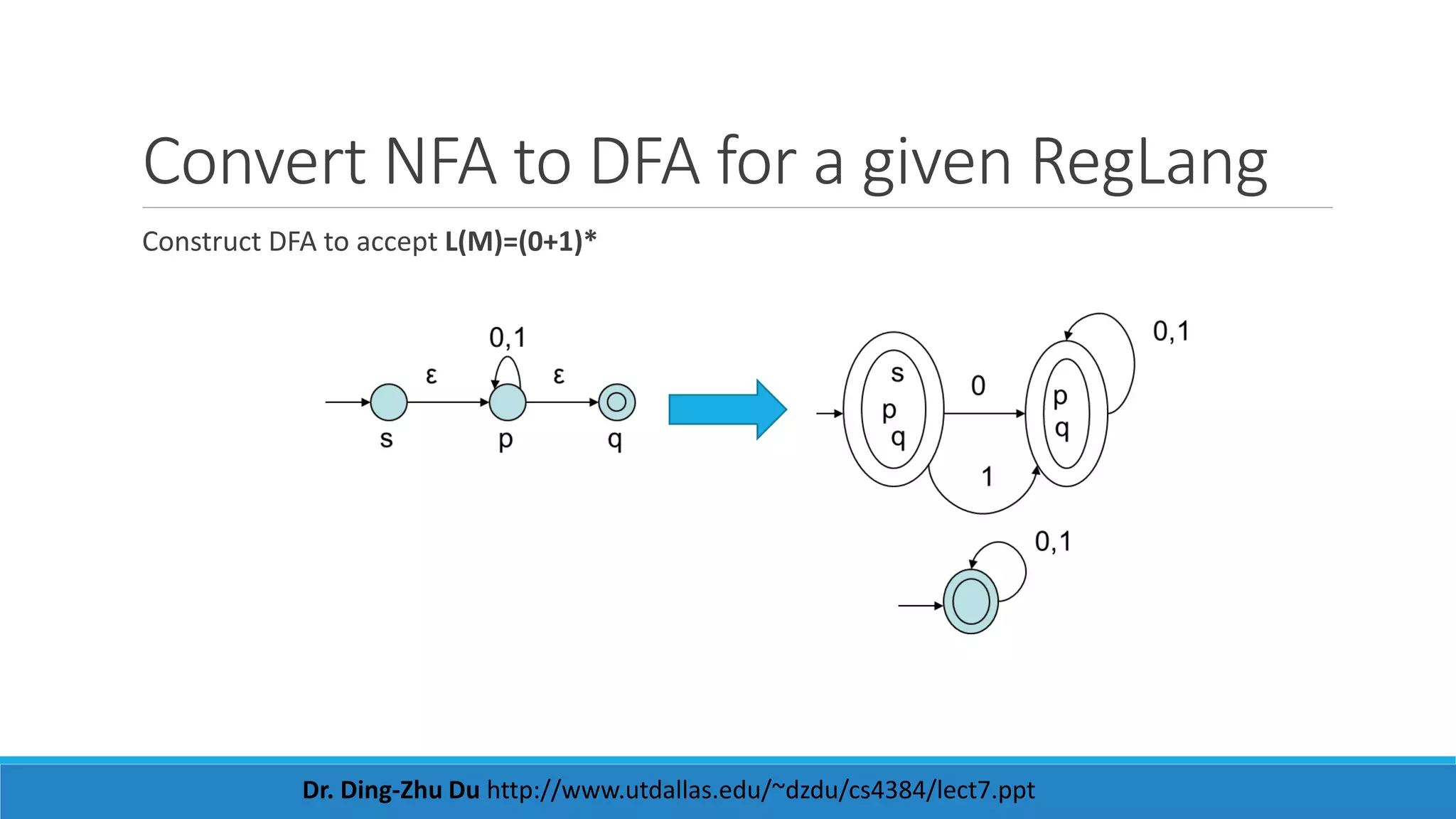
Convert NFA to DFA for a given RegLang
Construct DFA to accept L(M)=(0+1)*
Dr. Ding-Zhu Du http://www.utdallas.edu/~dzdu/cs4384/lect7.ppt
Convert NFA to DFA for a given RegLang
Construct DFA to accept L(M)=(0+1)*
Dr. Ding-Zhu Du http://www.utdallas.edu/~dzdu/cs4384/lect7.ppt
Regular Expression
What is the language accepted by the NFA for one literal {a} show below?
Assume ε is the empty string
Computer Science GATE 2012
Regular Expression
What is the language accepted by the NFA for one literal {a} show below?
Assume ε is the empty string
Language accepted by NFA is a+, so complement of this language is {є}
Computer Science GATE 2012
What is the DFA & Regular expression?
30Lexical Analysis by Prof. O. Nierstrasz
Example: the set of strings containing an even number of zeros and an even number of ones
What is the DFA & Regular expression?
31Lexical Analysis by Prof. O. Nierstrasz
Example: the set of strings containing an even number of zeros and an even number of ones
What is the DFA & Regular expression?
32Lexical Analysis by Prof. O. Nierstrasz
Example: the set of strings containing an even number of zeros and an even number of ones
The RE is (0011)*((0110)(0011)*(0110)(0011)*)*
Draw NFA for given regular expressions
33Lexical Analysis by Prof. O. Nierstrasz
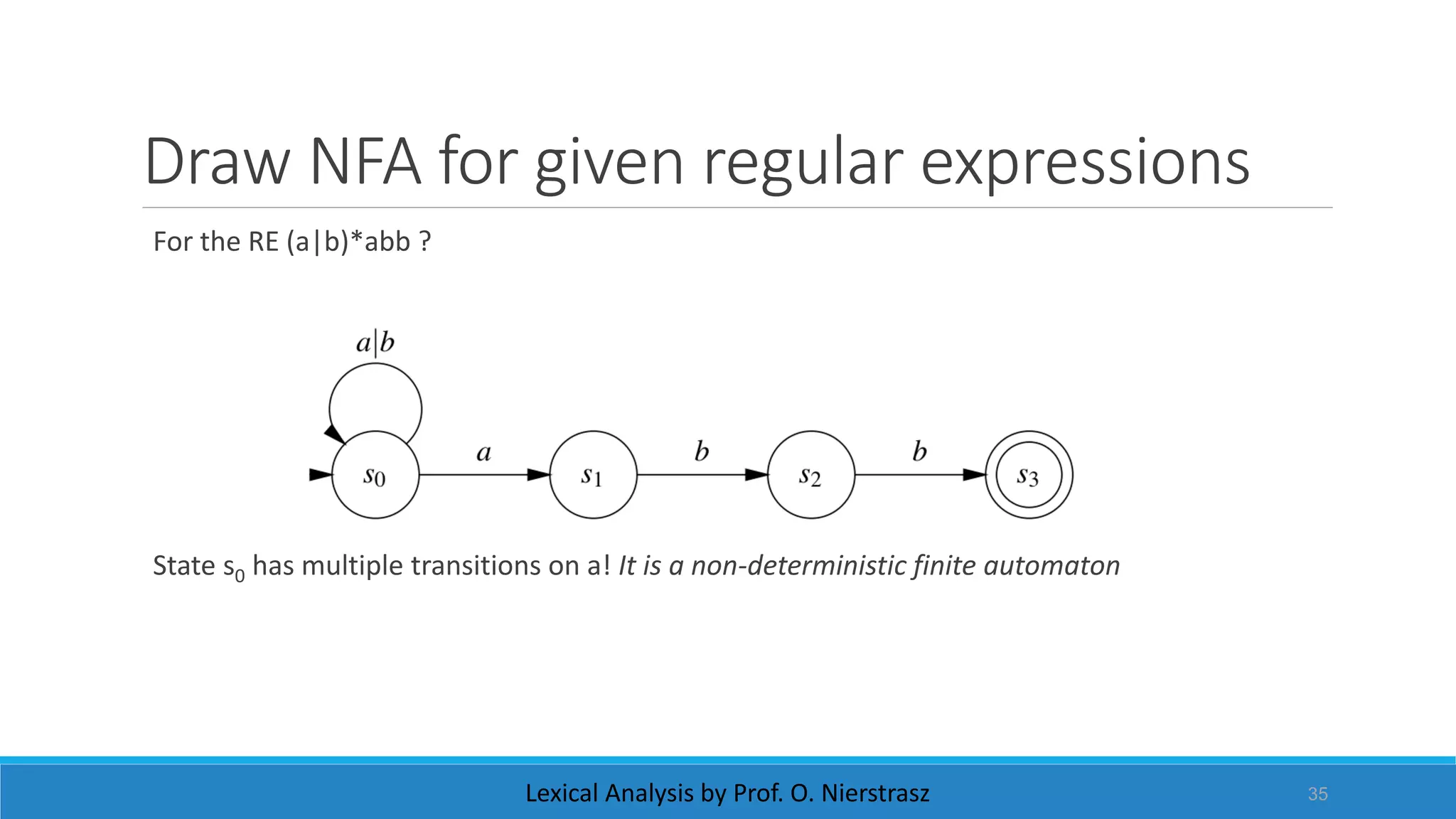
For the RE (a|b)*abb ?
Draw NFA for given regular expressions
34Lexical Analysis by Prof. O. Nierstrasz
For the RE (a|b)*abb ?
Draw NFA for given regular expressions
35
For the RE (a|b)*abb ?
State s0 has multiple transitions on a! It is a non-deterministic finite automaton
Lexical Analysis by Prof. O. Nierstrasz
36
A language is regular if it is recognized by
a deterministic finite automaton
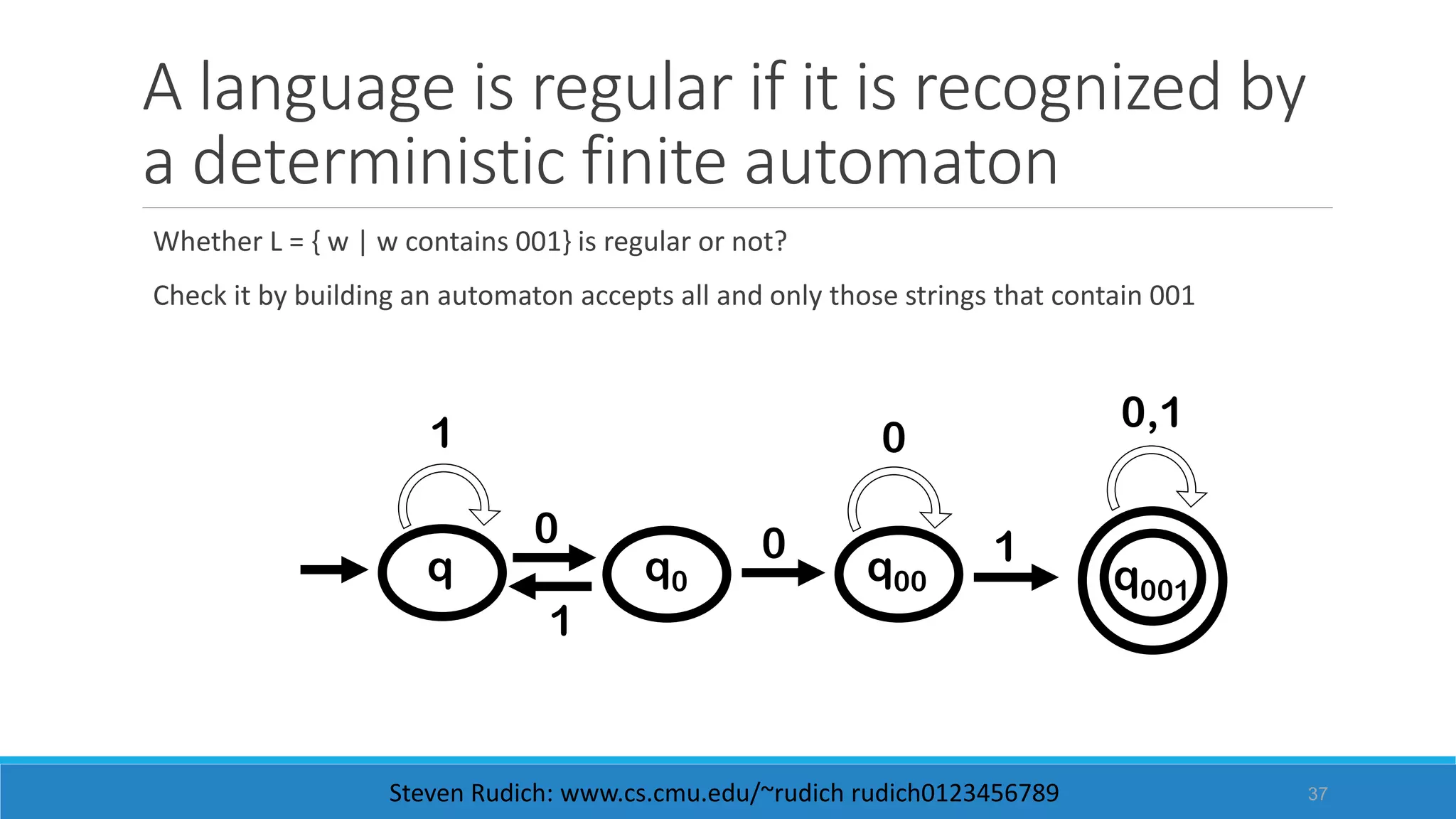
Whether L = { w | w contains 001} is regular or not?
Check it by building an automaton accepts all and only those strings that contain 001
Steven Rudich: www.cs.cmu.edu/~rudich rudich0123456789
37
q q00
1 0
1
q0 q001
0 0 1
0,1
A language is regular if it is recognized by
a deterministic finite automaton
Whether L = { w | w contains 001} is regular or not?
Check it by building an automaton accepts all and only those strings that contain 001
Steven Rudich: www.cs.cmu.edu/~rudich rudich0123456789
A language is regular if it is recognized by
a deterministic finite automaton
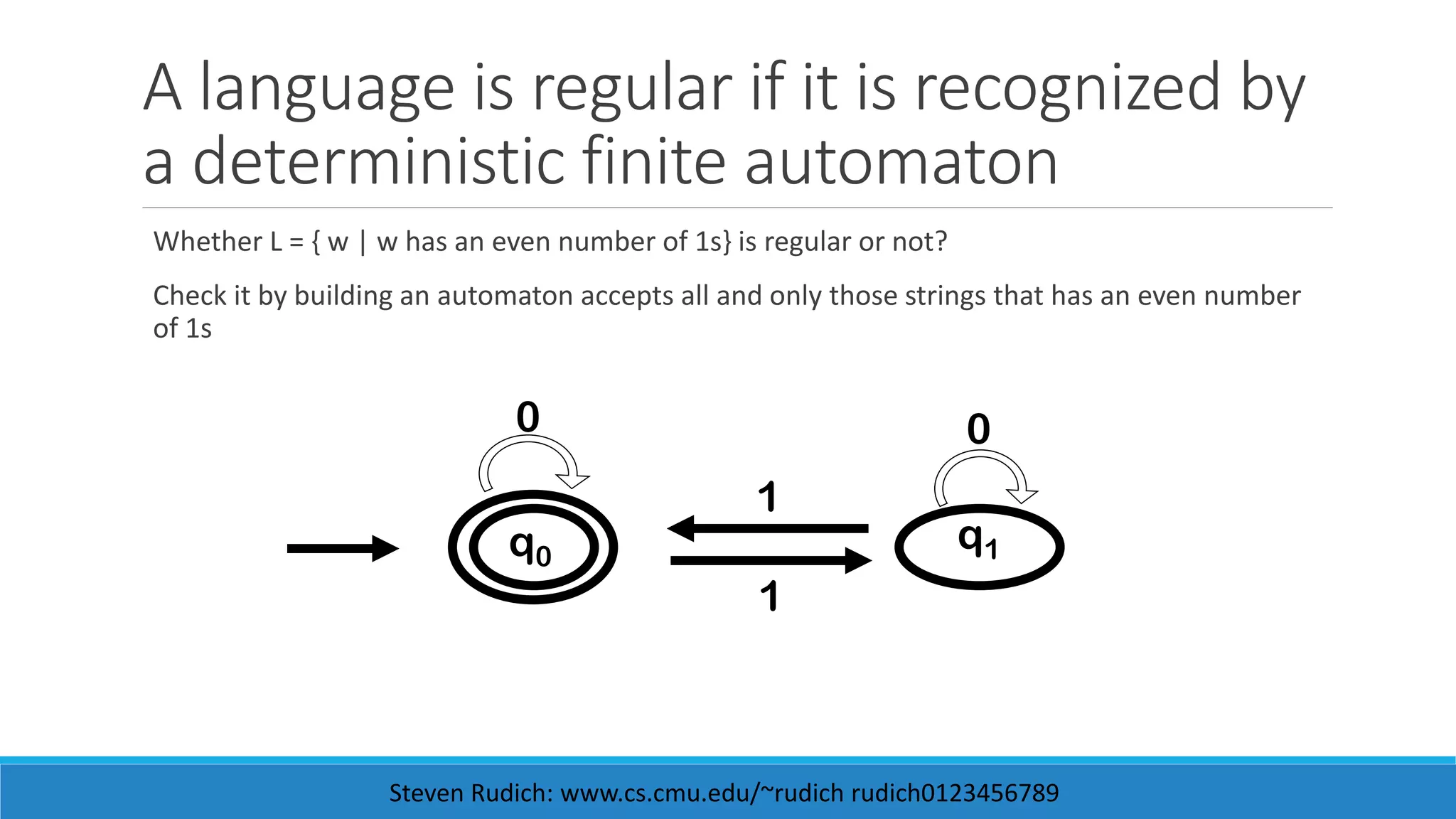
Whether L = { w | w has an even number of 1s} is regular or not?
Check it by building an automaton accepts all and only those strings that has an even number
of 1s
Steven Rudich: www.cs.cmu.edu/~rudich rudich0123456789
A language is regular if it is recognized by
a deterministic finite automaton
q0
q1
0 0
1
1
Whether L = { w | w has an even number of 1s} is regular or not?
Check it by building an automaton accepts all and only those strings that has an even number
of 1s
Steven Rudich: www.cs.cmu.edu/~rudich rudich0123456789
References
https://www.tutorialspoint.com/automata_theory/regular_expressions.htm
Slides modified by Benny Chor, based on original slides by Maurice Herlihy, Brown University
http://www.cs.tau.ac.il/~orilahav/CompModelFall10/Compute2-print.pdf
Slide by: Dr. Harry H. Porter http://web.cecs.pdx.edu/~harry/compilers/slides/LexicalPart3.pdf
Slide by Dr. Ding-Zhu Du http://www.utdallas.edu/~dzdu/cs4384/lect7.ppt
Prof. Shunichi Toida http://www.cs.odu.edu/~toida/nerzic/390teched/regular/fa/nfa-2-dfa.html
Konrad Slind Notes on Computation Theory, September 21, 2010
Lexical Analysis by Prof. O. Nierstrasz
GATE (Graduate Aptitude Test of Engineering) jointly conducted by IIT’s
Regular language and Regular expression

Regular language and Regular expression

  • 1.
    Automata Theory andLogic Regular Language & Regular Expression A TUTORIAL BY ANIMESH CHATURVEDI AT INDIAN INSTITUTE OF TECHNOLOGY INDORE (IIT-I)
  • 2.
    DFA, NFA, RegularExpression (RegEx) and Regular Language (RegLang) A DFA represent a Regular Expression language
  • 3.
    Regular Expression RegularLanguage (0 + 10∗) (0∗ 10∗) (0 + ε)(1 + ε) (a + b)* (a + b)* abb (11)* (aa)*(bb)*b (aa + ab + ba +bb)* Language of given Regular Expression? https://www.tutorialspoint.com/automata_theory/regular_expressions.htm
  • 4.
    Regular Expression RegularLanguage (0 + 10∗) L = { 0, 1, 10, 100, 1000, 10000, … } (0∗ 10∗) L = {1, 01, 10, 010, 0010, …} (0 + ε)(1 + ε) L = {ε, 0, 1, 01} (a + b)* (a + b)* abb (11)* (aa)*(bb)*b (aa + ab + ba +bb)* Language of given Regular Expression? https://www.tutorialspoint.com/automata_theory/regular_expressions.htm
  • 5.
    Regular Expression RegularLanguage (0 + 10∗) L = { 0, 1, 10, 100, 1000, 10000, … } (0∗ 10∗) L = {1, 01, 10, 010, 0010, …} (0 + ε)(1 + ε) L = {ε, 0, 1, 01} (a + b)* Set of strings of a’s and b’s of any length including the null string. So L = { ε, a, b, aa , ab , bb , ba, aaa…….} (a + b)* abb Set of strings of a’s and b’s ending with the string abb. So L = {abb, aabb, babb, aaabb, ababb, …………..} (11)* (aa)*(bb)*b (aa + ab + ba +bb)* Language of given Regular Expression? https://www.tutorialspoint.com/automata_theory/regular_expressions.htm
  • 6.
    Regular Expression RegularLanguage (0 + 10∗) L = { 0, 1, 10, 100, 1000, 10000, … } (0∗ 10∗) L = {1, 01, 10, 010, 0010, …} (0 + ε)(1 + ε) L = {ε, 0, 1, 01} (a + b)* Set of strings of a’s and b’s of any length including the null string. So L = { ε, a, b, aa , ab , bb , ba, aaa…….} (a + b)* abb Set of strings of a’s and b’s ending with the string abb. So L = {abb, aabb, babb, aaabb, ababb, …………..} (11)* Set consisting of even number of 1’s including empty string, So L= {ε, 11, 1111, 111111, ……….} (aa)*(bb)*b Set of strings consisting of even number of a’s followed by odd number of b’s , so L = {b, aab, aabbb, aabbbbb, aaaab, aaaabbb, …………..} (aa + ab + ba +bb)* String of a’s and b’s of even length can be obtained by concatenating any combination of the strings aa, ab, ba and bb including null, so L = {aa, ab, ba, bb, aaab, aaba, ………..} Language of given Regular Expression? https://www.tutorialspoint.com/automata_theory/regular_expressions.htm
  • 7.
    Number of statesfor a given language Definition of a language L with alphabet {a} is given as following L = {ank | k > 0, and n is a positive integer constant} What is the minimum number of states needed in a DFA to recognize L? Computer Science GATE 2011
  • 8.
    Number of statesfor a given language Definition of a language L with alphabet {a} is given as following L = {ank | k > 0, and n is a positive integer constant} What is the minimum number of states needed in a DFA to recognize L? n+1 states are needed in a DFA to recognize L Let n = 3 and k=1 3+1 = 4 states Computer Science GATE 2011
  • 9.
    Minimal DFA fora given language Draw a minimal DFA which accepts the same language as a DFA with alphabet ∑ = {0, 1} is given below {0, 1} ∪ {x ∈ {0, 1}∗ | len(x) ≥ 3} Konrad Slind Notes on Computation Theory, September 21, 2010
  • 10.
    Minimal DFA fora given language Draw a minimal DFA which accepts the same language as a DFA with alphabet ∑ = {0, 1} is given below {0, 1} ∪ {x ∈ {0, 1}∗ | len(x) ≥ 3} Konrad Slind Notes on Computation Theory, September 21, 2010
  • 11.
    Minimal DFA fora given language Draw a minimal DFA which accepts the same language as a DFA with alphabet ∑ = {0, 1} is given below {0, 1} ∪ {x ∈ {0, 1}∗ | len(x) ≥ 3} Konrad Slind Notes on Computation Theory, September 21, 2010
  • 12.
    Minimal DFA fora given language Draw a minimal DFA which accepts the same language as a DFA with alphabet ∑ = {0, 1} is given below {0, 1} ∪ {x ∈ {0, 1}∗ | len(x) ≥ 3} Konrad Slind Notes on Computation Theory, September 21, 2010
  • 13.
    Minimal DFA fora given language Draw a minimal DFA which accepts the same language as a DFA with alphabet ∑ = {0, 1} is given below {0n | ∃k. n = 3k + 1} Konrad Slind Notes on Computation Theory, September 21, 2010
  • 14.
    Minimal DFA fora given language Draw a minimal DFA which accepts the same language as a DFA with alphabet ∑ = {0, 1} is given below {0n | ∃k. n = 3k + 1} Konrad Slind Notes on Computation Theory, September 21, 2010
  • 15.
    Minimal DFA fora given language Draw a minimal DFA which accepts the same language as a DFA with alphabet ∑ = {0, 1} is given below {0n | ∃k. n = 3k + 1} Konrad Slind Notes on Computation Theory, September 21, 2010
  • 16.
    Convert NFA toDFA for a given RegEx Construct DFA to accept 00(0+1)* Dr. Ding-Zhu Du http://www.utdallas.edu/~dzdu/cs4384/lect7.ppt
  • 17.
    Convert NFA toDFA for a given RegEx Construct DFA to accept 00(0+1)* Dr. Ding-Zhu Du http://www.utdallas.edu/~dzdu/cs4384/lect7.ppt
  • 18.
    Convert NFA toDFA for a given RegEx Construct DFA to accept (0+1)*11 Dr. Ding-Zhu Du http://www.utdallas.edu/~dzdu/cs4384/lect7.ppt
  • 19.
    Convert NFA toDFA for a given RegEx Construct DFA to accept (0+1)*11 Dr. Ding-Zhu Du http://www.utdallas.edu/~dzdu/cs4384/lect7.ppt
  • 20.
    Convert NFA toDFA for a given RegEx Construct DFA to accept 00(0+1)*11 Dr. Ding-Zhu Du http://www.utdallas.edu/~dzdu/cs4384/lect7.ppt
  • 21.
    Convert NFA toDFA for a given RegEx Construct DFA to accept 00(0+1)*11 Dr. Ding-Zhu Du http://www.utdallas.edu/~dzdu/cs4384/lect7.ppt
  • 22.
    Convert NFA toDFA for a given RegLang Construct DFA to accept L(M)=ε Dr. Ding-Zhu Du http://www.utdallas.edu/~dzdu/cs4384/lect7.ppt
  • 23.
    Convert NFA toDFA for a given RegLang Construct DFA to accept L(M)=ε Dr. Ding-Zhu Du http://www.utdallas.edu/~dzdu/cs4384/lect7.ppt
  • 24.
    Convert NFA toDFA for a given RegLang Construct DFA to accept L(M)=Ǿ Dr. Ding-Zhu Du http://www.utdallas.edu/~dzdu/cs4384/lect7.ppt
  • 25.
    Convert NFA toDFA for a given RegLang Construct DFA to accept L(M)=Ǿ Dr. Ding-Zhu Du http://www.utdallas.edu/~dzdu/cs4384/lect7.ppt
  • 26.
    Convert NFA toDFA for a given RegLang Construct DFA to accept L(M)=(0+1)* Dr. Ding-Zhu Du http://www.utdallas.edu/~dzdu/cs4384/lect7.ppt
  • 27.
    Convert NFA toDFA for a given RegLang Construct DFA to accept L(M)=(0+1)* Dr. Ding-Zhu Du http://www.utdallas.edu/~dzdu/cs4384/lect7.ppt
  • 28.
    Regular Expression What isthe language accepted by the NFA for one literal {a} show below? Assume ε is the empty string Computer Science GATE 2012
  • 29.
    Regular Expression What isthe language accepted by the NFA for one literal {a} show below? Assume ε is the empty string Language accepted by NFA is a+, so complement of this language is {є} Computer Science GATE 2012
  • 30.
    What is theDFA & Regular expression? 30Lexical Analysis by Prof. O. Nierstrasz Example: the set of strings containing an even number of zeros and an even number of ones
  • 31.
    What is theDFA & Regular expression? 31Lexical Analysis by Prof. O. Nierstrasz Example: the set of strings containing an even number of zeros and an even number of ones
  • 32.
    What is theDFA & Regular expression? 32Lexical Analysis by Prof. O. Nierstrasz Example: the set of strings containing an even number of zeros and an even number of ones The RE is (0011)*((0110)(0011)*(0110)(0011)*)*
  • 33.
    Draw NFA forgiven regular expressions 33Lexical Analysis by Prof. O. Nierstrasz For the RE (a|b)*abb ?
  • 34.
    Draw NFA forgiven regular expressions 34Lexical Analysis by Prof. O. Nierstrasz For the RE (a|b)*abb ?
  • 35.
    Draw NFA forgiven regular expressions 35 For the RE (a|b)*abb ? State s0 has multiple transitions on a! It is a non-deterministic finite automaton Lexical Analysis by Prof. O. Nierstrasz
  • 36.
    36 A language isregular if it is recognized by a deterministic finite automaton Whether L = { w | w contains 001} is regular or not? Check it by building an automaton accepts all and only those strings that contain 001 Steven Rudich: www.cs.cmu.edu/~rudich rudich0123456789
  • 37.
    37 q q00 1 0 1 q0q001 0 0 1 0,1 A language is regular if it is recognized by a deterministic finite automaton Whether L = { w | w contains 001} is regular or not? Check it by building an automaton accepts all and only those strings that contain 001 Steven Rudich: www.cs.cmu.edu/~rudich rudich0123456789
  • 38.
    A language isregular if it is recognized by a deterministic finite automaton Whether L = { w | w has an even number of 1s} is regular or not? Check it by building an automaton accepts all and only those strings that has an even number of 1s Steven Rudich: www.cs.cmu.edu/~rudich rudich0123456789
  • 39.
    A language isregular if it is recognized by a deterministic finite automaton q0 q1 0 0 1 1 Whether L = { w | w has an even number of 1s} is regular or not? Check it by building an automaton accepts all and only those strings that has an even number of 1s Steven Rudich: www.cs.cmu.edu/~rudich rudich0123456789
  • 40.
    References https://www.tutorialspoint.com/automata_theory/regular_expressions.htm Slides modified byBenny Chor, based on original slides by Maurice Herlihy, Brown University http://www.cs.tau.ac.il/~orilahav/CompModelFall10/Compute2-print.pdf Slide by: Dr. Harry H. Porter http://web.cecs.pdx.edu/~harry/compilers/slides/LexicalPart3.pdf Slide by Dr. Ding-Zhu Du http://www.utdallas.edu/~dzdu/cs4384/lect7.ppt Prof. Shunichi Toida http://www.cs.odu.edu/~toida/nerzic/390teched/regular/fa/nfa-2-dfa.html Konrad Slind Notes on Computation Theory, September 21, 2010 Lexical Analysis by Prof. O. Nierstrasz GATE (Graduate Aptitude Test of Engineering) jointly conducted by IIT’s