opencypher.org | opencypher@googlegroups.comopencypher.org | opencypher@googlegroups.com
Nested subqueries
CIP
Petra Selmer
petra.selmer@neotechnology.com
opencypher.org | opencypher@googlegroups.com
Nested subqueries...
...are self-contained queries running within the scope of an outer
query
https://github.com/opencypher/openCypher/pull/100
● Two forms
○ Read-only
○ Read/Write
opencypher.org | opencypher@googlegroups.com
Some preliminaries regarding nested subqueries
...RETURN…
● Referred to as “inner-query” from now on
● Can be any complete read-only query
● Found within {}
● May be correlated (inner-query may use vars from the outer query) or
uncorrelated
● Read-only subqueries may be nested at an arbitrary depth
opencypher.org | opencypher@googlegroups.com
1. Read-only nested simple subqueries
{ <inner-query> }
● This is the simplest form
● No introductory keyword
● Only to be used as a primary clause, which is one of the following:
○ a top-level query
○ an inner query of another nested subquery
○ an inner query of another expression-level subquery (e.g. EXISTS subquery)
○ as an argument query to UNION
● Cannot be used as a so-called secondary clause succeeding a primary
clause
opencypher.org | opencypher@googlegroups.com
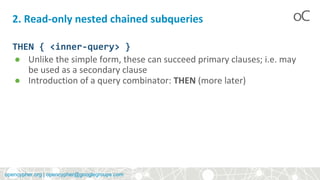
2. Read-only nested chained subqueries
THEN { <inner-query> }
● Unlike the simple form, these can succeed primary clauses; i.e. may
be used as a secondary clause
● Introduction of a query combinator: THEN (more later)
opencypher.org | opencypher@googlegroups.com
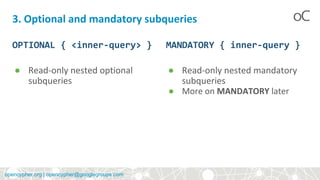
3. Optional and mandatory subqueries
OPTIONAL { <inner-query> }
● Read-only nested optional
subqueries
MANDATORY { inner-query }
● Read-only nested mandatory
subqueries
● More on MANDATORY later
opencypher.org | opencypher@googlegroups.com
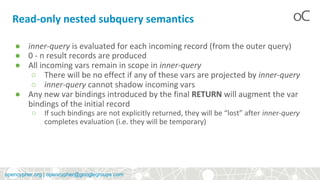
Read-only nested subquery semantics
● inner-query is evaluated for each incoming record (from the outer query)
● 0 - n result records are produced
● All incoming vars remain in scope in inner-query
○ There will be no effect if any of these vars are projected by inner-query
○ inner-query cannot shadow incoming vars
● Any new var bindings introduced by the final RETURN will augment the var
bindings of the initial record
○ If such bindings are not explicitly returned, they will be “lost” after inner-query
completes evaluation (i.e. they will be temporary)
opencypher.org | opencypher@googlegroups.com
Read-only subquery examples
{
MATCH (me:User {name: 'Alice'})-[:FOLLOWS]->(user:User),
(user)<-[:AUTHORED]-(tweet:Tweet)
RETURN tweet, tweet.time AS time, user.country AS country
UNION
MATCH (me:User {name: 'Alice'})-[:FOLLOWS]->(user:User),
(user)<-[:HAS_FAVOURITE]-(favorite:Favorite)-[:TARGETS]->(tweet:Tw
eet)
RETURN tweet, favourite.time AS time, user.country AS country
}
WHERE country = 'se'
RETURN DISTINCT tweet
ORDER BY time DESC
LIMIT 10
opencypher.org | opencypher@googlegroups.com
Read-only subquery examples
MATCH (f:Farm {id: $farmId})-[:IS_IN]->(country:Country)
THEN {
MATCH (u:User {id: $userId})-[:LIKES]->(b:Brand),
(b)-[:PRODUCES]->(p:Lawnmower)
RETURN b.name AS name, p.code AS code
UNION
MATCH (u:User {id: $userId})-[:LIKES]->(b:Brand),
(b)-[:PRODUCES]->(v:Vehicle),
(v)<-[:IS_A]-(:Category {name: 'Tractor'})
WHERE v.leftHandDrive = country.leftHandDrive
RETURN b.name AS name, p.code AS code
}
RETURN f, name, code
opencypher.org | opencypher@googlegroups.com
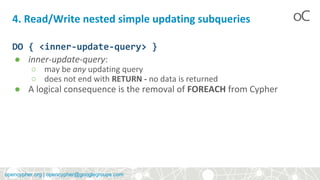
4. Read/Write nested simple updating subqueries
DO { <inner-update-query> }
● inner-update-query:
○ may be any updating query
○ does not end with RETURN - no data is returned
● A logical consequence is the removal of FOREACH from Cypher
opencypher.org | opencypher@googlegroups.com
5. Read/Write nested conditionally-updating subqueries
DO
[WHEN <cond> THEN <inner-update-query>]+
[ELSE <inner-update-query>]
END
● Conditions in WHEN evaluated in order
● inner-update query evaluated for the first true condition, falling
through to ELSE if no true conditions found. Otherwise, no updates
will occur.
opencypher.org | opencypher@googlegroups.com
Read/Write nested subquery semantics
● inner-update-query is run for each incoming record
○ Executing DO does not affect the cardinality
● Input records are passed on to any clauses following the subquery
○ This happens regardless if whether the record was eligible for
processing by inner-update-query
● A query can end with a DO subquery in the same way as a query
currently can end with any update clause
● These types of subqueries may not be contained within read-only
nested subqueries
opencypher.org | opencypher@googlegroups.com
Read/Write subquery examples
MATCH (r:Root)
UNWIND range(1, 10) AS x
DO {
MERGE (c:Child {id: x})
MERGE (r)-[:PARENT]->(c)
}
MATCH (r:Root)
UNWIND range(1, 10) AS x
DO WHEN x % 2 = 1 THEN {
MERGE (c:Odd:Child {id: x})
MERGE (r)-[:PARENT]->(c)
}
ELSE {
MERGE (c:Even:Child {id: x})
MERGE (r)-[:PARENT]->(c)
}
END
opencypher.org | opencypher@googlegroups.com
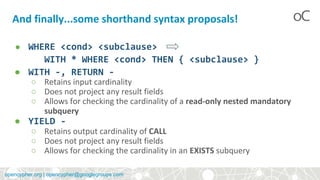
And finally...some shorthand syntax proposals!
● WHERE <cond> <subclause>
WITH * WHERE <cond> THEN { <subclause> }
● WITH -, RETURN -
○ Retains input cardinality
○ Does not project any result fields
○ Allows for checking the cardinality of a read-only nested mandatory
subquery
● YIELD -
○ Retains output cardinality of CALL
○ Does not project any result fields
○ Allows for checking the cardinality in an EXISTS subquery

openCypher: Introducing subqueries

  • 1.
    opencypher.org | opencypher@googlegroups.comopencypher.org| opencypher@googlegroups.com Nested subqueries CIP Petra Selmer petra.selmer@neotechnology.com
  • 2.
    opencypher.org | opencypher@googlegroups.com Nestedsubqueries... ...are self-contained queries running within the scope of an outer query https://github.com/opencypher/openCypher/pull/100 ● Two forms ○ Read-only ○ Read/Write
  • 3.
    opencypher.org | opencypher@googlegroups.com Somepreliminaries regarding nested subqueries ...RETURN… ● Referred to as “inner-query” from now on ● Can be any complete read-only query ● Found within {} ● May be correlated (inner-query may use vars from the outer query) or uncorrelated ● Read-only subqueries may be nested at an arbitrary depth
  • 4.
    opencypher.org | opencypher@googlegroups.com 1.Read-only nested simple subqueries { <inner-query> } ● This is the simplest form ● No introductory keyword ● Only to be used as a primary clause, which is one of the following: ○ a top-level query ○ an inner query of another nested subquery ○ an inner query of another expression-level subquery (e.g. EXISTS subquery) ○ as an argument query to UNION ● Cannot be used as a so-called secondary clause succeeding a primary clause
  • 5.
    opencypher.org | opencypher@googlegroups.com 2.Read-only nested chained subqueries THEN { <inner-query> } ● Unlike the simple form, these can succeed primary clauses; i.e. may be used as a secondary clause ● Introduction of a query combinator: THEN (more later)
  • 6.
    opencypher.org | opencypher@googlegroups.com 3.Optional and mandatory subqueries OPTIONAL { <inner-query> } ● Read-only nested optional subqueries MANDATORY { inner-query } ● Read-only nested mandatory subqueries ● More on MANDATORY later
  • 7.
    opencypher.org | opencypher@googlegroups.com Read-onlynested subquery semantics ● inner-query is evaluated for each incoming record (from the outer query) ● 0 - n result records are produced ● All incoming vars remain in scope in inner-query ○ There will be no effect if any of these vars are projected by inner-query ○ inner-query cannot shadow incoming vars ● Any new var bindings introduced by the final RETURN will augment the var bindings of the initial record ○ If such bindings are not explicitly returned, they will be “lost” after inner-query completes evaluation (i.e. they will be temporary)
  • 8.
    opencypher.org | opencypher@googlegroups.com Read-onlysubquery examples { MATCH (me:User {name: 'Alice'})-[:FOLLOWS]->(user:User), (user)<-[:AUTHORED]-(tweet:Tweet) RETURN tweet, tweet.time AS time, user.country AS country UNION MATCH (me:User {name: 'Alice'})-[:FOLLOWS]->(user:User), (user)<-[:HAS_FAVOURITE]-(favorite:Favorite)-[:TARGETS]->(tweet:Tw eet) RETURN tweet, favourite.time AS time, user.country AS country } WHERE country = 'se' RETURN DISTINCT tweet ORDER BY time DESC LIMIT 10
  • 9.
    opencypher.org | opencypher@googlegroups.com Read-onlysubquery examples MATCH (f:Farm {id: $farmId})-[:IS_IN]->(country:Country) THEN { MATCH (u:User {id: $userId})-[:LIKES]->(b:Brand), (b)-[:PRODUCES]->(p:Lawnmower) RETURN b.name AS name, p.code AS code UNION MATCH (u:User {id: $userId})-[:LIKES]->(b:Brand), (b)-[:PRODUCES]->(v:Vehicle), (v)<-[:IS_A]-(:Category {name: 'Tractor'}) WHERE v.leftHandDrive = country.leftHandDrive RETURN b.name AS name, p.code AS code } RETURN f, name, code
  • 10.
    opencypher.org | opencypher@googlegroups.com 4.Read/Write nested simple updating subqueries DO { <inner-update-query> } ● inner-update-query: ○ may be any updating query ○ does not end with RETURN - no data is returned ● A logical consequence is the removal of FOREACH from Cypher
  • 11.
    opencypher.org | opencypher@googlegroups.com 5.Read/Write nested conditionally-updating subqueries DO [WHEN <cond> THEN <inner-update-query>]+ [ELSE <inner-update-query>] END ● Conditions in WHEN evaluated in order ● inner-update query evaluated for the first true condition, falling through to ELSE if no true conditions found. Otherwise, no updates will occur.
  • 12.
    opencypher.org | opencypher@googlegroups.com Read/Writenested subquery semantics ● inner-update-query is run for each incoming record ○ Executing DO does not affect the cardinality ● Input records are passed on to any clauses following the subquery ○ This happens regardless if whether the record was eligible for processing by inner-update-query ● A query can end with a DO subquery in the same way as a query currently can end with any update clause ● These types of subqueries may not be contained within read-only nested subqueries
  • 13.
    opencypher.org | opencypher@googlegroups.com Read/Writesubquery examples MATCH (r:Root) UNWIND range(1, 10) AS x DO { MERGE (c:Child {id: x}) MERGE (r)-[:PARENT]->(c) } MATCH (r:Root) UNWIND range(1, 10) AS x DO WHEN x % 2 = 1 THEN { MERGE (c:Odd:Child {id: x}) MERGE (r)-[:PARENT]->(c) } ELSE { MERGE (c:Even:Child {id: x}) MERGE (r)-[:PARENT]->(c) } END
  • 14.
    opencypher.org | opencypher@googlegroups.com Andfinally...some shorthand syntax proposals! ● WHERE <cond> <subclause> WITH * WHERE <cond> THEN { <subclause> } ● WITH -, RETURN - ○ Retains input cardinality ○ Does not project any result fields ○ Allows for checking the cardinality of a read-only nested mandatory subquery ● YIELD - ○ Retains output cardinality of CALL ○ Does not project any result fields ○ Allows for checking the cardinality in an EXISTS subquery