Presented by
M.LAVANYA,
M.SC (CS & IT)
NADAR SARASWATHI COLLEGE OF ARTS & SCIENCE,
THENI.
INTRODUCTION
 The goal of the software requirement definition is to
completely and consistently specifies the technical
requirements for the software product.
 Software requirements specification is based on the
system specification high level requirements specified
during initial planning are elaborated.
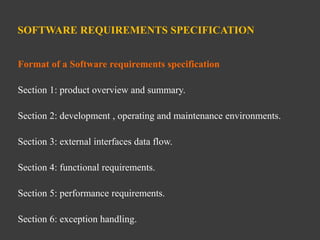
SOFTWARE REQUIREMENTS SPECIFICATION
Format of a Software requirements specification
Section 1: product overview and summary.
Section 2: development , operating and maintenance environments.
Section 3: external interfaces data flow.
Section 4: functional requirements.
Section 5: performance requirements.
Section 6: exception handling.
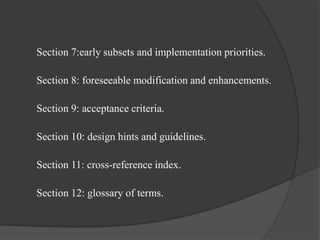
Section 7:early subsets and implementation priorities.
Section 8: foreseeable modification and enhancements.
Section 9: acceptance criteria.
Section 10: design hints and guidelines.
Section 11: cross-reference index.
Section 12: glossary of terms.
Section 1 & 2:
The requirements documents present and
overview of product features and summarize the
processing environments for development , operation
and maintenance of the product.
Section 3:
Include user displays and report formats , a
summary of user commands and report options ,
data flow diagram and data dictionary.
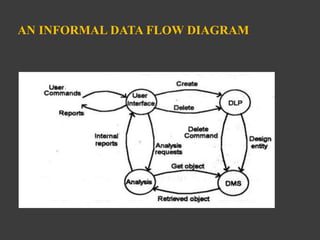
 Data flow diagram specify data sources and data
sinks , data stores , transformations to be performed.
 Data and flow of data between sources , sinks ,
transformation and stores.
 Data source and data sinks are depicted by shaded
rectangles , transformations by ordinary rectangles
and data stores by open ended rectangles.
AN INFORMAL DATA FLOW DIAGRAM
 A entities in a data dictionary include the name
of the data item and attributes such as the data
flow diagrams where it is used , it’s purpose
derived from , it’s sub items .
Section 4:
Functional requirements are expressed in
relational and state-oriented notation that specific
relationships among inputs, actions and outputs.
Section 5:
Performance characteristics such as response
time for various activities , processing time for
various processes , throughput, primary and
secondary memory constraints ,
telecommunications bandwidth
Section 6:
 Exception handling include the actions to be taken
and messages to be displayed to undesired situations
or events .
 Categories of possible exceptions include temporary ,
permanent resources, incorrect inconsistent values
and parameters.
Section 7:
Early subsets and implementations priorities for the
system under development . Product to be planned in three
versions:
 prototype ,
 modest and
 enhanced version
The customer may desire delivery of subset capabilities
and the successive versions can increasing level of
capabilities.
Section 8:
Foreseeable modifications and enhancements
that may be incorporated in to the product following
initial product release are specified in the product
requirements.
Section 9:
Acceptance criteria specify functional and
performance tests that must be performed and
standards to source code internal and external
documentation
Section 10:
Software requirements specification contains
design hints and guidelines. The requirements
specification is primary with functional and
performance aspects of a software product.
Section 11:
A cross-reference directory should be
provided to index specific paragraph number in
the software requirements specification to specific
paragraphs in the system definition.
Section 12:
Software requirements specification
provides definitions of terms that may be
unfamiliar to the customer and product
developers.
DESIRABLE PROPERTIES:
There are a number of desirable properties that a
software requirements specification should posses . In
particular , a requirements documents should be:
 Correct
 Complete
 Consistent
 Unambiguous
 Functional
 Verifiable
 Traceable
 Easily changed
THANK YOU

Software requirements specification

  • 1.
    Presented by M.LAVANYA, M.SC (CS& IT) NADAR SARASWATHI COLLEGE OF ARTS & SCIENCE, THENI.
  • 2.
    INTRODUCTION  The goalof the software requirement definition is to completely and consistently specifies the technical requirements for the software product.  Software requirements specification is based on the system specification high level requirements specified during initial planning are elaborated.
  • 3.
    SOFTWARE REQUIREMENTS SPECIFICATION Formatof a Software requirements specification Section 1: product overview and summary. Section 2: development , operating and maintenance environments. Section 3: external interfaces data flow. Section 4: functional requirements. Section 5: performance requirements. Section 6: exception handling.
  • 4.
    Section 7:early subsetsand implementation priorities. Section 8: foreseeable modification and enhancements. Section 9: acceptance criteria. Section 10: design hints and guidelines. Section 11: cross-reference index. Section 12: glossary of terms.
  • 5.
    Section 1 &2: The requirements documents present and overview of product features and summarize the processing environments for development , operation and maintenance of the product.
  • 6.
    Section 3: Include userdisplays and report formats , a summary of user commands and report options , data flow diagram and data dictionary.
  • 7.
     Data flowdiagram specify data sources and data sinks , data stores , transformations to be performed.  Data and flow of data between sources , sinks , transformation and stores.  Data source and data sinks are depicted by shaded rectangles , transformations by ordinary rectangles and data stores by open ended rectangles.
  • 8.
    AN INFORMAL DATAFLOW DIAGRAM
  • 9.
     A entitiesin a data dictionary include the name of the data item and attributes such as the data flow diagrams where it is used , it’s purpose derived from , it’s sub items .
  • 10.
    Section 4: Functional requirementsare expressed in relational and state-oriented notation that specific relationships among inputs, actions and outputs.
  • 11.
    Section 5: Performance characteristicssuch as response time for various activities , processing time for various processes , throughput, primary and secondary memory constraints , telecommunications bandwidth
  • 12.
    Section 6:  Exceptionhandling include the actions to be taken and messages to be displayed to undesired situations or events .  Categories of possible exceptions include temporary , permanent resources, incorrect inconsistent values and parameters.
  • 13.
    Section 7: Early subsetsand implementations priorities for the system under development . Product to be planned in three versions:  prototype ,  modest and  enhanced version The customer may desire delivery of subset capabilities and the successive versions can increasing level of capabilities.
  • 14.
    Section 8: Foreseeable modificationsand enhancements that may be incorporated in to the product following initial product release are specified in the product requirements.
  • 15.
    Section 9: Acceptance criteriaspecify functional and performance tests that must be performed and standards to source code internal and external documentation
  • 16.
    Section 10: Software requirementsspecification contains design hints and guidelines. The requirements specification is primary with functional and performance aspects of a software product.
  • 17.
    Section 11: A cross-referencedirectory should be provided to index specific paragraph number in the software requirements specification to specific paragraphs in the system definition.
  • 18.
    Section 12: Software requirementsspecification provides definitions of terms that may be unfamiliar to the customer and product developers.
  • 19.
    DESIRABLE PROPERTIES: There area number of desirable properties that a software requirements specification should posses . In particular , a requirements documents should be:  Correct  Complete  Consistent  Unambiguous  Functional  Verifiable  Traceable  Easily changed
  • 20.