Computer Organization
and Architecture
Topic: Registers
by
Upendra Mishra
(M. Tech., Ph.D.*)
KIET Group of Institutions
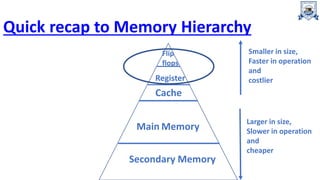
Quick recap to Memory Hierarchy
Secondary Memory
Main Memory
Cache
Register
Smaller in size,
Faster in operation
and
costlier
Larger in size,
Slower in operation
and
cheaper
Flip
flops
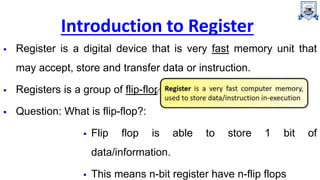
Introduction to Register
 Register is a digital device that is very fast memory unit that
may accept, store and transfer data or instruction.
 Registers is a group of flip-flops.
 Question: What is flip-flop?:
 Flip flop is able to store 1 bit of
data/information.
 This means n-bit register have n-flip flops
Two broad categories of Register
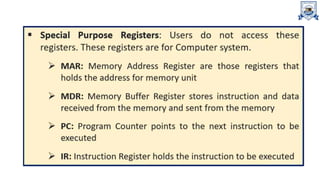
Special Purpose Registers
 Users do not access Special Purpose
registers. These registers are for
processor internal processing.
 Examples: Program Counter,
Memory Address Register,
Memory Data Register ,
Instruction Register, Flag register
General purpose register
 General purpose register is used to
store data intermediate results
during program execution. It can be
accessed via assembly
programming.
 Examples: Accumulator, Data Register
Computer components:
Top-Level View
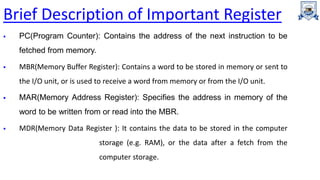
Brief Description of Important Register
 PC(Program Counter): Contains the address of the next instruction to be
fetched from memory.
 MBR(Memory Buffer Register): Contains a word to be stored in memory or sent to
the I/O unit, or is used to receive a word from memory or from the I/O unit.
 MAR(Memory Address Register): Specifies the address in memory of the
word to be written from or read into the MBR.
 MDR(Memory Data Register ): It contains the data to be stored in the computer
storage (e.g. RAM), or the data after a fetch from the
computer storage.
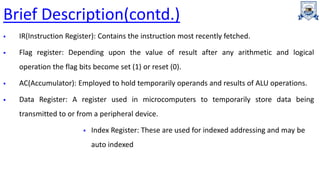
Brief Description(contd.)
 IR(Instruction Register): Contains the instruction most recently fetched.
 Flag register: Depending upon the value of result after any arithmetic and logical
operation the flag bits become set (1) or reset (0).
 AC(Accumulator): Employed to hold temporarily operands and results of ALU operations.
 Data Register: A register used in microcomputers to temporarily store data being
transmitted to or from a peripheral device.
 Index Register: These are used for indexed addressing and may be
auto indexed
Topic: Register Transfer and
Memory Transfer
Register Recap
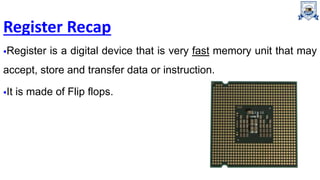
Register is a digital device that is very fast memory unit that may
accept, store and transfer data or instruction.
It is made of Flip flops.
Microoperations
The operations executed on data stored in registers are called
MICROOPERATIONS.
 A Microoperations is an elementary operation performed on the information
stored in one or more registers.
 The result of the operation may replace the previous binary information of a
register or may be transferred to another register.
Example, Counter, increment and load, bidirectional shift
Register Transfer
Register Transfer Language
implies the availability of hardware logic
circuits that can perform a stated
microoperation and transfer the result of
the operation to the same or another
register.
is borrowed from programmers, who
apply this term to programming
languages.
Expresses the symbolic form the
microoperation sequences among the
registers of a digital module.
Block representation of Register
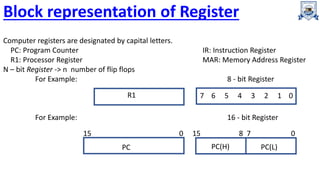
Computer registers are designated by capital letters.
PC: Program Counter IR: Instruction Register
R1: Processor Register MAR: Memory Address Register
N – bit Register -> n number of flip flops
For Example: 8 - bit Register
For Example: 16 - bit Register
7 6 5 4 3 2 1 0
R1
PC PC(H) PC(L)
15 0 15 8 7 0
Information Transfer
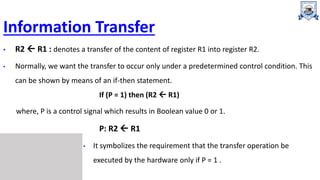
• R2  R1 : denotes a transfer of the content of register R1 into register R2.
• Normally, we want the transfer to occur only under a predetermined control condition. This
can be shown by means of an if-then statement.
If (P = 1) then (R2  R1)
where, P is a control signal which results in Boolean value 0 or 1.
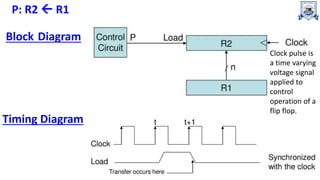
P: R2  R1
• It symbolizes the requirement that the transfer operation be
executed by the hardware only if P = 1 .
Block Diagram
Timing Diagram
P: R2  R1
Clock pulse is
a time varying
voltage signal
applied to
control
operation of a
flip flop.
Memory Transfer
The transfer of information from a memory word to the outside environment is called a
READ
operation.
Read: DR  M[AR]
The transfer of new information to be stored into the memory is called a WRITE operation.
Write: M[AR]  DR
A memory word will be symbolized by the letter M.
M[AR]: to specify the address of M when writing memory transfer
operations, address is enclosed in square brackets.(here, AR is
address register)
Arithmetic Microoperations
Symbolic Representation Description
R3 ← R1 + R2 The contents of R1 plus R2 are transferred to R3.
R3 ← R1 - R2 The contents of R1 minus R2 are transferred to R3.
R2 ← R2' Complement the contents of R2 (1's complement)
R2 ← R2' + 1 2's complement the contents of R2 (negate)
R3 ← R1 + R2' + 1 R1 plus the 2's complement of R2 (subtraction)
R1 ← R1 + 1 Increment the contents of R1 by one
R1 ← R1 - 1 Decrement the contents of R1 by one
Thank
You
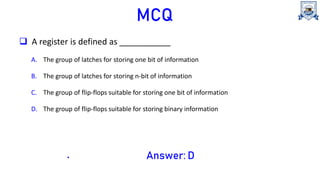
MCQ
 A register is defined as ___________
A. The group of latches for storing one bit of information
B. The group of latches for storing n-bit of information
C. The group of flip-flops suitable for storing one bit of information
D. The group of flip-flops suitable for storing binary information
 Answer: D
Thank
You

3_Register in COA.ppt

  • 1.
    Computer Organization and Architecture Topic:Registers by Upendra Mishra (M. Tech., Ph.D.*) KIET Group of Institutions
  • 2.
    Quick recap toMemory Hierarchy Secondary Memory Main Memory Cache Register Smaller in size, Faster in operation and costlier Larger in size, Slower in operation and cheaper Flip flops
  • 3.
    Introduction to Register Register is a digital device that is very fast memory unit that may accept, store and transfer data or instruction.  Registers is a group of flip-flops.  Question: What is flip-flop?:  Flip flop is able to store 1 bit of data/information.  This means n-bit register have n-flip flops
  • 4.
    Two broad categoriesof Register Special Purpose Registers  Users do not access Special Purpose registers. These registers are for processor internal processing.  Examples: Program Counter, Memory Address Register, Memory Data Register , Instruction Register, Flag register General purpose register  General purpose register is used to store data intermediate results during program execution. It can be accessed via assembly programming.  Examples: Accumulator, Data Register
  • 6.
  • 7.
    Brief Description ofImportant Register  PC(Program Counter): Contains the address of the next instruction to be fetched from memory.  MBR(Memory Buffer Register): Contains a word to be stored in memory or sent to the I/O unit, or is used to receive a word from memory or from the I/O unit.  MAR(Memory Address Register): Specifies the address in memory of the word to be written from or read into the MBR.  MDR(Memory Data Register ): It contains the data to be stored in the computer storage (e.g. RAM), or the data after a fetch from the computer storage.
  • 8.
    Brief Description(contd.)  IR(InstructionRegister): Contains the instruction most recently fetched.  Flag register: Depending upon the value of result after any arithmetic and logical operation the flag bits become set (1) or reset (0).  AC(Accumulator): Employed to hold temporarily operands and results of ALU operations.  Data Register: A register used in microcomputers to temporarily store data being transmitted to or from a peripheral device.  Index Register: These are used for indexed addressing and may be auto indexed
  • 9.
    Topic: Register Transferand Memory Transfer
  • 10.
    Register Recap Register isa digital device that is very fast memory unit that may accept, store and transfer data or instruction. It is made of Flip flops.
  • 11.
    Microoperations The operations executedon data stored in registers are called MICROOPERATIONS.  A Microoperations is an elementary operation performed on the information stored in one or more registers.  The result of the operation may replace the previous binary information of a register or may be transferred to another register. Example, Counter, increment and load, bidirectional shift
  • 12.
  • 13.
    Register Transfer Language RegisterTransfer Language Register Transfer Language implies the availability of hardware logic circuits that can perform a stated microoperation and transfer the result of the operation to the same or another register. is borrowed from programmers, who apply this term to programming languages. Expresses the symbolic form the microoperation sequences among the registers of a digital module.
  • 14.
    Block representation ofRegister Computer registers are designated by capital letters. PC: Program Counter IR: Instruction Register R1: Processor Register MAR: Memory Address Register N – bit Register -> n number of flip flops For Example: 8 - bit Register For Example: 16 - bit Register 7 6 5 4 3 2 1 0 R1 PC PC(H) PC(L) 15 0 15 8 7 0
  • 15.
    Information Transfer • R2 R1 : denotes a transfer of the content of register R1 into register R2. • Normally, we want the transfer to occur only under a predetermined control condition. This can be shown by means of an if-then statement. If (P = 1) then (R2  R1) where, P is a control signal which results in Boolean value 0 or 1. P: R2  R1 • It symbolizes the requirement that the transfer operation be executed by the hardware only if P = 1 .
  • 16.
    Block Diagram Timing Diagram P:R2  R1 Clock pulse is a time varying voltage signal applied to control operation of a flip flop.
  • 17.
    Memory Transfer The transferof information from a memory word to the outside environment is called a READ operation. Read: DR  M[AR] The transfer of new information to be stored into the memory is called a WRITE operation. Write: M[AR]  DR A memory word will be symbolized by the letter M. M[AR]: to specify the address of M when writing memory transfer operations, address is enclosed in square brackets.(here, AR is address register)
  • 18.
    Arithmetic Microoperations Symbolic RepresentationDescription R3 ← R1 + R2 The contents of R1 plus R2 are transferred to R3. R3 ← R1 - R2 The contents of R1 minus R2 are transferred to R3. R2 ← R2' Complement the contents of R2 (1's complement) R2 ← R2' + 1 2's complement the contents of R2 (negate) R3 ← R1 + R2' + 1 R1 plus the 2's complement of R2 (subtraction) R1 ← R1 + 1 Increment the contents of R1 by one R1 ← R1 - 1 Decrement the contents of R1 by one
  • 19.
  • 20.
    MCQ  A registeris defined as ___________ A. The group of latches for storing one bit of information B. The group of latches for storing n-bit of information C. The group of flip-flops suitable for storing one bit of information D. The group of flip-flops suitable for storing binary information  Answer: D
  • 21.