REGION OF INTEREST EXTRACTION   Guide   Prof. Shylaja. S. S   Varun Kamath B   HOD, ISE  Gopi Krishnan Nambiar
INTRODUCTION Content Based Image Retrieval(CBIR) Object Based Image Retrieval (OBIR) Perception Based Image Retrieval (PBIR) Region Of Interest  Saliency Map Visual Attention Map Itti – Koch Model Stentiford Model
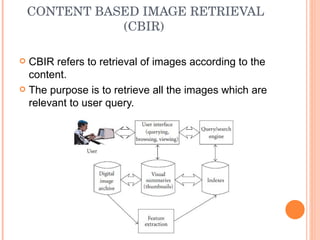
CONTENT BASED IMAGE RETRIEVAL (CBIR)  CBIR refers to retrieval of images according to the content. The purpose is to retrieve all the images which are relevant to user query.
CBIR Despite the large number of CBIR prototypes developed over the past 15 years, very few prototypes have experienced success or become popular commercial products . Most of the CBIR solutions is based on addressing the problem using a biological approach i.e. the way human perceives the image. The proposed models are applicable to image retrieval scenarios where one or few Regions of interest are present in each image.
OBJECT BASED IMAGE RETRIEVAL (OBIR) AND PERCEPTION BASED IMAGE RETRIEVAL (PBIR) OBIR  refers to retrieval of regions or objects of interest within an image but not the image as a whole. PBIR is one of the most successful CBIR solutions which addresses the problem from a perceptual perspective and doing so using psychophysical approach i.e. towards stimulus and sensation of the image on the human eye.
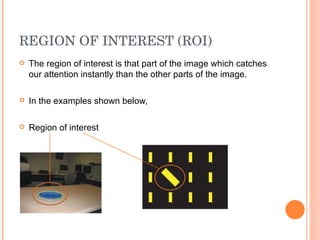
REGION OF INTEREST (ROI) The region of interest is that part of the image which catches our attention instantly than the other parts of the image. In the examples shown below,  Region of interest
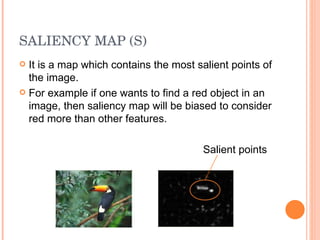
SALIENCY MAP (S) It is a map which contains the most salient points of the image. For example if one wants to find a red object in an image, then saliency map will be biased to consider red more than other features.   Salient points
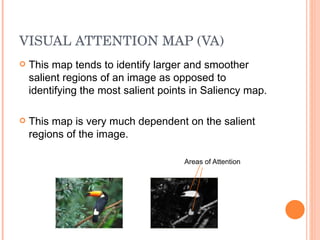
VISUAL ATTENTION MAP (VA) This map tends to identify larger and smoother salient regions of an image as opposed to identifying the most salient points in Saliency map. This map is very much dependent on the salient regions of the image. Areas of Attention
ITTI – KOCH MODEL (I-K MODEL) This model is used to identify the most salient points in an image. It works with three low level dimension of images  Colour. Orientation.  Intensity. The I-K model outputs a list of image coordinates, each one corresponding to a point of attention (POA)
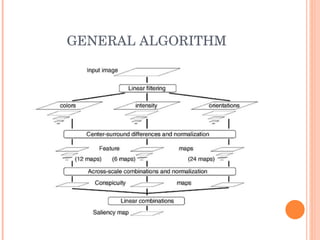
GENERAL ALGORITHM
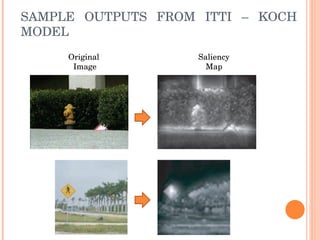
SAMPLE OUTPUTS FROM ITTI – KOCH MODEL  Original  Image Saliency Map
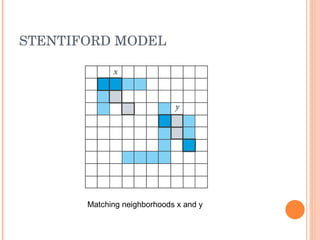
STENTIFORD MODEL This captures the image regions which have distinctive and uncommon features. It suppresses the areas of the image with repetitive colour patterns and enhances the salient ones. This is done by measuring colour dissimilarities between random neighbourhoods in the image and assigning high scores to the most dissimilar pixels in the entire image.
STENTIFORD MODEL Matching neighborhoods x and y
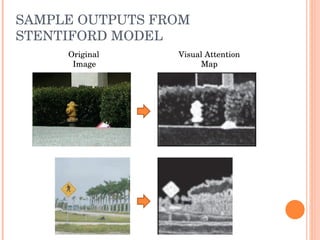
SAMPLE OUTPUTS FROM STENTIFORD MODEL Original Image Visual Attention  Map
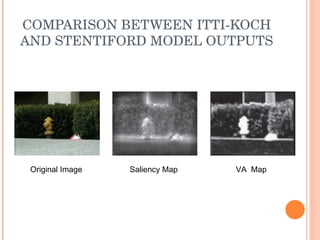
COMPARISON BETWEEN ITTI-KOCH AND STENTIFORD MODEL OUTPUTS Original Image Saliency Map VA  Map
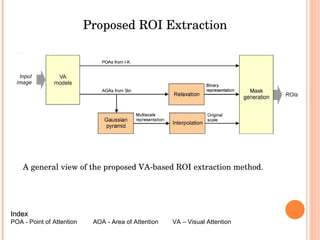
A general view of the proposed VA-based ROI extraction method. Proposed ROI Extraction Index POA - Point of Attention  AOA - Area of Attention  VA – Visual Attention
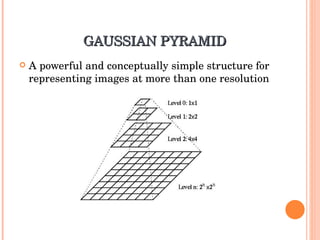
GAUSSIAN PYRAMID A powerful and conceptually simple structure for representing images at more than one resolution
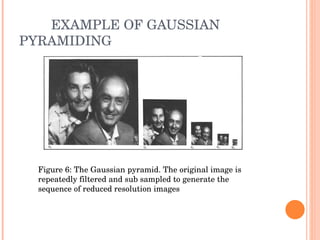
EXAMPLE OF GAUSSIAN PYRAMIDING Figure 6: The Gaussian pyramid. The original image is repeatedly filtered and sub sampled to generate the sequence of reduced resolution images
CONCLUSIONS Since the models produce their own ROIs, which may or may not match with each others’ maps (here referring to Itti-Koch and Stentiford models), better output can be derived i.e. by combining both the common ROIs of the respective maps. This procedure can be used for effective Thumbnail Cropping and indexing.
DRAWBACKS Both the models are still incomplete (still under development) and hence not completely accurate. If there are many ROIs in an image, all of them  may still not be recognized because the models are not completely perfect in recognizing every ROI. If the images are of poor quality and still ROIs are recognized by the human eye, the proposed models may not recognize them.
REFERENCES Extraction of Salient Regions of Interest Using Visual Attention Models Gustavo B. Borba and Humberto R. Gamba, Oge Marques and Liam M. Mayron An Attention-Driven Model for Grouping Similar Images with Image Retrieval Applications Oge Marques, Liam M. Mayron, Gustavo B. Borba and Humberto R. Gamba A  Model of Saliency-Based Visual Attention for Rapid Scene Analysis Laurent Itti, Christof Koch, and Ernst Niebur An attention based similarity measure with application to content based information retrieval Fred W M Stentiford

Region Of Interest Extraction

  • 1.
    REGION OF INTERESTEXTRACTION Guide Prof. Shylaja. S. S Varun Kamath B HOD, ISE Gopi Krishnan Nambiar
  • 2.
    INTRODUCTION Content BasedImage Retrieval(CBIR) Object Based Image Retrieval (OBIR) Perception Based Image Retrieval (PBIR) Region Of Interest Saliency Map Visual Attention Map Itti – Koch Model Stentiford Model
  • 3.
    CONTENT BASED IMAGERETRIEVAL (CBIR) CBIR refers to retrieval of images according to the content. The purpose is to retrieve all the images which are relevant to user query.
  • 4.
    CBIR Despite thelarge number of CBIR prototypes developed over the past 15 years, very few prototypes have experienced success or become popular commercial products . Most of the CBIR solutions is based on addressing the problem using a biological approach i.e. the way human perceives the image. The proposed models are applicable to image retrieval scenarios where one or few Regions of interest are present in each image.
  • 5.
    OBJECT BASED IMAGERETRIEVAL (OBIR) AND PERCEPTION BASED IMAGE RETRIEVAL (PBIR) OBIR refers to retrieval of regions or objects of interest within an image but not the image as a whole. PBIR is one of the most successful CBIR solutions which addresses the problem from a perceptual perspective and doing so using psychophysical approach i.e. towards stimulus and sensation of the image on the human eye.
  • 6.
    REGION OF INTEREST(ROI) The region of interest is that part of the image which catches our attention instantly than the other parts of the image. In the examples shown below, Region of interest
  • 7.
    SALIENCY MAP (S)It is a map which contains the most salient points of the image. For example if one wants to find a red object in an image, then saliency map will be biased to consider red more than other features. Salient points
  • 8.
    VISUAL ATTENTION MAP(VA) This map tends to identify larger and smoother salient regions of an image as opposed to identifying the most salient points in Saliency map. This map is very much dependent on the salient regions of the image. Areas of Attention
  • 9.
    ITTI – KOCHMODEL (I-K MODEL) This model is used to identify the most salient points in an image. It works with three low level dimension of images Colour. Orientation. Intensity. The I-K model outputs a list of image coordinates, each one corresponding to a point of attention (POA)
  • 10.
  • 11.
    SAMPLE OUTPUTS FROMITTI – KOCH MODEL Original Image Saliency Map
  • 12.
    STENTIFORD MODEL Thiscaptures the image regions which have distinctive and uncommon features. It suppresses the areas of the image with repetitive colour patterns and enhances the salient ones. This is done by measuring colour dissimilarities between random neighbourhoods in the image and assigning high scores to the most dissimilar pixels in the entire image.
  • 13.
    STENTIFORD MODEL Matchingneighborhoods x and y
  • 14.
    SAMPLE OUTPUTS FROMSTENTIFORD MODEL Original Image Visual Attention Map
  • 15.
    COMPARISON BETWEEN ITTI-KOCHAND STENTIFORD MODEL OUTPUTS Original Image Saliency Map VA Map
  • 16.
    A general viewof the proposed VA-based ROI extraction method. Proposed ROI Extraction Index POA - Point of Attention AOA - Area of Attention VA – Visual Attention
  • 17.
    GAUSSIAN PYRAMID Apowerful and conceptually simple structure for representing images at more than one resolution
  • 18.
    EXAMPLE OF GAUSSIANPYRAMIDING Figure 6: The Gaussian pyramid. The original image is repeatedly filtered and sub sampled to generate the sequence of reduced resolution images
  • 19.
    CONCLUSIONS Since themodels produce their own ROIs, which may or may not match with each others’ maps (here referring to Itti-Koch and Stentiford models), better output can be derived i.e. by combining both the common ROIs of the respective maps. This procedure can be used for effective Thumbnail Cropping and indexing.
  • 20.
    DRAWBACKS Both themodels are still incomplete (still under development) and hence not completely accurate. If there are many ROIs in an image, all of them may still not be recognized because the models are not completely perfect in recognizing every ROI. If the images are of poor quality and still ROIs are recognized by the human eye, the proposed models may not recognize them.
  • 21.
    REFERENCES Extraction ofSalient Regions of Interest Using Visual Attention Models Gustavo B. Borba and Humberto R. Gamba, Oge Marques and Liam M. Mayron An Attention-Driven Model for Grouping Similar Images with Image Retrieval Applications Oge Marques, Liam M. Mayron, Gustavo B. Borba and Humberto R. Gamba A Model of Saliency-Based Visual Attention for Rapid Scene Analysis Laurent Itti, Christof Koch, and Ernst Niebur An attention based similarity measure with application to content based information retrieval Fred W M Stentiford