A Quantitative Analysis of the State of the Art in
     Quality Provisioning for Multimedia Services over
                Next Generation Networks
                                              Iffat Ahmed, Leonardo Badia
                               IMT Institute for Advanced Studies, Piazza San Ponziano 6, 55100 Lucca, Italy
                       Dept. of Information Engineering, Università di Padova, via Gradenigo 6B, 35131 Padova, Italy
                                                  iffat.ahmed@imtlucca.it, badia@dei.unipd.it


                         Abstract:                                                                        Motivation:
Meta Analysis Research Methodology                                      Research trend of the topic can be predicted from scattered results
 A method of analysis in which text are systematically
                                                                        Main motivation is to aggregate research results
 examined by identifying and grouping themes and
 coding, classifying and developing categories.                         Check the research trends for the field

Investigated 190 articles for period 2006-2010 from leading             Investigate lacking areas
journals, magazines, conferences.                                       Define the taxonomies under the umbrella of Multimedia quality
Selection of top ranked collection is strong suite                      provisioning


             Subject Area Taxonomy                                                                 Scope of the study
Call Admission Control         Network Management                        Trans on MM                Mobile
                                                                                                11% Computing      7%   Infocom            4%
Cross Layer design             Packet/Flow Scheduling                    TSCVT                  4% JSAC            5%   Sigcomm            3%
Error Control                  Power control
                                                                         W. Comm                9% Comm. Letters 3%     Mobicom            3%
Mobility Management            Rate Control
                                                                         Trans on Comm 6% Globecom                 24% Comm Mag            5%
Multicast/Broadcast            Resource Management
                                                                         Trans on Net           7% ICME            9%   Trans Info.        1%
Management                     Routing                                                                                  Theory

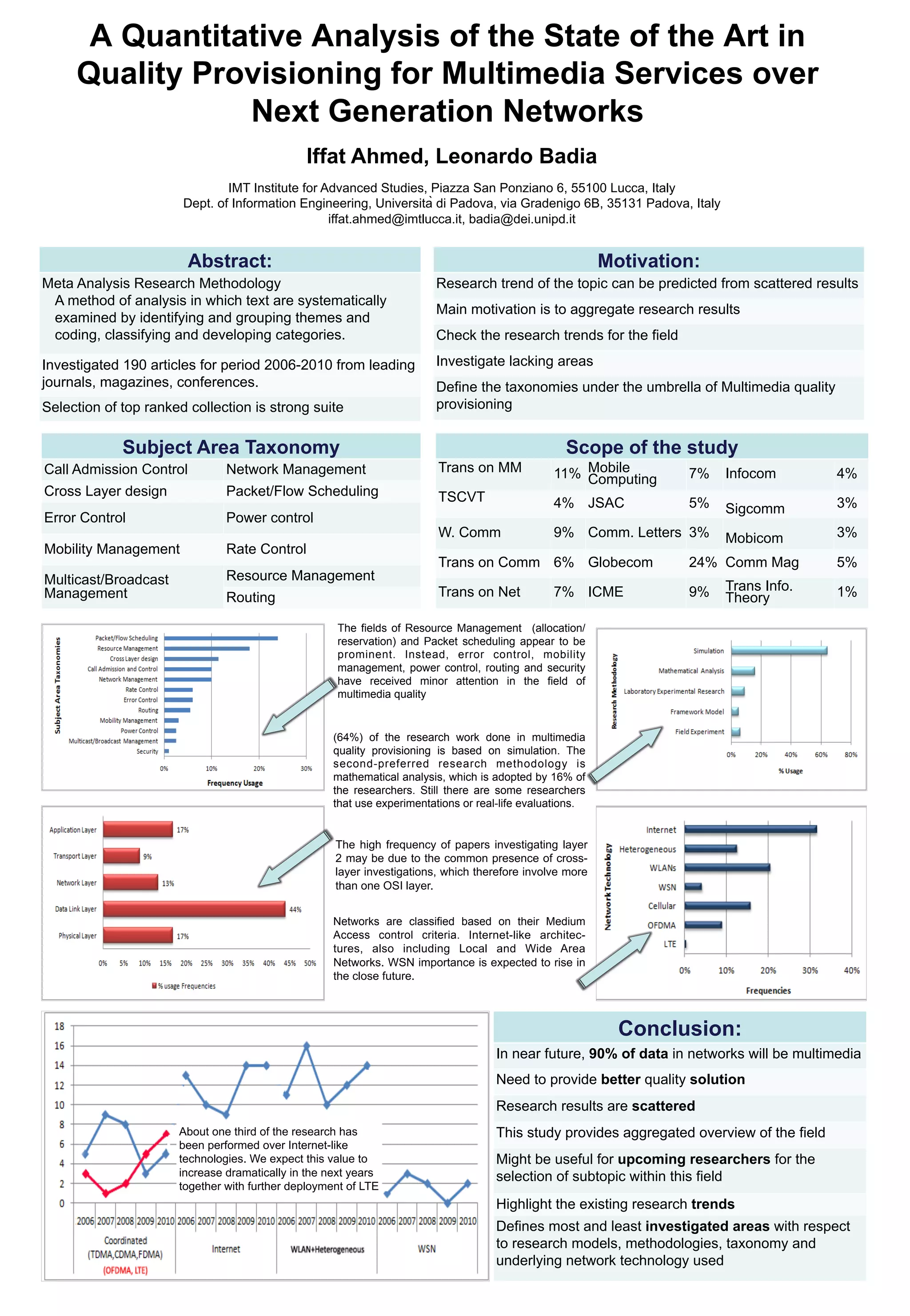
                                                    The fields of Resource Management (allocation/
                                                    reservation) and Packet scheduling appear to be
                                                    prominent. Instead, error control, mobility
                                                    management, power control, routing and security
                                                    have received minor attention in the field of
                                                    multimedia quality


                                                    (64%) of the research work done in multimedia
                                                    quality provisioning is based on simulation. The
                                                    second-preferred research methodology is
                                                    mathematical analysis, which is adopted by 16% of
                                                    the researchers. Still there are some researchers
                                                    that use experimentations or real-life evaluations.


                                                    The high frequency of papers investigating layer
                                                    2 may be due to the common presence of cross-
                                                    layer investigations, which therefore involve more
                                                    than one OSI layer.


                                                    Networks are classified based on their Medium
                                                    Access control criteria. Internet-like architec-
                                                    tures, also including Local and Wide Area
                                                    Networks. WSN importance is expected to rise in
                                                    the close future.


                                                                                                            Conclusion:
                                                                                    In near future, 90% of data in networks will be multimedia
                                                                                    Need to provide better quality solution
                                                                                    Research results are scattered
                      About one third of the research has                           This study provides aggregated overview of the field
                      been performed over Internet-like
                      technologies. We expect this value to                         Might be useful for upcoming researchers for the
                      increase dramatically in the next years                       selection of subtopic within this field
                      together with further deployment of LTE
                                                                                    Highlight the existing research trends
                                                                                    Defines most and least investigated areas with respect
                                                                                    to research models, methodologies, taxonomy and
                                                                                    underlying network technology used

MetaAnalysis of Multimedia Transmission quality improvements in Wireless Networks

  • 1.
    A Quantitative Analysisof the State of the Art in Quality Provisioning for Multimedia Services over Next Generation Networks Iffat Ahmed, Leonardo Badia IMT Institute for Advanced Studies, Piazza San Ponziano 6, 55100 Lucca, Italy Dept. of Information Engineering, Università di Padova, via Gradenigo 6B, 35131 Padova, Italy iffat.ahmed@imtlucca.it, badia@dei.unipd.it Abstract: Motivation: Meta Analysis Research Methodology Research trend of the topic can be predicted from scattered results A method of analysis in which text are systematically Main motivation is to aggregate research results examined by identifying and grouping themes and coding, classifying and developing categories. Check the research trends for the field Investigated 190 articles for period 2006-2010 from leading Investigate lacking areas journals, magazines, conferences. Define the taxonomies under the umbrella of Multimedia quality Selection of top ranked collection is strong suite provisioning Subject Area Taxonomy Scope of the study Call Admission Control Network Management Trans on MM Mobile 11% Computing 7% Infocom 4% Cross Layer design Packet/Flow Scheduling TSCVT 4% JSAC 5% Sigcomm 3% Error Control Power control W. Comm 9% Comm. Letters 3% Mobicom 3% Mobility Management Rate Control Trans on Comm 6% Globecom 24% Comm Mag 5% Multicast/Broadcast Resource Management Trans on Net 7% ICME 9% Trans Info. 1% Management Routing Theory The fields of Resource Management (allocation/ reservation) and Packet scheduling appear to be prominent. Instead, error control, mobility management, power control, routing and security have received minor attention in the field of multimedia quality (64%) of the research work done in multimedia quality provisioning is based on simulation. The second-preferred research methodology is mathematical analysis, which is adopted by 16% of the researchers. Still there are some researchers that use experimentations or real-life evaluations. The high frequency of papers investigating layer 2 may be due to the common presence of cross- layer investigations, which therefore involve more than one OSI layer. Networks are classified based on their Medium Access control criteria. Internet-like architec- tures, also including Local and Wide Area Networks. WSN importance is expected to rise in the close future. Conclusion: In near future, 90% of data in networks will be multimedia Need to provide better quality solution Research results are scattered About one third of the research has This study provides aggregated overview of the field been performed over Internet-like technologies. We expect this value to Might be useful for upcoming researchers for the increase dramatically in the next years selection of subtopic within this field together with further deployment of LTE Highlight the existing research trends Defines most and least investigated areas with respect to research models, methodologies, taxonomy and underlying network technology used