Blue Economy &
Marine Pollution
KARIN KEMPER, SENIOR DIRECTOR,
ENVIRONMENT AND NATURAL RESOURCES
13 APRIL 2019
Presentation Outline
The Ocean Economy
What is the Blue Economy?
World Bank Approach/Blue Economy
Action plan
Risks Faced by Our Oceans
Marine Pollution in SIDS and coastal
states
PROBLUE
1
2
5
6
3
4
The Ocean Economy is
Thriving
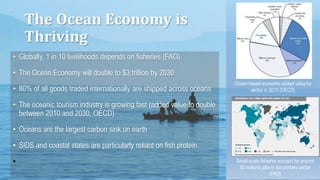
• Globally, 1 in 10 livelihoods depends on fisheries (FAO)
• The Ocean Economy will double to $3 trillion by 2030
• 80% of all goods traded internationally are shipped across oceans
• The oceanic tourism industry is growing fast (added value to double
between 2010 and 2030, OECD)
• Oceans are the largest carbon sink on earth
• SIDS and coastal states are particularly reliant on fish protein
•
Ocean-based economic added value by
sector in 2010 (OECD)
Small-scale fisheries account for around
60 millions jobs in the primary sector
(FAO)
What is the Blue Economy?
• Sustainable and integrated development of oceanic
activities in a healthy ocean
• Policies that determine whether the use of oceanic
resources is sustainable
• Both the traditional ocean uses – such as
fisheries, tourism, maritime transport – but also new
and emerging activities – offshore renewable
energy, aquaculture, bioprospecting, etc.
• Collaboration across nation-states and across the
public-private sectors, and on a scale that has not
previously been achieved
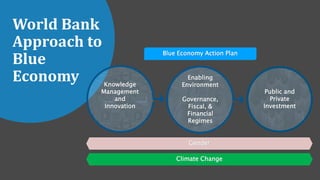
World Bank
Approach to
Blue
Economy Knowledge
Management
and
Innovation
Enabling
Environment
Governance,
Fiscal, &
Financial
Regimes
Public and
Private
Investment
Blue Economy Action Plan
Gender
Climate Change
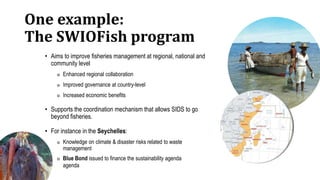
One example:
The SWIOFish program
• Aims to improve fisheries management at regional, national and
community level
◎ Enhanced regional collaboration
◎ Improved governance at country-level
◎ Increased economic benefits
• Supports the coordination mechanism that allows SIDS to go
beyond fisheries.
• For instance in the Seychelles:
◎ Knowledge on climate & disaster risks related to waste
management
◎ Blue Bond issued to finance the sustainability agenda
agenda
Our Oceans Also Face Many Risks
• Climate change: Warmer oceans mean
fisheries productivity decreases, ocean
acidification leads to the destruction of
habitats, etc.
• Fishing: Over-exploitation of fisheries
beyond what the oceans can sustain
• Trade-off between long-term sustainability
and short-term growth
• Scarcity of sustainable
aquaculture production models
• Pollution jeopardizes tourism, fisheries and
seafood safety
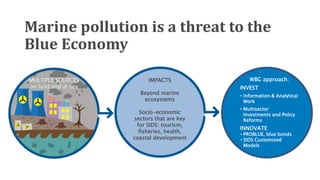
Marine pollution is a threat to the
Blue Economy
MULTIPLE SOURCES
on land and at sea
WBG approach:
INVEST
• Information & Analytical
Work
• Multisector
Investments and Policy
Reforms
INNOVATE
• PROBLUE, blue bonds
• SIDS Customized
Models
IMPACTS
Beyond marine
ecosystems
Socio-economic
sectors that are key
for SIDS: tourism,
fisheries, health,
coastal development
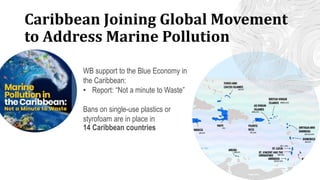
WB support to the Blue Economy in
the Caribbean:
• Report: “Not a minute to Waste”
Bans on single-use plastics or
styrofoam are in place in
14 Caribbean countries
Caribbean Joining Global Movement
to Address Marine Pollution
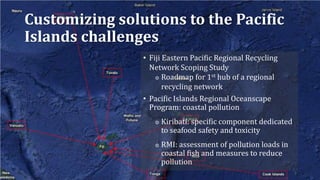
Customizing solutions to the Pacific
Islands challenges
• Fiji Eastern Pacific Regional Recycling
Network Scoping Study
◎ Roadmap for 1st hub of a regional
recycling network
• Pacific Islands Regional Oceanscape
Program: coastal pollution
◎ Kiribati: specific component dedicated
to seafood safety and toxicity
◎ RMI: assessment of pollution loads in
coastal fish and measures to reduce
pollution
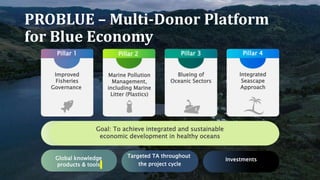
PROBLUE – Multi-Donor Platform
for Blue Economy
Pillar 1
Improved
Fisheries
Governance
Pillar 2
Marine Pollution
Management,
including Marine
Litter (Plastics)
Pillar 3
Blueing of
Oceanic Sectors
Pillar 4
Integrated
Seascape
Approach
Goal: To achieve integrated and sustainable
economic development in healthy oceans
Global knowledge
products & tools
Targeted TA throughout
the project cycle
Investments
Thank you.
www.worldbank.org/environment
www.worldbank.org/smallstates

SmallStates2019BlueEghghtrhytrconomy.pptx

  • 1.
    Blue Economy & MarinePollution KARIN KEMPER, SENIOR DIRECTOR, ENVIRONMENT AND NATURAL RESOURCES 13 APRIL 2019
  • 2.
    Presentation Outline The OceanEconomy What is the Blue Economy? World Bank Approach/Blue Economy Action plan Risks Faced by Our Oceans Marine Pollution in SIDS and coastal states PROBLUE 1 2 5 6 3 4
  • 3.
    The Ocean Economyis Thriving • Globally, 1 in 10 livelihoods depends on fisheries (FAO) • The Ocean Economy will double to $3 trillion by 2030 • 80% of all goods traded internationally are shipped across oceans • The oceanic tourism industry is growing fast (added value to double between 2010 and 2030, OECD) • Oceans are the largest carbon sink on earth • SIDS and coastal states are particularly reliant on fish protein • Ocean-based economic added value by sector in 2010 (OECD) Small-scale fisheries account for around 60 millions jobs in the primary sector (FAO)
  • 4.
    What is theBlue Economy? • Sustainable and integrated development of oceanic activities in a healthy ocean • Policies that determine whether the use of oceanic resources is sustainable • Both the traditional ocean uses – such as fisheries, tourism, maritime transport – but also new and emerging activities – offshore renewable energy, aquaculture, bioprospecting, etc. • Collaboration across nation-states and across the public-private sectors, and on a scale that has not previously been achieved
  • 5.
    World Bank Approach to Blue EconomyKnowledge Management and Innovation Enabling Environment Governance, Fiscal, & Financial Regimes Public and Private Investment Blue Economy Action Plan Gender Climate Change
  • 6.
    One example: The SWIOFishprogram • Aims to improve fisheries management at regional, national and community level ◎ Enhanced regional collaboration ◎ Improved governance at country-level ◎ Increased economic benefits • Supports the coordination mechanism that allows SIDS to go beyond fisheries. • For instance in the Seychelles: ◎ Knowledge on climate & disaster risks related to waste management ◎ Blue Bond issued to finance the sustainability agenda agenda
  • 7.
    Our Oceans AlsoFace Many Risks • Climate change: Warmer oceans mean fisheries productivity decreases, ocean acidification leads to the destruction of habitats, etc. • Fishing: Over-exploitation of fisheries beyond what the oceans can sustain • Trade-off between long-term sustainability and short-term growth • Scarcity of sustainable aquaculture production models • Pollution jeopardizes tourism, fisheries and seafood safety
  • 8.
    Marine pollution isa threat to the Blue Economy MULTIPLE SOURCES on land and at sea WBG approach: INVEST • Information & Analytical Work • Multisector Investments and Policy Reforms INNOVATE • PROBLUE, blue bonds • SIDS Customized Models IMPACTS Beyond marine ecosystems Socio-economic sectors that are key for SIDS: tourism, fisheries, health, coastal development
  • 9.
    WB support tothe Blue Economy in the Caribbean: • Report: “Not a minute to Waste” Bans on single-use plastics or styrofoam are in place in 14 Caribbean countries Caribbean Joining Global Movement to Address Marine Pollution
  • 10.
    Customizing solutions tothe Pacific Islands challenges • Fiji Eastern Pacific Regional Recycling Network Scoping Study ◎ Roadmap for 1st hub of a regional recycling network • Pacific Islands Regional Oceanscape Program: coastal pollution ◎ Kiribati: specific component dedicated to seafood safety and toxicity ◎ RMI: assessment of pollution loads in coastal fish and measures to reduce pollution
  • 11.
    PROBLUE – Multi-DonorPlatform for Blue Economy Pillar 1 Improved Fisheries Governance Pillar 2 Marine Pollution Management, including Marine Litter (Plastics) Pillar 3 Blueing of Oceanic Sectors Pillar 4 Integrated Seascape Approach Goal: To achieve integrated and sustainable economic development in healthy oceans Global knowledge products & tools Targeted TA throughout the project cycle Investments
  • 12.

Editor's Notes

  • #6 THEORY OF CHANGE: Knowledge & Innovation => enabling environment => investment, both private and public Knowledge: From data to information to raise awareness, to trigger actions & demand in client countries & globally/regionally, and to share & generate (innovative) solutions
  • #9 Impacts go beyond marine ecosystems. It affects key socio-economic sectors that SIDS countries depend on: Tourism, Fisheries, Health, Coastal Development About the impacts and costs: - Tourism accounts for over one quarter of GDP in at least seven SIDS and represents 9% of the overall exports (US$ 61 billion). - Tourism revenue more than 50% of exports in some countries: Antigua, Bahamas, Barbados, Grenada, St. Lucia, Comoros, Maldives, Cook Islands and Vanuatu Destruction of marine natural capital assets such as coral reefs, mangroves, and seagrass beds pose particular threats to the livelihoods of people working in tourism and those that rely on these habitats for a livelihood, fisheries and protection from storms and hurricanes. In the next slides we are going to explain how we are addressing the issues of marine pollution and plastics: First, we are investing in generating the information and analytical tools to advise governments and, initially, in key “no-regret” investments and policy reforms. Information & Analytical Work Multisector Investments: in waste management, resource efficiency clean production, agriculture, water. circular economy, policy reforms Second, we innovate: we establish new initiatives and instruments to increase our capacity to deliver, and explore new business models and conduct “game changing” analytics Third, we influence: we join relevant partnerships to inform and give momentum to international commitments, pushing our agenda forward.
  • #10 The World Bank is fully supporting the Blue Economy, and marine pollution prevention in the Caribbean… Analytics: conducting the underpinning work needed to define a tool with a 12-point action plan for combating marine pollution in the region, targeting Caribbean SIDS. OR: The report “Marine Pollution in the Caribbean: Not a Minute to Waste” provides a synopsis of the issues and impacts of marine pollu­tion in the region, and provides recommendations to enhance the region’s resilience and steer it towards a Blue Economy pathway.  CROP [placeholder Michele] In Grenada – $30 million, we support policy reforms for fiscal resilience and the Blue Growth, and the project includes a total ban on styroforam food containers and plastics bags
  • #11 In the Pacific… On the left: Based on the request of the Pacific Regional Environment Programme (SPREP), the World Bank is partnering with the Pacific Regional Infrastructure Facility (PRIF) to collect accurate and current information, develop a databank, and share data to inform the future development of a regional recycling network. The Study will produce a roadmap for the establishment of the first hub of a regional recycling network in the Pacific, and recommend the infrastructure and policy interventions required. Scheduled to be delivered by December 2019. On the right: Pacific Island Countries have become increasingly concerned about pollution loads in their coastal environments, particularly as it relates to contaminants in fish. Requests have been made by Republic of Marshall Islands (RMI) and Kiribati for the World Bank to support testing and comprehensive monitoring on the pollution loads of coastal fish (e.g. heavy metals, pesticides, plastics). The Kiribati PROP Project, to be delivered in FY20, will have a specific component dedicated to seafood safety and toxicity. The RMI PROP activities would include an assessment of pollution loads in coastal fish, recommendations for solutions, and some measures to reduce identified pollutants.
  • #12  We have established the PROBLUE, a MDTF platform that covers marine pollution with the goal to increase the Bank and client capacities to develop the Blue Economy. So far 150M in commitments (50M) and pledges (100M). I want to particularly thank Iceland (in the room) who is one of the founders in this partnership, together with… Norway, Sweden, France, Germany, EC (from PROFISH) and USA (from PROFISH). Canada will join soon. [Xavier to confirm status for Denmark? No confirmation, I took it out] PROBLUE is a new multi-donor trust fund that will support healthy and productive oceans. It supports the implementation of SDG 14, which covers the sustainable use of oceans, seas and marine resources. PROBLUE focuses on four key themes: the management of fisheries and aquaculture; the threat posed to ocean health by marine pollution, including plastics; the sustainable development of key oceanic sectors such as tourism, maritime transport and offshore renewable energy; and building the capacity of governments to manage their marine and coastal resources in an integrated fashion to deliver more and long-lasting benefits to countries and communities. PROBLUE as the over-arching framework for WB interventions (across GPs), not only in terms of increasing our lending interventions, but also in terms of focusing of identifying the right prioritization and sequencing of interventions and policies for the alternative solutions (re-use, re-cycle/waste management, and reduce).