Reflection
in and on
Action
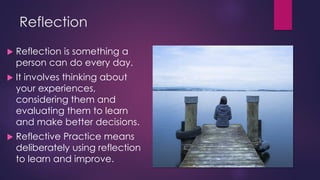
Reflection
 Reflection is something a
person can do every day.
 It involves thinking about
your experiences,
considering them and
evaluating them to learn
and make better decisions.
 Reflective Practice means
deliberately using reflection
to learn and improve.
John Dewey
 John Dewey was one of the
great psychologists of the
20th Century.
 He first explored how
experiences, interactions,
and reflection helped
learning.
Experiential Learning
 David A. Kolb and Ronald E. Fry developed a reflective
model influenced by John Dewey and another
psychologist, Jean Piaget.
 Their work focused on experiential learning, or
transforming information from experiences into new
knowledge.
 Reflective learning happens when a practitioner reflects
on a new experience and gains a general
understanding, then tests that general understanding in
a new situation.
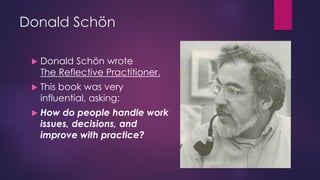
Donald Schön
 Donald Schön wrote
The Reflective Practitioner.
 This book was very
influential, asking:
 How do people handle work
issues, decisions, and
improve with practice?
Becoming a Professional
 Schön argued that a person
grows as a professional when he
or she starts to observe their
actions in retrospect, or in the
moment, through a critical
‘lens’.
 Using a professional lens means
deliberately considering actions,
knowledge, and possible
solutions or outcomes to
different professional situations.
 In this way a new professional
becomes more deliberate in
decisions and actions.
Kinds of reflective practice
Schön defined two kinds of
reflection:
Reflection in Action
Reflection on Action
Reflection in Action
Involves thinking and acting in the
moment:
 What existing knowledge or experience
will help me right now?
Reflection on Action
Involves thinking back about our past
actions:
 How can I change what I do,
professionally, considering what I did
before?
 Can be written or simply thought about,
hours, days or even years after the actions
being considered
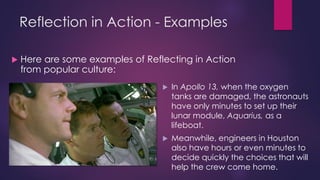
Reflection in Action - Examples
 Here are some examples of Reflecting in Action
from popular culture:
 In Apollo 13, when the oxygen
tanks are damaged, the astronauts
have only minutes to set up their
lunar module, Aquarius, as a
lifeboat.
 Meanwhile, engineers in Houston
also have hours or even minutes to
decide quickly the choices that will
help the crew come home.
Reflection in Action - Examples
 In Legally Blonde, Elle Woods
is asked at the last minute to
represent a criminal
defendant.
 She uses her new legal skills,
and her existing knowledge of
hair care, to win a court case.
Reflection in Action - Examples
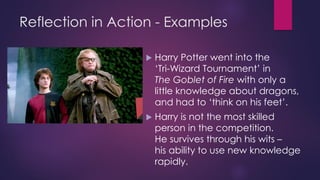
 Harry Potter went into the
‘Tri-Wizard Tournament’ in
The Goblet of Fire with only a
little knowledge about dragons,
and had to ‘think on his feet’.
 Harry is not the most skilled
person in the competition.
He survives through his wits –
his ability to use new knowledge
rapidly.
Most popular heroes reflect in action:
Reflection on Action
Reflection on action, by contrast, is something
we are more likely to read in a novel.
Reflecting on action means deeply considering
past decisions and what could have been
done differently.
In short, reflecting in action involves decision
making in the present. Reflecting on action
involves considering the past for future use.
Reflection on Action - Examples
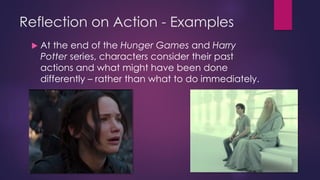
 At the end of the Hunger Games and Harry
Potter series, characters consider their past
actions and what might have been done
differently – rather than what to do immediately.
How can reflecting make a
difference in real life?
 In the “Miracle on the
Hudson”, pilot “Sully”
Sullenberger had just 208
seconds to land his plane
safely in the Hudson River.
 Sully decided in seconds
which tasks he should take,
and which his copilot should
take.
 Every passenger survived the
emergency landing because
of their quick thinking.
Reflection in the Health Professions
 Reflection is also very important to health professionals. On TV shows
from M.A.S.H. to ER, to Grey’s Anatomy, health professionals – especially
doctors, nurses, paramedics – can be shown reflecting on action, about
their careers and lives – but especially reflecting in action, when minutes
or seconds count to save a life, resolve an injury, or provide critical care.
Summary
 Reflection is a learned skill anyone can practice to help
learn better at school, work and even favorite pastimes.
 Reflecting in action involves decision making in the present.
Reflecting on action involves considering the past.
 To reflect in action, you can ask – “What existing knowledge
or experience will help me right now, to make the best
decision?”
 To reflect on action, you can ask – “How can I change the
way I do things, and make better decisions, considering
what I did before?”

Reflection in and on action

  • 1.
  • 2.
    Reflection  Reflection issomething a person can do every day.  It involves thinking about your experiences, considering them and evaluating them to learn and make better decisions.  Reflective Practice means deliberately using reflection to learn and improve.
  • 3.
    John Dewey  JohnDewey was one of the great psychologists of the 20th Century.  He first explored how experiences, interactions, and reflection helped learning.
  • 4.
    Experiential Learning  DavidA. Kolb and Ronald E. Fry developed a reflective model influenced by John Dewey and another psychologist, Jean Piaget.  Their work focused on experiential learning, or transforming information from experiences into new knowledge.  Reflective learning happens when a practitioner reflects on a new experience and gains a general understanding, then tests that general understanding in a new situation.
  • 5.
    Donald Schön  DonaldSchön wrote The Reflective Practitioner.  This book was very influential, asking:  How do people handle work issues, decisions, and improve with practice?
  • 6.
    Becoming a Professional Schön argued that a person grows as a professional when he or she starts to observe their actions in retrospect, or in the moment, through a critical ‘lens’.  Using a professional lens means deliberately considering actions, knowledge, and possible solutions or outcomes to different professional situations.  In this way a new professional becomes more deliberate in decisions and actions.
  • 7.
    Kinds of reflectivepractice Schön defined two kinds of reflection: Reflection in Action Reflection on Action
  • 8.
    Reflection in Action Involvesthinking and acting in the moment:  What existing knowledge or experience will help me right now?
  • 9.
    Reflection on Action Involvesthinking back about our past actions:  How can I change what I do, professionally, considering what I did before?  Can be written or simply thought about, hours, days or even years after the actions being considered
  • 10.
    Reflection in Action- Examples  Here are some examples of Reflecting in Action from popular culture:  In Apollo 13, when the oxygen tanks are damaged, the astronauts have only minutes to set up their lunar module, Aquarius, as a lifeboat.  Meanwhile, engineers in Houston also have hours or even minutes to decide quickly the choices that will help the crew come home.
  • 11.
    Reflection in Action- Examples  In Legally Blonde, Elle Woods is asked at the last minute to represent a criminal defendant.  She uses her new legal skills, and her existing knowledge of hair care, to win a court case.
  • 12.
    Reflection in Action- Examples  Harry Potter went into the ‘Tri-Wizard Tournament’ in The Goblet of Fire with only a little knowledge about dragons, and had to ‘think on his feet’.  Harry is not the most skilled person in the competition. He survives through his wits – his ability to use new knowledge rapidly.
  • 13.
    Most popular heroesreflect in action:
  • 14.
    Reflection on Action Reflectionon action, by contrast, is something we are more likely to read in a novel. Reflecting on action means deeply considering past decisions and what could have been done differently. In short, reflecting in action involves decision making in the present. Reflecting on action involves considering the past for future use.
  • 15.
    Reflection on Action- Examples  At the end of the Hunger Games and Harry Potter series, characters consider their past actions and what might have been done differently – rather than what to do immediately.
  • 16.
    How can reflectingmake a difference in real life?  In the “Miracle on the Hudson”, pilot “Sully” Sullenberger had just 208 seconds to land his plane safely in the Hudson River.  Sully decided in seconds which tasks he should take, and which his copilot should take.  Every passenger survived the emergency landing because of their quick thinking.
  • 17.
    Reflection in theHealth Professions  Reflection is also very important to health professionals. On TV shows from M.A.S.H. to ER, to Grey’s Anatomy, health professionals – especially doctors, nurses, paramedics – can be shown reflecting on action, about their careers and lives – but especially reflecting in action, when minutes or seconds count to save a life, resolve an injury, or provide critical care.
  • 18.
    Summary  Reflection isa learned skill anyone can practice to help learn better at school, work and even favorite pastimes.  Reflecting in action involves decision making in the present. Reflecting on action involves considering the past.  To reflect in action, you can ask – “What existing knowledge or experience will help me right now, to make the best decision?”  To reflect on action, you can ask – “How can I change the way I do things, and make better decisions, considering what I did before?”