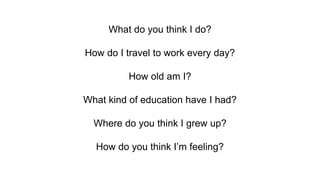
1. What do you think I do?
2. How do I travel to work every day?
3. How old am I?
4. What kind of education have I had?
5. Where do you think I grew up?
6. How do you think I’m feeling?
What is Reflective Practice?
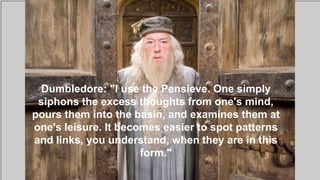
Dumbledore: "I use the Pensieve. One simply
siphons the excess thoughts from one's mind,
pours them into the basin, and examines them at
one's leisure. It becomes easier to spot patterns
and links, you understand, when they are in this
form."
‘Serious thought or
consideration’
OED, 2009
‘It is not sufficient simply to have an experience in
order to learn. Without reflecting upon this
experience it may quickly be forgotten, or its learning
potential lost. It is from the feelings and thoughts
emerging from this reflection that generalisations or
concepts can be generated. And it is generalisations
that allow new situations to be tackled effectively.’
(Gibbs 1988)
‘… a form of mental processing with a purpose
and/or anticipated outcome that is applied to
relatively complex or unstructured ideas for which
there is not an obvious solution’.
Moon 1999 pp23
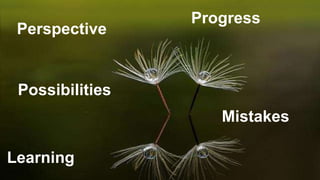
Progress
Perspective
Learning
Possibilities
Mistakes
‘We reflect in order to:
● Consider the process of our own learning – a process of metacognition
● Critically review something - our own behaviour, that of others or the product of
behaviour (e.g. an essay, book, painting etc.)
● Build theory from observations: we draw theory from generalisations - sometimes in
practical situations, sometimes in thoughts or a mixture of the two
● Engage in personal or self development
● Make decisions or resolve uncertainty …
● Empower or emancipate ourselves as individuals (and then it is close to self-
development) or to empower/emancipate ourselves within the context of our social
groups.’
(Ibid pp23)
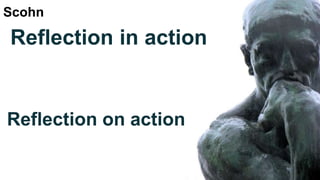
Reflection on action
Reflection in action
Scohn
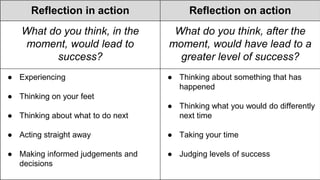
Reflection in action Reflection on action
What do you think, in the
moment, would lead to
success?
What do you think, after the
moment, would have lead to a
greater level of success?
● Experiencing
● Thinking on your feet
● Thinking about what to do next
● Acting straight away
● Making informed judgements and
decisions
● Thinking about something that has
happened
● Thinking what you would do differently
next time
● Taking your time
● Judging levels of success
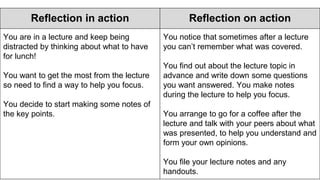
Reflection in action Reflection on action
You are in a lecture and keep being
distracted by thinking about what to have
for lunch!
You want to get the most from the lecture
so need to find a way to help you focus.
You decide to start making some notes of
the key points.
You notice that sometimes after a lecture
you can’t remember what was covered.
You find out about the lecture topic in
advance and write down some questions
you want answered. You make notes
during the lecture to help you focus.
You arrange to go for a coffee after the
lecture and talk with your peers about what
was presented, to help you understand and
form your own opinions.
You file your lecture notes and any
handouts.
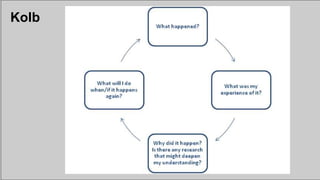
Kolb
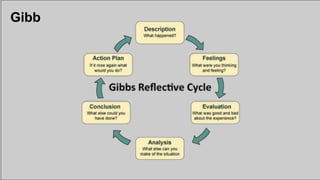
Gibb
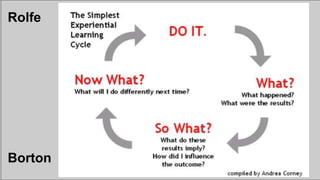
Rolfe
Borton
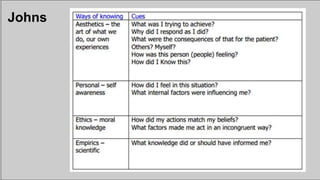
Johns
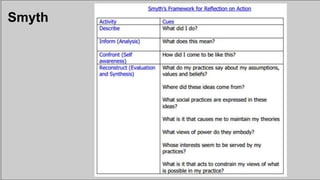
Smyth
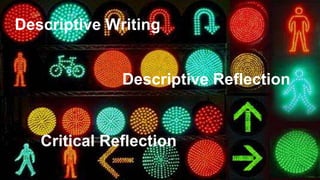
Descriptive Writing
Descriptive Reflection
Critical Reflection
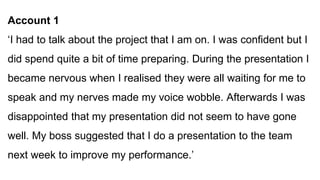
Account 1
‘I had to talk about the project that I am on. I was confident but I
did spend quite a bit of time preparing. During the presentation I
became nervous when I realised they were all waiting for me to
speak and my nerves made my voice wobble. Afterwards I was
disappointed that my presentation did not seem to have gone
well. My boss suggested that I do a presentation to the team
next week to improve my performance.’
Account 2
‘I was scared about not saying the right things and not being able to answer questions
properly. I did a presentation in my course at university and had felt the same about it
initially.
During the presentation I realise that I was desperately trying to prove that I could
present as well as my colleague. I wanted to impress everyone. Early on it went
wrong and I began to panic. Trying to pretend I was confident made the situation
worse because I did not admit I needed help. The more I spoke, the more my voice
wobbled.
Following on from the presentation, my self esteem is low at work now. However,
partly through talking over the presentation and the things that went wrong, I can see
several areas that I could get better. I am hoping to have a chance to practice with
some of the team.’
Account 3
‘I had to talk about the project that I am on. I spent quite a bit of time preparing it in the
way that I have seen others make similar presentations.
When it came to the presentation, I really wanted to do it well – as well as the
presentations were done the week before. Maybe I wanted too much to do well? My
efforts to be calm failed and my voice went wobbly – that’s how it felt to me anyway.
My colleague said afterwards that I looked quite calm despite what I was feeling.
In the event, the session was a disaster and has left me feeling uncomfortable in my
work and I even worry about it at home. I need to think about why a simple
presentation could have such an effect on me.
I am feeling more positive generally and I can begin to analyse what I could do better
in the presentation. It is interesting to see the change in my attitude after a week. I
need to think from the beginning about the process of giving a good presentation.’
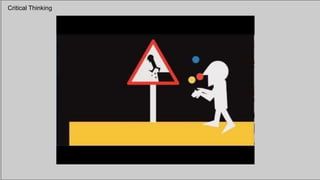
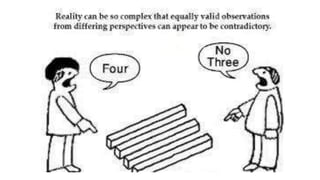
Critical Thinking
What do you think I do?
How do I travel to work every day?
How old am I?
What kind of education have I had?
Where do you think I grew up?
How do you think I’m feeling?
‘Without reflection, we go blindly on our way,
creating more unintended consequences, and
failing to achieve anything useful.’
Margaret J. Wheatley
‘Follow effective action with quiet reflection.
From the quiet reflection will come even more
effective action.’
Peter Drucker

Reflective practice (1)

  • 1.
    1. What doyou think I do? 2. How do I travel to work every day? 3. How old am I? 4. What kind of education have I had? 5. Where do you think I grew up? 6. How do you think I’m feeling?
  • 6.
  • 7.
    Dumbledore: "I usethe Pensieve. One simply siphons the excess thoughts from one's mind, pours them into the basin, and examines them at one's leisure. It becomes easier to spot patterns and links, you understand, when they are in this form."
  • 8.
  • 9.
    ‘It is notsufficient simply to have an experience in order to learn. Without reflecting upon this experience it may quickly be forgotten, or its learning potential lost. It is from the feelings and thoughts emerging from this reflection that generalisations or concepts can be generated. And it is generalisations that allow new situations to be tackled effectively.’ (Gibbs 1988)
  • 10.
    ‘… a formof mental processing with a purpose and/or anticipated outcome that is applied to relatively complex or unstructured ideas for which there is not an obvious solution’. Moon 1999 pp23
  • 11.
  • 12.
    ‘We reflect inorder to: ● Consider the process of our own learning – a process of metacognition ● Critically review something - our own behaviour, that of others or the product of behaviour (e.g. an essay, book, painting etc.) ● Build theory from observations: we draw theory from generalisations - sometimes in practical situations, sometimes in thoughts or a mixture of the two ● Engage in personal or self development ● Make decisions or resolve uncertainty … ● Empower or emancipate ourselves as individuals (and then it is close to self- development) or to empower/emancipate ourselves within the context of our social groups.’ (Ibid pp23)
  • 13.
  • 14.
    Reflection in actionReflection on action What do you think, in the moment, would lead to success? What do you think, after the moment, would have lead to a greater level of success? ● Experiencing ● Thinking on your feet ● Thinking about what to do next ● Acting straight away ● Making informed judgements and decisions ● Thinking about something that has happened ● Thinking what you would do differently next time ● Taking your time ● Judging levels of success
  • 15.
    Reflection in actionReflection on action You are in a lecture and keep being distracted by thinking about what to have for lunch! You want to get the most from the lecture so need to find a way to help you focus. You decide to start making some notes of the key points. You notice that sometimes after a lecture you can’t remember what was covered. You find out about the lecture topic in advance and write down some questions you want answered. You make notes during the lecture to help you focus. You arrange to go for a coffee after the lecture and talk with your peers about what was presented, to help you understand and form your own opinions. You file your lecture notes and any handouts.
  • 16.
  • 17.
  • 18.
  • 19.
  • 20.
  • 21.
  • 22.
    Account 1 ‘I hadto talk about the project that I am on. I was confident but I did spend quite a bit of time preparing. During the presentation I became nervous when I realised they were all waiting for me to speak and my nerves made my voice wobble. Afterwards I was disappointed that my presentation did not seem to have gone well. My boss suggested that I do a presentation to the team next week to improve my performance.’
  • 23.
    Account 2 ‘I wasscared about not saying the right things and not being able to answer questions properly. I did a presentation in my course at university and had felt the same about it initially. During the presentation I realise that I was desperately trying to prove that I could present as well as my colleague. I wanted to impress everyone. Early on it went wrong and I began to panic. Trying to pretend I was confident made the situation worse because I did not admit I needed help. The more I spoke, the more my voice wobbled. Following on from the presentation, my self esteem is low at work now. However, partly through talking over the presentation and the things that went wrong, I can see several areas that I could get better. I am hoping to have a chance to practice with some of the team.’
  • 24.
    Account 3 ‘I hadto talk about the project that I am on. I spent quite a bit of time preparing it in the way that I have seen others make similar presentations. When it came to the presentation, I really wanted to do it well – as well as the presentations were done the week before. Maybe I wanted too much to do well? My efforts to be calm failed and my voice went wobbly – that’s how it felt to me anyway. My colleague said afterwards that I looked quite calm despite what I was feeling. In the event, the session was a disaster and has left me feeling uncomfortable in my work and I even worry about it at home. I need to think about why a simple presentation could have such an effect on me. I am feeling more positive generally and I can begin to analyse what I could do better in the presentation. It is interesting to see the change in my attitude after a week. I need to think from the beginning about the process of giving a good presentation.’
  • 25.
  • 28.
    What do youthink I do? How do I travel to work every day? How old am I? What kind of education have I had? Where do you think I grew up? How do you think I’m feeling?
  • 32.
    ‘Without reflection, wego blindly on our way, creating more unintended consequences, and failing to achieve anything useful.’ Margaret J. Wheatley
  • 33.
    ‘Follow effective actionwith quiet reflection. From the quiet reflection will come even more effective action.’ Peter Drucker

Editor's Notes

  • #2 Note down assumptions about me on A5 slips of paper
  • #3 How are you feeling today? (Stickers) Rate your day on a scale from 1-5. Circle Time! Free usage images on Google
  • #4 What are the moments that lead to the way you’re feeling today? Free usage images on Google
  • #5 How did they lead to you feeling happy or sad? What were the moments and words that lead to your feelings? Free usage images on Google
  • #6 How could you replicate that happy or remove that sad in future similar events? Free usage images on Google
  • #7 Discuss in pairs Free usage images on Google
  • #8 Free usage images on Google
  • #12 Free usage images on Google
  • #14 Free usage images on Google
  • #15 Pymouth University (2010) ‘Reflection’, Available at: http://www.plymouth.ac.uk/uploads/production/document/path/1/1717/Reflection.pdf [Accessed 17 January 2015]
  • #16 Pymouth University (2010) ‘Reflection’, Available at: http://www.plymouth.ac.uk/uploads/production/document/path/1/1717/Reflection.pdf [Accessed 17 January 2015]
  • #17 Pymouth University (2010) ‘Reflection’, Available at: http://www.plymouth.ac.uk/uploads/production/document/path/1/1717/Reflection.pdf [Accessed 17 January 2015]
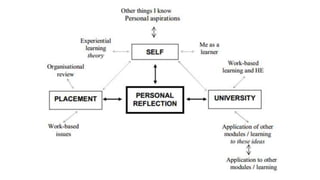
  • #18 Kent University (2012) ‘Reflective Learning’, Available at: http://www.kent.ac.uk/learning/PDP-and-employability/pdp/reflective.html [Accessed: 17 January 2015]
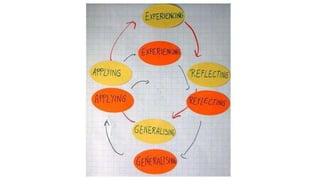
  • #19 Batista, Ed (2007) Experiential Learning Cycles, Available at: http://www.edbatista.com/2007/10/experiential.html [Accessed 17 January 2015]
  • #21 http://www.plymouth.ac.uk/uploads/production/document/path/1/1717/Reflection.pdf
  • #22 Free usage images on Google
  • #29 Note down assumptions about me.
  • #33 Free usage images on Google
  • #34 Free usage images on Google