Reduced relative clause

Raissa Devyna Rachmawati      5211100049
Sebastianus Bara Primananda   5211100147
Mayangsekar Agintiara         5211100189
Relative Clause
        Relative clauses are a special class
 of dependent clause (also called "subordinate
clause") that serve to modify a noun. In English,
  as in most other Indo-European languages,
      relative clauses are often introduced by
a relative pronoun one of the wh- words "who",
 "whom", "whose", "what", or "which", or by that.
  Reduced relative clauses, on the other hand,
 have no relative pronoun introducing them. The
     example below contrasts an English non-
   reduced relative clause and reduced relative
                       clause.
Relative Clause

Relative clause:   The man       who/that I saw     was big.


                   Subject of                       Predicate of
                                 Relative clause
                   main clause                      main clause


Reduced relative
                   The man       I saw              was big.
clause:


                   Subject of    Reduced relative   Predicate of
                   main clause   clause             main clause
Reduced Relative Clause

   A reduced relative clause is a relative
      clause that is not marked by an
   overt complementizer (such as that).
 Reduced relative clauses often give rise to
ambiguity or garden path effects, and have
            been a common topic
of psycholinguistic study, especially in the
        field of sentence processing.
Reduced Relative Clause
• Reader can interpret it in two different ways:
  as a main verb, or the first verb of a reduced
  relative clause.
                     "the florist sent the flowers to the elderly
                     widow“(in which "sent" is the main verb)

   "the florist                  "the florist [who was] sent the flowers was
     sent..."                    very pleased" (in which "sent" is the beginning
                                 of a reduced relative clause)


                                               effect whereby a reader begins a sentence
                  garden path effect           with one interpretation, and later is forced to
                                               backtrack and re-analyze the sentence's
                                               structure
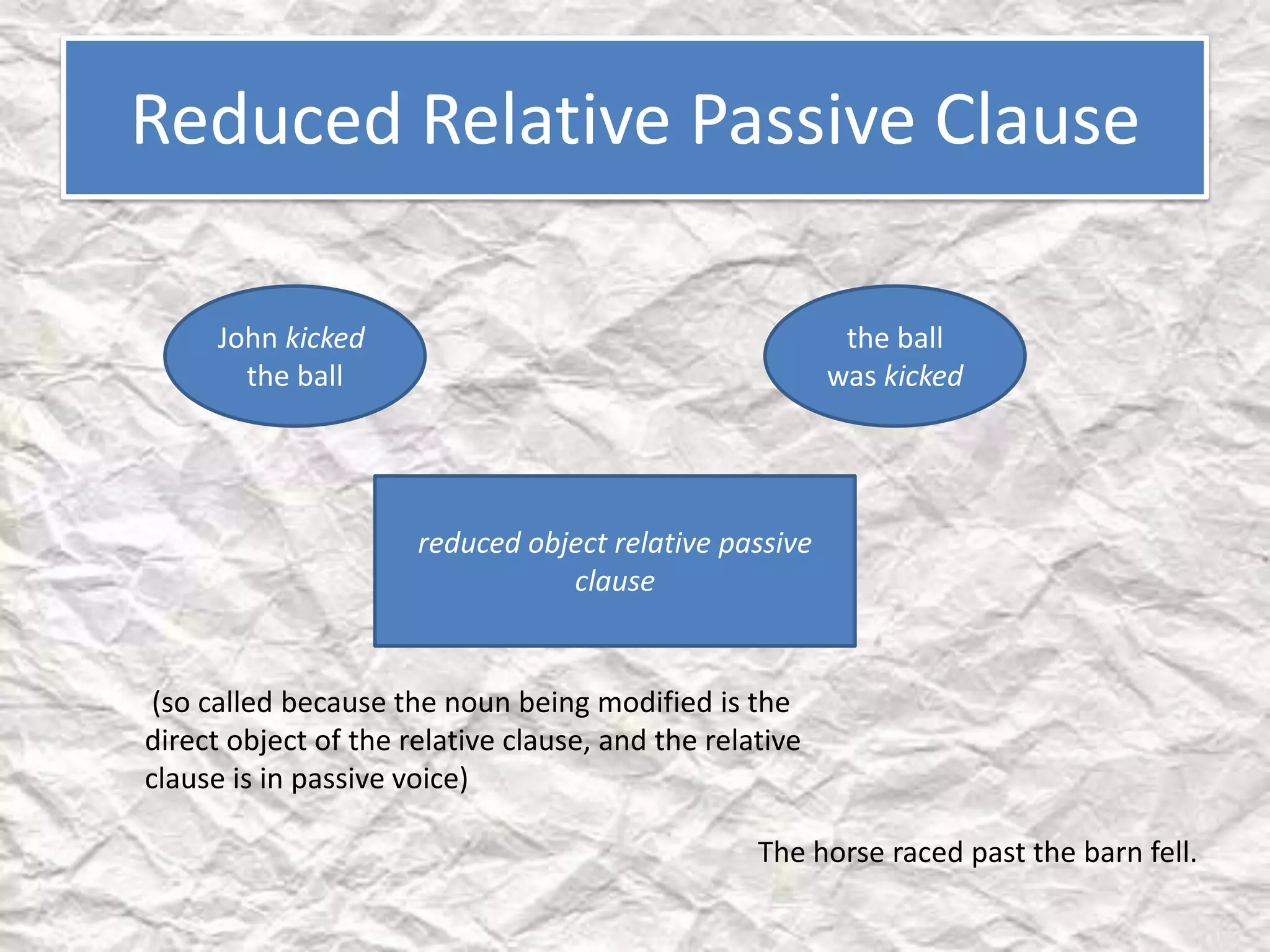
Reduced Relative Passive Clause

      John kicked                                         the ball
        the ball                                         was kicked


                      reduced object relative passive
                                 clause


 (so called because the noun being modified is the
direct object of the relative clause, and the relative
clause is in passive voice)

                                                  The horse raced past the barn fell.
Reduced Relative Clause
• While reduced relative clauses are not the
  only structures that create garden path
  sentences in English (other forms of garden
  path sentences include those caused by lexical
  ambiguity, or words that can have more than
  one meaning), they are the "classic" example
  of garden path sentences.
Summary & Quiz
Summary & Quiz

Reduced relative clause

  • 1.
    Reduced relative clause RaissaDevyna Rachmawati 5211100049 Sebastianus Bara Primananda 5211100147 Mayangsekar Agintiara 5211100189
  • 3.
    Relative Clause Relative clauses are a special class of dependent clause (also called "subordinate clause") that serve to modify a noun. In English, as in most other Indo-European languages, relative clauses are often introduced by a relative pronoun one of the wh- words "who", "whom", "whose", "what", or "which", or by that. Reduced relative clauses, on the other hand, have no relative pronoun introducing them. The example below contrasts an English non- reduced relative clause and reduced relative clause.
  • 4.
    Relative Clause Relative clause: The man who/that I saw was big. Subject of Predicate of Relative clause main clause main clause Reduced relative The man I saw was big. clause: Subject of Reduced relative Predicate of main clause clause main clause
  • 5.
    Reduced Relative Clause A reduced relative clause is a relative clause that is not marked by an overt complementizer (such as that). Reduced relative clauses often give rise to ambiguity or garden path effects, and have been a common topic of psycholinguistic study, especially in the field of sentence processing.
  • 6.
  • 7.
    Reduced Relative Clause •Reader can interpret it in two different ways: as a main verb, or the first verb of a reduced relative clause. "the florist sent the flowers to the elderly widow“(in which "sent" is the main verb) "the florist "the florist [who was] sent the flowers was sent..." very pleased" (in which "sent" is the beginning of a reduced relative clause) effect whereby a reader begins a sentence garden path effect with one interpretation, and later is forced to backtrack and re-analyze the sentence's structure
  • 8.
    Reduced Relative PassiveClause John kicked the ball the ball was kicked reduced object relative passive clause (so called because the noun being modified is the direct object of the relative clause, and the relative clause is in passive voice) The horse raced past the barn fell.
  • 9.
    Reduced Relative Clause •While reduced relative clauses are not the only structures that create garden path sentences in English (other forms of garden path sentences include those caused by lexical ambiguity, or words that can have more than one meaning), they are the "classic" example of garden path sentences.
  • 10.
  • 11.