Reduce clause =
make a clause into
     phrase


                     GRAMMAR
                     Reducing Clause
                                By: Agus Salim, S.Psi.
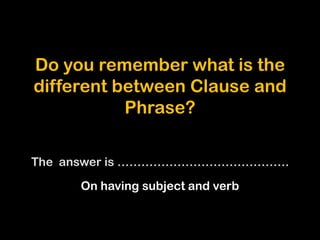
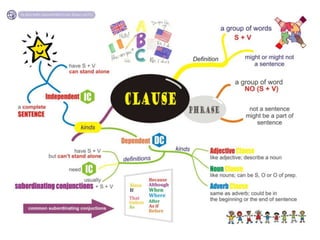
Do you remember what is the
different between Clause and
           Phrase?

The answer is …………………………………….

     On having subject and verb
REDUCING CLAUSE
       (Adjective clause)

How to reduce a clause to be a phrase?

       HERE ARE THE RULES
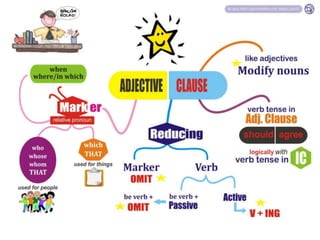
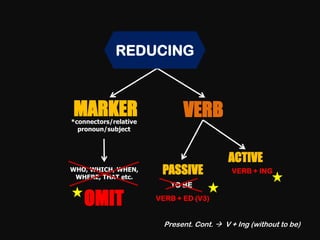
REDUCING


MARKER
*connectors/relative
                              VERB
  pronoun/subject


                                           ACTIVE
WHO, WHICH, WHEN,
 WHERE, THAT etc.
                        PASSIVE             VERB + ING
                           TO BE

   OMIT                VERB + ED (V3)


                         Present. Cont.  V + Ing (without to be)
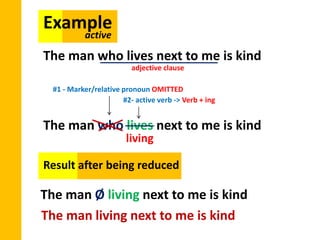
Example
           active

The man who lives next to me is kind
                          adjective clause

  #1 - Marker/relative pronoun OMITTED
                       #2- active verb -> Verb + ing


The man who lives next to me is kind
                        living

Result after being reduced

The man Ø living next to me is kind
The man living next to me is kind
Example
         passive

The letter which is sent last week is important
                     adjective clause (in passive form)

  #1 - Marker/relative pronoun OMITTED
                       #2- passive verb -> OMIT “to be”


The letter which is sent last week is important

Result after being reduced

The letter Ø Ø sent last week is important
The letter sent last week is important
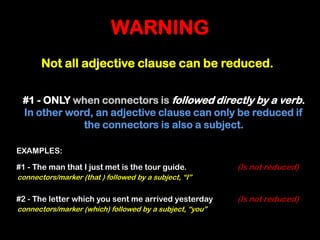
WARNING
       Not all adjective clause can be reduced.


 #1 - ONLY when connectors is followed directly by a verb.
 In other word, an adjective clause can only be reduced if
             the connectors is also a subject.

EXAMPLES:

#1 - The man that I just met is the tour guide.          (Is not reduced)
connectors/marker (that ) followed by a subject, “I”

#2 - The letter which you sent me arrived yesterday      (Is not reduced)
connectors/marker (which) followed by a subject, “you”
Exercise
1. The meeting, which was scheduled for last week, did not
    take place.
2. The plane, which is taking off now, is Boeing 477
3. The case, which stands in the corner, is for new books.
4. A room, which is painted white, appears to look larger.
5. The soup that I had for lunch was too salty.
6. The people whom Ani isvisiting live on A. Yani Street.
7. All people whom I asked them to my party was coming
8. The man that is reading thick book is my roommate.
9. The teacher who motivates us is really kind person.
10. The team who won football competition gets a lot of
    money.
Answer Keys
1.    The meeting scheduled for last week did not take place.
2.    The plane taking off now is Boeing 477
3.    The case standing in the corner is for new books.
4.    A room painted white appears to look larger.
5.    The soup that I had for lunch was too salty. (NR)
6.    The people whom Ani isvisiting live on A. Yani Street. (NR)
7.    All people whom I asked them to my party was coming. (NR)
8.    The man reading thick book is my roommate.
9.    The teacher motivating us is really kind person.
10.   The team winning football competition gets a lot of money.
THANK YOU
We have done a gooood Job together.

Now, let’s celebrate it!

Grammar - Reducing Adjective Clause

  • 1.
    Reduce clause = makea clause into phrase GRAMMAR Reducing Clause By: Agus Salim, S.Psi.
  • 2.
    Do you rememberwhat is the different between Clause and Phrase? The answer is ……………………………………. On having subject and verb
  • 5.
    REDUCING CLAUSE (Adjective clause) How to reduce a clause to be a phrase? HERE ARE THE RULES
  • 6.
    REDUCING MARKER *connectors/relative VERB pronoun/subject ACTIVE WHO, WHICH, WHEN, WHERE, THAT etc. PASSIVE VERB + ING TO BE OMIT VERB + ED (V3) Present. Cont.  V + Ing (without to be)
  • 7.
    Example active The man who lives next to me is kind adjective clause #1 - Marker/relative pronoun OMITTED #2- active verb -> Verb + ing The man who lives next to me is kind living Result after being reduced The man Ø living next to me is kind The man living next to me is kind
  • 8.
    Example passive The letter which is sent last week is important adjective clause (in passive form) #1 - Marker/relative pronoun OMITTED #2- passive verb -> OMIT “to be” The letter which is sent last week is important Result after being reduced The letter Ø Ø sent last week is important The letter sent last week is important
  • 9.
    WARNING Not all adjective clause can be reduced. #1 - ONLY when connectors is followed directly by a verb. In other word, an adjective clause can only be reduced if the connectors is also a subject. EXAMPLES: #1 - The man that I just met is the tour guide. (Is not reduced) connectors/marker (that ) followed by a subject, “I” #2 - The letter which you sent me arrived yesterday (Is not reduced) connectors/marker (which) followed by a subject, “you”
  • 10.
    Exercise 1. The meeting,which was scheduled for last week, did not take place. 2. The plane, which is taking off now, is Boeing 477 3. The case, which stands in the corner, is for new books. 4. A room, which is painted white, appears to look larger. 5. The soup that I had for lunch was too salty. 6. The people whom Ani isvisiting live on A. Yani Street. 7. All people whom I asked them to my party was coming 8. The man that is reading thick book is my roommate. 9. The teacher who motivates us is really kind person. 10. The team who won football competition gets a lot of money.
  • 12.
    Answer Keys 1. The meeting scheduled for last week did not take place. 2. The plane taking off now is Boeing 477 3. The case standing in the corner is for new books. 4. A room painted white appears to look larger. 5. The soup that I had for lunch was too salty. (NR) 6. The people whom Ani isvisiting live on A. Yani Street. (NR) 7. All people whom I asked them to my party was coming. (NR) 8. The man reading thick book is my roommate. 9. The teacher motivating us is really kind person. 10. The team winning football competition gets a lot of money.
  • 13.
    THANK YOU We havedone a gooood Job together. Now, let’s celebrate it!