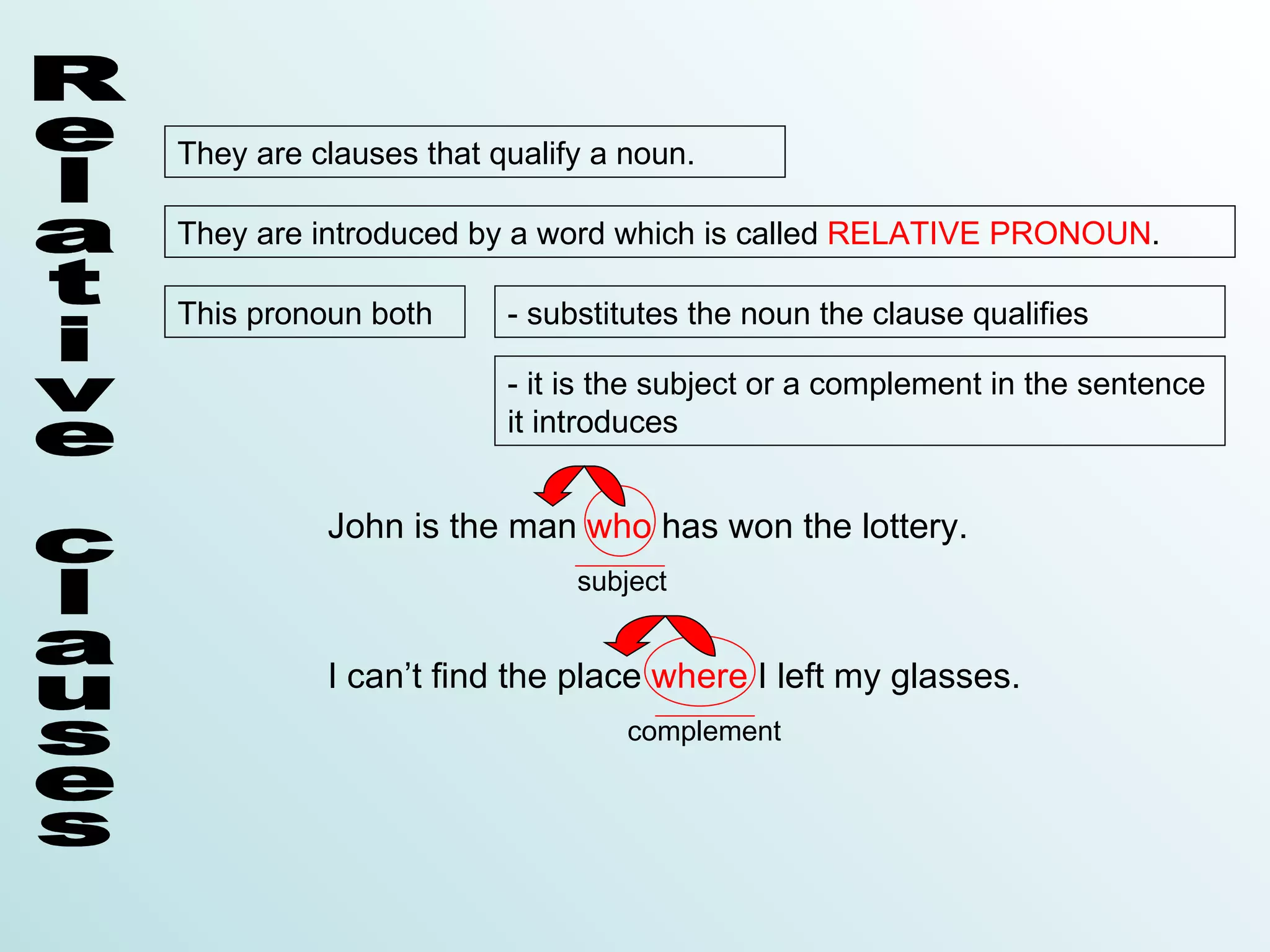
They are clauses that qualify a noun.

They are introduced by a word which is called RELATIVE PRONOUN.

This pronoun both      - substitutes the noun the clause qualifies

                       - it is the subject or a complement in the sentence
                       it introduces


          John is the man who has won the lottery.
                            subject


          I can’t find the place where I left my glasses.
                                complement
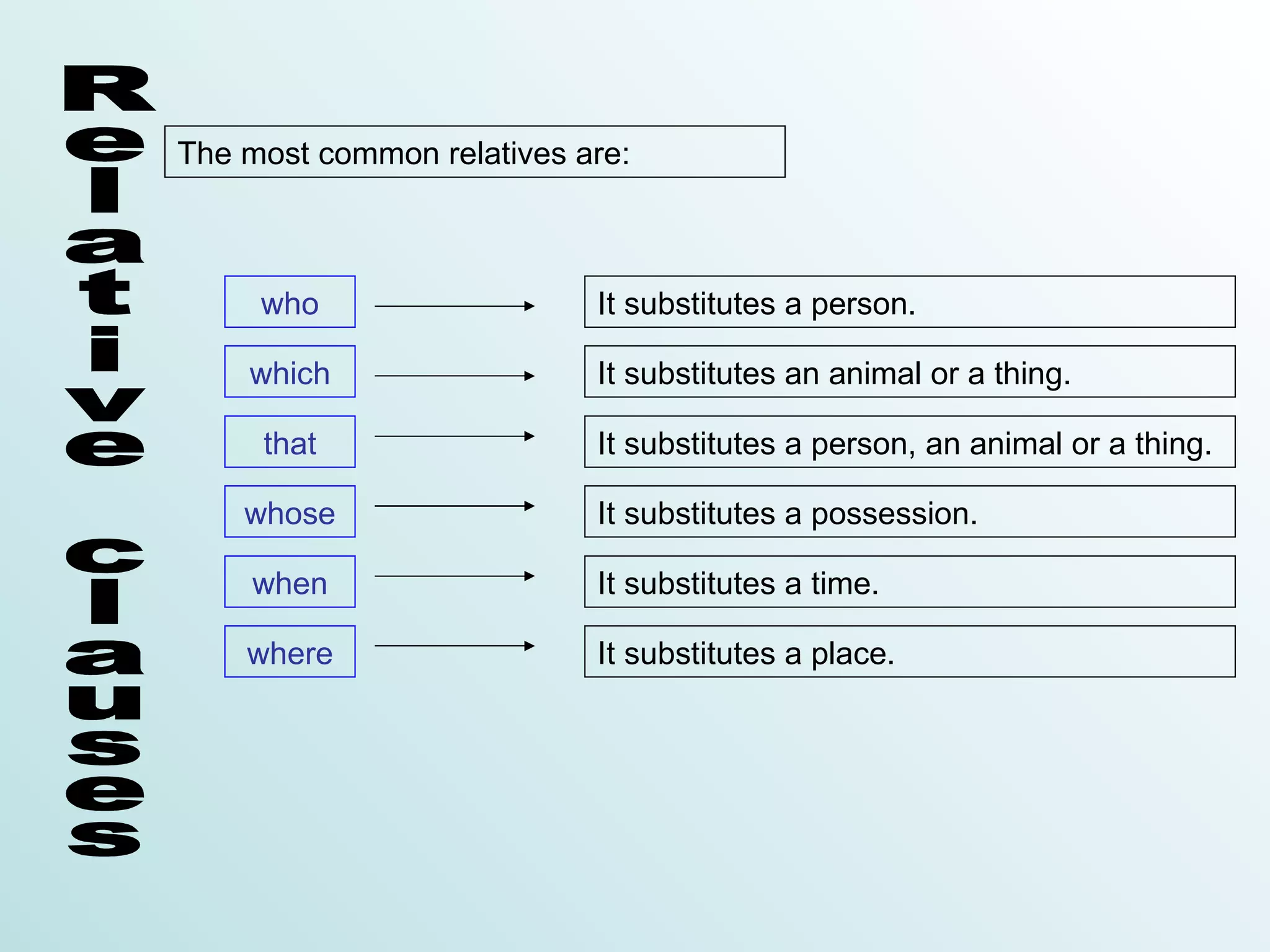
The most common relatives are:


     who                   It substitutes a person.

    which                  It substitutes an animal or a thing.

     that                  It substitutes a person, an animal or a thing.

    whose                  It substitutes a possession.

    when                   It substitutes a time.

    where                  It substitutes a place.
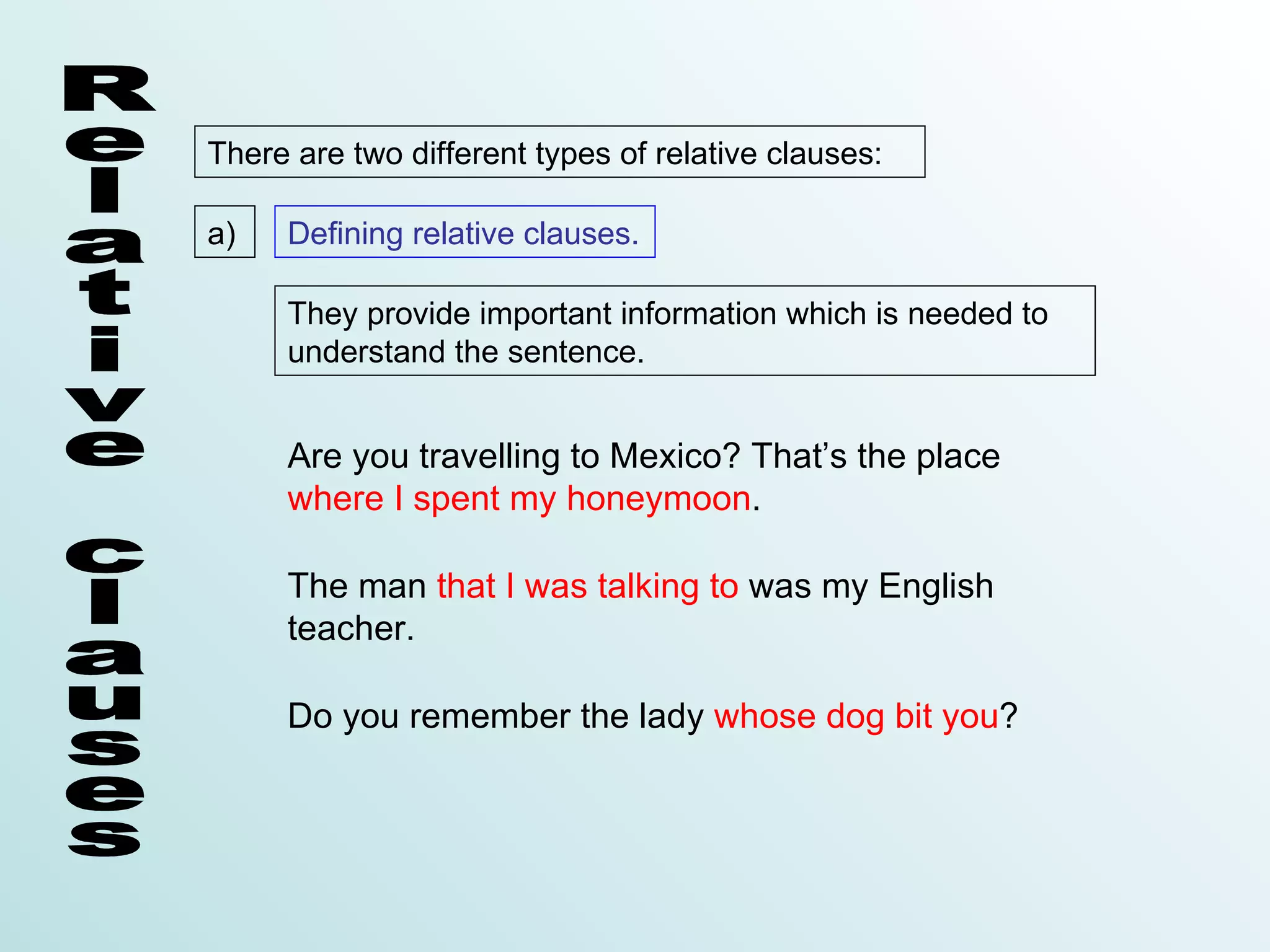
There are two different types of relative clauses:

a)   Defining relative clauses.

     They provide important information which is needed to
     understand the sentence.


     Are you travelling to Mexico? That’s the place
     where I spent my honeymoon.

     The man that I was talking to was my English
     teacher.

     Do you remember the lady whose dog bit you?
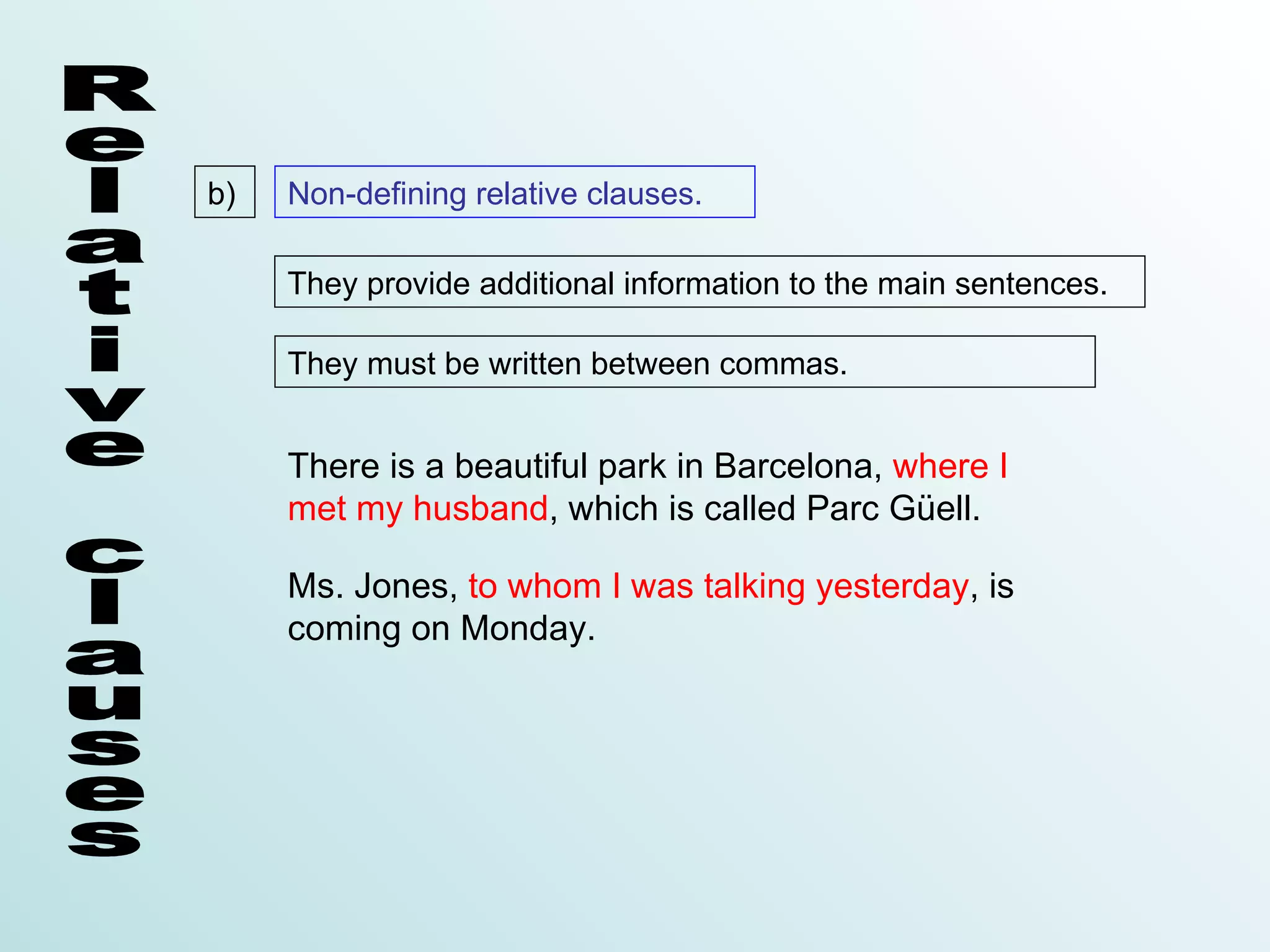
b)   Non-defining relative clauses.

     They provide additional information to the main sentences.

     They must be written between commas.


     There is a beautiful park in Barcelona, where I
     met my husband, which is called Parc Güell.

     Ms. Jones, to whom I was talking yesterday, is
     coming on Monday.
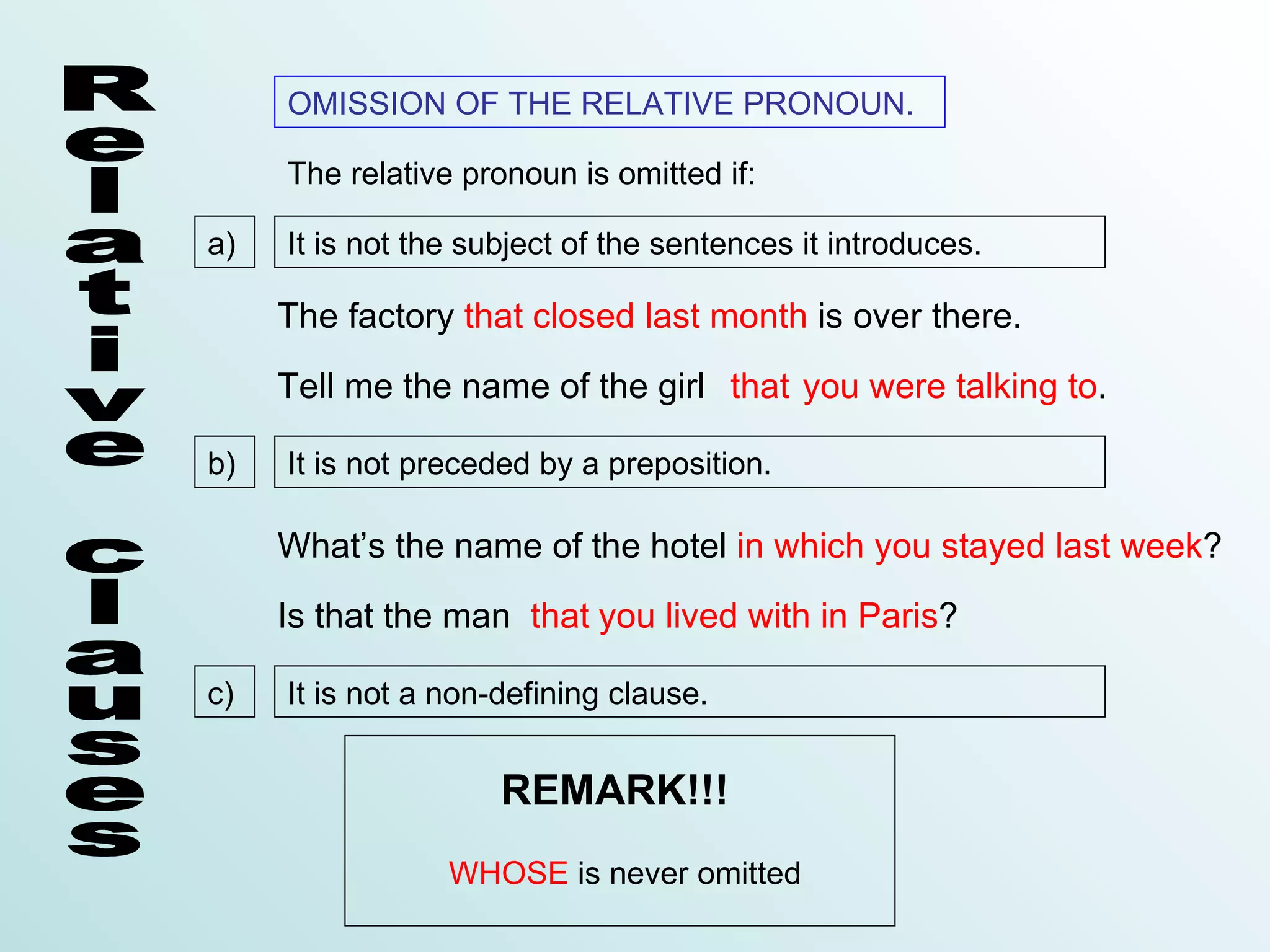
OMISSION OF THE RELATIVE PRONOUN.

     The relative pronoun is omitted if:

a)   It is not the subject of the sentences it introduces.

     The factory that closed last month is over there.
     Tell me the name of the girl that you were talking to.

b)   It is not preceded by a preposition.

     What’s the name of the hotel in which you stayed last week?
     Is that the man that you lived with in Paris?

c)   It is not a non-defining clause.


                     REMARK!!!
                 WHOSE is never omitted

Relative pronouns

  • 1.
    They are clausesthat qualify a noun. They are introduced by a word which is called RELATIVE PRONOUN. This pronoun both - substitutes the noun the clause qualifies - it is the subject or a complement in the sentence it introduces John is the man who has won the lottery. subject I can’t find the place where I left my glasses. complement
  • 2.
    The most commonrelatives are: who It substitutes a person. which It substitutes an animal or a thing. that It substitutes a person, an animal or a thing. whose It substitutes a possession. when It substitutes a time. where It substitutes a place.
  • 3.
    There are twodifferent types of relative clauses: a) Defining relative clauses. They provide important information which is needed to understand the sentence. Are you travelling to Mexico? That’s the place where I spent my honeymoon. The man that I was talking to was my English teacher. Do you remember the lady whose dog bit you?
  • 4.
    b) Non-defining relative clauses. They provide additional information to the main sentences. They must be written between commas. There is a beautiful park in Barcelona, where I met my husband, which is called Parc Güell. Ms. Jones, to whom I was talking yesterday, is coming on Monday.
  • 5.
    OMISSION OF THERELATIVE PRONOUN. The relative pronoun is omitted if: a) It is not the subject of the sentences it introduces. The factory that closed last month is over there. Tell me the name of the girl that you were talking to. b) It is not preceded by a preposition. What’s the name of the hotel in which you stayed last week? Is that the man that you lived with in Paris? c) It is not a non-defining clause. REMARK!!! WHOSE is never omitted