
PRESENT PARTICIPLE AND PAST PARTICIPLE
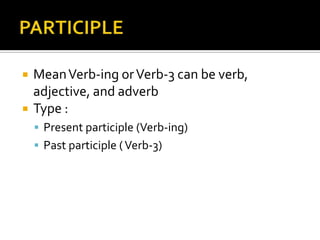
   Mean Verb-ing or Verb-3 can be verb,
    adjective, and adverb
   Type :
     Present participle (Verb-ing)
     Past participle ( Verb-3)
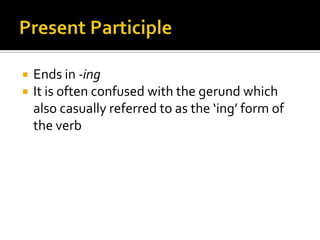
   Ends in -ing
   It is often confused with the gerund which
    also casually referred to as the ‘ing’ form of
    the verb
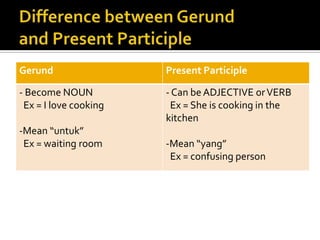
Gerund                 Present Participle

- Become NOUN          - Can be ADJECTIVE or VERB
 Ex = I love cooking    Ex = She is cooking in the
                       kitchen
-Mean “untuk”
 Ex = waiting room     -Mean “yang”
                        Ex = confusing person
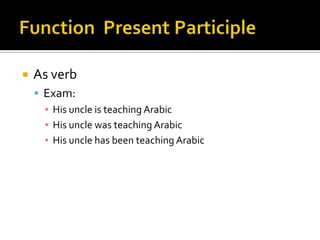
   As verb
     Exam:
      ▪ His uncle is teaching Arabic
      ▪ His uncle was teaching Arabic
      ▪ His uncle has been teaching Arabic
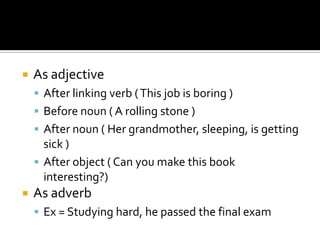
   As adjective
     After linking verb ( This job is boring )
     Before noun ( A rolling stone )
     After noun ( Her grandmother, sleeping, is getting
      sick )
     After object ( Can you make this book
      interesting?)
   As adverb
     Ex = Studying hard, he passed the final exam
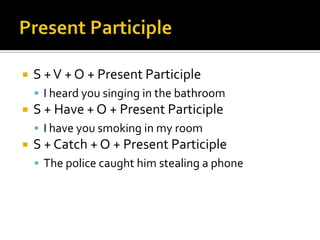
   S + V + O + Present Participle
     I heard you singing in the bathroom
   S + Have + O + Present Participle
     I have you smoking in my room
   S + Catch + O + Present Participle
     The police caught him stealing a phone
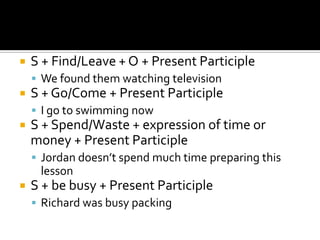
   S + Find/Leave + O + Present Participle
     We found them watching television
   S + Go/Come + Present Participle
     I go to swimming now
   S + Spend/Waste + expression of time or
    money + Present Participle
     Jordan doesn’t spend much time preparing this
     lesson
   S + be busy + Present Participle
     Richard was busy packing
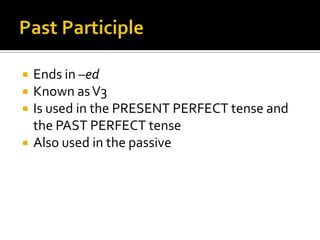
   Ends in –ed
   Known as V3
   Is used in the PRESENT PERFECT tense and
    the PAST PERFECT tense
   Also used in the passive
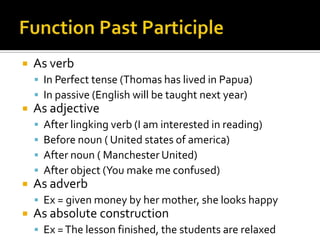
   As verb
     In Perfect tense (Thomas has lived in Papua)
     In passive (English will be taught next year)
   As adjective
       After lingking verb (I am interested in reading)
       Before noun ( United states of america)
       After noun ( Manchester United)
       After object (You make me confused)
   As adverb
     Ex = given money by her mother, she looks happy
   As absolute construction
     Ex = The lesson finished, the students are relaxed
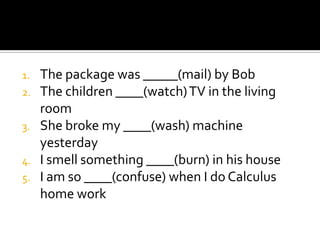
1.   The package was _____(mail) by Bob
2.   The children ____(watch) TV in the living
     room
3.   She broke my ____(wash) machine
     yesterday
4.   I smell something ____(burn) in his house
5.   I am so ____(confuse) when I do Calculus
     home work
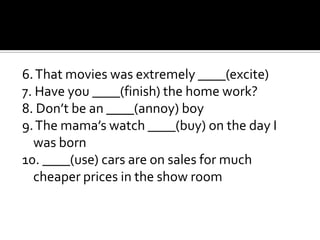
6. That movies was extremely ____(excite)
7. Have you ____(finish) the home work?
8. Don’t be an ____(annoy) boy
9. The mama’s watch ____(buy) on the day I
  was born
10. ____(use) cars are on sales for much
  cheaper prices in the show room

Participle

  • 1.
    PRESENT PARTICIPLE ANDPAST PARTICIPLE
  • 2.
    Mean Verb-ing or Verb-3 can be verb, adjective, and adverb  Type :  Present participle (Verb-ing)  Past participle ( Verb-3)
  • 3.
    Ends in -ing  It is often confused with the gerund which also casually referred to as the ‘ing’ form of the verb
  • 4.
    Gerund Present Participle - Become NOUN - Can be ADJECTIVE or VERB Ex = I love cooking Ex = She is cooking in the kitchen -Mean “untuk” Ex = waiting room -Mean “yang” Ex = confusing person
  • 5.
    As verb  Exam: ▪ His uncle is teaching Arabic ▪ His uncle was teaching Arabic ▪ His uncle has been teaching Arabic
  • 6.
    As adjective  After linking verb ( This job is boring )  Before noun ( A rolling stone )  After noun ( Her grandmother, sleeping, is getting sick )  After object ( Can you make this book interesting?)  As adverb  Ex = Studying hard, he passed the final exam
  • 7.
    S + V + O + Present Participle  I heard you singing in the bathroom  S + Have + O + Present Participle  I have you smoking in my room  S + Catch + O + Present Participle  The police caught him stealing a phone
  • 8.
    S + Find/Leave + O + Present Participle  We found them watching television  S + Go/Come + Present Participle  I go to swimming now  S + Spend/Waste + expression of time or money + Present Participle  Jordan doesn’t spend much time preparing this lesson  S + be busy + Present Participle  Richard was busy packing
  • 9.
    Ends in –ed  Known as V3  Is used in the PRESENT PERFECT tense and the PAST PERFECT tense  Also used in the passive
  • 10.
    As verb  In Perfect tense (Thomas has lived in Papua)  In passive (English will be taught next year)  As adjective  After lingking verb (I am interested in reading)  Before noun ( United states of america)  After noun ( Manchester United)  After object (You make me confused)  As adverb  Ex = given money by her mother, she looks happy  As absolute construction  Ex = The lesson finished, the students are relaxed
  • 12.
    1. The package was _____(mail) by Bob 2. The children ____(watch) TV in the living room 3. She broke my ____(wash) machine yesterday 4. I smell something ____(burn) in his house 5. I am so ____(confuse) when I do Calculus home work
  • 13.
    6. That movieswas extremely ____(excite) 7. Have you ____(finish) the home work? 8. Don’t be an ____(annoy) boy 9. The mama’s watch ____(buy) on the day I was born 10. ____(use) cars are on sales for much cheaper prices in the show room