Reduced Relative
Reduced Relative
clauses
clauses
Reduced Relative Clauses
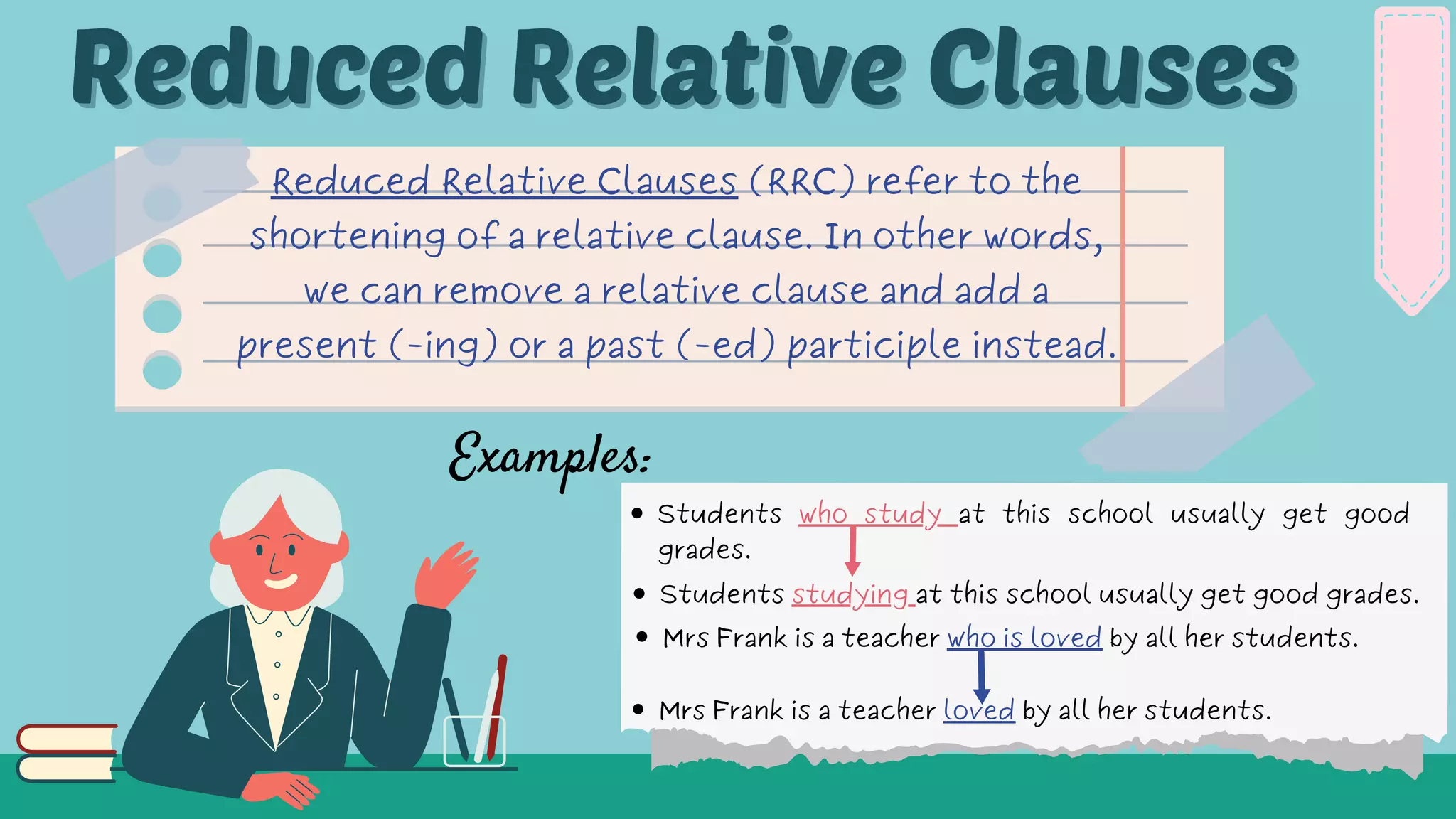
Students who study at this school usually get good
grades.
Students studying at this school usually get good grades.
Mrs Frank is a teacher who is loved by all her students.
Mrs Frank is a teacher loved by all her students.
Reduced Relative Clauses (RRC) refer to the
shortening of a relative clause. In other words,
we can remove a relative clause and add a
present (-ing) or a past (-ed) participle instead.
Examples:
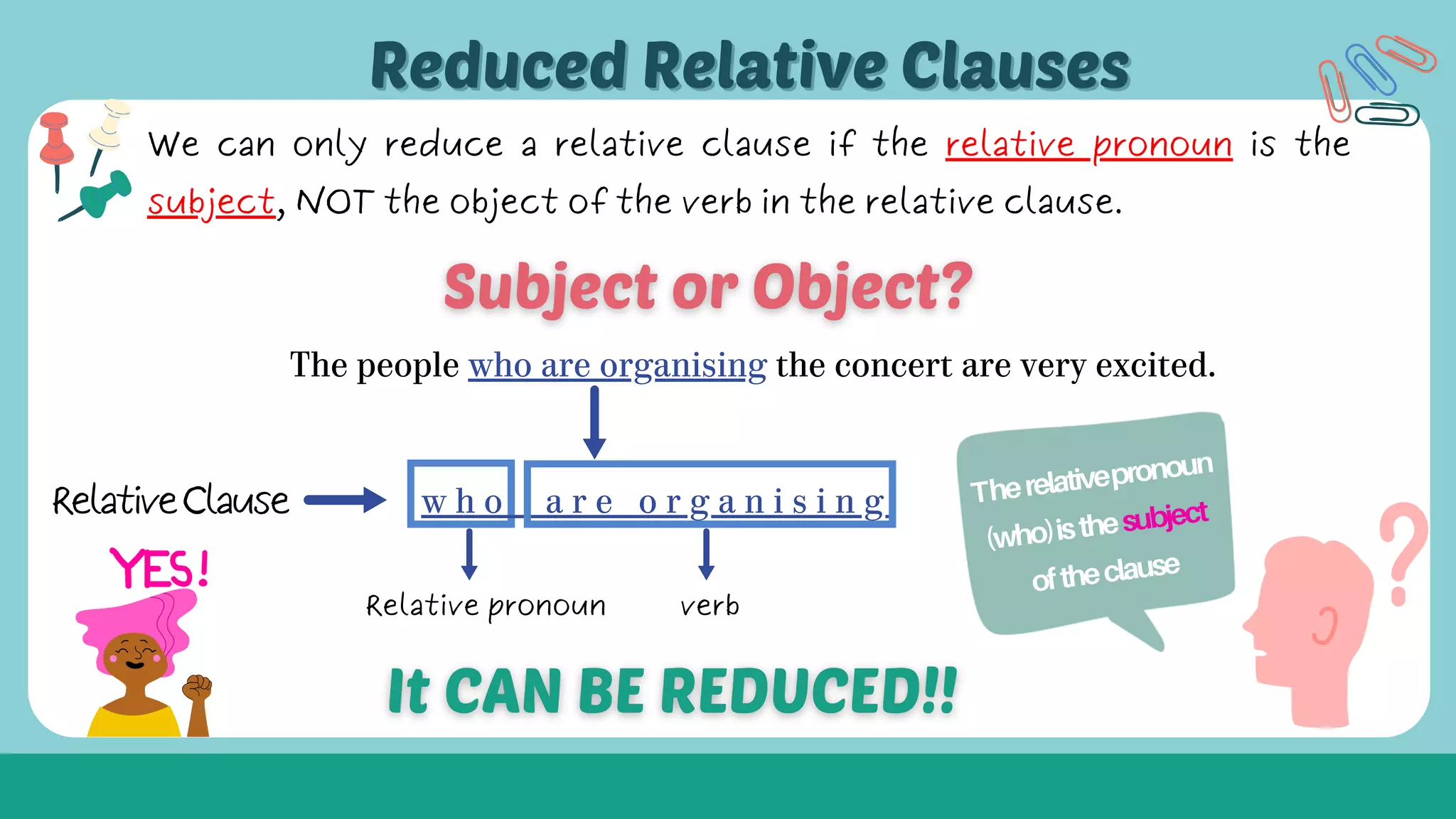
The people who are organising the concert are very excited.
w h o a r e o r g a n i s i n g
Relative pronoun verb
Therelativepronoun
(who)isthesubject
oftheclause
Reduced Relative Clauses
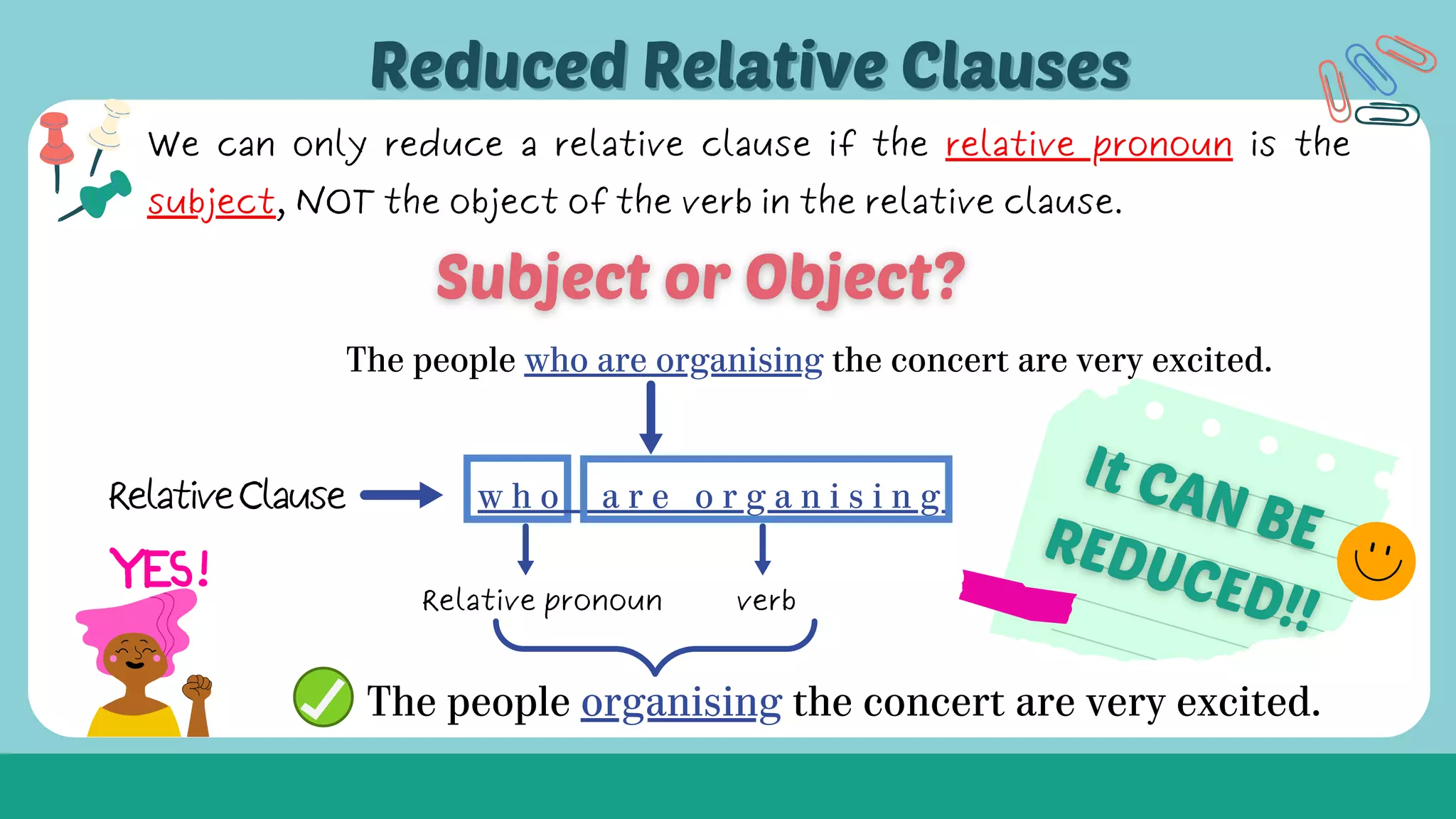
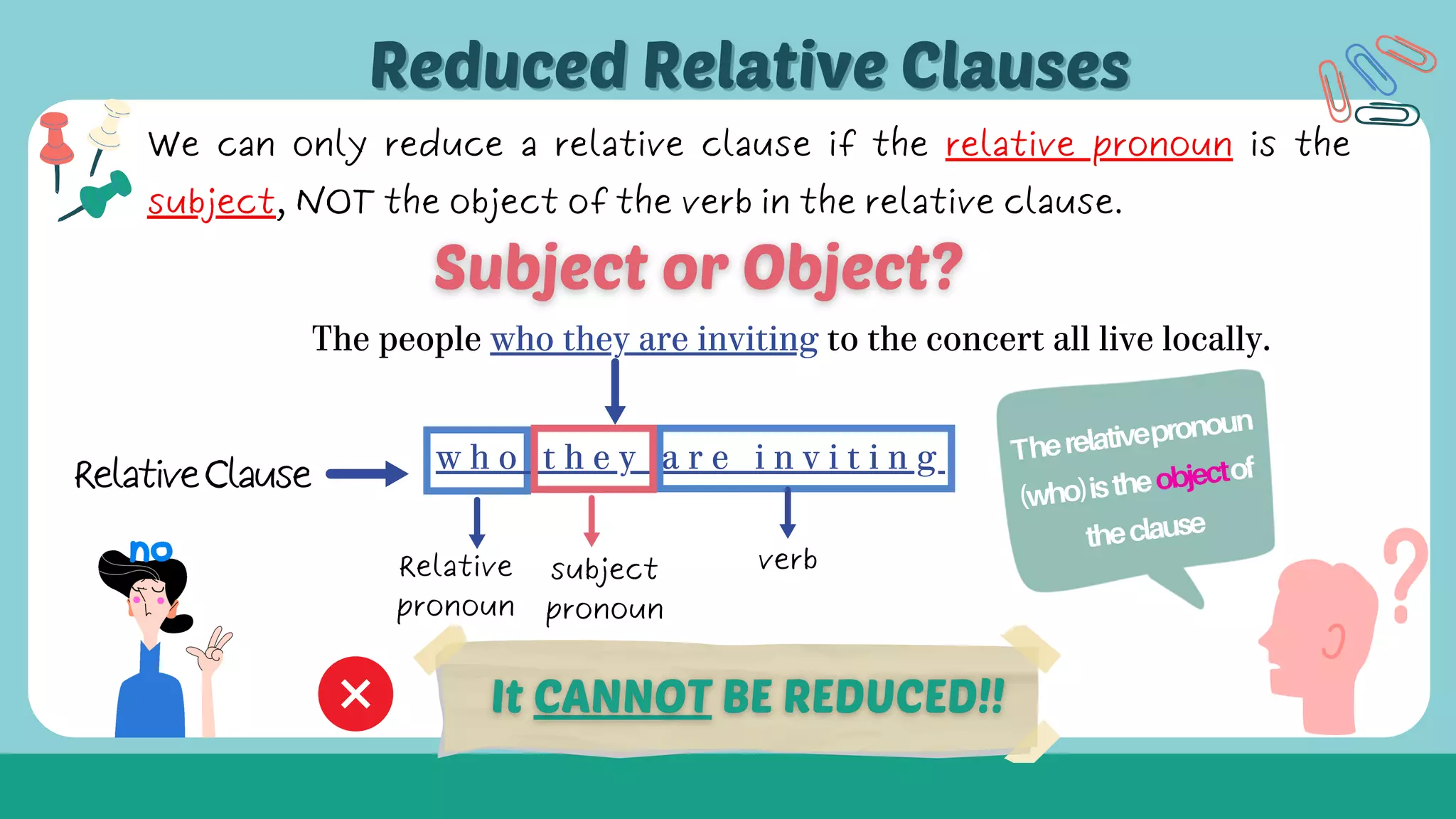
We can only reduce a relative clause if the relative pronoun is the
subject, NOT the object of the verb in the relative clause.
RelativeClause
w h o a r e o r g a n i s i n g
The people who are organising the concert are very excited.
Relative pronoun verb
RelativeClause
The people organising the concert are very excited.
Reduced Relative Clauses
We can only reduce a relative clause if the relative pronoun is the
subject, NOT the object of the verb in the relative clause.
Therelativepronoun
(who)istheobjectof
theclause
w h o t h e y a r e i n v i t i n g
The people who they are inviting to the concert all live locally.
Relative
pronoun
verb
RelativeClause
subject
pronoun
Reduced Relative Clauses
We can only reduce a relative clause if the relative pronoun is the
subject, NOT the object of the verb in the relative clause.
Reduced Relative Clauses
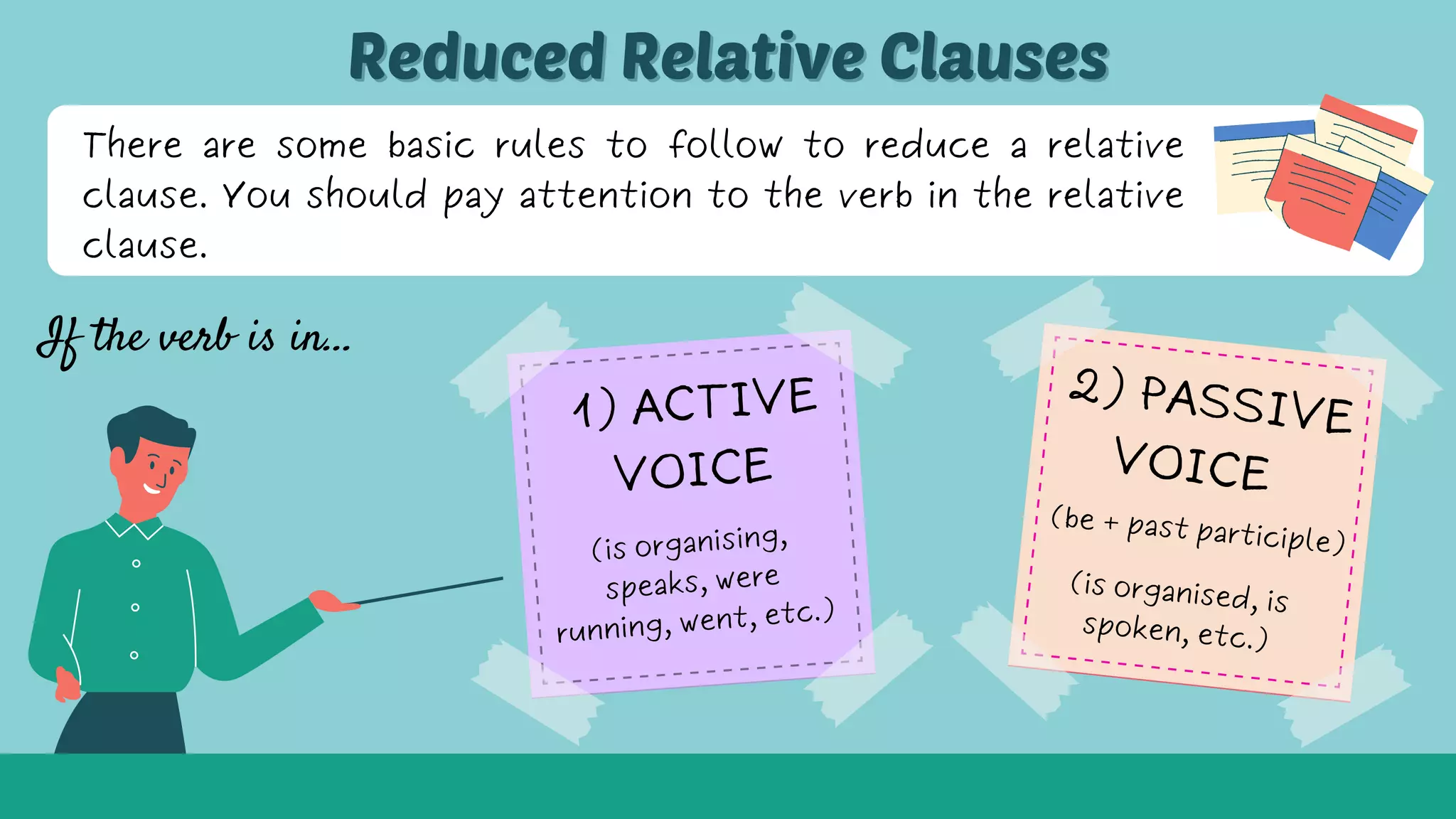
There are some basic rules to follow to reduce a relative
clause. You should pay attention to the verb in the relative
clause.
If the verb is in...
1) ACTIVE
VOICE
(is organising,
speaks, were
running, went, etc.)
2) PASSIVE
VOICE
(is organised, is
spoken, etc.)
(be + past participle)
1) ACTIVE
VOICE
(is organising,
speaks, were
running, went, etc.)
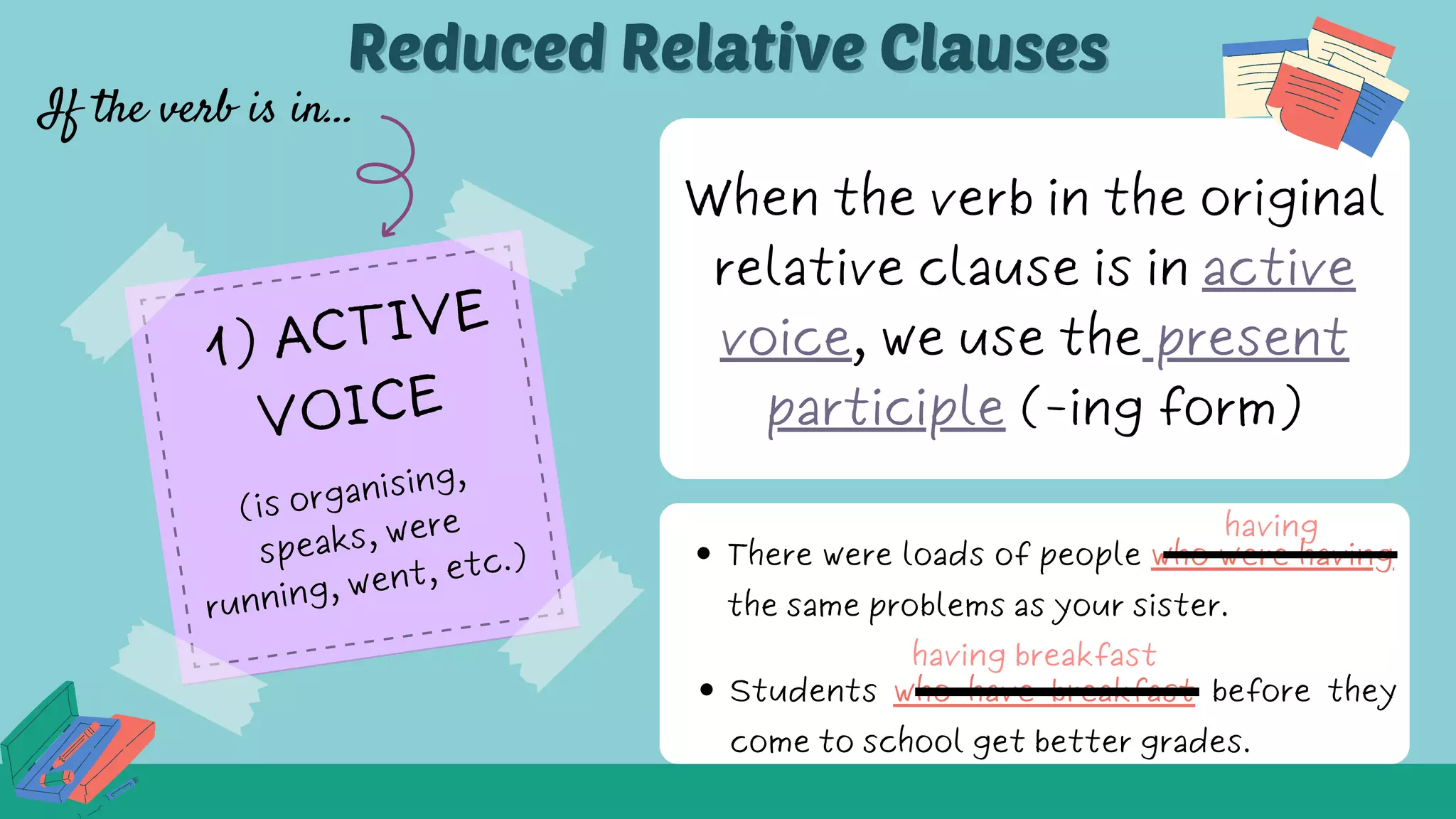
When the verb in the original
relative clause is in active
voice, we use the present
participle (-ing form)
There were loads of people who were having
the same problems as your sister.
If the verb is in...
Reduced Relative Clauses
having
Students who have breakfast before they
come to school get better grades.
having breakfast
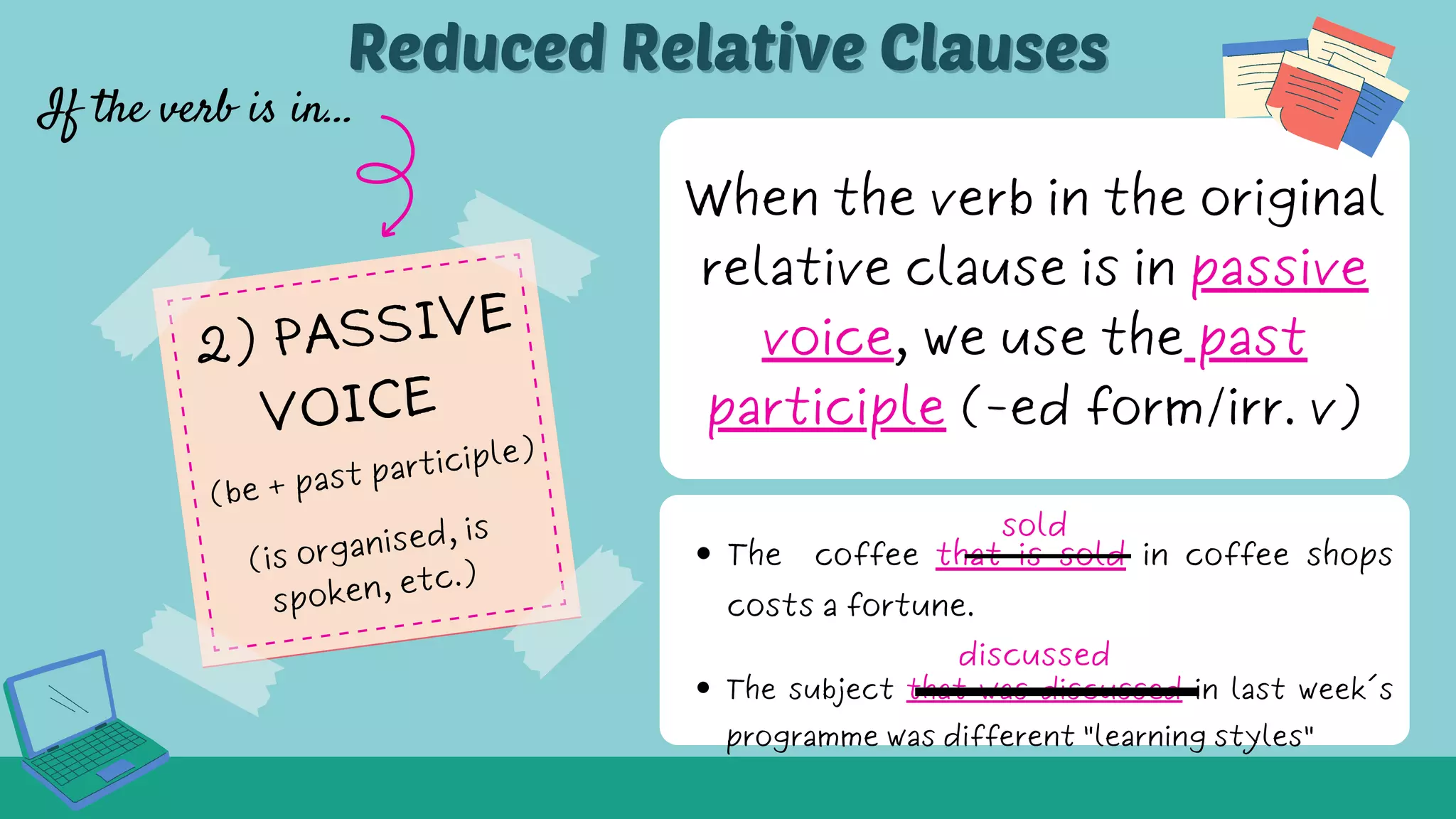
When the verb in the original
relative clause is in passive
voice, we use the past
participle (-ed form/irr. v)
The coffee that is sold in coffee shops
costs a fortune.
If the verb is in...
Reduced Relative Clauses
sold
The subject that was discussed in last week´s
programme was different "learning styles"
discussed
2) PASSIVE
VOICE
(is organised, is
spoken, etc.)
(be + past participle)
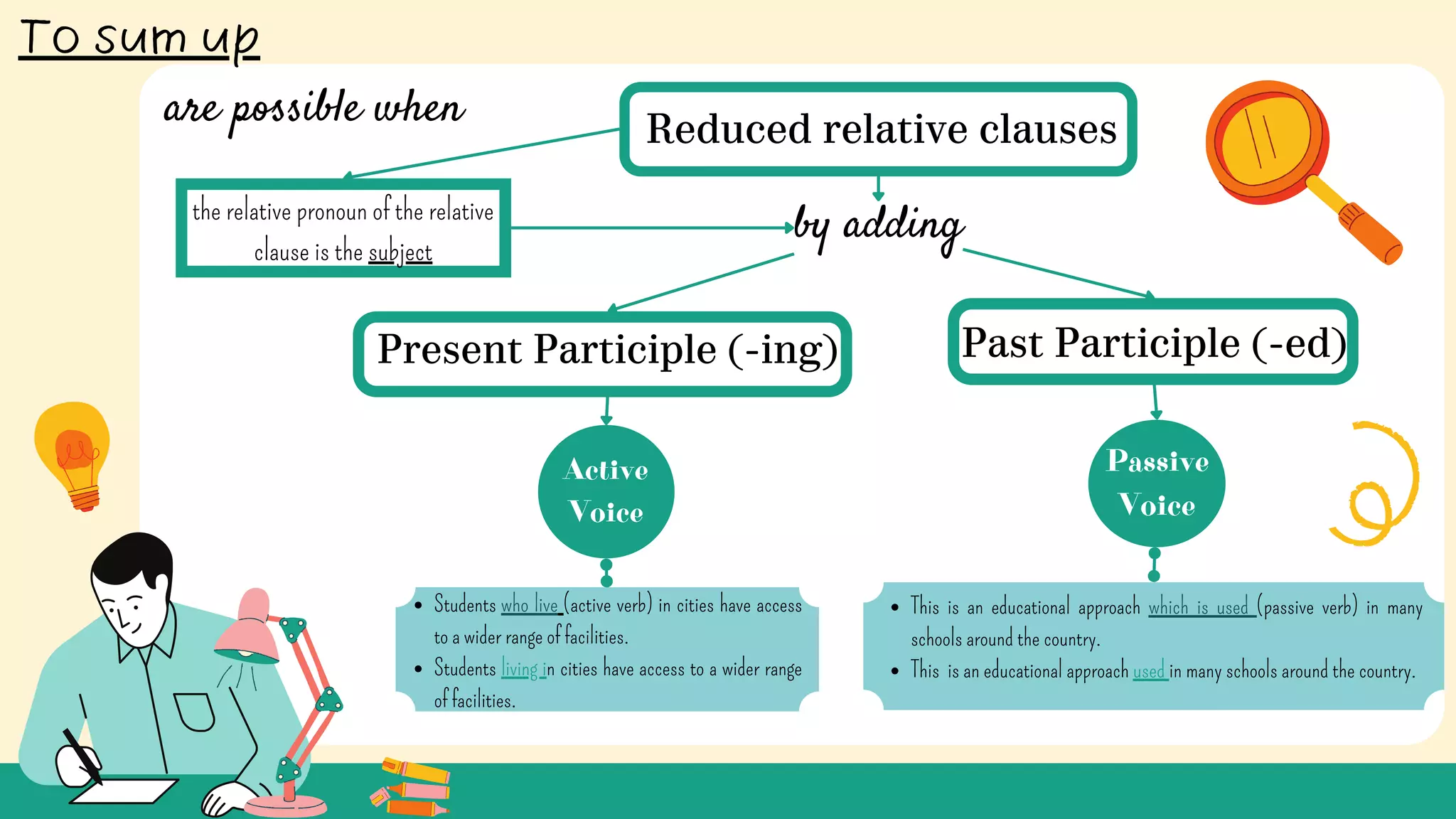
Present Participle (-ing) Past Participle (-ed)
Active
Voice
Passive
Voice
the relative pronoun of the relative
clause is the subject
by adding
Students who live (active verb) in cities have access
to a wider range of facilities.
Students living in cities have access to a wider range
of facilities.
This is an educational approach which is used (passive verb) in many
schools around the country.
This is an educational approach used in many schools around the country.
Reduced relative clauses
To sum up
are possible when

Reduced relative clauses 2022.pdf

  • 1.
  • 2.
    Reduced Relative Clauses ReducedRelative Clauses Students who study at this school usually get good grades. Students studying at this school usually get good grades. Mrs Frank is a teacher who is loved by all her students. Mrs Frank is a teacher loved by all her students. Reduced Relative Clauses (RRC) refer to the shortening of a relative clause. In other words, we can remove a relative clause and add a present (-ing) or a past (-ed) participle instead. Examples:
  • 3.
    The people whoare organising the concert are very excited. w h o a r e o r g a n i s i n g Relative pronoun verb Therelativepronoun (who)isthesubject oftheclause Reduced Relative Clauses Reduced Relative Clauses We can only reduce a relative clause if the relative pronoun is the subject, NOT the object of the verb in the relative clause. RelativeClause
  • 4.
    w h oa r e o r g a n i s i n g The people who are organising the concert are very excited. Relative pronoun verb RelativeClause The people organising the concert are very excited. Reduced Relative Clauses Reduced Relative Clauses We can only reduce a relative clause if the relative pronoun is the subject, NOT the object of the verb in the relative clause.
  • 5.
    Therelativepronoun (who)istheobjectof theclause w h ot h e y a r e i n v i t i n g The people who they are inviting to the concert all live locally. Relative pronoun verb RelativeClause subject pronoun Reduced Relative Clauses Reduced Relative Clauses We can only reduce a relative clause if the relative pronoun is the subject, NOT the object of the verb in the relative clause.
  • 6.
    Reduced Relative Clauses ReducedRelative Clauses There are some basic rules to follow to reduce a relative clause. You should pay attention to the verb in the relative clause. If the verb is in... 1) ACTIVE VOICE (is organising, speaks, were running, went, etc.) 2) PASSIVE VOICE (is organised, is spoken, etc.) (be + past participle)
  • 7.
    1) ACTIVE VOICE (is organising, speaks,were running, went, etc.) When the verb in the original relative clause is in active voice, we use the present participle (-ing form) There were loads of people who were having the same problems as your sister. If the verb is in... Reduced Relative Clauses Reduced Relative Clauses having Students who have breakfast before they come to school get better grades. having breakfast
  • 8.
    When the verbin the original relative clause is in passive voice, we use the past participle (-ed form/irr. v) The coffee that is sold in coffee shops costs a fortune. If the verb is in... Reduced Relative Clauses Reduced Relative Clauses sold The subject that was discussed in last week´s programme was different "learning styles" discussed 2) PASSIVE VOICE (is organised, is spoken, etc.) (be + past participle)
  • 9.
    Present Participle (-ing)Past Participle (-ed) Active Voice Passive Voice the relative pronoun of the relative clause is the subject by adding Students who live (active verb) in cities have access to a wider range of facilities. Students living in cities have access to a wider range of facilities. This is an educational approach which is used (passive verb) in many schools around the country. This is an educational approach used in many schools around the country. Reduced relative clauses To sum up are possible when