Reduction of
Relative Clauses
Prepared by Rebecca Soble
Be a detective!
Analyze the following
sentences to determine the
rules for reducing relative
clauses.
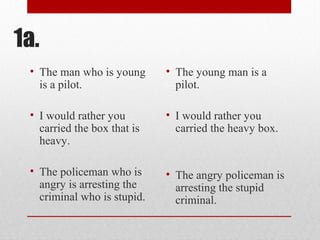
1a.
• The man who is young
is a pilot.
• I would rather you
carried the box that is
heavy.
• The policeman who is
angry is arresting the
criminal who is stupid.
• The young man is a
pilot.
• I would rather you
carried the heavy box.
• The angry policeman is
arresting the stupid
criminal.
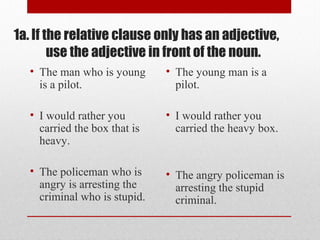
1a. If the relative clause only has an adjective,
use the adjective in front of the noun.
• The man who is young
is a pilot.
• I would rather you
carried the box that is
heavy.
• The policeman who is
angry is arresting the
criminal who is stupid.
• The young man is a
pilot.
• I would rather you
carried the heavy box.
• The angry policeman is
arresting the stupid
criminal.
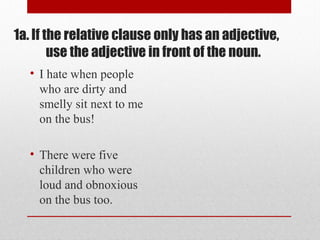
1a. If the relative clause only has an adjective,
use the adjective in front of the noun.
• I hate when people
who are dirty and
smelly sit next to me
on the bus!
• There were five
children who were
loud and obnoxious
on the bus too.
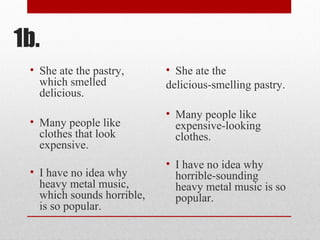
1b.
• She ate the pastry,
which smelled
delicious.
• Many people like
clothes that look
expensive.
• I have no idea why
heavy metal music,
which sounds horrible,
is so popular.
• She ate the
delicious-smelling pastry.
• Many people like
expensive-looking
clothes.
• I have no idea why
horrible-sounding
heavy metal music is so
popular.
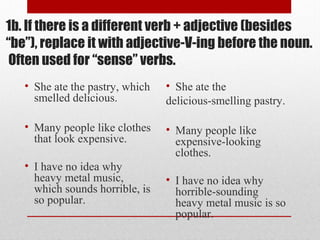
1b. If there is a different verb + adjective (besides
“be”), replace it with adjective-V-ing before the noun.
Often used for “sense” verbs.
• She ate the pastry, which
smelled delicious.
• Many people like clothes
that look expensive.
• I have no idea why
heavy metal music,
which sounds horrible, is
so popular.
• She ate the
delicious-smelling pastry.
• Many people like
expensive-looking
clothes.
• I have no idea why
horrible-sounding
heavy metal music is so
popular.
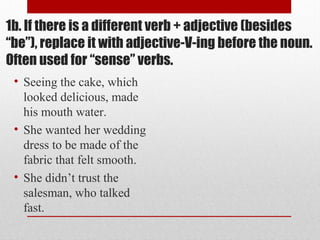
1b. If there is a different verb + adjective (besides
“be”), replace it with adjective-V-ing before the noun.
Often used for “sense” verbs.
• Seeing the cake, which
looked delicious, made
his mouth water.
• She wanted her wedding
dress to be made of the
fabric that felt smooth.
• She didn’t trust the
salesman, who talked
fast.
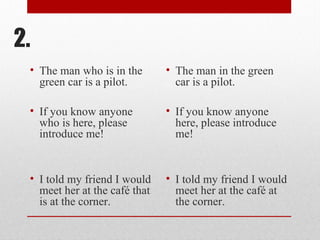
2.
• The man who is in the
green car is a pilot.
• If you know anyone
who is here, please
introduce me!
• I told my friend I would
meet her at the café that
is at the corner.
• The man in the green
car is a pilot.
• If you know anyone
here, please introduce
me!
• I told my friend I would
meet her at the café at
the corner.
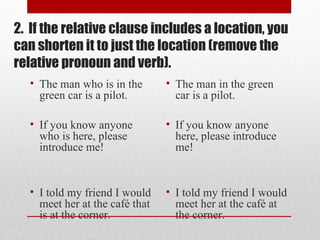
2. If the relative clause includes a location, you
can shorten it to just the location (remove the
relative pronoun and verb).
• The man who is in the
green car is a pilot.
• If you know anyone
who is here, please
introduce me!
• I told my friend I would
meet her at the café that
is at the corner.
• The man in the green
car is a pilot.
• If you know anyone
here, please introduce
me!
• I told my friend I would
meet her at the café at
the corner.
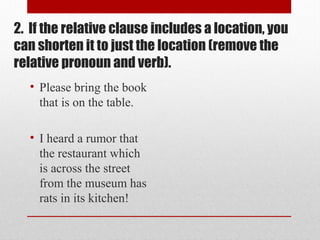
2. If the relative clause includes a location, you
can shorten it to just the location (remove the
relative pronoun and verb).
• Please bring the book
that is on the table.
• I heard a rumor that
the restaurant which
is across the street
from the museum has
rats in its kitchen!
3.
• The man who has red
hair is a pilot.
• The man who is
wearing the striped shirt
is an artist.
• The woman who is
holding the red
umbrella is my cousin.
• The man with red hair
is a pilot.
• The man with the
striped shirt is an artist.
• The woman with the
red umbrella is my
cousin.
3. Possession relative clauses (to have, to wear, to
hold, etc.) can be replaced with ‘with’.
• The man who has red
hair is a pilot.
• The man who is
wearing the striped shirt
is an artist.
• The woman who is
holding the red
umbrella is my cousin.
• The man with red hair
is a pilot.
• The man with the
striped shirt is an artist.
• The woman with the
red umbrella is my
cousin.
• The mosque that has
six minarets is called
the Blue Mosque.
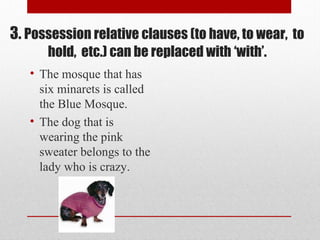
• The dog that is
wearing the pink
sweater belongs to the
lady who is crazy.
3. Possession relative clauses (to have, to wear, to
hold, etc.) can be replaced with ‘with’.
4.
• The man who is painting
the house is my uncle.
• I think the dog that is
chasing you has rabies, so
run really fast!
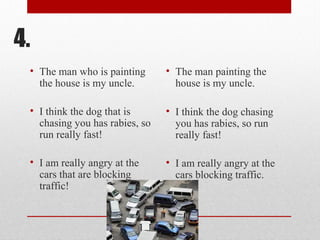
• I am really angry at the
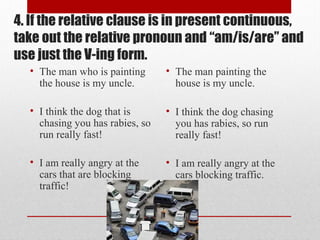
cars that are blocking
traffic!
• The man painting the
house is my uncle.
• I think the dog chasing
you has rabies, so run
really fast!
• I am really angry at the
cars blocking traffic.
4. If the relative clause is in present continuous,
take out the relative pronoun and “am/is/are” and
use just the V-ing form.
• The man who is painting
the house is my uncle.
• I think the dog that is
chasing you has rabies, so
run really fast!
• I am really angry at the
cars that are blocking
traffic!
• The man painting the
house is my uncle.
• I think the dog chasing
you has rabies, so run
really fast!
• I am really angry at the
cars blocking traffic.
4. If the relative clause is in present continuous,
take out the relative pronoun and “am/is/are” and
use just the V-ing form.
• The people who are
playing loud music
after midnight should
be shot!
• Anyone who is going
to the cinema
tomorrow, can I come
with you?
5.
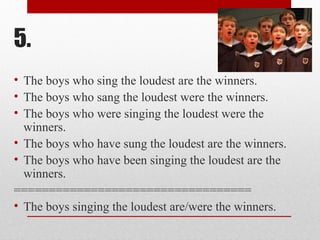
• The boys who sing the loudest are the winners.
• The boys who sang the loudest were the winners.
• The boys who were singing the loudest were the
winners.
• The boys who have sung the loudest are the winners.
• The boys who have been singing the loudest are the
winners.
==================================
• The boys singing the loudest are/were the winners.
5. In fact, rule 4 works for the other
verb tenses too: replace the relative
pronoun and verb with the V-ing form.
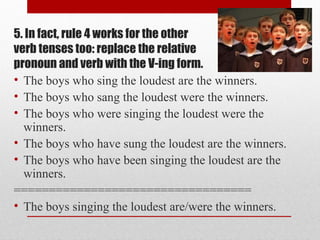
• The boys who sing the loudest are the winners.
• The boys who sang the loudest were the winners.
• The boys who were singing the loudest were the
winners.
• The boys who have sung the loudest are the winners.
• The boys who have been singing the loudest are the
winners.
==================================
• The boys singing the loudest are/were the winners.
• Any student who has been
studying regularly is sure to be
successful on the exam.
• People who think they can be
successful by cramming are
wrong.
• The football team that
practiced the hardest won the
World Cup.
5. In fact, rule 4 works for the other verb tenses too:
replace the relative pronoun and verb with the V-ing form.
6a.
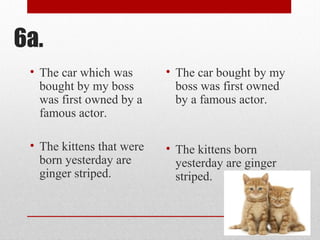
• The car which was
bought by my boss
was first owned by a
famous actor.
• The kittens that were
born yesterday are
ginger striped.
• The car bought by my
boss was first owned
by a famous actor.
• The kittens born
yesterday are ginger
striped.
6a. Passive Relative Pronouns can be replaced
with just V3.
• The car which was
bought by my boss
was first owned by a
famous actor.
• The kittens that were
born yesterday are
ginger striped.
• The car bought by my
boss was first owned
by a famous actor.
• The kittens born
yesterday are ginger
striped.
• The buildings that
were damaged in the
earthquake are being
rebuilt.
• Anyone who is scared
of the dark should see
a therapist.
6a. Passive Relative Pronouns can be replaced
with just V3.
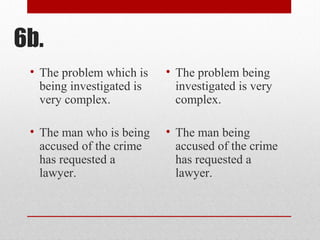
6b.
• The problem which is
being investigated is
very complex.
• The man who is being
accused of the crime
has requested a
lawyer.
• The problem being
investigated is very
complex.
• The man being
accused of the crime
has requested a
lawyer.
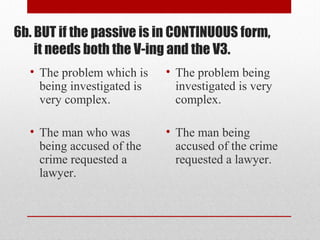
6b. BUT if the passive is in CONTINUOUS form,
it needs both the V-ing and the V3.
• The problem which is
being investigated is
very complex.
• The man who was
being accused of the
crime requested a
lawyer.
• The problem being
investigated is very
complex.
• The man being
accused of the crime
requested a lawyer.
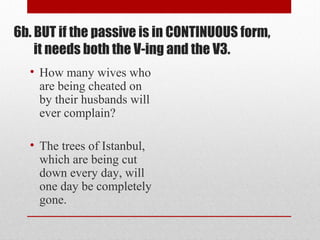
• How many wives who
are being cheated on
by their husbands will
ever complain?
• The trees of Istanbul,
which are being cut
down every day, will
one day be completely
gone.
6b. BUT if the passive is in CONTINUOUS form,
it needs both the V-ing and the V3.
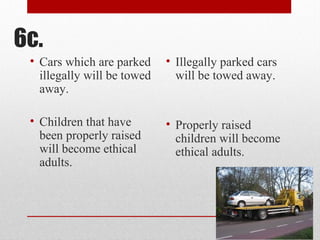
6c.
• Cars which are parked
illegally will be towed
away.
• Children that have
been properly raised
will become ethical
adults.
• Illegally parked cars
will be towed away.
• Properly raised
children will become
ethical adults.
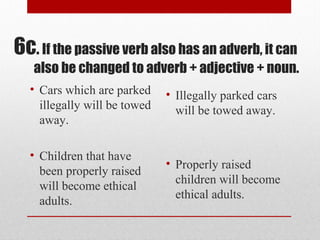
6c. If the passive verb also has an adverb, it can
also be changed to adverb + adjective + noun.
• Cars which are parked
illegally will be towed
away.
• Children that have
been properly raised
will become ethical
adults.
• Illegally parked cars
will be towed away.
• Properly raised
children will become
ethical adults.
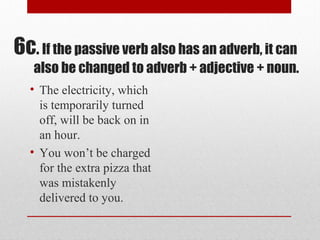
• The electricity, which
is temporarily turned
off, will be back on in
an hour.
• You won’t be charged
for the extra pizza that
was mistakenly
delivered to you.
6c. If the passive verb also has an adverb, it can
also be changed to adverb + adjective + noun.
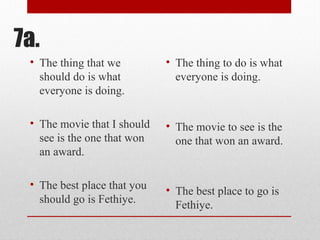
7a.
• The thing that we
should do is what
everyone is doing.
• The movie that I should
see is the one that won
an award.
• The best place that you
should go is Fethiye.
• The thing to do is what
everyone is doing.
• The movie to see is the
one that won an award.
• The best place to go is
Fethiye.
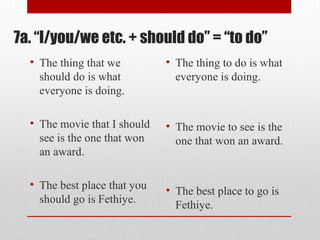
• The thing that we
should do is what
everyone is doing.
• The movie that I should
see is the one that won
an award.
• The best place that you
should go is Fethiye.
• The thing to do is what
everyone is doing.
• The movie to see is the
one that won an award.
• The best place to go is
Fethiye.
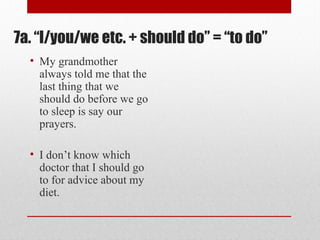
7a. “I/you/we etc. + should do” = “to do”
• My grandmother
always told me that the
last thing that we
should do before we go
to sleep is say our
prayers.
• I don’t know which
doctor that I should go
to for advice about my
diet.
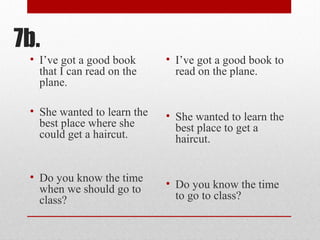
7b.
• I’ve got a good book
that I can read on the
plane.
• She wanted to learn the
best place where she
could get a haircut.
• Do you know the time
when we should go to
class?
• I’ve got a good book to
read on the plane.
• She wanted to learn the
best place to get a
haircut.
• Do you know the time
to go to class?
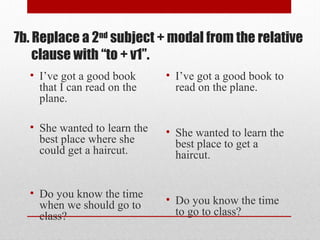
7b. Replace a 2nd
subject + modal from the relative
clause with “to + v1”.
• I’ve got a good book
that I can read on the
plane.
• She wanted to learn the
best place where she
could get a haircut.
• Do you know the time
when we should go to
class?
• I’ve got a good book to
read on the plane.
• She wanted to learn the
best place to get a
haircut.
• Do you know the time
to go to class?
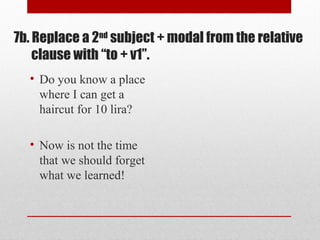
7b. Replace a 2nd
subject + modal from the relative
clause with “to + v1”.
• Do you know a place
where I can get a
haircut for 10 lira?
• Now is not the time
that we should forget
what we learned!
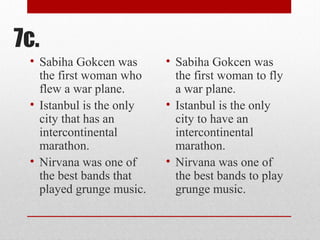
7c.
• Sabiha Gokcen was
the first woman who
flew a war plane.
• Istanbul is the only
city that has an
intercontinental
marathon.
• Nirvana was one of
the best bands that
played grunge music.
• Sabiha Gokcen was
the first woman to fly
a war plane.
• Istanbul is the only
city to have an
intercontinental
marathon.
• Nirvana was one of
the best bands to play
grunge music.
7c. With a superlative form, “to + V1” can
replace the relative pronoun.
• Sabiha Gokcen was
the first woman who
flew a war plane.
• Istanbul is the only
city that has an
intercontinental
marathon.
• Nirvana was one of
the best bands that
played grunge music.
• Sabiha Gokcen was
the first woman to fly
a war plane.
• Istanbul is the only
city to have an
intercontinental
marathon.
• Nirvana was one of
the best bands to play
grunge music.
• Uruguay was the first
country that won the
World Cup, in 1930.
• Turkey is one of only
three countries that
have not been
occupied.
7c. With a superlative form, “to + V1” can
replace the relative pronoun.
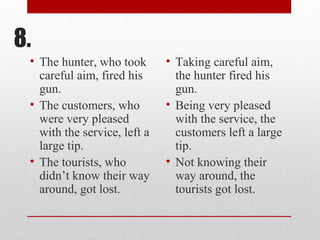
8.
• The hunter, who took
careful aim, fired his
gun.
• The customers, who
were very pleased
with the service, left a
large tip.
• The tourists, who
didn’t know their way
around, got lost.
• Taking careful aim,
the hunter fired his
gun.
• Being very pleased
with the service, the
customers left a large
tip.
• Not knowing their
way around, the
tourists got lost.
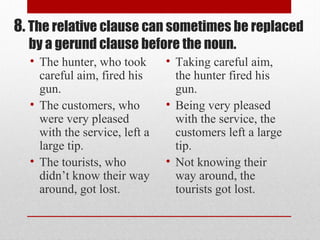
8. The relative clause can sometimes be replaced
by a gerund clause before the noun.
• The hunter, who took
careful aim, fired his
gun.
• The customers, who
were very pleased
with the service, left a
large tip.
• The tourists, who
didn’t know their way
around, got lost.
• Taking careful aim,
the hunter fired his
gun.
• Being very pleased
with the service, the
customers left a large
tip.
• Not knowing their
way around, the
tourists got lost.
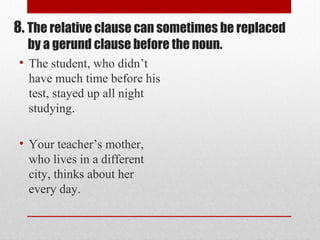
• The student, who didn’t
have much time before his
test, stayed up all night
studying.
• Your teacher’s mother,
who lives in a different
city, thinks about her
every day.
8. The relative clause can sometimes be replaced
by a gerund clause before the noun.
Finally, that’s it!

Reduced relative clauses

  • 1.
  • 2.
    Be a detective! Analyzethe following sentences to determine the rules for reducing relative clauses.
  • 3.
    1a. • The manwho is young is a pilot. • I would rather you carried the box that is heavy. • The policeman who is angry is arresting the criminal who is stupid. • The young man is a pilot. • I would rather you carried the heavy box. • The angry policeman is arresting the stupid criminal.
  • 4.
    1a. If therelative clause only has an adjective, use the adjective in front of the noun. • The man who is young is a pilot. • I would rather you carried the box that is heavy. • The policeman who is angry is arresting the criminal who is stupid. • The young man is a pilot. • I would rather you carried the heavy box. • The angry policeman is arresting the stupid criminal.
  • 5.
    1a. If therelative clause only has an adjective, use the adjective in front of the noun. • I hate when people who are dirty and smelly sit next to me on the bus! • There were five children who were loud and obnoxious on the bus too.
  • 6.
    1b. • She atethe pastry, which smelled delicious. • Many people like clothes that look expensive. • I have no idea why heavy metal music, which sounds horrible, is so popular. • She ate the delicious-smelling pastry. • Many people like expensive-looking clothes. • I have no idea why horrible-sounding heavy metal music is so popular.
  • 7.
    1b. If thereis a different verb + adjective (besides “be”), replace it with adjective-V-ing before the noun. Often used for “sense” verbs. • She ate the pastry, which smelled delicious. • Many people like clothes that look expensive. • I have no idea why heavy metal music, which sounds horrible, is so popular. • She ate the delicious-smelling pastry. • Many people like expensive-looking clothes. • I have no idea why horrible-sounding heavy metal music is so popular.
  • 8.
    1b. If thereis a different verb + adjective (besides “be”), replace it with adjective-V-ing before the noun. Often used for “sense” verbs. • Seeing the cake, which looked delicious, made his mouth water. • She wanted her wedding dress to be made of the fabric that felt smooth. • She didn’t trust the salesman, who talked fast.
  • 9.
    2. • The manwho is in the green car is a pilot. • If you know anyone who is here, please introduce me! • I told my friend I would meet her at the café that is at the corner. • The man in the green car is a pilot. • If you know anyone here, please introduce me! • I told my friend I would meet her at the café at the corner.
  • 10.
    2. If therelative clause includes a location, you can shorten it to just the location (remove the relative pronoun and verb). • The man who is in the green car is a pilot. • If you know anyone who is here, please introduce me! • I told my friend I would meet her at the café that is at the corner. • The man in the green car is a pilot. • If you know anyone here, please introduce me! • I told my friend I would meet her at the café at the corner.
  • 11.
    2. If therelative clause includes a location, you can shorten it to just the location (remove the relative pronoun and verb). • Please bring the book that is on the table. • I heard a rumor that the restaurant which is across the street from the museum has rats in its kitchen!
  • 12.
    3. • The manwho has red hair is a pilot. • The man who is wearing the striped shirt is an artist. • The woman who is holding the red umbrella is my cousin. • The man with red hair is a pilot. • The man with the striped shirt is an artist. • The woman with the red umbrella is my cousin.
  • 13.
    3. Possession relativeclauses (to have, to wear, to hold, etc.) can be replaced with ‘with’. • The man who has red hair is a pilot. • The man who is wearing the striped shirt is an artist. • The woman who is holding the red umbrella is my cousin. • The man with red hair is a pilot. • The man with the striped shirt is an artist. • The woman with the red umbrella is my cousin.
  • 14.
    • The mosquethat has six minarets is called the Blue Mosque. • The dog that is wearing the pink sweater belongs to the lady who is crazy. 3. Possession relative clauses (to have, to wear, to hold, etc.) can be replaced with ‘with’.
  • 15.
    4. • The manwho is painting the house is my uncle. • I think the dog that is chasing you has rabies, so run really fast! • I am really angry at the cars that are blocking traffic! • The man painting the house is my uncle. • I think the dog chasing you has rabies, so run really fast! • I am really angry at the cars blocking traffic.
  • 16.
    4. If therelative clause is in present continuous, take out the relative pronoun and “am/is/are” and use just the V-ing form. • The man who is painting the house is my uncle. • I think the dog that is chasing you has rabies, so run really fast! • I am really angry at the cars that are blocking traffic! • The man painting the house is my uncle. • I think the dog chasing you has rabies, so run really fast! • I am really angry at the cars blocking traffic.
  • 17.
    4. If therelative clause is in present continuous, take out the relative pronoun and “am/is/are” and use just the V-ing form. • The people who are playing loud music after midnight should be shot! • Anyone who is going to the cinema tomorrow, can I come with you?
  • 18.
    5. • The boyswho sing the loudest are the winners. • The boys who sang the loudest were the winners. • The boys who were singing the loudest were the winners. • The boys who have sung the loudest are the winners. • The boys who have been singing the loudest are the winners. ================================== • The boys singing the loudest are/were the winners.
  • 19.
    5. In fact,rule 4 works for the other verb tenses too: replace the relative pronoun and verb with the V-ing form. • The boys who sing the loudest are the winners. • The boys who sang the loudest were the winners. • The boys who were singing the loudest were the winners. • The boys who have sung the loudest are the winners. • The boys who have been singing the loudest are the winners. ================================== • The boys singing the loudest are/were the winners.
  • 20.
    • Any studentwho has been studying regularly is sure to be successful on the exam. • People who think they can be successful by cramming are wrong. • The football team that practiced the hardest won the World Cup. 5. In fact, rule 4 works for the other verb tenses too: replace the relative pronoun and verb with the V-ing form.
  • 21.
    6a. • The carwhich was bought by my boss was first owned by a famous actor. • The kittens that were born yesterday are ginger striped. • The car bought by my boss was first owned by a famous actor. • The kittens born yesterday are ginger striped.
  • 22.
    6a. Passive RelativePronouns can be replaced with just V3. • The car which was bought by my boss was first owned by a famous actor. • The kittens that were born yesterday are ginger striped. • The car bought by my boss was first owned by a famous actor. • The kittens born yesterday are ginger striped.
  • 23.
    • The buildingsthat were damaged in the earthquake are being rebuilt. • Anyone who is scared of the dark should see a therapist. 6a. Passive Relative Pronouns can be replaced with just V3.
  • 24.
    6b. • The problemwhich is being investigated is very complex. • The man who is being accused of the crime has requested a lawyer. • The problem being investigated is very complex. • The man being accused of the crime has requested a lawyer.
  • 25.
    6b. BUT ifthe passive is in CONTINUOUS form, it needs both the V-ing and the V3. • The problem which is being investigated is very complex. • The man who was being accused of the crime requested a lawyer. • The problem being investigated is very complex. • The man being accused of the crime requested a lawyer.
  • 26.
    • How manywives who are being cheated on by their husbands will ever complain? • The trees of Istanbul, which are being cut down every day, will one day be completely gone. 6b. BUT if the passive is in CONTINUOUS form, it needs both the V-ing and the V3.
  • 27.
    6c. • Cars whichare parked illegally will be towed away. • Children that have been properly raised will become ethical adults. • Illegally parked cars will be towed away. • Properly raised children will become ethical adults.
  • 28.
    6c. If thepassive verb also has an adverb, it can also be changed to adverb + adjective + noun. • Cars which are parked illegally will be towed away. • Children that have been properly raised will become ethical adults. • Illegally parked cars will be towed away. • Properly raised children will become ethical adults.
  • 29.
    • The electricity,which is temporarily turned off, will be back on in an hour. • You won’t be charged for the extra pizza that was mistakenly delivered to you. 6c. If the passive verb also has an adverb, it can also be changed to adverb + adjective + noun.
  • 30.
    7a. • The thingthat we should do is what everyone is doing. • The movie that I should see is the one that won an award. • The best place that you should go is Fethiye. • The thing to do is what everyone is doing. • The movie to see is the one that won an award. • The best place to go is Fethiye.
  • 31.
    • The thingthat we should do is what everyone is doing. • The movie that I should see is the one that won an award. • The best place that you should go is Fethiye. • The thing to do is what everyone is doing. • The movie to see is the one that won an award. • The best place to go is Fethiye. 7a. “I/you/we etc. + should do” = “to do”
  • 32.
    7a. “I/you/we etc.+ should do” = “to do” • My grandmother always told me that the last thing that we should do before we go to sleep is say our prayers. • I don’t know which doctor that I should go to for advice about my diet.
  • 33.
    7b. • I’ve gota good book that I can read on the plane. • She wanted to learn the best place where she could get a haircut. • Do you know the time when we should go to class? • I’ve got a good book to read on the plane. • She wanted to learn the best place to get a haircut. • Do you know the time to go to class?
  • 34.
    7b. Replace a2nd subject + modal from the relative clause with “to + v1”. • I’ve got a good book that I can read on the plane. • She wanted to learn the best place where she could get a haircut. • Do you know the time when we should go to class? • I’ve got a good book to read on the plane. • She wanted to learn the best place to get a haircut. • Do you know the time to go to class?
  • 35.
    7b. Replace a2nd subject + modal from the relative clause with “to + v1”. • Do you know a place where I can get a haircut for 10 lira? • Now is not the time that we should forget what we learned!
  • 36.
    7c. • Sabiha Gokcenwas the first woman who flew a war plane. • Istanbul is the only city that has an intercontinental marathon. • Nirvana was one of the best bands that played grunge music. • Sabiha Gokcen was the first woman to fly a war plane. • Istanbul is the only city to have an intercontinental marathon. • Nirvana was one of the best bands to play grunge music.
  • 37.
    7c. With asuperlative form, “to + V1” can replace the relative pronoun. • Sabiha Gokcen was the first woman who flew a war plane. • Istanbul is the only city that has an intercontinental marathon. • Nirvana was one of the best bands that played grunge music. • Sabiha Gokcen was the first woman to fly a war plane. • Istanbul is the only city to have an intercontinental marathon. • Nirvana was one of the best bands to play grunge music.
  • 38.
    • Uruguay wasthe first country that won the World Cup, in 1930. • Turkey is one of only three countries that have not been occupied. 7c. With a superlative form, “to + V1” can replace the relative pronoun.
  • 39.
    8. • The hunter,who took careful aim, fired his gun. • The customers, who were very pleased with the service, left a large tip. • The tourists, who didn’t know their way around, got lost. • Taking careful aim, the hunter fired his gun. • Being very pleased with the service, the customers left a large tip. • Not knowing their way around, the tourists got lost.
  • 40.
    8. The relativeclause can sometimes be replaced by a gerund clause before the noun. • The hunter, who took careful aim, fired his gun. • The customers, who were very pleased with the service, left a large tip. • The tourists, who didn’t know their way around, got lost. • Taking careful aim, the hunter fired his gun. • Being very pleased with the service, the customers left a large tip. • Not knowing their way around, the tourists got lost.
  • 41.
    • The student,who didn’t have much time before his test, stayed up all night studying. • Your teacher’s mother, who lives in a different city, thinks about her every day. 8. The relative clause can sometimes be replaced by a gerund clause before the noun.
  • 42.