Information of Mars
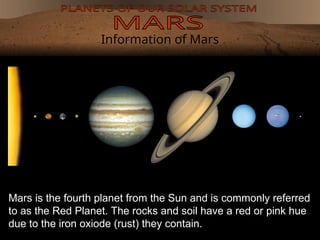
Mars is the fourth planet from the Sun and is commonly referred
to as the Red Planet. The rocks and soil have a red or pink hue
due to the iron oxiode (rust) they contain.
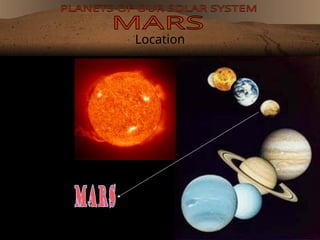
Location
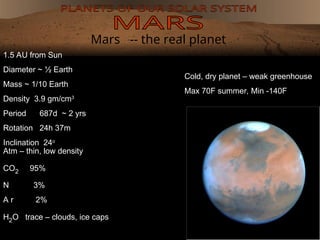
Mars -- the real planet
1.5 AU from Sun
Diameter ~ ½ Earth
Mass ~ 1/10 Earth
Density 3.9 gm/cm3
Period 687d ~ 2 yrs
Rotation 24h 37m
Inclination 24o
Atm – thin, low density
CO2 95%
N 3%
A r 2%
H2O trace – clouds, ice caps
Cold, dry planet – weak greenhouse
Max 70F summer, Min -140F
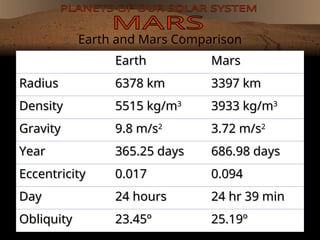
Earth and Mars Comparison
Earth
Earth Mars
Mars
Radius
Radius 6378 km
6378 km 3397 km
3397 km
Density
Density 5515 kg/m
5515 kg/m3
3
3933 kg/m
3933 kg/m3
3
Gravity
Gravity 9.8 m/s
9.8 m/s2
2
3.72 m/s
3.72 m/s2
2
Year
Year 365.25 days
365.25 days 686.98 days
686.98 days
Eccentricity
Eccentricity 0.017
0.017 0.094
0.094
Day
Day 24 hours
24 hours 24 hr 39 min
24 hr 39 min
Obliquity
Obliquity 23.45º
23.45º 25.19º
25.19º
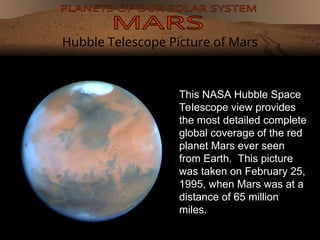
Hubble Telescope Picture of Mars
This NASA Hubble Space
Telescope view provides
the most detailed complete
global coverage of the red
planet Mars ever seen
from Earth. This picture
was taken on February 25,
1995, when Mars was at a
distance of 65 million
miles.
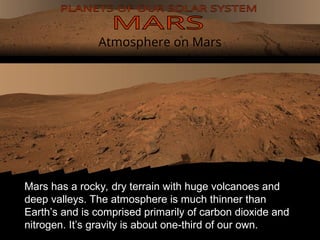
Atmosphere on Mars
Mars has a rocky, dry terrain with huge volcanoes and
deep valleys. The atmosphere is much thinner than
Earth’s and is comprised primarily of carbon dioxide and
nitrogen. It’s gravity is about one-third of our own.
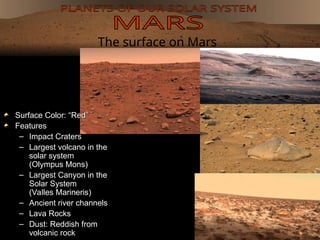
The surface on Mars
Surface Color: “Red”
Features
Features
– Impact Craters
Impact Craters
– Largest volcano in the
Largest volcano in the
solar system
solar system
(Olympus Mons)
(Olympus Mons)
– Largest Canyon in the
Largest Canyon in the
Solar System
Solar System
(Valles Marineris)
(Valles Marineris)
– Ancient river channels
Ancient river channels
– Lava Rocks
Lava Rocks
– Dust: Reddish from
Dust: Reddish from
volcanic rock
volcanic rock
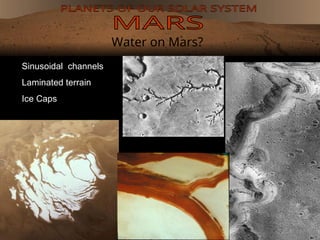
Water on Mars?
Sinusoidal channels
Laminated terrain
Ice Caps
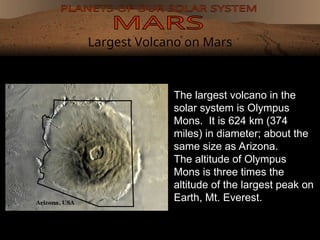
Largest Volcano on Mars
The largest volcano in the
solar system is Olympus
Mons. It is 624 km (374
miles) in diameter; about the
same size as Arizona.
The altitude of Olympus
Mons is three times the
altitude of the largest peak on
Earth, Mt. Everest.
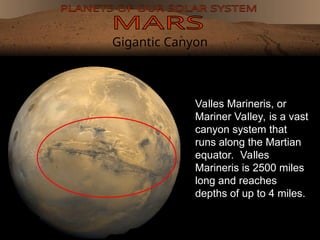
Gigantic Canyon
Valles Marineris, or
Mariner Valley, is a vast
canyon system that
runs along the Martian
equator. Valles
Marineris is 2500 miles
long and reaches
depths of up to 4 miles.
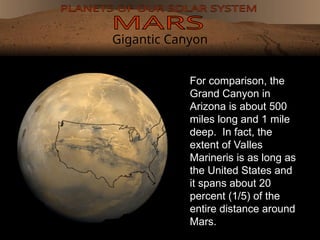
Gigantic Canyon
For comparison, the
Grand Canyon in
Arizona is about 500
miles long and 1 mile
deep. In fact, the
extent of Valles
Marineris is as long as
the United States and
it spans about 20
percent (1/5) of the
entire distance around
Mars.
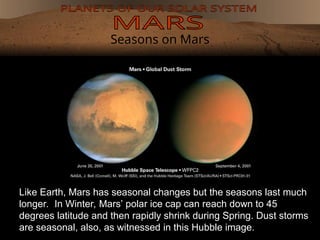
Seasons on Mars
Like Earth, Mars has seasonal changes but the seasons last much
longer. In Winter, Mars’ polar ice cap can reach down to 45
degrees latitude and then rapidly shrink during Spring. Dust storms
are seasonal, also, as witnessed in this Hubble image.
Earth/Mars Comparison
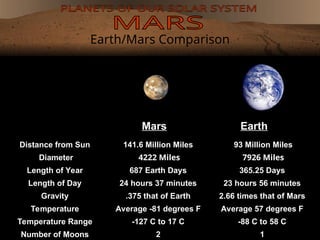
Distance from Sun 141.6 Million Miles 93 Million Miles
Diameter 4222 Miles 7926 Miles
Length of Year 687 Earth Days 365.25 Days
Length of Day 24 hours 37 minutes 23 hours 56 minutes
Gravity .375 that of Earth 2.66 times that of Mars
Temperature Average -81 degrees F Average 57 degrees F
Temperature Range -127 C to 17 C -88 C to 58 C
Number of Moons 2 1
Mars Earth
Mars, the god of War
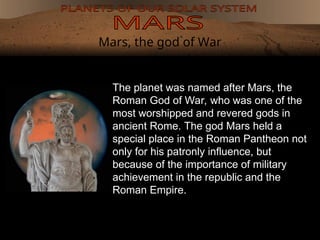
The planet was named after Mars, the
Roman God of War, who was one of the
most worshipped and revered gods in
ancient Rome. The god Mars held a
special place in the Roman Pantheon not
only for his patronly influence, but
because of the importance of military
achievement in the republic and the
Roman Empire.
Early concepts
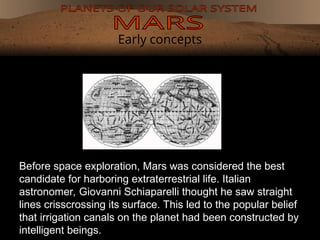
Before space exploration, Mars was considered the best
candidate for harboring extraterrestrial life. Italian
astronomer, Giovanni Schiaparelli thought he saw straight
lines crisscrossing its surface. This led to the popular belief
that irrigation canals on the planet had been constructed by
intelligent beings.
Mariner missions
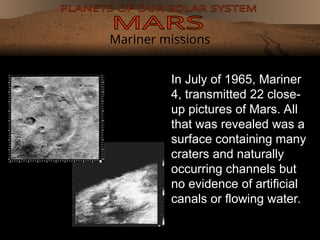
In July of 1965, Mariner
4, transmitted 22 close-
up pictures of Mars. All
that was revealed was a
surface containing many
craters and naturally
occurring channels but
no evidence of artificial
canals or flowing water.
Viking Landers
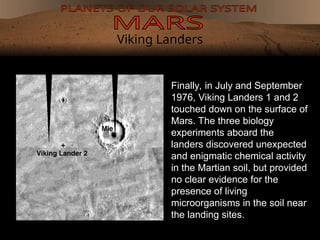
Finally, in July and September
1976, Viking Landers 1 and 2
touched down on the surface of
Mars. The three biology
experiments aboard the
landers discovered unexpected
and enigmatic chemical activity
in the Martian soil, but provided
no clear evidence for the
presence of living
microorganisms in the soil near
the landing sites.
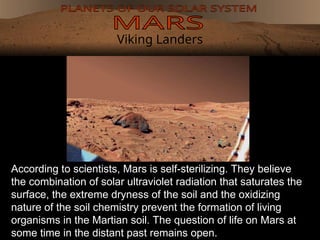
Viking Landers
According to scientists, Mars is self-sterilizing. They believe
the combination of solar ultraviolet radiation that saturates the
surface, the extreme dryness of the soil and the oxidizing
nature of the soil chemistry prevent the formation of living
organisms in the Martian soil. The question of life on Mars at
some time in the distant past remains open.
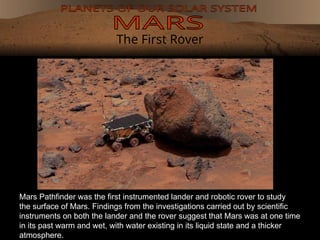
The First Rover
Mars Pathfinder was the first instrumented lander and robotic rover to study
the surface of Mars. Findings from the investigations carried out by scientific
instruments on both the lander and the rover suggest that Mars was at one time
in its past warm and wet, with water existing in its liquid state and a thicker
atmosphere.
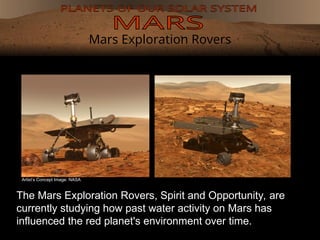
Mars Exploration Rovers
The Mars Exploration Rovers, Spirit and Opportunity, are
currently studying how past water activity on Mars has
influenced the red planet's environment over time.
Artist’s Concept Image: NASA
Spirit
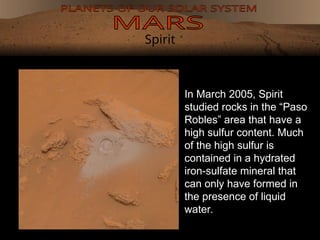
In March 2005, Spirit
studied rocks in the “Paso
Robles” area that have a
high sulfur content. Much
of the high sulfur is
contained in a hydrated
iron-sulfate mineral that
can only have formed in
the presence of liquid
water.
Opportunity
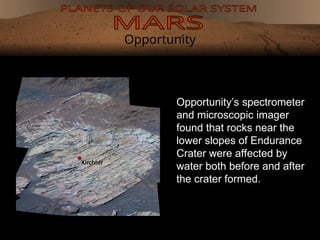
Opportunity’s spectrometer
and microscopic imager
found that rocks near the
lower slopes of Endurance
Crater were affected by
water both before and after
the crater formed.
NASA's Mars Science Laboratory
Curiosity rover, a mobile robot for
investigating Mars' past or present
ability to sustain microbial life.
Curiosity is being tested in
preparation for launch in the fall of
2011.
NASA's Curiosity Mars Rover
To handle this science toolkit, Curiosity is
twice as long and five times as heavy as Spirit
or Opportunity. The Gale Crater landing site
places the rover within driving distance of
layers of the crater's interior mountain.
Observations from orbit have identified clay
and sulfate minerals in the lower layers,
indicating a wet history.
Curiosity
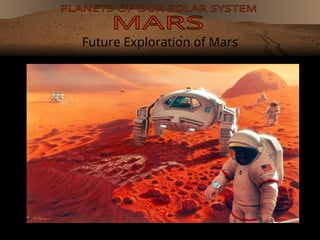
Future Exploration of Mars

Mars addaaaaaaaaaaadaaaaaaaaaaaaaaaaaaaaaaa

  • 1.
    Information of Mars Marsis the fourth planet from the Sun and is commonly referred to as the Red Planet. The rocks and soil have a red or pink hue due to the iron oxiode (rust) they contain.
  • 2.
  • 3.
    Mars -- thereal planet 1.5 AU from Sun Diameter ~ ½ Earth Mass ~ 1/10 Earth Density 3.9 gm/cm3 Period 687d ~ 2 yrs Rotation 24h 37m Inclination 24o Atm – thin, low density CO2 95% N 3% A r 2% H2O trace – clouds, ice caps Cold, dry planet – weak greenhouse Max 70F summer, Min -140F
  • 4.
    Earth and MarsComparison Earth Earth Mars Mars Radius Radius 6378 km 6378 km 3397 km 3397 km Density Density 5515 kg/m 5515 kg/m3 3 3933 kg/m 3933 kg/m3 3 Gravity Gravity 9.8 m/s 9.8 m/s2 2 3.72 m/s 3.72 m/s2 2 Year Year 365.25 days 365.25 days 686.98 days 686.98 days Eccentricity Eccentricity 0.017 0.017 0.094 0.094 Day Day 24 hours 24 hours 24 hr 39 min 24 hr 39 min Obliquity Obliquity 23.45º 23.45º 25.19º 25.19º
  • 5.
    Hubble Telescope Pictureof Mars This NASA Hubble Space Telescope view provides the most detailed complete global coverage of the red planet Mars ever seen from Earth. This picture was taken on February 25, 1995, when Mars was at a distance of 65 million miles.
  • 6.
    Atmosphere on Mars Marshas a rocky, dry terrain with huge volcanoes and deep valleys. The atmosphere is much thinner than Earth’s and is comprised primarily of carbon dioxide and nitrogen. It’s gravity is about one-third of our own.
  • 7.
    The surface onMars Surface Color: “Red” Surface Color: “Red” Features Features – Impact Craters Impact Craters – Largest volcano in the Largest volcano in the solar system solar system (Olympus Mons) (Olympus Mons) – Largest Canyon in the Largest Canyon in the Solar System Solar System (Valles Marineris) (Valles Marineris) – Ancient river channels Ancient river channels – Lava Rocks Lava Rocks – Dust: Reddish from Dust: Reddish from volcanic rock volcanic rock
  • 8.
    Water on Mars? Sinusoidalchannels Laminated terrain Ice Caps
  • 9.
    Largest Volcano onMars The largest volcano in the solar system is Olympus Mons. It is 624 km (374 miles) in diameter; about the same size as Arizona. The altitude of Olympus Mons is three times the altitude of the largest peak on Earth, Mt. Everest.
  • 10.
    Gigantic Canyon Valles Marineris,or Mariner Valley, is a vast canyon system that runs along the Martian equator. Valles Marineris is 2500 miles long and reaches depths of up to 4 miles.
  • 11.
    Gigantic Canyon For comparison,the Grand Canyon in Arizona is about 500 miles long and 1 mile deep. In fact, the extent of Valles Marineris is as long as the United States and it spans about 20 percent (1/5) of the entire distance around Mars.
  • 12.
    Seasons on Mars LikeEarth, Mars has seasonal changes but the seasons last much longer. In Winter, Mars’ polar ice cap can reach down to 45 degrees latitude and then rapidly shrink during Spring. Dust storms are seasonal, also, as witnessed in this Hubble image.
  • 13.
    Earth/Mars Comparison Distance fromSun 141.6 Million Miles 93 Million Miles Diameter 4222 Miles 7926 Miles Length of Year 687 Earth Days 365.25 Days Length of Day 24 hours 37 minutes 23 hours 56 minutes Gravity .375 that of Earth 2.66 times that of Mars Temperature Average -81 degrees F Average 57 degrees F Temperature Range -127 C to 17 C -88 C to 58 C Number of Moons 2 1 Mars Earth
  • 14.
    Mars, the godof War The planet was named after Mars, the Roman God of War, who was one of the most worshipped and revered gods in ancient Rome. The god Mars held a special place in the Roman Pantheon not only for his patronly influence, but because of the importance of military achievement in the republic and the Roman Empire.
  • 15.
    Early concepts Before spaceexploration, Mars was considered the best candidate for harboring extraterrestrial life. Italian astronomer, Giovanni Schiaparelli thought he saw straight lines crisscrossing its surface. This led to the popular belief that irrigation canals on the planet had been constructed by intelligent beings.
  • 16.
    Mariner missions In Julyof 1965, Mariner 4, transmitted 22 close- up pictures of Mars. All that was revealed was a surface containing many craters and naturally occurring channels but no evidence of artificial canals or flowing water.
  • 17.
    Viking Landers Finally, inJuly and September 1976, Viking Landers 1 and 2 touched down on the surface of Mars. The three biology experiments aboard the landers discovered unexpected and enigmatic chemical activity in the Martian soil, but provided no clear evidence for the presence of living microorganisms in the soil near the landing sites.
  • 18.
    Viking Landers According toscientists, Mars is self-sterilizing. They believe the combination of solar ultraviolet radiation that saturates the surface, the extreme dryness of the soil and the oxidizing nature of the soil chemistry prevent the formation of living organisms in the Martian soil. The question of life on Mars at some time in the distant past remains open.
  • 19.
    The First Rover MarsPathfinder was the first instrumented lander and robotic rover to study the surface of Mars. Findings from the investigations carried out by scientific instruments on both the lander and the rover suggest that Mars was at one time in its past warm and wet, with water existing in its liquid state and a thicker atmosphere.
  • 20.
    Mars Exploration Rovers TheMars Exploration Rovers, Spirit and Opportunity, are currently studying how past water activity on Mars has influenced the red planet's environment over time. Artist’s Concept Image: NASA
  • 21.
    Spirit In March 2005,Spirit studied rocks in the “Paso Robles” area that have a high sulfur content. Much of the high sulfur is contained in a hydrated iron-sulfate mineral that can only have formed in the presence of liquid water.
  • 22.
    Opportunity Opportunity’s spectrometer and microscopicimager found that rocks near the lower slopes of Endurance Crater were affected by water both before and after the crater formed.
  • 23.
    NASA's Mars ScienceLaboratory Curiosity rover, a mobile robot for investigating Mars' past or present ability to sustain microbial life. Curiosity is being tested in preparation for launch in the fall of 2011. NASA's Curiosity Mars Rover To handle this science toolkit, Curiosity is twice as long and five times as heavy as Spirit or Opportunity. The Gale Crater landing site places the rover within driving distance of layers of the crater's interior mountain. Observations from orbit have identified clay and sulfate minerals in the lower layers, indicating a wet history. Curiosity
  • 24.

Editor's Notes

  • #5 http://nssdc.gsfc.nasa.gov/photo_gallery/photogallery-mars.html
  • #9 http://mars.jpl.nasa.gov/mep/science/olympus_mons.html
  • #10 http://mars.jpl.nasa.gov/mep/science/vm.html
  • #13 http://www.the-planet-mars.com/mars-earth-comparison.html
  • #14 http://www.meridiangraphics.net/mars.htm
  • #15 http://www.solarviews.com/eng/mars.htm
  • #16 http://www.solarviews.com/eng/mars.htm
  • #19 http://mars.jpl.nasa.gov/MPF/ops/prm-thmb.html
  • #20 http://www.the-planet-mars.com/pathfinder/pathfinder-pictures.html
  • #21 http://marsrovers.jpl.nasa.gov/gallery/press/spirit/20050307a/Sol381A_P2543_True_RAD-A418R1_br.jpg
  • #24 http://spaceflight1.nasa.gov/mars/