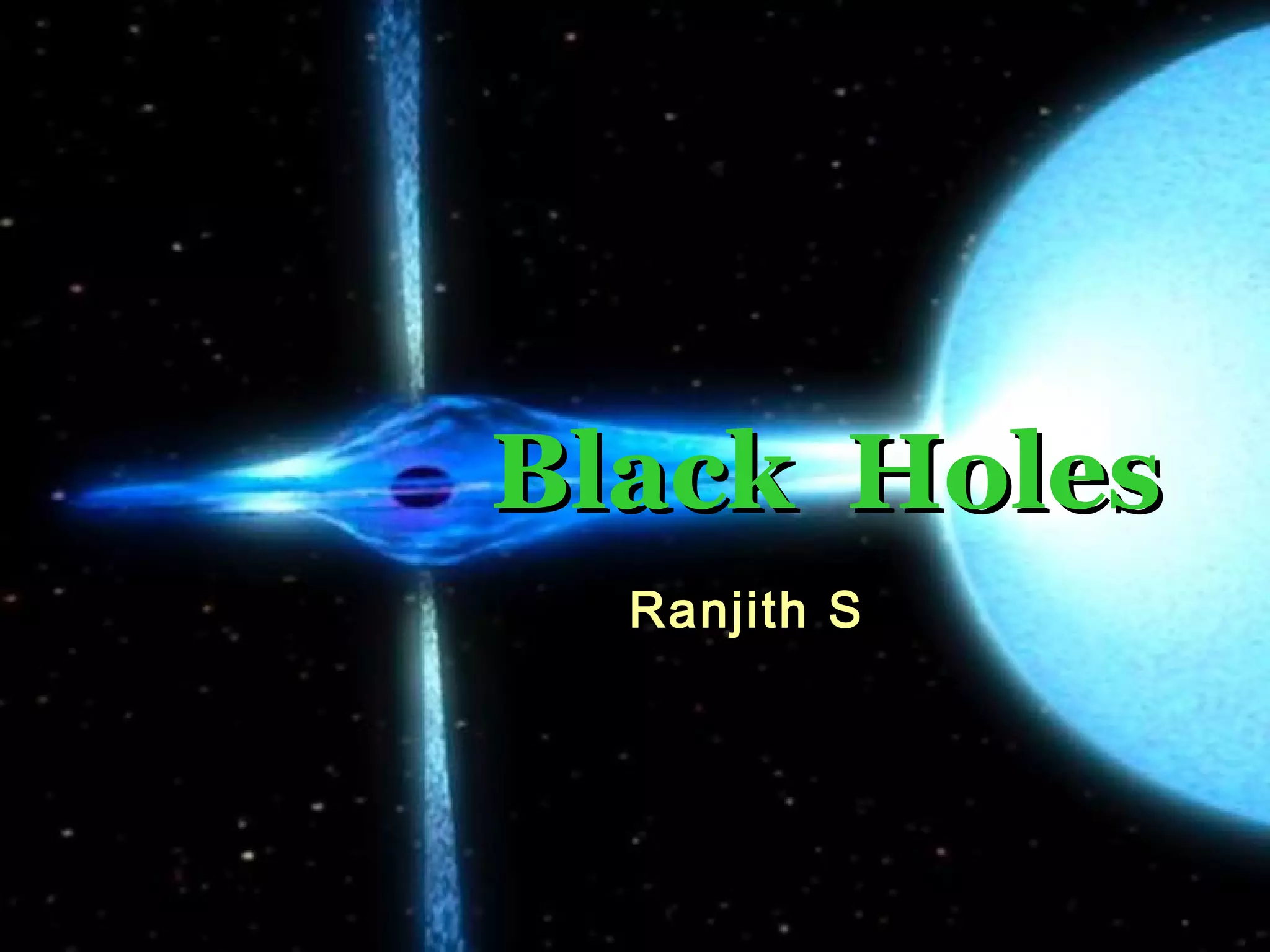
BBllaacckk HHoolleess 
RRaannjjiitthh SS
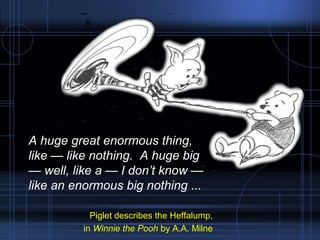
A huge great enormous thing, 
like — like nothing. A huge big 
— well, like a — I don’t know — 
like an enormous big nothing ... 
Piglet describes the Heffalump, 
in Winnie the Pooh by A.A. Milne
HHuuggee GGrraavviittyy 
• Black Holes are Gravity Centers of The 
Universe 
• Size ~ 0 and Density ~ a 
• Two Types 
– Static 
• Karl Schwarzschild solutions 
– Rotating 
• Kerr solutions
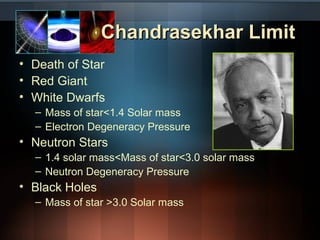
CChhaannddrraasseekkhhaarr LLiimmiitt 
• Death of Star 
• Red Giant 
• White Dwarfs 
– Mass of star<1.4 Solar mass 
– Electron Degeneracy Pressure 
• Neutron Stars 
– 1.4 solar mass<Mass of star<3.0 solar mass 
– Neutron Degeneracy Pressure 
• Black Holes 
– Mass of star >3.0 Solar mass
TThhee TTrraannssiittiioonn 
• Pauli Exclusion Principle: 
No two electrons can occupy the same position in space 
• Electron Degeneracy Pressure :- Electrons are packed 
side by side in a white dwarf This prevents it from 
collapsing any further 
• Neutron Degeneracy Pressure : - Neutrons are packed 
side by side in a Neutron Star This prevents it from 
collapsing any further 
• More Mass More Gravity :- Nothing can stop Collision 
• -> Black Holes
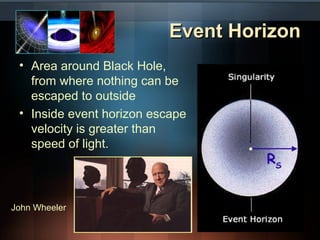
EEvveenntt HHoorriizzoonn 
• Area around Black Hole, 
from where nothing can be 
escaped to outside 
• Inside event horizon escape 
velocity is greater than 
speed of light. 
John Wheeler
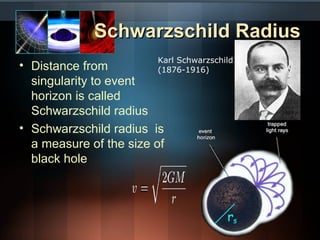
SScchhwwaarrzzsscchhiilldd RRaaddiiuuss 
Karl Schwarzschild 
(1876-1916) 
• Distance from 
singularity to event 
horizon is called 
Schwarzschild radius 
• Schwarzschild radius is 
a measure of the size of 
black hole
Black Hole 
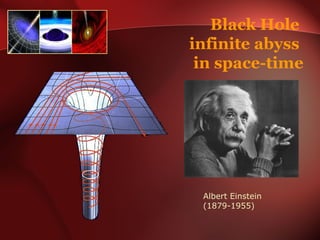
infinite abyss 
in space-time 
Albert Einstein 
(1879-1955)
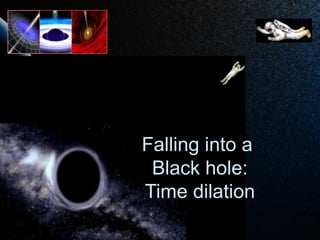
Falling into a 
Black hole: 
Time dilation
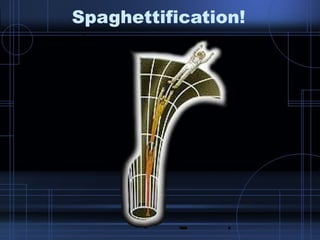
Spaghettification!
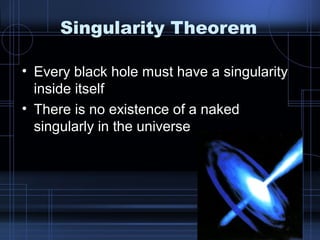
Singularity Theorem 
• Every black hole must have a singularity 
inside itself 
• There is no existence of a naked 
singularly in the universe
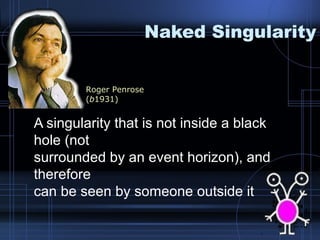
Naked Singularity 
Roger Penrose 
(b1931) 
A singularity that is not inside a black 
hole (not 
surrounded by an event horizon), and 
therefore 
can be seen by someone outside it
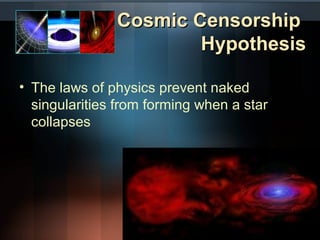
CCoossmmiicc CCeennssoorrsshhiipp 
HHyyppootthheessiiss 
• The laws of physics prevent naked 
singularities from forming when a star 
collapses
NNoo--HHaaiirr TThheeoorreemm 
• A black hole has almost no hair; 
its only ‘hair’ are its 
– mass 
– angular momentum 
– electric charge
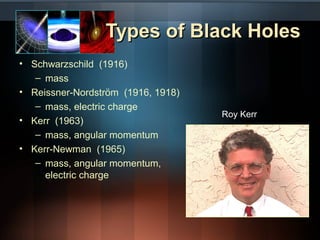
TTyyppeess ooff BBllaacckk HHoolleess 
• Schwarzschild (1916) 
– mass 
• Reissner-Nordström (1916, 1918) 
– mass, electric charge 
• Kerr (1963) 
– mass, angular momentum 
• Kerr-Newman (1965) 
– mass, angular momentum, 
electric charge 
Roy Kerr
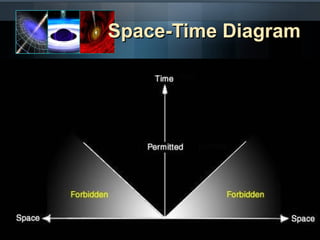
SSppaaccee--TTiimmee DDiiaaggrraamm
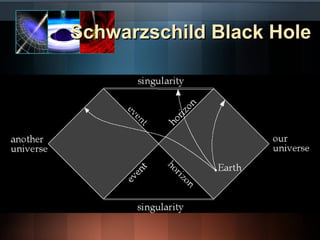
SScchhwwaarrzzsscchhiilldd BBllaacckk HHoollee
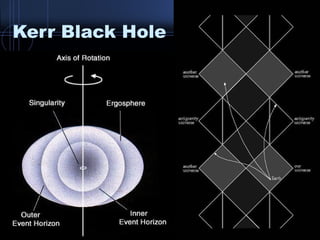
Kerr Black Hole
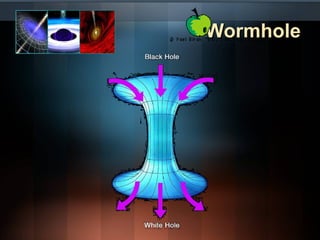
WWoorrmmhhoollee
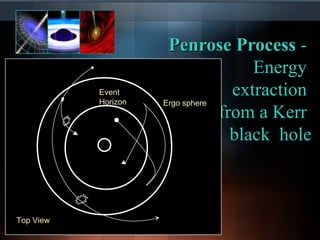
PPeennrroossee PPrroocceessss -- 
EEnneerrggyy 
eexxttrraaccttiioonn 
ffrroomm aa KKeerrrr 
bbllaacckk hhoollee 
Event 
Horizon Ergo sphere 
Top View
Black Hole Dynamics 
• First Law 
• Second Law 
• Third Law
First Law 
• If a body with a fixed mass and angular 
momentum is fall into a black hole then 
the mass and angular momentum of the 
black hole increases that much. 
• Resembles with the First law of 
thermodynamics 
• Energy conservation theorem
Second Law 
• The surface area of a black hole is not 
reduced in any process 
• If two black holes combined then the 
resultant surface area is greater than the 
sum of surface areas of each black 
holes. 
• Surface area ->Entropy 
• We cannot reduce the entropy of a 
system.
Third Law 
• The surface gravity of a black hole is 
never become zero. 
• Resumbles to third law in 
thermodynamics 
• We cannot reduce the temp: to absolute 
zero.
Virtual Particles 
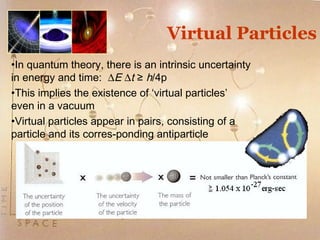
•In quantum theory, there is an intrinsic uncertainty 
in energy and time: DE Dt ≥ h/4p 
•This implies the existence of ‘virtual particles’ 
even in a vacuum 
•Virtual particles appear in pairs, consisting of a 
particle and its corres-ponding antiparticle
Hawking Radiation 
Stephen W. Hawking 
(b1942) 
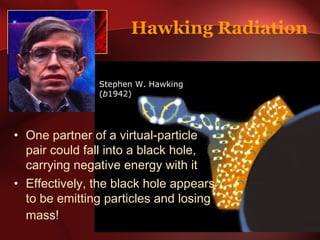
• One partner of a virtual-particle 
pair could fall into a black hole, 
carrying negative energy with it 
• Effectively, the black hole appears 
to be emitting particles and losing 
mass!
But this effect is very tiny 
for normal black holes 
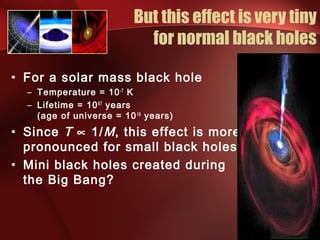
• For a solar mass black hole 
– Temperature = 10-7 K 
– Lifetime = 1067 years 
(age of universe = 1010 years) 
• Since T µ 1/M, this effect is more 
pronounced for small black holes 
• Mini black holes created during 
the Big Bang?
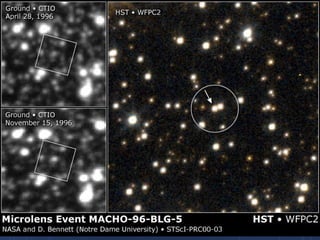
Microlens event
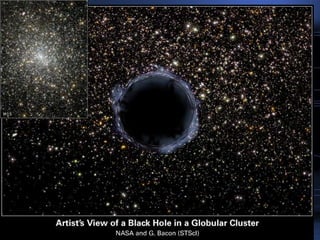
Black hole in globular 
cluster
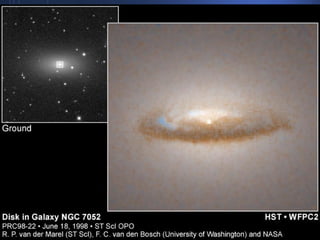
Disk in galaxy NGC 7052
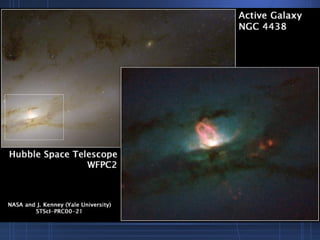
NGC 4438
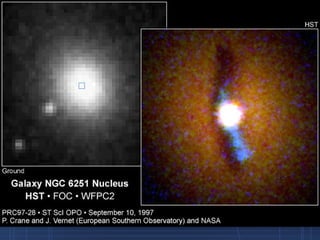
Galaxy NGC 6251 nucleus
M87
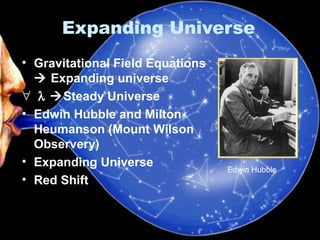
Expanding Universe 
• Gravitational Field Equations 
 Expanding universe 
"  l Steady Universe 
• Edwin Hubble and Milton 
Heumanson (Mount Wilson 
Observery) 
• Expanding Universe 
• Red Shift 
Edwin Hubble
Freedman-Robertson- 
Walker Model • Critical Mass 
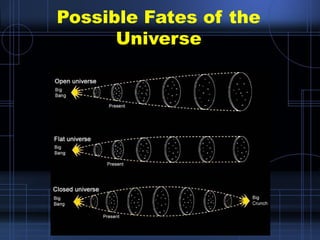
• Closed Universe 
– Mu <Critical Mass 
– Universe started Contracting after a particular time 
• Flat Universe 
– Mu = Critical Mass 
– Expansion rate of universe become constant 
• Open Universe 
– Mu > Critical Mass 
– Expansion rate increases with time
Possible Fates of the 
Universe
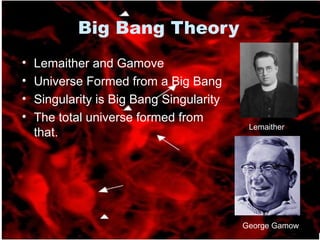
Big Bang Theory 
• Lemaither and Gamove 
• Universe Formed from a Big Bang 
• Singularity is Big Bang Singularity 
• The total universe formed from 
that. Lemaither 
George Gamow
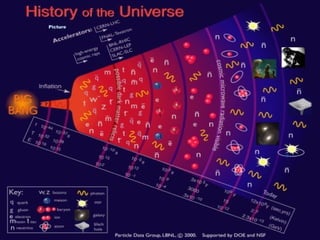
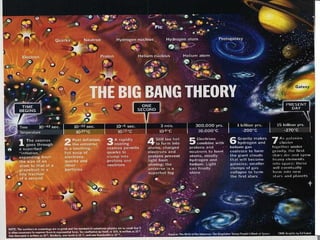
Picture
Pic
Big Bang Theory Proofs 
• Background Radiation 
• Large Scale of universe 
• Distribution of Galaxies
Other Theories 
• Stedy State Theory 
• Inflation Theory 
• Big Crunch Theory 
• Oscillatory state Theory
Will the Universe 
Recollapse? 
• Gravitational pull of the galaxies on each other 
is slowing down the rate of expansion 
• Required density for the universe to 
recollapse is 4.5 x 10⁻³⁰ g/cm3 
• Observed density of luminous material 
(stars, galaxies) is about 3 x 10-31 g/cm3
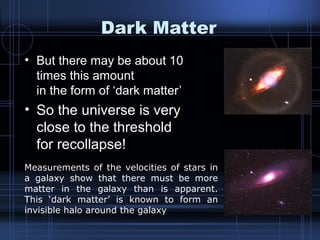
Dark Matter 
• But there may be about 10 
times this amount 
in the form of ‘dark matter’ 
• So the universe is very 
close to the threshold 
for recollapse! 
Measurements of the velocities of stars in 
a galaxy show that there must be more 
matter in the galaxy than is apparent. 
This ‘dark matter’ is known to form an 
invisible halo around the galaxy
Gravitational Waves 
• The Variations in space-time (When 
body Accelerated) causes 
Gravitational Waves. 
• Speed of Wave = C 
• Large gravity related Phenomena 
• Supernova, Black Holes etc…
Gravitational Wave Detector 
• When GW passing through a body it 
will expands the body in that 
direction and contracts in opposite 
direction by measuring this we can 
detect GW.
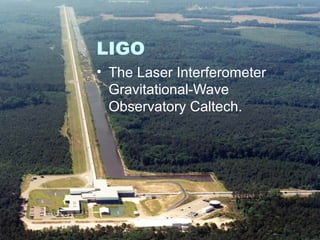
LIGO 
• The Laser Interferometer 
Gravitational-Wave 
Observatory Caltech.
Forces of Nature 
• Gravitational 
• Electromagnetic 
• Weak 
• Strong
Standard Model - Quarks 
• 6 Quarks 
[up,down,top,bottom,strange,charm] 
• Gluons – Exchange Particles 
• Super Symmetry
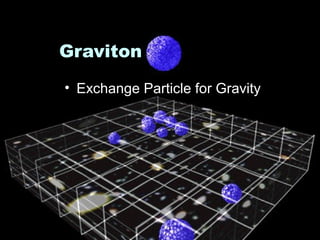
Graviton 
• Exchange Particle for Gravity
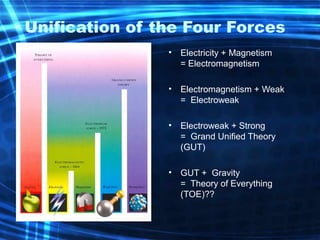
Unification of the Four Forces 
• Electricity + Magnetism 
= Electromagnetism 
• Electromagnetism + Weak 
= Electroweak 
• Electroweak + Strong 
= Grand Unified Theory 
(GUT) 
• GUT + Gravity 
= Theory of Everything 
(TOE)??
Gravity 
• Due to geometry rather than exchange of 
particles 
• Remains impossible to incorporate within 
the framework of quantum field theory 
like the other forces
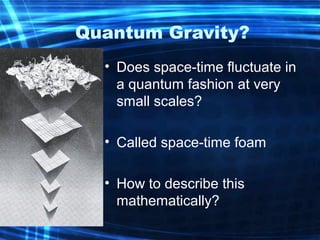
Quantum Gravity? 
• Does space-time fluctuate in 
a quantum fashion at very 
small scales? 
• Called space-time foam 
• How to describe this 
mathematically?
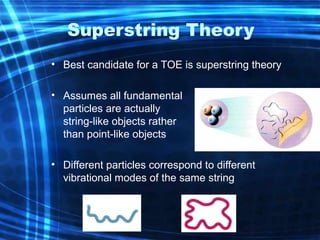
Superstring Theory 
• Best candidate for a TOE is superstring theory 
• Assumes all fundamental 
particles are actually 
string-like objects rather 
than point-like objects 
• Different particles correspond to different 
vibrational modes of the same string
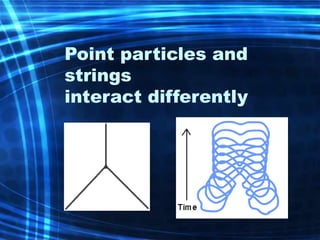
Point particles and 
strings 
interact differently
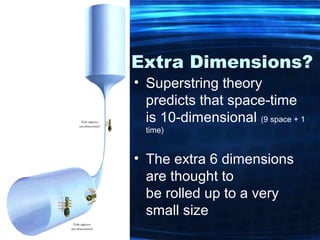
Extra Dimensions? 
• Superstring theory 
predicts that space-time 
is 10-dimensional (9 space + 1 
time) 
• The extra 6 dimensions 
are thought to 
be rolled up to a very 
small size
Unsolved Problems 
• Why Gravity happens? 
• No – Graviton in Standard Model 
• Dark Mater
TThhaannkkss

Black Holes and its Effects

  • 1.
  • 2.
    A huge greatenormous thing, like — like nothing. A huge big — well, like a — I don’t know — like an enormous big nothing ... Piglet describes the Heffalump, in Winnie the Pooh by A.A. Milne
  • 3.
    HHuuggee GGrraavviittyy •Black Holes are Gravity Centers of The Universe • Size ~ 0 and Density ~ a • Two Types – Static • Karl Schwarzschild solutions – Rotating • Kerr solutions
  • 4.
    CChhaannddrraasseekkhhaarr LLiimmiitt •Death of Star • Red Giant • White Dwarfs – Mass of star<1.4 Solar mass – Electron Degeneracy Pressure • Neutron Stars – 1.4 solar mass<Mass of star<3.0 solar mass – Neutron Degeneracy Pressure • Black Holes – Mass of star >3.0 Solar mass
  • 5.
    TThhee TTrraannssiittiioonn •Pauli Exclusion Principle: No two electrons can occupy the same position in space • Electron Degeneracy Pressure :- Electrons are packed side by side in a white dwarf This prevents it from collapsing any further • Neutron Degeneracy Pressure : - Neutrons are packed side by side in a Neutron Star This prevents it from collapsing any further • More Mass More Gravity :- Nothing can stop Collision • -> Black Holes
  • 6.
    EEvveenntt HHoorriizzoonn •Area around Black Hole, from where nothing can be escaped to outside • Inside event horizon escape velocity is greater than speed of light. John Wheeler
  • 7.
    SScchhwwaarrzzsscchhiilldd RRaaddiiuuss KarlSchwarzschild (1876-1916) • Distance from singularity to event horizon is called Schwarzschild radius • Schwarzschild radius is a measure of the size of black hole
  • 8.
    Black Hole infiniteabyss in space-time Albert Einstein (1879-1955)
  • 9.
    Falling into a Black hole: Time dilation
  • 10.
  • 11.
    Singularity Theorem •Every black hole must have a singularity inside itself • There is no existence of a naked singularly in the universe
  • 12.
    Naked Singularity RogerPenrose (b1931) A singularity that is not inside a black hole (not surrounded by an event horizon), and therefore can be seen by someone outside it
  • 13.
    CCoossmmiicc CCeennssoorrsshhiipp HHyyppootthheessiiss • The laws of physics prevent naked singularities from forming when a star collapses
  • 14.
    NNoo--HHaaiirr TThheeoorreemm •A black hole has almost no hair; its only ‘hair’ are its – mass – angular momentum – electric charge
  • 15.
    TTyyppeess ooff BBllaacckkHHoolleess • Schwarzschild (1916) – mass • Reissner-Nordström (1916, 1918) – mass, electric charge • Kerr (1963) – mass, angular momentum • Kerr-Newman (1965) – mass, angular momentum, electric charge Roy Kerr
  • 16.
  • 17.
  • 18.
  • 19.
  • 20.
    PPeennrroossee PPrroocceessss -- EEnneerrggyy eexxttrraaccttiioonn ffrroomm aa KKeerrrr bbllaacckk hhoollee Event Horizon Ergo sphere Top View
  • 21.
    Black Hole Dynamics • First Law • Second Law • Third Law
  • 22.
    First Law •If a body with a fixed mass and angular momentum is fall into a black hole then the mass and angular momentum of the black hole increases that much. • Resembles with the First law of thermodynamics • Energy conservation theorem
  • 23.
    Second Law •The surface area of a black hole is not reduced in any process • If two black holes combined then the resultant surface area is greater than the sum of surface areas of each black holes. • Surface area ->Entropy • We cannot reduce the entropy of a system.
  • 24.
    Third Law •The surface gravity of a black hole is never become zero. • Resumbles to third law in thermodynamics • We cannot reduce the temp: to absolute zero.
  • 25.
    Virtual Particles •Inquantum theory, there is an intrinsic uncertainty in energy and time: DE Dt ≥ h/4p •This implies the existence of ‘virtual particles’ even in a vacuum •Virtual particles appear in pairs, consisting of a particle and its corres-ponding antiparticle
  • 26.
    Hawking Radiation StephenW. Hawking (b1942) • One partner of a virtual-particle pair could fall into a black hole, carrying negative energy with it • Effectively, the black hole appears to be emitting particles and losing mass!
  • 27.
    But this effectis very tiny for normal black holes • For a solar mass black hole – Temperature = 10-7 K – Lifetime = 1067 years (age of universe = 1010 years) • Since T µ 1/M, this effect is more pronounced for small black holes • Mini black holes created during the Big Bang?
  • 28.
  • 29.
    Black hole inglobular cluster
  • 30.
  • 31.
  • 32.
  • 33.
  • 34.
    Expanding Universe •Gravitational Field Equations  Expanding universe " l Steady Universe • Edwin Hubble and Milton Heumanson (Mount Wilson Observery) • Expanding Universe • Red Shift Edwin Hubble
  • 35.
    Freedman-Robertson- Walker Model• Critical Mass • Closed Universe – Mu <Critical Mass – Universe started Contracting after a particular time • Flat Universe – Mu = Critical Mass – Expansion rate of universe become constant • Open Universe – Mu > Critical Mass – Expansion rate increases with time
  • 36.
    Possible Fates ofthe Universe
  • 37.
    Big Bang Theory • Lemaither and Gamove • Universe Formed from a Big Bang • Singularity is Big Bang Singularity • The total universe formed from that. Lemaither George Gamow
  • 38.
  • 39.
  • 40.
    Big Bang TheoryProofs • Background Radiation • Large Scale of universe • Distribution of Galaxies
  • 41.
    Other Theories •Stedy State Theory • Inflation Theory • Big Crunch Theory • Oscillatory state Theory
  • 42.
    Will the Universe Recollapse? • Gravitational pull of the galaxies on each other is slowing down the rate of expansion • Required density for the universe to recollapse is 4.5 x 10⁻³⁰ g/cm3 • Observed density of luminous material (stars, galaxies) is about 3 x 10-31 g/cm3
  • 43.
    Dark Matter •But there may be about 10 times this amount in the form of ‘dark matter’ • So the universe is very close to the threshold for recollapse! Measurements of the velocities of stars in a galaxy show that there must be more matter in the galaxy than is apparent. This ‘dark matter’ is known to form an invisible halo around the galaxy
  • 44.
    Gravitational Waves •The Variations in space-time (When body Accelerated) causes Gravitational Waves. • Speed of Wave = C • Large gravity related Phenomena • Supernova, Black Holes etc…
  • 45.
    Gravitational Wave Detector • When GW passing through a body it will expands the body in that direction and contracts in opposite direction by measuring this we can detect GW.
  • 46.
    LIGO • TheLaser Interferometer Gravitational-Wave Observatory Caltech.
  • 47.
    Forces of Nature • Gravitational • Electromagnetic • Weak • Strong
  • 48.
    Standard Model -Quarks • 6 Quarks [up,down,top,bottom,strange,charm] • Gluons – Exchange Particles • Super Symmetry
  • 49.
    Graviton • ExchangeParticle for Gravity
  • 50.
    Unification of theFour Forces • Electricity + Magnetism = Electromagnetism • Electromagnetism + Weak = Electroweak • Electroweak + Strong = Grand Unified Theory (GUT) • GUT + Gravity = Theory of Everything (TOE)??
  • 51.
    Gravity • Dueto geometry rather than exchange of particles • Remains impossible to incorporate within the framework of quantum field theory like the other forces
  • 52.
    Quantum Gravity? •Does space-time fluctuate in a quantum fashion at very small scales? • Called space-time foam • How to describe this mathematically?
  • 53.
    Superstring Theory •Best candidate for a TOE is superstring theory • Assumes all fundamental particles are actually string-like objects rather than point-like objects • Different particles correspond to different vibrational modes of the same string
  • 54.
    Point particles and strings interact differently
  • 55.
    Extra Dimensions? •Superstring theory predicts that space-time is 10-dimensional (9 space + 1 time) • The extra 6 dimensions are thought to be rolled up to a very small size
  • 56.
    Unsolved Problems •Why Gravity happens? • No – Graviton in Standard Model • Dark Mater
  • 57.

Editor's Notes

  • #29 http://hubblesite.org/newscenter/archive/2000/03/
  • #30 http://hubblesite.org/newscenter/archive/2002/18/
  • #31 http://hubblesite.org/newscenter/archive/1998/22/
  • #32 http://hubblesite.org/newscenter/archive/2000/21/
  • #33 http://hubblesite.org/newscenter/archive/1997/28/
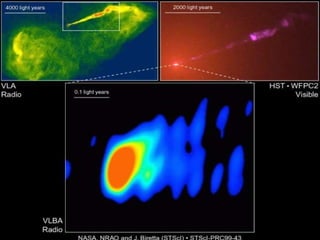
  • #34 http://hubblesite.org/newscenter/archive/1999/43/