MARS
NAME OF THE
PLANET
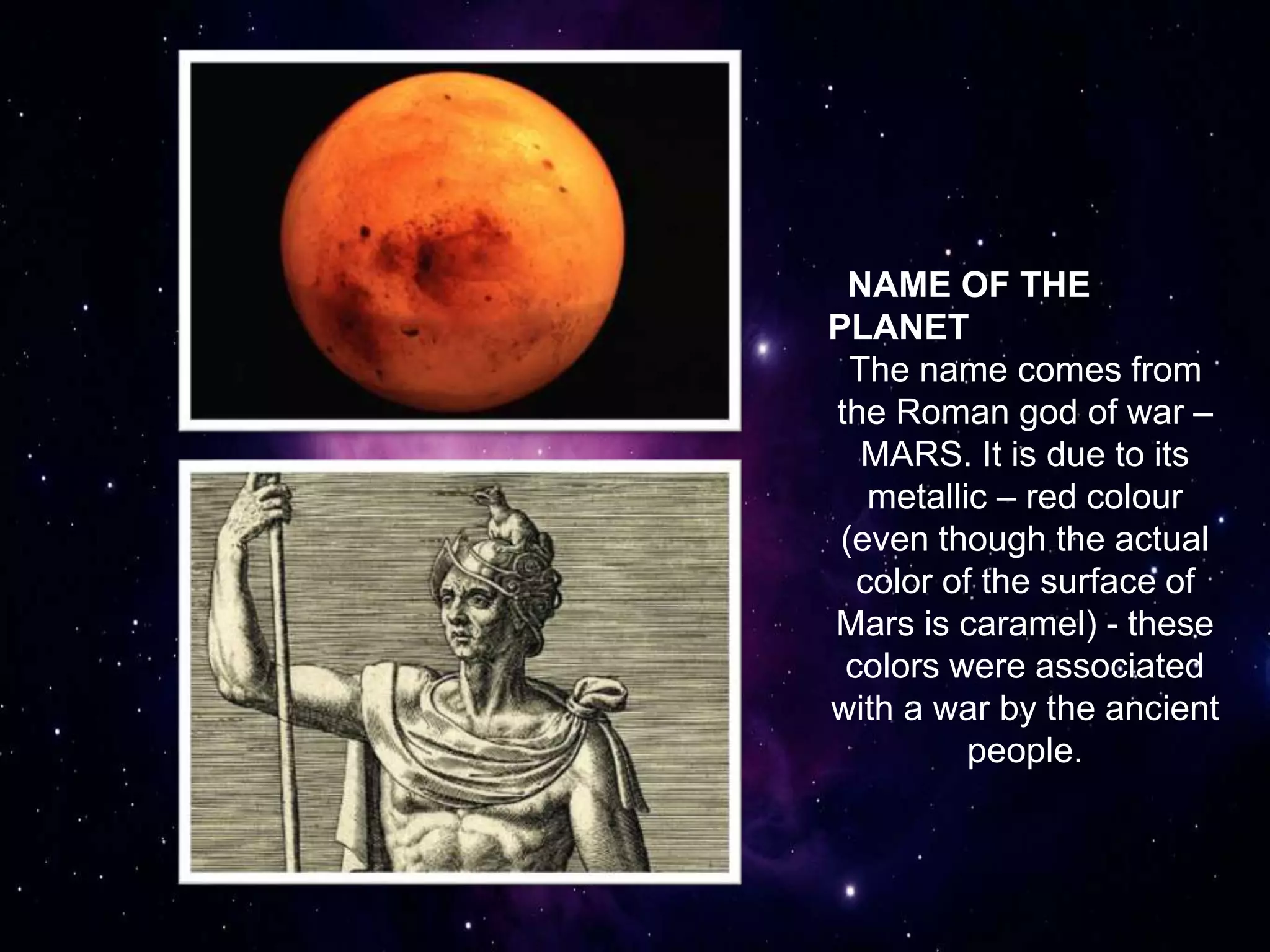
The name comes from
the Roman god of war –
MARS. It is due to its
metallic – red colour
(even though the actual
color of the surface of
Mars is caramel) - these
colors were associated
with a war by the ancient
people.
HISTORY OF MARS
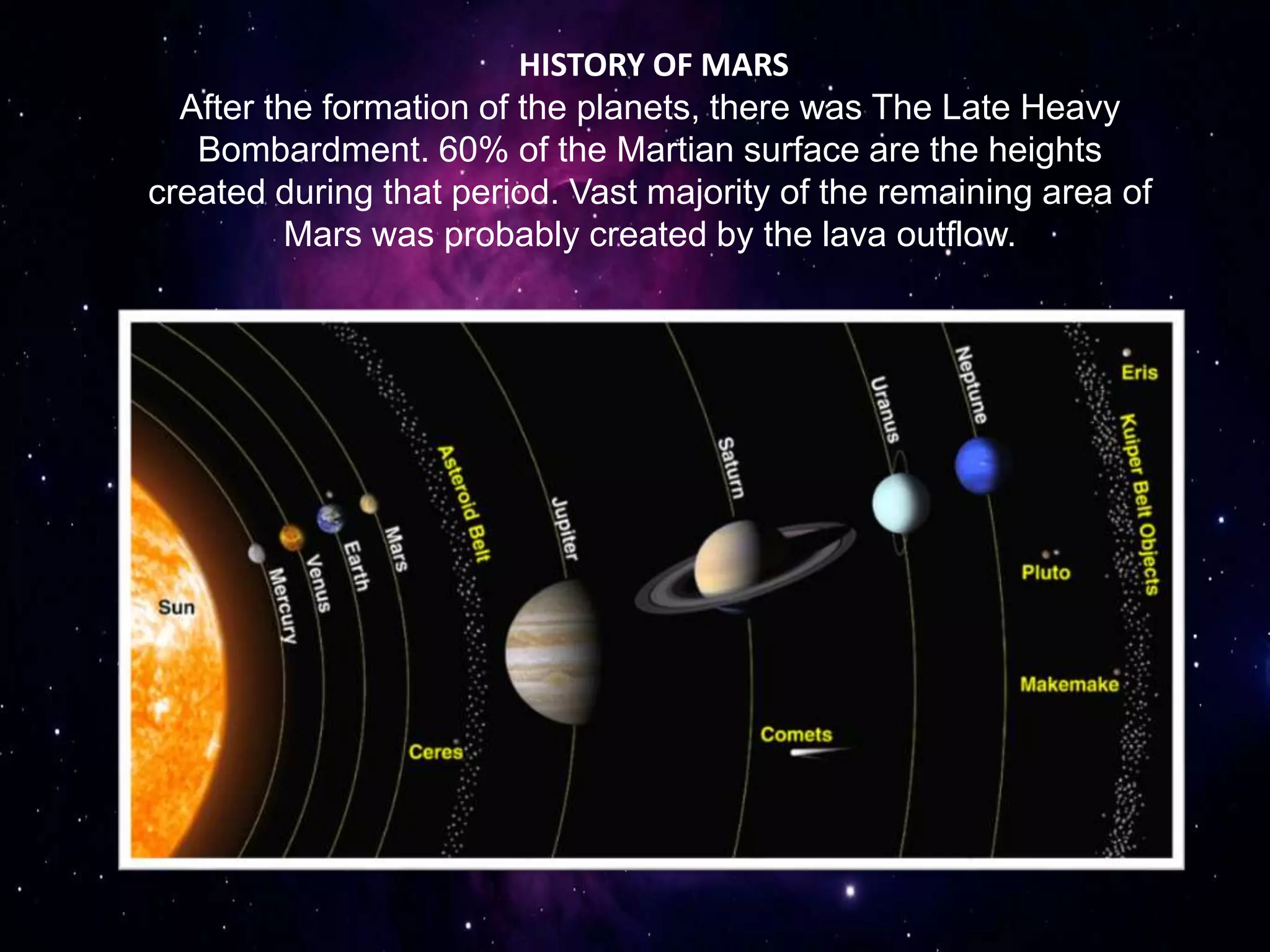
After the formation of the planets, there was The Late Heavy
Bombardment. 60% of the Martian surface are the heights
created during that period. Vast majority of the remaining area of
Mars was probably created by the lava outflow.
INFORMATION ABOUT GEOGRAPHICAL AND PHYSICAL MARS
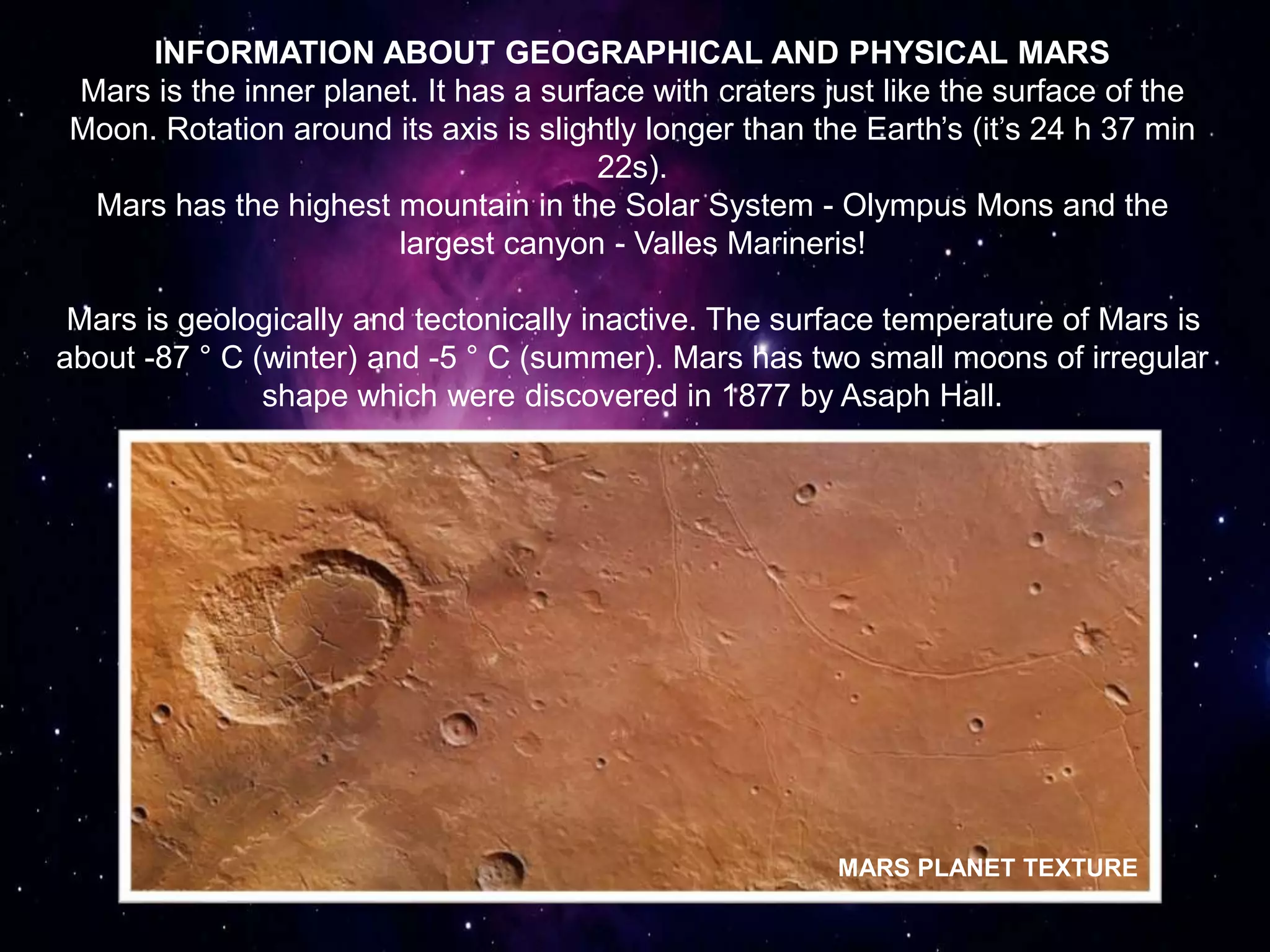
Mars is the inner planet. It has a surface with craters just like the surface of the
Moon. Rotation around its axis is slightly longer than the Earth’s (it’s 24 h 37 min
22s).
Mars has the highest mountain in the Solar System - Olympus Mons and the
largest canyon - Valles Marineris!
Mars is geologically and tectonically inactive. The surface temperature of Mars is
about -87 ° C (winter) and -5 ° C (summer). Mars has two small moons of irregular
shape which were discovered in 1877 by Asaph Hall.
MARS PLANET TEXTURE
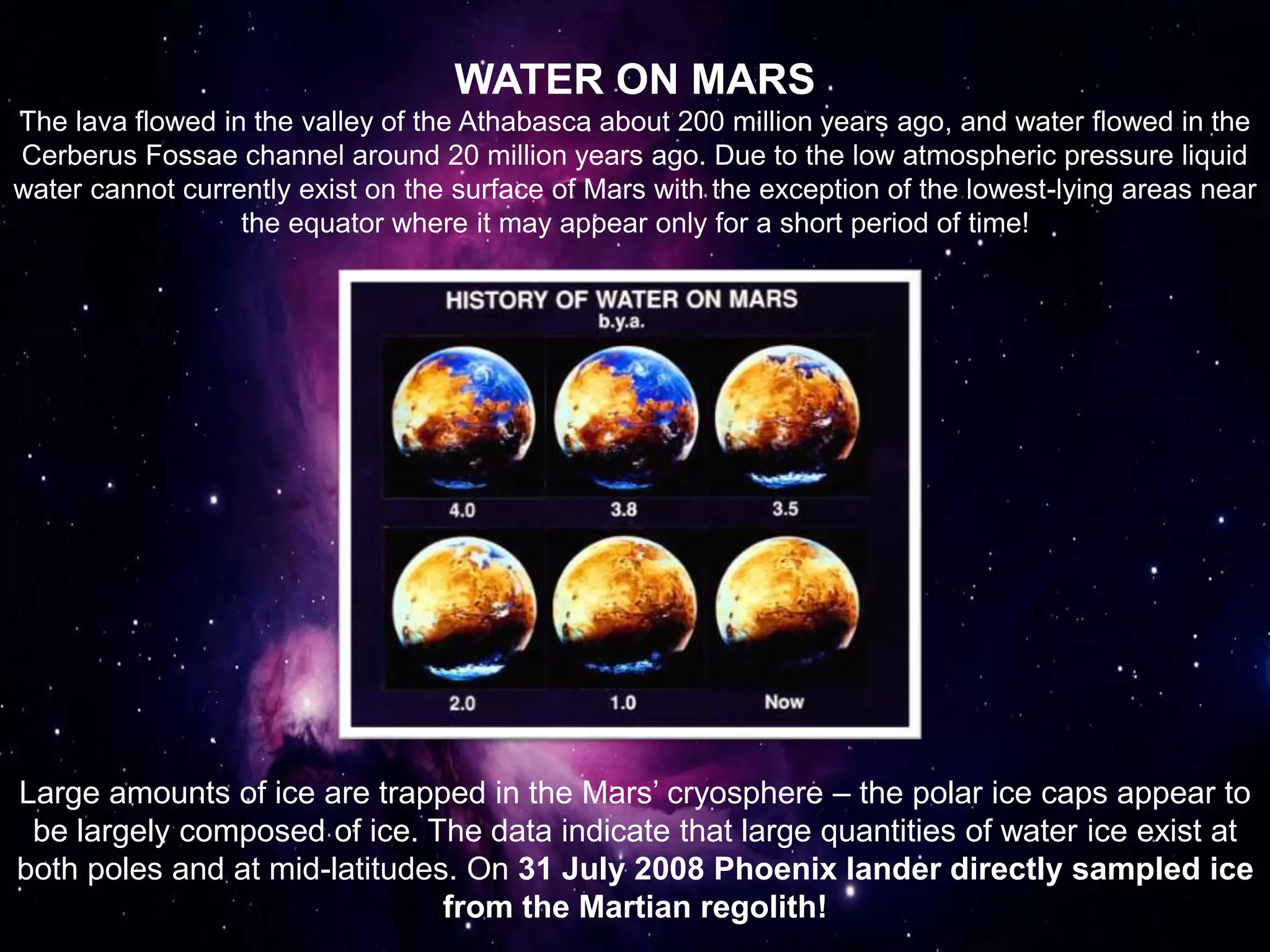
WATER ON MARS
The lava flowed in the valley of the Athabasca about 200 million years ago, and water flowed in the
Cerberus Fossae channel around 20 million years ago. Due to the low atmospheric pressure liquid
water cannot currently exist on the surface of Mars with the exception of the lowest-lying areas near
the equator where it may appear only for a short period of time!
Large amounts of ice are trapped in the Mars’ cryosphere – the polar ice caps appear to
be largely composed of ice. The data indicate that large quantities of water ice exist at
both poles and at mid-latitudes. On 31 July 2008 Phoenix lander directly sampled ice
from the Martian regolith!
LIFE AND EXPEDITIONS TO MARS
Mars was already observed by the ancient
Egyptian astronomers in the night sky, and before
1534 BC a retrograde motion was already known.
Babylonian astronomers during the rule of New –
Babylonian Empire keep regular records of the
position of the planets and conducted systematic
observations of their behavior.
Many space probes (orbiters, landers and rovers)
were sent in the direction of Mars, among others
by the United States and Japan to explore the
surface of the planet, its climate and geological
structure. Current cost of sending one kilogram of
load to Mars amounts to $ 310,000.
Approximately 2/3 of the Mars mission has not
been completed successfully (the probe
underwent a failure in the various stages of flight).
For 2016 it is planned to start the InSight mission
which is to conduct a geophysical research of the
planet.
The idea that Mars is inhabited by intelligent Martians was particularly popular
in the late nineteenth century.
In 1901, in an article for The New York Times, the director of the Harvard
College Observatory said that he received a telegram from Lowell Observatory
in Arizona which seemed to confirm that Mars tried to communicate with the
Earth: " At the beginning of December 1900 we received the Lowell
Observatory in Arizona telegram that the observed light beam from the
direction of Mars "
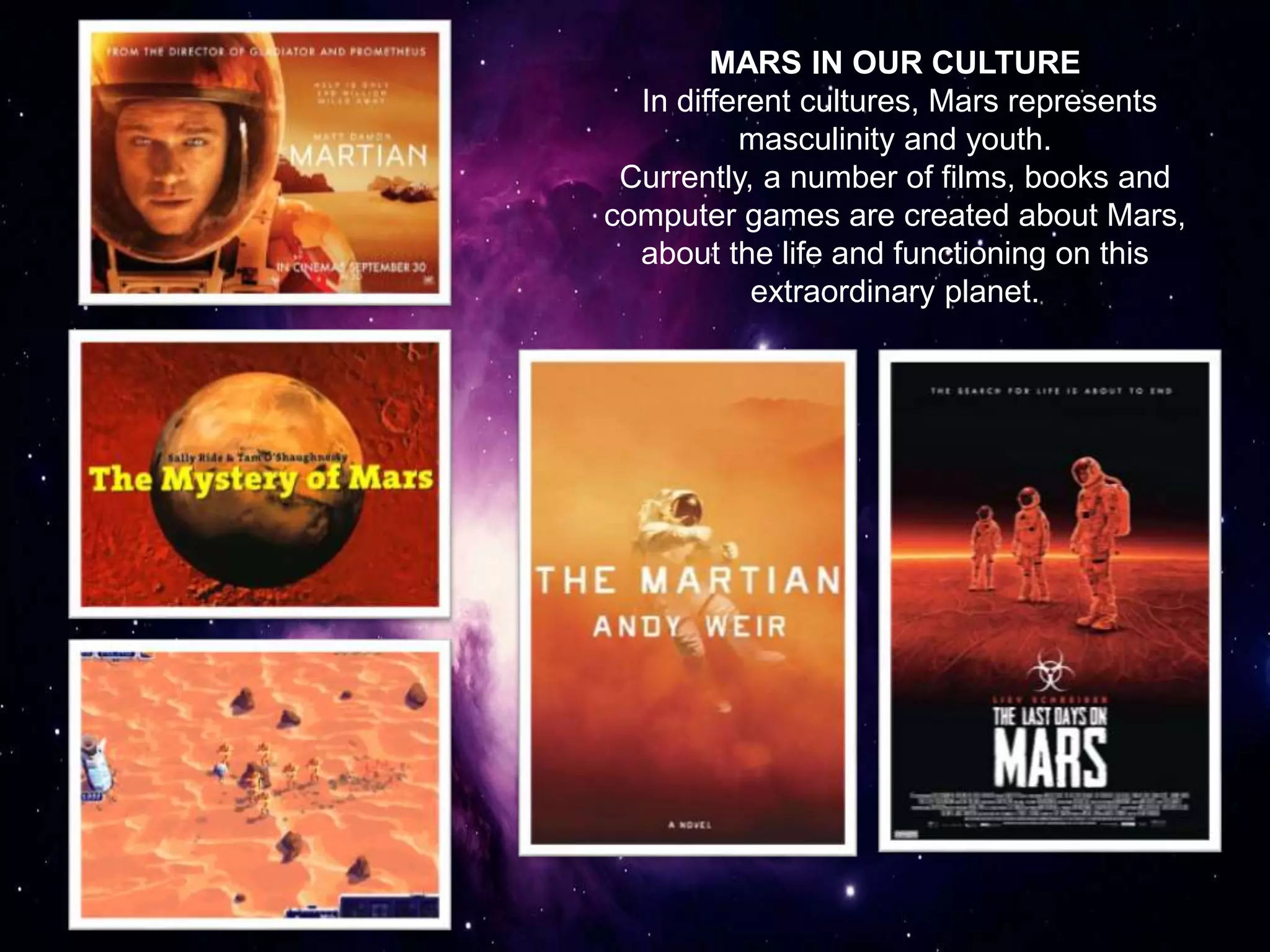
MARS IN OUR CULTURE
In different cultures, Mars represents
masculinity and youth.
Currently, a number of films, books and
computer games are created about Mars,
about the life and functioning on this
extraordinary planet.
INTERESTING THINGS ABOUT
MARS
In ancient Greece it was believed that
the Earth is the center of the universe,
and Mars is one of the five stars that
moves around it.
The famous Galileo was the first
person who observed Mars through a
telescope - it was in 1609.
The gravity on Mars is only 38% of the
Earth’s gravity which means that
terrestrial kilogram "weighs" 380
grams there.
Mars is a giant, the largest planet in
the solar system, a natural labyrinth
known as Noctis Labyrinthus (which
means "Labyrinth of Night"). This is a
system of deep intersecting valleys.
THANKS FOR
WATCHING!
by Group 3
Zuzanna Pruchniak
Alexandros Chrisanthou
Anna Hermanowska
Andreas Chrisanthou
Karolina Kuryj

Mars

  • 1.
  • 2.
    NAME OF THE PLANET Thename comes from the Roman god of war – MARS. It is due to its metallic – red colour (even though the actual color of the surface of Mars is caramel) - these colors were associated with a war by the ancient people.
  • 3.
    HISTORY OF MARS Afterthe formation of the planets, there was The Late Heavy Bombardment. 60% of the Martian surface are the heights created during that period. Vast majority of the remaining area of Mars was probably created by the lava outflow.
  • 4.
    INFORMATION ABOUT GEOGRAPHICALAND PHYSICAL MARS Mars is the inner planet. It has a surface with craters just like the surface of the Moon. Rotation around its axis is slightly longer than the Earth’s (it’s 24 h 37 min 22s). Mars has the highest mountain in the Solar System - Olympus Mons and the largest canyon - Valles Marineris! Mars is geologically and tectonically inactive. The surface temperature of Mars is about -87 ° C (winter) and -5 ° C (summer). Mars has two small moons of irregular shape which were discovered in 1877 by Asaph Hall. MARS PLANET TEXTURE
  • 5.
    WATER ON MARS Thelava flowed in the valley of the Athabasca about 200 million years ago, and water flowed in the Cerberus Fossae channel around 20 million years ago. Due to the low atmospheric pressure liquid water cannot currently exist on the surface of Mars with the exception of the lowest-lying areas near the equator where it may appear only for a short period of time! Large amounts of ice are trapped in the Mars’ cryosphere – the polar ice caps appear to be largely composed of ice. The data indicate that large quantities of water ice exist at both poles and at mid-latitudes. On 31 July 2008 Phoenix lander directly sampled ice from the Martian regolith!
  • 6.
    LIFE AND EXPEDITIONSTO MARS Mars was already observed by the ancient Egyptian astronomers in the night sky, and before 1534 BC a retrograde motion was already known. Babylonian astronomers during the rule of New – Babylonian Empire keep regular records of the position of the planets and conducted systematic observations of their behavior. Many space probes (orbiters, landers and rovers) were sent in the direction of Mars, among others by the United States and Japan to explore the surface of the planet, its climate and geological structure. Current cost of sending one kilogram of load to Mars amounts to $ 310,000. Approximately 2/3 of the Mars mission has not been completed successfully (the probe underwent a failure in the various stages of flight). For 2016 it is planned to start the InSight mission which is to conduct a geophysical research of the planet.
  • 7.
    The idea thatMars is inhabited by intelligent Martians was particularly popular in the late nineteenth century. In 1901, in an article for The New York Times, the director of the Harvard College Observatory said that he received a telegram from Lowell Observatory in Arizona which seemed to confirm that Mars tried to communicate with the Earth: " At the beginning of December 1900 we received the Lowell Observatory in Arizona telegram that the observed light beam from the direction of Mars "
  • 8.
    MARS IN OURCULTURE In different cultures, Mars represents masculinity and youth. Currently, a number of films, books and computer games are created about Mars, about the life and functioning on this extraordinary planet.
  • 9.
    INTERESTING THINGS ABOUT MARS Inancient Greece it was believed that the Earth is the center of the universe, and Mars is one of the five stars that moves around it. The famous Galileo was the first person who observed Mars through a telescope - it was in 1609. The gravity on Mars is only 38% of the Earth’s gravity which means that terrestrial kilogram "weighs" 380 grams there. Mars is a giant, the largest planet in the solar system, a natural labyrinth known as Noctis Labyrinthus (which means "Labyrinth of Night"). This is a system of deep intersecting valleys.
  • 10.
    THANKS FOR WATCHING! by Group3 Zuzanna Pruchniak Alexandros Chrisanthou Anna Hermanowska Andreas Chrisanthou Karolina Kuryj