National Aeronautics and Space Administration
300,000,000 900,000,000 1,500,000,000 2,100,000,000 2,700,000,000 3,300,000,000 3,900,000,000 4,500,000,000 5,100,000,000 5,700,000,000 kilometers
0
Mars
www.nasa.gov
Though details of Mars’ surface are difficult to see from Earth,
telescope observations show seasonally changing features and
white patches at the poles. For decades, people speculated that
bright and dark areas on Mars were patches of vegetation, Mars
was a likely place for advanced life forms, and water might exist
in the polar caps. When the Mariner 4 spacecraft flew by Mars in
1965, photographs of a bleak, cratered surface shocked many
— Mars seemed to be a dead planet. Later missions, however,
showed that Mars is a complex planet and holds many mysteries
yet to be solved. Chief among them is whether Mars ever had
the right conditions to support small life forms called microbes.
Mars is a rocky body about half the size of Earth. As with the
other terrestrial planets — Mercury, Venus, and Earth — volca-
noes, impact craters, crustal movement, and atmospheric condi-
tions such as dust storms have altered the surface of Mars.
Mars has two small moons, Phobos and Deimos, that may be
captured asteroids. Potato-shaped, they have too little mass for
gravity to make them spherical. Phobos, the innermost moon, is
heavily cratered, with deep grooves on its surface.
Like Earth, Mars experiences seasons due to the tilt of its rota-
tional axis. Mars’ orbit is about 1.5 times farther from the Sun
than Earth’s and is slightly elliptical, so its distance from the Sun
changes. That affects the length of martian seasons, which vary
in length. The polar ice caps on Mars grow and recede with the
seasons. Layered areas near the poles suggest that the planet’s
climate has changed more than once. Volcanism in the highlands
and plains was active more than 3 billion years ago. Some of the
giant shield volcanoes are younger, having formed between
1 and 2 billion years ago. Mars has the largest volcano in the
solar system, Olympus Mons, as well as a spectacular equatorial
canyon system, Valles Marineris.
Mars has no global magnetic field today. However, NASA’s Mars
Global Surveyor orbiter found that areas of the martian crust
in the southern hemisphere are highly magnetized, indicating
traces of a magnetic field from 4 billion years ago that remain.
Scientists believe that Mars experienced huge floods about
3.5 billion years ago. Though we do not know where the ancient
flood water came from, how long it lasted, or where it went,
recent missions to Mars have uncovered intriguing hints. In
2002, NASA’s Mars Odyssey orbiter detected hydrogen-rich
polar deposits, indicating large quantities of water ice close to
the surface. Further observations found hydrogen in other areas
as well. If water ice permeated the entire planet, Mars could
have substantial subsurface layers of frozen water. In 2004, Mars
Exploration Rover Opportunity found structures and minerals
indicating that liquid water once existed at its landing site. The
rover’s twin, Spirit, also found the signature of ancient water near
its landing site, halfway around Mars from Opportunity’s location.
The cold temperatures and thin atmosphere on Mars do not
allow liquid water to exist at the surface for long. The quantity
of water required to carve Mars’ great channels and flood plains
is not evident today. Unraveling the story of water on Mars is
important to unlocking its climate history, which will help us
understand the evolution of all the planets. Water is an essential
ingredient for life as we know it. Evidence of long-term past or
present water on Mars holds clues about whether Mars could
ever have been a habitat for life. In 2008, NASA’s Phoenix Mars
Lander was the first mission to “touch” water ice in the martian
arctic. Phoenix also observed precipitation (snow falling from
clouds), as confirmed by Mars Reconnaissance Orbiter. Soil
chemistry experiments led scientists to believe that the Phoenix
landing site had a wetter and warmer climate in the recent past
(the last few million years). NASA’s Mars Science Laboratory
mission, with its large rover Curiosity, is examining martian rocks
and soil at Gale Crater, looking for minerals that formed in water,
signs of subsurface water, and carbon-based molecules called
organics, the chemical building blocks of life. That information
will reveal more about the present and past habitability of Mars,
as well as whether humans could survive on Mars some day.
FAST FACTS
Namesake			 Roman god of war
Mean Distance from the Sun 227.94 million km
(141.63 million mi)
Orbit Period 1.8807 Earth years (686.98 Earth days)
Orbit Eccentricity (Circular Orbit = 0) 0.0934
Orbit Inclination to Ecliptic 1.8 deg
Inclination of Equator to Orbit 25.19 deg
Rotation Period 24.62 hr
Successive Sunrises 24.660 hr
Equatorial Radius 3,397 km (2,111 mi)
Mass 0.10744 of Earth’s
Density 3.934 g/cm3
(0.714 of Earth’s)
Surface Gravity 0.38 of Earth’s
Atmosphere Primary Components carbon dioxide,
nitrogen, argon
Temperature Range –87 to –5 deg C (–125 to 23 deg F)
Known Moons* 2
Rings 0
*As of July 2013.
SIGNIFICANT DATES
1877 — Asaph Hall discovers the two moons of Mars.
1965 — NASA’s Mariner 4 sends back 22 photos of Mars, the
world’s first close-up photos of a planet beyond Earth.
1976 — Viking 1 and 2 land on the surface of Mars.
1997 — Mars Pathfinder lands and dispatches Sojourner, the first
wheeled rover to explore the surface of another planet.
2002 — Mars Odyssey begins its mission to make global obser-
vations and find buried water ice on Mars.
2004 — Twin Mars Exploration Rovers named Spirit and
Opportunity find strong evidence that Mars once had long-term
liquid water on the surface.
2006 — Mars Reconnaissance Orbiter begins returning high-
resolution images as it studies the history of water on Mars and
seasonal changes.
2008 — Phoenix finds signs of possible habitability, including the
occasional presence of liquid water and potentially favorable soil
chemistry.
2012 — NASA’s Mars rover Curiosity lands in Gale Crater and
finds conditions once suited for ancient microbial life on Mars.
ABOUT THE IMAGES
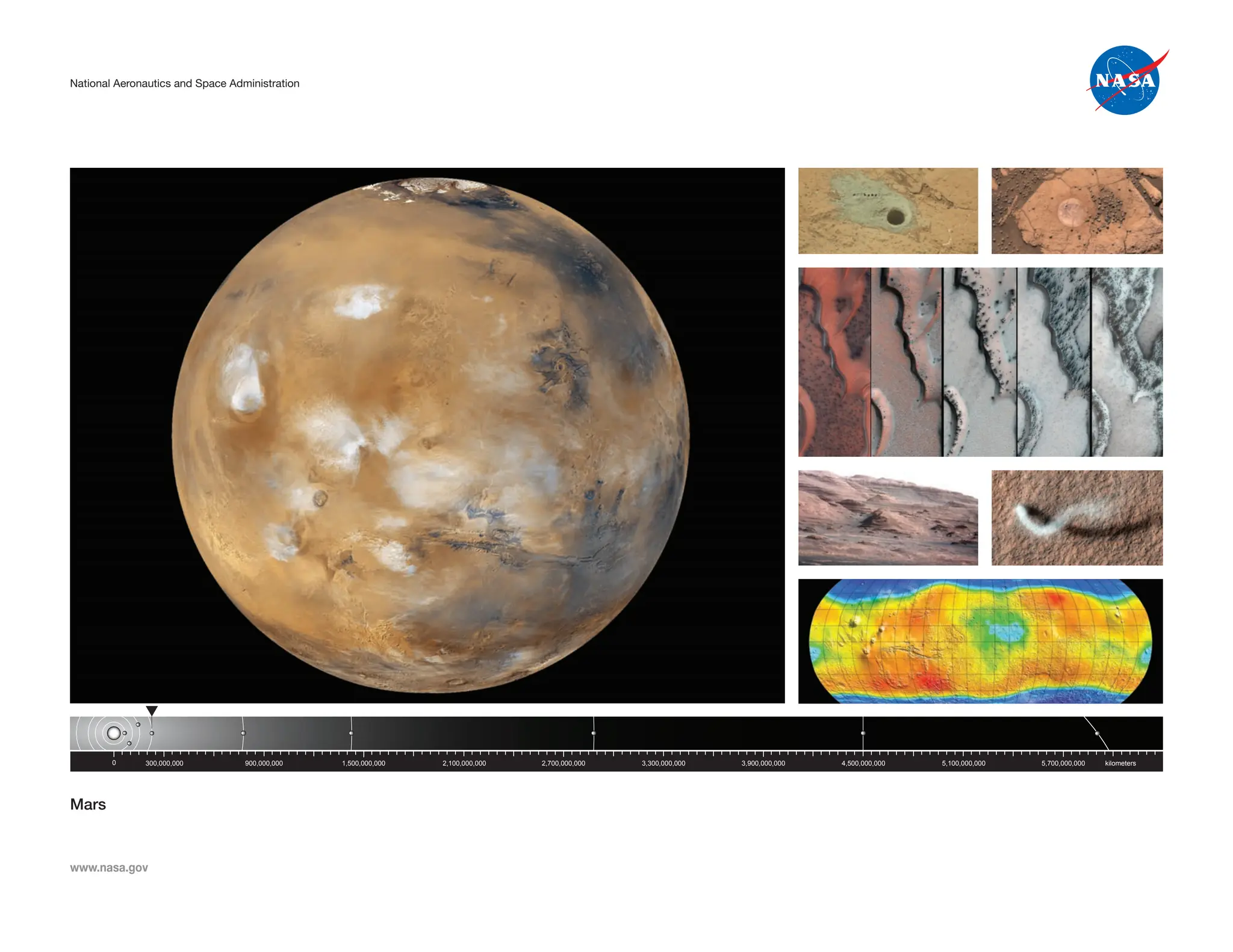
Water-ice clouds,
polar ice, polar regions,
and geological features
can be seen in this
full-disk image of
Mars.
1
Mars rover Curiosity drilled this hole and fired its laser
several times (creating small pits across the top of the hole) to
learn more about the composition of the gray matter.
Mars rover Opportunity found sphere-like grains of hematite
that likely formed in water.
Mars Reconnaissance Orbiter captured seasonal changes in
this false-color image of sand dunes from the north polar region.
Curiosity will sample the layered rocks of Mount Sharp in
Gale Crater to understand Mars as a possible place for life.
A dust devil towers about half a mile above the martian
surface in this Mars Reconnaissance Orbiter image.
False color (blue) shows where water ice is buried beneath
the martian surface in this Mars Odyssey orbiter image.
1 2
4
7
3
5 6
2
3
4
5
6
7
FOR MORE INFORMATION
solarsystem.nasa.gov/mars
LG-2013-07-569-HQ — JPL 400-1489H 07/13

Mars Lithograph Projects marsMars Lithograph Projects Mars Lithograph Mars Lithograph Mars Lithograph Mars Lithograph Mars Lithograph Mars Lithograph Mars Lithograph Mars Lithograph Projects mars mars mars mars mars mars mars mars

  • 1.
    National Aeronautics andSpace Administration National Aeronautics and Space Administration 300,000,000 900,000,000 1,500,000,000 2,100,000,000 2,700,000,000 3,300,000,000 3,900,000,000 4,500,000,000 5,100,000,000 5,700,000,000 kilometers 0 Mars www.nasa.gov
  • 2.
    Though details ofMars’ surface are difficult to see from Earth, telescope observations show seasonally changing features and white patches at the poles. For decades, people speculated that bright and dark areas on Mars were patches of vegetation, Mars was a likely place for advanced life forms, and water might exist in the polar caps. When the Mariner 4 spacecraft flew by Mars in 1965, photographs of a bleak, cratered surface shocked many — Mars seemed to be a dead planet. Later missions, however, showed that Mars is a complex planet and holds many mysteries yet to be solved. Chief among them is whether Mars ever had the right conditions to support small life forms called microbes. Mars is a rocky body about half the size of Earth. As with the other terrestrial planets — Mercury, Venus, and Earth — volca- noes, impact craters, crustal movement, and atmospheric condi- tions such as dust storms have altered the surface of Mars. Mars has two small moons, Phobos and Deimos, that may be captured asteroids. Potato-shaped, they have too little mass for gravity to make them spherical. Phobos, the innermost moon, is heavily cratered, with deep grooves on its surface. Like Earth, Mars experiences seasons due to the tilt of its rota- tional axis. Mars’ orbit is about 1.5 times farther from the Sun than Earth’s and is slightly elliptical, so its distance from the Sun changes. That affects the length of martian seasons, which vary in length. The polar ice caps on Mars grow and recede with the seasons. Layered areas near the poles suggest that the planet’s climate has changed more than once. Volcanism in the highlands and plains was active more than 3 billion years ago. Some of the giant shield volcanoes are younger, having formed between 1 and 2 billion years ago. Mars has the largest volcano in the solar system, Olympus Mons, as well as a spectacular equatorial canyon system, Valles Marineris. Mars has no global magnetic field today. However, NASA’s Mars Global Surveyor orbiter found that areas of the martian crust in the southern hemisphere are highly magnetized, indicating traces of a magnetic field from 4 billion years ago that remain. Scientists believe that Mars experienced huge floods about 3.5 billion years ago. Though we do not know where the ancient flood water came from, how long it lasted, or where it went, recent missions to Mars have uncovered intriguing hints. In 2002, NASA’s Mars Odyssey orbiter detected hydrogen-rich polar deposits, indicating large quantities of water ice close to the surface. Further observations found hydrogen in other areas as well. If water ice permeated the entire planet, Mars could have substantial subsurface layers of frozen water. In 2004, Mars Exploration Rover Opportunity found structures and minerals indicating that liquid water once existed at its landing site. The rover’s twin, Spirit, also found the signature of ancient water near its landing site, halfway around Mars from Opportunity’s location. The cold temperatures and thin atmosphere on Mars do not allow liquid water to exist at the surface for long. The quantity of water required to carve Mars’ great channels and flood plains is not evident today. Unraveling the story of water on Mars is important to unlocking its climate history, which will help us understand the evolution of all the planets. Water is an essential ingredient for life as we know it. Evidence of long-term past or present water on Mars holds clues about whether Mars could ever have been a habitat for life. In 2008, NASA’s Phoenix Mars Lander was the first mission to “touch” water ice in the martian arctic. Phoenix also observed precipitation (snow falling from clouds), as confirmed by Mars Reconnaissance Orbiter. Soil chemistry experiments led scientists to believe that the Phoenix landing site had a wetter and warmer climate in the recent past (the last few million years). NASA’s Mars Science Laboratory mission, with its large rover Curiosity, is examining martian rocks and soil at Gale Crater, looking for minerals that formed in water, signs of subsurface water, and carbon-based molecules called organics, the chemical building blocks of life. That information will reveal more about the present and past habitability of Mars, as well as whether humans could survive on Mars some day. FAST FACTS Namesake Roman god of war Mean Distance from the Sun 227.94 million km (141.63 million mi) Orbit Period 1.8807 Earth years (686.98 Earth days) Orbit Eccentricity (Circular Orbit = 0) 0.0934 Orbit Inclination to Ecliptic 1.8 deg Inclination of Equator to Orbit 25.19 deg Rotation Period 24.62 hr Successive Sunrises 24.660 hr Equatorial Radius 3,397 km (2,111 mi) Mass 0.10744 of Earth’s Density 3.934 g/cm3 (0.714 of Earth’s) Surface Gravity 0.38 of Earth’s Atmosphere Primary Components carbon dioxide, nitrogen, argon Temperature Range –87 to –5 deg C (–125 to 23 deg F) Known Moons* 2 Rings 0 *As of July 2013. SIGNIFICANT DATES 1877 — Asaph Hall discovers the two moons of Mars. 1965 — NASA’s Mariner 4 sends back 22 photos of Mars, the world’s first close-up photos of a planet beyond Earth. 1976 — Viking 1 and 2 land on the surface of Mars. 1997 — Mars Pathfinder lands and dispatches Sojourner, the first wheeled rover to explore the surface of another planet. 2002 — Mars Odyssey begins its mission to make global obser- vations and find buried water ice on Mars. 2004 — Twin Mars Exploration Rovers named Spirit and Opportunity find strong evidence that Mars once had long-term liquid water on the surface. 2006 — Mars Reconnaissance Orbiter begins returning high- resolution images as it studies the history of water on Mars and seasonal changes. 2008 — Phoenix finds signs of possible habitability, including the occasional presence of liquid water and potentially favorable soil chemistry. 2012 — NASA’s Mars rover Curiosity lands in Gale Crater and finds conditions once suited for ancient microbial life on Mars. ABOUT THE IMAGES Water-ice clouds, polar ice, polar regions, and geological features can be seen in this full-disk image of Mars. 1 Mars rover Curiosity drilled this hole and fired its laser several times (creating small pits across the top of the hole) to learn more about the composition of the gray matter. Mars rover Opportunity found sphere-like grains of hematite that likely formed in water. Mars Reconnaissance Orbiter captured seasonal changes in this false-color image of sand dunes from the north polar region. Curiosity will sample the layered rocks of Mount Sharp in Gale Crater to understand Mars as a possible place for life. A dust devil towers about half a mile above the martian surface in this Mars Reconnaissance Orbiter image. False color (blue) shows where water ice is buried beneath the martian surface in this Mars Odyssey orbiter image. 1 2 4 7 3 5 6 2 3 4 5 6 7 FOR MORE INFORMATION solarsystem.nasa.gov/mars LG-2013-07-569-HQ — JPL 400-1489H 07/13