 Faculty Name: Dr. Anupama Pandey
NIMS UNIVERSITY
NIMS School of Business
• Introduction to Financial, Cost and Management
Accounting
• Generally accepted Accounting principles
• Conventions and Concepts
• Balance sheet and Profit and Loss Account and related
concepts
• Introduction to Inflation Accounting
• Introduction to Human Resource Accounting
• Accounting Standards
• Scope and functions of Accounting Standards Boards
• International Financial Reporting System
The American Institute of Certified Public
Accountants (AICPA) had defined accounting as the
“art of recording, classifying, and summarizing in a
significant manner and in terms of money,
transactions and events which are, in part at least,
of financial character, and interpreting the results
thereof”.
 Financial Accounting – Financial accounting is that branch of
accounting that involves identifying, measuring, recording,
classifying, and summarising the business transactions, i.e. it
involves the steps from identifying, recording transactions to
summarisation, and communicating the financial data.
 Cost Accounting – Cost accounting is referred to as a form of
managerial accounting that is used by businesses to classify,
summarise and analyse the different costs with the purpose of cost
control and cost reduction and thereby helping management in
making better decisions.
 Management Accounting – Management accounting refers to that
branch of accounting that is concerned with presenting the
accounting information in such a way that helps the management in
planning and controlling the operations of a business and in
decision-making.
 Generally Accepted Accounting Principles or
GAAP is a defined set of rules and procedures
that needs to be followed in order to create
financial statements, which are consistent with
the industry standards.
 GAAP helps in ensuring that financial reporting is
transparent and uniform across industries.
 Conservatism
 Disclosure
 Consistency
 Materiality
 Accounting Period concept
 Dual Aspect concept
 Money measurement concept
 Realisation concept
 Separate entity concept/Business entity concept
 Cost concept
 Going concern concept
 Objective evidence concept
 Matching concept
 Accrual concept
 Meaning of Account : Transaction of a similar
nature when recorded at one place is known as
accounts. In other words, a summary of relevant
business transactions and events recorded at one
place relating to a particular head is called an
account and the entire group of accounts is called a
ledger.
 Types of Accounts: It can be classified into 3 types-
 1) Personal Accounts
 2) Real Accounts
 3) Nominal Accounts
1. Personal Account: It can be classified into 3 types:
(i) Real persons account
(ii) Artificial persons account
(iii) Representatives persons account
Rule: Debit- The Receiver
 Credit- The Giver
2. Real Account: Real accounts are of 2 types:
•(i) Tangible Real accounts
•(ii) Intangible Real accounts
Rule: Debit-What comes in
 Credit-What goes out
 3) Nominal Account:
 It includes all expenses, losses, incomes and
gains.
 Rule: Debit- Expenses & losses
 Credit- Income & Gains
 Rules of Journalising: The method of recording
transaction in journal on the basis of rules of
double entry system is called journalising.
 For a new business, it begin by setting up ledger
accounts.
 For an established business, begin with account
balances carried over from the previous period.
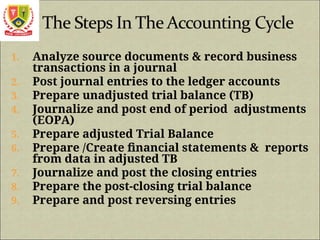
1. Analyze source documents & record business
transactions in a journal
2. Post journal entries to the ledger accounts
3. Prepare unadjusted trial balance (TB)
4. Journalize and post end of period adjustments
(EOPA)
5. Prepare adjusted Trial Balance
6. Prepare /Create financial statements & reports
from data in adjusted TB
7. Journalize and post the closing entries
8. Prepare the post-closing trial balance
9. Prepare and post reversing entries
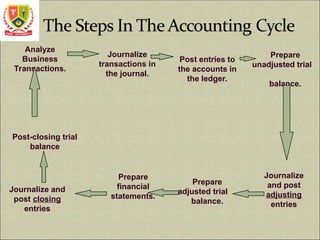
Analyze
Business
Transactions.
Journalize
transactions in
the journal.
Post entries to
the accounts in
the ledger.
Prepare
unadjusted trial
balance.
Prepare
financial
statements.
Post-closing trial
balance
Journalize and
post closing
entries
Journalize
and post
adjusting
entries
Prepare
adjusted trial
balance.
 Business transaction is an economic event that
causes a change in the financial position
 Financial Position:
 What the entity controls
 How the entity controls them (claims)
ASSETS = EQUITIES
ASSETS = LIABILITIES + OWNERS' EQUITY
 Recall the Basic Accounting Equation:
 Assets = Liabilities + Shareholders’ Equity
 Implications:
 Total Asset=Claims against the assets
 Therefore :
 If assets increase : either Liabilities and/or
Shareholders’ should also increase and vice
versa
 For example: borrow cash, cash (asset) will
increase and Liabilities will increase
 when it is paid back: cash (asset) will decrease
and liabilities will decrease
 An ACCOUNT (ledger Account) : is an
accounting device used to record changes
in a of a specific asset, liability or owners’
equity item
 Has 3 elements: title, debit side and credit
side (also called the “T-Account”)
 Changes in the accounts are entered
manually into a book called a ledger or
computerized ledger
 Basic forms of book ledgers: the two-
column account format, and the running
format account
 Chart of accounts
 Ledger Account
 Complete listing of business transactions for an
individual account
 Where you look if you want to find the balance of
any given account
 General Ledger
 A loose-leaf book or computer file containing all the
Ledger Accounts
 Each account from the chart of accounts has its
own ledger account in the general ledger
 Complete listing of all account tittles and account
names/codes used by an entity is called the chart
of accounts - It is like a table of content in a book
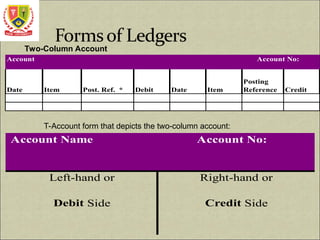
Date Item Post. Ref. * Debit Date Item
Posting
Reference Credit
Account No:
Account
Left-hand or Right-hand or
Debit Side Credit Side
Account Name Account No:
Two-Column Account
T-Account form that depicts the two-column account:
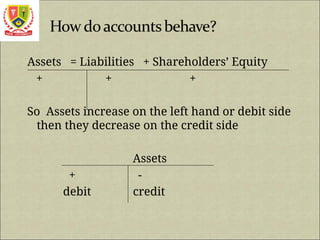
Assets = Liabilities + Shareholders’ Equity
+ + +
So Assets increase on the left hand or debit side
then they decrease on the credit side
Assets
+ -
debit credit
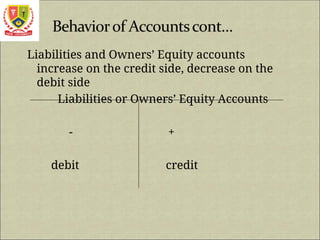
Liabilities and Owners’ Equity accounts
increase on the credit side, decrease on the
debit side
Liabilities or Owners’ Equity Accounts
- +
debit credit
Double entry system states that every transactions
affects at least two accounts.
Therefore
• If an asset account increases (decreases), because
of duality concept there must be a corresponding:
1. increase(decrease) in a specific liability account
2. or a decrease(increase) in a another asset
account
3. or an increase(decrease) in owners' equity
account.
 The book in which a person enters the original
record of a business transaction
 Commonly referred to as a book of original entry
 Chronological listing of all the business
transactions for the company
 Each listing records the debits and credits associated
with that business transaction
 A book or a location on a hard drive where all
business transactions are listed
 Like a diary
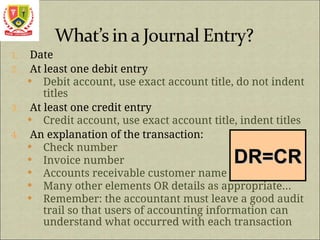
1. Date
2. At least one debit entry
 Debit account, use exact account title, do not indent
titles
3. At least one credit entry
 Credit account, use exact account title, indent titles
4. An explanation of the transaction:
 Check number
 Invoice number
 Accounts receivable customer name
 Many other elements OR details as appropriate…
 Remember: the accountant must leave a good audit
trail so that users of accounting information can
understand what occurred with each transaction
DR=CR
DR=CR
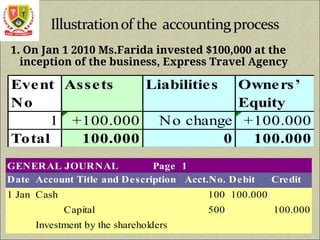
1. On Jan 1 2010 Ms.Farida invested $100,000 at the
inception of the business, Express Travel Agency
Event
No
Assets Liabilities Owners’
Equity
1 +100.000 No change +100.000
Total 100.000 0 100.000
GENERAL JOURNAL Page 1
Date Account Title and Description Acct.No. Debit Credit
1 Jan 2004
Cash 100 100.000
Capital 500 100.000
Investment by the shareholders
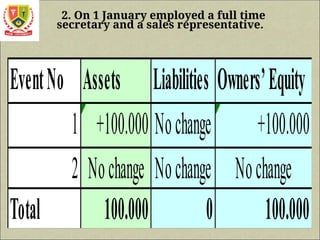
2. On 1 January employed a full time
secretary and a sales representative.
EventNo Assets Liabilities Owners’Equity
1 +100.000 Nochange +100.000
2 Nochange Nochange Nochange
Total 100.000 0 100.000
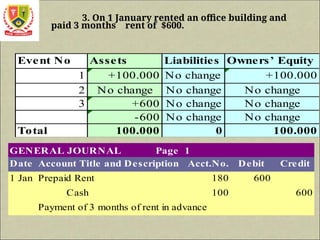
3. On 1 January rented an office building and
paid 3 months rent of $600.
Event No Assets Liabilities Owners’ Equity
1 +100.000 No change +100.000
2 No change No change No change
3 +600 No change No change
-600 No change No change
Total 100.000 0 100.000
GENERAL JOURNAL Page 1
Date Account Title and Description Acct.No. Debit Credit
1 Jan 2004
Prepaid Rent 180 600
Cash 100 600
Payment of 3 months of rent in advance
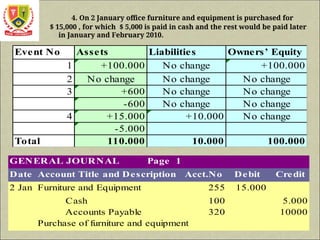
4. On 2 January office furniture and equipment is purchased for
$ 15,000 , for which $ 5,000 is paid in cash and the rest would be paid later
in January and February 2010.
Event No Assets Liabilities Owners’ Equity
1 +100.000 No change +100.000
2 No change No change No change
3 +600 No change No change
-600 No change No change
4 +15.000 +10.000 No change
-5.000
Total 110.000 10.000 100.000
GENERAL JOURNAL Page 1
Date Account Title and Description Acct.No Debit Credit
2 Jan 2004
Furniture and Equipment 255 15.000
Cash 100 5.000
Accounts Payable 320 10000
Purchase of furniture and equipment
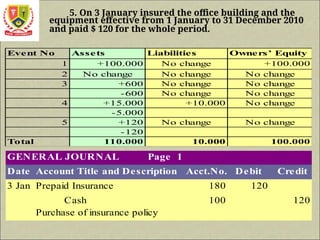
5. On 3 January insured the office building and the
equipment effective from 1 January to 31 December 2010
and paid $ 120 for the whole period.
Event No Assets Liabilities Owners’ Equity
1 +100.000 No change +100.000
2 No change No change No change
3 +600 No change No change
-600 No change No change
4 +15.000 +10.000 No change
-5.000
5 +120 No change No change
-120
Total 110.000 10.000 100.000
GENERAL JOURNAL Page 1
Date Account Title and Description Acct.No. Debit Credit
3 Jan 2004
Prepaid Insurance 180 120
Cash 100 120
Purchase of insurance policy
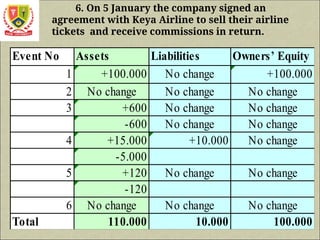
6. On 5 January the company signed an
agreement with Keya Airline to sell their airline
tickets and receive commissions in return.
Event No Assets Liabilities Owners’ Equity
1 +100.000 No change +100.000
2 No change No change No change
3 +600 No change No change
-600 No change No change
4 +15.000 +10.000 No change
-5.000
5 +120 No change No change
-120
6 No change No change No change
Total 110.000 10.000 100.000
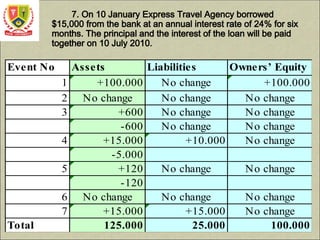
7. On 10 January Express Travel Agency borrowed
$15,000 from the bank at an annual interest rate of 24% for six
months. The principal and the interest of the loan will be paid
together on 10 July 2010.
Event No Assets Liabilities Owners’ Equity
1 +100.000 No change +100.000
2 No change No change No change
3 +600 No change No change
-600 No change No change
4 +15.000 +10.000 No change
-5.000
5 +120 No change No change
-120
6 No change No change No change
7 +15.000 +15.000 No change
Total 125.000 25.000 100.000
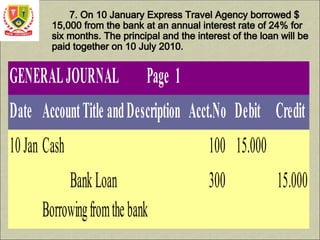
7. On 10 January Express Travel Agency borrowed $
15,000 from the bank at an annual interest rate of 24% for
six months. The principal and the interest of the loan will be
paid together on 10 July 2010.
GENERALJOURNAL Page 1
Date AccountTitle andDescription Acct.No. Debit Credit
10Jan2004
Cash 100 15.000
BankLoan 300 15.000
Borrowingfromthebank
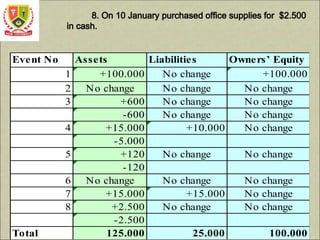
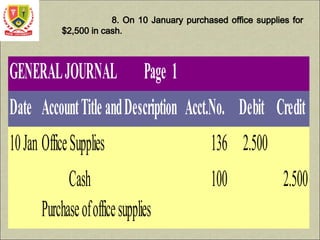
8. On 10 January purchased office supplies for $2.500
in cash.
Event No Assets Liabilities Owners’ Equity
1 +100.000 No change +100.000
2 No change No change No change
3 +600 No change No change
-600 No change No change
4 +15.000 +10.000 No change
-5.000
5 +120 No change No change
-120
6 No change No change No change
7 +15.000 +15.000 No change
8 +2.500 No change No change
-2.500
Total 125.000 25.000 100.000
8. On 10 January purchased office supplies for
$2,500 in cash.
GENERALJOURNAL Page 1
Date AccountTitleandDescription Acct.No. Debit Credit
10Jan2004
OfficeSupplies 136 2.500
Cash 100 2.500
Purchaseofofficesupplies
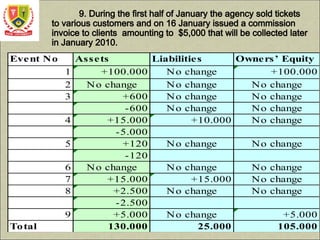
9. During the first half of January the agency sold tickets
to various customers and on 16 January issued a commission
invoice to clients amounting to $5,000 that will be collected later
in January 2010.
Event No Assets Liabilities Owners’ Equity
1 +100.000 No change +100.000
2 No change No change No change
3 +600 No change No change
-600 No change No change
4 +15.000 +10.000 No change
-5.000
5 +120 No change No change
-120
6 No change No change No change
7 +15.000 +15.000 No change
8 +2.500 No change No change
-2.500
9 +5.000 No change +5.000
Total 130.000 25.000 105.000
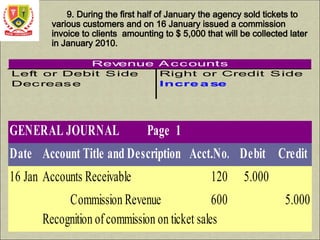
9. During the first half of January the agency sold tickets to
various customers and on 16 January issued a commission
invoice to clients amounting to $ 5,000 that will be collected later
in January 2010.
Left or Debit Side Right or Credit Side
Decrease Incre a se
Revenue A cc ounts
GENERAL JOURNAL Page 1
Date Account Title and Description Acct.No. Debit Credit
16 Jan 2004
Accounts Receivable 120 5.000
Commission Revenue 600 5.000
Recognition ofcommission on ticket sales
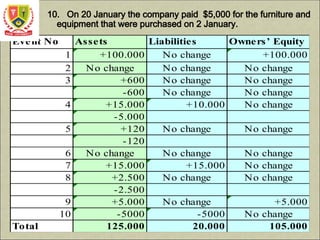
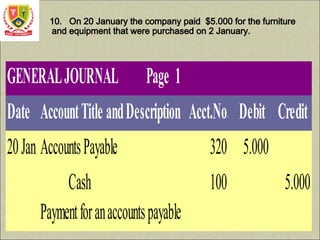
10. On 20 January the company paid $5,000 for the furniture and
equipment that were purchased on 2 January.
Event No Assets Liabilities Owners’ Equity
1 +100.000 No change +100.000
2 No change No change No change
3 +600 No change No change
-600 No change No change
4 +15.000 +10.000 No change
-5.000
5 +120 No change No change
-120
6 No change No change No change
7 +15.000 +15.000 No change
8 +2.500 No change No change
-2.500
9 +5.000 No change +5.000
10 -5000 -5000 No change
Total 125.000 20.000 105.000
10. On 20 January the company paid $5.000 for the furniture
and equipment that were purchased on 2 January.
GENERALJOURNAL Page 1
Date AccountTitle andDescription Acct.No. Debit Credit
20Jan2004
AccountsPayable 320 5.000
Cash 100 5.000
Paymentforanaccountspayable
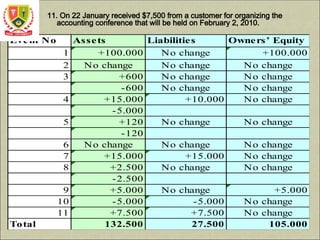
11. On 22 January received $7,500 from a customer for organizing the
accounting conference that will be held on February 2, 2010.
Event No Assets Liabilities Owners’ Equity
1 +100.000 No change +100.000
2 No change No change No change
3 +600 No change No change
-600 No change No change
4 +15.000 +10.000 No change
-5.000
5 +120 No change No change
-120
6 No change No change No change
7 +15.000 +15.000 No change
8 +2.500 No change No change
-2.500
9 +5.000 No change +5.000
10 -5.000 -5.000 No change
11 +7.500 +7.500 No change
Total 132.500 27.500 105.000
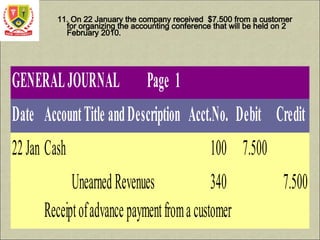
11. On 22 January the company received $7.500 from a customer
for organizing the accounting conference that will be held on 2
February 2010.
GENERALJOURNAL Page 1
Date AccountTitle andDescription Acct.No. Debit Credit
22Jan2004
Cash 100 7.500
UnearnedRevenues 340 7.500
Receiptofadvancepaymentfromacustomer
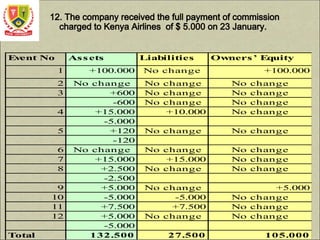
12. The company received the full payment of commission
charged to Kenya Airlines of $ 5.000 on 23 January.
E
vent No Assets Liabilities Owners’ E
quity
1 +100.000 No change +100.000
2 No change No change No change
3 +600 No change No change
-600 No change No change
4 +15.000 +10.000 No change
-5.000
5 +120 No change No change
-120
6 No change No change No change
7 +15.000 +15.000 No change
8 +2.500 No change No change
-2.500
9 +5.000 No change +5.000
10 -5.000 -5.000 No change
11 +7.500 +7.500 No change
12 +5.000 No change No change
-5.000
Total 132.500 27.500 105.000
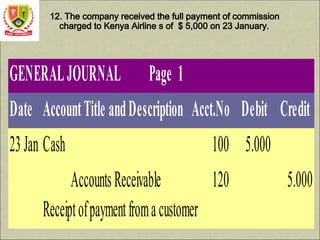
12. The company received the full payment of commission
charged to Kenya Airline s of $ 5,000 on 23 January.
GENERALJOURNAL Page 1
Date AccountTitle andDescription Acct.No. Debit Credit
23Jan2004
Cash 100 5.000
AccountsReceivable 120 5.000
Receiptofpaymentfromacustomer
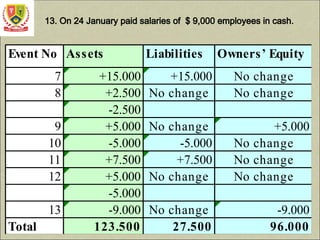
13. On 24 January paid salaries of $ 9,000 employees in cash.
Event No Assets Liabilities Owners’ Equity
7 +15.000 +15.000 No change
8 +2.500 No change No change
-2.500
9 +5.000 No change +5.000
10 -5.000 -5.000 No change
11 +7.500 +7.500 No change
12 +5.000 No change No change
-5.000
13 -9.000 No change -9.000
Total 123.500 27.500 96.000
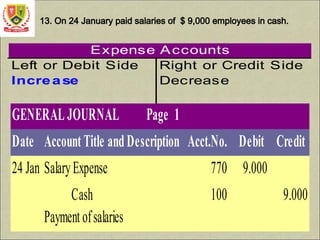
13. On 24 January paid salaries of $ 9,000 employees in cash.
Left or Debit Side Right or Credit Side
Increase Decrease
Expense Accounts
GENERAL JOURNAL Page 1
Date Account Title andDescription Acct.No. Debit Credit
24 Jan2004
SalaryExpense 770 9.000
Cash 100 9.000
Payment ofsalaries
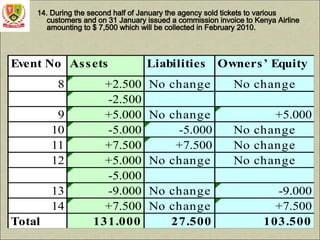
14. During the second half of January the agency sold tickets to various
customers and on 31 January issued a commission invoice to Kenya Airline
amounting to $ 7,500 which will be collected in February 2010.
Event No Assets Liabilities Owners’ Equity
8 +2.500 No change No change
-2.500
9 +5.000 No change +5.000
10 -5.000 -5.000 No change
11 +7.500 +7.500 No change
12 +5.000 No change No change
-5.000
13 -9.000 No change -9.000
14 +7.500 No change +7.500
Total 131.000 27.500 103.500
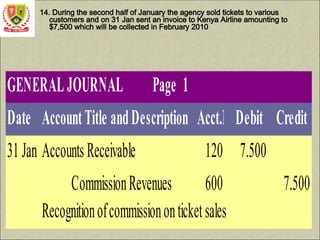
14. During the second half of January the agency sold tickets to various
customers and on 31 Jan sent an invoice to Kenya Airline amounting to
$7,500 which will be collected in February 2010
GENERALJOURNAL Page 1
Date AccountTitle andDescription Acct.No.
Debit Credit
31 Jan2004
AccountsReceivable 120 7.500
CommissionRevenues 600 7.500
Recognitionofcommissiononticketsales
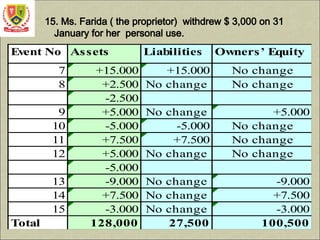
15. Ms. Farida ( the proprietor) withdrew $ 3,000 on 31
January for her personal use.
Event No Assets Liabilities Owners’ Equity
7 +15.000 +15.000 No change
8 +2.500 No change No change
-2.500
9 +5.000 No change +5.000
10 -5.000 -5.000 No change
11 +7.500 +7.500 No change
12 +5.000 No change No change
-5.000
13 -9.000 No change -9.000
14 +7.500 No change +7.500
15 -3.000 No change -3.000
Total 128,000 27,500 100,500
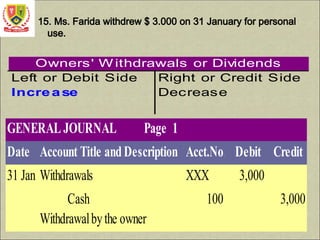
15. Ms. Farida withdrew $ 3.000 on 31 January for personal
use.
Left or Debit Side Right or Credit Side
Increase Decrease
Owners' W ithdrawals or Dividends
GENERAL JOURNAL Page 1
Date Account Title andDescription Acct.No. Debit Credit
31 Jan2004
Withdrawals XXX 3,000
Cash 100 3,000
Withdrawalbythe owner
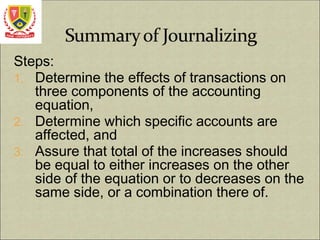
Steps:
1. Determine the effects of transactions on
three components of the accounting
equation,
2. Determine which specific accounts are
affected, and
3. Assure that total of the increases should
be equal to either increases on the other
side of the equation or to decreases on the
same side, or a combination there of.
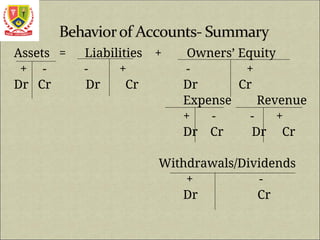
Assets = Liabilities + Owners’ Equity
+ - - + - +
Dr Cr Dr Cr Dr Cr
Expense Revenue
+ - - +
Dr Cr Dr Cr
Withdrawals/Dividends
+ -
Dr Cr
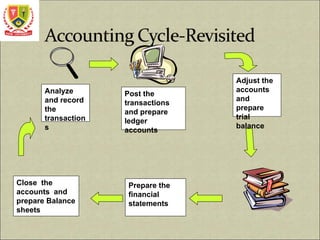
Analyze
and record
the
transaction
s
Post the
transactions
and prepare
ledger
accounts
Adjust the
accounts
and
prepare
trial
balance
Close the
accounts and
prepare Balance
sheets
Prepare the
financial
statements
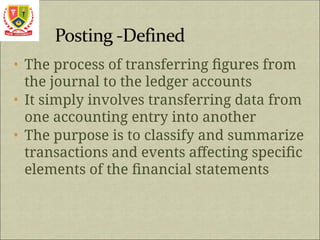
• The process of transferring figures from
the journal to the ledger accounts
• It simply involves transferring data from
one accounting entry into another
• The purpose is to classify and summarize
transactions and events affecting specific
elements of the financial statements
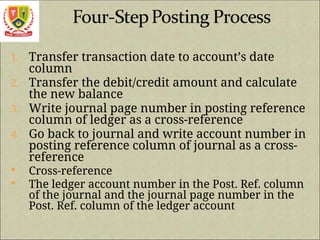
1. Transfer transaction date to account’s date
column
2. Transfer the debit/credit amount and calculate
the new balance
3. Write journal page number in posting reference
column of ledger as a cross-reference
4. Go back to journal and write account number in
posting reference column of journal as a cross-
reference
 Cross-reference
 The ledger account number in the Post. Ref. column
of the journal and the journal page number in the
Post. Ref. column of the ledger account
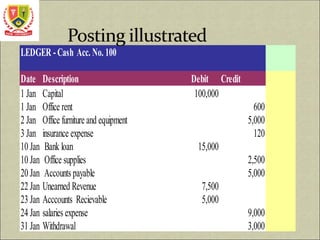
LEDGER - Cash Acc. No. 100
Date Description Debit Credit
1 Jan Capital 100,000
1 Jan Office rent 600
2 Jan Office furniture and equipment 5,000
3 Jan insurance expense 120
10 Jan Bank loan 15,000
10 Jan Office supplies 2,500
20 Jan Accounts payable 5,000
22 Jan Unearned Revenue 7,500
23 Jan Acccounts Recievable 5,000
24 Jan salaries expense 9,000
31 Jan Withdrawal 3,000
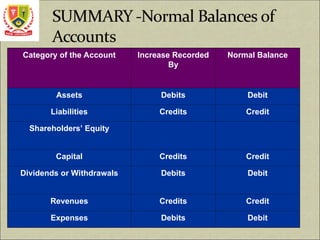
Category of the Account Increase Recorded
By
Normal Balance
Assets Debits Debit
Liabilities Credits Credit
Shareholders’ Equity
Capital Credits Credit
Dividends or Withdrawals Debits Debit
Revenues Credits Credit
Expenses Debits Debit
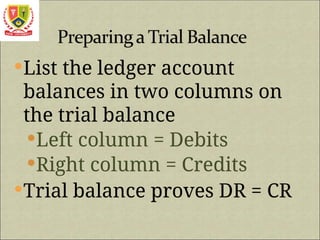
List the ledger account
balances in two columns on
the trial balance
Left column = Debits
Right column = Credits
Trial balance proves DR = CR
The Balancing of Accounts, The Trial Balance &
Financial statements
Introduction:
Before transferring the relevant balances at the
year end to the financial statements, it is usual
to test the accuracy of the double entry
bookkeeping records by preparing a trial
balance. This is done by taking all the balances
on every account. Due to the nature of double
entry, the total of the debit balances will be
exactly equal to the total of the credit balances.
The Balancing of Accounts & The Trial
Balance
• Question: Once you have closed all the accounts, what
would do?
• Answer: Prepare a Trial Balance
• Question: What is a Trial Balance then? What is it for? How does it
look like?
• Answer: A Trial Balance is a list of nominal ledger account
and their balances at a given date. It is usually prepared
on the last day of the accounting period. It consists of a Debit
and a Credit balance.
• Its purposes:
• (1) It is prepared to check that the total of debit balances is
the same as the total of credit balances and offer
reassurance that the double entry recording from day books
has been done correctly.
• (2) For preparation of statement of income and the
statement of financial position
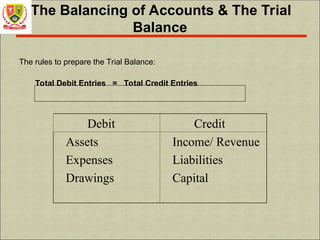
The Balancing of Accounts & The Trial
Balance
The rules to prepare the Trial Balance:
Total Debit Entries = Total Credit Entries
Debit Credit
Assets
Expenses
Drawings
Income/ Revenue
Liabilities
Capital
The Balancing of Accounts & The Trial
Balance
Steps to preparing the Trial Balance:
1) Balance/cast ALL the ledger accounts in the books.
2) List all the Debit balances on the debit side and add
them up.
3) List all the Credit balances on the credit side and add
them up.
4) Ideally the trial balance should balance after step 3
The Balancing of Accounts & The Trial
Balance
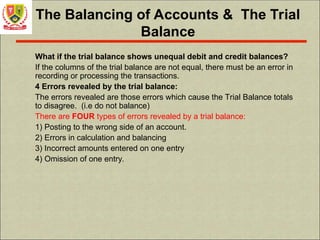
What if the trial balance shows unequal debit and credit balances?
If the columns of the trial balance are not equal, there must be an error in
recording or processing the transactions.
4 Errors revealed by the trial balance:
The errors revealed are those errors which cause the Trial Balance totals
to disagree. (i.e do not balance)
There are FOUR types of errors revealed by a trial balance:
1) Posting to the wrong side of an account.
2) Errors in calculation and balancing
3) Incorrect amounts entered on one entry
4) Omission of one entry.
The Balancing of Accounts & The Trial
Balance
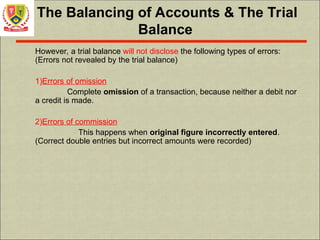
However, a trial balance will not disclose the following types of errors:
(Errors not revealed by the trial balance)
1)Errors of omission
Complete omission of a transaction, because neither a debit nor
a credit is made.
2)Errors of commission
This happens when original figure incorrectly entered.
(Correct double entries but incorrect amounts were recorded)
The Balancing of Accounts & The Trial
Balance
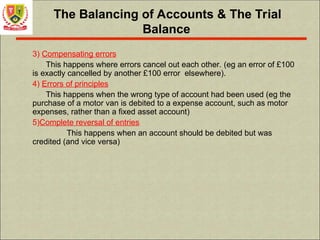
3) Compensating errors
This happens where errors cancel out each other. (eg an error of £100
is exactly cancelled by another £100 error elsewhere).
4) Errors of principles
This happens when the wrong type of account had been used (eg the
purchase of a motor van is debited to a expense account, such as motor
expenses, rather than a fixed asset account)
5)Complete reversal of entries
This happens when an account should be debited but was
credited (and vice versa)
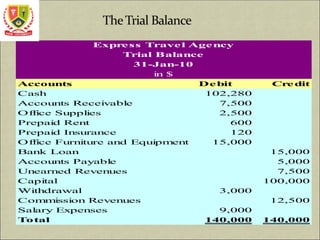
Accounts Debit Credit
Cash 102,280
Accounts Receivable 7,500
Office Supplies 2,500
Prepaid Rent 600
Prepaid Insurance 120
Office Furniture and Equipment 15,000
Bank Loan 15,000
Accounts Payable 5,000
Unearned Revenues 7,500
Capital 100,000
Withdrawal 3,000
Commission Revenues 12,500
Salary Expenses 9,000
Total 140,000 140,000
Express Travel Agency
Trial Balance
31-Jan-10
in $
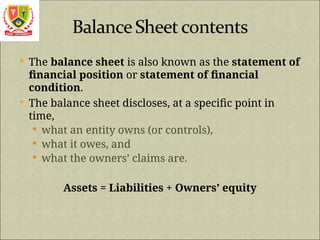
 The balance sheet is also known as the statement of
financial position or statement of financial
condition.
 The balance sheet discloses, at a specific point in
time,
 what an entity owns (or controls),
 what it owes, and
 what the owners’ claims are.
Assets = Liabilities + Owners’ equity
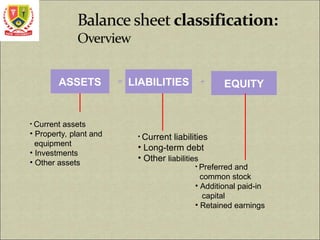
• Current assets
• Property, plant and
equipment
• Investments
• Other assets
• Current liabilities
• Long-term debt
• Other liabilities
• Preferred and
common stock
• Additional paid-in
capital
• Retained earnings
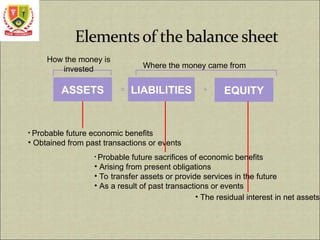
ASSETS LIABILITIES EQUITY
= +
• Probable future economic benefits
• Obtained from past transactions or events
• Probable future sacrifices of economic benefits
• Arising from present obligations
• To transfer assets or provide services in the future
• As a result of past transactions or events
• The residual interest in net assets.
ASSETS LIABILITIES EQUITY
= +
How the money is
invested Where the money came from
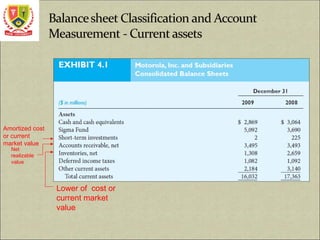
Amortized cost
or current
market value
Net
realizable
value
Lower of cost or
current market
value
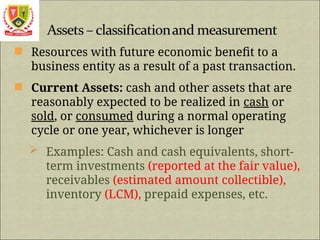
 Resources with future economic benefit to a
business entity as a result of a past transaction.
 Current Assets: cash and other assets that are
reasonably expected to be realized in cash or
sold, or consumed during a normal operating
cycle or one year, whichever is longer
 Examples: Cash and cash equivalents, short-
term investments (reported at the fair value),
receivables (estimated amount collectible),
inventory (LCM), prepaid expenses, etc.
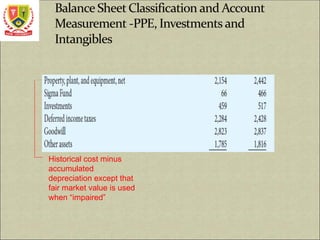
Historical cost minus
accumulated
depreciation except that
fair market value is used
when “impaired”
 Long-term Investments: Comprise of the
following
 Securities (i.e., bonds, stock, long-term notes)
 Fixed assets (i.e., land, building)
 Special funds (i.e., pension fund, bond
sinking fund)
 Nonconsolidated subsidiaries or affiliated
companies
 Property, Plant, Equipment (i.e.,
building, Land, Machinery and
equipment, capital leases): assets used in
firms’ operations and meet the following
criteria:
1. Economic life > 1 year;
2. Acquired for use in operation;
3. Not for resale to customers;
4. $ is material. (materiality)
Depreciation will be applied except for
land.
 Intangible Assets: assets with no
physical substance but have value
based on rights or privileges that
belong to the owner (i.e., goodwill,
patents, franchises, trademarks,…).
 Amortization for limited life
intangibles (i.e., patents, franchises)
and impairment test for indefinite-
life intangibles (i.e., goodwill).
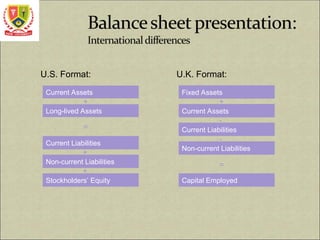
Current Assets
Long-lived Assets
Current Liabilities
Non-current Liabilities
Stockholders’ Equity
Fixed Assets
Current Assets
Current Liabilities
Non-current Liabilities
Capital Employed
U.S. Format: U.K. Format:
+
=
+
+
+
-
-
=
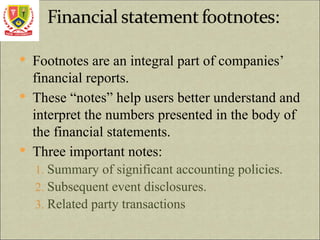
 Footnotes are an integral part of companies’
financial reports.
 These “notes” help users better understand and
interpret the numbers presented in the body of
the financial statements.
 Three important notes:
1. Summary of significant accounting policies.
2. Subsequent event disclosures.
3. Related party transactions
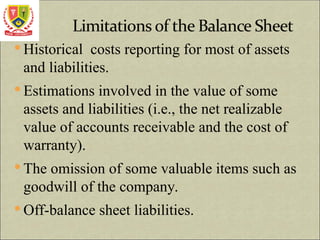
 Historical costs reporting for most of assets
and liabilities.
 Estimations involved in the value of some
assets and liabilities (i.e., the net realizable
value of accounts receivable and the cost of
warranty).
 The omission of some valuable items such as
goodwill of the company.
 Off-balance sheet liabilities.
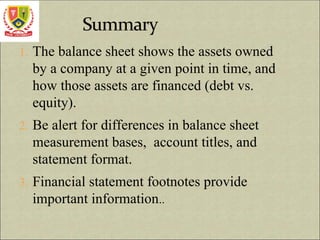
1. The balance sheet shows the assets owned
by a company at a given point in time, and
how those assets are financed (debt vs.
equity).
2. Be alert for differences in balance sheet
measurement bases, account titles, and
statement format.
3. Financial statement footnotes provide
important information..
 A method of accounting for the impact that rising or
falling prices have on international companies exposed to
various inflation rates.
 Inflation accounting is a type of accounting that takes into
account the effects of inflation on a company’s financial
statements. It adjusts the company’s financial statements
to reflect changes in the purchasing power of the currency,
which is necessary because inflation can distort the
accuracy of financial reporting.
 There are two main methods used in inflation accounting—
current purchasing power (CPP) and current cost accounting
(CCA).
1. Current Purchasing Power (CPP)
 Under the CPP method, monetary items and nonmonetary
items are separated. The accounting adjustment for monetary
items is subject to the recording of a net gain or loss.
Nonmonetary items (those that do not carry a fixed value) are
updated into figures with an inflation conversion factor
equivalent to the consumer price index (CPI) at the end of the
period divided by CPI at the date of transaction.
2. Current Cost Accounting (CCA)
The CCA approach values assets at their fair
market value (FMV) rather than historical cost, the
price incurred during the purchase of the fixed
asset. Under the CCA method, both monetary and
nonmonetary items are restated to current values.
 The percent inflation rate is calculated as the CPI
at the end of the period divided by the CPI at the
beginning of the period multiplied by 100.
 For example, let's assume you wanted to calculate
the inflation rate between January 2006 and
January 2022. According to the Consumer Price
Index table, January 2022 has a CPI of 281.148
and January 2006 has a CPI of 198.300. The
formula to calculate the percent inflation rate is
therefore 281.148 / 198.300 × 100 = 141.77%.
 Human Resource Accounting tracks and manages employees’ costs and
values, including performance, compensation, benefits, and training. HR
professionals use various tools to track and analyze data, such as
employee surveys, performance reviews, and compensation and benefits
reports. In addition to tracking employee performance, HR professionals
also need to track the performance of the organization as a whole.
 Human Resource Accounting is necessary for any organization that
wants to know how well its employees are performing and how to
improve more. In addition to tracking employee performance, HR
professionals also need to track the success of recruitment and retention
efforts as well as the success of initiatives that improve employee
morale and satisfaction.

• Human Resource Management: It involves everything from hiring and firing
to training and development.
• Employee Benefits: This includes things like health insurance and
retirement benefits.
• Payroll: Includes things like payroll taxes, employee overtime costs, and
other expenses related to compensation and payroll processes
• Compensation: Things like salary, bonuses, stock options, and other forms
of payment that employees receive are included.
• Human Capital: Includes things like work hours, absenteeism, turnover
rates, etc.
• Records Management: This involves everything from keeping track records
to tracking equipment usage.
• Benefits Administration: This involves keeping track of benefits provided
by employers, such as vacation days or paid time off.
• Recruitment & Selection - This involves recruiting new employees as well
as screening job applicants to fit into the organisation’s culture.
 Human Resource Accounting definition refers to a system of
accounting that tracks the financial, human, and non-financial
aspects of an organisation’s employees. It is used to measure the
effectiveness of an organisation’s human resources strategy and to
evaluate the performance of employees. A Human Resource
Accounting system should include metrics that measure employee
engagement, training effectiveness, and productivity. It should also
track employee turnover and absenteeism. The primary purpose of
a Human Resource Accounting system is to provide an accurate
and reliable record of employee performance. It should also be
used to measure the effectiveness of employee training programs
and evaluate employees' performance.
• Identifying and understanding the needs of the
organisation and its employees
• Identifying and developing the appropriate human
resources
• Implementing effective recruitment, selection, training,
development, and compensation programs
• Maintaining an accurate and up-to-date HR system
• Ensuring that all employees are treated equally and fairly
• Maintaining an accurate and up-to-date payroll system
• Historic Expense: Historical costs are based on actual human resources
expenses. There are two types of such expenses: purchase expenses and
learning expenses. Training and development expenses are included in the
acquisition price. Although this approach is easy to apply, it does not show
the true value of human assets.
• Replacement Price: Unlike historical price, which considers the actual price
sustained by workers, substitute expense considers the nationwide cost of
replacing today's employees.
In order to calculate the replacement price, various kinds of expenditures are
considered, both in terms of procurement and price determination. The
substitute expense is usually much higher than the historic expense.
• Requirement Expense: Rather than using historic or replacement prices for valuing
human assets, some businesses use basic prices just as they do for physical and
monetary assets. Based on their hierarchical placements, employees of a company are
categorised into different groups for utilising common costs. Every classification of a
staff member is dealt with in terms of standard expenses, and their value is determined.
• Present value of future earnings: In this method, the value of future earnings for a
number of individuals is approximated as much as their retired life. It is marked down at
a predetermined price to acquire the here-and-now value of such revenues. Today's
worth of future revenues is used when it comes to financial assets, but this approach
does not result in an appropriate measurement of human resources.
• Procurement Cost Approach: A key aspect of this method is the capitalisation of
historical costs. The company incurs these costs to improve its business performance.
The expenses incurred in employment are capitalised and written off over a period of
time. The unamortised portion of the cost has to be written off against the revenue and
loss account of the particular year.
• Replacement Cost Approach: Under this technique, one considers how
much it costs to replace existing sources as well as, thus, how much it costs
to replace a company's current resources. The method also stands for a
current market problem. This approach is often repetitive unless the
company wishes to replace its current resources. This, too, is a tough
approach as frequently the substitute is not identical.
• Present Value of Future Profits Method: The capitalisation of wage
technique is another method to capitalise wage income. It involves
estimating future earnings up to the employee's or worker's retirement age
and marking the worth accordingly to acquire the present value.
• Anticipated feasible worth: The above techniques reviewed thus far are based
on price consideration. For that reason, these methods might give information for
theoretical objectives but do not mirror the real worth of human assets compared to
these techniques.
• Economic Value Method: The economist refers to an asset's current market
value as the asset's 'value.' This approach has a number of strengths, but it
requires a certain amount of work. First, the future benefits and an appropriate
interest (discount) rate are estimated. Then, the present value of future benefits is
calculated.
• Competitive Bidding Method: This is also known as the opportunity cost method.
Opportunity cost is the tangible benefit of choosing an alternative path.
Once HRA has been audited, each bidder's total amount of capital expended is
recorded. The return on investment is determined by comparing the dollar amount
bid with the amount spent.
 Assists in Determining ROI
 Inspires Employees
 Boosts Process of Choice Making
 Sign of Health of the organisation
 Assist in Figuring Out the Requirement of
Recruitment
 Ascertains Unfavorable Results of the Programs
 Facilitates Organising and Executing HR Plans
 Accounting standards may be defined as codified
generally accepted accounting principles.
According to Kohler, "Accounting standard is a
mode of conduct imposed on the accountants by
custom, Law and a professional body".
 (1) Accounting standards are the norms of accounting
policies and practices to be adopted by the accountants.
 (2) Accounting standards make accounting procedures
universally acceptable by removing the diverse
accounting practices and policies.
 (3) Accounting standards serve as guides for solving one
or more accounting problems.
 (4) Accounting standards provide the basis upon which
financial statements are prepared.
 (6) Accounting standards are codified principles to be
followed by public accountants.
 (1) Main function of ASB is to formulate accounting
standards.
 (2) While formulation of standards ASB has to consider
applicable laws, customs, social and business environment.
 (3) ASB has to give due consideration to IAS issued by IASC
from time to time to develop own standards in light of
conditions and practices being followed in India.
 (4) ASB has to persuade the accounting professionals and
preparers of financial statements to adopt them.
 (5) ASB has to issue guidance notes on accounting standards.
 (6) To review all accounting standards from time to time.
 IFRS stands for International Financial Reporting
Standards. It is a set of accounting standards that
determine how financial events are going to be
reported in the financial statements of the company.
 IFRS or International Financial Reporting Standards
refers to a globally-accepted set of accounting and
financial reporting guidelines for preparing and
presenting financial statements. It ensures uniformity in
accounting practice that makes financial records
comparable across different reporting entities
worldwide.
 International Financial Reporting
Standards represents an international financial
reporting system and serves multiple purposes. Some
of its significant goals in the financial world are as
follows:
 #1- Create a Common Law
 One of its key objectives is to ensure that common law
is introduced and adopted by as many jurisdictions and
countries as possible to bring everyone on the same
page. It ensures that everyone follows the same
guidelines and adopts a universal way of reporting
business activities.
 #2 – Aid analysis
 It helps stakeholders in analyzing a company’s performance and
interpreting its financial position. For example, corporations and
governments use these standards to make credible financial
statements. It aids in categorizing and reporting financial data
with accuracy and consistency. Such financial records promote
better comprehension and help decision-making.
 #3 – Assist in preparation of reliable financial records
 By following International Financial Reporting Standards, the
data presented in the books of accounts are likely to be accurate,
reliable, uniform, and appropriate within the bounds of its rules.
The high quality of financial records assists investors in making
informed economic decisions.
 #4 – Ensure comparability, transparency, and
flexibility in reporting
 The consistency in reporting accounting practices
enables easy comparison of the financial records
of compliant companies across nations. Such
comparisons allow investors to identify risks and
opportunities before investing. As a result, it
promotes foreign trade and investment.
Thank you

FRSA Unit 1.ppt for studying accountings

  • 1.
     Faculty Name:Dr. Anupama Pandey NIMS UNIVERSITY NIMS School of Business
  • 2.
    • Introduction toFinancial, Cost and Management Accounting • Generally accepted Accounting principles • Conventions and Concepts • Balance sheet and Profit and Loss Account and related concepts • Introduction to Inflation Accounting • Introduction to Human Resource Accounting • Accounting Standards • Scope and functions of Accounting Standards Boards • International Financial Reporting System
  • 3.
    The American Instituteof Certified Public Accountants (AICPA) had defined accounting as the “art of recording, classifying, and summarizing in a significant manner and in terms of money, transactions and events which are, in part at least, of financial character, and interpreting the results thereof”.
  • 4.
     Financial Accounting– Financial accounting is that branch of accounting that involves identifying, measuring, recording, classifying, and summarising the business transactions, i.e. it involves the steps from identifying, recording transactions to summarisation, and communicating the financial data.  Cost Accounting – Cost accounting is referred to as a form of managerial accounting that is used by businesses to classify, summarise and analyse the different costs with the purpose of cost control and cost reduction and thereby helping management in making better decisions.  Management Accounting – Management accounting refers to that branch of accounting that is concerned with presenting the accounting information in such a way that helps the management in planning and controlling the operations of a business and in decision-making.
  • 5.
     Generally AcceptedAccounting Principles or GAAP is a defined set of rules and procedures that needs to be followed in order to create financial statements, which are consistent with the industry standards.  GAAP helps in ensuring that financial reporting is transparent and uniform across industries.
  • 6.
     Conservatism  Disclosure Consistency  Materiality
  • 7.
     Accounting Periodconcept  Dual Aspect concept  Money measurement concept  Realisation concept  Separate entity concept/Business entity concept  Cost concept  Going concern concept  Objective evidence concept  Matching concept  Accrual concept
  • 8.
     Meaning ofAccount : Transaction of a similar nature when recorded at one place is known as accounts. In other words, a summary of relevant business transactions and events recorded at one place relating to a particular head is called an account and the entire group of accounts is called a ledger.  Types of Accounts: It can be classified into 3 types-  1) Personal Accounts  2) Real Accounts  3) Nominal Accounts
  • 9.
    1. Personal Account:It can be classified into 3 types: (i) Real persons account (ii) Artificial persons account (iii) Representatives persons account Rule: Debit- The Receiver  Credit- The Giver 2. Real Account: Real accounts are of 2 types: •(i) Tangible Real accounts •(ii) Intangible Real accounts Rule: Debit-What comes in  Credit-What goes out
  • 10.
     3) NominalAccount:  It includes all expenses, losses, incomes and gains.  Rule: Debit- Expenses & losses  Credit- Income & Gains  Rules of Journalising: The method of recording transaction in journal on the basis of rules of double entry system is called journalising.
  • 11.
     For anew business, it begin by setting up ledger accounts.  For an established business, begin with account balances carried over from the previous period.
  • 12.
    1. Analyze sourcedocuments & record business transactions in a journal 2. Post journal entries to the ledger accounts 3. Prepare unadjusted trial balance (TB) 4. Journalize and post end of period adjustments (EOPA) 5. Prepare adjusted Trial Balance 6. Prepare /Create financial statements & reports from data in adjusted TB 7. Journalize and post the closing entries 8. Prepare the post-closing trial balance 9. Prepare and post reversing entries
  • 13.
    Analyze Business Transactions. Journalize transactions in the journal. Postentries to the accounts in the ledger. Prepare unadjusted trial balance. Prepare financial statements. Post-closing trial balance Journalize and post closing entries Journalize and post adjusting entries Prepare adjusted trial balance.
  • 14.
     Business transactionis an economic event that causes a change in the financial position  Financial Position:  What the entity controls  How the entity controls them (claims)
  • 15.
    ASSETS = EQUITIES ASSETS= LIABILITIES + OWNERS' EQUITY
  • 16.
     Recall theBasic Accounting Equation:  Assets = Liabilities + Shareholders’ Equity  Implications:  Total Asset=Claims against the assets  Therefore :  If assets increase : either Liabilities and/or Shareholders’ should also increase and vice versa  For example: borrow cash, cash (asset) will increase and Liabilities will increase  when it is paid back: cash (asset) will decrease and liabilities will decrease
  • 17.
     An ACCOUNT(ledger Account) : is an accounting device used to record changes in a of a specific asset, liability or owners’ equity item  Has 3 elements: title, debit side and credit side (also called the “T-Account”)  Changes in the accounts are entered manually into a book called a ledger or computerized ledger  Basic forms of book ledgers: the two- column account format, and the running format account  Chart of accounts
  • 18.
     Ledger Account Complete listing of business transactions for an individual account  Where you look if you want to find the balance of any given account  General Ledger  A loose-leaf book or computer file containing all the Ledger Accounts  Each account from the chart of accounts has its own ledger account in the general ledger  Complete listing of all account tittles and account names/codes used by an entity is called the chart of accounts - It is like a table of content in a book
  • 19.
    Date Item Post.Ref. * Debit Date Item Posting Reference Credit Account No: Account Left-hand or Right-hand or Debit Side Credit Side Account Name Account No: Two-Column Account T-Account form that depicts the two-column account:
  • 20.
    Assets = Liabilities+ Shareholders’ Equity + + + So Assets increase on the left hand or debit side then they decrease on the credit side Assets + - debit credit
  • 21.
    Liabilities and Owners’Equity accounts increase on the credit side, decrease on the debit side Liabilities or Owners’ Equity Accounts - + debit credit
  • 22.
    Double entry systemstates that every transactions affects at least two accounts. Therefore • If an asset account increases (decreases), because of duality concept there must be a corresponding: 1. increase(decrease) in a specific liability account 2. or a decrease(increase) in a another asset account 3. or an increase(decrease) in owners' equity account.
  • 23.
     The bookin which a person enters the original record of a business transaction  Commonly referred to as a book of original entry  Chronological listing of all the business transactions for the company  Each listing records the debits and credits associated with that business transaction  A book or a location on a hard drive where all business transactions are listed  Like a diary
  • 24.
    1. Date 2. Atleast one debit entry  Debit account, use exact account title, do not indent titles 3. At least one credit entry  Credit account, use exact account title, indent titles 4. An explanation of the transaction:  Check number  Invoice number  Accounts receivable customer name  Many other elements OR details as appropriate…  Remember: the accountant must leave a good audit trail so that users of accounting information can understand what occurred with each transaction DR=CR DR=CR
  • 25.
    1. On Jan1 2010 Ms.Farida invested $100,000 at the inception of the business, Express Travel Agency Event No Assets Liabilities Owners’ Equity 1 +100.000 No change +100.000 Total 100.000 0 100.000 GENERAL JOURNAL Page 1 Date Account Title and Description Acct.No. Debit Credit 1 Jan 2004 Cash 100 100.000 Capital 500 100.000 Investment by the shareholders
  • 26.
    2. On 1January employed a full time secretary and a sales representative. EventNo Assets Liabilities Owners’Equity 1 +100.000 Nochange +100.000 2 Nochange Nochange Nochange Total 100.000 0 100.000
  • 27.
    3. On 1January rented an office building and paid 3 months rent of $600. Event No Assets Liabilities Owners’ Equity 1 +100.000 No change +100.000 2 No change No change No change 3 +600 No change No change -600 No change No change Total 100.000 0 100.000 GENERAL JOURNAL Page 1 Date Account Title and Description Acct.No. Debit Credit 1 Jan 2004 Prepaid Rent 180 600 Cash 100 600 Payment of 3 months of rent in advance
  • 28.
    4. On 2January office furniture and equipment is purchased for $ 15,000 , for which $ 5,000 is paid in cash and the rest would be paid later in January and February 2010. Event No Assets Liabilities Owners’ Equity 1 +100.000 No change +100.000 2 No change No change No change 3 +600 No change No change -600 No change No change 4 +15.000 +10.000 No change -5.000 Total 110.000 10.000 100.000 GENERAL JOURNAL Page 1 Date Account Title and Description Acct.No Debit Credit 2 Jan 2004 Furniture and Equipment 255 15.000 Cash 100 5.000 Accounts Payable 320 10000 Purchase of furniture and equipment
  • 29.
    5. On 3January insured the office building and the equipment effective from 1 January to 31 December 2010 and paid $ 120 for the whole period. Event No Assets Liabilities Owners’ Equity 1 +100.000 No change +100.000 2 No change No change No change 3 +600 No change No change -600 No change No change 4 +15.000 +10.000 No change -5.000 5 +120 No change No change -120 Total 110.000 10.000 100.000 GENERAL JOURNAL Page 1 Date Account Title and Description Acct.No. Debit Credit 3 Jan 2004 Prepaid Insurance 180 120 Cash 100 120 Purchase of insurance policy
  • 30.
    6. On 5January the company signed an agreement with Keya Airline to sell their airline tickets and receive commissions in return. Event No Assets Liabilities Owners’ Equity 1 +100.000 No change +100.000 2 No change No change No change 3 +600 No change No change -600 No change No change 4 +15.000 +10.000 No change -5.000 5 +120 No change No change -120 6 No change No change No change Total 110.000 10.000 100.000
  • 31.
    7. On 10January Express Travel Agency borrowed $15,000 from the bank at an annual interest rate of 24% for six months. The principal and the interest of the loan will be paid together on 10 July 2010. Event No Assets Liabilities Owners’ Equity 1 +100.000 No change +100.000 2 No change No change No change 3 +600 No change No change -600 No change No change 4 +15.000 +10.000 No change -5.000 5 +120 No change No change -120 6 No change No change No change 7 +15.000 +15.000 No change Total 125.000 25.000 100.000
  • 32.
    7. On 10January Express Travel Agency borrowed $ 15,000 from the bank at an annual interest rate of 24% for six months. The principal and the interest of the loan will be paid together on 10 July 2010. GENERALJOURNAL Page 1 Date AccountTitle andDescription Acct.No. Debit Credit 10Jan2004 Cash 100 15.000 BankLoan 300 15.000 Borrowingfromthebank
  • 33.
    8. On 10January purchased office supplies for $2.500 in cash. Event No Assets Liabilities Owners’ Equity 1 +100.000 No change +100.000 2 No change No change No change 3 +600 No change No change -600 No change No change 4 +15.000 +10.000 No change -5.000 5 +120 No change No change -120 6 No change No change No change 7 +15.000 +15.000 No change 8 +2.500 No change No change -2.500 Total 125.000 25.000 100.000
  • 34.
    8. On 10January purchased office supplies for $2,500 in cash. GENERALJOURNAL Page 1 Date AccountTitleandDescription Acct.No. Debit Credit 10Jan2004 OfficeSupplies 136 2.500 Cash 100 2.500 Purchaseofofficesupplies
  • 35.
    9. During thefirst half of January the agency sold tickets to various customers and on 16 January issued a commission invoice to clients amounting to $5,000 that will be collected later in January 2010. Event No Assets Liabilities Owners’ Equity 1 +100.000 No change +100.000 2 No change No change No change 3 +600 No change No change -600 No change No change 4 +15.000 +10.000 No change -5.000 5 +120 No change No change -120 6 No change No change No change 7 +15.000 +15.000 No change 8 +2.500 No change No change -2.500 9 +5.000 No change +5.000 Total 130.000 25.000 105.000
  • 36.
    9. During thefirst half of January the agency sold tickets to various customers and on 16 January issued a commission invoice to clients amounting to $ 5,000 that will be collected later in January 2010. Left or Debit Side Right or Credit Side Decrease Incre a se Revenue A cc ounts GENERAL JOURNAL Page 1 Date Account Title and Description Acct.No. Debit Credit 16 Jan 2004 Accounts Receivable 120 5.000 Commission Revenue 600 5.000 Recognition ofcommission on ticket sales
  • 37.
    10. On 20January the company paid $5,000 for the furniture and equipment that were purchased on 2 January. Event No Assets Liabilities Owners’ Equity 1 +100.000 No change +100.000 2 No change No change No change 3 +600 No change No change -600 No change No change 4 +15.000 +10.000 No change -5.000 5 +120 No change No change -120 6 No change No change No change 7 +15.000 +15.000 No change 8 +2.500 No change No change -2.500 9 +5.000 No change +5.000 10 -5000 -5000 No change Total 125.000 20.000 105.000
  • 38.
    10. On 20January the company paid $5.000 for the furniture and equipment that were purchased on 2 January. GENERALJOURNAL Page 1 Date AccountTitle andDescription Acct.No. Debit Credit 20Jan2004 AccountsPayable 320 5.000 Cash 100 5.000 Paymentforanaccountspayable
  • 39.
    11. On 22January received $7,500 from a customer for organizing the accounting conference that will be held on February 2, 2010. Event No Assets Liabilities Owners’ Equity 1 +100.000 No change +100.000 2 No change No change No change 3 +600 No change No change -600 No change No change 4 +15.000 +10.000 No change -5.000 5 +120 No change No change -120 6 No change No change No change 7 +15.000 +15.000 No change 8 +2.500 No change No change -2.500 9 +5.000 No change +5.000 10 -5.000 -5.000 No change 11 +7.500 +7.500 No change Total 132.500 27.500 105.000
  • 40.
    11. On 22January the company received $7.500 from a customer for organizing the accounting conference that will be held on 2 February 2010. GENERALJOURNAL Page 1 Date AccountTitle andDescription Acct.No. Debit Credit 22Jan2004 Cash 100 7.500 UnearnedRevenues 340 7.500 Receiptofadvancepaymentfromacustomer
  • 41.
    12. The companyreceived the full payment of commission charged to Kenya Airlines of $ 5.000 on 23 January. E vent No Assets Liabilities Owners’ E quity 1 +100.000 No change +100.000 2 No change No change No change 3 +600 No change No change -600 No change No change 4 +15.000 +10.000 No change -5.000 5 +120 No change No change -120 6 No change No change No change 7 +15.000 +15.000 No change 8 +2.500 No change No change -2.500 9 +5.000 No change +5.000 10 -5.000 -5.000 No change 11 +7.500 +7.500 No change 12 +5.000 No change No change -5.000 Total 132.500 27.500 105.000
  • 42.
    12. The companyreceived the full payment of commission charged to Kenya Airline s of $ 5,000 on 23 January. GENERALJOURNAL Page 1 Date AccountTitle andDescription Acct.No. Debit Credit 23Jan2004 Cash 100 5.000 AccountsReceivable 120 5.000 Receiptofpaymentfromacustomer
  • 43.
    13. On 24January paid salaries of $ 9,000 employees in cash. Event No Assets Liabilities Owners’ Equity 7 +15.000 +15.000 No change 8 +2.500 No change No change -2.500 9 +5.000 No change +5.000 10 -5.000 -5.000 No change 11 +7.500 +7.500 No change 12 +5.000 No change No change -5.000 13 -9.000 No change -9.000 Total 123.500 27.500 96.000
  • 44.
    13. On 24January paid salaries of $ 9,000 employees in cash. Left or Debit Side Right or Credit Side Increase Decrease Expense Accounts GENERAL JOURNAL Page 1 Date Account Title andDescription Acct.No. Debit Credit 24 Jan2004 SalaryExpense 770 9.000 Cash 100 9.000 Payment ofsalaries
  • 45.
    14. During thesecond half of January the agency sold tickets to various customers and on 31 January issued a commission invoice to Kenya Airline amounting to $ 7,500 which will be collected in February 2010. Event No Assets Liabilities Owners’ Equity 8 +2.500 No change No change -2.500 9 +5.000 No change +5.000 10 -5.000 -5.000 No change 11 +7.500 +7.500 No change 12 +5.000 No change No change -5.000 13 -9.000 No change -9.000 14 +7.500 No change +7.500 Total 131.000 27.500 103.500
  • 46.
    14. During thesecond half of January the agency sold tickets to various customers and on 31 Jan sent an invoice to Kenya Airline amounting to $7,500 which will be collected in February 2010 GENERALJOURNAL Page 1 Date AccountTitle andDescription Acct.No. Debit Credit 31 Jan2004 AccountsReceivable 120 7.500 CommissionRevenues 600 7.500 Recognitionofcommissiononticketsales
  • 47.
    15. Ms. Farida( the proprietor) withdrew $ 3,000 on 31 January for her personal use. Event No Assets Liabilities Owners’ Equity 7 +15.000 +15.000 No change 8 +2.500 No change No change -2.500 9 +5.000 No change +5.000 10 -5.000 -5.000 No change 11 +7.500 +7.500 No change 12 +5.000 No change No change -5.000 13 -9.000 No change -9.000 14 +7.500 No change +7.500 15 -3.000 No change -3.000 Total 128,000 27,500 100,500
  • 48.
    15. Ms. Faridawithdrew $ 3.000 on 31 January for personal use. Left or Debit Side Right or Credit Side Increase Decrease Owners' W ithdrawals or Dividends GENERAL JOURNAL Page 1 Date Account Title andDescription Acct.No. Debit Credit 31 Jan2004 Withdrawals XXX 3,000 Cash 100 3,000 Withdrawalbythe owner
  • 49.
    Steps: 1. Determine theeffects of transactions on three components of the accounting equation, 2. Determine which specific accounts are affected, and 3. Assure that total of the increases should be equal to either increases on the other side of the equation or to decreases on the same side, or a combination there of.
  • 50.
    Assets = Liabilities+ Owners’ Equity + - - + - + Dr Cr Dr Cr Dr Cr Expense Revenue + - - + Dr Cr Dr Cr Withdrawals/Dividends + - Dr Cr
  • 51.
    Analyze and record the transaction s Post the transactions andprepare ledger accounts Adjust the accounts and prepare trial balance Close the accounts and prepare Balance sheets Prepare the financial statements
  • 52.
    • The processof transferring figures from the journal to the ledger accounts • It simply involves transferring data from one accounting entry into another • The purpose is to classify and summarize transactions and events affecting specific elements of the financial statements
  • 53.
    1. Transfer transactiondate to account’s date column 2. Transfer the debit/credit amount and calculate the new balance 3. Write journal page number in posting reference column of ledger as a cross-reference 4. Go back to journal and write account number in posting reference column of journal as a cross- reference  Cross-reference  The ledger account number in the Post. Ref. column of the journal and the journal page number in the Post. Ref. column of the ledger account
  • 54.
    LEDGER - CashAcc. No. 100 Date Description Debit Credit 1 Jan Capital 100,000 1 Jan Office rent 600 2 Jan Office furniture and equipment 5,000 3 Jan insurance expense 120 10 Jan Bank loan 15,000 10 Jan Office supplies 2,500 20 Jan Accounts payable 5,000 22 Jan Unearned Revenue 7,500 23 Jan Acccounts Recievable 5,000 24 Jan salaries expense 9,000 31 Jan Withdrawal 3,000
  • 55.
    Category of theAccount Increase Recorded By Normal Balance Assets Debits Debit Liabilities Credits Credit Shareholders’ Equity Capital Credits Credit Dividends or Withdrawals Debits Debit Revenues Credits Credit Expenses Debits Debit
  • 56.
    List the ledgeraccount balances in two columns on the trial balance Left column = Debits Right column = Credits Trial balance proves DR = CR
  • 57.
    The Balancing ofAccounts, The Trial Balance & Financial statements Introduction: Before transferring the relevant balances at the year end to the financial statements, it is usual to test the accuracy of the double entry bookkeeping records by preparing a trial balance. This is done by taking all the balances on every account. Due to the nature of double entry, the total of the debit balances will be exactly equal to the total of the credit balances.
  • 58.
    The Balancing ofAccounts & The Trial Balance • Question: Once you have closed all the accounts, what would do? • Answer: Prepare a Trial Balance • Question: What is a Trial Balance then? What is it for? How does it look like? • Answer: A Trial Balance is a list of nominal ledger account and their balances at a given date. It is usually prepared on the last day of the accounting period. It consists of a Debit and a Credit balance. • Its purposes: • (1) It is prepared to check that the total of debit balances is the same as the total of credit balances and offer reassurance that the double entry recording from day books has been done correctly. • (2) For preparation of statement of income and the statement of financial position
  • 59.
    The Balancing ofAccounts & The Trial Balance The rules to prepare the Trial Balance: Total Debit Entries = Total Credit Entries Debit Credit Assets Expenses Drawings Income/ Revenue Liabilities Capital
  • 60.
    The Balancing ofAccounts & The Trial Balance Steps to preparing the Trial Balance: 1) Balance/cast ALL the ledger accounts in the books. 2) List all the Debit balances on the debit side and add them up. 3) List all the Credit balances on the credit side and add them up. 4) Ideally the trial balance should balance after step 3
  • 61.
    The Balancing ofAccounts & The Trial Balance What if the trial balance shows unequal debit and credit balances? If the columns of the trial balance are not equal, there must be an error in recording or processing the transactions. 4 Errors revealed by the trial balance: The errors revealed are those errors which cause the Trial Balance totals to disagree. (i.e do not balance) There are FOUR types of errors revealed by a trial balance: 1) Posting to the wrong side of an account. 2) Errors in calculation and balancing 3) Incorrect amounts entered on one entry 4) Omission of one entry.
  • 62.
    The Balancing ofAccounts & The Trial Balance However, a trial balance will not disclose the following types of errors: (Errors not revealed by the trial balance) 1)Errors of omission Complete omission of a transaction, because neither a debit nor a credit is made. 2)Errors of commission This happens when original figure incorrectly entered. (Correct double entries but incorrect amounts were recorded)
  • 63.
    The Balancing ofAccounts & The Trial Balance 3) Compensating errors This happens where errors cancel out each other. (eg an error of £100 is exactly cancelled by another £100 error elsewhere). 4) Errors of principles This happens when the wrong type of account had been used (eg the purchase of a motor van is debited to a expense account, such as motor expenses, rather than a fixed asset account) 5)Complete reversal of entries This happens when an account should be debited but was credited (and vice versa)
  • 64.
    Accounts Debit Credit Cash102,280 Accounts Receivable 7,500 Office Supplies 2,500 Prepaid Rent 600 Prepaid Insurance 120 Office Furniture and Equipment 15,000 Bank Loan 15,000 Accounts Payable 5,000 Unearned Revenues 7,500 Capital 100,000 Withdrawal 3,000 Commission Revenues 12,500 Salary Expenses 9,000 Total 140,000 140,000 Express Travel Agency Trial Balance 31-Jan-10 in $
  • 65.
     The balancesheet is also known as the statement of financial position or statement of financial condition.  The balance sheet discloses, at a specific point in time,  what an entity owns (or controls),  what it owes, and  what the owners’ claims are. Assets = Liabilities + Owners’ equity
  • 66.
    • Current assets •Property, plant and equipment • Investments • Other assets • Current liabilities • Long-term debt • Other liabilities • Preferred and common stock • Additional paid-in capital • Retained earnings ASSETS LIABILITIES EQUITY = +
  • 67.
    • Probable futureeconomic benefits • Obtained from past transactions or events • Probable future sacrifices of economic benefits • Arising from present obligations • To transfer assets or provide services in the future • As a result of past transactions or events • The residual interest in net assets. ASSETS LIABILITIES EQUITY = + How the money is invested Where the money came from
  • 68.
    Amortized cost or current marketvalue Net realizable value Lower of cost or current market value
  • 69.
     Resources withfuture economic benefit to a business entity as a result of a past transaction.  Current Assets: cash and other assets that are reasonably expected to be realized in cash or sold, or consumed during a normal operating cycle or one year, whichever is longer  Examples: Cash and cash equivalents, short- term investments (reported at the fair value), receivables (estimated amount collectible), inventory (LCM), prepaid expenses, etc.
  • 70.
    Historical cost minus accumulated depreciationexcept that fair market value is used when “impaired”
  • 71.
     Long-term Investments:Comprise of the following  Securities (i.e., bonds, stock, long-term notes)  Fixed assets (i.e., land, building)  Special funds (i.e., pension fund, bond sinking fund)  Nonconsolidated subsidiaries or affiliated companies
  • 72.
     Property, Plant,Equipment (i.e., building, Land, Machinery and equipment, capital leases): assets used in firms’ operations and meet the following criteria: 1. Economic life > 1 year; 2. Acquired for use in operation; 3. Not for resale to customers; 4. $ is material. (materiality) Depreciation will be applied except for land.
  • 73.
     Intangible Assets:assets with no physical substance but have value based on rights or privileges that belong to the owner (i.e., goodwill, patents, franchises, trademarks,…).  Amortization for limited life intangibles (i.e., patents, franchises) and impairment test for indefinite- life intangibles (i.e., goodwill).
  • 74.
    Current Assets Long-lived Assets CurrentLiabilities Non-current Liabilities Stockholders’ Equity Fixed Assets Current Assets Current Liabilities Non-current Liabilities Capital Employed U.S. Format: U.K. Format: + = + + + - - =
  • 75.
     Footnotes arean integral part of companies’ financial reports.  These “notes” help users better understand and interpret the numbers presented in the body of the financial statements.  Three important notes: 1. Summary of significant accounting policies. 2. Subsequent event disclosures. 3. Related party transactions
  • 76.
     Historical costsreporting for most of assets and liabilities.  Estimations involved in the value of some assets and liabilities (i.e., the net realizable value of accounts receivable and the cost of warranty).  The omission of some valuable items such as goodwill of the company.  Off-balance sheet liabilities.
  • 77.
    1. The balancesheet shows the assets owned by a company at a given point in time, and how those assets are financed (debt vs. equity). 2. Be alert for differences in balance sheet measurement bases, account titles, and statement format. 3. Financial statement footnotes provide important information..
  • 79.
     A methodof accounting for the impact that rising or falling prices have on international companies exposed to various inflation rates.  Inflation accounting is a type of accounting that takes into account the effects of inflation on a company’s financial statements. It adjusts the company’s financial statements to reflect changes in the purchasing power of the currency, which is necessary because inflation can distort the accuracy of financial reporting.
  • 80.
     There aretwo main methods used in inflation accounting— current purchasing power (CPP) and current cost accounting (CCA). 1. Current Purchasing Power (CPP)  Under the CPP method, monetary items and nonmonetary items are separated. The accounting adjustment for monetary items is subject to the recording of a net gain or loss. Nonmonetary items (those that do not carry a fixed value) are updated into figures with an inflation conversion factor equivalent to the consumer price index (CPI) at the end of the period divided by CPI at the date of transaction.
  • 81.
    2. Current CostAccounting (CCA) The CCA approach values assets at their fair market value (FMV) rather than historical cost, the price incurred during the purchase of the fixed asset. Under the CCA method, both monetary and nonmonetary items are restated to current values.
  • 82.
     The percentinflation rate is calculated as the CPI at the end of the period divided by the CPI at the beginning of the period multiplied by 100.  For example, let's assume you wanted to calculate the inflation rate between January 2006 and January 2022. According to the Consumer Price Index table, January 2022 has a CPI of 281.148 and January 2006 has a CPI of 198.300. The formula to calculate the percent inflation rate is therefore 281.148 / 198.300 × 100 = 141.77%.
  • 83.
     Human ResourceAccounting tracks and manages employees’ costs and values, including performance, compensation, benefits, and training. HR professionals use various tools to track and analyze data, such as employee surveys, performance reviews, and compensation and benefits reports. In addition to tracking employee performance, HR professionals also need to track the performance of the organization as a whole.  Human Resource Accounting is necessary for any organization that wants to know how well its employees are performing and how to improve more. In addition to tracking employee performance, HR professionals also need to track the success of recruitment and retention efforts as well as the success of initiatives that improve employee morale and satisfaction. 
  • 84.
    • Human ResourceManagement: It involves everything from hiring and firing to training and development. • Employee Benefits: This includes things like health insurance and retirement benefits. • Payroll: Includes things like payroll taxes, employee overtime costs, and other expenses related to compensation and payroll processes • Compensation: Things like salary, bonuses, stock options, and other forms of payment that employees receive are included.
  • 85.
    • Human Capital:Includes things like work hours, absenteeism, turnover rates, etc. • Records Management: This involves everything from keeping track records to tracking equipment usage. • Benefits Administration: This involves keeping track of benefits provided by employers, such as vacation days or paid time off. • Recruitment & Selection - This involves recruiting new employees as well as screening job applicants to fit into the organisation’s culture.
  • 86.
     Human ResourceAccounting definition refers to a system of accounting that tracks the financial, human, and non-financial aspects of an organisation’s employees. It is used to measure the effectiveness of an organisation’s human resources strategy and to evaluate the performance of employees. A Human Resource Accounting system should include metrics that measure employee engagement, training effectiveness, and productivity. It should also track employee turnover and absenteeism. The primary purpose of a Human Resource Accounting system is to provide an accurate and reliable record of employee performance. It should also be used to measure the effectiveness of employee training programs and evaluate employees' performance.
  • 87.
    • Identifying andunderstanding the needs of the organisation and its employees • Identifying and developing the appropriate human resources • Implementing effective recruitment, selection, training, development, and compensation programs • Maintaining an accurate and up-to-date HR system • Ensuring that all employees are treated equally and fairly • Maintaining an accurate and up-to-date payroll system
  • 88.
    • Historic Expense:Historical costs are based on actual human resources expenses. There are two types of such expenses: purchase expenses and learning expenses. Training and development expenses are included in the acquisition price. Although this approach is easy to apply, it does not show the true value of human assets. • Replacement Price: Unlike historical price, which considers the actual price sustained by workers, substitute expense considers the nationwide cost of replacing today's employees. In order to calculate the replacement price, various kinds of expenditures are considered, both in terms of procurement and price determination. The substitute expense is usually much higher than the historic expense.
  • 89.
    • Requirement Expense:Rather than using historic or replacement prices for valuing human assets, some businesses use basic prices just as they do for physical and monetary assets. Based on their hierarchical placements, employees of a company are categorised into different groups for utilising common costs. Every classification of a staff member is dealt with in terms of standard expenses, and their value is determined. • Present value of future earnings: In this method, the value of future earnings for a number of individuals is approximated as much as their retired life. It is marked down at a predetermined price to acquire the here-and-now value of such revenues. Today's worth of future revenues is used when it comes to financial assets, but this approach does not result in an appropriate measurement of human resources. • Procurement Cost Approach: A key aspect of this method is the capitalisation of historical costs. The company incurs these costs to improve its business performance. The expenses incurred in employment are capitalised and written off over a period of time. The unamortised portion of the cost has to be written off against the revenue and loss account of the particular year.
  • 90.
    • Replacement CostApproach: Under this technique, one considers how much it costs to replace existing sources as well as, thus, how much it costs to replace a company's current resources. The method also stands for a current market problem. This approach is often repetitive unless the company wishes to replace its current resources. This, too, is a tough approach as frequently the substitute is not identical. • Present Value of Future Profits Method: The capitalisation of wage technique is another method to capitalise wage income. It involves estimating future earnings up to the employee's or worker's retirement age and marking the worth accordingly to acquire the present value.
  • 91.
    • Anticipated feasibleworth: The above techniques reviewed thus far are based on price consideration. For that reason, these methods might give information for theoretical objectives but do not mirror the real worth of human assets compared to these techniques. • Economic Value Method: The economist refers to an asset's current market value as the asset's 'value.' This approach has a number of strengths, but it requires a certain amount of work. First, the future benefits and an appropriate interest (discount) rate are estimated. Then, the present value of future benefits is calculated. • Competitive Bidding Method: This is also known as the opportunity cost method. Opportunity cost is the tangible benefit of choosing an alternative path. Once HRA has been audited, each bidder's total amount of capital expended is recorded. The return on investment is determined by comparing the dollar amount bid with the amount spent.
  • 92.
     Assists inDetermining ROI  Inspires Employees  Boosts Process of Choice Making  Sign of Health of the organisation  Assist in Figuring Out the Requirement of Recruitment  Ascertains Unfavorable Results of the Programs  Facilitates Organising and Executing HR Plans
  • 93.
     Accounting standardsmay be defined as codified generally accepted accounting principles. According to Kohler, "Accounting standard is a mode of conduct imposed on the accountants by custom, Law and a professional body".
  • 94.
     (1) Accountingstandards are the norms of accounting policies and practices to be adopted by the accountants.  (2) Accounting standards make accounting procedures universally acceptable by removing the diverse accounting practices and policies.  (3) Accounting standards serve as guides for solving one or more accounting problems.  (4) Accounting standards provide the basis upon which financial statements are prepared.  (6) Accounting standards are codified principles to be followed by public accountants.
  • 95.
     (1) Mainfunction of ASB is to formulate accounting standards.  (2) While formulation of standards ASB has to consider applicable laws, customs, social and business environment.  (3) ASB has to give due consideration to IAS issued by IASC from time to time to develop own standards in light of conditions and practices being followed in India.  (4) ASB has to persuade the accounting professionals and preparers of financial statements to adopt them.  (5) ASB has to issue guidance notes on accounting standards.  (6) To review all accounting standards from time to time.
  • 96.
     IFRS standsfor International Financial Reporting Standards. It is a set of accounting standards that determine how financial events are going to be reported in the financial statements of the company.  IFRS or International Financial Reporting Standards refers to a globally-accepted set of accounting and financial reporting guidelines for preparing and presenting financial statements. It ensures uniformity in accounting practice that makes financial records comparable across different reporting entities worldwide.
  • 97.
     International FinancialReporting Standards represents an international financial reporting system and serves multiple purposes. Some of its significant goals in the financial world are as follows:  #1- Create a Common Law  One of its key objectives is to ensure that common law is introduced and adopted by as many jurisdictions and countries as possible to bring everyone on the same page. It ensures that everyone follows the same guidelines and adopts a universal way of reporting business activities.
  • 98.
     #2 –Aid analysis  It helps stakeholders in analyzing a company’s performance and interpreting its financial position. For example, corporations and governments use these standards to make credible financial statements. It aids in categorizing and reporting financial data with accuracy and consistency. Such financial records promote better comprehension and help decision-making.  #3 – Assist in preparation of reliable financial records  By following International Financial Reporting Standards, the data presented in the books of accounts are likely to be accurate, reliable, uniform, and appropriate within the bounds of its rules. The high quality of financial records assists investors in making informed economic decisions.
  • 99.
     #4 –Ensure comparability, transparency, and flexibility in reporting  The consistency in reporting accounting practices enables easy comparison of the financial records of compliant companies across nations. Such comparisons allow investors to identify risks and opportunities before investing. As a result, it promotes foreign trade and investment.
  • 100.

Editor's Notes

  • #66 LOS. Describe the elements of the balance sheet: assets, liabilities, and equity. The balance sheet is also called the statement of financial position or statement of financial condition. IFRS uses the term “statement of financial position” (IAS 1, Presentation of Financial Statements), although U.S. GAAP uses the two terms interchangeably (ASC 210-10-05 [Balance Sheet–Overall–Overview and Background]). The balance sheet discloses what an entity owns (or controls), what it owes, and what the owners’ claims are at a specific point in time. The equation A = L + E is sometimes summarized as follows: The left side of the equation reflects the resources controlled by the company, and the right side reflects how those resources were financed.