Reconstruction Era
          (1867-1877)

Reconstruction: refers to the period following the Civil War
 when the southern states were rebuilt and new political
         gains emerged for African Americans.
Problems following the Civil War
Northern States                 Southern States
    Lost largest number of          Cities in ruins
     soldiers                        Money worthless
    Factories closed                Bitter feeling
    Government canceled             Bridges and Railroad
     work orders                      destroyed
    Returning soldiers needed       Farmland was burned
     jobs                            Lost political influence
Ruins in Richmond Ruins of Haxall's Flour Mill in Richmond, Virginia. When Union
forces entered the Confederate capital on April 3, 1865, they found much of the city destroyed
                                           by fire.
Savannah house destroyed by Union soldiers
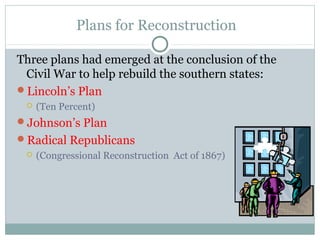
Plans for Reconstruction

Three plans had emerged at the conclusion of the
 Civil War to help rebuild the southern states:
Lincoln’s Plan
    (Ten Percent)
Johnson’s Plan
Radical Republicans
    (Congressional Reconstruction Act of 1867)
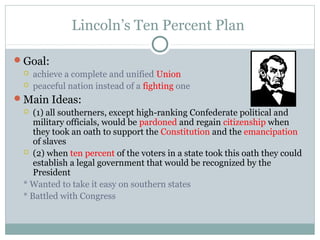
Lincoln’s Ten Percent Plan

Goal:
    achieve a complete and unified Union
    peaceful nation instead of a fighting one
Main Ideas:
   (1) all southerners, except high-ranking Confederate political and
    military officials, would be pardoned and regain citizenship when
    they took an oath to support the Constitution and the emancipation
    of slaves
  (2) when ten percent of the voters in a state took this oath they could
    establish a legal government that would be recognized by the
    President
 * Wanted to take it easy on southern states
 * Battled with Congress
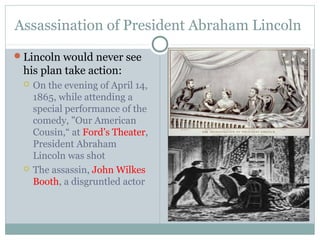
Assassination of President Abraham Lincoln
Lincoln would never see
 his plan take action:
    On the evening of April 14,
     1865, while attending a
     special performance of the
     comedy, "Our American
     Cousin,“ at Ford’s Theater,
     President Abraham
     Lincoln was shot
    The assassin, John Wilkes
     Booth, a disgruntled actor
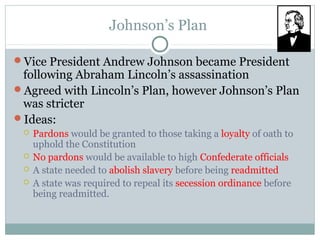
Johnson’s Plan

Vice President Andrew Johnson became President
 following Abraham Lincoln’s assassination
Agreed with Lincoln’s Plan, however Johnson’s Plan
 was stricter
Ideas:
    Pardons would be granted to those taking a loyalty of oath to
     uphold the Constitution
    No pardons would be available to high Confederate officials
    A state needed to abolish slavery before being readmitted
    A state was required to repeal its secession ordinance before
     being readmitted.
Impeachment of President Andrew Johnson

Congress wanted harsher terms for Reconstruction
President Andrew Johnson disagreed with
 congressional views on Reconstruction
Congress determined that President Andrew
 Johnson had violated the recent Tenure of Office Act
 and prompted the Republican-controlled House to
 impeach the president
The Senate fell short of their impeachment process
 by one vote, however Johnson’s political influence
 was gone
Radical Republicans

Congressional Military Reconstruction Act of 1867
Ideas:
    Organized the south into five military districts
    The states had to have a military leader from the north
    No state could return to civilian rule and be readmitted to the
     Union until white and black voters framed a constitution that
     guaranteed suffrage to African Americans and ratified the
     Fourteenth Amendment.
    Act banned confederate leaders from voting, and any who
     didn't pledge their allegiance to the U.S.
Five Military Districts
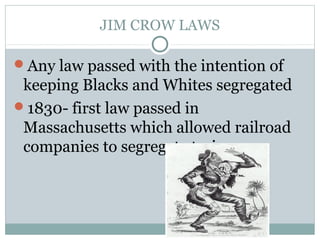
JIM CROW LAWS

Any law passed with the intention of
 keeping Blacks and Whites segregated
1830- first law passed in
 Massachusetts which allowed railroad
 companies to segregate train cars
Jim Crow Laws

Poll Tax – Must pay to vote.
Literacy Test – Must pass a test to vote.
Grandfather Clause – If your grandfather could not
 vote then you can not.
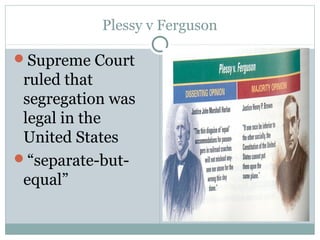
Plessy v Ferguson

Supreme Court
 ruled that
 segregation was
 legal in the
 United States
“separate-but-
 equal”
Booker T Washington


Born as a slave in
 1856
studied at
 Hampton
 University 1872
Founded Tuskegee
 Institute in 1881
W.E.B.DuBois


First African
 American to
 earn PhD from
 Harvard
Founded
 Niagara
 Movement
National Association for the Advancement of
                Colored People

N.A.A.C.P.
Fought for the rights of African
 Americans
4. reconstruction era

4. reconstruction era

  • 1.
    Reconstruction Era (1867-1877) Reconstruction: refers to the period following the Civil War when the southern states were rebuilt and new political gains emerged for African Americans.
  • 2.
    Problems following theCivil War Northern States Southern States  Lost largest number of  Cities in ruins soldiers  Money worthless  Factories closed  Bitter feeling  Government canceled  Bridges and Railroad work orders destroyed  Returning soldiers needed  Farmland was burned jobs  Lost political influence
  • 3.
    Ruins in RichmondRuins of Haxall's Flour Mill in Richmond, Virginia. When Union forces entered the Confederate capital on April 3, 1865, they found much of the city destroyed by fire.
  • 4.
    Savannah house destroyedby Union soldiers
  • 5.
    Plans for Reconstruction Threeplans had emerged at the conclusion of the Civil War to help rebuild the southern states: Lincoln’s Plan  (Ten Percent) Johnson’s Plan Radical Republicans  (Congressional Reconstruction Act of 1867)
  • 6.
    Lincoln’s Ten PercentPlan Goal:  achieve a complete and unified Union  peaceful nation instead of a fighting one Main Ideas:  (1) all southerners, except high-ranking Confederate political and military officials, would be pardoned and regain citizenship when they took an oath to support the Constitution and the emancipation of slaves  (2) when ten percent of the voters in a state took this oath they could establish a legal government that would be recognized by the President * Wanted to take it easy on southern states * Battled with Congress
  • 7.
    Assassination of PresidentAbraham Lincoln Lincoln would never see his plan take action:  On the evening of April 14, 1865, while attending a special performance of the comedy, "Our American Cousin,“ at Ford’s Theater, President Abraham Lincoln was shot  The assassin, John Wilkes Booth, a disgruntled actor
  • 8.
    Johnson’s Plan Vice PresidentAndrew Johnson became President following Abraham Lincoln’s assassination Agreed with Lincoln’s Plan, however Johnson’s Plan was stricter Ideas:  Pardons would be granted to those taking a loyalty of oath to uphold the Constitution  No pardons would be available to high Confederate officials  A state needed to abolish slavery before being readmitted  A state was required to repeal its secession ordinance before being readmitted.
  • 9.
    Impeachment of PresidentAndrew Johnson Congress wanted harsher terms for Reconstruction President Andrew Johnson disagreed with congressional views on Reconstruction Congress determined that President Andrew Johnson had violated the recent Tenure of Office Act and prompted the Republican-controlled House to impeach the president The Senate fell short of their impeachment process by one vote, however Johnson’s political influence was gone
  • 10.
    Radical Republicans Congressional MilitaryReconstruction Act of 1867 Ideas:  Organized the south into five military districts  The states had to have a military leader from the north  No state could return to civilian rule and be readmitted to the Union until white and black voters framed a constitution that guaranteed suffrage to African Americans and ratified the Fourteenth Amendment.  Act banned confederate leaders from voting, and any who didn't pledge their allegiance to the U.S.
  • 11.
  • 12.
    JIM CROW LAWS Anylaw passed with the intention of keeping Blacks and Whites segregated 1830- first law passed in Massachusetts which allowed railroad companies to segregate train cars
  • 13.
    Jim Crow Laws PollTax – Must pay to vote. Literacy Test – Must pass a test to vote. Grandfather Clause – If your grandfather could not vote then you can not.
  • 14.
    Plessy v Ferguson SupremeCourt ruled that segregation was legal in the United States “separate-but- equal”
  • 15.
    Booker T Washington Bornas a slave in 1856 studied at Hampton University 1872 Founded Tuskegee Institute in 1881
  • 16.
    W.E.B.DuBois First African Americanto earn PhD from Harvard Founded Niagara Movement
  • 17.
    National Association forthe Advancement of Colored People N.A.A.C.P. Fought for the rights of African Americans