Focus statement “what is EMT ( Emergency Medical Technicians ) workers ?
DONE BY : ANWAR
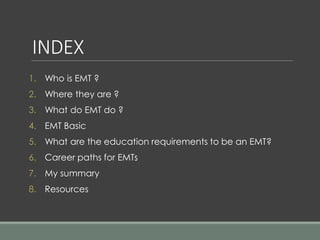
INDEX
1. Who is EMT ?
2. Where they are ?
3. What do EMT do ?
4. EMT Basic
5. What are the education requirements to be an EMT?
6. Career paths for EMTs
7. My summary
8. Resources
WHO IS EMT?
Emergency Medical Technician
(EMT) or ambulance technician
are terms used in some countries
to denote a health care provider
of emergency medical services.[1]
EMTs are clinicians, trained to
respond quickly to emergency
situations regarding medical issues,
traumatic injuries and accident
scenes. Under the British System
and those that are influenced by
it, are referred to as Ambulance
technician (often shortened to
tech), whereas in the American
system and its influenced
countries, it is known as
Emergency medical technician
(often abbreviated as EMT).
WHERE THEY ARE ?
EMTs are most commonly found
working in ambulances, but should
not be confused with "ambulance
drivers" – ambulance staff who in
the past were not trained in
emergency care or driving. EMTs
are often employed by
ambulance services, governments,
and hospitals, but are also
sometimes employed by fire
departments (and seen on fire
apparatus), in police departments
(and seen on police vehicles), and
there are many firefighter/EMTs
and police officer/EMTs.[1] EMTs
operate under a limited scope of
practice. EMTs are typically
supervised by a medical director,
who is a physician.
What do EMTs do?
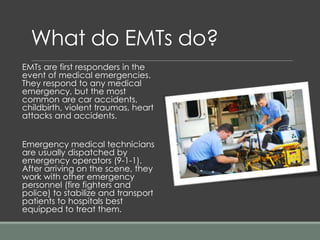
EMTs are first responders in the
event of medical emergencies.
They respond to any medical
emergency, but the most
common are car accidents,
childbirth, violent traumas, heart
attacks and accidents.
Emergency medical technicians
are usually dispatched by
emergency operators (9-1-1).
After arriving on the scene, they
work with other emergency
personnel (fire fighters and
police) to stabilize and transport
patients to hospitals best
equipped to treat them.
EMT-Basic
EMT-Basic is the entry level of EMS. The procedures and skills
allowed at this level are generally non-invasive such as
bleeding control, positive pressure ventilation with a bag
valve mask, oropharyngeal airway, nasopharyngeal airway,
supplemental oxygen administration, cardio-pulmonary
resuscitation (CPR), use of an automated external
defibrillator (AED), splinting (including full spinal
immobilization), and basic medication administration (such
as epinephrine auto-injectors, oral glucose, nitroglycerin,
and albuterol). Training requirements and treatment
protocols vary from area to area.
What are the education
requirements to be an EMT?
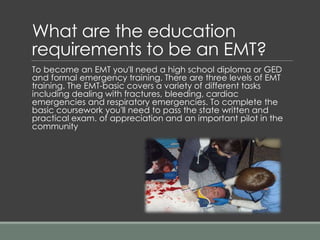
To become an EMT you'll need a high school diploma or GED
and formal emergency training. There are three levels of EMT
training. The EMT-basic covers a variety of different tasks
including dealing with fractures, bleeding, cardiac
emergencies and respiratory emergencies. To complete the
basic coursework you'll need to pass the state written and
practical exam. of appreciation and an important pilot in the
community
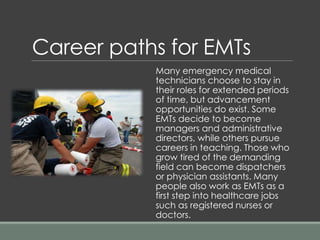
Many emergency medical
technicians choose to stay in
their roles for extended periods
of time, but advancement
opportunities do exist. Some
EMTs decide to become
managers and administrative
directors, while others pursue
careers in teaching. Those who
grow tired of the demanding
field can become dispatchers
or physician assistants. Many
people also work as EMTs as a
first step into healthcare jobs
such as registered nurses or
doctors.
Career paths for EMTs
My summary:
I learned that the EMT WORKERS are
the ones who are helping people to
denote a health care provider of
emergency medical services
Resources:
http://www.snagajob.com/job-descriptions/emt/
http://en.wikipedia.org/wiki/Emergency_medical_tec
hnician
Teacher's part:

Emt worker

  • 1.
    Focus statement “whatis EMT ( Emergency Medical Technicians ) workers ? DONE BY : ANWAR
  • 2.
    INDEX 1. Who isEMT ? 2. Where they are ? 3. What do EMT do ? 4. EMT Basic 5. What are the education requirements to be an EMT? 6. Career paths for EMTs 7. My summary 8. Resources
  • 3.
    WHO IS EMT? EmergencyMedical Technician (EMT) or ambulance technician are terms used in some countries to denote a health care provider of emergency medical services.[1] EMTs are clinicians, trained to respond quickly to emergency situations regarding medical issues, traumatic injuries and accident scenes. Under the British System and those that are influenced by it, are referred to as Ambulance technician (often shortened to tech), whereas in the American system and its influenced countries, it is known as Emergency medical technician (often abbreviated as EMT).
  • 4.
    WHERE THEY ARE? EMTs are most commonly found working in ambulances, but should not be confused with "ambulance drivers" – ambulance staff who in the past were not trained in emergency care or driving. EMTs are often employed by ambulance services, governments, and hospitals, but are also sometimes employed by fire departments (and seen on fire apparatus), in police departments (and seen on police vehicles), and there are many firefighter/EMTs and police officer/EMTs.[1] EMTs operate under a limited scope of practice. EMTs are typically supervised by a medical director, who is a physician.
  • 5.
    What do EMTsdo? EMTs are first responders in the event of medical emergencies. They respond to any medical emergency, but the most common are car accidents, childbirth, violent traumas, heart attacks and accidents. Emergency medical technicians are usually dispatched by emergency operators (9-1-1). After arriving on the scene, they work with other emergency personnel (fire fighters and police) to stabilize and transport patients to hospitals best equipped to treat them.
  • 6.
    EMT-Basic EMT-Basic is theentry level of EMS. The procedures and skills allowed at this level are generally non-invasive such as bleeding control, positive pressure ventilation with a bag valve mask, oropharyngeal airway, nasopharyngeal airway, supplemental oxygen administration, cardio-pulmonary resuscitation (CPR), use of an automated external defibrillator (AED), splinting (including full spinal immobilization), and basic medication administration (such as epinephrine auto-injectors, oral glucose, nitroglycerin, and albuterol). Training requirements and treatment protocols vary from area to area.
  • 7.
    What are theeducation requirements to be an EMT? To become an EMT you'll need a high school diploma or GED and formal emergency training. There are three levels of EMT training. The EMT-basic covers a variety of different tasks including dealing with fractures, bleeding, cardiac emergencies and respiratory emergencies. To complete the basic coursework you'll need to pass the state written and practical exam. of appreciation and an important pilot in the community
  • 8.
    Many emergency medical technicianschoose to stay in their roles for extended periods of time, but advancement opportunities do exist. Some EMTs decide to become managers and administrative directors, while others pursue careers in teaching. Those who grow tired of the demanding field can become dispatchers or physician assistants. Many people also work as EMTs as a first step into healthcare jobs such as registered nurses or doctors. Career paths for EMTs
  • 9.
    My summary: I learnedthat the EMT WORKERS are the ones who are helping people to denote a health care provider of emergency medical services
  • 10.