Reconstruction  1865-1877
What is Reconstruction ? The federal governments rebuilding efforts of the south after the Civil War to repair damages and restore southern state to the Union.
 
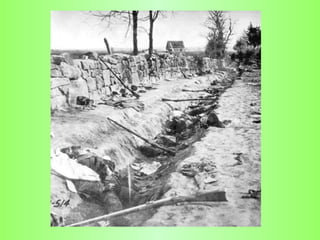
Why Reconstruct the South? The war destroyed 2/3 of all shipping and 9000 miles of Railroads in the south.  The infrastructure of the south was destroyed, Roads, factories, bridges, levees. The South lost one out of five adult white men in the conflict
If the Confederacy lost the war, Why is the federal Government willing to pay for reconstruction?
Plans for Reconstruction  Lincoln Plan The 10 Percent plan  Pardons to all confederate officers who took an oath of allegiance Permitted states to hold constitutional conventions after 10 percent of voter swore allegiance to the Union  Lincoln’s plan was seen as too lenient and did not include voting rights for blacks.
Johnson’s Plan pardoned all who swore allegiance to Union  Allowed each state to hold constitutional convention Each state was required to void secession, abolish slavery, ratify the thirteenth Amendment  Johnson plan was similar to Lincoln but it was more generous
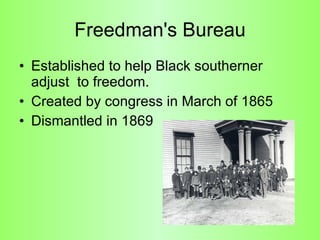
Freedman's Bureau Established to help Black southerner adjust  to freedom.  Created by congress in March of 1865 Dismantled in 1869
Freedman’s Bureau  What was the main role of this bureau? main role was providing emergency food, housing and medical aid to refugees  Major Achievements Education 250,000 freed children enrolled in schools  Church  Gender Issues
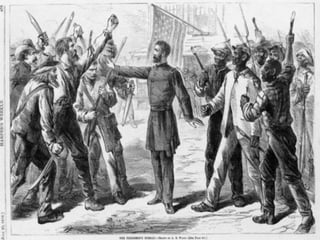
Congressional Reconstruction  Also know as  Radical reconstruction   -Put the south under military rule, divided in five districts Ordered new elections and constitutions  Required that  qualified  men be allow to Vote  Did not allow supporters of confederacy the right to vote  Equal Rights to all citizens Must Ratify 14 th  amendment
 
Civil Rights Act 1866 The  Civil Rights Act Of 1866  is a piece of United States legislation that gave further rights to the freed slaves after the end of the American Civil War. This law was a counter attack to the black codes passed at this time.
Veto the Act President Johnson vetoed the Civil right bill, but had little power and the veto was over ridded by congress And then congress kept pushing until the
14 th  Amendment  All persons born or naturalized in the United States, and subject to the jurisdiction thereof, are citizens of the United States and of the State wherein they reside. No State shall make or enforce any law which shall abridge the privileges or immunities of citizens of the United States; nor shall any State deprive any person of life, liberty, or property, without due process of law; nor deny to any person within its jurisdiction the equal protection of the laws.
What does it mean? All persons born in the U.S. are citizens of the U.S.  What is the status of  a Immigrant who has a baby in the U.S. ? A enemy combatant who has a child on a U.S. base ? Native Americans? U.S. is not responsible for any debt incurred during the war, namely the cost of Slaves.
15 th  amendment  No citizen can be denied the right to vote based on race, color and previous servitude  Who is excluded?
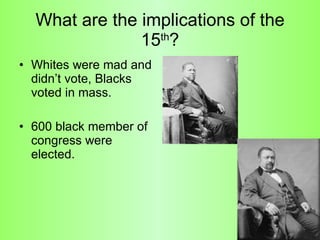
What are the implications of the 15 th ? Whites were mad and didn’t vote, Blacks voted in mass. 600 black member of congress were elected.
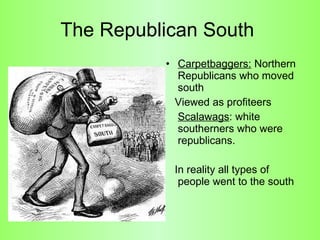
The Republican South  Carpetbaggers:  Northern Republicans who moved south  Viewed as profiteers Scalawags : white southerners who were republicans.  In reality all types of people went to the south
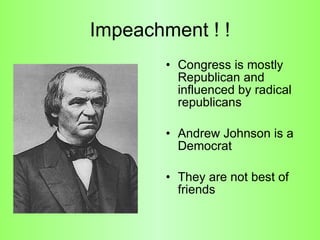
Impeachment ! ! Congress is mostly Republican and influenced by radical republicans  Andrew Johnson is a Democrat  They are not best of friends
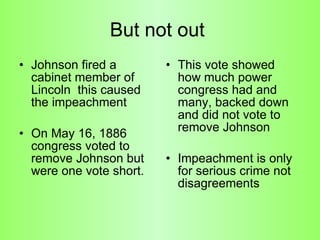
But not out  Johnson fired a cabinet member of Lincoln  this caused the impeachment  On May 16, 1886 congress voted to remove Johnson but were one vote short. This vote showed how much power congress had and many, backed down and did not vote to remove Johnson Impeachment is only for serious crime not disagreements
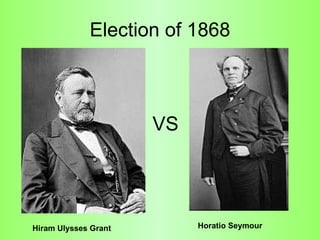
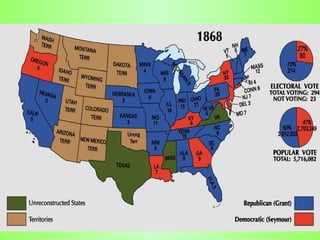
Election of 1868 VS Hiram Ulysses Grant   Horatio Seymour
 
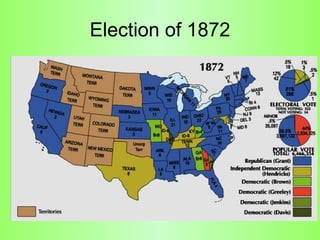
Election of 1872
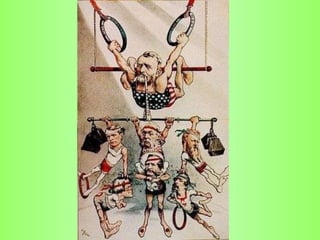
Effects of Reconstruction  Grant as leader of Radical Republicans is re-elected.  Civil rights act of 1866 14 th  and 15 th  Amendments to the Constitution  Freedman’s Bureau
 
End of Reconstruction
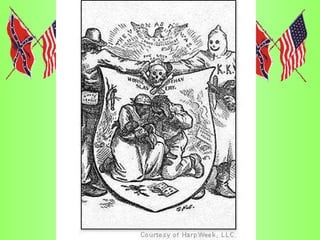
Lifestyle of Freedmen Poor  Most if not all of the freed slaves were poor and were forced to become  sharecroppers .  Segregated Black Codes  Terror Organization such as the Ku Klux Klan
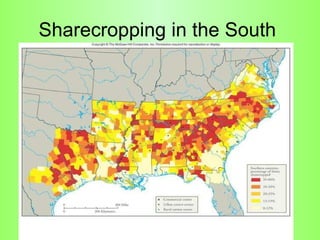
Sharecropping The problem:  whites could not farm the huge plantations of the south.  Blacks could not afford to move from their slave homes, on the plantation.  The Solution:   Whites would allow blacks to farm on their land, in return for labor in his cotton fields. Then he would deduct, food clothing and housing from the black families.
Sharecropping in the South
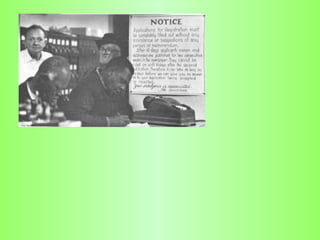
Black Codes Were designed to limit the opportunities of blacks Passed in the South during Reconstruction.  The Black Codes placed taxes on free blacks who tried to pursue nonagricultural professions. restricted the abilities of blacks to rent land or own guns, and even allowed the children of "unfit" parents to be apprenticed to the old slave masters
 
Terror  The Ku Klux Klan  . Founded in 1866 by veterans of the Confederate Army,  main purpose: to resist reconstruction, and it focused as much on intimidating "carpetbaggers" and "scalawags" as on putting down the freed slaves
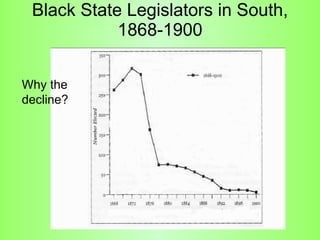
Black State Legislators in South, 1868-1900 Why the decline?
Enforcement Acts 1870 and 1871 •1870 Act: Ku Klux Klan Act •1871 Act: strengthen federal enforcement of election law in large cities
End of  Reconstruction, 1876-77 •By 1876, public support for racial equality wanes. •Election of 1876 •Compromise of 1877 •Courts and the Demise of Reconstruction
 
 
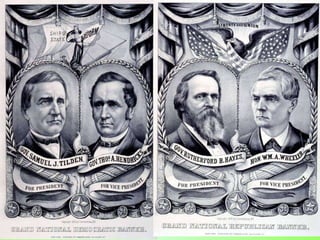
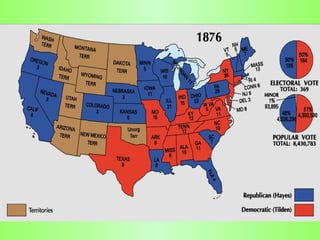
Compromise of 1877 and the End of Reconstruction Election of 1876–Democrat  Sam Tilden wins popular vote, but not electoral college vote –Vote disputed in OR, SC, FL, and LA –Congressional Committee resolves dispute •GOP Hayes given disputed Electoral  College votes •Hayes wins presidency and Pulls federal troops out of South
Courts and the Demise of Reconstruction • Slaughter-House Cases (1873) – State government tells butchers in New Orleans to move facilities outside of city limits – Butchers order to move violates 13 th  and 14 th  Amendments (Slavery and citizenship) – Court rules federal government was under no obligation to protect citizens from acts by state government.

Reconstruction

  • 1.
  • 2.
    What is Reconstruction? The federal governments rebuilding efforts of the south after the Civil War to repair damages and restore southern state to the Union.
  • 3.
  • 4.
    Why Reconstruct theSouth? The war destroyed 2/3 of all shipping and 9000 miles of Railroads in the south. The infrastructure of the south was destroyed, Roads, factories, bridges, levees. The South lost one out of five adult white men in the conflict
  • 5.
    If the Confederacylost the war, Why is the federal Government willing to pay for reconstruction?
  • 6.
    Plans for Reconstruction Lincoln Plan The 10 Percent plan Pardons to all confederate officers who took an oath of allegiance Permitted states to hold constitutional conventions after 10 percent of voter swore allegiance to the Union Lincoln’s plan was seen as too lenient and did not include voting rights for blacks.
  • 7.
    Johnson’s Plan pardonedall who swore allegiance to Union Allowed each state to hold constitutional convention Each state was required to void secession, abolish slavery, ratify the thirteenth Amendment Johnson plan was similar to Lincoln but it was more generous
  • 8.
    Freedman's Bureau Establishedto help Black southerner adjust to freedom. Created by congress in March of 1865 Dismantled in 1869
  • 9.
    Freedman’s Bureau What was the main role of this bureau? main role was providing emergency food, housing and medical aid to refugees Major Achievements Education 250,000 freed children enrolled in schools Church Gender Issues
  • 10.
    Congressional Reconstruction Also know as Radical reconstruction -Put the south under military rule, divided in five districts Ordered new elections and constitutions Required that qualified men be allow to Vote Did not allow supporters of confederacy the right to vote Equal Rights to all citizens Must Ratify 14 th amendment
  • 11.
  • 12.
    Civil Rights Act1866 The Civil Rights Act Of 1866 is a piece of United States legislation that gave further rights to the freed slaves after the end of the American Civil War. This law was a counter attack to the black codes passed at this time.
  • 13.
    Veto the ActPresident Johnson vetoed the Civil right bill, but had little power and the veto was over ridded by congress And then congress kept pushing until the
  • 14.
    14 th Amendment All persons born or naturalized in the United States, and subject to the jurisdiction thereof, are citizens of the United States and of the State wherein they reside. No State shall make or enforce any law which shall abridge the privileges or immunities of citizens of the United States; nor shall any State deprive any person of life, liberty, or property, without due process of law; nor deny to any person within its jurisdiction the equal protection of the laws.
  • 15.
    What does itmean? All persons born in the U.S. are citizens of the U.S. What is the status of a Immigrant who has a baby in the U.S. ? A enemy combatant who has a child on a U.S. base ? Native Americans? U.S. is not responsible for any debt incurred during the war, namely the cost of Slaves.
  • 16.
    15 th amendment No citizen can be denied the right to vote based on race, color and previous servitude Who is excluded?
  • 17.
    What are theimplications of the 15 th ? Whites were mad and didn’t vote, Blacks voted in mass. 600 black member of congress were elected.
  • 18.
    The Republican South Carpetbaggers: Northern Republicans who moved south Viewed as profiteers Scalawags : white southerners who were republicans. In reality all types of people went to the south
  • 19.
    Impeachment ! !Congress is mostly Republican and influenced by radical republicans Andrew Johnson is a Democrat They are not best of friends
  • 20.
    But not out Johnson fired a cabinet member of Lincoln this caused the impeachment On May 16, 1886 congress voted to remove Johnson but were one vote short. This vote showed how much power congress had and many, backed down and did not vote to remove Johnson Impeachment is only for serious crime not disagreements
  • 21.
    Election of 1868VS Hiram Ulysses Grant Horatio Seymour
  • 22.
  • 23.
  • 24.
    Effects of Reconstruction Grant as leader of Radical Republicans is re-elected. Civil rights act of 1866 14 th and 15 th Amendments to the Constitution Freedman’s Bureau
  • 25.
  • 26.
  • 27.
    Lifestyle of FreedmenPoor Most if not all of the freed slaves were poor and were forced to become sharecroppers . Segregated Black Codes Terror Organization such as the Ku Klux Klan
  • 28.
    Sharecropping The problem: whites could not farm the huge plantations of the south. Blacks could not afford to move from their slave homes, on the plantation. The Solution: Whites would allow blacks to farm on their land, in return for labor in his cotton fields. Then he would deduct, food clothing and housing from the black families.
  • 29.
  • 30.
    Black Codes Weredesigned to limit the opportunities of blacks Passed in the South during Reconstruction. The Black Codes placed taxes on free blacks who tried to pursue nonagricultural professions. restricted the abilities of blacks to rent land or own guns, and even allowed the children of "unfit" parents to be apprenticed to the old slave masters
  • 31.
  • 32.
    Terror TheKu Klux Klan . Founded in 1866 by veterans of the Confederate Army, main purpose: to resist reconstruction, and it focused as much on intimidating "carpetbaggers" and "scalawags" as on putting down the freed slaves
  • 33.
    Black State Legislatorsin South, 1868-1900 Why the decline?
  • 34.
    Enforcement Acts 1870and 1871 •1870 Act: Ku Klux Klan Act •1871 Act: strengthen federal enforcement of election law in large cities
  • 35.
    End of Reconstruction, 1876-77 •By 1876, public support for racial equality wanes. •Election of 1876 •Compromise of 1877 •Courts and the Demise of Reconstruction
  • 36.
  • 37.
  • 38.
    Compromise of 1877and the End of Reconstruction Election of 1876–Democrat Sam Tilden wins popular vote, but not electoral college vote –Vote disputed in OR, SC, FL, and LA –Congressional Committee resolves dispute •GOP Hayes given disputed Electoral College votes •Hayes wins presidency and Pulls federal troops out of South
  • 39.
    Courts and theDemise of Reconstruction • Slaughter-House Cases (1873) – State government tells butchers in New Orleans to move facilities outside of city limits – Butchers order to move violates 13 th and 14 th Amendments (Slavery and citizenship) – Court rules federal government was under no obligation to protect citizens from acts by state government.